For reusable vocabulary, see orbit-majorant centering , Birkhoff sums , the integrated log-positive growth rate , one-sided discrete matrix cocycles , and ergodicity . The companion textbook chapter is From Finite Centered Bad-Block Bounds to All-Positive-Length Control. For an analogous increasing-union architecture applied to a different observable and threshold event, compare the infinite-horizon Birkhoff-average exceedance event .
Orientation: removing a cap without changing the quantifier
The previous chapter, Finite Centered Bad-Block Measure Control in Lean, proved one estimate for every fixed finite cap. The new step is to identify the union of all those caps and pass the uniform estimate to that union.
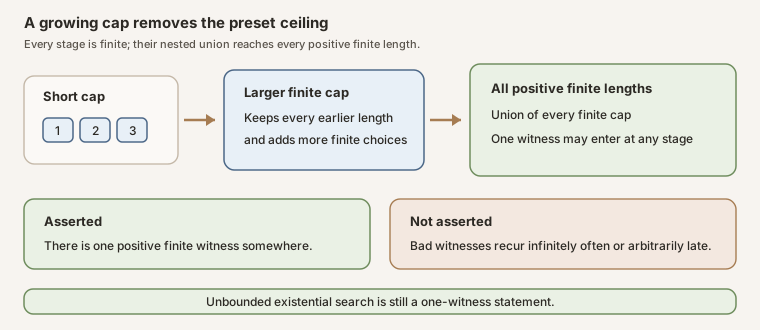
The quantifier is easy to overread. A point belongs to the all-length event when there exists one positive natural number \(n\) for which the strict inequality holds. The witness is always finite. The definition does not say that bad lengths are unbounded, arbitrarily late, or infinite in number.
Prior work, contribution, and nonclaims
Prior work. Kingman’s primary 1968 paper proves the much stronger
subadditive ergodic theorem (Kingman 1968). This module
formalizes only a measure-continuity bridge used on one possible route toward
its lower bound. RMT-30 supplies the cap-uniform estimate.
Mathlib supplies countable null-measurable union
closure, continuity from below for extended
measure, continuity of
ENNReal.toReal away from infinity, and the
order-closed limit lemma used to retain a uniform
upper bound.
This note’s contribution. RMT-31:
- names the once-bad event across every positive finite witness length;
- proves its exact existential membership semantics;
- exposes the nesting and inclusion API for finite caps;
- separates unconditional extended-measure continuity from locally finite real-measure continuity;
- passes the RMT-30 ratio unchanged to the union; and
- specializes the result to the cocycle log-positive process without adding probability, ergodicity, or a nonempty matrix index.
Not claimed. The module proves no infinitely-often statement, no raw-event invariance, no almost-invariance theorem, no lower-liminf bound, no samplewise convergence, no equality with the integrated rate, no full Kingman theorem, no \(L^1\) convergence, no limit-integral interchange, no powered-map ergodicity, no signed logarithmic rate, no Lyapunov exponent, and no Oseledets splitting.
The increasing-union argument
Write \(B_m=B_{m,c}\) with \(c\) fixed. If \(m\le M\), every length in the window from one through \(m\) also lies in the window from one through \(M\). Therefore
\[ B_m\subseteq B_M. \]This is monotonicity of the search window. It is not monotonicity of the sequence \(Y_n(\omega)\) in time. No such process monotonicity is assumed or proved.
The union identity is definitionally true:
\[ B_{\infty,c}=\bigcup_{m\in\mathbb N}B_{m,c}. \]Declaration 4 gives this rfl fact a stable theorem name. Although its proof
is one line, the name is intentional public API: later proofs and readers can
refer to the representation without unfolding the definition or depending on
its implementation spelling.
Every finite cap embeds into the union by choosing its own cap as the union index. Conversely, a member of the union arrives with some cap \(m\), some witness \(n\le m\), and a strict centered inequality. Erasing \(m\) leaves one positive finite witness. In the reverse direction, a witness \(n\) enters the union through cap \(m=n\).
Extended measure must come first
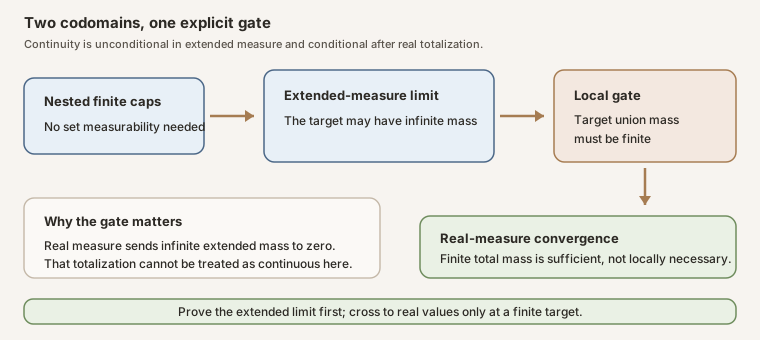
Mathlib measures take values in the extended nonnegative reals \(\mathbb R_{\ge0}\cup\{\infty\}\). Continuity from below naturally lives in that space:
\[ \mu(B_m)\longrightarrow\mu\!\left(\bigcup_m B_m\right). \]The theorem tendsto_measure_iUnion_atTop needs the nesting proof. It does not
need each \(B_m\) to be measurable, and it does not need finite total mass.
This is why RMT-31 states the extended-measure convergence theorem separately
from the null-measurability theorem.
Measure.real then applies ENNReal.toReal to an extended measure. That map
is intentionally total, and infinity is sent to zero. Consequently, it is not
continuous at infinity in the way this proof needs. The correct gate is local:
It is enough that the target union has finite extended mass. The theorem does
not require a globally finite measure space. A global [IsFiniteMeasure μ]
instance is merely a convenient sufficient condition used by the final ratio
theorems; Mathlib’s measure_ne_top discharges
the local gate.
Why the uniform ratio survives unchanged
RMT-30 proves for every cap \(m\):
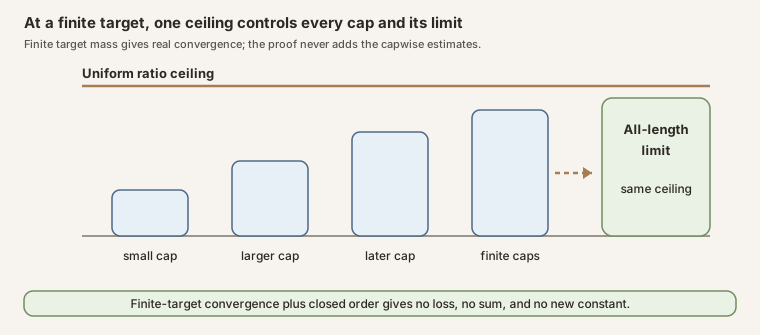
\[ \mu_{\mathbb R}(B_m)\le \frac{\delta}{c}. \]RMT-31 does not sum these estimates. Summing would introduce a useless factor
or divergence. Instead, the cap sets are nested and their real measures
converge to the union’s real measure under finite mass. The right side is the
same constant for every cap. The order-closed lemma le_of_tendsto' says that
a limit of values all bounded above by one constant remains bounded above by
that constant. Thus
with no loss.
le_of_tendsto' carries that bound to the union without summing cap estimates.The generic theorem retains exactly the RMT-30 analytic premises: an integrable candidate, a measure-preserving base, finite total mass, a lower bound \(\delta\) for every positive normalized centered integral, and \(c\lt\delta\). Probability and ergodicity remain absent. As in RMT-30, the time-one centered identity forces \(\delta\le0\), so \(c\lt0\); RMT-31 reuses the already proved finite-cap theorem rather than repeating that sign proof.
The raw once-bad event is not invariant
An asymptotic deviation event is often designed to ignore a finite prefix. This raw event is different. It remembers whether at least one witness occurs, so applying the base map can remove the only witness.
The compiled countermodel uses Bool. The map rmt31Collapse sends both
points to true and preserves the Dirac measure at true. The process is zero
on true; on false it is zero before length two and minus one from length
two onward. Its one-step value is zero, so orbit-majorant centering does not
change it. At slope minus two fifths, length two marks false, while true
is never marked. The all-length set is therefore the singleton {false}.
Its preimage under the collapse map is empty.
The source compiles both the integrable shifted-subadditive candidate and the measure-preserving proof before proving the unequal sets. The disagreement is setwise. In this particular Dirac model it occurs on a null point, so the probe does not refute a possible almost-everywhere statement under additional design. It does decisively refute calling the raw set invariant.
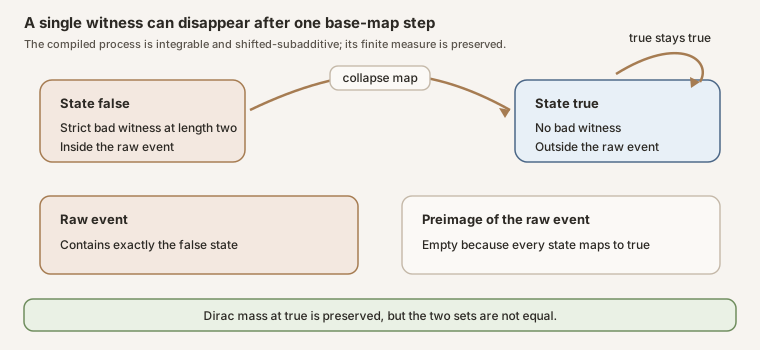
{false} and preimage empty. Once-bad membership is not setwise invariant.RMT-32 now defines the arbitrarily-late strict lower-deviation event with rational margins and proves its one-sided preimage relation. Finite-measure ergodicity gives an almost-empty or almost-full dichotomy. Probability normalization is a separate final ingredient: it makes the full branch have mass one, so the strict subunit estimate can exclude it.
Public declaration surface in exact source order
The module exports eleven declarations.
1. centeredAllLengthBadBlockSet
def centeredAllLengthBadBlockSet {Ω : Type uΩ} (T : Ω → Ω)
    (X : ℕ → Ω → ℝ) (c : ℝ) : Set Ω :=
  ⋃ m : ℕ, finiteCenteredBadBlockSet T X m c
Names the union over every natural cap. The cap-zero term is empty and causes no special case.
2. mem_centeredAllLengthBadBlockSet_iff
@[simp] theorem mem_centeredAllLengthBadBlockSet_iff
    {Ω : Type uΩ} {T : Ω → Ω} {X : ℕ → Ω → ℝ}
    {c : ℝ} {ω : Ω} :
    ω ∈ centeredAllLengthBadBlockSet T X c ↔
      ∃ n : ℕ, 0 < n ∧ centeredProcess T X n ω < c * (n : ℝ)
Eliminates the auxiliary cap from membership and records exactly one finite strict witness.
3. finiteCenteredBadBlockSet_mono
theorem finiteCenteredBadBlockSet_mono
    {m M : ℕ} (hmM : m ≤ M) (c : ℝ) :
    finiteCenteredBadBlockSet T X m c ⊆
      finiteCenteredBadBlockSet T X M c
Transports the same witness through the larger endpoint bound.
4. centeredAllLengthBadBlockSet_eq_iUnion_finite
theorem centeredAllLengthBadBlockSet_eq_iUnion_finite
    (T : Ω → Ω) (X : ℕ → Ω → ℝ) (c : ℝ) :
    centeredAllLengthBadBlockSet T X c =
      ⋃ m : ℕ, finiteCenteredBadBlockSet T X m c
This is deliberately a named rfl theorem. Its value is API stability and
readable rewriting, not proof complexity.
5. finiteCenteredBadBlockSet_subset_allLength
theorem finiteCenteredBadBlockSet_subset_allLength
    (T : Ω → Ω) (X : ℕ → Ω → ℝ) (m : ℕ) (c : ℝ) :
    finiteCenteredBadBlockSet T X m c ⊆
      centeredAllLengthBadBlockSet T X c
Injects cap \(m\) into the indexed union at index \(m\).
6. IsIntegrableSubadditiveProcessCandidate.nullMeasurableSet_centeredAllLengthBadBlockSet
theorem nullMeasurableSet_centeredAllLengthBadBlockSet
    (hX : IsIntegrableSubadditiveProcessCandidate T μ X)
    (hT : MeasurePreserving T μ μ) (c : ℝ) :
    NullMeasurableSet (centeredAllLengthBadBlockSet T X c) μ
Applies RMT-30 null measurability at every cap and Mathlib countable-union closure. Finite mass is not required.
7. tendsto_measure_finiteCenteredBadBlockSet
theorem tendsto_measure_finiteCenteredBadBlockSet
    (X : ℕ → Ω → ℝ) (c : ℝ) :
    Tendsto
      (fun m ↦ μ (finiteCenteredBadBlockSet T X m c))
      atTop (nhds (μ (centeredAllLengthBadBlockSet T X c)))
Uses nesting and tendsto_measure_iUnion_atTop. It needs neither candidate
integrability, preservation, set measurability, nor finite mass.
8. tendsto_measureReal_finiteCenteredBadBlockSet
theorem tendsto_measureReal_finiteCenteredBadBlockSet
    (X : ℕ → Ω → ℝ) (c : ℝ)
    (hfinite : μ (centeredAllLengthBadBlockSet T X c) ≠ ∞) :
    Tendsto
      (fun m ↦ μ.real (finiteCenteredBadBlockSet T X m c))
      atTop (nhds (μ.real (centeredAllLengthBadBlockSet T X c)))
Composes declaration 7 with ENNReal.tendsto_toReal. Only the target union’s
extended measure must be finite.
9. IsIntegrableSubadditiveProcessCandidate.measureReal_centeredAllLengthBadBlockSet_le_rateRatio
theorem measureReal_centeredAllLengthBadBlockSet_le_rateRatio
    [IsFiniteMeasure μ]
    (hX : IsIntegrableSubadditiveProcessCandidate T μ X)
    (hT : MeasurePreserving T μ μ) (δ c : ℝ)
    (hδ : ∀ n : ℕ, n ≠ 0 →
      δ ≤ (∫ ω, centeredProcess T X n ω ∂μ) / (n : ℝ))
    (hc : c < δ) :
    μ.real (centeredAllLengthBadBlockSet T X c) ≤ δ / c
Uses finite total mass to discharge declaration 8’s local gate, then
le_of_tendsto' and the RMT-30 bound at every cap.
10. DiscreteMatrixCocycle.centeredLogPlusAllLengthBadBlockSet
def centeredLogPlusAllLengthBadBlockSet
    (C : DiscreteMatrixCocycle (ι := ι) μ) (c : ℝ) : Set Ω :=
  centeredAllLengthBadBlockSet C.base C.logPlusNormObservable c
Gives the generic union a cocycle-facing name.
11. DiscreteMatrixCocycle.HasIntegrableGeneratorLogPlus.measureReal_centeredLogPlusAllLengthBadBlockSet_le_rateRatio
theorem HasIntegrableGeneratorLogPlus.measureReal_centeredLogPlusAllLengthBadBlockSet_le_rateRatio
    [IsFiniteMeasure μ]
    {C : DiscreteMatrixCocycle (ι := ι) μ}
    (hC : C.HasIntegrableGeneratorLogPlus) (c : ℝ)
    (hc : c < C.integratedLogPlusGrowthRate hC -
      C.integratedLogPlusNorm 1) :
    μ.real (C.centeredLogPlusAllLengthBadBlockSet c) ≤
      (C.integratedLogPlusGrowthRate hC -
        C.integratedLogPlusNorm 1) / c
Passes RMT-30’s cocycle bound cap by cap and takes the same real-measure limit. The finite decidable matrix index may be empty.
Complete proof-step ledger
| Declaration | Source-order proof step | Job |
|---|---|---|
| Membership | Unfold both set definitions and indexed-union membership | Exposes cap, witness, positivity, endpoint, and strict inequality |
| Membership | Forward direction erases the cap | Retains one positive finite witness |
| Membership | Reverse direction chooses cap equal to witness | Re-enters the union without choice or asymptotics |
| Cap monotonicity | Unpack the old witness | Retrieves \(1\le n\le m\) and its strict cost |
| Cap monotonicity | Compose \(n\le m\le M\) | Reuses the witness at the larger cap |
| Named union identity | rfl | Publishes the defining representation as stable API |
| Finite-cap inclusion | Rewrite by the named union identity | Makes the target visibly indexed |
| Finite-cap inclusion | subset_iUnion at index \(m\) | Embeds the chosen cap |
| Null measurability | Rewrite as the countable union | Aligns with Mathlib’s closure theorem |
| Null measurability | Apply NullMeasurableSet.iUnion | Reuses RMT-30 capwise null measurability |
| Extended convergence | Rewrite as the increasing union | Aligns target with continuity from below |
| Extended convergence | Apply tendsto_measure_iUnion_atTop | Supplies cap monotonicity and no extra analytic premise |
| Real convergence | Compose ENNReal.tendsto_toReal hfinite | Uses continuity away from infinity |
| Real convergence | Simplify Measure.real and composition | Restates the composed limit in public notation |
| Generic ratio | Apply le_of_tendsto' to real convergence | Makes the union measure the limit of cap measures |
| Generic ratio | Invoke RMT-30 for each \(m\) | Supplies the same \(\delta/c\) upper bound uniformly |
| Cocycle wrapper | Apply le_of_tendsto' | Uses finite measure for the local limit gate |
| Cocycle wrapper | Invoke RMT-30 cocycle theorem for each cap | Avoids duplicating the integrated-rate argument |
Fifteen private boundary-support items
The private items do not enlarge the public API. They make the anonymous examples executable.
| Order | Private item | Role |
|---|---|---|
| 1 | rmt31ZeroProcess | Constant-zero process on any space |
| 2 | rmt31ZeroProcess_candidate | Integrability and shifted subadditivity of the zero process |
| 3 | rmt31TwoPointProbability | Half the sum of the two Boolean Dirac masses |
| 4 | private IsProbabilityMeasure rmt31TwoPointProbability instance | Checks that the two half masses total one |
| 5 | rmt31Id_not_preErgodic | Uses the invariant singleton to refute pre-ergodicity of the identity |
| 6 | rmt31TwoPointProcess | Equals minus \(n-1\) on false and zero on true |
| 7 | rmt31TwoPointProcess_candidate | Finite-space integrability and shifted subadditivity proof |
| 8 | rmt31MassTwoMeasure | Twice the Dirac measure on Unit |
| 9 | private IsFiniteMeasure rmt31MassTwoMeasure instance | Records finite mass without probability normalization |
| 10 | rmt31Collapse | Constant Boolean map with value true |
| 11 | rmt31OneShotProcess | One negative value from length two onward only at false |
| 12 | rmt31_iterate_collapse_true | Every iterate fixes true |
| 13 | rmt31_iterate_collapse_of_ne_zero | Every positive iterate sends either point to true |
| 14 | rmt31OneShotProcess_candidate | Compiles integrability and shifted subadditivity for the countermodel |
| 15 | rmt31Collapse_preserving | Proves preservation of the Dirac mass at true |
Ten compiled boundary probes in exact source order
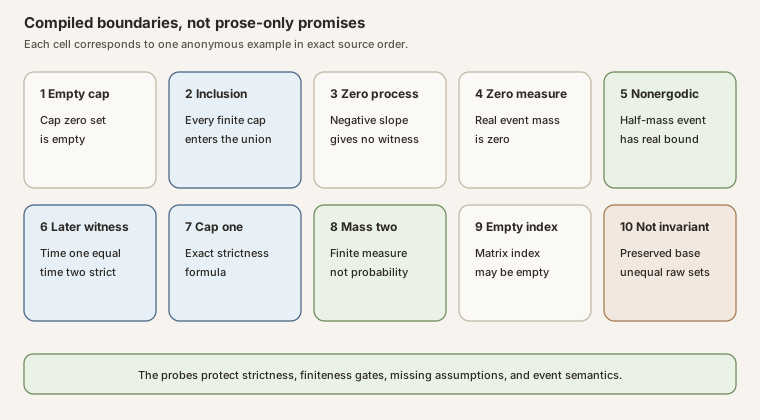
- Cap zero. The finite approximant at cap zero is empty. This says nothing about the union over larger caps.
- Finite-cap inclusion. Every finite bad-block set embeds in the all-length event through its own cap index.
- Zero process. At a negative slope, the zero process has no strict positive-length witness, so its all-length set is empty.
- Zero measure. Every all-length set has real measure zero under the zero measure.
- Nonergodic half-mass model. The Boolean identity is not pre-ergodic.
At \(c=-3/4\), the bad set is exactly
{false}, has real mass \(1/2\), and satisfies the theorem’s nontrivial \(1/2\le2/3\) bound. - Later witness after time-one equality. At \(c=0\), the point
falseis unmarked at length one but enters at length two. One strict later witness is enough. - Cap-one formula. For the two-point process, the cap-one set is all points exactly when \(0\lt c\), and is empty otherwise. This compiles the strict threshold.
- Mass-two finite measure. The generic union theorem works for a finite measure of total mass two. No probability instance is hidden.
- Empty matrix index. The cocycle theorem compiles with
ι := Empty. - Preserving non-invariance. The one-shot process is a valid candidate, the collapse map preserves its Dirac measure, and the raw all-length set still differs from its preimage.
Complete source-order map
| Order | Kind | Source item |
|---|---|---|
| 1 | Public definition | centeredAllLengthBadBlockSet |
| 2 | Public theorem | mem_centeredAllLengthBadBlockSet_iff |
| 3 | Public theorem | finiteCenteredBadBlockSet_mono |
| 4 | Public theorem | centeredAllLengthBadBlockSet_eq_iUnion_finite |
| 5 | Public theorem | finiteCenteredBadBlockSet_subset_allLength |
| 6 | Public receiver theorem | IsIntegrableSubadditiveProcessCandidate.nullMeasurableSet_centeredAllLengthBadBlockSet |
| 7 | Public theorem | tendsto_measure_finiteCenteredBadBlockSet |
| 8 | Public theorem | tendsto_measureReal_finiteCenteredBadBlockSet |
| 9 | Public receiver theorem | IsIntegrableSubadditiveProcessCandidate.measureReal_centeredAllLengthBadBlockSet_le_rateRatio |
| 10 | Public cocycle definition | DiscreteMatrixCocycle.centeredLogPlusAllLengthBadBlockSet |
| 11 | Public cocycle receiver theorem | DiscreteMatrixCocycle.HasIntegrableGeneratorLogPlus.measureReal_centeredLogPlusAllLengthBadBlockSet_le_rateRatio |
| 12 | Private definition | rmt31ZeroProcess |
| 13 | Private theorem | rmt31ZeroProcess_candidate |
| 14 | Private definition | rmt31TwoPointProbability |
| 15 | Private instance | IsProbabilityMeasure rmt31TwoPointProbability |
| 16 | Private theorem | rmt31Id_not_preErgodic |
| 17 | Private definition | rmt31TwoPointProcess |
| 18 | Private theorem | rmt31TwoPointProcess_candidate |
| 19 | Private definition | rmt31MassTwoMeasure |
| 20 | Private instance | IsFiniteMeasure rmt31MassTwoMeasure |
| 21 | Anonymous example | Cap zero is empty |
| 22 | Anonymous example | Finite-cap inclusion |
| 23 | Anonymous example | Zero process at negative slope |
| 24 | Anonymous example | Zero-measure real mass |
| 25 | Anonymous example | Nonergodic half-mass set and ratio |
| 26 | Anonymous example | Later strict witness at threshold zero |
| 27 | Anonymous example | Exact cap-one strictness formula |
| 28 | Anonymous example | Mass-two finite-measure theorem |
| 29 | Anonymous example | Empty matrix-index cocycle theorem |
| 30 | Private definition | rmt31Collapse |
| 31 | Private definition | rmt31OneShotProcess |
| 32 | Private theorem | rmt31_iterate_collapse_true |
| 33 | Private theorem | rmt31_iterate_collapse_of_ne_zero |
| 34 | Private theorem | rmt31OneShotProcess_candidate |
| 35 | Private theorem | rmt31Collapse_preserving |
| 36 | Anonymous example | Measure-preserving raw non-invariance |
| 37 | Axiom audit | Membership semantics |
| 38 | Axiom audit | Cap monotonicity |
| 39 | Axiom audit | All-length null measurability |
| 40 | Axiom audit | Extended-measure convergence |
| 41 | Axiom audit | Real-measure convergence |
| 42 | Axiom audit | Generic all-length ratio |
| 43 | Axiom audit | Cocycle all-length ratio |
Seven axiom reports
The warning-fatal Lean run prints all seven theorem footprints as exactly the same standard trio:
'NonlinearDynamics.Random.RandomCocycles.mem_centeredAllLengthBadBlockSet_iff'
depends on axioms: [propext, Classical.choice, Quot.sound]

'NonlinearDynamics.Random.RandomCocycles.finiteCenteredBadBlockSet_mono'
depends on axioms: [propext, Classical.choice, Quot.sound]

'NonlinearDynamics.Random.RandomCocycles.IsIntegrableSubadditiveProcessCandidate.nullMeasurableSet_centeredAllLengthBadBlockSet'
depends on axioms: [propext, Classical.choice, Quot.sound]

'NonlinearDynamics.Random.RandomCocycles.tendsto_measure_finiteCenteredBadBlockSet'
depends on axioms: [propext, Classical.choice, Quot.sound]

'NonlinearDynamics.Random.RandomCocycles.tendsto_measureReal_finiteCenteredBadBlockSet'
depends on axioms: [propext, Classical.choice, Quot.sound]

'NonlinearDynamics.Random.RandomCocycles.IsIntegrableSubadditiveProcessCandidate.measureReal_centeredAllLengthBadBlockSet_le_rateRatio'
depends on axioms: [propext, Classical.choice, Quot.sound]

'NonlinearDynamics.Random.RandomCocycles.DiscreteMatrixCocycle.HasIntegrableGeneratorLogPlus.measureReal_centeredLogPlusAllLengthBadBlockSet_le_rateRatio'
depends on axioms: [propext, Classical.choice, Quot.sound]
No project-specific axiom or proof hole appears.
Assumption and conclusion ledger
| Layer | Required assumptions | Exact output | Explicitly absent |
|---|---|---|---|
| Membership and nesting | Functions, natural caps, real threshold | Existential witness, subset relations | Measurability, measure, preservation |
| Null measurability | Integrable candidate, preservation | Union is null measurable | Finite total mass, probability, ergodicity |
| Extended continuity | Measurable-space structure and a measure | Extended cap measures tend to union measure | Set measurability, candidate, preservation, finite mass |
| Real continuity | Extended continuity plus finite target union mass | Real cap measures tend to real union measure | Global finite measure, probability, ergodicity |
| Generic ratio | Finite measure, candidate, preservation, blockwise lower rate, strict threshold | All-length real measure at most \(\delta/c\) | Probability, ergodicity, invariance |
| Cocycle ratio | Finite measure, finite decidable index, integrable generator log-positive norm, strict threshold | Same ratio at the integrated Fekete offset | Nonempty index, probability, ergodicity, signed log rate |
Common wrong turns
Confusing one witness with infinitely many
The union over caps eliminates a predetermined upper bound. It does not add the quantifiers needed for arbitrarily late or infinitely recurring failures.
Applying Measure.real before checking infinity
Extended measure is the native continuity-from-below target. Since
Measure.real totalizes infinite mass to zero, direct real conversion without
a finite target is not a valid general theorem.
Summing finite-cap bounds
The family is nested and the bound is uniform. Take the limit of the cap measures. Do not use a union bound and do not add one copy of \(\delta/c\) for every cap.
Adding measurability to extended continuity
The Mathlib continuity theorem used here is designed for an increasing family and does not ask for measurable sets. Null measurability remains useful for later measure-theoretic work but is not a hidden premise of declaration 7.
Treating local finiteness as global finiteness
Declaration 8 asks only that the limiting union have finite extended measure. The global finite-measure typeclass appears later because it automatically supplies that fact and is already required by the RMT-30 bound.
Calling the once-bad event invariant
The compiled collapse model refutes setwise invariance under preservation. An asymptotic event must be designed with different quantifiers and proved separately.
Calling real measure a probability
The mass-two model instantiates the theorem outside probability normalization. The left side is a real-valued measure, not necessarily a number at most one.
Reading log-positive growth as a Lyapunov exponent
The observable clips contractions. The theorem controls a log-positive envelope and says nothing about a signed exponent or invariant splitting.
Twenty-four solved exercises
Exercise 1: unfold membership
What does \(\omega\in B_{\infty,c}\) mean after eliminating the cap?
Solution. There exists a natural \(n\gt0\) such that \(Y_n(\omega)\lt cn\). The witness is finite because every natural is finite.
Exercise 2: separate the quantifiers
Does Exercise 1 imply that bad witnesses occur infinitely often?
Solution. No. An existential statement can be satisfied by exactly one witness. Infinitely often requires a different arbitrarily-late quantifier.
Exercise 3: choose the reverse cap
Given a witness \(n\), which cap proves membership in the union?
Solution. Choose \(m=n\). Then \(1\le n\le m\) follows from positivity and reflexivity.
Exercise 4: inspect cap zero
Why does including \(m=0\) in the outer union not add points?
Solution. The inner positive window from one through zero is empty, so \(B_{0,c}=\varnothing\).
Exercise 5: prove cap monotonicity
If \(m\le M\), why does \(B_{m,c}\subseteq B_{M,c}\)?
Solution. Reuse the same witness \(n\). Its endpoint proof composes as \(n\le m\le M\).
Exercise 6: reject process monotonicity
Does cap monotonicity say \(Y_m(\omega)\le Y_M(\omega)\)?
Solution. No. It compares search sets, not process values at different times.
Exercise 7: explain the named rfl
Why publish declaration 4 if its proof is reflexivity?
Solution. The theorem gives the defining union a stable rewrite name, so downstream proofs need not unfold an implementation detail.
Exercise 8: embed one cap
Which indexed-union lemma proves \(B_m\subseteq\bigcup_M B_M\)?
Solution. subset_iUnion at index \(m\).
Exercise 9: build null measurability
What are the two ingredients for the all-length null-measurability theorem?
Solution. RMT-30 proves each finite cap null measurable, and
NullMeasurableSet.iUnion closes a countable union.
Exercise 10: locate finite mass
Does extended-measure continuity from below require finite total mass?
Solution. No. Its codomain includes infinity, so the limit may legitimately be infinite.
Exercise 11: locate set measurability
Does declaration 7 consume declaration 6?
Solution. No. The Mathlib theorem used for the increasing union needs nesting but not measurability of the sets.
Exercise 12: explain the real-measure hazard
Why not apply ENNReal.toReal to the extended limit unconditionally?
Solution. It sends infinity to zero and lacks the required continuity at that point.
Exercise 13: state the local gate
What is the weakest finiteness assumption in declaration 8?
Solution. Only \(\mu(B_{\infty,c})\ne\infty\), not global finite total mass.
Exercise 14: discharge the gate globally
How does [IsFiniteMeasure μ] supply declaration 8’s premise?
Solution. Mathlib’s measure_ne_top says every set has extended measure
different from infinity under a finite-measure instance.
Exercise 15: preserve the ratio
Why is there no extra constant in the all-length estimate?
Solution. Every cap has the same upper bound, and a convergent limit of values below one fixed constant remains below that constant.
Exercise 16: name the order lemma
What does le_of_tendsto' contribute?
Solution. Given convergence of cap measures to the union measure and a pointwise upper bound on every cap measure, it closes the inequality at the limit.
Exercise 17: avoid a union bound
Why would countable subadditivity be the wrong main tool here?
Solution. It would sum repeated copies of the same cap bound and discard the nested structure. Continuity from below is exact.
Exercise 18: test the zero process
For \(Y_n=0\) and \(c\lt0\), can a positive witness exist?
Solution. No. For \(n\gt0\), \(cn\lt0\), so the strict inequality \(0\lt cn\) is false.
Exercise 19: read the nonergodic model
Which hypothesis is absent from the Boolean identity model?
Solution. The model has a genuine half-mass bad set and satisfies a nontrivial ratio bound, although the system is not pre-ergodic. Ergodicity is not a hypothesis of the theorem.
Exercise 20: read the mass-two probe
What hidden premise does rmt31MassTwoMeasure reject?
Solution. It rejects probability normalization. A finite measure of total mass two still satisfies the theorem.
Exercise 21: read threshold zero
Why can false enter the all-length event at \(c=0\) although the time-one
center is zero?
Solution. Equality at length one is not strict, but the length-two centered value is negative and supplies a later strict witness.
Exercise 22: compute the countermodel preimage
If a map sends both Boolean points to true, what is the preimage of
{false}?
Solution. It is empty, since no input maps to false.
Exercise 23: scope the countermodel
Does the compiled countermodel refute almost-everywhere invariance?
Solution. Not in its Dirac measure. The unequal point is null. The example refutes raw setwise invariance, which is exactly the claim the module avoids.
Exercise 24: identify future work
What must change before an ergodic zero-one lower-liminf argument can begin?
Solution. One must define an arbitrarily-late lower-deviation event and prove the appropriate preimage or almost-invariance relation before invoking ergodic rigidity. RMT-32 now does so. It also keeps the assumption order precise: finite-measure ergodicity gives the dichotomy, while probability normalization lets a strict subunit estimate select the null branch. None of those are RMT-31 conclusions.
Reproduction and audit
The frozen source inspected for this note has 481 lines and SHA-256
53438522344c078d64473316a594570993d694ada909a33184579cec6a996fb7.
Lean is pinned to 4.32.0 and Mathlib to commit
81a5d257c8e410db227a6665ed08f64fea08e997.
Build the leaf module with warnings fatal:
cd formalization
lake env lean -DwarningAsError=true \
  NonlinearDynamics/Random/RandomCocycles/SubadditiveAllLengthBadBlockMeasure.lean
Regenerate and byte-verify the page-owned social card from any working directory:
site/content/development-notebook/2026/07/all-positive-length-centered-bad-block-control-in-lean/generate-card.sh
site/content/development-notebook/2026/07/all-positive-length-centered-bad-block-control-in-lean/generate-card.sh --verify
Check the generator and conceptual assets directly:
shellcheck site/content/development-notebook/2026/07/all-positive-length-centered-bad-block-control-in-lean/generate-card.sh
xmllint --noout site/content/development-notebook/2026/07/all-positive-length-centered-bad-block-control-in-lean/*.svg
magick identify -format '%wx%h\n' site/content/development-notebook/2026/07/all-positive-length-centered-bad-block-control-in-lean/all-positive-length-centered-bad-block-control-in-lean-card.png
After the shared coverage map and companion teaching pages are integrated by their own release steps, run:
make content-coverage
make content-hygiene
make site-check
Discussion
RMT-31 is a small theorem layer with an important type discipline. The finite cap does not disappear by informal notation. It disappears through a named increasing union, an exact membership equivalence, and two separate continuity statements whose codomains have different boundary behavior.
The extended-measure theorem is stronger as an interface than a finite-measure only statement because it needs no measurability, preservation, candidate, or finiteness premise. The real-measure theorem is more delicate, not more general: its explicit local gate prevents the totalized value at infinity from masquerading as continuity. The final theorem then spends global finite mass only where the inherited capwise estimate and real conversion need it.
The second clarification concerns dynamics. A union over all finite witness lengths sounds infinite-horizon, but its logical form is still once-bad. The compiled collapse model shows why that distinction matters. A single witness can vanish after one shift, so the raw event is not the invariant event needed for ergodic rigidity. The next lower-deviation construction requires new quantifiers and proofs for its asymptotic and invariance properties.
Navigation: previous and future milestones
Previous, RMT-30: Finite Centered Bad-Block Measure Control in Lean proves the uniform estimate for each finite witness cap by visit counting, ordered interval packing, and exact finite-measure integration.
Next, RMT-32: Countably Generated Centered Lower-Deviation Events in Lean defines the rationally exhausted arbitrarily-late event, proves its measure-theoretic shift behavior, obtains finite-measure ergodic rigidity, and uses probability normalization plus this chapter’s ratio to select the null branch. It still stops before the exact real-liminf bridge.
References
J. F. C. Kingman. The ergodic theory of subadditive stochastic processes, Journal of the Royal Statistical Society: Series B 30(3), 499-510, 1968, doi:10.1111/j.2517-6161.1968.tb00749.x. This is the primary historical theorem source. Its convergence theorem is much stronger than the continuity bridge proved here.
This project. Finite Centered Bad-Block Measure Control in Lean, RMT-30. This checked predecessor supplies the finite-cap bad-set definition, capwise null measurability, and the uniform generic and cocycle ratio bounds.
Mathlib contributors.
Null-measurable sets,
Mathlib commit 81a5d257. The pinned source contains
NullMeasurableSet.iUnion for countable unions.
Mathlib contributors.
Measure-space continuity,
Mathlib commit 81a5d257. The pinned source contains
tendsto_measure_iUnion_atTop for increasing families, explicitly without a
measurability premise.
Mathlib contributors.
Extended nonnegative real topology,
Mathlib commit 81a5d257. The pinned source contains ENNReal.tendsto_toReal
at finite targets.
Mathlib contributors.
Closed-order limit lemmas,
Mathlib commit 81a5d257. The pinned source contains le_of_tendsto'.
Mathlib contributors.
Finite-measure typeclass,
Mathlib commit 81a5d257. The pinned source defines IsFiniteMeasure and
proves measure_ne_top.