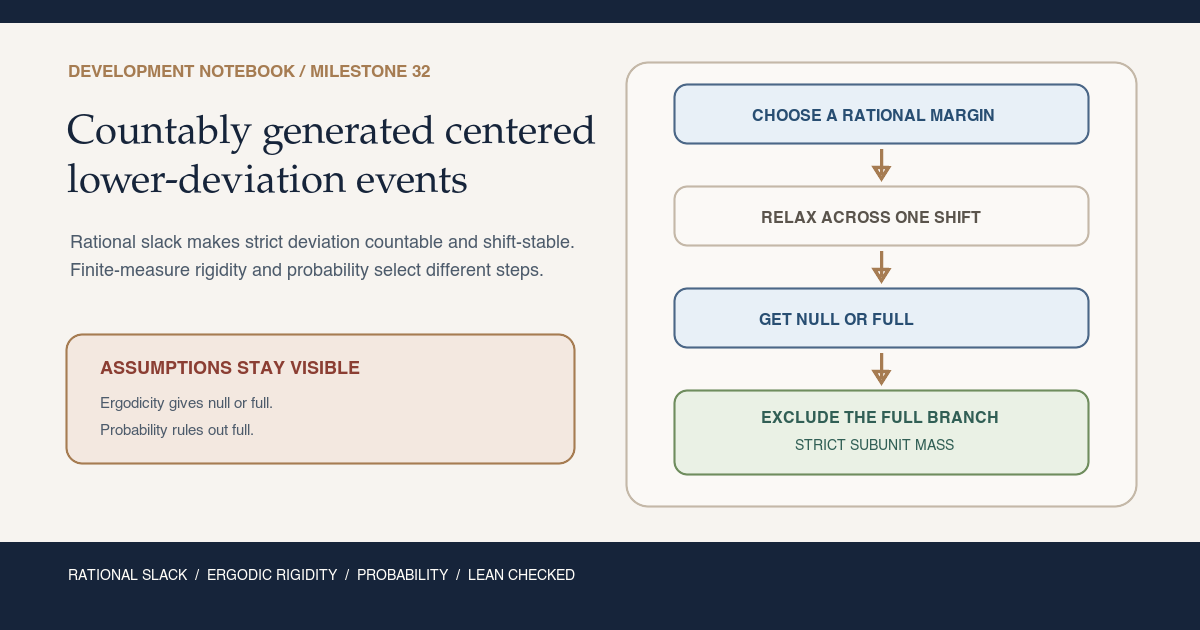
For reusable vocabulary, see orbit-majorant centering , Birkhoff sums , ergodicity , ergodic probability bases , the integrated log-positive growth rate , and one-sided discrete matrix cocycles . The companion textbook chapter is Rational-Slack Lower-Deviation Events and Ergodic Null Selection.
Orientation: the quantifier change is the theorem-design step
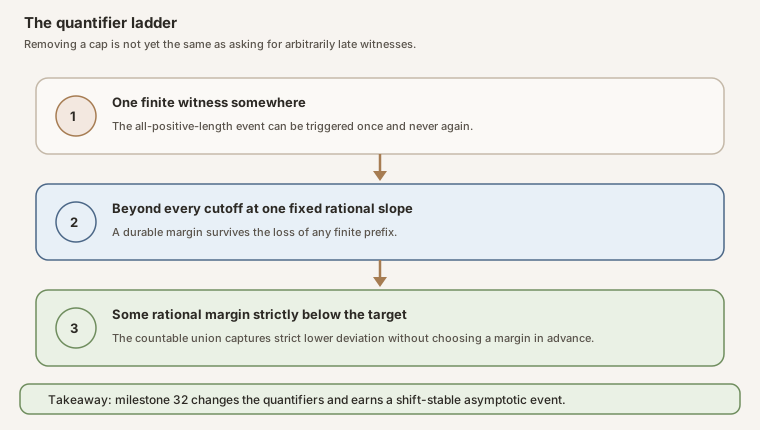
The previous chapter, All-Positive-Length Centered Bad-Block Control in Lean, defined the once-bad event \(B_{\infty,c}\). A point belongs when one positive finite length satisfies \(Y_n(\omega)\lt cn\). That event is useful for a uniform measure estimate, but one exceptional witness may vanish when the initial point is shifted.
RMT-32 changes the logical shape before invoking ergodicity. At one fixed slope \(q\), it requires a witness beyond every cutoff. It then takes a countable union over rational \(q\lt c\). The result remembers a durable strict gap below \(c\), not merely infinitely many values that happen to sit below \(c\) by a gap shrinking to zero.
Prior work, contribution, and nonclaims
Prior work. Kingman’s 1968 paper is the primary historical source for the subadditive ergodic theorem (Kingman 1968). Steele’s 1989 proof centers a subadditive process, introduces a lower asymptotic quantity, derives a one-sided transformation inequality, and then uses measure preservation to obtain almost-everywhere equality (Steele 1989). That proof architecture motivates this milestone.
The set \(D_c\), its rational exhaustion, and the exact Lean API in this note are a project adaptation. They are not definitions quoted from Steele or Kingman. Mathlib supplies countable null-measurable unions and intersections, measure preservation on preimages, finite-measure almost-equality, rational density, and ergodic almost-empty-or-full rigidity (Mathlib sources).
This note’s contribution. RMT-32:
- separates a once-bad event from an arbitrarily-late fixed-margin event;
- packages strict deviation below a real target as a countable rational union;
- proves the endpoint-absorption estimate with no sign assumption on either slope;
- proves fixed-slope preimage inclusion after a genuine slope relaxation;
- recovers a same-target preimage inclusion by rational density;
- separates finite-measure ergodic dichotomy from probability branch selection;
- reuses the RMT-31 ratio to exclude the full branch; and
- specializes the null result to the log-positive matrix-cocycle process, including empty matrix dimension.
Not claimed. The module proves no equality between \(D_c\) and a Mathlib
liminf event, no lower-liminf inequality, no samplewise convergence, no
identification of a limit with the integrated rate, no \(L^1\) convergence,
no limit-integral interchange, no signed logarithmic growth rate, no Lyapunov
exponent, and no Oseledets splitting. It also does not claim same-slope
setwise invariance of \(A_q\) or \(D_c\).
Why rational slack is doing two jobs
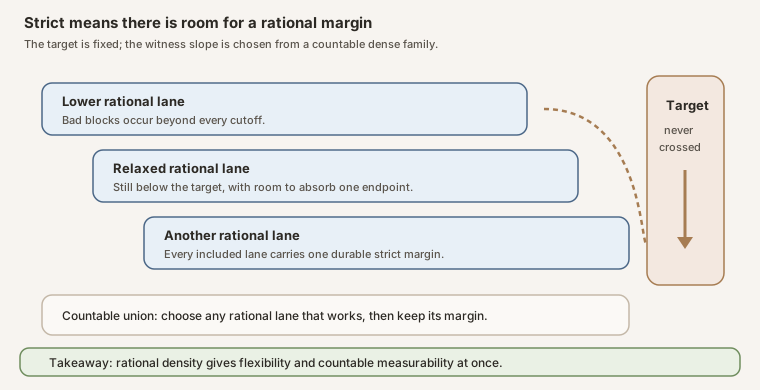
Suppose normalized centered values approach \(c\) from below. Then they can be strictly below \(c\) arbitrarily late while failing to stay below every fixed smaller threshold. For instance, a sequence with normalized values \(c-1/n\) has no uniform negative margin beneath \(c\). Therefore the raw same-target event \(A_c\) is too weak to represent a strict lower deviation.
The union over rational \(q\lt c\) says something stronger: at least one fixed rational margin works beyond every cutoff. Density of the rationals loses no strict gap. If a real margin lies strictly below \(c\), a rational one can be inserted between them.
Countability is the second job. A union over all real thresholds below \(c\) would not be directly closed by Mathlib’s countable null-measurable union theorem. The rationals preserve the intended strict semantics while keeping the event inside a countable construction.
The one-step shift spends some margin
Centered subadditivity at the split (1+n) simplifies because the centered time-one value is zero:
\[ Y_{n+1}(\omega)\le Y_n(T\omega). \]Assume \(T\omega\in A_q\). Given a desired cutoff \(N\), choose a witness \(n\) beyond both \(N\) and an arithmetic cutoff \(K\). The witness at the shifted point satisfies \(Y_n(T\omega)\lt qn\). At the original point, centered subadditivity produces length \(n+1\), not length \(n\). We therefore need
\[ qn\lt r(n+1) \]for a slightly larger slope \(r\). If \(q\lt r\), the growing gap
\((r-q)n\) eventually absorbs the fixed endpoint term \(r\). The theorem
exists_nat_forall_mul_lt_mul_succ proves this without assuming \(q\) or
\(r\) is negative.
This yields
\[ T^{-1}A_q\subseteq A_r\qquad(q\lt r). \]It does not yield \(T^{-1}A_q\subseteq A_q\). For \(D_c\), begin with a rational \(q\lt c\), choose a rational \(r\) with \(q\lt r\lt c\), and move from \(A_q\) to \(A_r\). Both lanes remain inside \(D_c\), so
\[ T^{-1}D_c\subseteq D_c. \]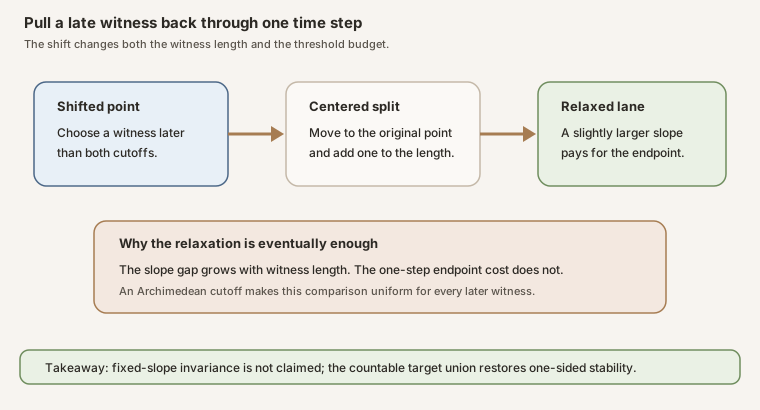
From inclusion to almost-everywhere invariance
The fixed-margin event is a countable intersection over cutoffs, a countable
union over witness lengths, and a proof-indexed union over the cutoff and
positivity conditions. Every leaf is a strict sublevel set of an integrable
centered process. NullMeasurableSet.iInter and
NullMeasurableSet.iUnion assemble the event. A further rational union
assembles \(D_c\). Finite total mass is not needed for either null-measurability
theorem.
Now let \(s=D_c\). The one-sided theorem gives \(T^{-1}s\subseteq s\). Preservation gives equal extended measures:
\[ \mu(T^{-1}s)=\mu(s). \]On a finite measure space, the target has finite mass. Mathlib’s
ae_eq_of_subset_of_measure_ge then upgrades subset plus equal measure to
This is almost-everywhere equality, not setwise equality. The distinction is intentional: null points may still disagree.
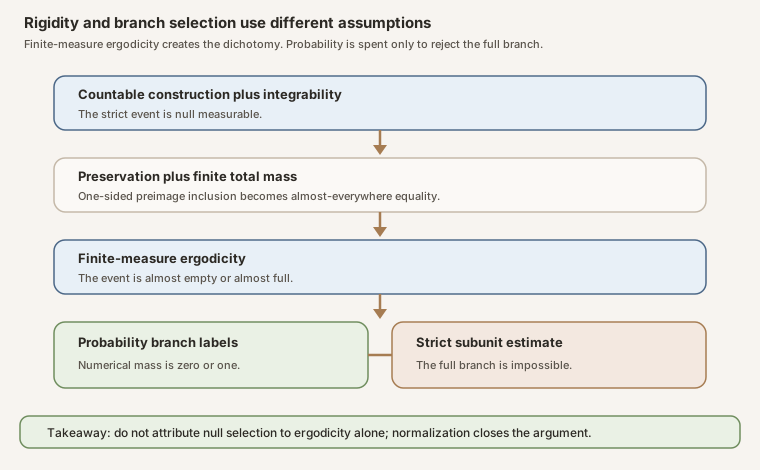
Ergodicity creates a dichotomy; probability selects a branch
Finite-measure ergodicity acts on the almost-invariant null-measurable event.
Through QuasiErgodic.ae_empty_or_univ₀, it yields
No probability normalization is needed for that dichotomy. This is the first important assumption boundary.
On a probability space, the two alternatives have numerical extended masses zero and one. The RMT-31 inclusion \(D_c\subseteq B_{\infty,c}\), together with the uniform all-length ratio, supplies a separate strict estimate. If \(\delta\) is a lower bound for every positive normalized centered integral and \(c\lt\delta\), then the time-one centered identity gives \(\delta\le0\), hence \(c\lt0\), and
\[ \mu_{\mathbb R}(D_c) \le \mu_{\mathbb R}(B_{\infty,c}) \le \frac{\delta}{c} \lt 1. \]Probability normalization is what makes the almost-full branch have mass one. The strict subunit estimate then excludes it. An ergodic finite measure whose total mass is one half can have \(D_c=\Omega\) and \(\mu_{\mathbb R}(D_c)=1/2\lt1\). A half-Dirac construction realizes this boundary case.
The cocycle specialization
For a discrete matrix cocycle \(C\), the generic process is
C.logPlusNormObservable. Its centered Fekete offset is
RMT-30 now exposes the reusable theorem
centeredFeketeOffset_le_normalizedIntegral, which proves that this
\(\delta\) bounds every positive normalized centered integral from below.
RMT-32 therefore instantiates the generic null-selection theorem directly.
The cocycle endpoint assumes an integrable generator log-positive norm, an
ergodic probability base, and \(c\lt\delta\). It retains Fintype and
DecidableEq on the matrix index but no Nonempty assumption. Empty matrix
dimension remains a compiled boundary. The observable is log-positive, so
contractions are clipped. The result is not a theorem about a signed
Lyapunov exponent.
Public declaration surface in exact source order
The module exports nineteen declarations.
1. centeredArbitrarilyLateBadBlockSet
def centeredArbitrarilyLateBadBlockSet {Ω : Type uΩ} (T : Ω → Ω)
    (X : ℕ → Ω → ℝ) (q : ℝ) : Set Ω :=
  ⋂ N : ℕ, ⋃ n : ℕ, ⋃ (_h : N ≤ n ∧ 0 < n),
    {ω | centeredProcess T X n ω < q * (n : ℝ)}
Names the fixed-real-slope event \(A_q\). The proof index records both the cutoff and positivity conditions inside the union.
2. mem_centeredArbitrarilyLateBadBlockSet_iff
@[simp] theorem mem_centeredArbitrarilyLateBadBlockSet_iff
    {Ω : Type uΩ} {T : Ω → Ω} {X : ℕ → Ω → ℝ}
    {q : ℝ} {ω : Ω} :
    ω ∈ centeredArbitrarilyLateBadBlockSet T X q ↔
      ∀ N : ℕ, ∃ n : ℕ, N ≤ n ∧ 0 < n ∧
        centeredProcess T X n ω < q * (n : ℝ)
Exposes the exact beyond-every-cutoff semantics and keeps witness positivity explicit.
3. centeredStrictLowerDeviationSet
def centeredStrictLowerDeviationSet {Ω : Type uΩ} (T : Ω → Ω)
    (X : ℕ → Ω → ℝ) (c : ℝ) : Set Ω :=
  ⋃ q : ℚ, ⋃ (_h : (q : ℝ) < c),
    centeredArbitrarilyLateBadBlockSet T X (q : ℝ)
Names \(D_c\), a countable union of durable rational margins.
4. mem_centeredStrictLowerDeviationSet_iff
@[simp] theorem mem_centeredStrictLowerDeviationSet_iff
    {Ω : Type uΩ} {T : Ω → Ω} {X : ℕ → Ω → ℝ}
    {c : ℝ} {ω : Ω} :
    ω ∈ centeredStrictLowerDeviationSet T X c ↔
      ∃ q : ℚ, (q : ℝ) < c ∧
        ω ∈ centeredArbitrarilyLateBadBlockSet T X (q : ℝ)
Turns nested indexed-union membership into one rational witness and its strict target inequality.
5. exists_nat_forall_mul_lt_mul_succ
theorem exists_nat_forall_mul_lt_mul_succ {q r : ℝ} (hqr : q < r) :
    ∃ N : ℕ, ∀ n : ℕ, N ≤ n →
      q * (n : ℝ) < r * ((n + 1 : ℕ) : ℝ)
Absorbs the one-step endpoint for any ordered real slopes. No negativity premise is hidden.
6. centeredArbitrarilyLateBadBlockSet_subset_allLength
theorem centeredArbitrarilyLateBadBlockSet_subset_allLength
    {Ω : Type uΩ} (T : Ω → Ω) (X : ℕ → Ω → ℝ) (q : ℝ) :
    centeredArbitrarilyLateBadBlockSet T X q ⊆
      centeredAllLengthBadBlockSet T X q
Chooses cutoff zero and forgets recurrence, leaving one positive witness.
7. centeredStrictLowerDeviationSet_subset_allLength
theorem centeredStrictLowerDeviationSet_subset_allLength
    {Ω : Type uΩ} (T : Ω → Ω) (X : ℕ → Ω → ℝ) (c : ℝ) :
    centeredStrictLowerDeviationSet T X c ⊆
      centeredAllLengthBadBlockSet T X c
Forgets recurrence and raises the rational witness slope from \(q\) to \(c\) using the positive witness length.
8. IsIntegrableSubadditiveProcessCandidate.nullMeasurableSet_centeredArbitrarilyLateBadBlockSet
theorem nullMeasurableSet_centeredArbitrarilyLateBadBlockSet
    (hX : IsIntegrableSubadditiveProcessCandidate T μ X)
    (hT : MeasurePreserving T μ μ) (q : ℝ) :
    NullMeasurableSet (centeredArbitrarilyLateBadBlockSet T X q) μ
Uses centered-process integrability at each length, strict-sublevel null measurability, and countable intersections and unions. Finite mass is absent.
9. IsIntegrableSubadditiveProcessCandidate.nullMeasurableSet_centeredStrictLowerDeviationSet
theorem nullMeasurableSet_centeredStrictLowerDeviationSet
    (hX : IsIntegrableSubadditiveProcessCandidate T μ X)
    (hT : MeasurePreserving T μ μ) (c : ℝ) :
    NullMeasurableSet (centeredStrictLowerDeviationSet T X c) μ
Adds the countable rational union to declaration 8.
10. IsIntegrableSubadditiveProcessCandidate.preimage_centeredArbitrarilyLateBadBlockSet_subset_of_lt
theorem preimage_centeredArbitrarilyLateBadBlockSet_subset_of_lt
    (hX : IsIntegrableSubadditiveProcessCandidate T μ X)
    {q r : ℝ} (hqr : q < r) :
    T ⁻¹' centeredArbitrarilyLateBadBlockSet T X q ⊆
      centeredArbitrarilyLateBadBlockSet T X r
Combines declaration 5 with centered shifted subadditivity. It needs the candidate’s algebraic law but neither preservation nor a finite measure.
11. IsIntegrableSubadditiveProcessCandidate.preimage_centeredStrictLowerDeviationSet_subset
theorem preimage_centeredStrictLowerDeviationSet_subset
    (hX : IsIntegrableSubadditiveProcessCandidate T μ X) (c : ℝ) :
    T ⁻¹' centeredStrictLowerDeviationSet T X c ⊆
      centeredStrictLowerDeviationSet T X c
Uses rational density to turn declaration 10’s relaxed-slope result into a same-target one-sided inclusion for \(D_c\).
12. IsIntegrableSubadditiveProcessCandidate.preimage_centeredStrictLowerDeviationSet_ae_eq
theorem preimage_centeredStrictLowerDeviationSet_ae_eq
    [IsFiniteMeasure μ]
    (hX : IsIntegrableSubadditiveProcessCandidate T μ X)
    (hT : MeasurePreserving T μ μ) (c : ℝ) :
    T ⁻¹' centeredStrictLowerDeviationSet T X c =ᵐ[μ]
      centeredStrictLowerDeviationSet T X c
Combines one-sided inclusion, preserved measure, preimage null measurability, and finite target mass to get almost-everywhere equality.
13. IsIntegrableSubadditiveProcessCandidate.centeredStrictLowerDeviationSet_ae_empty_or_univ
theorem centeredStrictLowerDeviationSet_ae_empty_or_univ
    [IsFiniteMeasure μ]
    (hX : IsIntegrableSubadditiveProcessCandidate T μ X)
    (hT : Ergodic T μ) (c : ℝ) :
    centeredStrictLowerDeviationSet T X c =ᵐ[μ] (∅ : Set Ω) ∨
      centeredStrictLowerDeviationSet T X c =ᵐ[μ] Set.univ
Applies quasi-ergodic rigidity to declarations 9 and 12. Probability is not required.
14. IsIntegrableSubadditiveProcessCandidate.measure_centeredStrictLowerDeviationSet_eq_zero_or_one
theorem measure_centeredStrictLowerDeviationSet_eq_zero_or_one
    [IsProbabilityMeasure μ]
    (hX : IsIntegrableSubadditiveProcessCandidate T μ X)
    (hT : Ergodic T μ) (c : ℝ) :
    μ (centeredStrictLowerDeviationSet T X c) = 0 ∨
      μ (centeredStrictLowerDeviationSet T X c) = 1
Converts the almost-empty or almost-full alternatives into numerical extended-measure branches using probability normalization.
15. IsIntegrableSubadditiveProcessCandidate.measureReal_centeredStrictLowerDeviationSet_lt_one
theorem measureReal_centeredStrictLowerDeviationSet_lt_one
    [IsFiniteMeasure μ]
    (hX : IsIntegrableSubadditiveProcessCandidate T μ X)
    (hT : MeasurePreserving T μ μ) (δ c : ℝ)
    (hδ : ∀ n : ℕ, n ≠ 0 →
      δ ≤ (∫ ω, centeredProcess T X n ω ∂μ) / (n : ℝ))
    (hc : c < δ) :
    μ.real (centeredStrictLowerDeviationSet T X c) < 1
Uses declaration 7, RMT-31’s all-length ratio, the time-one sign deduction, and negative-denominator arithmetic. It needs neither probability nor ergodicity.
16. IsIntegrableSubadditiveProcessCandidate.measure_centeredStrictLowerDeviationSet_eq_zero
theorem measure_centeredStrictLowerDeviationSet_eq_zero
    [IsProbabilityMeasure μ]
    (hX : IsIntegrableSubadditiveProcessCandidate T μ X)
    (hT : Ergodic T μ) (δ c : ℝ)
    (hδ : ∀ n : ℕ, n ≠ 0 →
      δ ≤ (∫ ω, centeredProcess T X n ω ∂μ) / (n : ℝ))
    (hc : c < δ) :
    μ (centeredStrictLowerDeviationSet T X c) = 0
Selects the zero branch from declaration 14 by contradicting declaration 15 if the mass were one.
17. DiscreteMatrixCocycle.centeredLogPlusArbitrarilyLateBadBlockSet
def centeredLogPlusArbitrarilyLateBadBlockSet
    (C : DiscreteMatrixCocycle (ι := ι) μ) (q : ℝ) : Set Ω :=
  centeredArbitrarilyLateBadBlockSet C.base C.logPlusNormObservable q
Gives the fixed-margin generic event a cocycle-facing name.
18. DiscreteMatrixCocycle.centeredLogPlusStrictLowerDeviationSet
def centeredLogPlusStrictLowerDeviationSet
    (C : DiscreteMatrixCocycle (ι := ι) μ) (c : ℝ) : Set Ω :=
  centeredStrictLowerDeviationSet C.base C.logPlusNormObservable c
Gives the rationally exhausted strict event a cocycle-facing name.
19. DiscreteMatrixCocycle.HasIntegrableGeneratorLogPlus.measure_centeredLogPlusStrictLowerDeviationSet_eq_zero
theorem HasIntegrableGeneratorLogPlus.measure_centeredLogPlusStrictLowerDeviationSet_eq_zero
    [IsProbabilityMeasure μ]
    {C : DiscreteMatrixCocycle (ι := ι) μ}
    (hC : C.HasIntegrableGeneratorLogPlus) (hErg : Ergodic C.base μ)
    (c : ℝ)
    (hc : c < C.integratedLogPlusGrowthRate hC -
      C.integratedLogPlusNorm 1) :
    μ (C.centeredLogPlusStrictLowerDeviationSet c) = 0
Instantiates declaration 16 with the cocycle candidate and RMT-30’s extracted centered Fekete offset lower bound. The matrix index may be empty.
Complete local proof-step ledger
| Declaration | Local step, in source order | Job |
|---|---|---|
| Fixed-margin membership | Unfold intersection and union membership | Converts nested set constructors into cutoff and witness quantifiers |
| Fixed-margin membership | Forward direction splits the proof pair | Separates cutoff and positivity evidence |
| Fixed-margin membership | Reverse direction repackages the proof pair | Re-enters the proof-indexed union |
| Strict-event membership | Unfold both rational unions | Exposes one rational slope and its strict target proof |
| Endpoint absorption | N from exists_nat_gt | Chooses an Archimedean cutoff above the required quotient |
| Endpoint absorption | hpos | Records positivity of the slope gap |
| Endpoint absorption | hquot | Moves the natural witness beyond the real cutoff |
| Endpoint absorption | hmul | Clears the positive denominator |
| Endpoint absorption | push_cast; linarith | Rewrites the successor cast and closes the linear inequality |
| Fixed-margin to once-bad | Specialize the cutoff at zero | Obtains one positive witness and forgets recurrence |
| Strict event to once-bad | Extract q, then specialize at zero | Obtains one positive rational-margin witness |
| Strict event to once-bad | mul_lt_mul_of_pos_right | Raises the threshold from \(q\) to \(c\) using positive length |
| Fixed-margin null measurability | iInter, then two iUnion steps | Mirrors the countable set constructor exactly |
| Fixed-margin null measurability | nullMeasurableSet_lt | Uses centered integrability against a measurable constant threshold |
| Strict-event null measurability | Two rational indexed unions | Reuses fixed-margin null measurability for every included slope |
| Relaxed fixed-slope preimage | K from endpoint absorption | Freezes when the slope gap pays for one endpoint |
| Relaxed fixed-slope preimage | Witness cutoff max N K | Satisfies the requested cutoff and arithmetic cutoff together |
| Relaxed fixed-slope preimage | hsub from centeredProcess_add_le 1 n | Moves a shifted witness to an original-point witness of length one larger |
| Relaxed fixed-slope preimage | Strict transitivity | Chains process control, badness, and endpoint absorption |
| Same-target strict preimage | Extract rational q | Opens membership in the source strict event |
| Same-target strict preimage | r from exists_rat_btwn | Inserts a relaxed rational slope while staying below the target |
| Same-target strict preimage | Declaration 10 | Moves from the q lane to the r lane |
| Almost invariance | Local abbreviation s and null-measurability fact hs | Keeps the measure proof readable |
| Almost invariance | hT.measure_preimage hs | Gives equal measure to the set and its preimage |
| Almost invariance | hs.preimage hT.quasiMeasurePreserving | Supplies null measurability on the subset side |
| Almost invariance | ae_eq_of_subset_of_measure_ge | Converts subset plus equal finite measure into almost-everywhere equality |
| Ergodic dichotomy | hT.quasiErgodic.ae_empty_or_univ₀ | Applies rigidity to a null-measurable almost-invariant set |
| Numerical zero or one | Case split on the dichotomy | Converts almost-empty and almost-full into measure equalities |
| Strict subunit mass | hδnonpos from time one | Proves \(\delta\le0\) because the time-one centered integral is zero |
| Strict subunit mass | hcneg | Derives \(c\lt0\) from \(c\lt\delta\le0\) |
| Strict subunit mass | measureReal_mono | Compares \(D_c\) with RMT-31’s once-bad event |
| Strict subunit mass | RMT-31 ratio theorem | Bounds the larger event by \(\delta/c\) |
| Strict subunit mass | div_lt_one_of_neg | Converts \(c\lt\delta\) into \(\delta/c\lt1\) for negative \(c\) |
| Null selection | Case split on zero or one | Returns the zero branch immediately |
| Null selection | hreal and hlt | Turns mass one into real mass one and contradicts strict subunit mass |
| Cocycle null theorem | Local candidate hX | Retrieves the generic centered-process interface |
| Cocycle null theorem | Extracted RMT-30 bound | Supplies every positive normalized centered-integral lower bound |
| Cocycle null theorem | Declaration 16 | Selects the null branch below the centered Fekete offset |
Receiver surface versus proof dependency
Declarations 10 and 11 are methods on the full
IsIntegrableSubadditiveProcessCandidate bundle. Their proofs use only the
bundle’s shifted-subadditivity field add_le. They do not use its
integrability field, preservation, or finite mass.
The receiver is retained for an ergonomic, uniform project API. This is not a claim that integrability is mathematically necessary for the two set inclusions. Integrability first becomes active in declaration 8, where it supplies null measurability of the strict sublevel leaves, and remains active through the measure-theoretic conclusions.
Private boundary-support declarations
The source next introduces twenty-one private declarations. They compile countermodels and degenerate cases without enlarging the public namespace.
| Private item, in source order | Construction or proof job |
|---|---|
rmt32ZeroProcess | Constant zero at every time and point |
rmt32Collapse | Sends both Boolean points to true |
rmt32OneShotProcess | Is minus one from length two onward at false, and zero otherwise |
rmt32_iterate_collapse_true | Proves every iterate fixes true |
rmt32_iterate_collapse_of_ne_zero | Proves every positive iterate sends either point to true |
rmt32OneShotProcess_candidate | Compiles integrability and shifted subadditivity over the collapse base |
rmt32Collapse_preserving | Proves the collapse preserves the Dirac measure at true |
rmt32OneShotProcess_centered_lower_bound | Gives the pointwise centered lower bound minus one |
rmt32OneShotProcess_not_mem_arbitrarilyLate_of_neg | Uses an Archimedean cutoff to exclude every negative fixed margin |
rmt32TwoPointProbability | Half the sum of the Dirac masses at false and true |
anonymous IsProbabilityMeasure instance | Establishes total mass one for the two-point measure |
rmt32Id_not_preErgodic | Uses the invariant singleton to refute pre-ergodicity of the Boolean identity |
rmt32TwoPointProcess | Equals minus n - 1 on false and zero on true |
rmt32TwoPointProcess_candidate | Compiles finite-space integrability and shifted subadditivity |
rmt32TwoPointStrictLowerDeviationSet | Computes the strict event at minus three quarters as {false} |
rmt32HalfUnitMeasure | Scales the Dirac mass on Unit to total mass one half |
anonymous IsFiniteMeasure instance | Records finiteness without probability normalization |
rmt32IdHalfUnit_ergodic | Proves the identity on the one-point space is ergodic for the half-Dirac measure |
rmt32UnitProcess | Equals minus n - 1 at the unique point |
rmt32UnitProcess_candidate | Compiles constant-function integrability and shifted subadditivity |
rmt32UnitStrictLowerDeviationSet | Computes the strict event at minus three quarters as the full space |
Six compiled boundary probes in exact source order
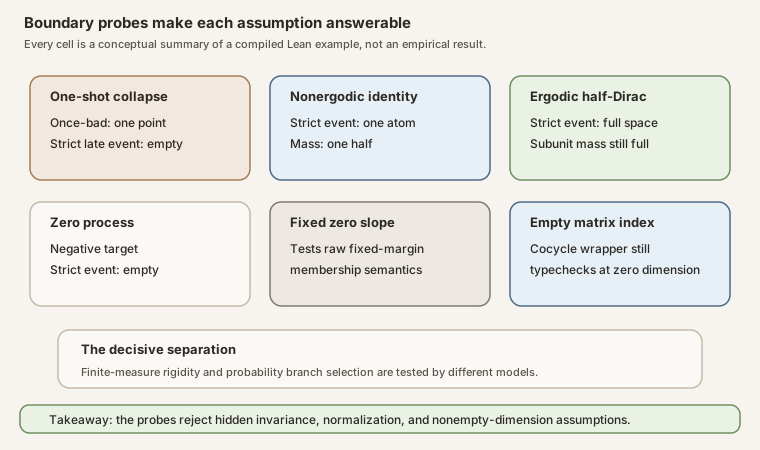
- Zero process. For every \(c\le0\), the zero process has \(D_c=\varnothing\). A rational \(q\lt c\) is nonpositive, so \(0\lt qn\) cannot hold at a positive length.
- One-shot collapse. At \(c=-2/5\), the RMT-31 once-bad event is exactly
{false}, while \(D_c\) is empty. The centered process never drops below minus one, whereas every negative linear threshold eventually does. - Raw fixed target versus strict rational event. For the same process, \(A_0=\{\mathsf{false}\}\) because minus one is below zero at every late length. Yet \(D_0=\varnothing\), since no fixed negative rational margin works. This compiles the reason \(A_c\) cannot replace \(D_c\).
- Nonergodic probability model. The Boolean identity preserves the
two-atom probability but is not pre-ergodic. At \(c=-3/4\), the strict
event is
{false}and has real mass \(1/2\). Intermediate probability is possible when ergodicity is absent. - Ergodic subprobability model. The identity on
Unitis ergodic for a Dirac measure scaled to total mass \(1/2\). The strict event is the full space and has real mass \(1/2\le2/3\lt1\). Thus ergodicity plus a strict subunit estimate does not select the null branch unless full-space mass is normalized to one. - Empty matrix index. The final cocycle null theorem typechecks with
ι := Empty. No coordinate choice or nonempty-index premise is hidden.
Complete source-order map
| Order | Kind | Source item |
|---|---|---|
| 1 | Public definition | centeredArbitrarilyLateBadBlockSet |
| 2 | Public theorem | mem_centeredArbitrarilyLateBadBlockSet_iff |
| 3 | Public definition | centeredStrictLowerDeviationSet |
| 4 | Public theorem | mem_centeredStrictLowerDeviationSet_iff |
| 5 | Public theorem | exists_nat_forall_mul_lt_mul_succ |
| 6 | Public theorem | centeredArbitrarilyLateBadBlockSet_subset_allLength |
| 7 | Public theorem | centeredStrictLowerDeviationSet_subset_allLength |
| 8 | Public receiver theorem | IsIntegrableSubadditiveProcessCandidate.nullMeasurableSet_centeredArbitrarilyLateBadBlockSet |
| 9 | Public receiver theorem | IsIntegrableSubadditiveProcessCandidate.nullMeasurableSet_centeredStrictLowerDeviationSet |
| 10 | Public receiver theorem | IsIntegrableSubadditiveProcessCandidate.preimage_centeredArbitrarilyLateBadBlockSet_subset_of_lt |
| 11 | Public receiver theorem | IsIntegrableSubadditiveProcessCandidate.preimage_centeredStrictLowerDeviationSet_subset |
| 12 | Public receiver theorem | IsIntegrableSubadditiveProcessCandidate.preimage_centeredStrictLowerDeviationSet_ae_eq |
| 13 | Public receiver theorem | IsIntegrableSubadditiveProcessCandidate.centeredStrictLowerDeviationSet_ae_empty_or_univ |
| 14 | Public receiver theorem | IsIntegrableSubadditiveProcessCandidate.measure_centeredStrictLowerDeviationSet_eq_zero_or_one |
| 15 | Public receiver theorem | IsIntegrableSubadditiveProcessCandidate.measureReal_centeredStrictLowerDeviationSet_lt_one |
| 16 | Public receiver theorem | IsIntegrableSubadditiveProcessCandidate.measure_centeredStrictLowerDeviationSet_eq_zero |
| 17 | Public cocycle definition | DiscreteMatrixCocycle.centeredLogPlusArbitrarilyLateBadBlockSet |
| 18 | Public cocycle definition | DiscreteMatrixCocycle.centeredLogPlusStrictLowerDeviationSet |
| 19 | Public cocycle receiver theorem | DiscreteMatrixCocycle.HasIntegrableGeneratorLogPlus.measure_centeredLogPlusStrictLowerDeviationSet_eq_zero |
| 20 | Private boundary definition | rmt32ZeroProcess |
| 21 | Private boundary definition | rmt32Collapse |
| 22 | Private boundary definition | rmt32OneShotProcess |
| 23 | Private boundary theorem | rmt32_iterate_collapse_true |
| 24 | Private boundary theorem | rmt32_iterate_collapse_of_ne_zero |
| 25 | Private boundary theorem | rmt32OneShotProcess_candidate |
| 26 | Private boundary theorem | rmt32Collapse_preserving |
| 27 | Private boundary theorem | rmt32OneShotProcess_centered_lower_bound |
| 28 | Private boundary theorem | rmt32OneShotProcess_not_mem_arbitrarilyLate_of_neg |
| 29 | Anonymous example | Zero process gives an empty strict event at every nonpositive target |
| 30 | Anonymous example | Once-bad one-shot event is nonempty while the strict late event is empty |
| 31 | Anonymous example | Raw fixed-zero-slope event is nonempty while the rational strict event is empty |
| 32 | Private boundary definition | rmt32TwoPointProbability |
| 33 | Private boundary instance | IsProbabilityMeasure rmt32TwoPointProbability |
| 34 | Private boundary theorem | rmt32Id_not_preErgodic |
| 35 | Private boundary definition | rmt32TwoPointProcess |
| 36 | Private boundary theorem | rmt32TwoPointProcess_candidate |
| 37 | Private boundary theorem | rmt32TwoPointStrictLowerDeviationSet |
| 38 | Anonymous example | Nonergodic strict event is a singleton of mass one half |
| 39 | Private boundary definition | rmt32HalfUnitMeasure |
| 40 | Private boundary instance | IsFiniteMeasure rmt32HalfUnitMeasure |
| 41 | Private boundary theorem | rmt32IdHalfUnit_ergodic |
| 42 | Private boundary definition | rmt32UnitProcess |
| 43 | Private boundary theorem | rmt32UnitProcess_candidate |
| 44 | Private boundary theorem | rmt32UnitStrictLowerDeviationSet |
| 45 | Anonymous example | Ergodic half-Dirac full event has strict subunit mass |
| 46 | Anonymous example | Empty matrix-index cocycle null theorem |
| 47 | Axiom audit | Fixed-margin membership semantics |
| 48 | Axiom audit | Strict-event membership semantics |
| 49 | Axiom audit | Endpoint absorption |
| 50 | Axiom audit | Strict event embeds into the once-bad event |
| 51 | Axiom audit | Strict-event null measurability |
| 52 | Axiom audit | Same-target one-sided preimage inclusion |
| 53 | Axiom audit | Almost-everywhere preimage equality |
| 54 | Axiom audit | Finite-measure ergodic dichotomy |
| 55 | Axiom audit | Generic null-branch selection |
| 56 | Axiom audit | Cocycle null-branch selection |
Ten axiom reports
The warning-fatal Lean run prints all ten theorem footprints as exactly the same standard trio:
'NonlinearDynamics.Random.RandomCocycles.mem_centeredArbitrarilyLateBadBlockSet_iff'
depends on axioms: [propext, Classical.choice, Quot.sound]

'NonlinearDynamics.Random.RandomCocycles.mem_centeredStrictLowerDeviationSet_iff'
depends on axioms: [propext, Classical.choice, Quot.sound]

'NonlinearDynamics.Random.RandomCocycles.exists_nat_forall_mul_lt_mul_succ'
depends on axioms: [propext, Classical.choice, Quot.sound]

'NonlinearDynamics.Random.RandomCocycles.centeredStrictLowerDeviationSet_subset_allLength'
depends on axioms: [propext, Classical.choice, Quot.sound]

'NonlinearDynamics.Random.RandomCocycles.IsIntegrableSubadditiveProcessCandidate.nullMeasurableSet_centeredStrictLowerDeviationSet'
depends on axioms: [propext, Classical.choice, Quot.sound]

'NonlinearDynamics.Random.RandomCocycles.IsIntegrableSubadditiveProcessCandidate.preimage_centeredStrictLowerDeviationSet_subset'
depends on axioms: [propext, Classical.choice, Quot.sound]

'NonlinearDynamics.Random.RandomCocycles.IsIntegrableSubadditiveProcessCandidate.preimage_centeredStrictLowerDeviationSet_ae_eq'
depends on axioms: [propext, Classical.choice, Quot.sound]

'NonlinearDynamics.Random.RandomCocycles.IsIntegrableSubadditiveProcessCandidate.centeredStrictLowerDeviationSet_ae_empty_or_univ'
depends on axioms: [propext, Classical.choice, Quot.sound]

'NonlinearDynamics.Random.RandomCocycles.IsIntegrableSubadditiveProcessCandidate.measure_centeredStrictLowerDeviationSet_eq_zero'
depends on axioms: [propext, Classical.choice, Quot.sound]

'NonlinearDynamics.Random.RandomCocycles.DiscreteMatrixCocycle.HasIntegrableGeneratorLogPlus.measure_centeredLogPlusStrictLowerDeviationSet_eq_zero'
depends on axioms: [propext, Classical.choice, Quot.sound]
No project-specific axiom or proof hole appears.
Assumption and conclusion ledger
| Layer | Required assumptions | Exact output | Explicitly absent |
|---|---|---|---|
| Event definitions and membership | Functions, naturals, real or rational slopes | Exact cutoff and witness semantics | Measurable space, measure, preservation |
| Endpoint absorption | Two ordered real slopes | Eventual successor threshold inequality | Sign restrictions, process, measure |
| Event inclusion into once-bad | Positive witness semantics and rational target ordering | Set inclusion | Candidate, measurability, preservation |
| Fixed and strict null measurability | Integrable candidate, preservation | NullMeasurableSet | Finite total mass, probability, ergodicity |
| Pure preimage inclusions | Full candidate receiver, with only add_le consumed by the proof | Relaxed fixed-slope inclusion and same-target strict-event inclusion | Integrability as proof dependency, preservation, finite mass |
| Almost invariance | Candidate, preservation, finite measure | Preimage equals event almost everywhere | Ergodicity, probability, setwise equality |
| Ergodic rigidity | Candidate, finite measure, ergodic base | Event almost empty or almost full | Probability normalization, rate bound |
| Numerical dichotomy | Candidate, ergodic probability base | Extended measure zero or one | Blockwise lower-rate premise |
| Strict subunit estimate | Candidate, finite measure, preservation, normalized lower bound, strict target | Real event mass below one | Ergodicity, probability |
| Generic null selection | Candidate, ergodic probability base, normalized lower bound, strict target | Extended event measure zero | Liminf identification, process convergence |
| Cocycle null selection | Finite decidable index, integrable generator log-positive norm, ergodic probability base, target below centered Fekete offset | Cocycle strict-event measure zero | Nonempty index, signed log, Lyapunov exponent |
Common wrong turns
Using the once-bad event in an ergodic argument
One witness can disappear after a shift. The compiled collapse model has a nonempty once-bad event and an empty strict late event at the same threshold.
Replacing \(D_c\) with \(A_c\)
Arbitrarily late values below \(c\) may approach \(c\) with vanishing slack. The fixed-zero-slope probe has \(A_0\ne D_0\). Strict lower deviation needs a fixed smaller rational slope.
Taking an uncountable real union
The intended strict event can be exhausted by rational thresholds. Using all real thresholds discards the direct countable-union measurability proof for no mathematical gain.
Claiming same-slope preimage stability
The shift changes length from \(n\) to \(n+1\). The public fixed-slope theorem therefore moves from \(q\) to a strictly larger \(r\). Same-target stability appears only after taking the rational union.
Calling one-sided inclusion invariance
T ⁻¹' D_c ⊆ D_c is not equality. Preservation and finite mass are used in a
separate theorem to obtain equality only almost everywhere.
Treating finite-measure ergodicity as probability
Ergodicity gives the almost-empty or almost-full dichotomy at any finite total mass. It does not make the full space have mass one.
Inferring nullity from real mass below one
The half-Dirac probe is ergodic, has \(D_c=\Omega\), and still has real event mass below one. Probability normalization is exactly what makes subunit mass contradict the full branch.
Dividing before establishing the sign
The ratio denominator is negative. The proof first specializes the normalized
lower bound at time one to get \(\delta\le0\), then derives \(c\lt0\), and only
then uses div_lt_one_of_neg.
Treating the receiver bundle as a minimal hypothesis list
The pure preimage-inclusion methods live on the project candidate bundle for
API consistency, but their proofs project only add_le. Integrability is not
a hidden logical input to those two proofs.
Calling \(D_c\) a liminf event already
Its quantifiers are designed for a lower-limit bridge, but no theorem in this
module equates it with a library-level real liminf. The later
RMT-33 Notebook
states and proves the guarded bridge explicitly.
Reading log-positive growth as signed asymptotic growth
The cocycle observable clips contractions. Nullity of its strict centered lower-deviation event is not a Lyapunov-exponent or Oseledets theorem.
Thirty solved exercises
Exercise 1: unfold the fixed-margin event
What does \(\omega\in A_q\) mean without set constructors?
Solution. For every natural cutoff \(N\), there is a natural \(n\ge N\) with \(n\gt0\) and \(Y_n(\omega)\lt qn\). The same fixed \(q\) must work for all cutoffs, while \(n\) may depend on \(N\).
Exercise 2: explain the positivity conjunct
Why retain \(n\gt0\) even when cutoffs eventually become positive?
Solution. The definition quantifies over cutoff zero too, and downstream normalized expressions divide by \(n\). Positivity makes the intended witness domain explicit at every use and prevents time zero from entering by accident.
Exercise 3: forget recurrence
Why does \(A_q\subseteq B_{\infty,q}\)?
Solution. Specialize the beyond-every-cutoff property at \(N=0\). It returns one positive witness satisfying the once-bad inequality.
Exercise 4: reject the converse
Why need \(B_{\infty,q}\not\subseteq A_q\) in general?
Solution. The one-shot collapse process has one strict witness at length
two but no fixed negative-margin witnesses arbitrarily late. Its once-bad set
is {false} while the corresponding strict late event is empty.
Exercise 5: distinguish \(A_c\) from \(D_c\)
Suppose \(Y_n/n=c-1/n\). Which same-target property holds, and which durable margin property can fail?
Solution. Every normalized value is below \(c\), so the same-target event \(A_c\) holds. For any fixed \(q\lt c\), eventually \(c-1/n\gt q\), so no single \(A_q\) with \(q\lt c\) need hold. Thus membership in \(D_c\) can fail.
Exercise 6: justify rational thresholds
Why are rationals sufficient for a strict real target?
Solution. If a working real margin \(a\) satisfies \(a\lt c\), density provides a rational \(q\) with \(a\lt q\lt c\). A value below \(an\) at positive \(n\) is also below \(qn\), so the rational lane preserves the strict deviation.
Exercise 7: identify the countability benefit
What measure-theoretic closure becomes available after restricting margins to \(\mathbb Q\)?
Solution. NullMeasurableSet.iUnion closes countable indexed unions. The
rationals form a countable type, so the strict event inherits null
measurability from its fixed-margin pieces.
Exercise 8: derive the endpoint inequality
Rewrite \(qn\lt r(n+1)\) to show why \(q\lt r\) is enough eventually.
Solution. The inequality is equivalent to \(-r\lt(r-q)n\). Since \(r-q\gt0\), the right side grows without bound as \(n\) grows, so one Archimedean cutoff suffices.
Exercise 9: inspect signs
Does Exercise 8 require \(q\lt0\) or \(r\lt0\)?
Solution. No. Only \(r-q\gt0\) is used. The numerator (-r) may have any
sign; exists_nat_gt still chooses a natural above its quotient by the
positive gap.
Exercise 10: orient the preimage
What does \(\omega\in T^{-1}A_q\) say?
Solution. It says \(T\omega\in A_q\). The proof starts with arbitrarily late bad witnesses at the shifted point and uses centered subadditivity to construct witnesses at the original point.
Exercise 11: account for the successor
Why does the constructed original-point witness have length \(n+1\)?
Solution. The centered subadditive split is (1+n): the first block starts at \(\omega\), and the remaining length-\(n\) block starts at \(T\omega\). The centered time-one term simplifies to zero.
Exercise 12: combine cutoffs
Why does the Lean proof query the shifted event at max N K?
Solution. The witness must be beyond the caller’s desired cutoff \(N\) and beyond the arithmetic cutoff \(K\) where the slope relaxation is valid. The maximum enforces both with one query.
Exercise 13: recover the same target
Given a source lane \(q\lt c\), how does the proof stay inside \(D_c\) after the shift?
Solution. Choose rational \(r\) with \(q\lt r\lt c\). Declaration 10 moves the witness into \(A_r\), and \(r\lt c\) places that lane back inside \(D_c\).
Exercise 14: assemble null measurability
Which countable constructors appear in \(A_q\)?
Solution. A countable intersection over cutoffs, a countable union over lengths, and a union over a proof proposition. The proof proposition is a subsingleton and therefore countable. Each leaf is a null-measurable strict sublevel set.
Exercise 15: locate finite mass
Do declarations 8 and 9 need [IsFiniteMeasure μ]?
Solution. No. Countable null-measurable closure and integrability of each centered process suffice. Finite mass first enters the almost-equality theorem.
Exercise 16: upgrade a subset
Why does preservation matter after \(T^{-1}D_c\subseteq D_c\)?
Solution. It gives equal measures to \(D_c\) and its preimage. On a finite target, a null-measurable subset with at least the target’s measure must agree with the target almost everywhere.
Exercise 17: distinguish equality notions
Does declaration 12 prove \(T^{-1}D_c=D_c\) as sets?
Solution. No. It proves equality almost everywhere under \(\mu\). Setwise disagreement on a null subset remains possible.
Exercise 18: isolate the ergodic conclusion
What does finite-measure ergodicity yield before probability enters?
Solution. It yields \(D_c=^{\mu}_{\mathrm{a.e.}}\varnothing\) or \(D_c=^{\mu}_{\mathrm{a.e.}}\Omega\). These are qualitative alternatives relative to the given measure, not yet the numerical statement zero or one.
Exercise 19: spend probability normalization
Where is total mass one used?
Solution. It turns the almost-full alternative into \(\mu(D_c)=\mu(\Omega)=1\). The almost-empty alternative already has mass zero without normalization.
Exercise 20: read the half-Dirac probe
Why does event mass \(1/2\lt1\) fail to exclude the full branch there?
Solution. The full space itself has mass \(1/2\). Since \(D_c=\Omega\), the event can be full and still have strict subunit mass. This is exactly what probability normalization prevents.
Exercise 21: derive the sign of \(\delta\)
What does the normalized lower bound say at \(n=1\)?
Solution. The centered time-one process is identically zero, so its integral and normalized integral are zero. Therefore \(\delta\le0\).
Exercise 22: prove the ratio is strict
Given \(c\lt\delta\le0\), why is \(\delta/c\lt1\)?
Solution. First \(c\lt0\). Multiplying the desired inequality by the negative \(c\) reverses it, reducing \(\delta/c\lt1\) exactly to \(c\lt\delta\).
Exercise 23: read the nonergodic Boolean probe
What assumption does its half-mass event show to be necessary for the dichotomy theorem?
Solution. It shows the need for ergodicity. The preserved probability space has a strict event of mass \(1/2\), neither zero nor one, because the identity preserves the nontrivial singleton.
Exercise 24: test the zero process
Why is \(D_c\) empty for the zero process when \(c\le0\)?
Solution. Every included rational satisfies \(q\lt c\le0\). At positive length \(n\), \(qn\le0\), so the required strict inequality \(0\lt qn\) is impossible.
Exercise 25: audit the API receiver
Which field of the candidate bundle do declarations 10 and 11 actually use?
Solution. Only add_le, through centeredProcess_add_le. They remain
methods on the full bundle for project ergonomics, while integrability begins
its proof role in declaration 8.
Exercise 26: retain empty matrix dimension
Why can the cocycle theorem compile for ι := Empty?
Solution. Its assumptions require only a finite decidable index and the
bundled cocycle and integrability laws. No step chooses a coordinate, so no
Nonempty ι premise is needed.
Exercise 27: state the source relationship precisely
Did Steele define the event \(D_c\) used here?
Solution. No. Steele supplies related centering, one-sided transformation, and preservation architecture for a liminf proof. The rationally generated event and its exact formal interface are this project’s adaptation.
Exercise 28: identify the RMT-33 bridge
What equivalence remains before \(D_c\) can prove a lower-liminf statement?
Solution. The later RMT-33 module connects membership in \(D_c\) with frequent strict threshold crossings and then with a real lower-limit failure, including the exact filter, boundedness, and positive-time conventions.
Exercise 29: reject a full Kingman claim
Why does nullity of \(D_c\) for every \(c\lt\delta\) not yet finish samplewise Kingman convergence?
Solution. The event-to-liminf bridge is absent from RMT-32, and a complete convergence theorem must combine the lower bound with the earlier upper limsup bound at the same deterministic rate. The present module proves only the null-event component; RMT-33 later supplies those additional theorems.
Exercise 30: read the cocycle threshold
Which number replaces the generic \(\delta\) in declaration 19?
Solution. The integrated log-positive growth rate minus the one-step integrated log-positive norm. RMT-30’s extracted theorem proves that this centered Fekete offset is below every positive normalized centered integral.
Reproduction and audit
The frozen source inspected for this note has 668 lines and SHA-256
1bdcfd6b3be654f52bae22bdb2b44c15848e66d51f3a0973ce1c8aba61db14d4.
Lean is pinned to 4.32.0 and Mathlib to commit
81a5d257c8e410db227a6665ed08f64fea08e997.
Build the leaf module with warnings fatal:
cd formalization
lake env lean -DwarningAsError=true \
  NonlinearDynamics/Random/RandomCocycles/SubadditiveLowerDeviation.lean
Regenerate and byte-verify the page-owned social card from any working directory:
site/content/development-notebook/2026/07/countably-generated-centered-lower-deviation-events-in-lean/generate-card.sh
site/content/development-notebook/2026/07/countably-generated-centered-lower-deviation-events-in-lean/generate-card.sh --verify
Check the generator and conceptual assets directly:
shellcheck site/content/development-notebook/2026/07/countably-generated-centered-lower-deviation-events-in-lean/generate-card.sh
xmllint --noout site/content/development-notebook/2026/07/countably-generated-centered-lower-deviation-events-in-lean/*.svg
magick identify -format '%wx%h\n' site/content/development-notebook/2026/07/countably-generated-centered-lower-deviation-events-in-lean/countably-generated-centered-lower-deviation-events-in-lean-card.png
After the shared coverage map and companion textbook chapter are integrated, run:
make content-coverage
make content-hygiene
make site-check
Discussion
Everything in this section interprets the checked architecture; the formal declarations and their explicit assumptions stand on their own. The central design lesson is that an ergodic proof begins before the ergodic theorem is called. It begins with choosing an event whose quantifiers can survive a shift.
The rational union is not cosmetic encoding. It simultaneously expresses a strict asymptotic gap, exposes the slack needed to absorb one endpoint, and keeps null measurability countable. Removing any one of those roles produces a plausible but unusable event: the once-bad event forgets recurrence, the raw same-target event allows vanishing slack, and an uncountable threshold union loses the immediate Mathlib closure theorem.
The assumption split is equally substantive. Finite-measure ergodicity says an almost-invariant event carries no nontrivial measurable information. It does not normalize the mass of the universe. The half-Dirac probe makes that distinction concrete: the event is full, ergodicity holds, and a real-mass bound below one also holds. Probability is therefore not decorative notation around the final theorem. It changes which numerical value represents the full branch.
RMT-32 reaches the last event-level step of the lower-bound route. The
subsequent RMT-33 milestone connects this hand-built countable event to a
guarded real liminf formulation and combines it with the upper-limsup
machinery. That bridge is checked rather than inferred from the suggestive
name centeredStrictLowerDeviationSet.
Navigation: adjacent milestones
Previous, RMT-31: All-Positive-Length Centered Bad-Block Control in Lean passes one uniform finite-cap measure ratio to the once-bad union over every positive length. It assumes finite measure and preservation but no probability or ergodicity.
Current companion: Rational-Slack Lower-Deviation Events and Ergodic Null Selection develops the mathematics as a textbook ascent, with the event design, one-sided shift geometry, and measure-theoretic rigidity separated into reusable conceptual layers.
Next, RMT-33: Log-Positive Kingman Convergence from Rational Lower Deviations in Lean builds the guarded real-liminf bridge, derives the almost-everywhere centered and uncentered lower bounds, and combines them with the checked upper-limsup route. RMT-32 itself does not pre-claim any of those later results.
References
J. F. C. Kingman. The ergodic theory of subadditive stochastic processes, Journal of the Royal Statistical Society: Series B 30(3), 499-510, 1968, doi:10.1111/j.2517-6161.1968.tb00749.x. This is the primary historical theorem source. Its convergence theorem is strictly stronger than the event-nullity result formalized here.
J. Michael Steele. Kingman’s subadditive ergodic theorem, Annales de l’Institut Henri Poincaré, Probabilités et Statistiques 25(1), 93-98, 1989, MR 995293, Zbl 0669.60039, with the archival PDF. Page 94 centers the process, introduces its lower asymptotic quantity, obtains a one-sided transformation comparison, and uses preservation to reach almost-everywhere equality. RMT-32 follows that architectural cue while using a project-specific rational event rather than attributing the event to Steele.
This project. All-Positive-Length Centered Bad-Block Control in Lean, RMT-31. This checked predecessor supplies the once-bad superset and its uniform real-measure ratio.
This project. Finite Centered Bad-Block Measure Control in Lean, RMT-30. This checked predecessor now exposes the centered Fekete offset as a reusable lower bound for every positive normalized centered integral.
Mathlib contributors.
Null-measurable countable unions and intersections,
Mathlib commit 81a5d257. The pinned source contains
NullMeasurableSet.iUnion and NullMeasurableSet.iInter.
Mathlib contributors.
Measure-preserving preimage equality,
Mathlib commit 81a5d257. The pinned source contains
MeasurePreserving.measure_preimage and its real-measure companion.
Mathlib contributors.
Almost-equality from subset and finite equal mass,
Mathlib commit 81a5d257. The pinned source contains
ae_eq_of_subset_of_measure_ge.
Mathlib contributors.
Almost-invariant-set rigidity,
Mathlib commit 81a5d257. The pinned source contains
QuasiErgodic.ae_empty_or_univ₀. The finite-measure ergodic wrappers appear
later in the same file.
Mathlib contributors.
Rational density in Archimedean ordered fields,
Mathlib commit 81a5d257. The pinned source contains exists_rat_btwn.
Mathlib contributors.
Monotonicity of real-valued measure,
Mathlib commit 81a5d257. The pinned source contains measureReal_mono.
Mathlib contributors.
Division by a negative denominator,
Mathlib commit 81a5d257. The pinned source contains div_lt_one_of_neg.