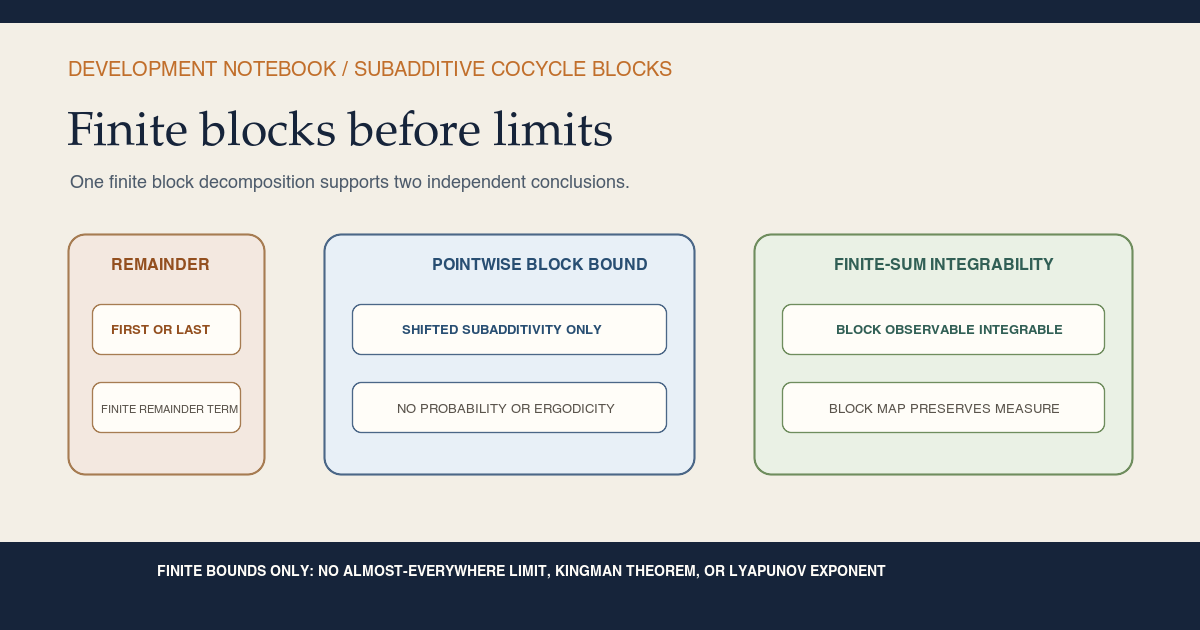
This is the proof-to-prose companion for
formalization/NonlinearDynamics/Random/RandomCocycles/SubadditiveFiniteBlocks.lean.
It covers all twelve public declarations and all three private proof helpers
in exact source order. The immediate predecessor is
Probability and Ergodic Bases in Lean: Three Gates Before Kingman.
The immediate successor is
Subtract the Orbit Majorant: Centering Subadditive Cocycles in Lean.
It specializes the exact-block majorant to one-step blocks, subtracts that
additive orbit budget, and preserves shifted subadditivity and finite-horizon
integrability without calling the residual mean zero or claiming a limit.
Reusable foundations include
one-sided discrete matrix cocycle
,
log-positive integrability envelope
,
and
ergodic probability base
.
The parallel textbook treatment is Finite-Block Decomposition for Subadditive Processes.
Choose a route up
| Route | Begin | Destination |
|---|---|---|
| First encounter | Why finite blocks come before limits | See the tiling idea without Lean syntax |
| Worked example | Seventeen steps in blocks of five | Expand both remainder orientations by hand |
| Boundary route | The time-zero trap | Understand exactly where \(X_0=0\) is necessary |
| Lean route | The three private engines | Follow induction, rewriting, and sum orientation |
| API route | The twelve public declarations | Audit every theorem in source order |
| Analysis route | Integrability belongs to the block map | Separate finite algebra from measure theory |
| Counterexample route | Five adversarial examples | Test zero blocks, powers, equality, scalars, and empty dimension |
| Integrity route | What finite blocks do not prove | Block every accidental asymptotic upgrade |
Learning objectives
By the summit, a reader should be able to:
- expand Mathlib’s finite Birkhoff sum in orbit notation;
- distinguish the one-step map \(T\) from the block map \(T^b\);
- derive the terminal-remainder and remainder-first bounds;
- explain why both generic remainder bounds work with no assumption on \(X_0\);
- explain why a nonzero exact-block count also works without \(X_0=0\);
- construct the constant-one obstruction at zero block count;
- read Lean’s total natural-number division at \(b=0\);
- calculate the \(n=17\), \(b=5\) example in both orientations;
- identify the three private helper theorems and the public declarations that consume them;
- follow the induction step that prepends one full block;
- recognize why
birkhoffSum_succ’rather than onlybirkhoffSum_succmatches that induction; - state the exact hypothesis used to integrate a block sum;
- explain why preservation of \(T^b\) is weaker data than an explicit assumption that \(T\) preserves the measure;
- give an ergodic two-cycle whose square is not ergodic;
- identify the two cocycle pointwise results that need no
HasIntegrableGeneratorLogPlushypothesis; - identify the one cocycle result that does need that hypothesis;
- verify that empty matrix dimension remains supported; and
- separate these finite estimates from Birkhoff’s, Kingman’s, Furstenberg-Kesten’s, and Oseledets’ asymptotic conclusions.
Why finite blocks come before limits
A long piece of orbit is difficult to control all at once. A fixed block length turns it into repeated copies of one finite observable. If the horizon is \(n\) and the block length is \(b\), natural-number division provides a quotient and remainder:
\[ q=n/b, \qquad r=n\bmod b, \qquad n=bq+r. \]When \(b\gt0\), the remainder is genuinely shorter: \(r\lt b\). The finite bound itself does not need that strict inequality. This matters in Lean because natural-number division is total. The expressions \(n/0\) and \(n\bmod0\) are defined, so the theorem may quantify over every natural \(b\) and discuss the degenerate case explicitly instead of hiding it behind a positive-block premise.
The main term is a Birkhoff sum . Mathlib defines
\[ \operatorname{birkhoffSum}(S,f,q,\omega) =\sum_{j=0}^{q-1} f\bigl(S^j\omega\bigr). \]Here \(S=T^b\) and \(f=X_b\), so
\[ \operatorname{birkhoffSum}(T^b,X_b,q,\omega) =\sum_{j=0}^{q-1}X_b\bigl(T^{bj}\omega\bigr). \]The alignment \((T^b)^j=T^{bj}\) is an iterate-composition identity, not a typographical convention (Mathlib function iteration). That definition and its zero, successor, and addition identities are the official API used by the module (Mathlib Birkhoff sums). The finite sum is an algebraic object. Its name does not assert a Birkhoff ergodic theorem. The module imports the file that defines the sums, not a theorem asserting convergence of their averages.
The historical reason this finite algebra matters is visible in standard proofs of the subadditive ergodic theorem. Fixed-block expansions compare a long subadditive process with orbit sums of a block observable. Lalley’s notes display this strategy and also call out the power-ergodicity trap: even when \(T\) is ergodic, \(T^b\) need not be ergodic (Lalley). Steele’s proof belongs to the same proof lineage and uses finite interval decompositions in the service of a genuine asymptotic theorem (Steele, 1989). RMT-18 freezes only the finite algebraic layer that can be proved now.
Lineage, contribution, and nonclaims
The block method is classical. This note does not claim to invent Birkhoff sums, quotient-and-remainder tilings, or the subadditive ergodic theorem. Kingman’s original paper develops the eventual stochastic-process theorem (Kingman, 1968). Furstenberg and Kesten provide the historic random-matrix-product destination that motivates this project (Furstenberg and Kesten, 1960).
This milestone’s contribution is narrower and formalization-specific:
- it matches the project’s exact shifted-subadditive orientation;
- it exposes both locations for the finite remainder;
- it proves that those two generic bounds require no time-zero normalization;
- it isolates the single zero-count exact-block boundary where \(X_0=0\) is required;
- it states integrability against preservation of the block map \(T^b\), rather than imposing more one-step structure than the proof consumes; and
- it gives pointwise matrix-cocycle specializations with no irrelevant integrability premise.
It does not claim:
- convergence of \(X_n/n\) at any sample;
- convergence of Birkhoff averages;
- an almost-everywhere upper bound after dividing and passing to a limit;
- ergodicity of \(T^b\);
- equality between a samplewise limit and an integrated Fekete rate;
- a signed Lyapunov exponent; or
- an invariant splitting of the matrix space.
The exact objects and assumptions
The generic input comes from RMT-17:
import NonlinearDynamics.Random.RandomCocycles.SubadditiveFiniteBlocks

open MeasureTheory
open NonlinearDynamics.Random.RandomCocycles
open NonlinearDynamics.Random.RandomCocycles.DiscreteMatrixCocycle

#check @IsIntegrableSubadditiveProcessCandidate
Every public #check block below assumes this same import and these
three open commands. They may be copied after this header into a
scratch Lean file. The three private helper names are source-local and are
therefore presented in prose instead of as external import checks.
For a measurable space \(\Omega\), base map \(T\), measure \(\mu\), and real process \(X\), the structure stores exactly two fields:
integrable: every finite-horizon function \(X_n\) is integrable with respect to \(\mu\);add_le: for every \(m,k,\omega\), \(X_{m+k}(\omega)\le X_k(T^m\omega)+X_m(\omega)\).
The pointwise helper proofs use only add_le. They do not use the
measurable space, the measure, or the integrable field. The public
generic pointwise theorems are methods on the larger structure because that
is the process interface already established by RMT-17, but their proof
dependency remains visibly algebraic.
The finite-sum integrability theorem is different. It uses
hX.integrable b for the block observable and an explicit proof
hTb : MeasurePreserving (T^[b]) μ μ
for the block map. It needs neither IsProbabilityMeasure μ nor
Ergodic T μ. The cocycle specialization obtains the required
block-map preservation by iterating the cocycle’s stored one-step
preservation.
| Result family | Shifted subadditivity | \(X_0=0\) | Integrability | Block-map preservation | Probability | Ergodicity |
|---|---|---|---|---|---|---|
| Two remainder bounds | yes | no | no | no | no | no |
| Exact blocks with \(q\ne0\) | yes | no | no | no | no | no |
| Exact blocks for every \(q\) | yes | yes | no | no | no | no |
| Generic finite-sum integrability | not used | no | yes | yes | no | no |
| Cocycle exact-block pointwise bound | cocycle theorem | built-in zero identity | no | no | no | no |
| Cocycle quotient pointwise bound | cocycle theorem | not required by helper | no | no | no | no |
| Cocycle block-sum integrability | candidate bridge | no | yes | supplied by cocycle | no | no |
Seventeen steps in blocks of five
Take \(n=17\) and \(b=5\). Natural-number division gives \(q=3\) and \(r=2\). The terminal-remainder orientation reads
\[ \begin{aligned} X_{17}(\omega) &\le X_5(\omega) +X_5(T^5\omega) +X_5(T^{10}\omega) +X_2(T^{15}\omega). \end{aligned} \]The complete blocks start at times zero, five, and ten. The two-step
remainder starts at time fifteen. This is exactly
le_birkhoffSum_div_add_mod specialized to five and seventeen.
The remainder-first orientation reads
\[ \begin{aligned} X_{17}(\omega) &\le X_2(\omega) +X_5(T^2\omega) +X_5(T^7\omega) +X_5(T^{12}\omega). \end{aligned} \]Now the two-step remainder stays at the original sample. The block orbit
begins after that remainder, then advances in jumps of five. This is
le_mod_add_birkhoffSum_div at the same values.
The two upper bounds need not be equal. They evaluate different finite pieces at different orbit points. Subadditivity licenses both tilings, but it does not assert that every tiling gives the same numerical upper bound. Equality does occur for an additive process, which will become one of the adversarial checks below.
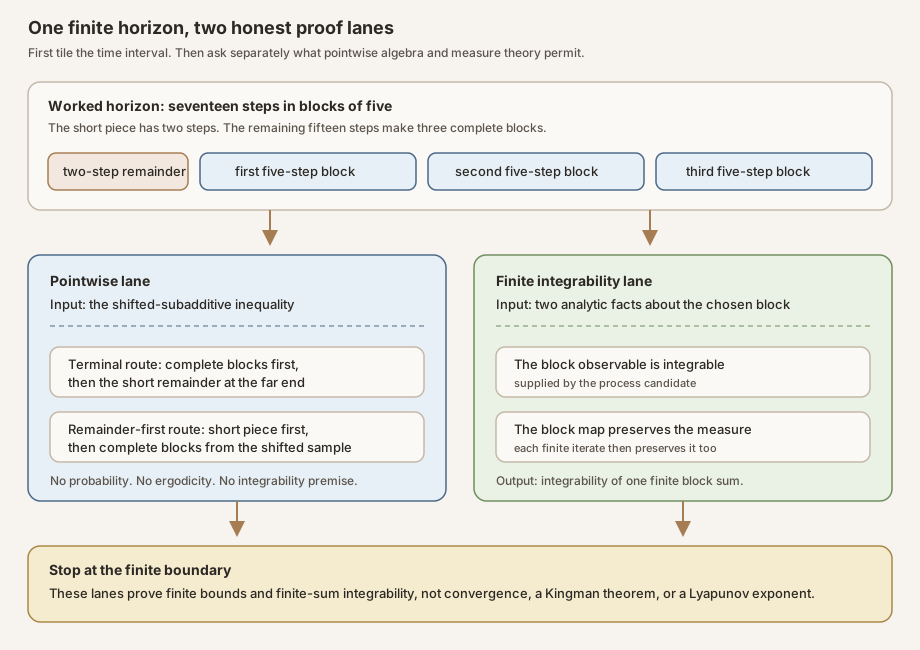
Figure: The same finite horizon can be read with the short remainder first or last. Shifted subadditivity alone controls either pointwise route. The separate analytic lane asks whether the block observable is integrable and whether the block map preserves the measure. No limit arrow appears because this module contains no limit theorem.
Why two orientations are useful
The terminal remainder is the most direct output of induction on the number of complete blocks. Each induction step peels off one block at the beginning and leaves a shorter block-and-remainder problem at the shifted sample.
The remainder-first form is often better when the remainder should remain a bounded finite-time disturbance at the original sample. One first splits \(r+bq\) at time \(r\), then bounds the positive number of complete blocks at the shifted point \(T^r\omega\). At \(q=0\), no full block exists, and the whole statement closes by simplification.
Neither orientation dominates the other in all applications. Exposing both at the API level avoids asking later proofs to reverse orbit order by informal algebra.
The time-zero trap
Set \(m=k=0\) in shifted subadditivity. Since \(T^0\omega=\omega\), we get
\[ X_0(\omega)\le X_0(\omega)+X_0(\omega). \]Subtracting \(X_0(\omega)\) proves only
\[ 0\le X_0(\omega). \]It does not prove equality with zero. This small distinction controls the exact-block boundary. A Birkhoff sum with zero terms is exactly zero, so a uniform theorem
\[ X_{bq}(\omega) \le \sum_{j=0}^{q-1}X_b(T^{bj}\omega) \]at \(q=0\) would say \(X_0(\omega)\le0\). Combined with the forced nonnegativity, that is precisely \(X_0(\omega)=0\).
The constant-one obstruction
Let every process value be one:
\[ X_n(\omega)=1 \]for every \(n\) and \(\omega\). On a one-point probability space with the identity base, every \(X_n\) is integrable, the base preserves the measure, and shifted subadditivity holds because \(1\le1+1\). Yet at \(q=0\),
\[ X_{b\cdot0}(\omega)=1, \qquad \operatorname{birkhoffSum}(T^b,X_b,0,\omega)=0. \]The desired exact-block inequality is false. Probability normalization and
measure preservation do not repair it. This counterexample is why
le_birkhoffSum_blocks_of_zero visibly asks for
X 0 = 0.
Now inspect the generic remainder-first formula at the same \(q=0\):
\[ X_{r+b\cdot0}(\omega) \le X_r(\omega)+0. \]It reduces to equality for the constant-one process. There is no missing normalization. The terminal-remainder formula likewise reduces to \(X_r(\omega)\le0+X_r(\omega)\). The obstruction is local to erasing the last time-zero term from a zero-count exact-block statement.
The three private engines
The file begins with three private theorems. They are implementation details, not exported API, but they explain nearly every later proof. Keeping them private prevents the public namespace from exposing versions parameterized by a raw inequality when the project already has a named process structure.
Private helper A: blocks plus a terminal remainder
The source-local declaration is
le_birkhoffSum_blocks_add_remainder_of_add_le. It assumes only a
function-level law
hadd : ∀ m k ω, X (m + k) ω ≤ X k (T^[m] ω) + X m ω
and proves the terminal-remainder bound by induction on \(q\). The zero case is simplification: \(b\cdot0+r=r\), the empty Birkhoff sum is zero, and the zero iterate of the block map leaves \(\omega\) unchanged.
For the successor step, arithmetic first rewrites
\[ b(q+1)+r=b+(bq+r). \]Shifted subadditivity peels off the first block:
\[ X_{b+(bq+r)}(\omega) \le X_{bq+r}(T^b\omega)+X_b(\omega). \]The induction hypothesis applies at \(T^b\omega\). Mathlib’s
birkhoffSum_succ’ then identifies the new sum as the first block
value plus a shorter sum beginning at the shifted sample. The iterate rewrite
Function.iterate_succ_apply aligns the terminal remainder. A final
ring closes only the additive rearrangement; it proves no dynamic
fact.
Private helper B: a positive number of exact blocks
The source-local declaration is
le_birkhoffSum_blocks_succ_of_add_le. Its inputs are the same raw
hadd law, a block length \(b\), a predecessor count \(q\), and a
sample \(\omega\). Its conclusion is
The helper obtains this exact-block estimate by feeding
remainder \(b\) and block count \(q\) into helper A. The identity
\(bq+b=b(q+1)\) turns the terminal remainder into the final complete block.
The theorem birkhoffSum_succ turns the corresponding right side
into a sum with \(q+1\) terms.
The logical point is that there is at least one complete block. No time-zero process value remains to be discarded, so no normalization appears.
Private helper C: a remainder followed by blocks
The source-local declaration is
le_remainder_add_birkhoffSum_blocks_of_add_le. Its inputs are the
raw hadd law, \(r,b,q\), and \(\omega\). Its conclusion is the
remainder-first inequality displayed in declaration 7 below.
This helper proves the complementary orientation. It splits on \(q\). At zero blocks, simplification proves the reflexive result and never inspects \(X_0\). At \(q+1\), shifted subadditivity first separates the remainder:
\[ X_{r+b(q+1)}(\omega) \le X_{b(q+1)}(T^r\omega)+X_r(\omega). \]Helper B bounds the positive exact-block term at the shifted sample. Commuting the two real summands produces the public remainder-first order. This proof architecture is the checked reason that the remainder-first theorem needs no time-zero hypothesis.
The three helpers use no measure-theoretic field. Their dependencies are natural arithmetic, function iteration, finite sums, order-compatible addition, and the raw shifted inequality.
The twelve public declarations
The following map is in exact source order. The declaration numbers are used throughout the remainder of the chapter.
| No. | Declaration | What it establishes | Essential proof dependency |
|---|---|---|---|
| 1 | zero_nonneg | \(0\le X_0(\omega)\) | add_le 0 0 plus linear arithmetic |
| 2 | zero_eq_zero_iff_nonpos | \(X_0=0\) iff \(X_0\le0\) pointwise | declaration 1 and function extensionality |
| 3 | le_birkhoffSum_blocks_add_remainder | terminal-remainder finite bound | private helper A |
| 4 | le_birkhoffSum_div_add_mod | quotient-and-remainder terminal form | declaration 3 and Nat.div_add_mod |
| 5 | le_birkhoffSum_blocks_of_ne_zero | exact blocks for \(q\ne0\) | successor witness and private helper B |
| 6 | le_birkhoffSum_blocks_of_zero | exact blocks for every \(q\) under \(X_0=0\) | case split and private helper B |
| 7 | le_remainder_add_birkhoffSum_blocks | generic remainder-first bound | private helper C |
| 8 | le_mod_add_birkhoffSum_div | quotient-and-remainder first form | declaration 7 and Nat.mod_add_div |
| 9 | integrable_birkhoffSum_blocks | finite block sum is integrable | finite-sum integrability and iterated block preservation |
| 10 | logPlusNormObservable_nat_mul_le_birkhoffSum | cocycle exact-block pointwise bound | cocycle subadditivity and time-zero identity |
| 11 | logPlusNormObservable_le_mod_add_blockBirkhoffSum | cocycle remainder-first quotient bound | cocycle subadditivity and private helper C |
| 12 | HasIntegrableGeneratorLogPlus.integrable_blockBirkhoffSum | cocycle finite block sum is integrable | candidate bridge and iterated base preservation |
Declaration 1: time zero is nonnegative
#check @IsIntegrableSubadditiveProcessCandidate.zero_nonneg
The signature takes a process candidate hX and a sample
ω, then returns 0 ≤ X 0 ω. The proof applies the
candidate for hX.add_le 0 0 ω. Simplification reduces zero plus
zero to zero and the zero iterate to the identity. The remaining real
inequality has the form \(x\le x+x\), which linarith rearranges to
\(0\le x\).
No integrability fact is read. In particular, the theorem remains mathematically pointwise even though the candidate also stores analytic data. It is deliberately non-strict. The constant-one process shows the result cannot be strengthened to equality.
Declaration 2: nonpositive means normalized
#check @IsIntegrableSubadditiveProcessCandidate.zero_eq_zero_iff_nonpos
This theorem states a function equality on the left and a pointwise inequality on the right:
\[ X_0=0 \quad\Longleftrightarrow\quad \forall\omega,\ X_0(\omega)\le0. \]The forward direction rewrites by the function equality and closes by
reflexivity. The reverse direction uses funext to reduce function
equality to one sample at a time. At that sample, the supplied nonpositivity
and declaration 1’s nonnegativity give both inequalities needed by
le_antisymm.
This declaration is a diagnostic equivalence. It does not infer normalization from integrability, probability, or measure preservation. A caller must still provide the nonpositive side or the equality itself.
Declaration 3: blocks followed by a remainder
#check @IsIntegrableSubadditiveProcessCandidate.le_birkhoffSum_blocks_add_remainder
The full mathematical signature is
\[ X_{bq+r}(\omega) \le \operatorname{birkhoffSum}(T^b,X_b,q,\omega) +X_r\bigl((T^b)^q\omega\bigr). \]Lean’s expression ((T^[b])^[q] ω) keeps the iterate nesting
literal. Mathematically it is the orbit point after \(bq\) one-step updates.
The proof is a direct application of private helper A to
hX.add_le. Because the helper treats \(r\) as an arbitrary
natural number, no claim that \(r\lt b\) appears.
This generality is useful. The theorem can model any chosen tail length, not only a Euclidean remainder. It also remains valid at \(q=0\) and \(b=0\).
Declaration 4: terminal Euclidean remainder
#check @IsIntegrableSubadditiveProcessCandidate.le_birkhoffSum_div_add_mod
Declaration 4 substitutes \(q=n/b\) and \(r=n\bmod b\) into declaration 3.
The library identity Nat.div_add_mod rewrites the left side back
to \(X_n\). The exact result is
There is no premise \(b\ne0\). In Lean’s natural-number arithmetic, \(n/0=0\) and \(n\bmod0=n\). Therefore the right side becomes an empty sum plus \(X_n(\omega)\), and the theorem is reflexive. A positive block length is needed only for the additional fact \(n\bmod b\lt b\), not for this inequality or its type correctness. The official natural-division documentation is the reference for these total operations (Lean natural division).
Declaration 5: nonzero exact-block count
#check @IsIntegrableSubadditiveProcessCandidate.le_birkhoffSum_blocks_of_ne_zero
The inputs are \(b\), \(q\), a proof hq : q ≠ 0, and
\(\omega\). The conclusion contains no remainder:
Lean turns the nonzero natural number into a successor using
Nat.exists_eq_succ_of_ne_zero. Private helper B then supplies the
bound. This path is stronger than imposing \(X_0=0\): every positive block
count is handled for every shifted-subadditive process candidate, including
the constant-one process.
The hypothesis concerns the count \(q\), not the length \(b\). A positive number of zero-length blocks is permitted. The theorem is still true because subadditivity repeatedly bounds \(X_0\) by sums of copies of \(X_0\), whose nonnegativity was established in declaration 1.
Declaration 6: exact blocks uniformly through zero
#check @IsIntegrableSubadditiveProcessCandidate.le_birkhoffSum_blocks_of_zero
This version removes the nonzero-count premise and instead takes
hX0 : X 0 = 0. The proof splits on \(q\). At zero, simplification
uses hX0 to identify the left side with zero. At a successor,
private helper B proves the result without using hX0 at all.
The case split documents the assumption boundary in executable form. The normalization is consumed only by the zero branch. It is not a hidden global premise of the finite-block induction.
For the matrix cocycle later in the file, the log-positive norm observable has an independently checked time-zero identity. That identity makes declaration 6’s uniform form available, though the final cocycle proof chooses the private successor helper directly after splitting on \(q\).
Declaration 7: the remainder comes first
#check @IsIntegrableSubadditiveProcessCandidate.le_remainder_add_birkhoffSum_blocks
The exact conclusion is
\[ X_{r+bq}(\omega) \le X_r(\omega) +\operatorname{birkhoffSum} \bigl(T^b,X_b,q,T^r\omega\bigr). \]This public theorem is private helper C applied to hX.add_le.
There is no hX0 argument. The block sum is evaluated at
\(T^r\omega\), which means its terms occur at times
\(r,r+b,\ldots,r+b(q-1)\). That orientation is not cosmetic. Starting the
sum at \(\omega\) would describe a different tiling.
At \(q=0\), the theorem is \(X_r\le X_r+0\). At positive \(q\), the helper splits at \(r\) and invokes the positive-count exact-block result. These two branches are why no time-zero normalization is needed.
Declaration 8: Euclidean remainder first
#check @IsIntegrableSubadditiveProcessCandidate.le_mod_add_birkhoffSum_div
Declaration 8 substitutes \(r=n\bmod b\) and \(q=n/b\) into declaration 7,
then rewrites with Nat.mod_add_div. Its output is the form used in
the \(17=2+5\cdot3\) example:
Again, \(b=0\) is valid. The remainder becomes \(n\), the quotient becomes
zero, and the sum is empty. The theorem reduces to \(X_n\le X_n\). The doc
comment explicitly separates that total theorem from the optional strict
remainder fact Nat.mod_lt, which would require positive \(b\).
Declaration 9: integrability belongs to the block map
#check @IsIntegrableSubadditiveProcessCandidate.integrable_birkhoffSum_blocks
This is the first declaration in the module that uses the candidate’s
integrable field. Its inputs include
hTb : MeasurePreserving (T^[b]) μ μ
and its conclusion is
Integrable (birkhoffSum (T^[b]) (X b) q) μ
The proof unfolds the Birkhoff sum into a finite sum over
Finset.range q. The theorem integrable_finsetSum
reduces the goal to one summand for each \(j\). That summand is the
composition
The candidate gives integrability of \(X_b\). The proof
hTb.iterate j says the \(j\)-fold iterate of the block map also
preserves \(\mu\). Mathlib’s
MeasurePreserving.integrable_comp_of_integrable transports
integrability through that iterate. The final sum is finite, so the proof is
complete. The upstream interfaces are documented in Mathlib’s
measure-preserving API and
integrability API.
The assumption is intentionally MeasurePreserving (T^[b]) μ μ,
not MeasurePreserving T μ μ. One-step preservation is sufficient
because it can be iterated, but it is not required by this theorem. This
matters at \(b=0\): \(T^0\) is the identity and preserves every measure even
if \(T\) does not. It also matters whenever preservation of a particular
power is known directly.
Probability and ergodicity play no role. Integrability is a finite-sum property here, not a limit claim.
Declaration 10: exact blocks for cocycle growth
#check @DiscreteMatrixCocycle.logPlusNormObservable_nat_mul_le_birkhoffSum
Now let \(C\) be a one-sided discrete matrix cocycle and write \(G_n=C.\operatorname{logPlusNormObservable}(n)\). Declaration 10 states
\[ G_{bq}(\omega) \le \operatorname{birkhoffSum}(C.\mathrm{base}^b,G_b,q,\omega). \]Read the signature carefully: the receiver is C itself. There is
no hC : C.HasIntegrableGeneratorLogPlus. The proof splits on
\(q\). At zero, the checked cocycle identity \(G_0=0\) closes the goal. At a
successor, private helper B consumes only
C.logPlusNormObservable_add_le.
This formulation has the widest scope supported by its proof dependencies. Pointwise finite subadditivity is already available for every cocycle in the module’s matrix setting. Adding integrability to the theorem would obscure that fact and make later callers carry irrelevant evidence.
The declaration assumes Fintype ι and
DecidableEq ι because the underlying finite matrix norm
observable uses them. It does not assume Nonempty ι. Empty matrix
index types remain valid.
Declaration 11: remainder-first cocycle growth
#check @DiscreteMatrixCocycle.logPlusNormObservable_le_mod_add_blockBirkhoffSum
This specialization gives
\[ \begin{aligned} G_n(\omega) \le{}&G_{n\bmod b}(\omega)\\ &+\operatorname{birkhoffSum} \bigl(C.\mathrm{base}^b,G_b,n/b, C.\mathrm{base}^{n\bmod b}\omega\bigr). \end{aligned} \]Like declaration 10, it is a method on C, not on an integrability
hypothesis. The proof rewrites the horizon with Nat.mod_add_div
and applies private helper C directly to
C.logPlusNormObservable_add_le. It does not need the cocycle’s
time-zero identity because the generic remainder-first helper does not.
That last sentence is an important correction to a tempting but overly strong
design: it would be easy to route the proof through a normalized generic
candidate and accidentally make HasIntegrableGeneratorLogPlus
look necessary. The frozen theorem exposes the weaker true boundary.
Declaration 12: integrable cocycle block sums
#check @HasIntegrableGeneratorLogPlus.integrable_blockBirkhoffSum
The final declaration moves to the hypothesis namespace. It receives
hC : C.HasIntegrableGeneratorLogPlus
and proves integrability of the block Birkhoff sum for every \(b,q\). The
bridge hC.isIntegrableSubadditiveProcessCandidate supplies the
generic process candidate. The cocycle’s stored one-step measure preservation
is iterated to obtain
C.base_preserving.iterate b, exactly the block-map preservation
proof required by declaration 9.
This is the only cocycle declaration in RMT-18 that needs
HasIntegrableGeneratorLogPlus. The reason is transparent: a
finite sum of measurable-looking terms is not automatically integrable. The
one-step hypothesis was previously propagated to every finite horizon, and
that analytic result is now consumed at block length \(b\).
Integrability belongs to the block map
There are three maps worth keeping separate:
- the one-step map \(T\);
- the block map \(S=T^b\);
- the \(j\)-fold block iterate \(S^j=(T^b)^j\).
Declaration 9 assumes that map 2 preserves \(\mu\). Its proof obtains preservation of map 3 by iteration. It never goes backward to infer anything about map 1. This one-way dependency is mathematically important.
Suppose \(b=2\) and a transformation swaps two components in a way that fails some desired one-step property, while its square is the identity. The block map can have more structure than the original map. In the other direction, if \(T\) preserves \(\mu\), Mathlib proves that every iterate preserves it, so the cocycle specialization can discharge the block premise uniformly.
Measure preservation transports an integrable observable along the orbit without changing the measure used for integration. It does not say the observable has constant pointwise value. It does not say different block terms are independent. It does not say time averages converge. Those are separate properties and the Lean type contains none of them.
Ergodicity does not pass automatically to powers
Let \(\Omega=\{0,1\}\) with the uniform probability measure, and let \(T\) swap the two points. The only subsets invariant under the swap are the empty set and the whole space, so \(T\) is ergodic. But \(T^2\) is the identity. Every subset is invariant under the identity, including either singleton of probability one half, so \(T^2\) is not ergodic.
This two-cycle is the smallest concrete warning against applying an ergodic theorem to the block map merely because the original map is ergodic. Lalley’s fixed-block discussion flags exactly this power-ergodicity complication (Lalley). RMT-18 avoids the issue because declaration 9 asks only for measure preservation of \(T^b\), which does pass to powers from one-step preservation.
Five adversarial examples
The fastest way to learn an interface is to try to delete each assumption. These examples are not decorations. They explain why the signatures have the shape they do.
1. Constant one defeats the zero-count exact-block theorem
As shown above, \(X_n=1\) is integrable and shifted-subadditive on the one-point probability space, but \(X_0=1\). It satisfies declarations 1, 3, 4, 5, 7, 8, and 9 whenever the map premise is supplied. It cannot satisfy the conclusion of declaration 6 at \(q=0\) without the explicit normalization.
2. Total division makes \(b=0\) a theorem, not an exception
At \(b=0\), Lean computes \(n/0=0\) and \(n\bmod0=n\). Both quotient forms
reduce to reflexivity. The statement does not claim a short remainder in this
case. If a later proof needs \(n\bmod b\lt b\), it must separately assume
\(b\gt0\) and apply Nat.mod_lt.
3. Additivity turns every finite upper bound into equality
Suppose
\[ X_{m+k}(\omega)=X_k(T^m\omega)+X_m(\omega) \]for every input. Induction then gives equality in both block decompositions. An ordinary additive orbit sum is the canonical example:
\[ X_n(\omega)=\sum_{j=0}^{n-1}f(T^j\omega). \]This control checks the orientation. If a proposed formula placed the shifted remainder or the first block at the wrong orbit point, the additive case would expose the error immediately.
4. Scalar cocycles show that the theorem is not specifically high-dimensional
Take a one-dimensional matrix index. Each cocycle value is a scalar complex multiplier, and the induced infinity norm is absolute value. The log-positive observable becomes a finite scalar growth cost. Declarations 10 through 12 still apply. Their block logic comes from cocycle multiplication and norm submultiplicativity, not from a special high-dimensional phenomenon.
5. Empty matrix dimension remains valid
Take an empty finite index type. The project has explicit conventions for the
empty matrix norm observable, and none of the RMT-18 signatures requires
Nonempty ι. The two pointwise cocycle bounds and the integrability
specialization still typecheck. The block layer’s signatures therefore contain
no positivity-of-dimension premise from an unrelated matrix argument.
Lean proofcraft: why the source looks this way
The mathematics is short enough to write on one board, but formalization must choose exact rewrite orientations. Several proof patterns are worth carrying forward.
Generalize the sample in the induction
Private helper A says
induction q generalizing ω with
because the induction hypothesis must later be applied at
T^[b] ω, not only at the original sample. Without
generalizing ω, Lean would freeze the sample too early and the
successor step would be unusable.
Match the sum identity to the block peeled off
Mathlib provides two successor views. Informally,
\[ \begin{aligned} S_{q+1}(\omega)&=S_q(\omega)+f(S^q\omega),\\ S_{q+1}(\omega)&=f(\omega)+S_q(S\omega). \end{aligned} \]The induction peels off the first block, so the second orientation,
birkhoffSum_succ’, matches the proof state. Private helper B uses
birkhoffSum_succ when it interprets the old terminal block as the
new last term. Choosing the fitting identity avoids a thicket of commutativity
rewrites.
Use exact natural identities, not informal division algebra
The two quotient theorems deliberately use different library identities:
Nat.div_add_modfor \(b(n/b)+(n\bmod b)=n\);Nat.mod_add_divfor \((n\bmod b)+b(n/b)=n\).
The order matches the left side of the corresponding generic theorem. No subtraction, positivity premise, or conversion to integers is needed.
Keep analytic transport out of pointwise helpers
The private helpers are parameterized by hadd rather than a full
candidate. This makes their dependencies explicit. The measurable space
and measure appear only after the namespace opens for public declarations,
and actual integration occurs only in declaration 9.
Compile the public surface, not only the file
The direct leaf check is:
cd formalization
source "$HOME/.elan/env"
lake env lean -DwarningAsError=true \
  NonlinearDynamics/Random/RandomCocycles/SubadditiveFiniteBlocks.lean
An import smoke test should also import the root library and run
#check on all twelve declarations. That catches an aggregator
omission or namespace mismatch that a direct leaf build could miss.
Common wrong turns
| Wrong turn | Why it fails | Correct repair |
|---|---|---|
| Require \(X_0=0\) for the remainder-first bound | The \(q=0\) branch is already reflexive | Keep declaration 7 normalization-free |
| Remove \(X_0=0\) from the uniform exact-block theorem | Constant one gives \(1\nleq0\) at \(q=0\) | Use declaration 5 for \(q\ne0\), or retain declaration 6’s premise |
| Require \(b\gt0\) for the quotient inequalities | Natural division is total and the inequalities remain true at zero | Add positivity only when a strict short-remainder fact is needed |
Assume MeasurePreserving T in declaration 9 | The proof consumes only preservation of \(T^b\) | State the block-map premise and derive it from one-step preservation when available |
| Add probability or ergodicity to finite-sum integrability | Neither participates in finite transport or finite addition | Keep the theorem at raw-measure generality |
Add HasIntegrableGeneratorLogPlus to declarations 10 and 11 | Their proofs use only pointwise cocycle subadditivity and a zero identity where needed | Make them methods on the cocycle itself |
| Treat a Birkhoff sum as a Birkhoff theorem | A finite sum has no convergence content | Reserve theorem language for a checked asymptotic result |
| Infer ergodicity of \(T^b\) from ergodicity of \(T\) | The two-cycle swap has nonergodic square | Use only measure preservation here; handle power ergodicity separately if ever needed |
| Call log-positive growth a signed Lyapunov exponent | Negative logarithmic contraction has been clipped to zero | Add a signed or extended-log layer before exponent claims |
| Exclude the empty matrix dimension without proof need | No theorem requires a nonempty index | Preserve the general finite index type |
The symbol \(\nleq\) in the counterexample row means “is not less than or
equal to.” It is a mathematical diagnosis, not a Lean token. Executable Lean
uses ¬ (1 ≤ 0) or a numerical tactic.
What finite blocks do not prove
The finite estimates resemble lines inside proofs of larger ergodic theorems. Resemblance is not implication. RMT-18 proves none of the following:
- that \(X_n(\omega)/n\) converges for any \(\omega\);
- that its limsup is bounded by an expected block cost;
- that a Birkhoff average under \(T^b\) converges;
- that a limit is invariant under \(T\);
- that ergodicity makes a future limit constant;
- that the limit’s integral equals the deterministic Fekete rate;
- that raw log norms have an integrable negative part;
- that singular-value growth converges;
- that a top Lyapunov exponent exists; or
- that an Oseledets filtration or splitting exists.
Kingman’s paper is cited for the eventual theorem, not as evidence that this module has already proved it. Lalley and Steele are cited for proof context, especially the fixed-block strategy and its complications, not as imported Lean dependencies. Furstenberg-Kesten is cited for random-product history, not as a result silently inherited by the cocycle specialization.
The exact output is more modest and more reusable: every finite horizon can be compared with a chosen block observable, the remainder can be placed where a later proof needs it, and the resulting finite sum has a checked integrability interface.
Exercises with solutions
Exercise 1: expand a Birkhoff sum
Expand \(\operatorname{birkhoffSum}(T^4,X_4,3,\omega)\).
Solution. By definition it is \(X_4(\omega)+X_4(T^4\omega)+X_4(T^8\omega)\). The sum has three terms; the block map advances the sample by four one-step iterates each time.
Exercise 2: find the terminal remainder
Write declaration 4 explicitly for \(n=17\) and \(b=5\).
Solution. Since \(17/5=3\) and \(17\bmod5=2\),
\[ X_{17}(\omega)\le X_5(\omega)+X_5(T^5\omega)+X_5(T^{10}\omega) +X_2(T^{15}\omega). \]Exercise 3: put the same remainder first
Write declaration 8 for the same numbers.
Solution. The result is
\[ X_{17}(\omega)\le X_2(\omega)+X_5(T^2\omega)+X_5(T^7\omega) +X_5(T^{12}\omega). \]The block orbit starts after the two-step remainder.
Exercise 4: test zero complete blocks
What do declarations 3 and 7 become when \(q=0\)?
Solution. Declaration 3 becomes \(X_r(\omega)\le0+X_r(\omega)\). Declaration 7 becomes \(X_r(\omega)\le X_r(\omega)+0\). Both are reflexive and neither uses \(X_0\).
Exercise 5: derive nonnegativity at time zero
Use shifted subadditivity with \(m=k=0\) to derive declaration 1.
Solution. It gives \(X_0\le X_0+X_0\) at the same sample. Subtracting \(X_0\) from both sides gives \(0\le X_0\).
Exercise 6: reject an equality upgrade
Why does exercise 5 not prove \(X_0=0\)?
Solution. Every positive number satisfies \(x\le x+x\). The constant-one process is an explicit integrable shifted-subadditive candidate with \(X_0=1\).
Exercise 7: locate the exact normalization use
In declaration 6’s proof, which branch consumes hX0 : X 0 = 0?
Solution. Only the \(q=0\) branch. The successor branch is private helper B and needs no normalization.
Exercise 8: prefer the nonzero theorem
Suppose \(q\ne0\) but nothing is known about \(X_0\). Which declaration gives the exact-block bound?
Solution. Declaration 5,
le_birkhoffSum_blocks_of_ne_zero. It turns \(q\) into a successor
and applies the positive-count helper.
Exercise 9: compute the zero divisor case
Simplify declaration 4 at \(b=0\).
Solution. Natural-number division gives \(n/0=0\) and \(n\bmod0=n\). The zero-term Birkhoff sum vanishes, both iterates of the zero block map are identities at count zero, and the result is \(X_n(\omega)\le X_n(\omega)\).
Exercise 10: identify a genuinely short remainder
What extra premise is needed to prove \(n\bmod b\lt b\)?
Solution. A positive block length, represented in Lean by
0 < b. The finite inequality itself needs no such premise.
Exercise 11: explain generalizing ω
Why does private helper A generalize the sample during induction on \(q\)?
Solution. The successor step applies the induction hypothesis at \(T^b\omega\). If \(\omega\) were fixed by the induction, that shifted application would not match.
Exercise 12: choose the successor identity
Why is birkhoffSum_succ’ natural after peeling the first block?
Solution. It writes a \(q+1\)-term sum as the value at the original sample plus a \(q\)-term sum at the once-shifted sample, exactly matching the induction’s structure.
Exercise 13: list declaration 9’s analytic inputs
What facts establish integrability of each block summand?
Solution. The candidate supplies Integrable (X b) μ. The
premise says \(T^b\) preserves \(\mu\), so every iterate \((T^b)^j\) also
preserves \(\mu\). Integrability transports through composition, and a finite
sum of integrable functions is integrable.
Exercise 14: delete probability
Can declaration 9 be applied on a measure whose total mass is not one?
Solution. Yes. It has no IsProbabilityMeasure μ premise. It
requires only candidate integrability and preservation by the block map.
Exercise 15: distinguish preservation from ergodicity
For the uniform two-point swap, why is \(T\) ergodic but \(T^2\) not?
Solution. The swap leaves only the empty set and whole space strictly invariant, while its square is the identity and leaves each singleton invariant. Each singleton has probability one half, so the identity is not ergodic.
Exercise 16: test an additive process
If shifted subadditivity is equality at every split, what happens to the two finite block inequalities?
Solution. Every induction inequality becomes equality. Both tilings equal the same additive orbit sum, though they group its terms differently.
Exercise 17: find the unnecessary cocycle premise
Do declarations 10 and 11 require
C.HasIntegrableGeneratorLogPlus?
Solution. No. Declaration 10 uses the cocycle’s pointwise log-positive-subadditivity and its time-zero identity. Declaration 11 uses only the pointwise subadditivity through private helper C.
Exercise 18: find the necessary cocycle premise
Which cocycle declaration does require generator log-positive integrability, and why?
Solution. Declaration 12. It proves an Integrable conclusion,
so it needs the previously checked bridge from one-step integrability to
integrability of every finite-horizon block observable.
Exercise 19: inspect empty dimension
Which new premise would have excluded an empty matrix index, and is it present?
Solution. A premise such as Nonempty ι would exclude it. None
is present. The module keeps only Fintype ι and
DecidableEq ι for the finite matrix observable.
Exercise 20: reject the Birkhoff-theorem overread
Does integrability of every finite Birkhoff sum prove convergence of its normalized averages?
Solution. No. Finite-sum integrability holds one \(q\) at a time. A pointwise or mean ergodic theorem needs additional hypotheses and a separate limit proof.
Exercise 21: reject the power-ergodicity overread
If Ergodic T μ is available, may a future proof immediately use an
ergodic theorem for T^[b]?
Solution. No. The two-cycle construction is a counterexample to the implication from ergodicity of a map to ergodicity of each power. A future proof must avoid that step or supply an appropriate stronger hypothesis.
Exercise 22: place RMT-18 inside a Kingman proof
Which part of a future subadditive ergodic proof does this module resemble, and which part remains absent?
Solution. It supplies fixed-block finite upper bounds and integrability of their finite sums. It does not supply convergence of Birkhoff averages, control of remainders after normalization, a lower bound for the liminf, invariance of a limit, or identification of that limit with the integrated rate.
Reproducibility and audit ledger
| Artifact | Role | Validation |
|---|---|---|
SubadditiveFiniteBlocks.lean | Twelve public declarations and three private helpers | Direct warning-fatal Lean check |
RandomCocycles.lean | Aggregator import | Root-library build and import smoke test |
This index.md | Declaration-complete proof-to-prose map | Coverage manifest, source hygiene, Hugo warnings fatal |
blocks-and-remainder-proof-route.svg | Prose-only conceptual route | UTF-8 XML parse and rendered inspection |
generate-card.sh | Deterministic featured-card generator | –verify byte comparison and 1200x630 dimension check |
The local commands are:
source "$HOME/.elan/env"
cd formalization
lake env lean -DwarningAsError=true \
  NonlinearDynamics/Random/RandomCocycles/SubadditiveFiniteBlocks.lean
cd ..
python3 scripts/check_lean_notebook_coverage.py
python3 scripts/check_teaching_source_hygiene.py
make site-check
The article publishes as an open working note with draft: false and
retains pro_reviewed: false. Automated source and render checks do not
replace the pending human editorial decision or the two separate review
passes required by the Development Notebook guide.
The next ridge
RMT-18 leaves the project at an exact finite boundary. We can tile every horizon, orient the remainder either way, and integrate every finite block sum under the exact preservation premise. The immediate RMT-19 successor subtracts the additive one-step orbit majorant, proves the residual nonpositive at positive horizons, preserves shifted subadditivity, and records an exact normalized identity. That centering is pointwise compensation, not expectation subtraction or a mean-zero construction.
That next finite layer is now Average the Phases: Sliding-Block Bounds for Subadditive Cocycles in Lean. It reconciles block-map sums with the one-step base without assuming that ergodicity passes from \(T\) to \(T^b\). It also records the finite index repair explicitly: the displayed phase decomposition with \(q\) complete blocks and both boundary gaps has horizon \(bq+b+r\), not \(bq+r\).
Only after the complementary finite interval-packing layer should a future Kingman layer select a precise theorem statement compatible with the project’s indexing and shifted orientation. It must decide whether subadditivity holds everywhere or almost everywhere, what negative-part or lower-bound assumptions are needed, what kind of convergence is claimed, how the invariant sigma-algebra enters, and when ergodicity is used.
For matrix products, a further design choice remains. The log-positive observable is ideal for upper-tail integrability but clips negative logarithmic growth. A signed Lyapunov exponent needs a different observable and may need invertibility, negative-tail control, singular values, or exterior powers. The Furstenberg-Kesten and Oseledets destinations therefore cannot be reached by renaming the present finite bound.
What has been gained is the proof skeleton’s first reliable beam. Later work will not have to rediscover how blocks and remainders align in Lean, which assumption repairs zero exact blocks, or which map must preserve the measure. The remaining difficulty is now visible rather than hidden behind notation.
References
The links below were checked on 2026-07-21. The pinned local Mathlib 4.32.0
checkout at commit
81a5d257c8e410db227a6665ed08f64fea08e997 remains the exact API
authority for Lean declarations.
Mathlib contributors.
Birkhoff sums,
Mathlib 4 documentation, with the
pinned source.
This official source defines birkhoffSum and the zero, successor,
and addition identities used by the private helpers.
Mathlib contributors. Function iteration, Mathlib 4 documentation, with the pinned source. This official source defines the iterate notation and composition identities used to align block shifts.
Mathlib contributors.
Measure-preserving maps,
Mathlib 4 documentation. The pinned file defines
MeasurePreserving at
lines 43 through 48
and proves iterate preservation at
lines 193 through 196.
Mathlib contributors.
Integrable functions,
Mathlib 4 documentation. The pinned source provides
MeasurePreserving.integrable_comp and
MeasurePreserving.integrable_comp_of_integrable at
lines 381 through 390,
and integrable_finsetSum at
lines 439 through 449.
Together these official interfaces warrant the transported-summand and finite-
sum steps in declaration 9.
Lean contributors. Natural-number division, Lean and Mathlib documentation. This official page documents total natural quotient and remainder operations and the identities used by declarations 4 and 8.
Steven P. Lalley. “Kingman’s Subadditive Ergodic Theorem”, lecture notes, accessed 2026-07-21. These notes are cited specifically for the fixed-block proof strategy and the warning that ergodicity of a map does not imply ergodicity of every power. RMT-18 does not formalize the limit theorem stated there.
J. F. C. Kingman. “The Ergodic Theory of Subadditive Stochastic Processes”, Journal of the Royal Statistical Society: Series B 30(3), 499-510, 1968. This primary source is cited for the eventual subadditive stochastic process theorem. The current module proves only finite block estimates.
J. Michael Steele. “Kingman’s Subadditive Ergodic Theorem”, Annales de l’Institut Henri Poincaré, Probabilités et Statistiques 25(1), 93-98, 1989. This paper is cited for proof lineage and finite interval decomposition context, not as a theorem imported into Lean.
Harry Furstenberg and Harry Kesten. “Products of Random Matrices”, The Annals of Mathematical Statistics 31(2), 457-469, 1960. This primary source supplies the historical random-matrix-product destination. Its probabilistic limit theorem is not formalized here.