This is the proof-to-prose companion to
formalization/NonlinearDynamics/Random/RandomMatrices/GaussianUnitaryEnsemble.lean.
Every named public declaration in that module appears below, with its exact
role and proof architecture.
The immediate prerequisite is Hermitian Coordinate Assembly, which built the deterministic measurable map without choosing a law. The probability ingredients were developed in Gaussian Primitives, Complex Gaussians, and Independent Complex Gaussian Families.
For a stable textbook treatment, see Finite GUE from Independent Gaussian Coordinates. Reusable definitions live under gaussian-unitary-ensemble , normalization convention , gaussian-distribution , Cartesian complex Gaussian law , independence , probability-law , pushforward measure , and hermitian-coordinate-space .
Choose a route up
| Route | Begin | Destination |
|---|---|---|
| First encounter | Why scale entries with dimension? | Understand why this convention targets an order-one spectral scale |
| Normalization route | The ledger | Audit every variance, trace, density, and boundary convention |
| Probability route | The coordinate product | See how two finite product measures encode the free entries |
| Independence route | Blocks to scalars | Separate block, mutual-family, and cross-coordinate independence |
| Lean route | The declaration map | Locate all twenty-six public declarations and their proof engines |
| Matrix-law route | Pushforward | Transfer exact coordinate laws through measurable Hermitian assembly |
| Edge-case route | Dimension zero | Follow both empty product laws to Dirac masses |
Learning objectives
By the summit, a reader should be able to:
- state the positive-dimensional GUE variance convention used here;
- derive why two off-diagonal Cartesian variances of \(1/(2n)\) give \(\mathbb{E}|H_{ij}|^2=1/n\) as contextual mathematics;
- recover the contextual density exponent from the coordinate Gaussian factors and \(\operatorname{Tr}(H^2)\);
- explain why
varianceScalepattern matches on zero instead of hiding a division-by-zero convention; - read
coordinateMeasureas a product of a diagonal vector law and a strict-upper vector law; - distinguish exact marginal laws, independence of two blocks, mutual independence within a block, and cross-block coordinate independence;
- explain why
matrixLawis a pushforward rather than a new sampling algorithm; - follow the transport of exact diagonal and upper-entry laws from the coordinate space to the matrix space;
- understand why a diagonal entry is represented as a complex Gaussian with imaginary variance zero;
- reduce the zero-dimensional coordinate product and matrix pushforward to Dirac laws; and
- name the density, support, invariance, spectral, moment, and asymptotic claims that are still absent.
The construction in one picture
flowchart LR
  S["Explicit variance ledger"] --> D["Real diagonal Gaussian product"]
  S --> U["Complex strict-upper Gaussian product"]
  D --> C["Coordinate product measure"]
  U --> C
  C --> B["Block and coordinate independence"]
  C --> P["Measurable Hermitian assembly pushforward"]
  P --> M["GUE matrix law"]
  M --> E["Exact diagonal and upper-entry laws"]
  Z["Dimension zero"] --> C
  Z --> M
  M -. later .-> I["Support, density, and unitary invariance"]
  I -. later .-> Q["Spectra, moments, and asymptotics"]
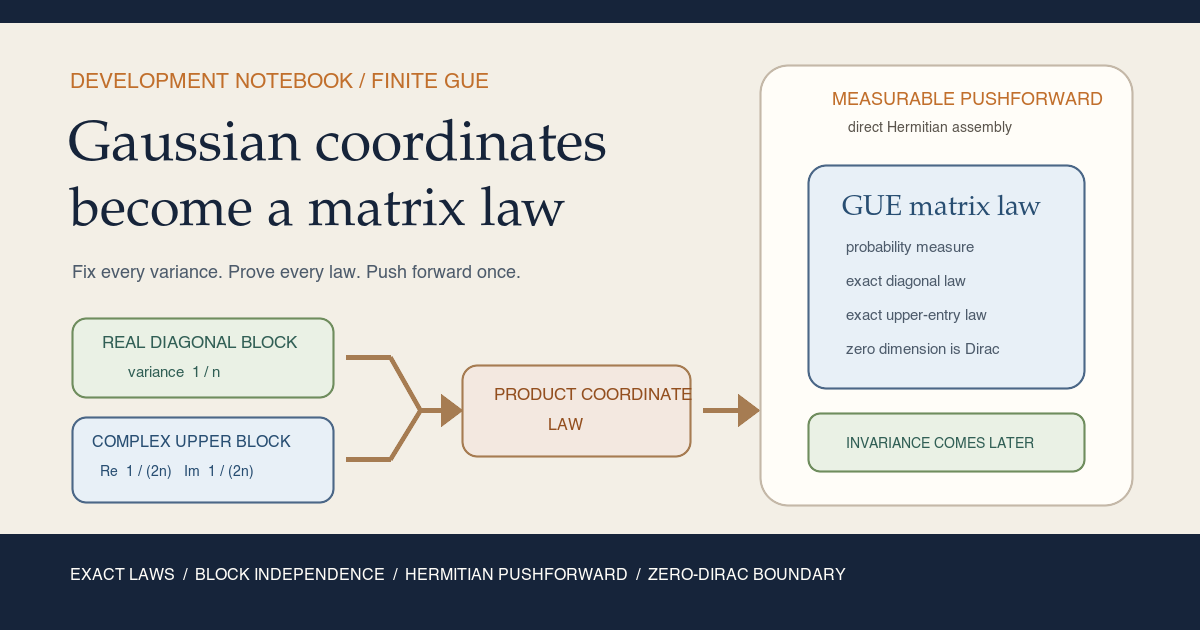
Figure. The solid arrows are checked in this module. The diagonal and strict-upper product laws form one canonical coordinate probability space; measurable Hermitian assembly pushes it to an ambient matrix law, and exact entry marginals are transferred through that map. The dotted arrows are dependency-ordered future work, not consequences of the ensemble's name.
Why scale entries with dimension?
Imagine an \(n\)-component vector \(v\) whose Euclidean norm is one. A dense matrix-vector product has entries of the form
\[ (Hv)_i=\sum_{j=0}^{n-1} H_{ij}v_j. \]If the matrix entries had variance independent of \(n\), the sum would typically grow with dimension. Wigner scaling compensates by making a typical entry size of order \(n^{-1/2}\), hence variance of order \(1/n\). With that choice, each row combines many small contributions into an order-one effect. This is the scale at which a nontrivial order-one spectral picture can emerge.
The Hermitian constraint changes how the variance is recorded. A diagonal entry is real, so one real coordinate receives variance \(1/n\). A strict-upper entry is complex:
\[ H_{ij}=X_{ij}+iY_{ij}, \qquad i\lt j. \]The chosen Cartesian convention gives each displayed coordinate half the total:
\[ \operatorname{Var}(X_{ij})=\operatorname{Var}(Y_{ij})=\frac{1}{2n}. \]When the two centered coordinates are independent, the contextual moment calculation is
\[ \mathbb{E}|H_{ij}|^2 =\mathbb{E}(X_{ij}^2+Y_{ij}^2) =\frac{1}{2n}+\frac{1}{2n} =\frac1n. \]The current Lean file records the two exact one-dimensional variances and the independence structure. It does not introduce a named theorem for \(\mathbb{E}|H_{ij}|^2\), because expectation and integrability of matrix observables belong to a later slice.
The physics intuition, with the claim boundary visible
Random Hermitian matrices entered physics as effective models for complicated quantum Hamiltonians whose individual microscopic couplings are inaccessible but whose statistical spectral behavior can still be studied. Hermiticity is the structural requirement that makes a finite Hamiltonian generate unitary time evolution. Gaussian coordinates then give a tractable quadratic model once the scale is fixed.
The letter U in GUE points toward invariance under deterministic unitary changes of basis. That symmetry expresses the requirement that a physical prediction not depend on an arbitrary orthonormal coordinate system. Yet the entrywise construction alone does not certify that symmetry in Lean. The current module constructs the law from independent entries in one basis. A later module must prove that conjugation \(H\mapsto UHU^*\) preserves the resulting measure.
This separation is useful, not cosmetic. Entry independence is basis dependent, while unitary invariance is a statement about the whole measure. Conflating them would replace a theorem with a name.
The normalization ledger
Normalization disagreements are common enough in random-matrix theory that the convention should be treated like an interface, not an implicit custom. Here is the full ledger for this module.
| Feature | Dimension \(n=0\) | Dimension \(n\gt0\) | Checked in this file? |
|---|---|---|---|
| Base scale | \(0\) | \(1/n\) | Yes, by named zero and successor theorems |
| Diagonal mean | empty block | \(0\) | Yes, exact Gaussian law |
| Diagonal real variance | empty block | \(1/n\) | Yes |
| Diagonal imaginary variance | empty block | \(0\) | Yes, in the full complex diagonal law |
| Strict-upper complex mean | empty block | \(0\) | Yes |
| Strict-upper real variance | empty block | \(1/(2n)\) | Yes |
| Strict-upper imaginary variance | empty block | \(1/(2n)\) | Yes |
| Matrix trace convention | unique empty trace | unnormalized \(\operatorname{Tr}\) | Context only |
| Matrix-coordinate density | not applicable (Dirac law) | proportional to \(\exp(-n\operatorname{Tr}(H^2)/2)\) | Context only |
| Spectral scale | empty spectrum | order one, conventionally associated with support \([-2,2]\) asymptotically | Context only |
| Coordinate law | Dirac at the unique empty pair | finite Gaussian product law | Yes |
| Matrix law | Dirac at the unique empty matrix | measurable pushforward | Yes |
The positive-dimensional convention agrees with the GUE normalization presented by Guionnet: real and imaginary parts above the diagonal have variance \(1/(2n)\), diagonal entries have variance \(1/n\), and the general Gaussian-ensemble density exponent \(-\beta n\operatorname{Tr}(H^2)/4\) becomes \(-n\operatorname{Tr}(H^2)/2\) at \(\beta=2\) (Guionnet, 2022). Tao and Vu use the corresponding \(1/\sqrt n\) Wigner scale and describe the spectrum on \([-2,2]\) (Tao and Vu, 2013).
Why the density exponent matches the coordinate variances
This calculation explains the convention but is not a theorem in the module. For \(n\gt0\), a centered real Gaussian of variance \(1/n\) contributes an exponential factor
\[ \exp\left(-\frac n2 d_i^2\right). \]Each upper real coordinate has variance \(1/(2n)\), so the pair \(z_{ij}=x_{ij}+iy_{ij}\) contributes
\[ \exp(-n x_{ij}^2)\exp(-n y_{ij}^2) =\exp(-n|z_{ij}|^2). \]For a Hermitian matrix assembled from these coordinates,
\[ \operatorname{Tr}(H^2) =\sum_i d_i^2+2\sum_{i\lt j}|z_{ij}|^2. \]Multiplying all coordinate factors therefore yields an exponent
\[ -\frac n2\sum_i d_i^2-n\sum_{i\lt j}|z_{ij}|^2 =-\frac n2\operatorname{Tr}(H^2). \]Turning that calculation into a checked density identity requires a real
Lebesgue measure on Hermitian coordinate space, a Jacobian or real-linear
equivalence for assembly, and a product-density theorem at the matrix level.
None is assumed by matrixLaw here.
Lineage, local contribution, and nonclaims
The GUE and its Wigner scaling are classical. The local contribution is a machine-checked finite law built entirely from previously verified project interfaces and the pinned Mathlib 4.32.0 release. Mathlib supplies the real Gaussian measure, binary product measures, exact-law transport, and independence predicates (real Gaussian API, product measures, laws of random variables, independence).
This module contributes:
- a total dimension-indexed Wigner variance scale with explicit zero and successor equations;
- a canonical product measure on the free Hermitian coordinates;
- exact laws for both coordinate blocks and every scalar coordinate;
- block independence, finite mutual independence within each block, and diagonal-to-upper cross independence;
- a probability-preserving pushforward through measurable Hermitian assembly;
- exact full complex laws for diagonal and strict-upper matrix entries; and
- coordinate and matrix Dirac theorems at dimension zero.
Not claimed
- No matrix-space density or normalization constant is proved.
- No theorem says the matrix law is supported on Hermitian matrices, although every output of the assembly map is pointwise Hermitian.
- No unitary-conjugation invariance is proved.
- No eigenvalue, empirical spectral measure, semicircle law, edge law, level statistic, or universality statement is formalized.
- No matrix expectation, covariance operator, trace moment, or integrability theorem appears.
- No equivalence with an isotropic Gaussian measure on the real vector space of Hermitian matrices is established.
- The name GUE is attached to the exact coordinate convention and its pushforward, not used as evidence for later properties.
Camp one: make the scale executable
GUE.varianceScale
noncomputable def varianceScale : ℕ → ℝ≥0
  | 0 => 0
  | n + 1 => (((n + 1 : ℕ) : ℝ≥0))⁻¹
The codomain is ℝ≥0, Mathlib’s nonnegative reals. This is the same parameter
type used by gaussianReal, whose second argument is variance rather than
standard deviation. The definition does not write n⁻¹ for all naturals and
then let an algebraic convention decide the zero case. Pattern matching makes
the scientific policy explicit: dimension zero receives scale zero.
The definition is noncomputable because inversion and the inherited real
number structure are used as mathematical objects, not because the theorem
contains randomness or an unimplemented algorithm.
GUE.diagonalVariance
diagonalVariance n names varianceScale n. The separate name may look
redundant, but it prevents later theorem signatures from losing the semantic
role of the number. A proof about a diagonal entry should say diagonal
variance, even when its current formula equals the shared scale.
GUE.upperCartesianVariance
upperCartesianVariance n is varianceScale n / 2. It is the variance of
each displayed real coordinate of a complex strict-upper entry. It is not the
second moment of the complex number as a whole. Keeping the word Cartesian
in the name blocks that common factor-of-two error.
The six boundary formulas
The next six declarations expose both branches in simplifier-friendly form:
GUE.varianceScale_zeroprovesvarianceScale 0 = 0by reflexivity;GUE.varianceScale_succexposes the reciprocal formula atn + 1;GUE.diagonalVariance_zeroproves the diagonal zero branch;GUE.diagonalVariance_succreuses the base successor theorem;GUE.upperCartesianVariance_zerosimplifies zero divided by two; andGUE.upperCartesianVariance_succproves the exact reciprocal \((2(n+1))^{-1}\).
The last proof is the only one with real algebra. It expands the definitions, rewrites the inverse of a product, normalizes division as multiplication by an inverse, and commutes the factors. Named formulas mean later positive-dimension proofs can rewrite to the intended convention without unfolding a piecewise definition.
Camp two: one coordinate probability space
GUE.coordinateMeasure
The free Hermitian coordinate space is a pair:
\[ (\operatorname{Fin}(n)\to\mathbb R) \times (\operatorname{StrictUpperIndex}(n)\to\mathbb C). \]coordinateMeasure n puts one finite product measure on each component and
then takes their binary product:
noncomputable def coordinateMeasure (n : ℕ) :
    Measure (HermitianCoordinateSpace n) :=
  (gaussianProductMeasure
      (fun _ : Fin n => 0)
      (fun _ => diagonalVariance n)).prod
    (cartesianComplexGaussianProductMeasure
      (fun _ : StrictUpperIndex n => 0)
      (fun _ => upperCartesianVariance n)
      (fun _ => upperCartesianVariance n))
The left law is the exact joint law of a centered real Gaussian vector. The
right law is the exact joint law of centered Cartesian complex Gaussians with
equal real and imaginary variances. The outer .prod does two jobs at once:
it creates the joint sample space and encodes independence between the two
blocks.
This is a measure-first construction. The sample point is a coordinate
pair x, and the canonical random variables are projections and evaluations
of x. No pseudorandom generator or algorithmic sampler is part of the Lean
definition.
GUE.instIsProbabilityMeasureCoordinateMeasure
Both finite product factors are already probability measures. Mathlib’s
binary product of probability measures is again a probability measure, so the
instance unfolds coordinateMeasure and asks type-class inference to assemble
the proof. The result is available automatically whenever a later theorem
needs [IsProbabilityMeasure (coordinateMeasure n)].
This is an important distinction: defining a Measure does not by itself
prove total mass one. The instance closes that gap in every dimension.
Camp three: expose the two blocks
GUE.coordinateMeasure_hasLaw_diagonalBlock
Under the product coordinate measure, Prod.fst returns the full diagonal
vector. Mathlib proves that the first projection of a product probability
measure is measure preserving. Calling .hasLaw converts that statement into
an exact HasLaw theorem for the canonical diagonal product measure.
The conclusion is about the entire vector, not one coordinate. This full block law later becomes the certificate from which mutual independence of all diagonal evaluations can be recovered.
GUE.coordinateMeasure_hasLaw_upperBlock
The symmetric theorem for Prod.snd gives the complete strict-upper vector
its Cartesian complex Gaussian product law. Again the target is a function
space indexed by every strict-upper position, not a single entry.
GUE.coordinateMeasure_indepFun_diagonal_upper
coordinateMeasure_indepFun_diagonal_upper states that Prod.fst and
Prod.snd are independent functions under the coordinate measure. The proof
is exactly Mathlib’s indepFun_prod measurable_id measurable_id.
This theorem is stronger than saying that one selected diagonal coordinate is independent of one selected upper coordinate. It separates the sigma-algebras generated by the two full random vectors. Coordinate-level cross independence will be derived by measurable postcomposition.
High camp: from block independence to coordinate independence
GUE.coordinateMeasure_diagonal_hasLaw
For i : Fin n, evaluation x ↦ x.1 i has the centered real Gaussian law
with variance diagonalVariance n. The proof starts from the existing
evaluation theorem on gaussianProductMeasure and composes it with the full
diagonal-block law.
The direction of composition matters. First sample the pair from
coordinateMeasure; then project its first component; then evaluate at i.
The law follows that same path.
GUE.coordinateMeasure_upper_hasLaw
For ij : StrictUpperIndex n, evaluation x ↦ x.2 ij has the exact centered
Cartesian complex Gaussian law with both coordinate variances equal to
upperCartesianVariance n. This theorem does not abbreviate the pair of
variances to a single ambiguous “complex variance.”
For positive dimension, its two real marginals therefore each have variance
\(1/(2n)\). At dimension zero no ij can be supplied, so the theorem is total
without making a vacuous coordinate assertion.
GUE.coordinateMeasure_diagonal_iIndepFun
This theorem states mutual independence of the complete family
\[ i\longmapsto (x\longmapsto x.1_i). \]The proof uses iIndepFun_iff_hasLaw_pi_pi. In a finite family, exact scalar
laws plus the exact joint product law characterize mutual independence. After
rewriting with the scalar law theorem, the already checked diagonal-block law
is precisely the joint law required by that equivalence.
Mutual independence is stronger than pairwise independence. The theorem can support later products of more than two diagonal observables without silently upgrading a pairwise claim.
GUE.coordinateMeasure_upper_iIndepFun
The upper family receives the same treatment. The scalar laws are Cartesian
complex Gaussian, the joint law is their finite product, and the equivalence
recovers iIndepFun for every strict-upper evaluation.
This family indexes each complex entry as one random variable. Independence of its displayed real and imaginary parts was built into each Cartesian complex law earlier; mutual independence here is across distinct strict-upper matrix positions.
GUE.coordinateMeasure_diagonal_indepFun_upper
Given one diagonal index i and one upper index ij, the theorem derives
independence of x ↦ x.1 i and x ↦ x.2 ij. It composes the full block
independence theorem with the two measurable evaluation maps.
The proof records a durable probability principle: measurable functions of independent random objects remain independent. It does not need to expand the definition of independent events or recompute rectangle probabilities.
Summit camp: push the coordinate law to matrices
GUE.matrixLaw
noncomputable def matrixLaw (n : ℕ) :
    Measure (Matrix (Fin n) (Fin n) ℂ) :=
  RandomMatrix.law (RandomMatrix.hermitianCoordinateMap n)
    (RandomMatrix.measurable_hermitianCoordinateMap n)
    (coordinateMeasure n)
matrixLaw n does not sample entries again. It sends the already assembled
coordinate probability space through the deterministic map checked in RMT-05.
In mathematical notation,
The measurability proof is an explicit argument to RandomMatrix.law. This
matters because Mathlib’s Measure.map is total even outside its intended
measurable regime; carrying the proof prevents a fallback branch from being
mistaken for the desired pushforward.
GUE.matrixLaw_eq_map
The named equation unfolds the project wrapper and exposes the raw
Measure.map expression. Its proof is reflexivity. Downstream measure algebra
can rewrite with this theorem without depending on the implementation details
of RandomMatrix.law.
GUE.instIsProbabilityMeasureMatrixLaw
A measurable pushforward of a probability measure is a probability measure.
The instance applies the reusable theorem
RandomMatrix.law_isProbabilityMeasure to the coordinate map, its
measurability certificate, and the coordinate probability measure.
The type-class result establishes total mass one. It does not by itself establish support, invariance, density, or moments.
GUE.matrixLaw_diagonal_hasLaw
The diagonal theorem is deliberately stronger than a statement only about the
real part. For i : Fin n, it proves
The real coordinate has the exact diagonal Gaussian law, while the imaginary
coordinate is the constant zero with zero-variance Gaussian law. The proof
constructs that constant law, proves the real coordinate independent of a
constant, combines the pair with
HasCartesianComplexGaussianLaw.of_indep_re_im, and uses the deterministic
diagonal assembly formula to identify the resulting complex value.
The final transport is subtle. On the coordinate sample space, assembly is a
random matrix with law matrixLaw n. On the matrix sample space equipped with
that very law, the identity is another random matrix with the same law.
HasLaw.comp_of_hasLaw_comp transfers the diagonal-entry distribution from
the first realization to the second. Measurability of matrix entry evaluation
supplies the required observable hypothesis.
Consequently the theorem contains both facts experts expect from a Hermitian diagonal: the entry lies on the real line in distribution, and its real coordinate has the selected Gaussian variance. It still does not prove a separate matrix-level support theorem.
GUE.matrixLaw_upper_hasLaw
Given hij : i < j, the strict-upper matrix evaluation H ↦ H i j has the
exact centered Cartesian complex Gaussian law with equal variances
upperCartesianVariance n. The source coordinate is indexed by the proof
carrying value ⟨(i, j), hij⟩.
On the coordinate space, the upper-entry simplification theorem says assembly
returns that coordinate unchanged. The proof first turns this pointwise
identity into almost-everywhere equality with HasLaw.congr. It then uses the
same HasLaw.comp_of_hasLaw_comp transport pattern as the diagonal theorem.
No lower-entry theorem is necessary in this slice. The deterministic assembly file already proves lower entries are conjugates of their upper partners. Transferring that law, or packaging joint conjugate-pair laws, can be added when a downstream observable needs it.
The zero-dimensional law is deliberate
At \(n=0\), Fin 0 and StrictUpperIndex 0 are empty. Each function space in
HermitianCoordinateSpace 0 therefore has exactly one value, and their product
also has exactly one value. The selected scale is zero, but there are no scalar
coordinates on which even that degenerate law must be evaluated.
GUE.coordinateMeasure_zero
The theorem proves
\[ \operatorname{coordinateMeasure}(0) =\delta_{0}. \]The proof unfolds both finite product-measure abbreviations. Measure.pi_of_empty
turns each empty indexed product into a Dirac measure. The product of two Dirac
measures is Dirac at their pair, and Subsingleton.elim identifies that pair
with the zero coordinate point.
GUE.matrixLaw_zero
The matrix theorem rewrites the law as a map, substitutes the coordinate Dirac formula, maps the Dirac mass through the measurable Hermitian coordinate map, and simplifies the assembled empty matrix to zero:
\[ \operatorname{matrixLaw}(0) =\delta_{0_{0\times0}}. \]The result is not a statement about a limiting ensemble as \(n\to0\). It is a totality theorem for the dimension-indexed API. Every natural dimension can be passed to the same definitions without an exception or an unrecorded division policy.
The complete declaration map
| Public declaration | Checked content | Main proof mechanism |
|---|---|---|
GUE.varianceScale | Total Wigner variance scale with explicit zero branch | Pattern match on dimension |
GUE.diagonalVariance | Semantic name for diagonal variance | Definition by varianceScale |
GUE.upperCartesianVariance | Variance of each upper real/imaginary coordinate | Divide base scale by two |
GUE.varianceScale_zero | Base scale is zero at dimension zero | Reflexivity |
GUE.varianceScale_succ | Positive-dimensional base scale is reciprocal dimension | Reflexivity |
GUE.diagonalVariance_zero | Diagonal variance is zero at dimension zero | Reflexivity |
GUE.diagonalVariance_succ | Positive diagonal variance is reciprocal dimension | Reuse scale successor theorem |
GUE.upperCartesianVariance_zero | Upper Cartesian variance is zero at dimension zero | Simplification |
GUE.upperCartesianVariance_succ | Positive upper Cartesian variance is reciprocal twice-dimension | Nonnegative-real inverse algebra |
GUE.coordinateMeasure | Product law on real diagonal and complex strict upper coordinates | Two finite products, then binary product |
GUE.instIsProbabilityMeasureCoordinateMeasure | Coordinate law has total mass one | Product probability instance |
GUE.coordinateMeasure_hasLaw_diagonalBlock | First projection has the full diagonal product law | Measure-preserving first projection |
GUE.coordinateMeasure_hasLaw_upperBlock | Second projection has the full upper product law | Measure-preserving second projection |
GUE.coordinateMeasure_indepFun_diagonal_upper | The two full coordinate blocks are independent | Independence of product projections |
GUE.coordinateMeasure_diagonal_hasLaw | Each diagonal coordinate has its exact real Gaussian law | Evaluation law composed with block law |
GUE.coordinateMeasure_upper_hasLaw | Each upper coordinate has its exact Cartesian complex Gaussian law | Evaluation law composed with block law |
GUE.coordinateMeasure_diagonal_iIndepFun | All diagonal evaluations are mutually independent | Joint product-law characterization |
GUE.coordinateMeasure_upper_iIndepFun | All upper evaluations are mutually independent | Joint product-law characterization |
GUE.coordinateMeasure_diagonal_indepFun_upper | Any diagonal coordinate is independent of any upper coordinate | Measurable postcomposition of block independence |
GUE.matrixLaw | Ambient matrix law induced by Hermitian assembly | RandomMatrix.law pushforward |
GUE.matrixLaw_eq_map | Matrix law equals the explicit Measure.map | Reflexivity |
GUE.instIsProbabilityMeasureMatrixLaw | Matrix law has total mass one | Probability preservation under measurable map |
GUE.matrixLaw_diagonal_hasLaw | Full complex diagonal law has real variance diagonalVariance n and imaginary variance zero | Build line-supported complex law, then exact-law transport |
GUE.matrixLaw_upper_hasLaw | Strict-upper entry has equal-variance Cartesian complex Gaussian law | Assembly lookup, congruence, exact-law transport |
GUE.coordinateMeasure_zero | Empty coordinate law is Dirac at zero | Empty finite products and Dirac product |
GUE.matrixLaw_zero | Empty matrix law is Dirac at the zero matrix | Map Dirac through zero-dimensional assembly |
The map contains exactly twenty-six named public declarations in this version of the module. Namespace openings, imported declarations, generated instance machinery, and local proof terms are not counted as new public declarations.
Run the checked source
From the repository root on macOS or Linux, load elan and invoke Lean through the pinned Lake environment:
source "$HOME/.elan/env"
cd formalization
lake env lean -DwarningAsError=true \
  NonlinearDynamics/Random/RandomMatrices/GaussianUnitaryEnsemble.lean
Starting from the repository root, build the full formalization and check the public teaching content:
cd formalization
lake build

cd ..
make content-hygiene
make site-check
At this milestone the full Lean build checks 3,142 jobs. The direct command is the narrower reproducibility test for this module. The final two commands check the teaching content and render the Hugo site.
This complete Lean snippet inspects the main API without placeholders:
import NonlinearDynamics.Random.RandomMatrices.GaussianUnitaryEnsemble

open Matrix MeasureTheory ProbabilityTheory
open scoped NNReal ProbabilityTheory Matrix

open NonlinearDynamics.Random

#check GUE.varianceScale
#check GUE.diagonalVariance_succ
#check GUE.upperCartesianVariance_succ
#check GUE.coordinateMeasure
#check GUE.coordinateMeasure_indepFun_diagonal_upper
#check GUE.coordinateMeasure_diagonal_iIndepFun
#check GUE.coordinateMeasure_upper_iIndepFun
#check GUE.matrixLaw
#check GUE.matrixLaw_diagonal_hasLaw
#check GUE.matrixLaw_upper_hasLaw
#check GUE.coordinateMeasure_zero
#check GUE.matrixLaw_zero
Save it inside formalization and run lake env lean on the file. The snippet
uses the exact checked names and contains no omitted terms or noncompiling
ellipses.
Failure modes the API is designed to expose
| Tempting shortcut | What goes wrong | Checked repair |
|---|---|---|
| Call the Gaussian parameter a standard deviation | Every scale is off by a square | Use Mathlib’s documented variance parameter and semantic names |
| Give a whole complex upper entry variance \(1/(2n)\) | Its two Cartesian coordinates then total only \(1/(2n)\) | Give each real/imaginary coordinate variance \(1/(2n)\) |
| Give each upper coordinate variance \(1/n\) | The complex second moment becomes \(2/n\) | Split the target \(1/n\) equally between two displayed axes |
Define every scale as n⁻¹ and ignore zero | The scientific edge policy is hidden inside algebra | Pattern match and prove named zero/successor formulas |
| State scalar marginal laws only | Marginals do not determine a joint law or independence | Prove full block laws and finite iIndepFun theorems |
| Treat pairwise independence as mutual independence | Products of three or more observables are unsupported | Recover finite mutual independence from the joint product law |
| Infer cross-family independence from within-family results | Two internally independent blocks can still be coupled | Build a binary product measure and prove block independence |
| Define a matrix law without a measurability proof | Measure.map may use fallback behavior | Pass measurable_hermitianCoordinateMap explicitly |
| Prove only the real part of a diagonal is Gaussian | The ambient complex entry’s imaginary support remains unstated | Prove the full Cartesian complex law with imaginary variance zero |
| Say assembled matrices are Hermitian, therefore the measure has a support theorem | Pointwise construction and measure-level support are different statements | Keep support as a later pushforward-a.e. theorem |
| Use “GUE” as a proof of unitary invariance | A conventional name does not establish equality of measures | Prove invariance separately through the law interface |
| Quote the density after defining a pushforward | Coordinate-product equivalence to Hermitian Lebesgue density still needs geometry | Label the density calculation contextual and defer its theorem |
| Drop dimension zero because no matrix entry exists | A dimension-indexed API becomes partial exactly at a natural boundary | Prove coordinate and matrix Dirac laws |
Exercises with solutions
Exercise 1: audit the two-by-two ledger
At \(n=2\), what are the diagonal and displayed upper-coordinate variances? What is the contextual value of \(\mathbb{E}|H_{01}|^2\)?
Solution. Each diagonal real coordinate has variance \(1/2\). The real and imaginary parts of the one strict-upper entry each have variance \(1/4\). For centered independent coordinates, their second moments add, so \(\mathbb{E}|H_{01}|^2=1/4+1/4=1/2\). The Lean file proves the exact component laws and independence architecture, not this expectation equation as a named theorem.
Exercise 2: recover the density coefficient
Why does one off-diagonal complex coordinate contribute \(\exp(-n|z|^2)\), not \(\exp(-n|z|^2/2)\)?
Solution. Write \(z=x+iy\). Each real coordinate has variance \(1/(2n)\), so its Gaussian exponent is \(-x^2/(2/(2n))=-nx^2\), and similarly for \(y\). Multiplication yields \(\exp(-n(x^2+y^2))\). The factor of two in \(\operatorname{Tr}(H^2)\) counts the reflected lower entry, producing the same coefficient in \(\exp(-n\operatorname{Tr}(H^2)/2)\).
Exercise 3: identify four independence statements
Name the declarations for independence of the two full blocks, all diagonal coordinates, all upper coordinates, and one selected cross-block pair.
Solution. Use
coordinateMeasure_indepFun_diagonal_upper,
coordinateMeasure_diagonal_iIndepFun,
coordinateMeasure_upper_iIndepFun, and
coordinateMeasure_diagonal_indepFun_upper, respectively. The different
types prevent one scope from silently substituting for another.
Exercise 4: explain the diagonal complex law
Why is matrixLaw_diagonal_hasLaw a Cartesian complex Gaussian theorem rather
than only a real Gaussian theorem?
Solution. matrixLaw n lives on ambient complex matrices, so H i i has
type ℂ. The theorem records the exact law in that codomain: its real part is
the chosen Gaussian, its imaginary part is the constant zero Gaussian, and the
two are independent. A real-part-only theorem would omit the line-supported
nature of the full entry.
Exercise 5: follow the pushforward transport
Why can an entry law proved for hermitianCoordinateMap n x under
coordinateMeasure n be reused for the identity matrix variable under
matrixLaw n?
Solution. By definition, the assembled coordinate variable has law
matrixLaw n. The identity variable on the matrix space equipped with that
measure has the same law. HasLaw.comp_of_hasLaw_comp says a measurable
observable with a known law under one realization of a source law has that
same law under any other realization. Matrix-entry evaluation is the
observable.
Exercise 6: distinguish pointwise Hermiticity from support
What additional shape would a measure-level support theorem need?
Solution. One precise formulation would show that the predicate
Matrix.IsHermitian holds almost everywhere under matrixLaw n, or that the
measure of the set of Hermitian matrices is one after proving that set
measurable. RMT-05 proves every assembled output Hermitian, but RMT-06 does not
package that fact into either measure statement.
Exercise 7: collapse dimension zero
Why does coordinateMeasure_zero need no calculation with Gaussian density
constants?
Solution. Both index types are empty. A finite product over an empty type is the Dirac mass at the unique empty function regardless of the scalar family that would have been indexed. The binary product of those two Dirac masses is Dirac at the unique coordinate pair. No scalar Gaussian coordinate exists.
What the construction provides, and what comes next
The symbol matrixLaw records the complete dependency chain:
- an audited numerical convention determines exact scalar laws;
- finite products determine exact joint block laws;
- a binary product determines cross-block independence;
- a measurable deterministic map assembles matrices; and
- a pushforward transfers the coordinate probability measure to matrix space.
Every later random-matrix observable can now begin from one concrete probability measure. If it needs a diagonal marginal, an upper marginal, or a coordinate-independence fact, those are named theorems rather than informal properties of an ensemble label.
The next ridge is genuinely geometric. To prove the familiar density and unitary invariance, the project needs to relate the coordinate product to a Gaussian measure on the real vector space of Hermitian matrices, prove how the Hilbert-Schmidt quadratic form counts strict-upper coordinates, and show unitary conjugation preserves that geometry. The factor two in the upper triangle is exactly where a casual proof is most likely to break.
Only after support and invariance are checked should the development climb to expectations, trace moments, eigenvalue measurability, empirical spectral measures, and asymptotic laws. The present file is finite-dimensional and exact. That narrowness is what makes it a reliable base camp.
References
The external links below were opened and checked on 2026-07-21. The pinned local Mathlib checkout remains the API authority for the Lean proofs.
Alice Guionnet. “Rare Events in Random Matrix Theory”, Proceedings of the International Congress of Mathematicians 2022, volume 2, pages 1008–1052. DOI 10.4171/ICM2022/174. Section 1.1.1 states the GUE coordinate variances and the \(-\beta n\operatorname{Tr}(H^2)/4\) Gaussian-ensemble density convention. This source warrants the normalization context, not a claim that the density or invariance has already been formalized here.
Terence Tao and Van Vu. “Random Matrices: Sharp Concentration of Eigenvalues”, Random Matrices: Theory and Applications 2(3), 1350007, 2013. DOI 10.1142/S201032631350007X. The final arXiv version was posted 2013-08-10. Its abstract explicitly uses the \(1/\sqrt n\) Wigner normalization and the \([-2,2]\) spectral scale. The citation supplies context only; no spectral theorem from the paper is claimed in Lean.
Mathlib contributors.
Mathlib 4.32.0 release,
2026. This is the exact dependency release selected by
formalization/lakefile.toml.
Mathlib contributors.
Real Gaussian distributions,
Mathlib 4 documentation. The page documents gaussianReal, identifies its
ℝ≥0 parameter as variance, and states that zero variance produces a Dirac
measure.
Mathlib contributors. Product measures, Mathlib 4 documentation. This is the official source for binary product measures, measure-preserving projections, probability instances, and Dirac product identities used by the coordinate and zero-dimensional proofs.
Mathlib contributors.
Laws of random variables,
Mathlib 4 documentation. This module defines HasLaw as an
almost-everywhere-measurable random variable with a specified pushforward law
and provides the finite product-law characterization of mutual independence
used here.
Mathlib contributors.
Independence,
Mathlib 4 documentation. This is the official interface for IndepFun,
iIndepFun, independence under product measures, and measurable
postcomposition.