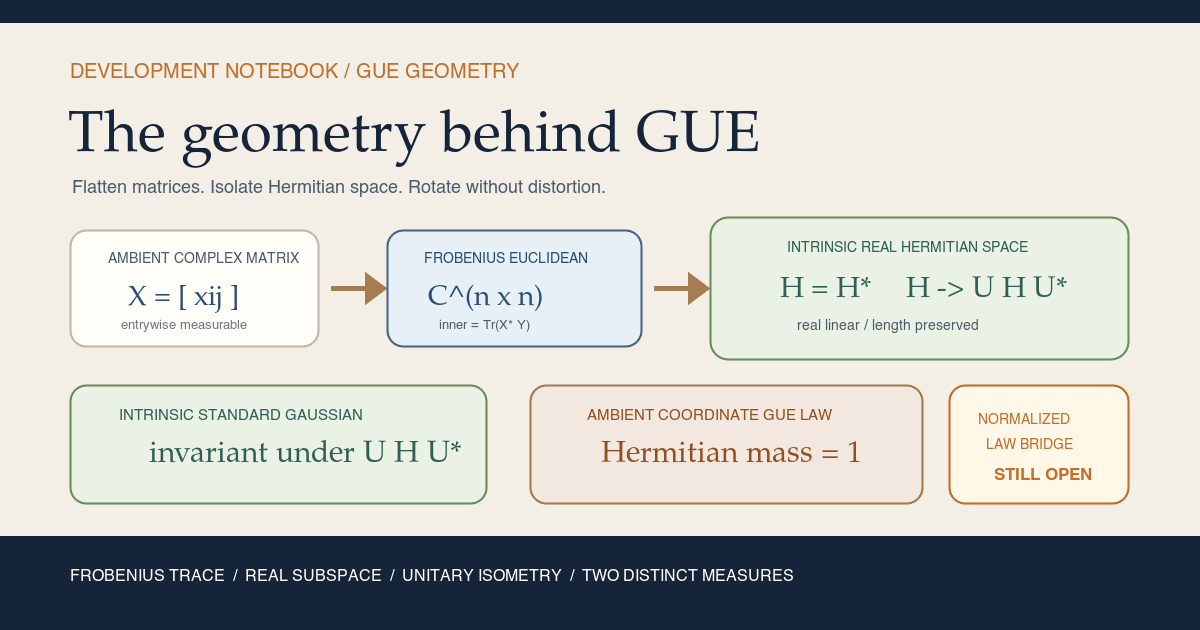
This is the proof-to-prose companion to
formalization/NonlinearDynamics/Random/RandomMatrices/GaussianUnitaryEnsembleGeometry.lean.
Every named public declaration in that module appears below.
The immediate predecessor, A Finite GUE Law in Lean, constructs the coordinate and ambient matrix measures with the Wigner variance ledger. The deterministic assembly map comes from Hermitian Coordinate Assembly, while From Random Matrices to Laws defines the exact measure-level property that the future bridge must prove.
The parallel textbook treatment of this milestone is Intrinsic Hermitian Gaussian Symmetry and Matrix-Law Support. Its prerequisite background is developed in Finite GUE from Independent Gaussian Coordinates, Finite Hermitian Matrices from Coordinates, and Random Matrices: From Outcomes to Spectra. Reusable vocabulary is indexed under gaussian-unitary-ensemble , hermitian-matrix , conjugate transpose , matrix trace , hermitian-frobenius-geometry , unitary-invariance , almost-everywhere , measurable-space , and pushforward measure .
Choose a route up
| Route | Begin | Destination |
|---|---|---|
| First encounter | Why matrices need a geometric carrier | See how an array becomes a point in finite Euclidean space |
| Linear-algebra route | Trace pairing | Derive the Frobenius inner product and unitary isometry |
| Hermitian route | A real, not complex, subspace | Understand why Hermitian matrices form an intrinsic real Euclidean space |
| Probability route | Standard Gaussian symmetry | Apply basis-independent Gaussian invariance under real isometries |
| Measure route | Ambient support | Convert pointwise assembly into mass-one and almost-everywhere statements |
| Lean route | Declaration map | Locate all twenty-seven public declarations and their proof engines |
| Boundary route | The missing bridge | See exactly why GUE.matrixLaw invariance is not yet proved |
Learning objectives
By the summit, a reader should be able to:
- reinterpret an \(n\times n\) complex matrix as a vector with \(n^2\) complex coordinates;
- move between the curried matrix carrier and a pair-indexed Euclidean carrier without losing entries;
- derive \(\langle X,Y\rangle_F=\operatorname{Tr}(X^*Y)\);
- explain why Hermitian matrices are closed under real, but not arbitrary complex, scalar multiplication;
- distinguish ambient complex linearity from intrinsic real linearity;
- prove on paper that \(X\mapsto UXU^*\) preserves the Frobenius pairing when \(U\) is unitary;
- understand the inverse congruence and the two unitary identities used by Lean;
- state why a standard Gaussian on a real inner-product space is invariant under a linear isometry;
- explain the local
Module ℝinstance wrinkle in thestdGaussian_mapproof; - distinguish a measurable full-mass Hermitian set, an almost-everywhere Hermitian predicate, and topological measure support;
- trace the support proof back through the coordinate pushforward; and
- identify the normalized orthonormal-coordinate theorem still required to
transfer intrinsic symmetry to
GUE.matrixLaw.
Two theorem tracks, one future bridge
flowchart LR
  A["Ambient complex matrices"] --> F["Frobenius Euclidean carrier"]
  F --> H["Intrinsic real Hermitian subspace"]
  U["Unitary congruence"] --> IF["Ambient complex isometry"]
  IF --> IH["Intrinsic real isometry"]
  IH --> SG["Intrinsic standard Gaussian invariant"]
  C["RMT-06 coordinate GUE law"] --> P["Hermitian assembly pushforward"]
  P --> M["Ambient GUE matrix law"]
  M --> S["Hermitian set has mass one"]
  SG -. normalized coordinate-law bridge .-> M
Figure. The top path is intrinsic geometry and Gaussian symmetry. The lower path is the already constructed coordinate GUE law and its newly checked Hermitian support. Every solid arrow is formalized. The dotted bridge is not: until the scaled intrinsic Gaussian is identified with the coordinate pushforward, symmetry of the top measure cannot be transferred to the lower one.
Why matrices need a geometric carrier
The project’s ambient matrix type is
\[ \operatorname{Matrix}(\operatorname{Fin}(n),\operatorname{Fin}(n),\mathbb C) =\operatorname{Fin}(n)\to\operatorname{Fin}(n)\to\mathbb C. \]That function type is ideal for entrywise algebra and for the measurable space introduced in the earliest random-matrix module. It does not, in this project’s current instance graph, arrive as the exact finite Hilbert carrier expected by Mathlib’s canonical multivariate standard Gaussian.
The remedy is to flatten the two matrix indices into one pair index:
\[ \operatorname{FrobeniusMatrix}(n) =\operatorname{EuclideanSpace} \bigl(\mathbb C,\operatorname{Fin}(n)\times\operatorname{Fin}(n)\bigr). \]This does not change the data. A matrix stores \(A_{ij}\); the flattened
vector stores the same value at coordinate \((i,j)\). What changes is the
available structure. EuclideanSpace supplies a norm, a complex inner
product, finite-dimensionality, a Borel measurable space, and the interfaces
used by linear isometries and Gaussian measures
(Mathlib Euclidean spaces).
Flatten, restore, and package the equivalence
RandomMatrix.FrobeniusMatrix is the carrier abbreviation.
RandomMatrix.frobeniusToMatrix uncouples a pair index into a row and column:
def frobeniusToMatrix {n : ℕ} (x : FrobeniusMatrix n) :
    Matrix (Fin n) (Fin n) ℂ :=
  fun i j => x (i, j)
RandomMatrix.matrixToFrobenius performs the reverse operation with
WithLp.toLp 2. The Lp wrapper carries the Euclidean norm; finiteness means
every coordinate function belongs to it.
The simplification theorems
RandomMatrix.frobeniusToMatrix_matrixToFrobenius and
RandomMatrix.matrixToFrobenius_frobeniusToMatrix prove that both round trips
are identities. Both proofs are rfl: flattening is representational rather
than an algorithm that rearranges or approximates entries.
RandomMatrix.frobeniusMatrixLinearEquiv packages those maps as a complex
linear equivalence. Addition and complex scalar multiplication are preserved
definitionally. This bundle gives later proofs injectivity, an explicit
inverse, and standard LinearEquiv transport without reopening entry
extensionality each time.
The Frobenius inner product is a trace
For flattened matrices \(x,y\), write \(X\) and \(Y\) for their restored matrices. The complex Euclidean inner product is the sum over all pair coordinates:
\[ \langle x,y\rangle_{\mathbb C} =\sum_{i,j}\overline{X_{ij}}Y_{ij}. \]The conjugate transpose has \((X^*)_{ij}=\overline{X_{ji}}\), so
\[ \begin{aligned} \operatorname{Tr}(X^*Y) &=\sum_i (X^*Y)_{ii}\\ &=\sum_i\sum_j (X^*)_{ij}Y_{ji}\\ &=\sum_i\sum_j \overline{X_{ji}}Y_{ji}\\ &=\sum_{i,j}\overline{X_{ij}}Y_{ij}. \end{aligned} \]RandomMatrix.inner_frobenius_eq_trace checks exactly this identity:
inner ℂ x y = Matrix.trace ((frobeniusToMatrix x)ᴴ * frobeniusToMatrix y)
The Lean proof expands the Euclidean inner product, trace, diagonal lookup,
matrix multiplication, and conjugate transpose. Fintype.sum_prod_type turns
the sum over pairs into nested sums, Finset.sum_comm aligns their order, and
the final scalar equality is definitional after one commutation. This theorem
is the hinge between coordinate geometry and the invariant matrix expression
used in random-matrix theory
(Mathlib matrix trace).
Setting \(x=y\) gives the familiar contextual norm identity
\[ \|X\|_F^2=\operatorname{Tr}(X^*X)=\sum_{i,j}|X_{ij}|^2. \]The file does not add a separately named squared-norm corollary, but every later isometry proof uses the inner-product theorem that implies it.
The Hermitian locus is real, not complex
A matrix is Hermitian when \(H^*=H\). If \(r\in\mathbb R\), then
\[ (rH)^*=rH^*=rH, \]so real scalar multiplication stays inside the Hermitian locus. For a general complex \(c\), however,
\[ (cH)^*=\overline c H. \]Unless \(c=\overline c\) or \(H=0\), that is not \(cH\). In particular, \(iH\) is anti-Hermitian for nonzero Hermitian \(H\). Hermitian matrices are therefore a real vector space living inside a complex vector space.
RandomMatrix.hermitianSubmodule
hermitianSubmodule n makes this fact a type. Its carrier is the set of
Frobenius vectors whose restored matrices satisfy Matrix.IsHermitian. The
three closure obligations reuse checked matrix facts:
- zero is Hermitian;
- sums of Hermitian matrices are Hermitian; and
- real scalars are self-adjoint, so real scalar multiples remain Hermitian.
Choosing Submodule ℝ, rather than Submodule ℂ, is a mathematical decision,
not a workaround for the prover.
RandomMatrix.HermitianEuclidean
HermitianEuclidean n abbreviates that real submodule. As a submodule of a
finite Euclidean space, it inherits an additive normed group, a real inner
product, finite-dimensionality, its measurable structure, and a Borel-space
instance. A term contains a Frobenius vector together with proof that its
matrix is Hermitian.
The abbreviation does not yet construct the explicit \(n^2\)-element real orthonormal basis. That basis, or an equivalent normalized coordinate map, is exactly what the next probability bridge will need.
RandomMatrix.hermitianToMatrix
hermitianToMatrix forgets the proof and Euclidean packaging, restoring the
ambient complex matrix. It is the inclusion through which the intrinsic
measure will eventually be compared with GUE.matrixLaw.
RandomMatrix.measurable_hermitianToMatrix
The inclusion is measurable. The proof uses the project’s entrywise matrix
criterion, fixes \(i,j\), and observes that the desired entry is coordinate
evaluation of the underlying Frobenius vector. fun_prop supplies the
measurability of the subtype coercion and evaluation.
This result is important for a future pushforward measure. Merely having an algebraic inclusion would not justify mapping the intrinsic Gaussian to the ambient matrix measurable space.
Unitary congruence preserves Frobenius geometry
For a fixed complex matrix \(U\), define congruence by
\[ \mathcal C_U(X)=UXU^*. \]The operation preserves Hermiticity for every \(U\), because \((UXU^*)^*=UX^*U^*\). It becomes invertible and length preserving when \(U\) is unitary, meaning
\[ U^*U=I \qquad\text{and}\qquad UU^*=I. \]Mathlib’s Matrix.unitaryGroup packages a matrix with these identities
(Mathlib unitary group).
RandomMatrix.frobeniusCongruence
frobeniusCongruence U x restores x, forms \(UXU^*\), and flattens the
result. The companion theorem
RandomMatrix.frobeniusToMatrix_frobeniusCongruence exposes exactly that
matrix expression after restoration. Its proof is reflexivity.
This low-level definition accepts any matrix \(U\). Unitarity is introduced only when invertibility or isometry is claimed.
RandomMatrix.unitaryCongruenceLinearEquiv
For U : Matrix.unitaryGroup (Fin n) ℂ, congruence is packaged as a complex
linear equivalence of the full Frobenius carrier. Its inverse is congruence by
\(U^*\):
The two inverse proofs are not duplicates. The first collapses \(U^*U\); the second collapses \(UU^*\). Lean applies injectivity of the flattening linear equivalence, rewrites both congruences as matrix expressions, reassociates products, and then uses the corresponding field of the unitary-group proof.
Addition and complex scalar multiplication follow from distributivity of matrix multiplication. This ambient map is genuinely complex linear because the full matrix space is closed under complex scaling.
RandomMatrix.frobeniusCongruence_inner
The central calculation establishes the inner-product identity
\[ \langle \mathcal C_U(X),\mathcal C_U(Y)\rangle_F =\langle X,Y\rangle_F. \]Using the trace pairing, the paper proof is
\[ \begin{aligned} \operatorname{Tr}\bigl((UXU^*)^*(UYU^*)\bigr) &=\operatorname{Tr}(UX^*U^*UYU^*)\\ &=\operatorname{Tr}(UX^*YU^*)\\ &=\operatorname{Tr}(U^*UX^*Y)\\ &=\operatorname{Tr}(X^*Y). \end{aligned} \]The third line uses cyclicity of trace. The Lean proof follows the same route:
rewrite both inner products, simplify conjugate transposes, collapse
\(U^*U\), apply Matrix.trace_mul_cycle, and collapse the remaining unit.
No determinant or eigenvalue argument is involved.
RandomMatrix.unitaryCongruenceLinearIsometryEquiv
LinearEquiv.isometryOfInner upgrades the complex linear equivalence using the
preserved inner product. The result records in one object that congruence is
bijective, complex linear, and norm preserving.
That bundle is more useful than a standalone norm equation. It can transport orthonormal bases and eventually any construction functorial under isometries.
Restrict the symmetry to intrinsic Hermitian space
RandomMatrix.hermitianCongruence
hermitianCongruence U x applies Frobenius congruence to an intrinsic
Hermitian point and supplies the proof that the result is still Hermitian.
This restriction works for arbitrary \(U\), not only unitary matrices, by
Matrix.isHermitian_mul_mul_conjTranspose.
RandomMatrix.hermitianCongruence_coe says that forgetting the subtype after
intrinsic congruence gives the full Frobenius congruence. The theorem is rfl.
RandomMatrix.hermitianToMatrix_hermitianCongruence is the commuting-square
theorem. Including the intrinsic result into ambient matrices is the same as
including first and applying the project’s existing ambient
RandomMatrix.congruence. This too is definitional, but naming it prevents
future measure proofs from depending on record layout.
RandomMatrix.hermitianUnitaryCongruenceLinearEquiv
On HermitianEuclidean n, unitary congruence is a real linear
equivalence. The to-function and inverse are the restricted congruences by
\(U\) and \(U^*\). Equality of subtype values reduces to equality of their
Frobenius values, where the ambient complex linear equivalence already proves
the inverse and addition laws.
The real scalar law is the first nontrivial coercion seam. Lean rewrites real
scalar multiplication on complex Frobenius coordinates as multiplication by
the embedded complex number with Complex.real_smul, applies ambient complex
linearity, and rewrites back. The proof mirrors the mathematics: restriction
from complex to real scalars preserves linearity, but the conversion must be
made explicit.
RandomMatrix.hermitianUnitaryCongruenceLinearIsometryEquiv
The intrinsic real equivalence is upgraded with
LinearIsometryEquiv.ofBounds. One norm inequality comes from the ambient
unitary isometry; the other applies the inverse ambient isometry. Since both
bounds are equalities in disguise, the packaged map is a real linear
isometric equivalence.
This is the exact input shape required by Mathlib’s standard-Gaussian invariance theorem.
Summit one: the intrinsic standard Gaussian is invariant
For any finite-dimensional real inner-product space \(E\), Mathlib defines
ProbabilityTheory.stdGaussian E by taking independent standard real
Gaussian coordinates in an orthonormal basis and mapping them into \(E\). The
definition is basis independent. Its characteristic function depends only on
the norm, and stdGaussian_map states that every real linear isometric
equivalence preserves the measure
(Mathlib multivariate Gaussians).
RandomMatrix.map_stdGaussian_hermitianUnitaryCongruence
The theorem applies that interface to the intrinsic Hermitian space:
\[ (\mathcal C_U)_*\gamma_{\mathrm{Herm}(n)} =\gamma_{\mathrm{Herm}(n)}, \]where \(\gamma_{\mathrm{Herm}(n)}\) is Mathlib’s canonical standard Gaussian
on HermitianEuclidean n.
This is a checked invariance theorem, but its subject is exact: the unscaled
intrinsic stdGaussian, not GUE.matrixLaw and not an unnamed Gaussian with
matching marginal variances.
The Module ℝ instance wrinkle
The proof contains more scaffolding than the one-line mathematical argument
“apply stdGaussian_map to the isometry.” HermitianEuclidean n is a
submodule subtype and already inherits a real module instance. The
inner-product hierarchy can also recover a real module through
InnerProductSpace.toNormedSpace.toModule. These scalar actions agree on
values, but the structures are not definitionally interchangeable at every
elaboration boundary used by stdGaussian_map.
The proof therefore pins the instance locally:
letI : Module ℝ (HermitianEuclidean n) :=
  InnerProductSpace.toNormedSpace.toModule
It then rebuilds a local real linear equivalence e and a local real linear
isometric equivalence f under that exact instance, changes the map in the
goal back to concrete hermitianCongruence, and applies stdGaussian_map f.
Nothing mathematical changes. No new scalar action is introduced, and no extra assumption is added. The maneuver aligns type-class identity so Lean can see the already proved pointwise map as the isometry expected by the Gaussian theorem. Recording this wrinkle matters because a future refactor that merely reuses the earlier bundle may fail for definitional reasons even though the theorem is unchanged.
Summit two: the ambient GUE law has Hermitian support
The intrinsic carrier contains only Hermitian matrices by type. The RMT-06
law, in contrast, lives on the full ambient type
Matrix (Fin n) (Fin n) ℂ. To state that its samples are Hermitian, the
Hermitian predicate must first become a measurable set in that ambient space.
RandomMatrix.hermitianSet
hermitianSet n is the set
It deliberately stays in the ambient matrix carrier. This lets the already
defined GUE.matrixLaw n evaluate it directly.
RandomMatrix.measurableSet_hermitianSet
The ambient entrywise measurable space has no global MeasurableEq instance,
so the proof cannot declare the matrix equation \(H^*=H\) measurable without
an additional argument.
It expands Hermiticity into all entry equations:
Each entry projection is measurable, complex conjugation is measurable, and equality of two complex-valued measurable functions is a measurable set. Finite dependent intersections assemble those scalar facts into the whole Hermitian locus.
The entrywise route matches the project’s measurable-space design. It does not import a topological matrix-space structure or assume an unavailable global equality interface.
GUE.matrixLaw_hermitianSet
The first support theorem proves
\[ \operatorname{matrixLaw}(n)(\operatorname{hermitianSet}(n))=1. \]The proof rewrites matrixLaw as the pushforward of coordinateMeasure, uses
Measure.map_apply with the coordinate-map measurability and Hermitian-set
measurability proofs, and identifies the preimage with the whole coordinate
space. That last step is exactly RMT-05’s pointwise theorem that every direct
coordinate assembly is Hermitian. The source probability measure of the
universe is one.
This is stronger than saying the matrix is Hermitian with high probability. It is an exact mass-one statement in every natural dimension, including zero.
GUE.matrixLaw_ae_isHermitian
The second theorem changes presentation, not content:
\[ \forall^{\mu_n}\,H,\quad H\text{ is Hermitian}. \]mem_ae_iff_prob_eq_one converts membership of the measurable Hermitian set
in the almost-everywhere filter to its probability-one equation. This is the
form downstream random-variable theorems can consume directly.
GUE.matrixLaw_compl_hermitianSet
The third theorem states that the non-Hermitian complement has mass zero:
\[ \operatorname{matrixLaw}(n) \bigl(\operatorname{hermitianSet}(n)^c\bigr)=0. \]It follows from the almost-everywhere membership theorem via mem_ae_iff.
Keeping all three formulations is useful: set evaluation, almost-everywhere
reasoning, and null-complement calculations appear in different downstream
APIs.
Physics view: basis changes and ensemble symmetry
A finite quantum Hamiltonian is represented by a Hermitian matrix after an orthonormal basis is chosen. Replacing the basis by a unitary \(U\) transforms the matrix by \(H\mapsto UHU^*\). The operator has not changed; only its coordinates have. The Frobenius trace pairing is invariant under this change, so it gives a basis-independent quadratic geometry on Hamiltonians.
An intrinsic standard Gaussian depends only on that quadratic geometry. In
finite-dimensional statistical mechanics language, its weight is radial in
the Euclidean norm; a unitary congruence is a rotation of the real Hermitian
space. Mathlib’s stdGaussian_map captures the measure-theoretic version of
that statement without choosing a basis.
Classical GUE combines this geometry with a dimension-dependent scale. Guionnet presents the Wigner-scaled coordinate variances and states invariance under unitary conjugation (Guionnet, 2022). This module formalizes the geometric rotation and the intrinsic standard-Gaussian invariance, but not yet their identification with the RMT-06 ensemble. It also does not formalize quantum states, spectra, Schrödinger evolution, measurement, or any universality claim.
Lineage, local contribution, and nonclaims
The Frobenius pairing, Hermitian real vector space, and unitary-congruence symmetry are standard finite-dimensional mathematics. Mathlib supplies the Euclidean-space inner product, matrix trace and cyclicity, Hermitian and unitary interfaces, real linear isometries, Borel structures, and canonical standard Gaussian theorem (Euclidean spaces, matrix trace, Hermitian matrices, unitary group, multivariate Gaussians).
This module’s local contribution is the bridge among those interfaces and the project’s ambient matrix law:
- mutually inverse flattening maps and a complex linear equivalence;
- a real Hermitian submodule with measurable ambient inclusion;
- the exact trace formula for the complex Frobenius inner product;
- ambient complex and intrinsic real unitary-congruence equivalences;
- their isometric upgrades;
- invariance of the intrinsic standard Gaussian;
- an entrywise measurable ambient Hermitian set; and
- three equivalent full-mass/null-complement forms of Hermitian support for
GUE.matrixLaw.
Not claimed
- No equality identifies
GUE.matrixLaw nwith the ambient image of an intrinsic standard Gaussian or a scaled version of it. - No theorem proves
RandomMatrix.IsUnitaryConjugationInvariant (GUE.matrixLaw n). - No normalized Hermitian coordinate equivalence or \(n^2\) real dimension theorem is constructed.
- No Lebesgue density, Jacobian, normalizing constant, or change-of-variables theorem appears.
- No topological-support equality is proved.
- No eigenvalue, spectrum, empirical measure, trace expectation, covariance, moment, semicircle, edge, spacing, or universality result is formalized.
- Intrinsic
stdGaussianis unscaled. The Wigner \(1/n\) covariance scale has not yet been transferred into that carrier.
The normalized coordinate bridge is still missing
RMT-06 chooses free coordinates \(d_i\in\mathbb R\) and \(u_{ij}\in\mathbb C\) for \(i\lt j\). The Frobenius norm of the assembled Hermitian matrix satisfies the contextual identity
\[ \|H\|_F^2 =\sum_i d_i^2+2\sum_{i\lt j}|u_{ij}|^2. \]The factor two appears because every strict-upper value also appears below the diagonal as its conjugate. Therefore an orthonormal real coordinate list is
\[ d_i, \qquad \sqrt{2}\operatorname{Re}(u_{ij}), \qquad \sqrt{2}\operatorname{Im}(u_{ij}). \]Under the RMT-06 law, \(d_i\) has variance \(1/n\), while each unscaled real or imaginary upper coordinate has variance \(1/(2n)\). Multiplication by \(\sqrt{2}\) makes every orthonormal coordinate have variance \(1/n\). This is the mathematical reason the positive-dimensional GUE should correspond to a \(1/\sqrt n\)-scaled intrinsic standard Gaussian.
RMT-08 must make every word of that sentence exact:
- define the normalized real coordinate carrier and its measurable map;
- prove the Frobenius norm or inner-product identity with the factor two;
- package the map as a real linear isometric equivalence;
- push the RMT-06 finite product law through it;
- identify the result with the scaled intrinsic
stdGaussian; - include the intrinsic measure into ambient matrices; and
- transfer the checked intrinsic congruence symmetry through those exact measure equalities.
Dimension zero also needs its explicit Dirac branch. Skipping any one of these steps would turn matching coordinates into an unsupported equality of measures.
The complete declaration map
| Public declaration | Checked content | Main proof mechanism |
|---|---|---|
RandomMatrix.FrobeniusMatrix | Pair-indexed complex Euclidean carrier for square matrices | EuclideanSpace abbreviation |
RandomMatrix.frobeniusToMatrix | Restore a flattened vector as a curried matrix | Pair-coordinate evaluation |
RandomMatrix.matrixToFrobenius | Flatten a curried matrix into Euclidean space | WithLp.toLp 2 |
RandomMatrix.frobeniusToMatrix_matrixToFrobenius | Restore after flattening is identity | Reflexivity |
RandomMatrix.matrixToFrobenius_frobeniusToMatrix | Flatten after restoring is identity | Reflexivity |
RandomMatrix.frobeniusMatrixLinearEquiv | Flattening is a complex linear equivalence | Inverse lemmas and definitional linearity |
RandomMatrix.hermitianSubmodule | Hermitian matrices form a real submodule | Zero, addition, and self-adjoint real scaling |
RandomMatrix.HermitianEuclidean | Intrinsic real Euclidean Hermitian carrier | Submodule abbreviation |
RandomMatrix.hermitianToMatrix | Forget intrinsic structure into ambient matrices | Frobenius restoration |
RandomMatrix.measurable_hermitianToMatrix | Intrinsic inclusion is measurable | Entrywise criterion and coordinate evaluation |
RandomMatrix.inner_frobenius_eq_trace | Complex Euclidean inner product equals Tr (XᴴY) | Expand sums, commute finite indices |
RandomMatrix.frobeniusCongruence | Transport UXUᴴ to the Frobenius carrier | Restore, multiply, flatten |
RandomMatrix.frobeniusToMatrix_frobeniusCongruence | Restored Frobenius congruence is ordinary matrix congruence | Reflexivity |
RandomMatrix.unitaryCongruenceLinearEquiv | Unitary congruence is an ambient complex linear equivalence | Inverse by Uᴴ, two unitary identities, distributivity |
RandomMatrix.frobeniusCongruence_inner | Unitary congruence preserves the complex Frobenius inner product | Trace identity, cyclicity, UᴴU=I |
RandomMatrix.unitaryCongruenceLinearIsometryEquiv | Ambient congruence is a complex linear isometric equivalence | LinearEquiv.isometryOfInner |
RandomMatrix.hermitianCongruence | Congruence restricts to intrinsic Hermitian space | Hermiticity of UXUᴴ |
RandomMatrix.hermitianCongruence_coe | Intrinsic congruence coerces to Frobenius congruence | Reflexivity |
RandomMatrix.hermitianToMatrix_hermitianCongruence | Intrinsic inclusion intertwines ambient congruence | Reflexivity |
RandomMatrix.hermitianUnitaryCongruenceLinearEquiv | Restricted unitary congruence is a real linear equivalence | Ambient equivalence plus real-to-complex scalar bridge |
RandomMatrix.hermitianUnitaryCongruenceLinearIsometryEquiv | Restricted congruence is a real linear isometric equivalence | Forward and inverse norm bounds |
RandomMatrix.map_stdGaussian_hermitianUnitaryCongruence | Intrinsic standard Gaussian is invariant under unitary congruence | Local module alignment and stdGaussian_map |
RandomMatrix.hermitianSet | Ambient measurable-set target for Hermitian matrices | Set-builder definition |
RandomMatrix.measurableSet_hermitianSet | Ambient Hermitian locus is measurable | Finite entrywise intersections and measurable equality |
GUE.matrixLaw_hermitianSet | Ambient GUE law gives the Hermitian set mass one | Pushforward evaluation and universal preimage |
GUE.matrixLaw_ae_isHermitian | An ambient GUE matrix is Hermitian almost everywhere | Probability-one set to ae membership |
GUE.matrixLaw_compl_hermitianSet | Non-Hermitian matrices have GUE mass zero | Almost-everywhere membership to null complement |
The map contains exactly twenty-seven named public declarations in this version of the module. Local equivalences inside the standard-Gaussian proof, namespace openings, imported declarations, and automatically generated submodule structure are not counted as new public declarations.
Run the checked source
From the repository root on macOS or Linux, load elan and invoke Lean through the pinned Lake environment:
source "$HOME/.elan/env"
cd formalization
lake env lean -DwarningAsError=true \
  NonlinearDynamics/Random/RandomMatrices/GaussianUnitaryEnsembleGeometry.lean
Starting from the repository root, build the whole formalization and check the public teaching content:
cd formalization
lake build

cd ..
make content-hygiene
make site-check
The direct command checks the geometry and support module with warnings promoted to errors. The full build checks every dependency, and the final two commands inspect the public teaching content and render the site.
This complete Lean snippet inspects the main interfaces:
import NonlinearDynamics.Random.RandomMatrices.GaussianUnitaryEnsembleGeometry

open Matrix MeasureTheory ProbabilityTheory
open scoped Matrix RealInnerProductSpace

open NonlinearDynamics.Random

#check RandomMatrix.FrobeniusMatrix
#check RandomMatrix.frobeniusMatrixLinearEquiv
#check RandomMatrix.HermitianEuclidean
#check RandomMatrix.inner_frobenius_eq_trace
#check RandomMatrix.unitaryCongruenceLinearIsometryEquiv
#check RandomMatrix.hermitianUnitaryCongruenceLinearIsometryEquiv
#check RandomMatrix.map_stdGaussian_hermitianUnitaryCongruence
#check RandomMatrix.measurableSet_hermitianSet
#check GUE.matrixLaw_hermitianSet
#check GUE.matrixLaw_ae_isHermitian
#check GUE.matrixLaw_compl_hermitianSet
Save the snippet inside formalization and run lake env lean on it. Every
name is part of the checked public API; the code contains no omitted terms or
noncompiling ellipses.
Failure modes this layer blocks
| Tempting shortcut | What goes wrong | Checked repair |
|---|---|---|
| Treat a matrix array as already carrying the needed Hilbert instances | The matrix array lacks the Hilbert instances required by the standard-Gaussian API | Flatten into EuclideanSpace ℂ (Fin n × Fin n) |
| Call the Hermitian locus a complex subspace | Multiplication by \(i\) generally leaves the locus | Define a Submodule ℝ |
| Prove only \(\|UXU^*\|=\|X\|\) pointwise | Inverses, linearity, and transport APIs remain unavailable | Package linear and linear-isometric equivalences |
| Use only \(U^*U=I\) for both inverse directions | One composite actually requires \(UU^*=I\) | Use both unitary-group identities explicitly |
| Claim trace invariance without handling product order | Matrix multiplication is noncommutative | Use trace cyclicity at the exact reordering step |
| Reuse the complex linear map on the Hermitian subtype | The subtype is only a real vector space | Build the restricted real linear equivalence |
| Assume matching real scalar actions are definitionally identical | Type-class elaboration can reject the Gaussian theorem application | Pin the local module instance and rebuild the local isometry |
| Call a set measurable because matrix equality is measurable globally | The project ambient matrix space has no global MeasurableEq instance | Expand Hermiticity into finitely many complex entry equations |
| Read pointwise Hermitian assembly as a statement about an ambient law | The pushforward and measurable-set steps are missing | Prove the preimage is universal and evaluate the map |
| Read full mass as topological support equality | A measure can have full mass on many larger measurable sets | State mass one, almost everywhere, and null complement only |
Transfer stdGaussian invariance to GUE.matrixLaw by naming both Gaussian | The exact scaled pushforward equality is absent | Defer the claim until the normalized coordinate bridge is proved |
| Forget the strict-upper factor two | The proposed coordinate map is not an isometry | Normalize upper real and imaginary coordinates by \(\sqrt{2}\) |
Exercises with solutions
Exercise 1: flatten a two-by-two matrix
For
\[ A=\begin{pmatrix}a&b\\c&d\end{pmatrix}, \]what values does matrixToFrobenius A have at the four pair coordinates?
Solution. It has values \(a,b,c,d\) at \((0,0),(0,1),(1,0),(1,1)\),
respectively. frobeniusToMatrix_matrixToFrobenius says restoration returns
the same four entries definitionally.
Exercise 2: find the scalar-field obstruction
Let \(H\ne0\) be Hermitian. Show that \(iH\) is not generally Hermitian.
Solution. Since \(\overline i=-i\), \((iH)^*=\overline i H^*=-iH\). Equality with \(iH\) would force \(2iH=0\), hence \(H=0\) over \(\mathbb C\). The Hermitian locus is therefore real linear but not complex linear.
Exercise 3: derive the trace pairing
Which index swap turns \(\operatorname{Tr}(X^*Y)\) into the Euclidean coordinate sum?
Solution. Expansion gives
\(\sum_i\sum_j\overline{X_{ji}}Y_{ji}\). Swap the dummy indices \(i,j\) to
obtain \(\sum_i\sum_j\overline{X_{ij}}Y_{ij}\). Lean performs the finite-sum
version with Fintype.sum_prod_type, Finset.sum_comm, and scalar
commutation.
Exercise 4: choose the inverse congruence
Why is the inverse of \(X\mapsto UXU^*\) given by \(X\mapsto U^*XU\)?
Solution. Compose in one direction: \(U^*(UXU^*)U=(U^*U)X(U^*U)=X\). The other direction uses \(U(U^*XU)U^*=(UU^*)X(UU^*)=X\). Both unitary identities are required.
Exercise 5: separate the two invariance claims
What exact measure is known invariant after this module, and which measure is not yet known invariant?
Solution. stdGaussian (HermitianEuclidean n) is invariant under the
intrinsic real unitary-congruence isometry. GUE.matrixLaw n is known to give
full mass to ambient Hermitian matrices, but its unitary-conjugation invariance
is not proved. An exact scaled pushforward equality must connect the measures.
Exercise 6: prove the Hermitian preimage is universal
Why is the preimage of hermitianSet n under
hermitianCoordinateMap n equal to Set.univ?
Solution. A coordinate point is a real diagonal paired with a complex
strict upper triangle. RMT-05’s
hermitianFromCoordinates_isHermitian proves its direct assembly Hermitian
without hypotheses. Hence every coordinate point belongs to the preimage.
Exercise 7: compute the orthonormal upper coordinates
If one complex upper coordinate is \(u=x+iy\), what contribution does it make to \(\|H\|_F^2\), and which real coordinates reproduce that contribution as a sum of squares?
Solution. The upper value and its conjugate below the diagonal contribute \(2|u|^2=2x^2+2y^2\). The real coordinates \(\sqrt{2}x\) and \(\sqrt{2}y\) have squares summing to exactly that value. Omitting \(\sqrt2\) breaks isometry and the probability normalization.
The next ridge
RMT-07 has established the geometry that a clean invariance proof needs. The intrinsic standard Gaussian is basis free and invariant. The ambient GUE law is a genuine probability measure concentrated on Hermitian matrices. What is missing is no longer vague: it is one normalized equality of finite product and pushforward measures.
Once that bridge is checked, the existing commuting-square theorem can move
intrinsic congruence to ambient RandomMatrix.congruence, and the project’s
law-level interface can finally discharge
RandomMatrix.IsUnitaryConjugationInvariant (GUE.matrixLaw n). Only then
should density formulas or invariant-ensemble spectral calculations be built
on top.
References
The external links below were opened and checked on 2026-07-21. The pinned local Mathlib 4.32.0 source remains the API authority for the Lean proofs.
Alice Guionnet. “Rare Events in Random Matrix Theory”, Proceedings of the International Congress of Mathematicians 2022, volume 2, pages 1008–1052. DOI 10.4171/ICM2022/174. Section 1.1.1 states the GUE coordinate variances, matrix density convention, and invariance under unitary conjugation. Those statements supply classical context; this chapter claims only the portions checked in the local Lean module.
Mathlib contributors.
Mathlib 4.32.0 release,
2026. This is the exact dependency release selected by
formalization/lakefile.toml.
Mathlib contributors.
Multivariate Gaussian distributions,
Mathlib 4 documentation. The page defines stdGaussian on finite-dimensional
real inner-product spaces, states its basis-independent orthonormal-coordinate
description, and proves stdGaussian_map for real linear isometric
equivalences.
Mathlib contributors.
Euclidean spaces and inner products,
Mathlib 4 documentation. This is the official source for EuclideanSpace, its
pair-indexed inner product, finite-dimensional instances, norms, and
orthonormal-basis infrastructure.
Mathlib contributors.
Hermitian matrices,
Mathlib 4 documentation. This module defines Matrix.IsHermitian and supplies
its entrywise, additive, real-scalar, and congruence closure theorems.
Mathlib contributors. The unitary group, Mathlib 4 documentation. This page packages finite unitary matrices and the identities \(U^*U=I\) and \(UU^*=I\) used for inverse congruence and isometry.
Mathlib contributors. Matrix trace, Mathlib 4 documentation. This is the official interface for finite matrix trace and cyclic multiplication used in the Frobenius invariance proof.