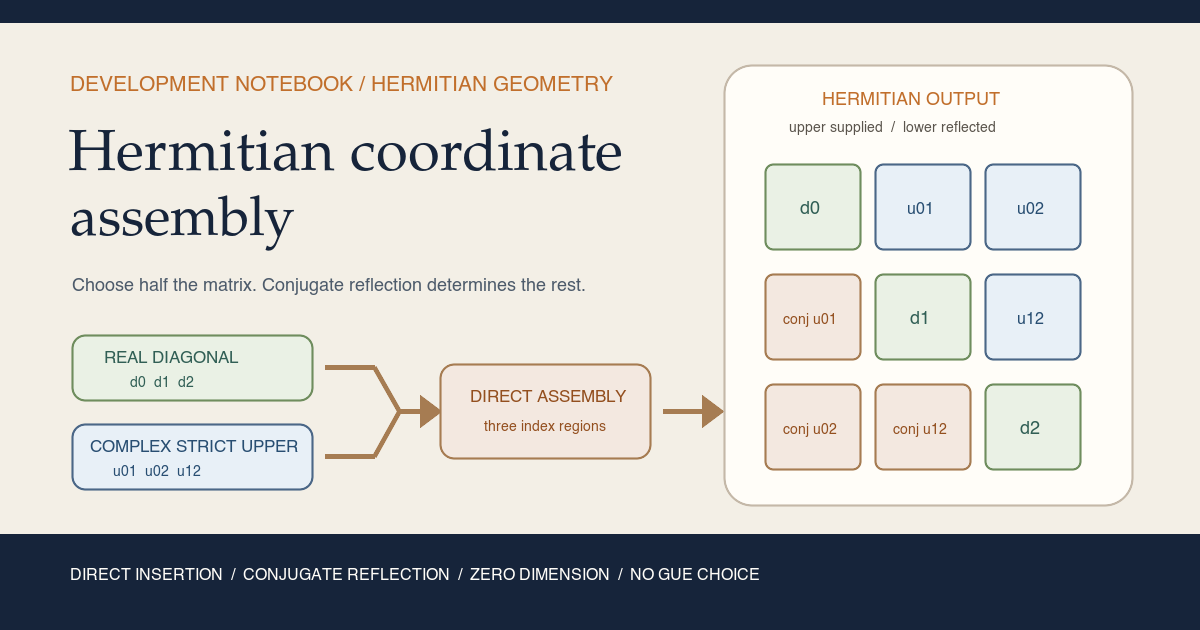
This is the proof-to-prose companion to
formalization/NonlinearDynamics/Random/RandomMatrices/HermitianCoordinates.lean.
Every named public declaration in that file appears below. Explanatory formulas
use ordinary mathematical notation, while the source file gives the exact Lean
types.
The earlier chapters When Randomness Becomes a Matrix and Hermitian Random Matrices establish the measurable matrix carrier and the pointwise Hermitian bundle. The probability-side coordinate chapters culminate in Independent Complex Gaussian Families. The stable textbook treatment is Finite Hermitian Matrices from Coordinates.
Reusable vocabulary is indexed under hermitian-coordinate-space , hermitian-matrix , conjugate transpose , random-matrix , measurable-space , and normalization convention .
Choose a route up
| Route | Begin | Destination |
|---|---|---|
| First encounter | Why half a matrix is enough | See why a real diagonal plus one complex triangle determines a Hermitian matrix |
| Geometry route | The coordinate count | Recover the \(n^2\) real degrees of freedom without duplicating entries |
| Lean route | The strict-upper subtype | Follow all seventeen public declarations and their proof engines |
| Measure-theory route | Measurability | See why static index branches preserve measurable coordinate processes |
| Edge-case route | Dimension zero | Understand why the empty matrix needs no exceptional division or probability convention |
| Ensemble route | What comes next | Separate this deterministic constructor from the future GUE law |
Learning objectives
By the summit, a reader should be able to:
- derive the Hermitian entry pattern from \(H^*=H\);
- explain why diagonal inputs are real and only strict-upper entries are free complex coordinates;
- read
StrictUpperIndex nas a pair of indices bundled with a proof of strict order; - evaluate
hermitianFromCoordinatesabove, below, and on the diagonal; - explain why direct insertion avoids the diagonal factor introduced by
X + Xᴴ; - follow the trichotomy proof of pointwise Hermiticity;
- reduce matrix measurability to fixed entry functions;
- explain the roles of
measurable_pi_apply,measurable_fst, andmeasurable_sndin the canonical map; - distinguish free algebraic coordinates from probabilistically independent random variables; and
- run the exact strict compiler command and identify every theorem that is intentionally absent.
The construction in one picture
flowchart LR
  D["Real diagonal coordinates"] --> A["Direct three-region assembly"]
  U["Complex strict-upper coordinates"] --> A
  A --> H["Complex matrix"]
  A --> R["Conjugate reflection below diagonal"]
  R --> H
  H --> P["Hermitian at every input"]
  MD["Measurable diagonal processes"] --> MM["Measurable matrix map"]
  MU["Measurable upper processes"] --> MM
  A --> MM
  L["Probability laws and normalization"] -. later .-> E["Matrix ensemble law"]
  MM -. pushforward later .-> E
Figure. The solid path is checked in this module. Real diagonal and complex strict-upper data are parallel inputs; conjugate reflection fills the lower triangle, and entrywise hypotheses prove measurability. The dotted path is future work. The current file does not put a measure on the coordinate space or name any ensemble.
Why half a matrix is enough
For a complex square matrix \(H\), Hermiticity means
\[ H^*=H. \]The conjugate transpose reverses the indices and conjugates the entry, so the same condition says
\[ H_{ji}=\overline{H_{ij}} \qquad\text{for every }i,j. \]Two consequences arrive immediately. First, if \(i=j\), then
\[ H_{ii}=\overline{H_{ii}}, \]so the diagonal entry is real. Second, if \(i\lt j\), choosing \(H_{ij}\) automatically fixes the reflected entry \(H_{ji}\). Choosing both would be redundant and would create a consistency obligation.
The efficient coordinates are therefore:
- \(d_i\in\mathbb R\) for each diagonal position \(i\); and
- \(u_{ij}\in\mathbb C\) for each strict-upper position \(i\lt j\).
Assembly is the piecewise rule
\[ H_{ij}= \begin{cases} u_{ij}, & i\lt j,\\ \overline{u_{ji}}, & j\lt i,\\ d_i, & i=j. \end{cases} \]The comparisons are comparisons of fixed finite indices, not random events. Once \(i\) and \(j\) are fixed, exactly one branch is active for every outcome. That small observation drives both the algebraic and measurable proofs.
A three-by-three matrix by hand
Take three real diagonal values \(d_0,d_1,d_2\) and three complex values \(u_{01},u_{02},u_{12}\). The assembled matrix is
\[ H= \begin{pmatrix} d_0 & u_{01} & u_{02}\\ \overline{u_{01}} & d_1 & u_{12}\\ \overline{u_{02}} & \overline{u_{12}} & d_2 \end{pmatrix}. \]Reading across the first row uses supplied upper coordinates. Reading down the first column uses their conjugates. The diagonal is inserted as real data. A second entrywise pass establishes \(H_{ji}=\overline{H_{ij}}\) in every cell, so no probability argument is needed.
This pattern also explains a physics use. For any complex state vector \(\psi\), the scalar \(\psi^*H\psi\) is real when \(H\) is Hermitian:
\[ \overline{\psi^*H\psi} =\psi^*H^*\psi =\psi^*H\psi. \]In finite-dimensional quantum mechanics, a Hermitian \(H\) represents an observable or Hamiltonian, while, in units where \(\hbar=1\), the anti-Hermitian \(-iH\) generates unitary time evolution. The Lean file proves the matrix symmetry needed for the real-valued quadratic-form calculation, but it does not formalize quantum states, dynamics, the spectral theorem, or a physical measurement postulate.
Lineage, local contribution, and nonclaims
The mathematics of Hermitian matrices and product measurable spaces is
standard. The implementation targets the pinned
Mathlib 4.32.0 release and reuses its official interfaces for
Matrix.IsHermitian, function-space measurable structures, finite indices,
and complex conjugation
(Hermitian matrix API,
measurable constructions,
finite indices,
complex numbers). The project-specific entrywise matrix
measurable space was introduced in the earlier Basic.lean module.
This module’s local contribution is the narrow bridge later ensemble code needs:
- a proof-carrying type for strict-upper positions;
- a normalization-free coordinate space;
- direct entry assembly with three named simplification theorems;
- pointwise Hermiticity for every coordinate input;
- a general measurability theorem for coordinate processes;
- a named measurable map on the canonical product space;
- total definitions and simplification theorems at \(n=0\); and
- a constructor for the existing
HermitianRandomMatrixbundle.
Not claimed
- The word coordinate is algebraic here. No random coordinates are proved independent in this module.
- No probability measure or pushforward matrix law is constructed.
- No Gaussian, GUE, GOE, or other ensemble is defined.
- No diagonal or off-diagonal variance and no dimension scaling is selected.
- No density, partition function, covariance operator, or normalization constant is stated.
- No unitary invariance, eigenvalue law, trace moment, integrability result, spectral statistic, or asymptotic limit is proved.
- The source does not prove a cardinality formula for
StrictUpperIndex; the degree-of-freedom calculation below is explanatory mathematics.
The real geometry hidden in the entry pattern
An \(n\times n\) Hermitian matrix has \(n\) real diagonal coordinates. It has
\[ \binom n2=\frac{n(n-1)}2 \]strict-upper positions, and every complex coordinate contributes two real coordinates. The total real coordinate count is therefore
\[ n+2\binom n2 =n+n(n-1) =n^2. \]That is the real dimension of the vector space of complex Hermitian matrices. The coordinate representation is not merely storage compression. It is a global real-linear parameterization of the entire finite-dimensional space. The current Lean map is expressed as a function, not yet packaged as a linear equivalence, so linearity, injectivity, surjectivity, and the cardinality formula are not named theorems in this file.
Camp one: an index that carries its own proof
StrictUpperIndex
def StrictUpperIndex (n : ℕ) := {ij : Fin n × Fin n // ij.1 < ij.2}
The braces describe a Lean subtype. A term contains an index pair and a proof
that its row lies strictly before its column. If ij : StrictUpperIndex n,
then ij.1 is the underlying pair and ij.2 is the order proof. The official
Lean reference explains how subtypes retain a value together with evidence of
a proposition (Lean subtypes).
The strict inequality matters. Replacing it with \(i\le j\) would include the diagonal and permit complex diagonal coordinates. That would duplicate the separate real diagonal and weaken the representation of Hermiticity.
StrictUpperIndex.instFintype
StrictUpperIndex.instFintype proves that the strict upper triangle is finite.
The implementation unfolds the subtype and lets type-class inference reuse the
finite structure of Fin n × Fin n and its finite subtype. Later product
measures and finite sums can therefore index over these coordinates without a
new enumeration.
StrictUpperIndex.instDecidableEq
StrictUpperIndex.instDecidableEq gives decidable equality on proof-carrying
upper indices. Again the proof is inherited after unfolding. Lean’s proof
irrelevance means two subtype terms with the same pair are not distinguished
because their inequality proofs were constructed differently.
StrictUpperIndex.instIsEmptyZero
StrictUpperIndex.instIsEmptyZero records the first boundary fact:
StrictUpperIndex 0 has no elements. Any supposed member contains a first
coordinate of type Fin 0; Fin.elim0 eliminates that impossible value
(Lean finite natural numbers). This
explicit instance supplies later zero-dimensional code with IsEmpty
directly instead of replaying the contradiction.
HermitianCoordinateSpace
abbrev HermitianCoordinateSpace (n : ℕ) :=
  (Fin n → ℝ) × (StrictUpperIndex n → ℂ)
HermitianCoordinateSpace is an abbreviation for a product of two function
spaces. The first function supplies a real diagonal. The second supplies the
complex strict upper triangle. Because it is an abbrev, Lean can unfold it
transparently when projections or measurable-space instances are needed. No
law, topology beyond the inherited coordinate types, or distribution is part
of this abbreviation.
Camp two: direct assembly without a hidden factor
RandomMatrix.hermitianFromCoordinates
RandomMatrix.hermitianFromCoordinates d u implements the three-region rule
literally. Its first dependent if tests \(i\lt j\). If false, the second tests
\(j\lt i\). If both are false, linear order forces equality, and the diagonal
branch returns d i, coerced from \(\mathbb R\) to \(\mathbb C\).
The upper and lower branches build subtype values such as
⟨(i, j), hij⟩. The branch proof hij is exactly the evidence required to
index u. The function is total for every natural dimension, including zero.
RandomMatrix.hermitianFromCoordinates_apply_diag
hermitianFromCoordinates_apply_diag says that the diagonal is exactly the
supplied real value:
Both strict comparisons \(i\lt i\) simplify to false, so simp reaches the final
branch. The theorem is marked [simp], allowing later proofs to reduce a
diagonal lookup automatically.
RandomMatrix.hermitianFromCoordinates_apply_upper
Given hij : i < j,
hermitianFromCoordinates_apply_upper reduces the entry to the exact supplied
coordinate u ⟨(i, j), hij⟩. There is no rescaling, conjugation, or addition.
The proof supplies hij to the definition and lets simp select the first
branch.
RandomMatrix.hermitianFromCoordinates_apply_lower
Given hji : j < i,
hermitianFromCoordinates_apply_lower returns
The proof first derives ¬ i < j from hji, preventing the first branch from
firing. Simplification then selects the lower branch. The star operation is
complex conjugation here.
Why not reuse X + Xᴴ?
The earlier module deliberately defines unnormalized Hermitian symmetrization. For an arbitrary matrix \(X\),
\[ (X+X^*)_{ii}=X_{ii}+\overline{X_{ii}}=2\operatorname{Re}(X_{ii}). \]If a real diagonal coordinate \(d_i\) were placed into \(X_{ii}\), that constructor would return \(2d_i\), not \(d_i\). Dividing by two would inject a scale choice into a function whose job is only to assemble coordinates. Direct insertion gives the exact coordinate semantics needed for later variance ledgers.
The same distinction protects off-diagonal meaning. A future law attached to
u ⟨(i,j),hij⟩ should become the law of \(H_{ij}\) without an unnoticed sum
of two source variables. The direct branch makes that relationship
definitionally transparent.
High camp one: Hermiticity by index trichotomy
RandomMatrix.hermitianFromCoordinates_isHermitian
hermitianFromCoordinates_isHermitian proves
for every input. The proof rewrites Mathlib’s matrix predicate with
Matrix.IsHermitian.ext_iff, reducing a matrix equality to entries. It then
uses lt_trichotomy i j, which gives exactly three cases.
- If \(i\lt j\), the right-hand entry is
uand its reflected partner isstar u; simplifying the double star closes the goal. - If \(i=j\), the entry is the embedded real value
d i, which complex conjugation fixes. - If \(j\lt i\), the upper and lower simplification theorems reverse their roles and close the symmetric case.
No coordinate hypothesis appears because the output is Hermitian by construction. In particular, neither measurability nor independence is needed for this algebraic theorem.
High camp two: measurability is entrywise
RandomMatrix.measurable_hermitianFromCoordinates
Let the coordinates vary with an outcome \(\omega\):
\[ d:\Omega\to(\operatorname{Fin}(n)\to\mathbb R), \qquad u:\Omega\to(\operatorname{StrictUpperIndex}(n)\to\mathbb C). \]The theorem assumes ordinary measurability of each scalar coordinate:
\[ \omega\mapsto d(\omega)_i \quad\text{and}\quad \omega\mapsto u(\omega)_{ij}. \]It concludes that the assembled matrix-valued map is measurable. The proof
starts with the project’s measurable_iff_entries, so it suffices to fix
\(i,j\) and prove measurability of one entry.
The two by_cases decisions are made on the fixed propositions \(i\lt j\) and
\(j\lt i\). They do not partition the outcome space. In the upper branch, the
corresponding hypothesis hu is the whole proof. In the lower branch,
measurable complex conjugation composes with hu. In the diagonal branch,
the measurable real coordinate composes with the canonical real-to-complex
map. The fun_prop tactic discharges those standard function-property
compositions.
This theorem requires Measurable, not merely AEMeasurable. An exact
HasLaw statement elsewhere may provide only almost-everywhere measurability;
it cannot silently satisfy these stronger premises. The distinction keeps the
deterministic map reusable under any later probability measure.
RandomMatrix.hermitianCoordinateMap
hermitianCoordinateMap n names the uncurried function
Naming the map matters at the law level. A later ensemble can place a measure
on HermitianCoordinateSpace n and push it through this one deterministic
map. The present definition does not perform that pushforward.
RandomMatrix.measurable_hermitianCoordinateMap
measurable_hermitianCoordinateMap proves that the named map is measurable
for the inherited product measurable space. The proof invokes the general
assembly theorem and supplies its hypotheses from canonical projections:
measurable_fstreaches the diagonal function;measurable_pi_apply ievaluates it at a fixed diagonal index;measurable_sndreaches the upper-coordinate function; andmeasurable_pi_apply ijevaluates it at a fixed strict-upper index.
Composition gives each requested scalar coordinate. This proof is the formal bridge between a product measure on coordinates and a later measurable pushforward to matrices (Mathlib measurable constructions).
The zero-dimensional boundary is a theorem
Dimension zero is not an error case. Fin 0 has no values, so the diagonal
function is the unique function out of an empty type. The explicit
StrictUpperIndex.instIsEmptyZero instance says the same for the upper
triangle. Their product is therefore a one-point coordinate space.
A zero-by-zero matrix is a function Fin 0 → Fin 0 → ℂ. It too is unique.
The matrix called zero and the matrix returned by any assembly input must be
the same function.
RandomMatrix.hermitianFromCoordinates_zero
hermitianFromCoordinates_zero proves that every zero-dimensional input
assembles to the zero matrix. The proof applies matrix extensionality and then
uses Fin.elim0 on the impossible row index. No entry branch needs to be
evaluated.
RandomMatrix.hermitianCoordinateMap_zero
hermitianCoordinateMap_zero specializes the named map. It unfolds to the
previous theorem on the two projections of its coordinate input. Marking both
zero theorems [simp] makes later boundary calculations executable.
This design is normalization-free. It does not divide by \(n\), so \(n=0\) does not force an arbitrary replacement for \(1/n\). A future ensemble module must still decide what probability law and scaling convention it assigns in dimension zero, but the deterministic map is already total.
Summit camp: bundle measurable coordinate processes
HermitianRandomMatrix.ofCoordinates
The existing HermitianRandomMatrix Ω (Fin n) structure stores a measurable
matrix-valued map and proof that every realization is Hermitian.
HermitianRandomMatrix.ofCoordinates builds that structure from coordinate
processes d and u plus their entrywise measurability proofs.
Its three structure fields are filled directly:
toRandomMatrixis coordinate assembly at each outcome;measurable_toRandomMatrixisRandomMatrix.measurable_hermitianFromCoordinates hd hu; andisHermitianappliesRandomMatrix.hermitianFromCoordinates_isHermitianpointwise.
The result is stronger than an almost-surely Hermitian map. It is Hermitian at every outcome, including outcomes that a later measure might assign probability zero.
HermitianRandomMatrix.ofCoordinates_apply
ofCoordinates_apply exposes the underlying matrix at an outcome:
The proof is rfl: the equality holds by unfolding the constructor and the
bundle’s function coercion. Marking it [simp] lets downstream entry proofs
move from the bundled object to the concrete assembly without manual record
unpacking.
The complete declaration map
| Public declaration | Checked content | Main proof mechanism |
|---|---|---|
StrictUpperIndex | Proof-carrying pairs \(i\lt j\) | Subtype definition |
StrictUpperIndex.instFintype | The upper index type is finite | Unfold, then type-class inference |
StrictUpperIndex.instDecidableEq | Equality of upper indices is decidable | Unfold, then type-class inference |
StrictUpperIndex.instIsEmptyZero | There is no upper coordinate at \(n=0\) | Eliminate Fin 0 |
HermitianCoordinateSpace | Real diagonal times complex strict upper triangle | Transparent abbreviation |
RandomMatrix.hermitianFromCoordinates | Direct three-region matrix assembly | Two dependent conditionals |
RandomMatrix.hermitianFromCoordinates_apply_diag | Exact diagonal lookup | simp |
RandomMatrix.hermitianFromCoordinates_apply_upper | Exact upper lookup | simp with \(i\lt j\) |
RandomMatrix.hermitianFromCoordinates_apply_lower | Conjugate reflected lower lookup | Derive ¬ i < j, then simp |
RandomMatrix.hermitianFromCoordinates_isHermitian | Every assembled matrix is Hermitian | Entry extensionality and trichotomy |
RandomMatrix.measurable_hermitianFromCoordinates | Measurable scalar processes assemble measurably | Entrywise criterion, static cases, fun_prop |
RandomMatrix.hermitianCoordinateMap | Named uncurried coordinate map | Definition by projections |
RandomMatrix.measurable_hermitianCoordinateMap | Canonical coordinate map is measurable | Product projections and evaluation maps |
RandomMatrix.hermitianFromCoordinates_zero | Zero-dimensional assembly is the zero matrix | Extensionality and Fin.elim0 |
RandomMatrix.hermitianCoordinateMap_zero | The zero-dimensional named map is zero | Previous zero theorem |
HermitianRandomMatrix.ofCoordinates | Measurable coordinate processes form a bundled Hermitian random matrix | Fill structure fields with checked theorems |
HermitianRandomMatrix.ofCoordinates_apply | Bundle evaluation is concrete assembly | Definitional equality |
The map contains exactly seventeen named public declarations in this version of the module. Generated projections from existing structures are not new declarations in this file.
Run the checked source
From the repository root on macOS or Linux, load elan and invoke Lean through the pinned Lake environment:
source "$HOME/.elan/env"
cd formalization
lake env lean -DwarningAsError=true \
  NonlinearDynamics/Random/RandomMatrices/HermitianCoordinates.lean
Starting from the repository root, build the whole library and check the public teaching content:
cd formalization
lake build

cd ..
make content-hygiene
make site-check
The first command checks this file directly and promotes warnings to errors. The full build checks the complete import graph. The final two commands inspect the public teaching content and render the site.
For a small API-oriented session, the following file is complete Lean code:
import NonlinearDynamics.Random.RandomMatrices.HermitianCoordinates

open Matrix MeasureTheory
open scoped Matrix

open NonlinearDynamics.Random

#check StrictUpperIndex
#check HermitianCoordinateSpace
#check RandomMatrix.hermitianFromCoordinates
#check RandomMatrix.hermitianFromCoordinates_isHermitian
#check RandomMatrix.measurable_hermitianCoordinateMap
#check HermitianRandomMatrix.ofCoordinates
Save it inside formalization and run it with lake env lean. The snippet
contains no omitted terms or noncompiling ellipses.
Failure modes the API is designed to expose
| Tempting shortcut | What goes wrong | Checked repair |
|---|---|---|
| Store every matrix entry independently | Lower and upper entries may violate conjugate symmetry | Store only the strict upper triangle and reflect it |
| Include \(i=j\) in the complex upper coordinates | The diagonal is duplicated and may cease to be real | Use strict inequality in StrictUpperIndex |
Assemble with X + Xᴴ | A real diagonal inserted into \(X\) is doubled | Use direct three-region insertion |
| Forget conjugation below the diagonal | The output is generally transpose-symmetric, not Hermitian | Lower theorem returns star of the mirrored coordinate |
| Treat the index branch as outcome-dependent | The measurability proof looks harder than it is | Fix \(i,j\), then split on their static order |
| Infer ordinary measurability from an arbitrary exact law | HasLaw may supply only almost-everywhere measurability | Pass explicit Measurable coordinate hypotheses |
| Read “free coordinates” as random independence | Algebraic freedom says nothing about a joint probability law | Add independence only in the future coordinate measure |
| Insert \(1/n\) into deterministic assembly | Dimension zero becomes undefined and scale becomes hidden | Keep assembly normalization-free |
| Prove Hermiticity only almost everywhere | A structural identity is unnecessarily weakened | Use the pointwise trichotomy theorem |
| Unpack the bundle manually downstream | Proofs become tied to record layout | Rewrite with ofCoordinates_apply |
Exercises with solutions
Exercise 1: reconstruct a two-by-two input
Let \(d_0=2\), \(d_1=-1\), and \(u_{01}=3+4i\). Write the assembled matrix and check one off-diagonal Hermitian equality.
Solution. Direct assembly gives
\[ H= \begin{pmatrix} 2 & 3+4i\\ 3-4i & -1 \end{pmatrix}. \]The reflected equality is
\(H_{10}=3-4i=\overline{3+4i}=\overline{H_{01}}\).
hermitianFromCoordinates_apply_upper and
hermitianFromCoordinates_apply_lower are the two Lean lemmas that expose
those entries.
Exercise 2: locate the factor of two
Place the same real diagonal into a matrix \(X\) and compare direct assembly
with X + Xᴴ on the diagonal.
Solution. Direct assembly returns \(d_i\). Symmetrization returns
\(d_i+\overline{d_i}=2d_i\). The mismatch is deterministic and occurs before
any variance is chosen. This is why the module introduces a separate direct
constructor instead of reusing hermitianSymmetrization.
Exercise 3: count coordinates at dimension four
How many real parameters are present in HermitianCoordinateSpace 4?
Solution. There are four real diagonal values and \(\binom 42=6\) complex upper values. Complex coordinates contribute twelve real parameters, so the total is \(4+12=16=4^2\). The module represents these coordinates, but does not yet contain this cardinality theorem.
Exercise 4: identify the exact measurability hypotheses
Suppose \(d_i(\omega)\) is measurable for every diagonal index and \(u_{ij}(\omega)\) is measurable for every strict-upper index. Which theorem produces the matrix-valued measurable map, and which theorem packages it in the canonical coordinate space?
Solution. Use
RandomMatrix.measurable_hermitianFromCoordinates for arbitrary coordinate
processes. Use RandomMatrix.measurable_hermitianCoordinateMap when the sample
space itself is HermitianCoordinateSpace n and the processes are the two
canonical projections.
Exercise 5: explain dimension zero without entries
Why does the proof of hermitianFromCoordinates_zero not inspect the
piecewise definition?
Solution. Matrix extensionality asks for a row index of type Fin 0.
Fin.elim0 eliminates it immediately. Since no row exists, there is no cell at
which two zero-dimensional matrices can differ.
Exercise 6: choose the weakest sufficient theorem
A later proof only needs to know that one deterministic assembled matrix is Hermitian. Should it invoke the measurable theorem, the bundled constructor, or the pointwise algebraic theorem?
Solution. Use
RandomMatrix.hermitianFromCoordinates_isHermitian. It asks for no measurable
space and no coordinate measurability. Adding those hypotheses would make the
statement stronger than the conclusion requires.
The next ridge: push a law through the map
The module has now separated two layers cleanly:
- a deterministic, measurable assembly map; and
- probability laws that may later be placed on its coordinate domain.
The next ensemble slice can select an explicit normalization ledger, construct a joint coordinate probability measure, and define the matrix law as the pushforward
\[ \mu_H = (\operatorname{hermitianCoordinateMap}(n))_*\mu_{\mathrm{coord}}. \]That later file must state the diagonal variances, the real and imaginary upper-coordinate variances, their dimension dependence, the independence scope, and a zero-dimensional policy. Those choices must be fixed before the pushforward can be called a GUE law. Unitary invariance is then a theorem to be proved, not a consequence of the word “Gaussian.”
The present constructor is valuable precisely because it does less. Every future probabilistic statement will pass through one map whose entry behavior, Hermiticity, measurability, and empty boundary have already been proved.
References
The official documentation links below were checked on 2026-07-21. The local
Mathlib 4.32.0 checkout is the API authority for the checked proof, and the
release named by lakefile.toml is the reproducibility pin.
Mathlib contributors. Mathlib 4.32.0 release, 2026. This is the exact dependency release used by the project.
Mathlib contributors.
Hermitian matrices,
Mathlib 4 documentation. This is the official source for
Matrix.IsHermitian, Matrix.IsHermitian.ext_iff, and the entrywise symmetry
interface used by the proof.
Mathlib contributors.
Measurable-space constructions,
Mathlib 4 documentation. This official module defines product and function
measurable spaces together with measurable_fst, measurable_snd,
measurable_pi_iff, and measurable_pi_apply.
Mathlib contributors.
Finite natural-number types,
Mathlib 4 documentation. This is the official finite-index API used for
Fin n and the impossible Fin 0 boundary.
Mathlib contributors. Complex numbers, Mathlib 4 documentation. This official module supplies complex conjugation and the star structure simplified in the Hermiticity proof.
Lean developers.
Subtypes,
Lean Language Reference. This official reference explains values paired with
proofs, the representation used by StrictUpperIndex.
Lean developers.
Finite natural numbers,
Lean Language Reference. This official reference documents Fin n as a
natural number carrying an upper-bound proof.