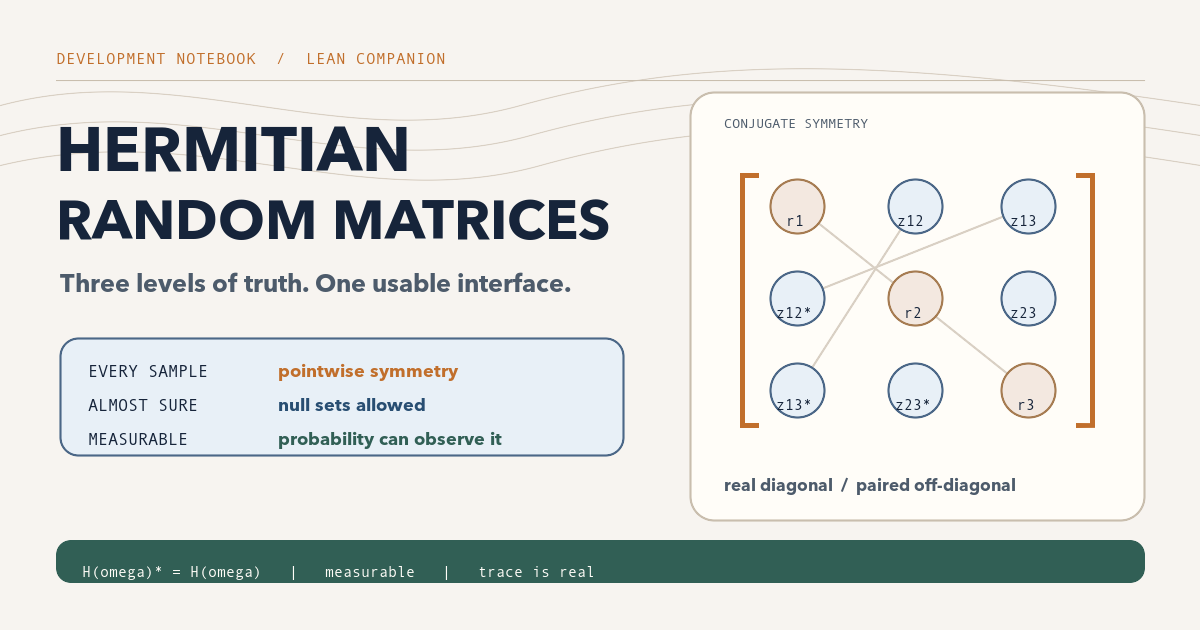
This entry is the code companion to
formalization/NonlinearDynamics/Random/RandomMatrices/Hermitian.lean.
Every major declaration in that source file is quoted or summarized below.
For the broader mathematical road from sample spaces to spectra, read the Random Matrices Deep Dive. This notebook entry has a narrower job: explain why this particular Lean file is shaped as it is, how each proof works, and what later formalizations may now reuse.
Choose your route
| Route | Start | What you will reach |
|---|---|---|
| First encounter | The mirror rule | Why Hermitian matrices have real diagonal entries |
| Probability route | Three levels of truth | Pointwise versus almost-sure assertions |
| Lean route | Open the module | Every major declaration and proof design |
| Algebra route | Congruence transforms | Why \(AHA^*\) is Hermitian without \(A\) being unitary |
| Builder route | Run the proof | Check the file with the pinned toolchain |
| Summit route | Limits and next steps | The exact runway toward observables and GUE |
Learning objectives
By the end, a reader should be able to:
- state Hermitian symmetry both as a matrix equality and entry by entry;
- distinguish pointwise, almost-sure, and measurable-Hermitian predicates;
- explain the Lean bridges from a universal proof to an almost-everywhere proof;
- derive why diagonal entries and finite traces are real;
- read the
HermitianRandomMatrixstructure, function coercion, and extensionality theorem; - verify measurability of trace and deterministic congruence transforms; and
- identify which distributional claims are still absent.
The summit map
flowchart BT
  A[Entrywise mirror rule] --> B[Hermitian at each sample]
  B --> C[Hermitian almost surely]
  D[Matrix-valued measurability] --> E[Measurable and Hermitian]
  B --> E
  E --> F[Bundled Hermitian random matrix]
  F --> G[Measurable entries]
  F --> H[Real measurable trace]
  F --> I[Hermitian congruence A X A*]
  J[Unnormalized symmetrization X + X*] --> E
Figure. The arrows are logical or constructor dependencies, not claims about probability laws. Pointwise Hermiticity implies the almost-sure form for any measure, while the reverse implication generally allows null-set exceptions. Measurability is a separate branch until the predicates or structure explicitly combine it with symmetry.
Base camp: the mirror rule
A Hermitian matrix \(H\) is fixed by its conjugate transpose :
\[ H^*=H. \]Entrywise, this is
\[ \overline{H_{ji}}=H_{ij}. \]The rule couples entries across the diagonal. A general two-by-two Hermitian matrix has the form
\[ H= \begin{bmatrix} a & z \\ \overline z & b \end{bmatrix}, \qquad a,b\in\mathbb R,\quad z\in\mathbb C. \]Setting \(i=j\) in the entrywise rule gives
\[ \overline{H_{ii}}=H_{ii}. \]A complex number equals its conjugate exactly when its imaginary part vanishes. Therefore every diagonal entry is real. Later, the module repeats the same fixed-by-conjugation move for the trace.
The official Mathlib definition is exactly the matrix equality \(H^*=H\), and
its API exposes both the entrywise theorem Matrix.IsHermitian.apply and the
if-and-only-if theorem Matrix.IsHermitian.ext_iff
(Mathlib Hermitian API).
Three levels of truth
Let \(X\) be a random matrix carrier, meaning a map from outcomes to square complex matrices:
\[ X:\Omega\longrightarrow\mathbb C^{\iota\times\iota}. \]The module separates three questions that ordinary prose often compresses into one sentence.
| Question | Mathematical form | Can exceptions occur? | Depends on a measure? |
|---|---|---|---|
| Is every realization Hermitian? | \(\forall \omega,\ X(\omega)^*=X(\omega)\) | No | No |
| Is it Hermitian almost surely? | \(X(\omega)^*=X(\omega)\) for \(\mu\)-a.e. \(\omega\) | Only on a null set | Yes |
| Is it measurable? | \(X\) is a measurable map | Not a symmetry claim | Uses the measurable structures, not a probability mass by itself |
The second row uses
almost everywhere
.
The third uses a
measurable space
on the
sample space and the entrywise measurable structure on matrices established in
RandomMatrices.Basic.
Open the module
The file begins with two imports:
import Mathlib.LinearAlgebra.Matrix.Trace
import NonlinearDynamics.Random.RandomMatrices.Basic
The project import supplies RandomMatrix, its entrywise measurable space,
measurable matrix operations, IsHermitianAE, and unnormalized Hermitian
symmetrization. The Mathlib import supplies finite matrix trace and the theorem
relating trace to conjugate transpose
(Mathlib trace API).
open Matrix MeasureTheory
open scoped Matrix

universe uΩ uι

namespace NonlinearDynamics.Random
namespace RandomMatrix

variable {Ω : Type uΩ} {ι : Type uι} [MeasurableSpace Ω]
open scoped Matrix activates notation such as Aᴴ. The universes keep the
sample type and index type general. The [MeasurableSpace Ω] parameter
supplies the structure required whenever a theorem says Measurable or
mentions a measure on \(\Omega\).
Why some theorems say omit
Several declarations begin like this:
omit [MeasurableSpace Ω] in
That marker records a useful negative fact: the theorem is purely algebraic or logical and its proof does not use the measurable-space instance. The same outcome type can therefore support the theorem before any probability-facing structure is relevant. This is dependency hygiene, not cosmetic syntax.
Layer one: Hermitian at every sample
The first project-level predicate is deliberately direct:
def IsHermitianEverywhere (X : RandomMatrix Ω ι ι ℂ) : Prop :=
  ∀ ω, (X ω).IsHermitian
Read it left to right. X accepts an outcome. X ω is one ordinary complex
matrix. Mathlib’s .IsHermitian checks that realization. The outer ∀ ω
forbids exceptional outcomes.
The entrywise characterization then exposes the mirror rule:
theorem isHermitianEverywhere_iff_entries
    (X : RandomMatrix Ω ι ι ℂ) :
    IsHermitianEverywhere X ↔
      ∀ ω i j, star (X ω j i) = X ω i j := by
  simp only [IsHermitianEverywhere, Matrix.IsHermitian.ext_iff]
Mathlib already contains the matrix-level equivalence. After unfolding the
project predicate, simp only applies that theorem at every outcome. There is
no entry-by-entry algebra to redo.
Layer two: descend safely to almost surely
RandomMatrices.Basic defines
def IsHermitianAE (X : RandomMatrix Ω ι ι ℂ) (μ : Measure Ω) : Prop :=
  ∀ᵐ ω ∂μ, (X ω).IsHermitian
Mathlib’s ∀ᵐ notation means that the property holds outside a set of
\(\mu\)-measure zero
(Mathlib almost-everywhere API). Pointwise truth is stronger,
so the bridge is short:
theorem IsHermitianEverywhere.isHermitianAE
    {X : RandomMatrix Ω ι ι ℂ}
    (hX : IsHermitianEverywhere X) (μ : Measure Ω) :
    IsHermitianAE X μ :=
  Filter.Eventually.of_forall hX
hX proves the predicate for every \(\omega\). Eventually.of_forall
places that universal proof inside any filter, including the almost-everywhere
filter belonging to \(\mu\). No property of the measure is required.
The converse is absent for a reason. An almost-sure proof may ignore a null
set, while IsHermitianEverywhere may not.
Layer three: combine symmetry with measurability
The file offers unbundled predicates for both strengths:
def IsMeasurableHermitian (X : RandomMatrix Ω ι ι ℂ) : Prop :=
  Measurable X ∧ IsHermitianEverywhere X

def IsMeasurableHermitianAE
    (X : RandomMatrix Ω ι ι ℂ) (μ : Measure Ω) : Prop :=
  Measurable X ∧ IsHermitianAE X μ
These are propositions about an existing map. They do not create a new data type. Their conjunction shape makes projection straightforward:
theorem IsMeasurableHermitian.isMeasurableHermitianAE
    {X : RandomMatrix Ω ι ι ℂ}
    (hX : IsMeasurableHermitian X) (μ : Measure Ω) :
    IsMeasurableHermitianAE X μ :=
  ⟨hX.1, hX.2.isHermitianAE μ⟩
The first component hX.1 is measurability. The second component hX.2 is
pointwise Hermiticity, which the preceding theorem lowers to the
almost-sure form.
The universal constructor
The basic module defines the unnormalized symmetrization
\[ \operatorname{sym}(X)(\omega)=X(\omega)+X(\omega)^*. \]This file packages the two existing facts about it:
theorem isMeasurableHermitian_hermitianSymmetrization
    {X : RandomMatrix Ω ι ι ℂ} (hX : Measurable X) :
    IsMeasurableHermitian (hermitianSymmetrization X) :=
  ⟨measurable_hermitianSymmetrization hX,
    hermitianSymmetrization_isHermitian X⟩
The first proof field follows from measurable addition and measurable conjugate transpose. The second is pointwise algebra:
\[ (A+A^*)^*=A^*+A=A+A^*. \]Extracting the algebraic consequences
Once pointwise Hermiticity is available, the reflected-entry theorem is a thin wrapper around Mathlib:
theorem IsHermitianEverywhere.star_entry
    {X : RandomMatrix Ω ι ι ℂ}
    (hX : IsHermitianEverywhere X) (ω : Ω) (i j : ι) :
    star (X ω j i) = X ω i j :=
  (hX ω).apply i j
hX ω specializes the random-matrix property to one realized matrix.
.apply i j then extracts the scalar equality at the chosen entries.
The diagonal proof as a change of language
theorem IsHermitianEverywhere.diagonal_im_eq_zero
    {X : RandomMatrix Ω ι ι ℂ}
    (hX : IsHermitianEverywhere X) (ω : Ω) (i : ι) :
    (X ω i i).im = 0 := by
  rw [← Complex.conj_eq_iff_im, ← Complex.star_def]
  exact hX.star_entry ω i i
The goal begins as a statement about an imaginary part. The first rewrite uses the equivalence
\[ \overline z=z\quad\Longleftrightarrow\quad\operatorname{Im}(z)=0. \]Because the arrow on rw points left, Lean changes the goal into a conjugation
fixed-point equality. Complex.star_def aligns generic star notation with
complex conjugation. The existing diagonal instance of star_entry closes the
goal. The supporting complex-number lemmas are documented in Mathlib’s official
complex API (Mathlib complex API).
Carrying consequences through a null set
The almost-sure entry theorem maps an implication over an existing eventual proof:
theorem isHermitianAE_star_entry
    {X : RandomMatrix Ω ι ι ℂ} {μ : Measure Ω}
    (hX : IsHermitianAE X μ) (i j : ι) :
    ∀ᵐ ω ∂μ, star (X ω j i) = X ω i j :=
  hX.mono fun _ hω ↦ hω.apply i j
For almost every outcome, hω says the realized matrix is Hermitian. The
function after .mono turns that matrix-level fact into the desired
entry-level fact without changing the exceptional set.
The diagonal theorem uses tactic syntax for the same pattern:
theorem isHermitianAE_diagonal_im_eq_zero
    {X : RandomMatrix Ω ι ι ℂ} {μ : Measure Ω}
    (hX : IsHermitianAE X μ) (i : ι) :
    ∀ᵐ ω ∂μ, (X ω i i).im = 0 := by
  filter_upwards [hX] with ω hω
  rw [← Complex.conj_eq_iff_im, ← Complex.star_def]
  exact hω.apply i i
filter_upwards brings an outcome and its Hermitian proof into the local
context. The remaining algebra is the pointwise diagonal argument again.
The trace ridge
For a finite square matrix,
\[ \operatorname{tr}(A)=\sum_i A_{ii}. \]The file proves both facts needed for a useful Hermitian trace observable: measurability for measurable finite matrices, and real-valuedness for Hermitian ones.
Why finite trace is measurable
theorem measurable_trace [Fintype ι]
    {X : RandomMatrix Ω ι ι ℂ} (hX : Measurable X) :
    Measurable fun ω ↦ Matrix.trace (X ω) := by
  simp only [Matrix.trace, Matrix.diag_apply]
  exact Finset.measurable_sum Finset.univ fun i _ ↦
    measurable_entry hX i i
The proof unfolds trace into a sum over Finset.univ. Each diagonal coordinate
is measurable by RandomMatrix.measurable_entry. A finite sum of measurable
complex-valued functions is measurable. [Fintype ι] is exactly what supplies
the finite index set.
Why a Hermitian trace is real
The central deterministic lemma is:
theorem star_trace_eq_of_isHermitian [Fintype ι]
    {A : Matrix ι ι ℂ} (hA : A.IsHermitian) :
    star (Matrix.trace A) = Matrix.trace A := by
  rw [← Matrix.trace_conjTranspose, hA.eq]
Mathlib proves
\[ \operatorname{tr}(A^*)=\overline{\operatorname{tr}(A)}. \]The backwards rewrite turns the left side of the goal into
\(\operatorname{tr}(A^*)\). Hermiticity supplies \(A^*=A\), exposed in Lean as
hA.eq. The trace is therefore fixed by conjugation, so its imaginary part is
zero.
The file applies that lemma at two strengths:
omit [MeasurableSpace Ω] in
theorem IsHermitianEverywhere.trace_im_eq_zero [Fintype ι]
    {X : RandomMatrix Ω ι ι ℂ} (hX : IsHermitianEverywhere X) (ω : Ω) :
    (Matrix.trace (X ω)).im = 0 := by
  rw [← Complex.conj_eq_iff_im, ← Complex.star_def]
  exact star_trace_eq_of_isHermitian (hX ω)

theorem isHermitianAE_trace_im_eq_zero [Fintype ι]
    {X : RandomMatrix Ω ι ι ℂ} {μ : Measure Ω}
    (hX : IsHermitianAE X μ) :
    ∀ᵐ ω ∂μ, (Matrix.trace (X ω)).im = 0 := by
  filter_upwards [hX] with ω hω
  rw [← Complex.conj_eq_iff_im, ← Complex.star_def]
  exact star_trace_eq_of_isHermitian hω
The pointwise theorem specializes hX at one outcome. The almost-sure theorem
uses filter_upwards, proving the same deterministic statement at every
outcome outside the inherited null set.
The bundle: carry evidence with the object
Unbundled predicates are ideal when a theorem starts with an existing function. Repeated construction is easier when the data and its invariants travel together. The file therefore introduces:
structure HermitianRandomMatrix
    (Ω : Type uΩ) (ι : Type uι) [MeasurableSpace Ω] where
  toRandomMatrix : RandomMatrix Ω ι ι ℂ
  measurable_toRandomMatrix : Measurable toRandomMatrix
  isHermitian : RandomMatrix.IsHermitianEverywhere toRandomMatrix
This structure stores one map and two proofs. It chooses pointwise Hermiticity,
the strongest predicate in the module. The documentation explicitly directs
measure-dependent null-set use cases toward
RandomMatrix.IsMeasurableHermitianAE instead.
Use a bundle like a function
instance : CoeFun (HermitianRandomMatrix Ω ι)
    fun _ ↦ Ω → Matrix ι ι ℂ where
  coe X := X.toRandomMatrix
The CoeFun instance lets Lean insert the projection automatically, so X ω
means X.toRandomMatrix ω. The official Lean manual describes this same
function-coercion pattern for bundled morphisms
(Lean type classes).
The simplification theorem
@[simp]
theorem coe_toRandomMatrix (X : HermitianRandomMatrix Ω ι) :
    (X.toRandomMatrix : Ω → Matrix ι ι ℂ) = X := rfl
states that the projection and the function view are definitionally the same. The right side is coerced to a function because the expected type is already a function type.
Equality follows the underlying realizations
@[ext]
theorem ext {X Y : HermitianRandomMatrix Ω ι}
    (h : ∀ ω, X ω = Y ω) : X = Y := by
  cases X
  cases Y
  congr
  funext ω
  exact h ω
The theorem turns equality of bundles into the natural mathematical test:
their realized matrices agree for every outcome. After both structures are
opened, funext converts pointwise equality into equality of the stored
functions. Proof fields live in Prop, so they do not create a second notion
of mathematical equality. The @[ext] attribute registers this theorem for
future extensionality proofs. Lean’s official structures chapter explains the
underlying record model (Lean structures).
The bundled projection lemmas
The next declarations make the stored evidence easy to consume:
| Declaration | What it returns | Evidence reused |
|---|---|---|
measurable_entry | Every scalar entry is measurable | measurable_toRandomMatrix |
isHermitianAE | Hermitian almost surely for any measure | pointwise isHermitian |
isMeasurableHermitianAE | Measurable and Hermitian almost surely | both structure fields |
star_entry | Conjugate symmetry at each sample | pointwise isHermitian |
diagonal_im_eq_zero | Real diagonal entries | pointwise isHermitian |
measurable_trace | A measurable complex trace | measurable structure field |
trace_im_eq_zero | A real trace at every sample | pointwise structure field |
These theorems are intentionally short. The bundle’s purpose is to pay for the foundational obligations once and then route later proofs through projections.
Two bundled constructors
Package symmetrization
def ofSymmetrization
    (X : RandomMatrix Ω ι ι ℂ) (hX : Measurable X) :
    HermitianRandomMatrix Ω ι where
  toRandomMatrix := RandomMatrix.hermitianSymmetrization X
  measurable_toRandomMatrix :=
    RandomMatrix.measurable_hermitianSymmetrization hX
  isHermitian :=
    RandomMatrix.hermitianSymmetrization_isHermitian X
The constructor asks for a convenient sufficient premise: measurability of the input. Algebra supplies Hermiticity automatically. This premise is not logically necessary for every possible input, since cancellation can make a symmetrization measurable even when the original map is not. No measure is necessary for the Hermitian conclusion because it holds at every sample.
A congruence transform that preserves Hermiticity
For a deterministic complex matrix \(A\), define
\[ Y(\omega)=A\,X(\omega)\,A^*. \]The module packages this construction:
def conjugateBy [Fintype ι]
    (A : Matrix ι ι ℂ) (X : HermitianRandomMatrix Ω ι) :
    HermitianRandomMatrix Ω ι where
  toRandomMatrix := fun ω ↦ A * X ω * Aᴴ
  measurable_toRandomMatrix :=
    RandomMatrix.measurable_mul
      (RandomMatrix.measurable_mul
        (RandomMatrix.measurable_const (Ω := Ω) A)
        X.measurable_toRandomMatrix)
      (RandomMatrix.measurable_const (Ω := Ω) Aᴴ)
  isHermitian := fun ω ↦
    Matrix.isHermitian_mul_mul_conjTranspose A (X.isHermitian ω)
The algebra is worth doing in full. If \(H^*=H\), then
\[ \begin{aligned} (AHA^*)^* &= (A^*)^* H^* A^* \\ &= AHA^*. \end{aligned} \]No inverse appears. No unitary equation appears. Any square \(A\) gives a
Hermitian congruence transform. Mathlib’s theorem
Matrix.isHermitian_mul_mul_conjTranspose packages precisely that algebra
(Mathlib Hermitian API).
Measurability is built from the inside out:
- the deterministic matrix \(A\) is a measurable constant;
- the stored matrix \(X\) is measurable;
- finite matrix multiplication makes \(AX\) measurable;
- \(A^*\) is another measurable constant; and
- a second finite multiplication makes \(AXA^*\) measurable.
Worked algebra: Hermitian does not mean invariant
Take
\[ H= \begin{bmatrix} a & z \\ \overline z & b \end{bmatrix}, \qquad A= \begin{bmatrix} 2 & 0 \\ 0 & 1 \end{bmatrix}. \]Because \(A^*=A\),
\[ AHA^*= \begin{bmatrix} 4a & 2z \\ 2\overline z & b \end{bmatrix}. \]The result is still Hermitian. Its trace is \(4a+b\), which generally differs from \(a+b\). This is why the constructor’s theorem must not be misread as trace invariance, spectral invariance, or distributional invariance.
Declaration inventory
The module’s public story can be read as four layers.
| Layer | Declarations | Design job |
|---|---|---|
| Predicates | IsHermitianEverywhere, IsMeasurableHermitian, IsMeasurableHermitianAE | Separate algebraic strength from probability-facing structure |
| Bridges | isHermitianEverywhere_iff_entries, .isHermitianAE, .isMeasurableHermitianAE, isMeasurableHermitian_hermitianSymmetrization | Move between entrywise, pointwise, almost-sure, and measurable views |
| Consequences | star_entry, diagonal_im_eq_zero, their a.e. forms, measurable_trace, star_trace_eq_of_isHermitian, the two trace-realness theorems | Expose reusable scalar observables and symmetry facts |
| Bundle API | HermitianRandomMatrix, coercion, ext, projections, ofSymmetrization, conjugateBy | Make later modules construct and consume certified objects |
That separation is the main proof-engineering result. Each later theorem can request the weakest interface it needs instead of unfolding one oversized definition.
Run the proof yourself
From the repository root, activate the pinned elan environment and check only this file with warnings treated as errors:
source "$HOME/.elan/env"
cd formalization
lake env lean -DwarningAsError=true \
  NonlinearDynamics/Random/RandomMatrices/Hermitian.lean
From the repository root, build the entire formalization with:
cd formalization
lake build
A successful file check returns to the shell without diagnostic output. A full
lake build prints its build progress and final status. The exact Lean release
is pinned in formalization/lean-toolchain, and Mathlib is pinned in
formalization/lakefile.toml.
A scratch theorem to try
Create a temporary file inside formalization/ with this import and example:
import NonlinearDynamics.Random.RandomMatrices.Hermitian

open Matrix MeasureTheory
open scoped Matrix

namespace Scratch

open NonlinearDynamics.Random

variable {Ω ι : Type} [MeasurableSpace Ω]

example [Fintype ι] (X : HermitianRandomMatrix Ω ι) (ω : Ω) :
    (Matrix.trace (X ω)).im = 0 := by
  exact X.trace_im_eq_zero ω

end Scratch
Run it with lake env lean YourScratchFile.lean. The exercise illustrates the
benefit of bundling: the final proof names the theorem that matches the
intended mathematics and does not reopen any matrix entries.
What this module does not claim
This boundary is as important as the successful proofs.
- It defines no probability distribution or pushforward law on matrix space.
- It imposes no Gaussianity, independence, identical distribution, variance, or dimension normalization.
- It does not define GOE or GUE.
- Its symmetrization is explicitly unnormalized.
- Its bundle requires Hermiticity at every sample, not merely almost surely.
- Its congruence matrix \(A\) is deterministic. The file does not handle a random change of basis.
- It proves no unitary invariance in law.
- It proves trace measurability and realness, not integrability or existence of expected trace moments.
- It contains no eigenvalue measurability theorem and does not import the spectral theorem.
- Matrix multiplication and trace results here are finite-dimensional.
The broader Deep Dive explains why these missing layers matter before one can claim GUE, spectral statistics, or quantum-chaos results. The official Mathlib spectrum module already contains finite Hermitian diagonalization, but that result is a future dependency, not a theorem proved by this file (Mathlib spectrum API).
The next ridge
The immediate project module RandomMatrices.Observables builds trace powers
on top of the trace interface proved here. The next ensemble-facing ascent then needs:
- probability laws for scalar primitives and matrices;
- an explicit finite index such as
Fin n; - Gaussian diagonal and off-diagonal variables with a stated convention;
- independence on the primitive coordinates;
- a normalization ledger;
- equality in law under unitary conjugation; and
- integrability before expected trace moments are formed.
The present module prepares that climb by recording Hermitian structure as an explicit predicate on every sample. Every future ensemble must say which symmetry predicate it has, how measurability is obtained, and whether a statement is pointwise or only almost sure.
Exercises: foothills to summit
1. Mirror the entry
For
\[ H= \begin{bmatrix} 3 & 1+2i \\ ? & -4 \end{bmatrix}, \]fill the missing entry so that \(H\) is Hermitian. Then state which Lean theorem
extracts the equality you used from an IsHermitianEverywhere hypothesis.
Hint and answer
The missing entry is \(1-2i\). The project theorem is
RandomMatrix.IsHermitianEverywhere.star_entry, which delegates to
Matrix.IsHermitian.apply for the realized matrix.
2. Break the false converse
Give a conceptual example of a matrix-valued map that is Hermitian almost everywhere under a continuous measure but not Hermitian everywhere.
Hint and answer
Start with a constant Hermitian map and change its value at one outcome to a non-Hermitian matrix. Under a measure that assigns that singleton measure zero, the modified map can remain Hermitian almost everywhere while failing the pointwise predicate. A complete Lean construction would also need to establish measurability of the modification.
3. Find the finite hypothesis
Why does measurable_trace assume [Fintype ι] while
IsHermitianEverywhere.diagonal_im_eq_zero does not?
Hint and answer
One diagonal entry is local and needs only an index. Trace sums over all
indices, so this implementation uses Finset.univ and finite-sum measurability.
4. Predict the weakest premise
Suppose a theorem needs only that trace (X ω) is real for almost every
outcome. Should its input be a HermitianRandomMatrix,
IsHermitianEverywhere X, or IsHermitianAE X μ?
Hint and answer
IsHermitianAE X μ is the weakest of those premises that directly supports
the desired conclusion through isHermitianAE_trace_im_eq_zero. Requesting a
bundle would unnecessarily require measurability and pointwise symmetry.
5. Congruence versus similarity
Show algebraically that \(AHA^*\) is Hermitian for arbitrary square \(A\). Then name the extra equation that makes the same operation a unitary similarity transform.
Hint and answer
Use \((BCD)^*=D^*C^*B^*\), \(H^*=H\), and \((A^*)^*=A\). For a unitary matrix, the extra equation is \(A^*=A^{-1}\). Only then can \(AHA^*\) be read as \(AHA^{-1}\).
6. Extend the API
Draft the statement of a theorem saying that the real part of every entry of a
bundled Hermitian random matrix is measurable. Which existing theorem should
be composed with continuity of Complex.re?
Hint
Begin with X.measurable_entry i j. Then compose it with the official Mathlib
measurability or continuity theorem for the real-part projection. The task is
to find the exact library declaration before writing a proof.
References
Every external source below was opened and checked against the claim it supports on 2026-07-20. Generated Mathlib documentation can move with later releases, so the repository’s Mathlib 4.32.0 pin remains the build authority.
Mathlib contributors.
Mathlib 4.32.0 release,
2026. This is the exact dependency release named by lakefile.toml.
Mathlib contributors.
Hermitian matrices,
Mathlib 4 documentation. This is the official API source for
Matrix.IsHermitian, its entrywise forms, and
Matrix.isHermitian_mul_mul_conjTranspose.
Mathlib contributors.
Conjugate transpose,
Mathlib 4 documentation. This defines Matrix.conjTranspose, the ᴴ notation,
entry lookup, involution, and reversal of multiplication order.
Mathlib contributors.
Matrix trace,
Mathlib 4 documentation. This is the official source for
Matrix.trace_conjTranspose and the finite trace interface.
Mathlib contributors.
Complex numbers,
Mathlib 4 documentation. This documents Complex.conj_eq_iff_im and
Complex.star_def, used to turn conjugation fixed points into realness.
Mathlib contributors.
The almost-everywhere filter,
Mathlib 4 documentation. This defines ∀ᵐ ω ∂μ, P ω as truth outside a
\(\mu\)-null set and explains its reduction to Filter.Eventually.
Mathlib contributors.
Spectral theory of matrices,
Mathlib 4 documentation. This official module contains finite Hermitian
eigenvalue and diagonalization results. It is cited as future infrastructure,
not as content proved in RandomMatrices.Hermitian.
Lean developers. Structures and records, Theorem Proving in Lean 4. This is the official language guide for structure declarations and their generated projections.
Lean developers.
Type classes,
Theorem Proving in Lean 4. Its coercion section documents CoeFun, the
mechanism that lets a bundled object be applied like its underlying function.