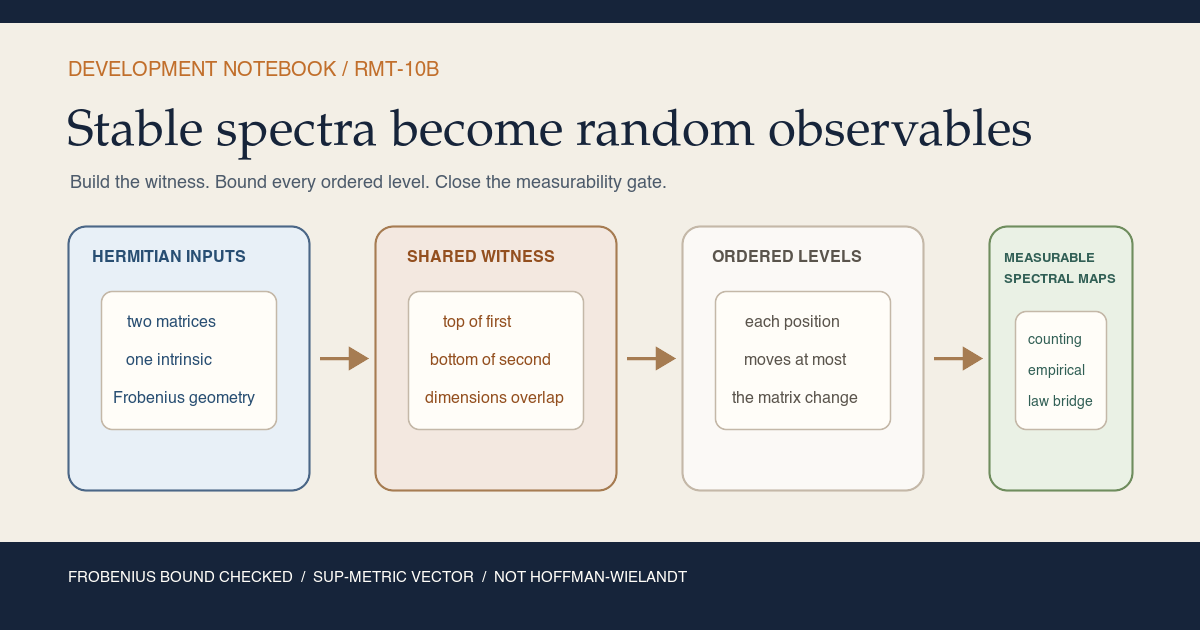
This is the proof-to-prose companion for
formalization/NonlinearDynamics/Random/RandomMatrices/HermitianSpectrumContinuity.lean.
It maps all fourteen public theorems and the eighteen private definitions and
proof helpers in source order.
The immediate predecessor, Ordered Hermitian Spectra in Lean, constructed the ordered spectrum and its finite measures while leaving coordinatewise measurability explicit. RMT-10B preserves that interface and supplies exactly the missing theorem. Reusable background appears under empirical-spectral-measure , hermitian-matrix , hermitian-frobenius-geometry , weyl-eigenvalue-bound , measurable-space , pushforward-measure , and probability-law .
Its immediate successor, Finite Gaussian Unitary Ensemble Spectral Laws in Lean, uses the completed measurability bridge to name the law of the random empirical measure, construct its Giry barycenter, and transport the first two exact normalized GUE moments.
Choose a route up
| Route | Begin | Destination |
|---|---|---|
| First encounter | The stability question | Understand why sorted roots need perturbation control |
| Physics route | Energy levels under a finite perturbation | Read the theorem as a deterministic Hamiltonian error bar |
| Geometry route | The dimension count that creates a witness | See why top and bottom spectral subspaces must meet |
| Variational route | Quadratic forms bracket the ordered level | Follow the finite min-max mechanism without importing a black box |
| Norm route | A vector is a one-column matrix | Derive the Frobenius matrix-vector estimate |
| Metric route | One bound, two Lipschitz theorems | Distinguish scalar and full-vector codomain metrics |
| Probability route | Closing the measurability gate | Turn pointwise spectra into random measure-valued observables |
| Lean route | The complete declaration map | Audit all public and private declarations |
| Integrity route | Strict nonclaims | Separate this theorem from stronger perturbation results |
Learning objectives
By the summit, a reader should be able to:
- state the exact Frobenius perturbation bound for each decreasingly ordered Hermitian eigenvalue;
- explain why ordering by value survives degeneracies even when individual eigenvector labels do not;
- describe how Mathlib’s orthonormal eigenbasis is reindexed to match
orderedHermitianEigenvalues; - derive the weighted quadratic-form expansion in that basis;
- identify the top \(i+1\) and bottom \(n-i\) spectral subspaces;
- prove that those subspaces have a nonzero intersection by dimension;
- use support vanishing to bracket the quadratic form by the \(i\)-th eigenvalue;
- derive a Frobenius matrix-vector bound by treating a vector as a one-column matrix;
- control the difference of two Hermitian quadratic forms;
- cancel the squared norm of a nonzero witness without hiding positivity;
- obtain an absolute bound by swapping the two matrices;
- read the scalar
LipschitzWith 1theorem in the real metric; - read the vector
LipschitzWith 1theorem in the product sup metric; - distinguish this result from the Hoffman-Wielandt Euclidean matching inequality and the sharper operator-norm Weyl estimate;
- follow the implication from Lipschitz to continuous to measurable;
- see how one coordinatewise measurability theorem discharges all four measure-valued interfaces from RMT-10A;
- explain the unconditional ambient/intrinsic GUE pushforward equality; and
- state precisely what remains unproved about eigenvectors, gaps, densities, and large-dimension behavior.
The stability question
RMT-10A supplied a function
\[ H\longmapsto \bigl(\lambda_0(H),\ldots,\lambda_{n-1}(H)\bigr), \]where the real eigenvalues are listed in decreasing order and repeated according to algebraic multiplicity. That definition answers the static question: what ordered spectrum belongs to one Hermitian matrix?
The analytic question compares two matrices. If \(A\) and \(B\) are close in the intrinsic Frobenius geometry, must their \(i\)-th ordered eigenvalues be close? RMT-10B proves
\[ \left|\lambda_i(A)-\lambda_i(B)\right| \le \left\|A-B\right\|_{\mathrm F}. \]This has the coordinate-stability shape associated with the classical
Hermitian eigenvalue inequalities initiated by
Weyl (1912), but the checked right side is specifically the
Frobenius norm produced by this module’s direct argument.
The norm on the right is the norm already carried by
HermitianEuclidean n. RMT-07 built that intrinsic real Euclidean space from
ambient Frobenius coordinates, so no new metric is chosen here. The bound is
uniform in the index, includes repeated eigenvalues, and is vacuous in
dimension zero because there is no i : Fin 0.
The result does three jobs. It is a deterministic error estimate for finite Hermitian spectra. It makes each ordered coordinate continuous. Finally, it makes the spectrum a measurable random observable, supplying the regularity required by the measure-valued constructions from RMT-10A.
Continuity is not obtained by saying only that polynomial roots “vary continuously.” Sorted repeated roots need an actual theorem, especially at collisions. The perturbation inequality provides a quantitative result that remains valid exactly where eigenvector labels become ambiguous.
flowchart LR
  A["two intrinsic Hermitian matrices"] --> B["ordered eigenbases"]
  B --> C["top and bottom spectral subspaces"]
  C --> D["nonzero intersection witness"]
  D --> E["one-sided level bound"]
  E --> F["absolute Frobenius bound"]
  F --> G["1-Lipschitz ordered spectrum"]
  G --> H["continuity and measurability"]
  H --> I["unconditional random spectral measures"]
Figure. The proof does not call an opaque eigenvalue-continuity oracle. It creates one vector that lies in a top spectral subspace for the first matrix and a bottom spectral subspace for the second, controls its two quadratic forms, and then transports the coordinate estimate through topology and probability.
Energy levels under a finite perturbation
In finite quantum mechanics, a Hermitian matrix represents an observable, and a finite Hamiltonian’s eigenvalues are its possible energy levels. Suppose a model Hamiltonian \(H\) is replaced by \(H+E\), where \(E\) collects a field perturbation, truncation error, calibration error, or numerical approximation. The checked bound implies, for every ordered level,
\[ \left|\lambda_i(H+E)-\lambda_i(H)\right| \le \left\|E\right\|_{\mathrm F}. \]This is a worst-case deterministic certificate. It needs no distribution for the perturbation, no nondegeneracy assumption, and no first-order expansion. If two levels collide, the ordered list still moves continuously. What can fail at a collision is a persistent identity for a particular eigenvector or eigenstate, not the ordered numerical spectrum.
The distinction matters physically. A small perturbation can rotate an eigenbasis dramatically inside a nearly degenerate subspace while moving every energy level only slightly. RMT-10B controls the latter. It proves no eigenvector angle bound, spectral-projector estimate, adiabatic theorem, or selection rule.
As a paper consequence, if two adjacent levels of \(H\) are separated by more than \(2\varepsilon\) and \(\left\|E\right\|_{\mathrm F}\le\varepsilon\), their ordered gap cannot close. This elementary corollary is not exported as a named Lean theorem. It says nothing about random level repulsion or universal spacing statistics.
An ordered orthonormal eigenbasis
The first private definition is orderedHermitianEigenvectorBasis. Mathlib
supplies an orthonormal eigenbasis for the symmetric linear map associated
with a Hermitian matrix
(Mathlib spectrum documentation). RMT-10B reindexes
that basis by the same order-preserving finite cast used for
orderedHermitianEigenvalues.
This alignment is structural. A top subspace spanned by indices at most \(i\)
means nothing unless basis index \(j\) carries ordered eigenvalue
\(\lambda_j\). The theorem
orderedHermitianEigenvectorBasis_repr_mulVec proves
Lean represents vectors in EuclideanSpace ℂ (Fin n) with an Lp wrapper,
so the theorem visibly passes through WithLp.toLp. The underlying statement
is familiar: in an eigenbasis, applying \(H\) multiplies each coordinate by
its eigenvalue.
The private scalar helper re_inner_real_mul_self proves
for \(r\in\mathbb R\) and \(z\in\mathbb C\). It is the local bridge between a complex inner product and the real quadratic form of a Hermitian operator.
Combining coordinate action, preservation of inner products by the basis
representation, and the finite PiLp formula,
hermitian_quadratic_eq_weighted_sum obtains
Nonnegativity of these weights is the input to both variational inequalities.
Spectral subspaces from index intervals
Fix \(i : \operatorname{Fin}(n)\). The private definitions select two pieces of an ordered eigenbasis:
\[ T_i(H)=\operatorname{span}\{e_j(H):j\le i\}, \qquad B_i(H)=\operatorname{span}\{e_j(H):i\le j\}. \]Their Lean names are orderedTopEigenSubspace and
orderedBottomEigenSubspace. The top space includes the first \(i+1\)
eigenvectors. The bottom space includes the final \(n-i\) eigenvectors. Both
include the \(i\)-th position.
The interval types are Set.Iic i and Set.Ici i. This is one reason the
order-preserving basis reindexing was necessary. An arbitrary equivalence
would preserve cardinality but destroy the meaning of these intervals.
The simp theorems finrank_orderedTopEigenSubspace and
finrank_orderedBottomEigenSubspace prove
Each uses finrank_span_eq_card. Orthonormality gives linear independence,
composition with subtype inclusion keeps the selected family independent,
and finite interval cardinality completes the calculation.
The helpers orderedTopEigenSubspace_eq_span_image and
orderedBottomEigenSubspace_eq_span_image rewrite the subtype-indexed ranges
into ordinary basis-image spans. Then
ordered_repr_eq_zero_of_mem_top says that \(x\in T_i(H)\) and \(i\lt j\)
force coordinate \(j\) to vanish. Dually,
ordered_repr_eq_zero_of_mem_bottom says that \(x\in B_i(H)\) and \(j\lt i\)
force coordinate \(j\) to vanish. Both ask the underlying basis for a
support-subset theorem and contradict any forbidden nonzero coordinate.
This explicit layer closes a gap paper proofs often suppress. Membership in a span and vanishing of representation coordinates are related facts, not the same expression to Lean.
Quadratic forms bracket the ordered level
On the top subspace, only indices \(j\le i\) contribute. Antitonicity gives \(\lambda_j(H)\ge\lambda_i(H)\), so
\[ \lambda_i(H)\lVert x\rVert^2\le q_H(x) \qquad\text{for }x\in T_i(H). \]This is
ordered_eigenvalue_mul_norm_sq_le_quadratic_of_mem_top. The proof transports
the norm through the orthonormal representation, expands the Euclidean norm
square, distributes \(\lambda_i(H)\), and compares each term. Forbidden
coordinates are zero, so they close even where the eigenvalue order points the
other way.
On the bottom subspace, only \(j\ge i\) contributes and
\(\lambda_j(H)\le\lambda_i(H)\). The dual theorem
quadratic_le_ordered_eigenvalue_mul_norm_sq_of_mem_bottom proves
These two inequalities are the finite variational engine. The module does not export a general Courant-Fischer formula involving extrema over all subspaces. It proves exactly the brackets needed by the perturbation theorem.
The dimension count that creates a witness
For two matrices \(A\) and \(B\), consider \(T_i(A)\cap B_i(B)\). Its two source dimensions add to
\[ (i+1)+(n-i)=n+1. \]Two subspaces of an \(n\)-dimensional space with dimensions totaling \(n+1\)
cannot be disjoint. The private theorem ordered_top_inf_bottom_ne_bot
formalizes this by contradiction. If the intersection were bottom, Mathlib’s
Submodule.finrank_add_finrank_le_of_disjoint would force \(n+1\le n\)
(finite-dimensional lemmas). omega closes the
impossible arithmetic.
Choose a nonzero \(x\) in the intersection. It satisfies
\[ \lambda_i(A)\lVert x\rVert^2\le q_A(x), \qquad q_B(x)\le\lambda_i(B)\lVert x\rVert^2. \]It need not be an eigenvector of either matrix. It is a dimension-forced variational witness located in two different spectral subspaces.
flowchart TD
  V["ambient complex space: dimension n"]
  T["top space of A: dimension i plus one"]
  B["bottom space of B: dimension n minus i"]
  X["shared nonzero vector"]
  V --> T
  V --> B
  T --> X
  B --> X
  X --> L["A form: lower bracket at ordered level i"]
  X --> U["B form: upper bracket at ordered level i"]
Figure. The selected dimensions sum to one more than the ambient dimension, forcing a nonzero intersection. Membership in the top space of the first matrix and the bottom space of the second supplies opposite quadratic-form bounds at the same ordered index.
A vector is a one-column matrix
The first public theorem, norm_mulVec_le_frobenius, states:
theorem norm_mulVec_le_frobenius {n : ℕ}
    (A : Matrix (Fin n) (Fin n) ℂ)
    (x : EuclideanSpace ℂ (Fin n)) :
    ‖WithLp.toLp 2 (A *ᵥ x)‖ ≤
      ‖matrixToFrobenius A‖ * ‖x‖
The proof uses a clean matrix trick. Regard \(x\) as an \(n\)-by-one matrix by
replicating it over Fin 1. Matrix-vector multiplication then becomes
ordinary matrix multiplication:
Mathlib proves Frobenius submultiplicativity,
\[ \lVert AC\rVert_{\mathrm F} \le\lVert A\rVert_{\mathrm F}\lVert C\rVert_{\mathrm F}, \]and identifies the Frobenius norm of a replicated one-column matrix with the
Euclidean vector norm
(Mathlib matrix norms). The private helper
norm_matrixToFrobenius_eq_frobenius aligns the project’s Frobenius carrier
with Mathlib’s matrix norm by expanding the same finite sum of squared entry
norms.
The theorem is reusable beyond this proof, which is why it is public. Its norm is specifically the Frobenius norm selected in the statement. No claim is made that this is the best matrix norm constant.
Comparing two quadratic forms
The private definition hermitianQuadratic names
For fixed \(x\), subtraction and linearity give
\[ q_A(x)-q_B(x) {} = \operatorname{Re}\langle x,(A-B)x\rangle. \]The helper abs_hermitianQuadratic_sub_le_frobenius combines three bounds:
The first bounds the real part by the complex norm. The second is
Cauchy-Schwarz. The third invokes norm_mulVec_le_frobenius. Lean also proves
explicitly that subtracting the two wrapped matrix-vector products equals
applying the matrix difference.
Insert the nonzero intersection witness. The top and bottom brackets give
\[ \bigl(\lambda_i(A)-\lambda_i(B)\bigr)\lVert x\rVert^2 \le \lVert A-B\rVert_{\mathrm F}\lVert x\rVert^2. \]Because \(x\ne0\), its squared norm is strictly positive. Lean records this
with norm_pos_iff, squares the positive value, and uses
mul_le_mul_iff_of_pos_right to cancel it. The public one-sided theorem is:
theorem orderedHermitianEigenvalues_le_add_frobenius {n : ℕ}
    (A B : HermitianEuclidean n) (i : Fin n) :
    orderedHermitianEigenvalues A i ≤
      orderedHermitianEigenvalues B i + ‖A - B‖
Swap \(A\) and \(B\), rewrite
\(\lVert B-A\rVert=\lVert A-B\rVert\), and combine the directions with
abs_le:
theorem abs_orderedHermitianEigenvalues_sub_le_frobenius {n : ℕ}
    (A B : HermitianEuclidean n) (i : Fin n) :
    |orderedHermitianEigenvalues A i -
      orderedHermitianEigenvalues B i| ≤ ‖A - B‖
This quantitative theorem is the summit from which the topological and probability results descend.
One bound, two Lipschitz theorems
Mathlib’s LipschitzWith K f means that output distance is at most \(K\)
times input distance, with K : ℝ≥0
(Mathlib Lipschitz documentation). RMT-10B exports
two constant-one theorems.
lipschitzWith_orderedHermitianEigenvalues_apply i fixes an index. The
codomain is \(\mathbb R\), so distance is absolute difference:
lipschitzWith_orderedHermitianEigenvalues keeps the whole function
Fin n → ℝ. This finite function space carries the product sup metric:
The proof uses dist_pi_le_iff and applies the coordinate theorem at every
index. Therefore
Why this is not Hoffman-Wielandt
Hoffman and Wielandt’s original theorem concerns a Euclidean sum of squared spectral displacements for normal matrices after matching their spectra (Hoffman and Wielandt, 1953). For Hermitian matrices, ordered matching gives the familiar shape
\[ \sum_i\left|\lambda_i(A)-\lambda_i(B)\right|^2 \le \lVert A-B\rVert_{\mathrm F}^2. \]RMT-10B does not prove that statement. Its vector result is
\[ \max_i\left|\lambda_i(A)-\lambda_i(B)\right| \le \lVert A-B\rVert_{\mathrm F}. \]| Result | Spectral output metric | Matrix input metric | Status here |
|---|---|---|---|
| RMT-10B coordinate bound | One absolute coordinate | Frobenius | Proved |
| RMT-10B vector bound | Product sup metric | Frobenius | Proved |
| Hoffman-Wielandt shape | Euclidean matched spectrum | Frobenius | Not proved |
| Sharp Weyl perturbation shape | Sup ordered spectrum | Operator norm | Not proved |
Coordinatewise Frobenius control gives only a dimension-dependent Euclidean estimate if one separately sums the same bound. It does not recover the constant-one Hoffman-Wielandt theorem. Conversely, the checked result is already sufficient for continuity and measurability.
Closing the measurability gate
A Lipschitz map is continuous. A continuous map between these Borel spaces is measurable. RMT-10B exports both steps at scalar and vector level:
continuous_orderedHermitianEigenvalues_apply;continuous_orderedHermitianEigenvalues;measurable_orderedHermitianEigenvalues_apply; andmeasurable_orderedHermitianEigenvalues.
The scalar theorem has exactly the hypothesis type required by RMT-10A:
∀ i, Measurable (fun H : HermitianEuclidean n =>
  orderedHermitianEigenvalues H i)
RMT-10A deliberately kept this assumption visible. RMT-10B invokes each
conditional interface with
measurable_orderedHermitianEigenvalues_apply:
measurable_spectralCountingMeasureproves that the finite sum of eigenvalue Dirac masses is measurable.measurable_empiricalSpectralMeasureproves measurability after the zero-aware inverse-dimension scaling.measurable_empiricalSpectralProbabilityproves measurability of the positive-dimensional bundled probability measure.measurable_ambientEmpiricalSpectralMeasureproves measurability after the Hermitian-or-zero totalization on ambient matrices.
Finite summation, normalization, probability bundling, and ambient totalization are not reproved. That separation supports the RMT-10A design: one explicit analytic gate now opens every measure-valued route.
flowchart TD
  W["coordinate Frobenius bound"] --> LC["coordinate 1-Lipschitz"]
  W --> LV["ordered vector 1-Lipschitz in sup metric"]
  LC --> CC["coordinate continuity"]
  LV --> CV["vector continuity"]
  CC --> MC["coordinate measurability"]
  CV --> MV["vector measurability"]
  MC --> S["spectral counting measure measurable"]
  MC --> E["empirical spectral measure measurable"]
  MC --> P["positive-dimensional probability wrapper measurable"]
  MC --> A["ambient empirical observable measurable"]
Figure. The public dependency graph keeps scalar and vector topology separate. RMT-10A's Giry interfaces consume the scalar coordinate theorem, while full-vector measurability remains available for later finite spectral statistics.
The unconditional GUE pushforward bridge
RMT-10A proved, under coordinatewise measurability, that two routes to a law on real-line measures agree:
\[ \operatorname{map}\! \left(\operatorname{GUE.matrixLaw}(n), \operatorname{ambientEmpiricalSpectralMeasure}(n)\right) {} = \operatorname{map}\! \left(\operatorname{GUE.intrinsicLaw}(n), \operatorname{empiricalSpectralMeasure}\right). \]Its conditional theorem is named
map_matrixLaw_ambientEmpiricalSpectralMeasure_eq_map_intrinsicLaw_of_measurable_eigenvalues.
RMT-10B supplies the hypothesis and exports the clean unconditional theorem
map_matrixLaw_ambientEmpiricalSpectralMeasure_eq_map_intrinsicLaw.
The left route samples an ambient GUE matrix and applies its totalized spectral observable. The right samples an intrinsic Hermitian GUE matrix and applies the intrinsic empirical measure. Their pushforward distributions agree.
The theorem does not yet give that common law a new finite-GUE spectral-law definition. It does not compute an average measure or a density. It closes the measurability and representation seam so the next slice can define and study that law without carrying an assumption.
The complete declaration map
The module exports fourteen theorems and keeps eighteen proof components private. It adds no public definitions because RMT-10A already designed the spectral objects.
Public API
| Declaration | Exact role |
|---|---|
norm_mulVec_le_frobenius | Bounds a complex matrix-vector product by Frobenius matrix norm times Euclidean vector norm |
orderedHermitianEigenvalues_le_add_frobenius | Gives the one-sided ordered-coordinate perturbation inequality |
abs_orderedHermitianEigenvalues_sub_le_frobenius | Gives the absolute coordinatewise Frobenius perturbation bound |
lipschitzWith_orderedHermitianEigenvalues_apply | Packages one ordered coordinate as LipschitzWith 1 |
lipschitzWith_orderedHermitianEigenvalues | Packages the full ordered vector as LipschitzWith 1 in the product sup metric |
continuous_orderedHermitianEigenvalues_apply | Derives continuity of one ordered coordinate |
continuous_orderedHermitianEigenvalues | Derives continuity of the full ordered vector |
measurable_orderedHermitianEigenvalues_apply | Derives coordinatewise Borel measurability |
measurable_orderedHermitianEigenvalues | Derives Borel measurability of the full ordered vector |
measurable_spectralCountingMeasure | Discharges RMT-10A’s hypothesis for the counting-measure observable |
measurable_empiricalSpectralMeasure | Discharges RMT-10A’s hypothesis for the zero-aware empirical measure |
measurable_empiricalSpectralProbability | Discharges the hypothesis for the positive-dimensional ProbabilityMeasure wrapper |
measurable_ambientEmpiricalSpectralMeasure | Makes the total ambient spectral observable unconditionally measurable |
map_matrixLaw_ambientEmpiricalSpectralMeasure_eq_map_intrinsicLaw | Gives unconditional equality of ambient and intrinsic GUE spectral pushforward laws |
Private proof architecture
| Declaration | Proof job |
|---|---|
orderedHermitianEigenvectorBasis | Reindexes Mathlib’s Hermitian orthonormal eigenbasis into decreasing eigenvalue order |
orderedHermitianEigenvectorBasis_repr_mulVec | Identifies every matrix-action coordinate with eigenvalue times input coordinate |
re_inner_real_mul_self | Reduces a scalar complex inner product’s real part to real weight times squared norm |
hermitian_quadratic_eq_weighted_sum | Expands the Hermitian quadratic form as the ordered eigenvalue-weighted sum |
orderedTopEigenSubspace | Spans eigenvectors with indices in Set.Iic i |
orderedBottomEigenSubspace | Spans eigenvectors with indices in Set.Ici i |
finrank_orderedTopEigenSubspace | Computes the top dimension as i + 1 |
finrank_orderedBottomEigenSubspace | Computes the bottom dimension as n - i |
orderedTopEigenSubspace_eq_span_image | Rewrites the top subtype range as a basis-image span |
orderedBottomEigenSubspace_eq_span_image | Rewrites the bottom subtype range as a basis-image span |
ordered_repr_eq_zero_of_mem_top | Proves coordinates after i vanish in the top subspace |
ordered_repr_eq_zero_of_mem_bottom | Proves coordinates before i vanish in the bottom subspace |
ordered_eigenvalue_mul_norm_sq_le_quadratic_of_mem_top | Gives the lower quadratic bracket on the top subspace |
quadratic_le_ordered_eigenvalue_mul_norm_sq_of_mem_bottom | Gives the upper quadratic bracket on the bottom subspace |
ordered_top_inf_bottom_ne_bot | Forces a nonzero top/bottom intersection by finite dimension |
norm_matrixToFrobenius_eq_frobenius | Aligns the project carrier norm with Mathlib’s matrix Frobenius norm |
hermitianQuadratic | Names the real Hermitian quadratic form |
abs_hermitianQuadratic_sub_le_frobenius | Controls quadratic-form difference by Frobenius distance times squared vector norm |
The dependency spine has four levels: diagonal coordinates, variational geometry, perturbation analysis, and public topological transport. Keeping the basis and subspace machinery private lets later modules consume a stable perturbation API without depending on its proof representation.
Lean proof engineering
Why not call a prepackaged Weyl theorem?
The pinned Mathlib checkout supplies the Hermitian spectral theorem, orthonormal eigenbases, Frobenius multiplication bounds, and finite-dimensional submodule arithmetic. It does not supply the exact project theorem with this ordered indexing and intrinsic Frobenius carrier. RMT-10B composes the local APIs into a direct proof instead of guessing a theorem name or hiding a new assumption.
Why reindex the basis, not only the eigenvalues?
RMT-10A reindexed eigenvalues₀ to Fin n. A variational proof also needs
“all contributing indices are at most \(i\).” The basis must carry the same
order for support facts to connect to eigenvalue antitonicity.
Why use spans and coordinate support?
Spectral subspaces could be represented through projectors or polynomial functional calculus. This finite proof needs less machinery. Spans of selected orthonormal eigenvectors expose their dimensions and support through existing Mathlib lemmas.
Why export the one-sided theorem?
The intersection argument naturally yields \(\lambda_i(A)\le\lambda_i(B)+\lVert A-B\rVert\). The absolute theorem is a small symmetric wrapper obtained by swapping matrices. Exporting both records the proof’s natural reusable form and keeps the hard argument out of metric packaging.
Why is the full-vector metric a sup metric?
The codomain is literally Fin n → ℝ, and Mathlib gives function spaces their
uniform product metric. dist_pi_le_iff reduces the vector goal to coordinate
goals. An EuclideanSpace ℝ (Fin n) codomain would encode a different theorem
and would need a Hoffman-Wielandt-style proof.
Why prove scalar and vector measurability?
RMT-10A consumes a family of scalar measurable maps, so the coordinate theorem is the direct discharge. Full-vector measurability is independently useful for later functions of the ordered spectrum. Neither fact is hidden in typeclass search.
How to run the checked source
Load elan and compile this module with warnings promoted to errors:
source "$HOME/.elan/env"
cd formalization
lake env lean -DwarningAsError=true \
  NonlinearDynamics/Random/RandomMatrices/HermitianSpectrumContinuity.lean
Build the complete Lean library:
source "$HOME/.elan/env"
cd formalization
lake build
From the repository root, check the public teaching content:
make content-hygiene
make site-check
Useful local API reconnaissance:
rg -n "eigenvectorBasis|eigenvalues₀|eigenvectorBasis_apply_self_apply" \
  formalization/.lake/packages/mathlib/Mathlib/Analysis/Matrix/Spectrum.lean \
  formalization/.lake/packages/mathlib/Mathlib/Analysis/InnerProductSpace/Spectrum.lean

rg -n "frobenius_norm_mul|frobenius_norm_replicateCol|replicateCol_mulVec" \
  formalization/.lake/packages/mathlib/Mathlib

rg -n "finrank_add_finrank_le_of_disjoint|repr_support_subset_of_mem_span" \
  formalization/.lake/packages/mathlib/Mathlib
The local checkout of the pinned Mathlib 4.32.0 release is the API authority. Online documentation is an orientation map, not a substitute for compiling the pinned source.
Common failure modes
Pairing sorted eigenvalues with an arbitrarily indexed basis
Cardinality reindexing does not preserve Set.Iic and Set.Ici. Variational
support claims require the basis and eigenvalue vector to share the same
order-preserving cast.
Reversing the top-space inequality
The eigenvalues decrease. In the top space, \(j\le i\), so \(\lambda_j\ge\lambda_i\) and the quadratic form is bounded below. In the bottom space, \(i\le j\), so it is bounded above.
Forgetting the shared index
Both selected intervals include \(i\). Their dimensions are \(i+1\) and \(n-i\). The sum \(n+1\), not \(n\), forces a nonzero intersection.
Dividing by a norm without proving nonzero
The witness comes from exists_mem_ne_zero_of_ne_bot. Lean proves the squared
norm is strictly positive before cancellation. An arbitrary intersection
element could be zero and would yield no eigenvalue comparison.
Confusing the intrinsic norm with a matrix norm instance
Matrices admit several useful norms. The helper
norm_matrixToFrobenius_eq_frobenius explicitly aligns the project Euclidean
carrier with the Frobenius scope used by Mathlib’s submultiplicativity theorem.
Claiming the sharper operator-norm inequality
The right side is Frobenius norm. The operator-norm Weyl bound is stronger in finite dimensions. It is not proved by silently renaming the checked norm.
Calling the vector theorem Hoffman-Wielandt
Fin n → ℝ carries the sup metric here. Hoffman-Wielandt controls a Euclidean
sum after spectral matching. The codomain type and metric are part of the
formal claim.
Treating continuity as differentiability
Lipschitz continuity permits corners. Ordered eigenvalues can be nonsmooth at degeneracies. RMT-10B proves no derivative formula.
Assuming measurable eigenvalues imply a density
Measurability licenses Measure.map. It does not imply absolute continuity,
a joint density, a Vandermonde factor, or integrability of an arbitrary
spectral observable.
Strict nonclaims
RMT-10B does not prove:
- the operator-norm-optimal Weyl perturbation inequality;
- the Hoffman-Wielandt Euclidean eigenvalue matching theorem;
- a public Courant-Fischer or Rayleigh-Ritz min-max characterization;
- continuity or perturbation bounds for a chosen eigenbasis;
- Davis-Kahan estimates for eigenspaces or spectral projectors;
- differentiability or analyticity of eigenvalue branches;
- a Hellmann-Feynman derivative formula;
- level repulsion, avoided crossing, or random spacing statistics;
- spectral rigidity, eigenvalue concentration, or tail probabilities;
- a joint eigenvalue density for GUE;
- a Vandermonde Jacobian or matrix-to-spectrum change of variables;
- a new named finite-GUE empirical spectral law or the expectation of its sample empirical measure;
- normalized empirical spectral moment identities under GUE;
- Wasserstein or weak-convergence stability of empirical spectral measures;
- convergence to the semicircle law or another large-dimension limit;
- universality of local or global spectral statistics;
- non-Hermitian eigenvalue perturbation theory; or
- an executable numerical eigensolver with floating-point error analysis.
The Hoffman-Wielandt paper is cited to mark a nearby stronger theorem, not to claim that this module formalizes it. The checked result is exactly the coordinatewise and sup-metric Frobenius bound stated in Lean.
Exercises with solutions
Exercise 1: read the order
If \(j\le i\), which eigenvalue is larger?
Solution. Antitonicity gives \(\lambda_i(H)\le\lambda_j(H)\). Earlier indices carry greater or equal eigenvalues.
Exercise 2: count the subspaces
For \(n=7\) and zero-based \(i=2\), what are the top and bottom dimensions?
Solution. The top interval contains \(0,1,2\), so its dimension is three. The bottom interval contains \(2,3,4,5,6\), so its dimension is five. Their sum is eight, one more than the ambient dimension.
Exercise 3: explain the intersection
Why does dimension sum \(n+1\) force a shared nonzero vector?
Solution. If the intersection were only zero, the subspaces would be disjoint and their dimension sum could not exceed \(n\). The computed sum contradicts that inequality.
Exercise 4: bracket the top form
Why does \(x\in T_i(H)\) imply \(q_H(x)\ge\lambda_i(H)\lVert x\rVert^2\)?
Solution. Coordinates after \(i\) vanish. Every remaining index \(j\le i\) has \(\lambda_j(H)\ge\lambda_i(H)\). Compare each nonnegative squared coordinate weight and sum.
Exercise 5: use the one-column trick
Why can matrix submultiplicativity bound mulVec?
Solution. A vector replicated over Fin 1 is a one-column matrix.
Multiplying that column agrees with mulVec. Frobenius submultiplicativity
applies, and the one-column Frobenius norm equals the vector norm.
Exercise 6: identify the cancellation hypothesis
What fails if the intersection witness is zero?
Solution. Both quadratic inequalities collapse to \(0\le0\). The squared norm cannot be canceled, so no eigenvalue comparison follows. The witness must be nonzero.
Exercise 7: get the absolute value
How does the one-sided theorem yield the absolute bound?
Solution. Apply it to \(A,B\) and then to \(B,A\). Norm symmetry gives the
same right side. The two inequalities bound a difference and its negative,
which is the abs_le criterion.
Exercise 8: identify the vector metric
Does the vector Lipschitz theorem prove
\[ \left(\sum_i|\lambda_i(A)-\lambda_i(B)|^2\right)^{1/2} \le\lVert A-B\rVert_{\mathrm F}? \]Solution. No. Its function-space codomain carries the product sup metric. It bounds the maximum coordinate displacement. The displayed Euclidean statement has Hoffman-Wielandt shape and is not formalized here.
Exercise 9: pass to probability
Why does continuity make the empirical spectral pushforward available?
Solution. Lipschitz implies continuous, and continuous maps between these Borel spaces are measurable. RMT-10A already lifted measurable eigenvalue coordinates through Dirac sums and normalization into measurable measure-valued maps.
Exercise 10: audit dimension zero
Does the coordinate theorem need a special \(n=0\) branch?
Solution. It quantifies over i : Fin n, so there is no coordinate at
zero dimension. The all-dimension measure statements reuse RMT-10A’s zero
measure policy, while its probability wrapper remains successor-only.
Exercise 11: separate levels from states
Can the theorem prevent a large eigenvector rotation near a repeated level?
Solution. No. It controls ordered numerical eigenvalues only. A repeated eigenspace has many orthonormal bases, and a small perturbation may select a different one while moving the levels little.
Exercise 12: classify the final theorem
What is unconditional about
map_matrixLaw_ambientEmpiricalSpectralMeasure_eq_map_intrinsicLaw?
Solution. It no longer assumes coordinatewise eigenvalue measurability; RMT-10B proves that premise. It identifies the two pushforward representations. It still does not name the common law, compute moments, or derive a density or limit.
The next ridge
RMT-10B turns the finite Hermitian spectrum into an unconditional measurable observable. Its completed successor, Finite Gaussian Unitary Ensemble Spectral Laws in Lean, defines the finite-GUE empirical spectral law, gives its ambient and intrinsic presentations, proves its zero-dimensional Dirac boundary, constructs its mean measure, and connects its first two normalized spectral moments to the exact trace identities from RMT-09.
That chapter keeps three layers separate: one sample empirical measure, a probability law over empirical measures, and the averaged spectral measure. It preserves the approved Wigner normalization. A semicircle law, joint eigenvalue density, Vandermonde formula, local spacing statistic, or large-\(n\) convergence theorem still needs additional mathematics.
References
The links below were checked on 2026-07-21. The pinned local Mathlib 4.32.0 checkout remains the exact API authority for the Lean proof.
Mathlib contributors.
Mathlib 4.32.0 release,
2026. This is the release selected by formalization/lakefile.toml.
Mathlib contributors. Hermitian matrix spectra, Mathlib 4 documentation. This official API page documents Hermitian eigenvalues, the orthonormal eigenvector basis, basis-coordinate eigenvector action, and the matrix spectral theorem used by the private proof.
Mathlib contributors.
Matrices as normed spaces,
Mathlib 4 documentation. This official API page defines the Frobenius norm
scope and documents Matrix.frobenius_norm_mul.
Mathlib contributors.
Finite-dimensional vector-space lemmas,
Mathlib 4 documentation. This official API page documents
Submodule.finrank_add_finrank_le_of_disjoint, the inequality contradicted by
the top and bottom subspaces.
Mathlib contributors.
Lipschitz maps in metric spaces,
Mathlib 4 documentation. This official page defines LipschitzWith, its
nonnegative-real constant, and the distance-bound constructors used here.
Alan J. Hoffman and Helmut W. Wielandt. “The Variation of the Spectrum of a Normal Matrix”, Duke Mathematical Journal 20(1), 37-39, 1953. This original paper proves the normal-matrix spectral variation theorem bearing the authors’ names. It is cited to distinguish its Euclidean matched-spectrum inequality from the sup-metric Frobenius result checked in RMT-10B.
Hermann Weyl. “Das asymptotische Verteilungsgesetz der Eigenwerte linearer partieller Differentialgleichungen (mit einer Anwendung auf die Theorie der Hohlraumstrahlung)”, Mathematische Annalen 71, 441-479, 1912. This original paper is the historical source associated with Weyl’s Hermitian eigenvalue inequalities. RMT-10B proves only the finite coordinate perturbation statement and norm choice written in its Lean theorem.