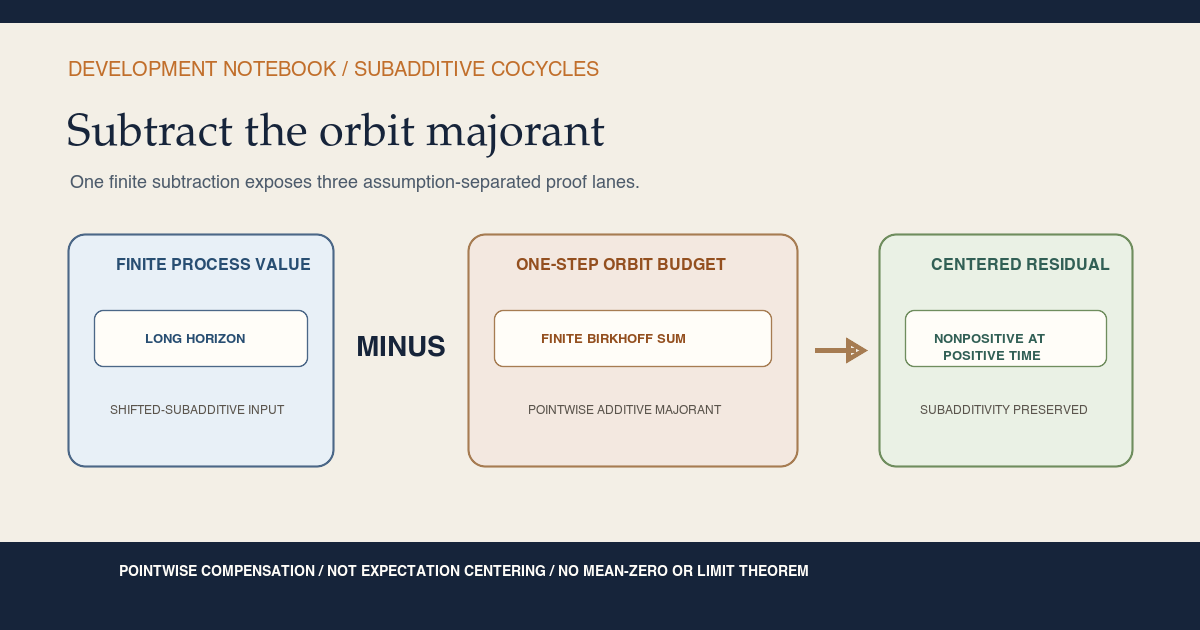
This is the proof-to-prose companion for
formalization/NonlinearDynamics/Random/RandomCocycles/SubadditiveCentering.lean.
It covers all eighteen public declarations and both private helpers in exact
source order. The immediate predecessor is
Finite Blocks Before Limits: Birkhoff Bounds for Subadditive Cocycles in Lean.
That chapter proves the exact finite-block inequalities from which the
positive-horizon and uniform one-step majorants can be understood.
Reusable foundations include the orbit-majorant centering , the Birkhoff sum , the one-sided discrete matrix cocycle , and the log-positive integrability envelope . The parallel textbook treatment is Orbit-Majorant Centering for Subadditive Processes.
Choose a route up
| Route | Begin | Destination |
|---|---|---|
| First encounter | Why subtract an orbit majorant? | See the finite reduction before Lean syntax |
| Terminology route | Centered does not mean mean zero | Separate two different mathematical operations |
| Worked route | A singleton example with a strict residual | Compute every term by hand |
| Boundary route | Zero and one are different boundaries | Audit \(n=0\) and \(n=1\) |
| Algebra route | The two private engines | See which assumptions the core proofs actually consume |
| API route | The eighteen public declarations | Read the complete interface in source order |
| Analysis route | Integrability has one dynamical gate | Locate the sole use of measure preservation |
| Cocycle route | The thin cocycle specialization | Distinguish direct pointwise results from the \(hC\) package |
| Integrity route | What the exact identity does not prove | Block every asymptotic overread |
Learning objectives
By the summit, a reader should be able to:
- define the additive one-step orbit sum \(A_n\);
- define the residual \(Y_n=X_n-A_n\);
- explain why this operation is pointwise compensation rather than expectation centering;
- compute \(Y_0\) and \(Y_1\) exactly;
- derive the positive-horizon one-step majorant without assuming \(X_0=0\);
- identify the exact reason a uniform majorant through zero needs \(X_0=0\);
- convert a majorant inequality into nonpositivity with
sub_nonpos.mpr; - use the Birkhoff-sum addition law to show that subtracting \(A_n\) preserves shifted subadditivity;
- identify both raw private helpers and the public declarations they serve;
- explain why the algebraic helper needs no measurable structure;
- prove finite-horizon integrability of the residual under one-step measure preservation;
- explain why probability and ergodicity are absent from that proof;
- package the residual as a new integrable subadditive-process candidate;
- simplify the normalized identity at \(n=0\);
- distinguish a Birkhoff average from an expectation;
- calculate the singleton process \(X_n=\sqrt n\) at \(n=4\);
- use that example to refute a mean-zero interpretation;
- use the constant-one process to expose the time-zero obstruction;
- use an additive process to see when the residual vanishes;
- follow all eighteen public declarations in exact source order;
- explain why the cocycle’s orbit sum is definitionally a Birkhoff sum;
- identify which cocycle theorems take \(C\) directly;
- identify the one cocycle theorem that consumes \(hC\);
- verify that an empty matrix index remains supported;
- distinguish log-positive compensation from a signed Lyapunov exponent;
- state every limit theorem that remains absent; and
- explain why finite phase averaging is the next dependency-ordered layer.
Why subtract an orbit majorant?
Subadditivity compares a long horizon with shorter pieces, but it does not immediately put every \(X_n\) on one common additive scale. The one-step observable does. Starting at \(\omega\), read \(X_1\) at the successive orbit points
\[ \omega,\quad T\omega,\quad T^2\omega,\quad \ldots,\quad T^{n-1}\omega, \]and add those \(n\) readings. The resulting function is the finite Birkhoff sum
\[ A_n(\omega) {} = \operatorname{birkhoffSum}(T,X_1,n,\omega). \]It is additive across time splits in exactly the shifted sense needed here:
\[ A_{m+n}(\omega) {} = A_n\bigl(T^m\omega\bigr)+A_m(\omega). \]The order of the two real summands can be reversed, but the sample shift cannot. The later \(n\)-step orbit sum starts after \(m\) applications of the base map. Mathlib’s finite Birkhoff-sum definition and addition law are the exact library interfaces used here (pinned Birkhoff-sum API).
The original process satisfies only an inequality at the same split:
\[ X_{m+n}(\omega) \le X_n\bigl(T^m\omega\bigr)+X_m(\omega). \]Subtracting the exact additive identity from this inequality produces a residual with the same shifted-subadditive orientation. The definition is
\[ Y_n(\omega) {} = X_n(\omega)-A_n(\omega). \]Repeatedly taking one-step pieces also gives \(X_n\le A_n\) whenever \(n\gt0\). Consequently \(Y_n\le0\) at every positive horizon. This is a finite pointwise fact. No measure has entered, so there is no probability statement hiding inside it. This subtractive reduction appears explicitly in the subadditive-cocycle literature (Karlsson and Margulis, Lalley); the present module freezes only its finite Lean layer.
The residual records how much smaller the finite process is than the particular additive upper budget generated by its one-step values. In a matrix-cocycle application, this difference can reflect strictness in norm submultiplicativity, cancellations, or the information discarded by the log-positive envelope. Random matrix products are a classical asymptotic setting for such growth questions (Furstenberg and Kesten). Those interpretations are useful intuitions, but the Lean theorem states only the inequality and shifted-subadditive law.
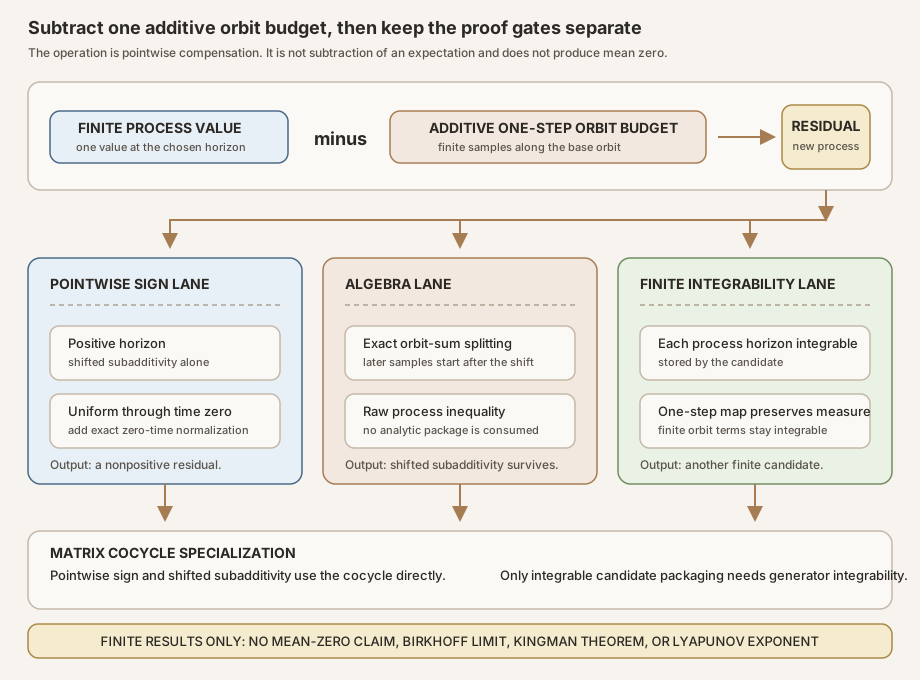
Centered does not mean mean zero
The word “centered” is overloaded. In probability, centering an integrable random variable often means subtracting its expectation:
\[ Z^{\mathrm{mean}}(\omega) {} = Z(\omega)-\int Z\,d\mu. \]When \(\mu\) is a probability measure and the integral is legitimate, this construction has mean zero. It subtracts one scalar that summarizes the whole distribution.
RMT-19 performs a different operation:
[ Y_n(\omega) {} = X_n(\omega)
\sum_{\substack{j\in\mathbb N\j\lt n}} X_1\bigl(T^j\omega\bigr). ]
The subtracted term depends on the horizon, the sample, the base orbit, and the one-step observable. It is a pointwise finite orbit budget, not a scalar expectation. The definition makes sense before a measurable space or measure has been chosen.
| Question | Orbit-majorant compensation in RMT-19 | Expectation centering |
|---|---|---|
| What is subtracted? | A finite orbit sum depending on \(n\) and \(\omega\) | One scalar integral |
| Is a measure required to define it? | No | Yes |
| Is probability normalization required? | No | Usually, for the mean interpretation |
| What is guaranteed? | Pointwise nonpositivity at positive horizons under shifted subadditivity | Mean zero under the needed integration hypotheses |
| Is convergence guaranteed? | No | No |
Calling the new process “centered” is therefore a project-level shorthand for
compensation by an additive orbit majorant. Every page, card, caption, and
summary must keep that qualifier visible. A reader who sees only
centeredProcess should not infer expectation subtraction.
The term “Birkhoff average” introduces another possible confusion. It means a finite Birkhoff sum divided by its finite horizon. It is not the same object as a space average or expectation. An ergodic theorem may later relate a limit of orbit averages to a space average under substantial hypotheses. RMT-19 proves no such relation.
A singleton example with a strict residual
Take a state space with one point, let \(T\) be the identity, and define
\[ X_n=\sqrt n. \]The sample argument can be suppressed because there is only one outcome. The square-root function is subadditive on nonnegative reals, so
\[ \sqrt{m+n}\le\sqrt m+\sqrt n. \]The one-step value is \(X_1=1\). The length-\(n\) orbit sum is therefore
\[ A_n=n. \]At \(n=4\),
\[ X_4=2,\qquad A_4=4,\qquad Y_4=2-4=-2. \]The normalized identity becomes
\[ \frac{2}{4} {} = \frac{-2}{4}+1. \]Both sides equal \(1/2\). This calculation exhibits four features in one model:
- the additive orbit sum can strictly majorize the subadditive process;
- the centered residual can be strictly negative;
- the normalized identity can be checked without any limiting argument; and
- the residual is not mean zero.
For the last point, equip the singleton with its Dirac probability measure. The integral of the constant function \(Y_4=-2\) is \(-2\). Probability normalization does not turn orbit-majorant compensation into expectation centering.
An additive comparison provides the opposite boundary. If
\[ X_n(\omega)=\operatorname{birkhoffSum}(T,f,n,\omega) \]for some one-step observable \(f\), then \(X_1=f\), the majorant \(A_n\) equals \(X_n\), and \(Y_n=0\) at every horizon. The new construction therefore measures finite slack relative to the one-step additive budget. It is zero for an exactly additive process and can be negative for a strictly subadditive one.
Zero and one are different boundaries
At time zero, a Birkhoff sum is empty:
\[ A_0=0. \]Therefore
\[ Y_0=X_0. \]Shifted subadditivity forces \(X_0\ge0\), but it does not force \(X_0=0\). This was proved explicitly in RMT-18. Thus a theorem asserting \(Y_n\le0\) for every natural \(n\) needs the additional normalization \(X_0=0\).
The constant-one process is the sharp counterexample. On any nonempty state space, define \(X_n(\omega)=1\) for every \(n\) and \(\omega\). It is subadditive because \(1\le1+1\). For \(n\gt0\), its one-step orbit sum equals \(n\), so
\[ Y_n=1-n\le0. \]At zero, however,
\[ Y_0=1\gt0. \]This counterexample survives on a probability space with a preserved identity base map. Probability, preservation, and ergodicity cannot repair a missing time-zero normalization because the obstruction is pointwise algebra.
At time one, the behavior is entirely different:
\[ A_1(\omega)=X_1(\omega), \qquad Y_1(\omega)=0. \]This identity needs no subadditivity, measure, normalization, or probability. It is a direct consequence of a one-term Birkhoff sum. The API records both boundaries as simplification theorems so later proofs do not have to unfold the definition and rediscover them.
The normalized identity has another zero-time subtlety. In Lean’s real field, division by zero is totalized, so \(x/0=0\). Mathlib also defines the zero-length Birkhoff average as zero. Hence declaration 11 at \(n=0\) reads
\[ 0=0+0. \]It is true without \(X_0=0\), but it says nothing about the unnormalized value \(Y_0=X_0\). Totalized normalization erases the zero-time obstruction; it does not solve it. The totalized definition and its zero law are visible in Mathlib’s pinned average API (Birkhoff averages).
The two private engines
The public API uses a bundled candidate because that is the project’s reusable finite-horizon interface. The strongest pointwise arguments, however, consume only its shifted-subadditive field. RMT-19 records this fact with two private raw helpers.
Private helper 1: subtract an additive orbit sum
centeredProcess_add_le_of_add_le assumes only
Its conclusion is the same shifted-subadditive inequality for
centeredProcess T X. The Lean proof has three moves:
- unfold
centeredProcess; - rewrite the long Birkhoff sum with
birkhoffSum_add; and - use
linarithwith the raw inequality.
The rewrite supplies an equality, not an estimate:
\[ A_{m+n}(\omega) {} = A_n(T^m\omega)+A_m(\omega). \]Subtracting that equality from the process inequality preserves its orientation. No measurable-space instance appears in the helper’s signature. No integrability field, measure-preserving map, probability typeclass, time-zero normalization, or limit is available for the proof to use.
This helper is private because the public method belongs on the existing candidate interface. Keeping the raw engine private records assumption minimality without creating a second public hierarchy.
Private helper 2: build the positive-horizon majorant
oneStepBirkhoffMajorant_of_add_le also consumes only the raw
shifted-subadditive inequality. It takes \(n\ne0\), rewrites the horizon as a
successor, and inducts on the remaining natural number.
The base case is a one-step horizon. The process value \(X_1\) equals the one-term Birkhoff sum. At the successor step, shifted subadditivity peels off the newest one-step contribution:
\[ X_{n+2}(\omega) \le X_1(T^{n+1}\omega)+X_{n+1}(\omega). \]The induction hypothesis replaces \(X_{n+1}\) with its orbit-sum majorant.
The recurrence birkhoffSum_succ then identifies the result with
the length-\(n+2\) Birkhoff sum. Real addition is commutative, so the final
proof closes with add_comm.
Why not expose RMT-18’s exact-block theorem at block length one? The public mathematical result is the same, but the raw helper makes a stronger API audit possible: the positive-horizon majorant depends only on shifted-subadditivity. It does not consume the candidate’s integrability field. The helper also compiles the boundary \(n\ne0\) directly rather than hiding it behind time-zero normalization.
The eighteen public declarations
The source order is part of the teaching contract. Definitions and boundary simplifications come first, then the two private engines, then the generic candidate methods, the normalized identity, and finally the thin cocycle specialization.
| Order | Declaration | Mathematical output | Essential input |
|---|---|---|---|
| 1 | centeredProcess | \(Y_n=X_n-A_n\) | Functions only |
| 2 | centeredProcess_zero | \(Y_0=X_0\) | Empty finite sum |
| 3 | centeredProcess_one | \(Y_1=0\) | One-term finite sum |
| private A | centeredProcess_add_le_of_add_le | Subtracting the orbit sum preserves shifted subadditivity | Raw shifted subadditivity only |
| private B | oneStepBirkhoffMajorant_of_add_le | \(X_n\le A_n\) for \(n\ne0\) | Raw shifted subadditivity only |
| 4 | oneStepBirkhoffMajorant_of_ne_zero | \(X_n\le A_n\) for \(n\ne0\) | Shifted subadditivity |
| 5 | oneStepBirkhoffMajorant | \(X_n\le A_n\) for all \(n\) | Shifted subadditivity and \(X_0=0\) |
| 6 | centeredProcess_nonpos_of_ne_zero | \(Y_n\le0\) for \(n\ne0\) | Declaration 4 |
| 7 | centeredProcess_nonpos | \(Y_n\le0\) for all \(n\) | Declaration 5 |
| 8 | centeredProcess_add_le | \(Y\) remains shifted-subadditive | Private helper 1 |
| 9 | integrable_centeredProcess | Every \(Y_n\) is integrable | Candidate integrability and preservation of \(T\) |
| 10 | centeredProcess_candidate | \(Y\) is a new candidate | Declarations 8 and 9 |
| 11 | normalized_eq_centered_add_birkhoffAverage | Exact normalized split | Ring algebra |
| 12 | birkhoffSum_logPlusNormObservable_one_eq_orbitLogPlusSum | Generic and cocycle sum notations agree | Definitional equality |
| 13 | centeredLogPlusNormObservable | Define the cocycle residual | Declaration 1 |
| 14 | centeredLogPlusNormObservable_apply | Expose \(G_n-S_n\) | Definitional equality |
| 15 | centeredLogPlusNormObservable_nonpos | Cocycle residual is nonpositive | Existing pointwise majorant from \(C\) |
| 16 | centeredLogPlusNormObservable_add_le | Cocycle residual is shifted-subadditive | Private helper 1 and \(C\) |
| 17 | centeredLogPlusNormObservable_candidate | Integrable cocycle residual candidate | \(hC\) and base preservation |
| 18 | logPlusNormObservable_normalized_eq_centered_add_birkhoffAverage | Cocycle normalized split | Declaration 11 |
Declaration 1: define the orbit-majorant residual
def centeredProcess {Ω : Type uΩ} (T : Ω → Ω) (X : ℕ → Ω → ℝ)
    (n : ℕ) (ω : Ω) : ℝ :=
  X n ω - birkhoffSum T (X 1) n ω
The definition is deliberately prior to every analytic structure. The type \(\Omega\) need not carry a measurable space, \(T\) need not preserve anything, and \(X\) need not satisfy subadditivity. Those hypotheses enter only when a theorem needs them.
There are two important design choices. First, the observable in the orbit sum is exactly \(X_1\). The definition does not select an arbitrary comparison function. Second, the base map is \(T\), not a powered block map. RMT-18 handled a general block length \(b\); RMT-19 chooses \(b=1\) because the goal is to separate every finite process value into a one-step additive part and a residual.
The declaration name says centeredProcess, while its docstring
says “pointwise compensation, not centering by an expectation.” That
docstring is part of the mathematical interface. A short name remains useful
inside later formulas, but it must not erase the operation’s meaning.
Declaration 2: time zero retains the original value
@[simp] theorem centeredProcess_zero {Ω : Type uΩ} (T : Ω → Ω)
    (X : ℕ → Ω → ℝ) :
    centeredProcess T X 0 = X 0
The theorem is an equality of functions. The proof uses
funext to fix an outcome and then simplifies the empty Birkhoff
sum. Registering the theorem with simp means that a later goal
containing centeredProcess T X 0 exposes the true boundary
immediately.
This result prevents a common false intuition. Subtracting a majorant does not automatically normalize time zero. The majorant contributes nothing there, so whatever value \(X_0\) had remains visible in \(Y_0\).
Declaration 3: one step cancels exactly
@[simp] theorem centeredProcess_one {Ω : Type uΩ} (T : Ω → Ω)
    (X : ℕ → Ω → ℝ) :
    centeredProcess T X 1 = 0
Again the result is a function equality. Mathlib’s
birkhoffSum_one says the one-term orbit sum is the observable at
the original point. Therefore \(X_1-X_1=0\).
This exact identity is stronger than nonpositivity and needs no candidate hypothesis. It is a useful consistency check for the definition, the cocycle specialization, and any future normalization formula.
The two private helpers occur here in the source. Their placement matters: they are raw engines available to both the generic candidate namespace and the later cocycle namespace.
Declaration 4: positive time needs no zero normalization
theorem oneStepBirkhoffMajorant_of_ne_zero
    (hX : IsIntegrableSubadditiveProcessCandidate T μ X)
    (n : ℕ) (hn : n ≠ 0) (ω : Ω) :
    X n ω ≤ birkhoffSum T (X 1) n ω
The method invokes oneStepBirkhoffMajorant_of_add_le with
hX.add_le. The bundled receiver contains integrability of every
horizon, but this proof does not read that field. Its mathematical core is
pure shifted subadditivity.
The explicit premise \(n\ne0\) is not clutter. It is the exact guard that removes the constant-one obstruction. Once at least one one-step piece is present, repeated subadditivity controls the process with no statement about \(X_0\).
Declaration 5: exact zero normalization gives a uniform theorem
theorem oneStepBirkhoffMajorant
    (hX : IsIntegrableSubadditiveProcessCandidate T μ X)
    (hX0 : X 0 = 0) (n : ℕ) (ω : Ω) :
    X n ω ≤ birkhoffSum T (X 1) n ω
The proof splits on \(n\). At zero, simp [hX0] closes the exact
boundary. At a successor horizon, the raw positive-time helper supplies the
inequality, so the proof never uses \(hX0\) away from zero.
This case split documents premise locality. A stronger hypothesis is attached only to the branch that needs it. The theorem is convenient when a normalized process already has \(X_0=0\), while declaration 4 remains the more general interface for positive time.
Declaration 6: positive-horizon residuals are nonpositive
theorem centeredProcess_nonpos_of_ne_zero
    (hX : IsIntegrableSubadditiveProcessCandidate T μ X)
    (n : ℕ) (hn : n ≠ 0) (ω : Ω) :
    centeredProcess T X n ω ≤ 0
For real numbers, \(a-b\le0\) is equivalent to \(a\le b\).
sub_nonpos.mpr performs exactly that conversion. The proof is one
line because declaration 4 already has the correct pointwise inequality.
Nonpositivity is a sign statement about a residual. It does not say the residual is a negative part, a martingale difference, a fluctuation about a mean, or a quantity with zero integral. The theorem has no measure premise.
Declaration 7: uniform nonpositivity includes time zero
theorem centeredProcess_nonpos
    (hX : IsIntegrableSubadditiveProcessCandidate T μ X)
    (hX0 : X 0 = 0) (n : ℕ) (ω : Ω) :
    centeredProcess T X n ω ≤ 0
This is the same order conversion applied to declaration 5. At \(n=0\), it reduces to \(X_0\le0\). RMT-18 proved that subadditivity already forces \(X_0\ge0\), so the equality \(X_0=0\) is exactly what a uniform sign theorem requires.
Do not reverse this logic. The uniform theorem does not prove normalization from nothing. It takes normalization as an explicit premise.
Declaration 8: the residual remains shifted-subadditive
theorem centeredProcess_add_le
    (hX : IsIntegrableSubadditiveProcessCandidate T μ X)
    (m n : ℕ) (ω : Ω) :
    centeredProcess T X (m + n) ω ≤
      centeredProcess T X n (T^[m] ω) + centeredProcess T X m ω
The public method delegates to centeredProcess_add_le_of_add_le
with hX.add_le. It does not require \(X_0=0\). It also does not
use hX.integrable, even though the receiver stores that field.
The general principle is worth isolating:
subtracting a shifted-additive process from a shifted-subadditive process leaves a shifted-subadditive process.
Here the Birkhoff sum generated by \(X_1\) is the shifted-additive process.
The exact birkhoffSum_add theorem is what makes the subtraction
safe. Subtracting an arbitrary family \(B_n\) would not preserve
subadditivity unless \(B\) obeyed a compatible law.
Declaration 9: finite-horizon integrability
theorem integrable_centeredProcess
    (hX : IsIntegrableSubadditiveProcessCandidate T μ X)
    (hT : MeasurePreserving T μ μ) (n : ℕ) :
    Integrable (centeredProcess T X n) μ
The definition is a difference, so the proof needs two integrable functions.
The candidate supplies hX.integrable n for \(X_n\). RMT-18’s
integrable_birkhoffSum_blocks, specialized to block length one,
supplies integrability of \(A_n\). The identity
Function.iterate_one turns preservation of \(T^{1}\) into the
given premise \(hT\).
Then Integrable.sub closes the proof. The assumption ledger is:
| Input | Why it appears |
|---|---|
| Integrability of \(X_n\) | The first term in \(Y_n=X_n-A_n\) |
| Integrability of \(X_1\) | Each summand in \(A_n\) |
| Preservation of \(T\) | Transport integrability through every finite iterate |
| Probability | Not used |
| Ergodicity | Not used |
| \(X_0=0\) | Not used |
Measure preservation is not needed to define the Birkhoff sum or prove its pointwise majorant. It enters only because composition with an arbitrary map need not preserve integrability.
Declaration 10: package the centered candidate
theorem centeredProcess_candidate
    (hX : IsIntegrableSubadditiveProcessCandidate T μ X)
    (hT : MeasurePreserving T μ μ) :
    IsIntegrableSubadditiveProcessCandidate T μ (centeredProcess T X)
The constructor has two fields. Declaration 9 fills
integrable, and declaration 8 fills add_le. There
is no field asserting nonpositivity and no field asserting \(Y_0=0\).
Consequently this package needs neither \(X_0=0\) nor declaration 7.
That distinction is important for future reuse. A centered candidate is available whenever the original candidate lives over a measure-preserving base, even if its zero-time value is positive. Positive-horizon nonpositivity remains separately available from declaration 6.
Declaration 11: the normalized finite identity
theorem normalized_eq_centered_add_birkhoffAverage
    {Ω : Type uΩ} {T : Ω → Ω} {X : ℕ → Ω → ℝ}
    (n : ℕ) (ω : Ω) :
    X n ω / (n : ℝ) = centeredProcess T X n ω / (n : ℝ) +
      birkhoffAverage ℝ T (X 1) n ω
Unfolding the two definitions turns the theorem into ordinary field algebra.
The proof uses ring. There is no measurable-space instance in
the signature, and there are no subadditivity, integrability, preservation,
probability, or ergodicity premises.
For \(n\gt0\), the identity reads
\[ \begin{aligned} \frac{X_n(\omega)}{n} &= \frac{Y_n(\omega)}{n} \\ &\quad+\frac{1}{n} \sum_{\substack{j\in\mathbb N\\j\lt n}} X_1(T^j\omega). \end{aligned} \]At \(n=0\), every displayed normalized term is totalized to zero. That branch is a valuable compilation test, but it must not be described as division by a positive horizon.
The equality offers a route for later asymptotic work: control the normalized residual and control the Birkhoff average. RMT-19 does neither. An exact decomposition of a sequence is not convergence of either term.
Declaration 12: two names for the same cocycle orbit sum
@[simp] theorem birkhoffSum_logPlusNormObservable_one_eq_orbitLogPlusSum
    (C : DiscreteMatrixCocycle (ι := ι) μ) (n : ℕ) :
    birkhoffSum C.base (C.logPlusNormObservable 1) n =
      C.orbitLogPlusSum n
The proof is rfl. RMT-15 defined
orbitLogPlusSum by the same finite sum. RMT-19 does not create a
second numerical object. It adds a named bridge between generic Birkhoff
language and the established cocycle API.
This bridge is an equality of functions, so later simplification can rewrite an entire finite observable without fixing an outcome.
Declaration 13: define the cocycle residual
def centeredLogPlusNormObservable
    (C : DiscreteMatrixCocycle (ι := ι) μ) (n : ℕ) : Ω → ℝ :=
  centeredProcess C.base C.logPlusNormObservable n
The specialization carries no new premise. A
DiscreteMatrixCocycle already supplies its base map and
finite-horizon log-positive observable. The residual is the generic centered
process applied to those data.
The name remains careful: this is a centered log-positive norm observable, not a signed logarithmic norm and not a Lyapunov exponent.
Declaration 14: expose the finite difference
@[simp] theorem centeredLogPlusNormObservable_apply
    (C : DiscreteMatrixCocycle (ι := ι) μ) (n : ℕ) (ω : Ω) :
    C.centeredLogPlusNormObservable n ω =
      C.logPlusNormObservable n ω - C.orbitLogPlusSum n ω
This theorem is also proved by rfl. The project definitions were
chosen to line up definitionally. No theorem about integrability or
subadditivity is needed merely to expose the expression.
Declaration 15: cocycle nonpositivity uses \(C\), not \(hC\)
theorem centeredLogPlusNormObservable_nonpos
    (C : DiscreteMatrixCocycle (ι := ι) μ) (n : ℕ) (ω : Ω) :
    C.centeredLogPlusNormObservable n ω ≤ 0
RMT-15 already proved
C.logPlusNormObservable_le_orbitLogPlusSum n ω. Declaration 14
rewrites the residual, and sub_nonpos.mpr converts that existing
pointwise majorant into nonpositivity.
The result includes \(n=0\) without an explicit normalization premise because the cocycle observable was previously proved to vanish at zero. This is an example of a specialization discharging a generic boundary internally.
No HasIntegrableGeneratorLogPlus hypothesis appears. Adding one
would confuse a pointwise norm inequality with the separate analytic question
of whether the functions are integrable.
Declaration 16: cocycle shifted subadditivity also uses \(C\) directly
theorem centeredLogPlusNormObservable_add_le
    (C : DiscreteMatrixCocycle (ι := ι) μ)
    (m n : ℕ) (ω : Ω) :
    C.centeredLogPlusNormObservable (m + n) ω ≤
      C.centeredLogPlusNormObservable n (C.base^[m] ω) +
        C.centeredLogPlusNormObservable m ω
The proof calls private helper 1 with
C.logPlusNormObservable_add_le. It deliberately bypasses the
integrable candidate wrapper. The cocycle itself already carries the raw
finite subadditivity theorem required by the algebra.
Again there is no \(hC\). This is precisely why the private raw helper was retained.
Declaration 17: \(hC\) enters only for candidate packaging
theorem HasIntegrableGeneratorLogPlus.centeredLogPlusNormObservable_candidate
    {C : DiscreteMatrixCocycle (ι := ι) μ}
    (hC : C.HasIntegrableGeneratorLogPlus) :
    IsIntegrableSubadditiveProcessCandidate C.base μ
      C.centeredLogPlusNormObservable
The package needs integrability of every centered horizon. The hypothesis
\(hC\) supplies the existing candidate for the original log-positive family.
Declaration 9 then centers that candidate using
C.base_preserving. Declaration 16 supplies the shifted
subadditivity field directly.
This is the only public cocycle declaration in RMT-19 that needs \(hC\). The distinction should remain visible in every assumption table:
| Cocycle conclusion | Receiver | Uses \(hC\)? |
|---|---|---|
| Pointwise nonpositivity | \(C\) | No |
| Shifted subadditivity | \(C\) | No |
| Integrable candidate | \(hC\) | Yes |
| Normalized pointwise identity | \(C\) | No |
Declaration 18: the cocycle normalized split
theorem logPlusNormObservable_normalized_eq_centered_add_birkhoffAverage
    (C : DiscreteMatrixCocycle (ι := ι) μ) (n : ℕ) (ω : Ω) :
    C.logPlusNormObservable n ω / (n : ℝ) =
      C.centeredLogPlusNormObservable n ω / (n : ℝ) +
        birkhoffAverage ℝ C.base (C.logPlusNormObservable 1) n ω
The proof is declaration 11 with the generic arguments inferred. The theorem is pointwise and finite. It needs neither \(hC\) nor a probability measure.
The first term on the right is nonpositive. That sign may be useful in future upper-bound arguments, but it does not prove that the term converges, vanishes after normalization, or has an integrable dominating function independent of \(n\). The second term is a finite orbit average. Its notation does not invoke a pointwise ergodic theorem.
Integrability has one dynamical gate
The formalization separates three questions that are often compressed in informal arguments:
- Is the residual defined?
- Is it pointwise nonpositive and shifted-subadditive?
- Is every residual horizon integrable?
The first question needs functions only. The second needs shifted subadditivity, plus \(X_0=0\) only if the sign theorem must include zero. The third needs analytic data: integrability from the candidate and preservation of the one-step map.
Why preservation? The orbit sum contains functions
\[ X_1\circ T^j. \]Even if \(X_1\) is integrable, composition with an arbitrary map can concentrate the domain on a nonintegrable region. A measure-preserving map keeps the integral under control, and every natural iterate of a measure-preserving map is measure preserving. A finite sum of the transported integrable functions is therefore integrable. The proof uses the official measure-preserving iterate interface and integrability closure results at exactly this gate.
The result is finite in two senses. First, \(n\) is fixed when integrability is proved. Second, the sum has exactly \(n\) terms. Nothing establishes uniform integrability as \(n\to\infty\), an integrable envelope common to all normalized residuals, or permission to exchange a future limit and integral.
Probability normalization is irrelevant here. The proof works for any measure preserved by \(T\), including the zero measure and measures of arbitrary total mass. Ergodicity is also irrelevant. It constrains invariant objects; it is not required to transport integrability through a finite orbit.
The thin cocycle specialization
For a discrete matrix cocycle \(C\), write
\[ G_n(\omega) {} = C.\operatorname{logPlusNormObservable}(n,\omega) \]and
\[ S_n(\omega) {} = C.\operatorname{orbitLogPlusSum}(n,\omega). \]The centered cocycle observable is
\[ H_n(\omega)=G_n(\omega)-S_n(\omega). \]The earlier cocycle modules already established \(G_n\le S_n\), the shifted subadditivity of \(G_n\), base-map preservation, and the conditional integrability package. RMT-19 should reuse those facts rather than derive them again through a stronger interface.
The two rfl declarations show that the generic and cocycle
definitions align exactly. The pointwise nonpositivity theorem reads the old
majorant directly. The shifted-subadditivity theorem reads the old raw
inequality directly. Only the candidate constructor crosses the
integrability gate.
This thinness matters. A theorem that takes \(hC\) merely because a convenient candidate object can be built from \(hC\) advertises an assumption the mathematics does not need. The source instead uses a private raw helper so the public signatures expose only the dependencies used by the proofs.
Empty matrix dimension
The cocycle namespace assumes Fintype ι and
DecidableEq ι. It does not assume Nonempty ι. When
\(\iota\) is empty, the matrices have no entries, but the previous norm and
log-positive definitions still supply total values and checked laws. All six
cocycle declarations remain meaningful.
This boundary guards against an accidental positive-dimension assumption entering through intuition about ordinary matrices. Nothing in orbit-majorant centering needs a row, eigenvalue, determinant, or nonzero vector.
Two scalar calibrations
For a constant one-dimensional cocycle with multiplier \(\lambda\), the log-positive observable illustrates what the residual can forget.
If \(|\lambda|\gt1\), then finite log-positive growth is additive:
\[ G_n=n\log|\lambda|, \qquad S_n=n\log|\lambda|, \qquad H_n=0. \]If \(0\lt|\lambda|\lt1\), the positive logarithm clips contraction:
\[ G_n=0, \qquad S_n=0, \qquad H_n=0. \]The same zero residual therefore occurs for exact expansion accounting and for completely clipped contraction. It cannot by itself be called a signed growth fluctuation or a Lyapunov exponent. Matrix-valued examples can produce strictly negative residuals when the finite norm of a product is smaller than the product of one-step norm budgets, but the theorem does not classify the source of that slack.
Assumption ledger
| Result family | Shifted subadditivity | \(X_0=0\) | Measure preserving \(T\) | Probability | Ergodicity | \(hC\) |
|---|---|---|---|---|---|---|
| Definition and zero/one simp laws | No | No | No | No | No | No |
| Positive-horizon majorant and sign | Yes | No | No | No | No | No |
| Uniform majorant and sign | Yes | Yes | No | No | No | No |
| Residual shifted subadditivity | Yes | No | No | No | No | No |
| Generic residual integrability | Candidate fields | No | Yes | No | No | Not applicable |
| Generic centered candidate | Candidate fields | No | Yes | No | No | Not applicable |
| Normalized identity | No | No | No | No | No | No |
| Cocycle pointwise sign and algebra | Stored in \(C\) | Internally discharged | Stored but not needed pointwise | No | No | No |
| Cocycle centered candidate | Stored in \(C\) | No | Stored in \(C\) | No | No | Yes |
| Cocycle normalized identity | No | No | No | No | No | No |
The phrase “candidate fields” in the analytic rows means that integrability and shifted subadditivity come from the existing structure, while preservation remains a separate premise. It does not mean that every field is used by every theorem.
Lean proofcraft
Keep raw algebra outside analytic namespaces
Both private helpers quantify over an arbitrary type \(\Omega\). This is not merely aesthetic generality. It makes Lean enforce the claim that their proofs cannot use measurability, integrability, preservation, probability, or ergodicity. The helpers accept one raw inequality and return one raw inequality.
The public methods still live in
IsIntegrableSubadditiveProcessCandidate. That placement gives
users a discoverable dot-notation API even though the underlying proof does
not use every stored field.
Match the recurrence to the peeled piece
The positive-horizon induction peels off the final one-step term
\(X_1(T^{n+1}\omega)\). Mathlib’s birkhoffSum_succ appends exactly
that newest orbit reading. If the proof had peeled the first step instead,
birkhoffSum_succ’ would have been the more natural recurrence.
Choosing the recurrence that matches the proof prevents unnecessary iterate algebra. It also makes the chronological meaning of the shift visible.
Use function equality at stable boundaries
Declarations 2, 3, and 12 state equalities of functions rather than only
pointwise equalities. The proofs use funext or rfl,
and downstream simplification can rewrite the whole observable. Declaration
14 is pointwise because its intended use immediately compares real values.
Let totalization compile the boundary, then explain it
Lean’s natural horizons and real division are total. The theorem does not need a separate positive-horizon signature merely to be syntactically meaningful at zero. That convenience increases the prose obligation: the zero branch must be simplified explicitly so a reader does not mistake \(x/0=0\) for ordinary positive-denominator algebra.
Prove the public surface in a root import smoke test
A leaf file can compile while a declaration remains unavailable from the root
aggregator. The milestone therefore needs both a warning-fatal leaf check and
an import smoke test through NonlinearDynamics. The Notebook’s
#check block below names every public declaration and catches a
missing import or namespace mismatch.
Common wrong turns
Calling \(Y_n\) mean zero
Nonpositivity and mean zero are different conclusions. The singleton \(X_n=\sqrt n\) example gives \(Y_4=-2\), including under a probability measure. Replace “mean-zero centered process” with “pointwise residual after subtracting the additive one-step orbit majorant.”
Subtracting \(\int X_n\,d\mu\)
That would define another process with different hypotheses and different algebra. It would not be definitionally the RMT-19 process, and it would not automatically preserve the same shifted-subadditive law.
Demanding \(X_0=0\) at every theorem
The positive-horizon majorant, positive-horizon sign, preservation of subadditivity, integrability, candidate packaging, and normalized identity do not need this premise. It belongs only on the uniform generic majorant and uniform generic sign theorem.
Removing \(X_0=0\) from the uniform sign theorem
The constant-one process refutes the resulting statement at \(n=0\). Adding probability or ergodicity does not help.
Treating \(Y_1=0\) as a consequence of subadditivity
It is definitional finite-sum cancellation and holds for every family \(X\). The proof should remain at the weaker assumption level.
Requiring measure preservation for pointwise algebra
Preservation enters only to transport integrability through orbit iterates. The finite sum, majorant, sign, and subadditive residual exist pointwise without it.
Requiring probability for an integral theorem
Integrable is defined relative to a measure of arbitrary mass.
Declaration 9 and both candidate constructors make no expectation claim, so a
probability typeclass would be gratuitous.
Requiring ergodicity because a Birkhoff name appears
A Birkhoff sum and Birkhoff average are finite definitions. Ergodicity belongs to some limit theorems, not to the syntax of the finite objects.
Assuming the normalized residual tends to zero
The sign \(Y_n/n\le0\) for positive \(n\) is not a convergence result. A nonpositive sequence can oscillate or diverge to negative infinity. A future proof needs quantitative lower control or a separate asymptotic argument.
Assuming the Birkhoff average converges
The module imports Mathlib’s finite average definition. The pinned Mathlib release does not supply a theorem in this module proving pointwise convergence for the present observable and base.
Interpreting the exact split as Kingman’s theorem
An identity of three finite values does not give an almost-everywhere limit, an invariant limit field, an integral formula, or ergodic constancy. It is a coordinate change for later reasoning. Kingman’s primary theorem is the eventual asymptotic destination, not a result imported by this module (Kingman, 1968).
Reconstructing the cocycle proof through \(hC\)
Declarations 15 and 16 need only the cocycle’s established pointwise laws.
Routing them through
hC.isIntegrableSubadditiveProcessCandidate would strengthen their
signatures for no mathematical reason.
Calling the cocycle residual a signed Lyapunov fluctuation
The observable uses \(\log^+\), which discards contraction and exact collapse. Even a future limit of it would not automatically equal a signed top Lyapunov exponent. The residual is finite log-positive slack relative to a one-step budget.
Adding a positive matrix dimension
No proof selects an index or vector. The empty finite index is a legitimate boundary and must remain accepted.
What the exact identity does not prove
RMT-19 proves finite definitions, inequalities, integrability statements, and identities. It proves none of the following:
- convergence of \(Y_n/n\);
- convergence of the finite Birkhoff averages;
- almost-everywhere convergence of \(X_n/n\);
- convergence in probability, measure, \(L^1\), or any \(L^p\) space;
- a pointwise or mean Birkhoff ergodic theorem;
- Kingman’s subadditive ergodic theorem;
- a maximal inequality;
- invariance of a samplewise limit;
- constancy of a limit under ergodicity;
- equality between a samplewise limit and the deterministic Fekete rate;
- permission to exchange a limit and an integral;
- uniform integrability of any normalized family;
- a rate of convergence;
- a martingale or martingale-difference structure;
- independence, stationarity as a separate law, or mixing;
- expectation centering or mean zero;
- a signed logarithmic norm observable;
- a Furstenberg-Kesten exponent;
- a Lyapunov exponent;
- singular-value growth or an Oseledets splitting;
- invertibility of the base or matrices;
- negative-tail integrability;
- positive matrix dimension; or
- the finite phase-averaging identities needed by the next proof layer.
The completed layer separates the process into one additive orbit component and one shifted-subadditive residual that is nonpositive at positive horizons, and uniformly nonpositive through time zero under \(X_0=0\), with every finite-horizon analytic gate exposed. Later asymptotic work can now state exactly which of the two normalized terms it controls.
Exercises with solutions
Exercise 1: expand the orbit majorant
Write \(A_3(\omega)\) without Birkhoff notation.
Solution.
\[ A_3(\omega) {} = X_1(\omega)+X_1(T\omega)+X_1(T^2\omega). \]There are three readings, at orbit times zero, one, and two.
Exercise 2: evaluate time zero
What is \(Y_0\), and which assumption is needed?
Solution. \(A_0=0\), so \(Y_0=X_0\). No assumption is needed. Exact normalization is needed only if one wants to simplify this further to zero.
Exercise 3: evaluate time one
Prove \(Y_1=0\) without subadditivity.
Solution. The one-term Birkhoff sum is \(A_1(\omega)=X_1(\omega)\). Therefore \(Y_1=X_1-X_1=0\).
Exercise 4: compute the strict singleton example
For \(X_n=\sqrt n\), compute \(X_4\), \(A_4\), and \(Y_4\).
Solution. \(X_4=2\), \(X_1=1\), \(A_4=4\), and \(Y_4=-2\).
Exercise 5: reject mean zero
Put the Dirac probability measure on that singleton. What is \(\int Y_4\,d\mu\)?
Solution. It is \(-2\), because \(Y_4\) is the constant function \(-2\). Orbit-majorant centering does not imply mean zero.
Exercise 6: find the equality case
Suppose \(X_n=\operatorname{birkhoffSum}(T,f,n)\). What is \(Y_n\)?
Solution. Since \(X_1=f\), the subtracted orbit sum is \(X_n\) itself. Thus \(Y_n=0\) for every horizon.
Exercise 7: expose the zero-time obstruction
For the constant-one process, calculate \(Y_n\).
Solution. At positive \(n\), \(A_n=n\) and \(Y_n=1-n\le0\). At zero, \(Y_0=1\gt0\). This refutes an assumption-free uniform sign theorem.
Exercise 8: derive the first positive majorant step
Use shifted subadditivity to bound \(X_2(\omega)\).
Solution.
\[ X_2(\omega) \le X_1(T\omega)+X_1(\omega) {} = A_2(\omega). \]This is the first nontrivial induction step.
Exercise 9: locate \(X_0=0\)
Which public declarations use the premise \(X_0=0\)?
Solution. Declarations 5 and 7: the uniform majorant and uniform generic nonpositivity. No other public declaration takes that premise.
Exercise 10: convert majorization to a sign
Which order lemma turns \(X_n\le A_n\) into \(X_n-A_n\le0\)?
Solution. sub_nonpos.mpr. The reverse direction is
sub_nonpos.mp.
Exercise 11: prove residual subadditivity on paper
Starting from the process inequality and the exact addition law for \(A\), derive the inequality for \(Y\).
Solution.
\[ \begin{aligned} Y_{m+n}(\omega) &=X_{m+n}(\omega)-A_{m+n}(\omega)\\ &\le X_n(T^m\omega)+X_m(\omega) -A_n(T^m\omega)-A_m(\omega)\\ &=Y_n(T^m\omega)+Y_m(\omega). \end{aligned} \]The middle step uses the exact shifted-additive identity for \(A\).
Exercise 12: identify the private-helper fields
Which fields of the candidate do the two private helpers use?
Solution. Neither helper takes the candidate. Each takes only a raw
shifted-subadditive inequality. Public declarations pass hX.add_le
or the cocycle’s raw inequality into them.
Exercise 13: explain the integrability subtraction
Which two functions are subtracted in declaration 9, and why is each integrable?
Solution. \(X_n\) is integrable by hX.integrable n. The
finite orbit sum \(A_n\) is integrable because \(X_1\) is integrable, \(T\)
preserves \(\mu\), its iterates preserve \(\mu\), and finite sums preserve
integrability.
Exercise 14: delete probability
Would declaration 9 remain true for a nonprobability measure?
Solution. Yes. Its proof uses only integrability and
MeasurePreserving T μ μ. Total mass one never appears.
Exercise 15: delete ergodicity
Would an identity base map invalidate any RMT-19 theorem?
Solution. No. If it preserves the measure, it satisfies the analytic gate. It need not be ergodic. All pointwise algebra works regardless.
Exercise 16: inspect the zero measure
Does declaration 10 work with the zero measure?
Solution. Yes. Every real-valued measurable function relevant to the candidate is integrable against the zero measure, and every map preserves the zero measure. No probability premise excludes this boundary.
Exercise 17: simplify the normalized identity at zero
What does declaration 11 say when \(n=0\)?
Solution. Real division by zero is totalized to zero, and
birkhoffAverage at zero is zero. The theorem becomes \(0=0+0\).
It does not imply \(X_0=0\).
Exercise 18: distinguish two averages
Why is birkhoffAverage ℝ T (X 1) n ω not an expectation?
Solution. It averages finitely many values along one orbit beginning at \(\omega\). An expectation integrates over a measure on the sample space. No measure occurs in declaration 11.
Exercise 19: audit the first cocycle bridge
Why can declaration 12 be proved by rfl?
Solution. orbitLogPlusSum was defined as the Birkhoff sum of
the one-step log-positive observable along C.base. The two sides
reduce to the same expression.
Exercise 20: find the unnecessary cocycle premise
Does declaration 15 need
HasIntegrableGeneratorLogPlus?
Solution. No. The established pointwise majorant belongs directly to \(C\). The sign proof uses only that majorant and real order algebra.
Exercise 21: find the necessary cocycle premise
Which cocycle declaration needs \(hC\), and why?
Solution. Declaration 17. It packages an
IsIntegrableSubadditiveProcessCandidate, so every centered
horizon must be integrable. The hypothesis \(hC\) supplies one-step
log-positive integrability and its propagation.
Exercise 22: test empty matrix dimension
Which premise would exclude the empty matrix index, and is it present?
Solution. Nonempty ι would exclude it. RMT-19 assumes only a
finite decidable index, so the empty case remains supported.
Exercise 23: reject the Lyapunov overread
Why can \(H_n=0\) fail to distinguish uniform expansion from uniform contraction?
Solution. The observable uses \(\log^+\). A contracting scalar multiplier has log-positive value zero at every horizon, while an expanding additive scalar cocycle has exact equality with its one-step sum. Both give zero residual for different reasons.
Exercise 24: reject the limit overread
Suppose declaration 18 holds for every \(n\). Which convergence statement follows immediately?
Solution. None. An identity at every finite index does not prove that any of its three sequences converges. Each asymptotic term needs a separate theorem.
Exercise 25: design the next layer
Why is finite phase averaging a plausible next step before Kingman’s theorem?
Solution. Finite block arguments produce Birkhoff sums for powered maps, while the one-step reduction uses \(T\). Phase averaging can reconcile the different starting phases without assuming that ergodicity passes from \(T\) to every power. The needed identities and error terms must be proved before a limit theorem is invoked.
Exercise 26: write the referee correction
Correct the sentence “RMT-19 centers the process to mean zero and therefore its normalized values converge.”
Solution. RMT-19 subtracts the pointwise additive one-step orbit majorant. The residual is nonpositive at positive horizons, remains shifted-subadditive, and is integrable under one-step measure preservation. It need not have mean zero, and no normalized convergence theorem is proved.
Reproducibility and audit ledger
| Artifact | Role | Validation |
|---|---|---|
SubadditiveCentering.lean | Eighteen public declarations and two private helpers | Direct warning-fatal Lean check |
RandomCocycles.lean | Aggregator import | Root-library build and import smoke test |
This index.md | Declaration-complete proof-to-prose map | Coverage, source hygiene, and Hugo warnings fatal |
rmt19-assumption-and-proof-route.svg | Prose-only assumption route | UTF-8 XML parse and rendered inspection |
generate-card.sh | Deterministic featured-card generator | –verify byte comparison and 1200x630 dimension check |
From the repository root:
source "$HOME/.elan/env"
cd formalization
lake env lean -DwarningAsError=true \
  NonlinearDynamics/Random/RandomCocycles/SubadditiveCentering.lean
lake build NonlinearDynamics.Random.RandomCocycles.SubadditiveCentering
cd ..
python3 scripts/check_teaching_source_hygiene.py
make site-check
The public-surface smoke test is:
import NonlinearDynamics

open NonlinearDynamics.Random.RandomCocycles

#check centeredProcess
#check centeredProcess_zero
#check centeredProcess_one
#check IsIntegrableSubadditiveProcessCandidate.oneStepBirkhoffMajorant_of_ne_zero
#check IsIntegrableSubadditiveProcessCandidate.oneStepBirkhoffMajorant
#check IsIntegrableSubadditiveProcessCandidate.centeredProcess_nonpos_of_ne_zero
#check IsIntegrableSubadditiveProcessCandidate.centeredProcess_nonpos
#check IsIntegrableSubadditiveProcessCandidate.centeredProcess_add_le
#check IsIntegrableSubadditiveProcessCandidate.integrable_centeredProcess
#check IsIntegrableSubadditiveProcessCandidate.centeredProcess_candidate
#check normalized_eq_centered_add_birkhoffAverage
#check DiscreteMatrixCocycle.birkhoffSum_logPlusNormObservable_one_eq_orbitLogPlusSum
#check DiscreteMatrixCocycle.centeredLogPlusNormObservable
#check DiscreteMatrixCocycle.centeredLogPlusNormObservable_apply
#check DiscreteMatrixCocycle.centeredLogPlusNormObservable_nonpos
#check DiscreteMatrixCocycle.centeredLogPlusNormObservable_add_le
#check DiscreteMatrixCocycle.HasIntegrableGeneratorLogPlus.centeredLogPlusNormObservable_candidate
#check DiscreteMatrixCocycle.logPlusNormObservable_normalized_eq_centered_add_birkhoffAverage
The article publishes as an open working note with draft: false and
retains pro_reviewed: false. Automated checks do not replace human
mathematical, source, accessibility, and editorial review.
The next ridge
RMT-19 has changed coordinates at finite time. Every process value is now an additive one-step orbit budget plus a shifted-subadditive residual that is nonpositive at positive horizons, and uniformly so under the exact time-zero normalization. The residual remains integrable under the exact finite analytic gate, and the cocycle layer exposes the same split without strengthening its pointwise assumptions.
The next finite layer is now Average the Phases: Sliding-Block Bounds for Subadditive Cocycles in Lean. Block arguments sample \(X_b\) under the powered map \(T^b\), while the present centering uses \(X_1\) under \(T\). RMT-20 compares every residue phase, reindexes the resulting powered-map sums as one ordinary sliding Birkhoff sum, and does so without assuming that ergodicity of \(T\) passes to \(T^b\), which is false in general.
Only after that shipped finite identity and the complementary interval-packing layer are frozen should the project design the missing measure-theoretic convergence infrastructure. That later work must state exact almost-everywhere, integrability, stationarity, maximal-inequality, and limit-identification hypotheses. The present Birkhoff average notation is not permission to skip them.
For matrix products, signed Lyapunov terminology remains farther away. The log-positive envelope controls expansion and upper-tail integrability but clips contraction. A signed exponent may require a signed logarithmic observable, negative-tail control, invertibility or singular-value machinery, and eventually exterior powers. RMT-19 does not settle those choices.
References
The links below were checked on 2026-07-21. The pinned local Mathlib 4.32.0
checkout at commit
81a5d257c8e410db227a6665ed08f64fea08e997 is the exact authority for
Lean declarations.
Mathlib contributors. Birkhoff sums, Mathlib 4 documentation, with the pinned source. This official source defines the finite orbit sum and the zero, one, successor, and addition identities used throughout RMT-19.
Mathlib contributors. Birkhoff averages, Mathlib 4 documentation, with the pinned definition and zero/one laws. This official source defines the finite average by inverse natural scaling. RMT-19 imports the definition and does not invoke a convergence theorem.
Mathlib contributors. Measure-preserving maps, Mathlib 4 documentation. The pinned source gives the definition and preservation under natural iteration. These are the exact dynamical inputs to finite orbit-sum integrability.
Mathlib contributors. Integrable functions, Mathlib 4 documentation. The pinned source records integrability under measure-preserving composition and closure under finite sums. Declaration 9 uses this finite analytic route.
Anders Karlsson and Gregory A. Margulis. A Multiplicative Ergodic Theorem and Nonpositively Curved Spaces, Communications in Mathematical Physics 208, 107-123, 1999, DOI 10.1007/s002200050750. The proof explicitly subtracts the additive one-step orbit cocycle and records the resulting nonpositive subadditive cocycle. RMT-19 formalizes only that finite reduction, not the paper’s multiplicative ergodic conclusion.
J. F. C. Kingman. The ergodic theory of subadditive stochastic processes, Journal of the Royal Statistical Society: Series B 30(3), 499-510, 1968. This primary source supplies the asymptotic destination and its historical context. RMT-19 proves only a finite reduction and does not claim to formalize Kingman’s theorem.
Steven P. Lalley. Kingman’s Subadditive Ergodic Theorem, University of Chicago lecture notes, undated, accessed 2026-07-21. These notes explain a finite blocking route and warn that ergodicity of a map need not pass to its powers. They are a teaching source, not the primary source for Kingman’s theorem and not an upstream Lean dependency.
Harry Furstenberg and Harry Kesten. Products of Random Matrices, The Annals of Mathematical Statistics 31(2), 457-469, 1960. This primary source motivates the random-matrix-product destination. No samplewise Furstenberg-Kesten conclusion is claimed in RMT-19.
The exact upstream Lean revision audited for this chapter is Mathlib commit
81a5d257,
the revision pinned by formalization/lake-manifest.json.