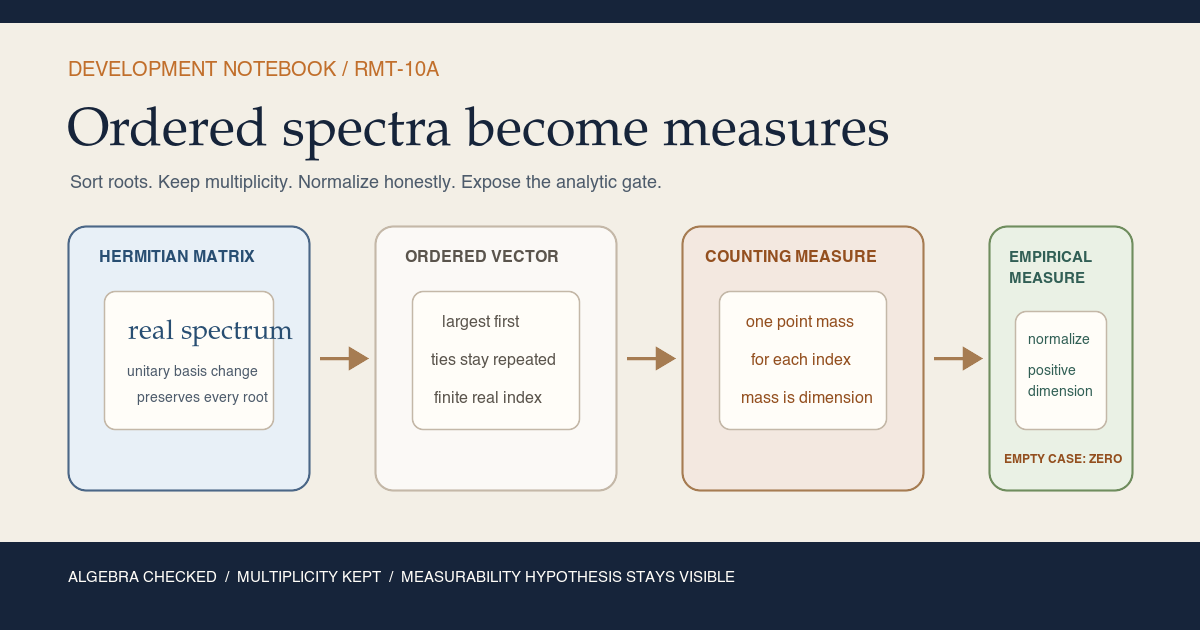
This is the proof-to-prose companion for
formalization/NonlinearDynamics/Random/RandomMatrices/HermitianSpectrum.lean.
Every public declaration and both private proof helpers in that stable source
are mapped below.
The immediate predecessor, The First Exact GUE Trace Moments, computed the first two matrix trace moments without eigenvalues. The present chapter builds the deterministic spectral object that can eventually turn those trace powers into moments of an empirical spectral measure. The broader textbook ascent is introduced in Random Matrices: From Outcomes to Spectra.
Its immediate successor, Hermitian Spectral Stability in Lean, proves the missing Frobenius perturbation bound and discharges every coordinatewise eigenvalue-measurability hypothesis kept visible here.
Reusable background appears under empirical-spectral-measure , hermitian-matrix , matrix-trace , trace-power , unitary-invariance , pushforward-measure , probability-law , and normalization-convention .
Choose a route up
| Route | Begin | Destination |
|---|---|---|
| First encounter | One matrix, three spectral objects | See why a vector, a counting measure, and an empirical measure are different |
| Algebra route | A decreasing vector with multiplicity | Understand the ordered Mathlib eigenvalue interface |
| Trace route | The first two spectral power sums | Recover the trace and the trace of the matrix square from eigenvalues |
| Symmetry route | Unitary congruence preserves the ordered vector | Follow characteristic polynomials through a basis change |
| Measure route | From repeated eigenvalues to a counting measure | Package multiplicity as Dirac mass |
| Boundary route | Why dimension zero cannot be a probability measure | Audit the zero-aware normalization policy |
| Probability route | Measures as measurable outputs | Learn the Giry interface and its exact missing hypothesis |
| Ambient route | Totalizing an intrinsic observable | Compare the ambient and intrinsic GUE pushforwards |
| Lean route | The complete declaration map | Inspect all twenty-six public declarations and two private helpers |
| Integrity route | Strict nonclaims | Separate this finite algebraic layer from perturbation and asymptotics |
Learning objectives
By the summit, a reader should be able to:
- explain why an unordered multiset, an ordered eigenvalue vector, a counting measure, and a probability measure serve different jobs;
- read
Antitoneas a decreasing-order guarantee onFin n; - explain why repeated indices preserve algebraic multiplicity;
- distinguish Mathlib’s
eigenvalues₀ordering from its arbitrarily reindexedeigenvaluesfunction; - follow the order-preserving
Fin.castOrderIsoreindexing used by the project; - derive the trace as the first eigenvalue power sum;
- derive the trace of the square as the second eigenvalue power sum;
- explain how unitary congruence preserves the characteristic polynomial and therefore the entire sorted vector;
- interpret a finite sum of Dirac measures as a multiplicity-aware spectral counting measure;
- distinguish mass
nfrom mass one; - audit the explicit
n = 0policy for the empirical measure; - understand why
IsZeroOrProbabilityMeasureis the correct all-dimension statement andIsProbabilityMeasureis restricted to successor dimension; - read
ProbabilityMeasure ℝas a bundled positive-dimensional object; - explain what Giry measurability of a measure-valued map means;
- identify coordinatewise eigenvalue measurability as a hypothesis, not a theorem proved in this module;
- understand why an ambient matrix observable needs a total extension away from the Hermitian locus;
- follow the exact ambient/intrinsic GUE pushforward bridge; and
- state precisely which density, perturbation, random-law, and asymptotic claims remain open.
One matrix, three spectral objects
flowchart LR
  H["intrinsic Hermitian matrix"] --> E["decreasing real eigenvalue vector"]
  E --> C["one Dirac mass per index"]
  C --> M["counting measure of mass equal to dimension"]
  M --> N["dimension-normalized empirical measure"]
  Z["dimension zero"] --> Q["zero measure policy"]
  Q --> N
  P["coordinatewise eigenvalue measurability"] --> G["measurable random measure"]
  N --> G
Figure. The algebraic path from a Hermitian matrix to its ordered spectrum and finite spectral measures is checked without an analytic hypothesis. The last arrow, from a matrix-varying empirical measure to a measurable random measure, is conditional on coordinatewise eigenvalue measurability. Dimension zero follows a separate zero-measure policy: an empty spectrum does not have total mass one.
The diagram separates three objects that are easy to blur in handwritten notation.
- The ordered vector remembers which eigenvalue is largest, second largest, and so on. Equal values may occupy several indices.
- The counting measure forgets the names of the indices but keeps their multiplicities as repeated Dirac mass. Its total mass is the dimension.
- The empirical measure divides that mass by the dimension when the dimension is positive. It gives equal weight to every eigenvalue occurrence.
The ordered vector is convenient for edge statistics and perturbation bounds. The empirical measure is convenient for integration and weak convergence. Neither is interchangeable with the matrix law itself. A matrix law is a measure on matrices. An empirical spectral measure is one measure on the real line produced from one matrix. A random empirical spectral law, when it is legitimate to construct one, is a measure on the space of measures on the real line.
Base camp: the deterministic object comes first
Fix a natural dimension \(n\). The intrinsic carrier
RandomMatrix.HermitianEuclidean n is the real inner-product space of
Hermitian complex matrices developed in RMT-07. An element \(H\) has an
ambient matrix hermitianToMatrix H and a proof \(H^*=H\).
The finite spectral theorem gives real eigenvalues and a unitary
diagonalization. Pinned Mathlib packages that theorem through
Matrix.IsHermitian.eigenvalues₀, eigenvectorUnitary, and
spectral_theorem (Mathlib matrix-spectrum documentation).
The project deliberately starts there, before randomness. For each fixed
matrix, all statements in the first two-thirds of the module are algebraic or
finite-measure statements. They require no probability space and no GUE law.
This dependency order matters. If we first wrote “the random eigenvalue distribution,” several hidden obligations would be fused together:
| Obligation | Question it answers | Status in RMT-10A |
|---|---|---|
| Algebraic spectrum | What are the eigenvalues, with order and multiplicity? | Proved |
| Spectral measures | How does one matrix become a finite measure? | Defined and normalized |
| Matrix-varying measurability | Is the spectral object a random variable? | Conditional interface only |
| Pushforward law | What is the distribution of the random spectral object? | Equality proved under the same hypothesis |
| Asymptotics | What happens as dimension grows? | Not addressed |
The point is not bureaucratic caution. Each row lives in a different mathematical category. A correct statement in one row cannot silently supply the next.
A decreasing vector with multiplicity
Why eigenvalues₀ is the right source
Mathlib exposes two related Hermitian eigenvalue functions. The distinction is small in type syntax and large in meaning.
Matrix.IsHermitian.eigenvalues₀is indexed byFin (Fintype.card (Fin n))and is decreasing by construction.Matrix.IsHermitian.eigenvaluesis reindexed to the matrix index type byFintype.equivOfCardEq. That equivalence supplies a bijection, but it is not an order theorem.
For a statement such as “the largest eigenvalue is coordinate zero,” arbitrary reindexing is not acceptable. RMT-10A therefore defines:
noncomputable def orderedHermitianEigenvalues {n : ℕ}
    (H : HermitianEuclidean n) : Fin n → ℝ :=
  fun i => H.2.eigenvalues₀ (Fin.cast (Fintype.card_fin n).symm i)
Fintype.card_fin n proves that the cardinality of Fin n is n. Its
symmetric equality transports an index from Fin n to the natural index of
eigenvalues₀. The corresponding Fin.castOrderIso is an order isomorphism,
so this transport preserves the sorted interpretation.
The definition is noncomputable because the eigenvalue construction uses
classical spectral data. That does not weaken its theorem content. It means
Lean is specifying the value extensionally rather than extracting an
executable numerical eigensolver.
Decreasing means antitone
The theorem
orderedHermitianEigenvalues_antitone states:
theorem orderedHermitianEigenvalues_antitone {n : ℕ}
    (H : HermitianEuclidean n) :
    Antitone (orderedHermitianEigenvalues H)
For indices \(i\le j\), antitonicity says
\(\lambda_i(H)\ge \lambda_j(H)\). The proof sends the index inequality through
Fin.cast_le_cast and invokes Mathlib’s
Matrix.IsHermitian.eigenvalues₀_antitone. This is the small theorem that
licenses all later language about a decreasing spectrum.
At \(n=0\), Fin 0 has no elements. The function still exists, and every
universal statement about its coordinates is vacuous. No dummy eigenvalue is
invented.
The first two spectral power sums
The next two declarations connect RMT-10A back to the observable layer. They are deterministic identities for one Hermitian matrix, not expectations under a random law.
The trace is the first power sum
trace_eq_sum_orderedHermitianEigenvalues proves
with the left side in \(\mathbb C\) and each real eigenvalue coerced to \(\mathbb C\). The Lean statement is:
theorem trace_eq_sum_orderedHermitianEigenvalues {n : ℕ}
    (H : HermitianEuclidean n) :
    Matrix.trace (hermitianToMatrix H) =
      ∑ i, (orderedHermitianEigenvalues H i : ℂ)
The proof does not rely on a slogan about diagonalization. It walks through the characteristic polynomial:
- Hermiticity supplies
H.2.splits_charpoly, so the trace equals the sum of characteristic-polynomial roots. H.2.roots_charpoly_eq_eigenvalues₀identifies those roots with the sorted real eigenvalues after coercion to \(\mathbb C\).Equiv.sum_comptransports the finite sum through the order-preserving cast from Mathlib’s cardinality index toFin n.
Because finite sums over Fin 0 are empty and the trace of the empty matrix is
zero, the same theorem includes dimension zero.
The trace of the square is the second power sum
trace_sq_eq_sum_sq_orderedHermitianEigenvalues proves
This proof uses the spectral theorem more visibly. Let \(U\) be Mathlib’s
unitary eigenvector matrix and let \(D\) be the diagonal matrix containing the
arbitrarily reindexed H.2.eigenvalues. The spectral theorem gives
The proof expands the square, cancels \(U^*U=I\), and cycles factors under the trace until only \(D^2\) remains:
\[ \operatorname{Tr}\!\left((UDU^*)^2\right) =\operatorname{Tr}(D^2) =\sum_i\lambda_i^2. \]Lean’s proof then performs two separate finite reindexings. The first moves
from Mathlib’s arbitrary eigenvalues index back to eigenvalues₀. The second
moves from the native eigenvalues₀ cardinality index to the project’s
order-preserving Fin n index. The square sum is permutation invariant, so
the first reindexing is legitimate even though it does not preserve order.
The final public statement nevertheless uses the ordered vector.
This is a useful proof-engineering lesson: order matters to the interface, but a symmetric finite sum may pass through a temporary arbitrary enumeration.
Matrix moments are not random moments yet
The two identities can be read as first and second moments of a finite
counting measure, which the module proves shortly. They are not the RMT-09
expectation statements. RMT-09 integrated trace powers over GUE.matrixLaw n.
RMT-10A currently integrates powers over the spectral measure of one fixed
matrix. An outer integral over a random matrix law would require the
matrix-to-spectral-measure map to be measurable.
Unitary congruence preserves the ordered vector
For a unitary matrix \(U\), intrinsic Hermitian congruence sends
\[ H\longmapsto UHU^*. \]The theorem
orderedHermitianEigenvalues_hermitianCongruence proves equality of the
entire functions Fin n → ℝ, not merely equality of their sums:
theorem orderedHermitianEigenvalues_hermitianCongruence {n : ℕ}
    (U : Matrix.unitaryGroup (Fin n) ℂ)
    (H : HermitianEuclidean n) :
    orderedHermitianEigenvalues (hermitianCongruence U H) =
      orderedHermitianEigenvalues H
The proof architecture is characteristic-polynomial invariance followed by sorting:
Matrix.charpoly_mul_commcycles a factor in the characteristic polynomial of \(UHU^*\).- Unitarity supplies \(U^*U=I\), reducing the polynomial to the characteristic polynomial of \(H\).
sort_roots_charpoly_eq_eigenvalues₀describes each sorted eigenvalue vector as the decreasing sort of the real parts of the polynomial roots.- Equal characteristic polynomials therefore give equal
List.ofFnlists. List.ofFn_injconverts that list equality back to equality of functions, after which the same index cast gives the public vector equality.
This result is deterministic spectral invariance. It should not be confused with RMT-08’s law-level unitary invariance of GUE. Every individual Hermitian matrix and its unitary conjugate have the same spectrum. A random matrix law is unitarily invariant only when the distribution of the whole matrix is also unchanged.
From repeated eigenvalues to a counting measure
The definition spectralCountingMeasure places one Dirac mass at each index:
Its Lean spelling is:
noncomputable def spectralCountingMeasure {n : ℕ}
    (H : HermitianEuclidean n) : Measure ℝ :=
  ∑ i, Measure.dirac (orderedHermitianEigenvalues H i)
Dirac measure turns one point into one unit of measure. A finite sum of Dirac measures is therefore a natural counting measure for a finite multiset. The official Mathlib documentation defines its general counting measure through a sum of Dirac masses as well (counting measure, Dirac measure). RMT-10A uses an explicit finite sum because the eigenvalue locations, rather than the index set itself, carry the mass.
If \(\lambda\) occurs at \(r\) different indices, then a measurable set containing \(\lambda\) receives \(r\) contributions. Algebraic multiplicity is therefore retained without separately storing a multiplicity function.
Five immediate theorems
spectralCountingMeasure_hermitianCongruence is a simplification theorem. It
rewrites each eigenvalue through
orderedHermitianEigenvalues_hermitianCongruence, so the finite sum of Dirac
measures is unchanged.
spectralCountingMeasure_zero proves that an intrinsic zero-dimensional
Hermitian matrix has the zero counting measure. The proof is literally
Fintype.sum_empty: there are no indices and therefore no Dirac masses.
spectralCountingMeasure_univ evaluates the measure on the whole real line:
The equality lives in extended nonnegative reals, with the natural number coerced into the measure’s value type. Every Dirac measure assigns mass one to the whole space, and the finite sum has one term per index.
The final two declarations in this group turn the earlier power-sum identities into integral identities:
\[ \int_{\mathbb R}x\,d\Xi_H(x)=\operatorname{Tr}(H), \qquad \int_{\mathbb R}x^2\,d\Xi_H(x)=\operatorname{Tr}(H^2). \]Because the public trace codomain is complex, Lean integrates the functions
fun x : ℝ => (x : ℂ) and fun x : ℝ => (x : ℂ) ^ 2. The theorems are named
integral_complex_ofReal_spectralCountingMeasure and
integral_sq_complex_ofReal_spectralCountingMeasure.
Both proofs use integral_finsetSum_measure to exchange an integral against a
finite sum of measures with a finite sum of integrals. Every Dirac integral is
integrable, and integral_dirac evaluates it at its support point. The result
then closes with the corresponding trace identity. No limiting theorem and no
matrix probability law appears.
Normalizing the cloud
Random-matrix theory often replaces the mass-\(n\) counting measure by a mass-one empirical spectral measure. For positive dimension, the familiar formula is
\[ L_H=\frac1n\sum_{i\in\operatorname{Fin}(n)}\delta_{\lambda_i(H)}. \]The definition empiricalSpectralMeasure implements the same idea in the
scalar system used by Mathlib measures:
noncomputable def empiricalSpectralMeasure {n : ℕ}
    (H : HermitianEuclidean n) : Measure ℝ :=
  (n : ℝ≥0∞)⁻¹ • spectralCountingMeasure H
The scalar belongs to ℝ≥0∞, Mathlib’s extended nonnegative reals, because
that is the scalar action on positive measures. The inverse is attached to the
dimension and not hidden in notation. The definition is total for every
natural \(n\), but the theorem interface distinguishes zero from positive
dimension.
empiricalSpectralMeasure_hermitianCongruence follows immediately from the
counting-measure invariance. Scaling the same measure by the same scalar gives
the same empirical measure.
Why dimension zero cannot be a probability measure
At \(n=0\), the spectrum has no points. Its counting measure is zero, and the
module chooses the empirical measure to be zero as well. The theorem
empiricalSpectralMeasure_zero states this explicitly.
There is a subtle type-level detail worth seeing. In extended nonnegative
reals, the inverse of zero is the top element. The definition therefore does
not replace that inverse with an ordinary real reciprocal. Instead,
spectralCountingMeasure_zero first reduces the measure to zero, and
smul_zero proves that any scalar multiple of the zero measure is zero. The
mathematical policy is clear: an empty spectrum has zero mass, not an invented
unit mass at a placeholder location.
That choice forces two probability interfaces.
empiricalSpectralMeasure_isZeroOrProbabilitystates, in every dimension, that the empirical measure is either zero or a probability measure. Its proof observes that the scaling factor is the inverse of the counting measure’s total mass and invokes Mathlib’s normalized-measure instance.empiricalSpectralMeasure_succ_isProbabilityspecializes to dimensionn + 1, where the total mass is positive and finite. It proves directly that inverse dimension multiplied by dimension is one.
The all-dimension theorem is not a weaker proof accidentally left in place. It records the real boundary. There is no probability measure on the real line with total mass zero.
Bundle probability only where it is true
Mathlib’s ProbabilityMeasure ℝ is a bundled measure together with a proof of
total mass one. The definition
empiricalSpectralProbability accepts a matrix of dimension n + 1 and
packages empiricalSpectralMeasure H with
empiricalSpectralMeasure_succ_isProbability n H:
noncomputable def empiricalSpectralProbability (n : ℕ)
    (H : HermitianEuclidean (n + 1)) : ProbabilityMeasure ℝ
The successor index is not cosmetic. It makes an invalid zero-dimensional
probability object unrepresentable at this API boundary. The official Mathlib
documentation describes ProbabilityMeasure as the type of probability
measures and equips it with the topology of weak convergence
(Mathlib probability measures). RMT-10A
uses only its bundled mass-one structure and measurable subtype here. It does
not prove convergence of any sequence of these measures.
A finite worked example
Suppose a three-dimensional Hermitian matrix has ordered eigenvalues
\[ \lambda_0=4, \qquad \lambda_1=1, \qquad \lambda_2=1. \]The repeated value is kept twice. The counting and empirical measures are
\[ \Xi_H=\delta_4+2\delta_1, \qquad L_H=\frac13\delta_4+\frac23\delta_1. \]Their total masses are three and one. Their first moments are
\[ \int x\,d\Xi_H(x)=6=\operatorname{Tr}(H), \qquad \int x\,dL_H(x)=2=\frac1{3}\operatorname{Tr}(H). \]The module checks the counting-measure identity directly. The normalized first-moment identity displayed in the example is an immediate paper calculation from scalar multiplication, but it is not exported as a named RMT-10A theorem. This distinction keeps the chapter aligned with the actual public API.
Measures as measurable outputs
Defining \(H\mapsto L_H\) pointwise does not yet make it a random variable.
The codomain is itself Measure ℝ, and Mathlib equips that type with the Giry
measurable structure. A map into measures is measurable when evaluation on
every measurable set varies measurably. The official documentation states
this through Measure.measurable_coe and
Measure.measurable_of_measurable_coe, and proves that the Dirac map itself is
measurable (Mathlib Giry monad).
The central unresolved input is:
h : ∀ i, Measurable (fun H : HermitianEuclidean n =>
  orderedHermitianEigenvalues H i)
This hypothesis says that every fixed ordered eigenvalue coordinate is a measurable real-valued function of the intrinsic Hermitian matrix. It is exactly the theorem one expects to obtain from a continuity or perturbation bound. RMT-10A does not prove it.
Counting measures are measurable if the coordinates are
measurable_spectralCountingMeasure_of_measurable_eigenvalues consumes the
coordinatewise hypothesis and proves:
Measurable (@spectralCountingMeasure n)
For each index, measurability of the eigenvalue coordinate composes with
Measure.measurable_dirac. Finset.measurable_fun_sum then closes the finite
sum. This proof exposes the exact analytic dependency: finite summation and
Dirac packaging add no new obstacle once each coordinate is measurable.
Constant scaling in the Giry space
The private helper measurable_const_smul_measure proves that, for a fixed
extended nonnegative scalar \(c\), the map
from Measure ℝ to Measure ℝ is measurable. It applies
Measure.measurable_of_measurable_coe, fixes an arbitrary measurable set
\(s\), rewrites evaluation as \(c\mu(s)\), and multiplies a measurable
constant by the measurable evaluation function Measure.measurable_coe hs.
This helper is private because the public scientific interface needs only the specific inverse-dimension scaling. Its proof is still important: it shows that normalization happens inside the Giry measurable space rather than by an unjustified coercion.
measurable_empiricalSpectralMeasure_of_measurable_eigenvalues composes this
constant-scaling map with the measurable counting-measure map. It proves
measurability of the intrinsic empirical spectral measure under the same
coordinatewise hypothesis.
measurable_empiricalSpectralProbability_of_measurable_eigenvalues handles
positive dimension. Since empiricalSpectralProbability n H is a subtype
whose underlying measure is the empirical measure, .subtype_mk lifts the
measurability theorem into ProbabilityMeasure ℝ.
Why the missing theorem belongs to perturbation theory
The intended next theorem is continuity of each ordered eigenvalue coordinate. One route is a Weyl-type bound controlling each coordinate by an operator-norm perturbation; once such continuity is checked, measurability follows. None of that mathematics is encoded in this module. Merely knowing that the characteristic polynomial depends continuously on entries is not enough to claim that a chosen sorted root coordinate is measurable without a root or eigenvalue continuity theorem.
The explicit hypothesis is therefore a useful dependency seam. RMT-10A can finish the algebra, normalization, and pushforward architecture now. A later perturbation slice can discharge the one named assumption everywhere without redesigning the measure interfaces.
Totalizing an intrinsic observable
GUE.matrixLaw n lives on the full ambient matrix type, while
empiricalSpectralMeasure accepts the intrinsic Hermitian subtype. Even though
the GUE law gives the Hermitian locus mass one, a function used by
Measure.map must still be defined on every ambient matrix.
The module solves this with an explicit total extension.
Hermitian matrices pass through; everything else becomes zero
matrixToHermitianOrZero checks whether an ambient matrix \(A\) is Hermitian.
If it is, the function packages the same entries as an element of
HermitianEuclidean n. If it is not, the function returns the zero intrinsic
matrix.
noncomputable def matrixToHermitianOrZero (n : ℕ)
    (A : Matrix (Fin n) (Fin n) ℂ) : HermitianEuclidean n
This policy is total and deterministic. It does not assert that a non-Hermitian matrix has a Hermitian spectrum. It merely supplies a fallback value outside the intended locus so a measurable function can exist on the ambient carrier.
The private helper measurable_matrixToFrobenius proves that the ambient
matrix-to-Frobenius conversion is measurable. It unfolds the finite
EuclideanSpace representation, uses WithLp.measurable_toLp, reduces
function-space measurability with measurable_pi_iff, and closes each
coordinate with the project’s measurable matrix-entry theorem.
measurable_matrixToHermitianOrZero then rewrites the underlying Frobenius
value as a piecewise function on RandomMatrix.hermitianSet n. The set is
measurable by RMT-07, the true branch is
measurable_matrixToFrobenius n, and the false branch is constant zero.
Measurable.piecewise and Measurable.subtype_mk produce the final intrinsic
map.
Finally,
matrixToHermitianOrZero_hermitianToMatrix proves the exact left-inverse
identity
The Hermitian proof stored in \(H\) selects the true branch, and subtype extensionality reduces equality to the unchanged entries. This theorem is the key simplification in the final pushforward bridge.
The ambient spectral observable
ambientEmpiricalSpectralMeasure is the composition
It is a total function from ambient complex matrices to measures on \(\mathbb R\). On the Hermitian locus it agrees exactly with the intrinsic observable. Off that locus it applies the intrinsic empirical-measure definition to the zero Hermitian matrix. The module needs no further formula for that fallback value.
measurable_ambientEmpiricalSpectralMeasure_of_measurable_eigenvalues
composes measurable_matrixToHermitianOrZero with the conditional intrinsic
measurability theorem. It carries precisely the same coordinatewise
eigenvalue-measurability hypothesis.
The conditional ambient/intrinsic GUE bridge
The module culminates in the long but descriptive theorem
map_matrixLaw_ambientEmpiricalSpectralMeasure_eq_map_intrinsicLaw_of_measurable_eigenvalues:
theorem map_matrixLaw_ambientEmpiricalSpectralMeasure_eq_map_intrinsicLaw_of_measurable_eigenvalues
    {n : ℕ}
    (h : ∀ i, Measurable (fun H : HermitianEuclidean n =>
      orderedHermitianEigenvalues H i)) :
    (GUE.matrixLaw n).map (ambientEmpiricalSpectralMeasure n) =
      (GUE.intrinsicLaw n).map empiricalSpectralMeasure
Both sides are measures on Measure ℝ. The left side samples an ambient GUE
matrix and applies the totalized spectral observable. The right side samples
an intrinsic Hermitian GUE matrix and applies the intrinsic observable. The
theorem says these two laws of measure-valued outputs agree, provided the
eigenvalue coordinates are measurable.
The proof uses the exact RMT-08 identity
GUE.matrixLaw_eq_map_hermitianToMatrix_intrinsicLaw, not merely the statement
that the Hermitian locus has mass one. It then applies Measure.map_map with
both measurability proofs and uses function extensionality. At each intrinsic
matrix, matrixToHermitianOrZero_hermitianToMatrix collapses the composition
back to empiricalSpectralMeasure.
flowchart LR
  I["intrinsic GUE law"] --> H["intrinsic Hermitian matrix"]
  I -->|"map inclusion"| A["ambient GUE law"]
  H --> E["intrinsic empirical measure"]
  A --> T["Hermitian-or-zero totalization"]
  T --> E
  E --> L["law on the space of real-line measures"]
Figure. RMT-08 identifies the ambient GUE law as the pushforward of the intrinsic law. The totalization is a left inverse on every included Hermitian matrix, so the two routes to a law on measure-valued outputs agree. The diagram presupposes the coordinatewise eigenvalue-measurability hypothesis required by both `Measure.map` calculations.
This theorem is an architectural bridge, not the final random spectral law.
Until the hypothesis h is discharged by a checked continuity or
measurability theorem, downstream code cannot invoke it without carrying the
assumption.
The complete declaration map
The frozen module exports six definitions and twenty theorems. Two additional private theorems are proof engines. The table follows source order.
| Declaration | Kind | Exact role |
|---|---|---|
orderedHermitianEigenvalues | public definition | Reindexes Mathlib’s decreasing eigenvalues₀ vector to Fin n with the finite cardinal cast |
orderedHermitianEigenvalues_antitone | public theorem | Proves the project vector is decreasing |
trace_eq_sum_orderedHermitianEigenvalues | public theorem | Identifies the complex trace with the first ordered eigenvalue power sum |
trace_sq_eq_sum_sq_orderedHermitianEigenvalues | public theorem | Identifies the trace of the matrix square with the second ordered eigenvalue power sum |
orderedHermitianEigenvalues_hermitianCongruence | public theorem | Proves equality of the whole ordered vector under intrinsic unitary congruence |
spectralCountingMeasure | public definition | Sums one Dirac measure per eigenvalue index, retaining multiplicity |
spectralCountingMeasure_hermitianCongruence | public theorem | Preserves the counting measure under unitary congruence |
spectralCountingMeasure_zero | public theorem | Reduces the empty spectral sum to the zero measure at dimension zero |
spectralCountingMeasure_univ | public theorem | Computes total counting mass as n |
integral_complex_ofReal_spectralCountingMeasure | public theorem | Computes the first complex counting-measure moment as the matrix trace |
integral_sq_complex_ofReal_spectralCountingMeasure | public theorem | Computes the second complex counting-measure moment as the trace of the matrix square |
measurable_spectralCountingMeasure_of_measurable_eigenvalues | public theorem | Lifts coordinatewise eigenvalue measurability through Dirac maps and a finite sum |
empiricalSpectralMeasure | public definition | Scales the counting measure by inverse dimension, with a total zero-aware definition |
empiricalSpectralMeasure_hermitianCongruence | public theorem | Preserves the normalized measure under unitary congruence |
empiricalSpectralMeasure_zero | public theorem | Proves the explicit zero-measure policy at dimension zero |
empiricalSpectralMeasure_isZeroOrProbability | public theorem | Gives the correct zero-or-probability statement uniformly in dimension |
empiricalSpectralMeasure_succ_isProbability | public theorem | Proves total mass one for successor dimensions |
empiricalSpectralProbability | public definition | Bundles the positive-dimensional empirical measure as ProbabilityMeasure ℝ |
measurable_const_smul_measure | private theorem | Proves fixed scalar multiplication is measurable in the Giry measurable space |
measurable_empiricalSpectralMeasure_of_measurable_eigenvalues | public theorem | Composes counting-measure measurability with inverse-dimension scaling |
measurable_empiricalSpectralProbability_of_measurable_eigenvalues | public theorem | Lifts conditional measurability into the bundled probability-measure subtype |
matrixToHermitianOrZero | public definition | Totalizes the intrinsic carrier on ambient matrices with a zero fallback |
measurable_matrixToFrobenius | private theorem | Proves the ambient-to-Frobenius coordinate conversion measurable |
measurable_matrixToHermitianOrZero | public theorem | Proves the totalization measurable as a piecewise map on the Hermitian set |
matrixToHermitianOrZero_hermitianToMatrix | public theorem | Proves totalization is a left inverse to intrinsic inclusion |
ambientEmpiricalSpectralMeasure | public definition | Composes totalization with the intrinsic empirical measure |
measurable_ambientEmpiricalSpectralMeasure_of_measurable_eigenvalues | public theorem | Makes the ambient measure-valued observable measurable under the same hypothesis |
map_matrixLaw_ambientEmpiricalSpectralMeasure_eq_map_intrinsicLaw_of_measurable_eigenvalues | public theorem | Equates ambient and intrinsic GUE pushforward laws under coordinatewise measurability |
The dependency shape
The declaration graph has four layers:
- Ordered algebra: sorted eigenvalues, order, power sums, and congruence.
- Finite measures: counting measure, total mass, and pointwise moments.
- Normalization: zero-aware empirical measure and positive-dimensional probability bundling.
- Measurable transport: conditional Giry maps, ambient totalization, and the GUE pushforward equality.
Only the fourth layer depends on the missing coordinatewise measurability hypothesis. That separation is the main design achievement of the module.
Lean proof anatomy and engineering choices
Why there are two eigenvalue enumerations in one proof
trace_sq_eq_sum_sq_orderedHermitianEigenvalues temporarily uses
H.2.eigenvalues because Mathlib’s spectral_theorem is stated with that
enumeration. It later reindexes to eigenvalues₀, and then through the ordered
cast to the project vector. This is not an inconsistency. The diagonalization
needs a complete enumeration; the public interface needs a sorted one; the
square sum is invariant under the intermediate permutation.
Why characteristic polynomials prove congruence invariance
One might try to transport each eigenvector through \(U\). That creates bookkeeping around repeated eigenspaces and the chosen basis. Characteristic polynomials avoid the choice. Unitary congruence is a similarity because \(U^{-1}=U^*\), so the characteristic polynomial is unchanged. Sorting the same multiset of real roots then produces the same ordered vector, including ties.
Why measures use ℝ≥0∞
A positive measure evaluates sets in extended nonnegative reals, and scalar
multiplication by ℝ≥0∞ remains within that structure. It naturally handles
infinite mass in general measure theory. The spectral counting measure is
finite, but using the ambient measure API avoids building a separate custom
finite-measure calculus.
Why the ambient fallback is zero
Any fixed intrinsic Hermitian matrix could serve as the off-locus fallback.
Zero is canonical, dimension-uniform, and measurable as a constant. More
importantly, the final bridge starts from the exact intrinsic pushforward
representation of GUE.matrixLaw, so only the value on included Hermitian
matrices is used in the composition proof. The left-inverse theorem makes that
fact syntactic.
Why there is no global measurability instance
Installing an instance without a proof would hide a mathematical assumption
inside typeclass search. The module instead uses named theorems with an
explicit argument h. Downstream declarations must state whether they have
actually discharged the perturbation-theory dependency.
How to run the checked source
Load elan and compile this module with warnings promoted to errors:
source "$HOME/.elan/env"
cd formalization
lake env lean -DwarningAsError=true \
  NonlinearDynamics/Random/RandomMatrices/HermitianSpectrum.lean
Build the entire Lean library:
source "$HOME/.elan/env"
cd formalization
lake build
From the repository root, check the public teaching content:
make content-hygiene
make site-check
Useful source reconnaissance commands are:
rg -n "eigenvalues₀|eigenvalues₀_antitone|spectral_theorem" \
  formalization/.lake/packages/mathlib/Mathlib/Analysis/Matrix/Spectrum.lean

rg -n "measurable_dirac|measurable_of_measurable_coe|measurable_coe" \
  formalization/.lake/packages/mathlib/Mathlib/MeasureTheory/Measure/GiryMonad.lean
The pinned Mathlib 4.32.0 checkout is the API authority. Web documentation is useful for orientation, but it may describe a newer revision than the project’s dependency.
Common failure modes
Treating an arbitrary enumeration as sorted
Mathlib’s eigenvalues supplies values indexed by the matrix index type, but
its reindexing equivalence is not an order-preserving theorem. Use
orderedHermitianEigenvalues whenever coordinate order has meaning.
Deduplicating repeated eigenvalues
An empirical spectral measure counts roots with algebraic multiplicity. Replacing the indexed vector by the set of distinct real values changes the measure, its total mass, and its moments.
Calling the counting measure a probability measure
spectralCountingMeasure H has total mass n, not one. Only the normalized
measure in positive dimension is a probability measure.
Hiding the zero-dimensional branch
The formula \(1/n\) is a positive-dimensional mnemonic. The checked definition
is total and theorems state that dimension zero gives the zero measure. Do not
package that result as a ProbabilityMeasure.
Reading a conditional theorem as an unconditional result
Every declaration ending in _of_measurable_eigenvalues takes the missing
coordinatewise theorem as an argument. The final map equality does too.
Confusing pointwise spectral invariance with law invariance
orderedHermitianEigenvalues_hermitianCongruence concerns one matrix and one
unitary. RMT-08’s GUE theorem concerns equality of matrix probability laws.
The final RMT-10A bridge combines law transport with a pointwise left inverse,
but only after measurability is supplied.
Calling matrixToHermitianOrZero a spectral theorem for general matrices
The function discards non-Hermitian inputs by returning zero. It does not compute the possibly complex spectrum of a non-Hermitian matrix.
Equating a random measure with its expectation
ambientEmpiricalSpectralMeasure n A is a measure-valued observable. Mapping a
matrix law through it gives a distribution over measures. Averaging those
measures, or integrating a test function against that average, is an
additional construction not exported here.
Strict nonclaims
RMT-10A does not prove any of the following:
- continuity, Lipschitz continuity, or measurability of the ordered eigenvalue coordinates;
- a Weyl perturbation inequality, min-max theorem, or Courant-Fischer characterization;
- an unconditional measurable empirical spectral observable;
- an unconditional finite-GUE empirical spectral law;
- a joint eigenvalue density, Vandermonde factor, or matrix-to-eigenvalue Jacobian;
- a formula for the expected empirical spectral measure;
- a connection between the RMT-09 GUE expectations and expectations of empirical spectral moments;
- eigenvalue rigidity, spacing, unfolding, edge statistics, or spectral form factors;
- convergence to the semicircle law or any other large-dimension limit;
- universality, concentration, or a rate of convergence;
- an executable numerical eigenvalue algorithm; or
- spectral results for arbitrary non-Hermitian matrices.
The finite empirical spectral distribution is standard random-matrix language. For example, Tao, Vu, and Krishnapur define the empirical spectral distribution of a finite complex matrix by assigning equal mass to its eigenvalues before studying a limiting circular law (Tao, Vu, and Krishnapur, 2010). That source illustrates the broader role of empirical spectral distributions. It does not warrant importing its non-Hermitian universality or asymptotic conclusions into this Hermitian finite Lean module.
Exercises with solutions
Exercise 1: read antitonicity
Suppose \(i\le j\). What does
orderedHermitianEigenvalues_antitone H say?
Solution. It says
\[ \operatorname{orderedHermitianEigenvalues}(H)(j)\le \operatorname{orderedHermitianEigenvalues}(H)(i). \]Equivalently, earlier indices hold eigenvalues at least as large as later indices.
Exercise 2: preserve multiplicity
A four-dimensional Hermitian matrix has eigenvalues \(3,3,0,-2\). Write its counting measure and empirical measure.
Solution. The counting measure is \(2\delta_3+\delta_0+\delta_{-2}\). The empirical measure is \(\tfrac12\delta_3+\tfrac14\delta_0+\tfrac14\delta_{-2}\). Replacing the two copies of three by one point would give the wrong mass.
Exercise 3: separate order from symmetric sums
Why may the proof of the trace-of-square identity pass through Mathlib’s arbitrarily reindexed
eigenvalues, while the public vector should still use eigenvalues₀?
Solution. A finite sum of squares is unchanged by a permutation, so the intermediate enumeration does not affect the value. Coordinate claims such as largest or second largest do depend on order, so the public interface must retain the sorted enumeration.
Exercise 4: check the first two moments
For ordered eigenvalues \(2,0,-1\), compute the mass, first counting-measure moment, and second counting-measure moment.
Solution. The mass is three. The first moment is \(2+0-1=1\), which equals the trace. The second is \(4+0+1=5\), which equals the trace of the square for a Hermitian matrix with that spectrum.
Exercise 5: explain unitary congruence
Why is \(H\mapsto UHU^*\) a similarity transformation when \(U\) is unitary?
Solution. Unitarity gives \(U^{-1}=U^*\). Therefore \(UHU^*=UHU^{-1}\), so the characteristic polynomial and its roots are unchanged. Sorting the same roots gives the same ordered vector.
Exercise 6: audit dimension zero
What are spectralCountingMeasure H and empiricalSpectralMeasure H when
H : HermitianEuclidean 0?
Solution. Both are the zero measure. The counting sum has no terms, and scalar multiplication of the zero measure remains zero.
Exercise 7: choose the correct probability predicate
Why does the all-dimension theorem use IsZeroOrProbabilityMeasure?
Solution. At positive dimension the normalized measure has total mass one. At dimension zero the explicit policy gives total mass zero. One predicate must cover both cases without classifying the zero measure as a probability measure.
Exercise 8: identify the missing analytic input
Which exact hypothesis is reused by all conditional measurability theorems?
Solution. For every i : Fin n, the map from an intrinsic Hermitian matrix
to orderedHermitianEigenvalues H i must be measurable. A future continuity
or perturbation theorem should discharge this coordinatewise statement.
Exercise 9: understand Giry measurability
What does it mean, operationally, for
fun H => spectralCountingMeasure H to be measurable?
Solution. The codomain Measure ℝ has the Giry measurable structure. For
each measurable set \(s\subseteq\mathbb R\), evaluating the output measure on
\(s\) must give a measurable scalar function of \(H\). Mathlib packages this
criterion through its measure-evaluation API.
Exercise 10: test the ambient fallback
Let \(A\) be non-Hermitian. Does matrixToHermitianOrZero n A expose the
spectrum of \(A\)?
Solution. No. It returns the zero intrinsic Hermitian matrix. The function exists to totalize an intrinsic observable on the ambient carrier, not to extend Hermitian spectral theory to general matrices.
Exercise 11: follow the commuting square
Why is matrixToHermitianOrZero_hermitianToMatrix sufficient to identify the
two GUE pushforward routes after Measure.map_map?
Solution. RMT-08 already writes the ambient law as the map of the intrinsic
law through hermitianToMatrix. Composing that inclusion with the ambient
observable first applies matrixToHermitianOrZero; the left-inverse theorem
reduces the composition pointwise to the intrinsic empirical measure.
Exercise 12: classify the final theorem
Does
map_matrixLaw_ambientEmpiricalSpectralMeasure_eq_map_intrinsicLaw_of_measurable_eigenvalues construct
an unconditional GUE empirical spectral law?
Solution. No. It takes coordinatewise eigenvalue measurability as an explicit argument. It proves an exact equality of two pushforward measures under that assumption.
The next ridge
RMT-10A has built the algebraic summit and stopped at the first analytic cliff.
The next dependency is a reusable perturbation theorem for decreasingly
ordered Hermitian eigenvalues. A Weyl or Courant-Fischer layer should give a
coordinate bound strong enough to prove continuity, hence measurability, of
orderedHermitianEigenvalues.
That dependency is carried by the next chapter, Hermitian Spectral Stability in Lean, which proves the coordinatewise Frobenius bound and closes the conditional measurability interfaces without changing their design.
With that theorem in place, a later vertical slice may now define the finite-GUE empirical spectral law, audit its zero-dimensional law, and connect its first two normalized moments to RMT-09. Joint densities, higher moments, and asymptotic semicircle behavior remain later ridges.
References
The external links below were opened and checked on 2026-07-21. The pinned local Mathlib 4.32.0 source remains the API authority for the Lean proof.
Mathlib contributors.
Mathlib 4.32.0 release,
2026. This is the exact dependency release selected by
formalization/lakefile.toml.
Mathlib contributors.
Hermitian matrix spectra,
Mathlib 4 documentation. This page documents eigenvalues₀, its antitone
ordering, unitary diagonalization, characteristic-polynomial roots, and trace
as an eigenvalue sum. RMT-10A reuses those algebraic results and adds the
project’s concrete ordered index and spectral-measure layer.
Mathlib contributors.
The Giry monad,
Mathlib 4 documentation. This page defines the measurable structure on
Measure α through measurable-set evaluations and documents measurable
Dirac, map, and measure-evaluation interfaces used in the conditional proofs.
Mathlib contributors. Dirac measure, Mathlib 4 documentation. This page defines the point mass and its integration, mapping, finiteness, and probability properties.
Mathlib contributors. Counting measure, Mathlib 4 documentation. This page records the general construction of counting measure as a sum of Dirac masses and its total-mass behavior on finite sets.
Mathlib contributors.
Probability measures,
Mathlib 4 documentation. This page defines the bundled ProbabilityMeasure
type and its weak-convergence topology. RMT-10A uses the bundle only in
positive dimension and proves no convergence theorem.
Terence Tao, Van Vu, with an appendix by Manjunath Krishnapur. “Random Matrices: Universality of ESDs and the Circular Law”, The Annals of Probability 38(5), 2023-2065, 2010. arXiv:0807.4898, first submitted 2008. The paper gives a primary finite empirical-spectral-distribution definition before studying a non-Hermitian large-dimension problem. It is cited here for that standard measure viewpoint, not as support for any Hermitian continuity, GUE density, or asymptotic theorem in this module.