This is the proof-to-prose companion for
formalization/NonlinearDynamics/Random/RandomCocycles/SubadditivePhaseAveraging.lean.
It covers all eight public declarations and all seven private named helpers
and smoke declarations in exact source order. Its immediate predecessor is
Subtract the Orbit Majorant: Centering Subadditive Cocycles in Lean,
which proves the positive-horizon nonpositivity consumed here.
Its immediate successor is
Pack the Marked Starts: Ordered Disjoint Intervals for Subadditive Cocycles in Lean,
which formalizes the complementary finite interval-selection mechanism.
The reusable term introduced by this chapter is phase averaging. The parallel textbook treatment is Finite Phase Averaging for Nonpositive Subadditive Processes. Earlier foundations include the Birkhoff sum , orbit-majorant-centered process , and one-sided discrete matrix cocycle .
Choose a route up
| Route | Begin | Destination |
|---|---|---|
| First encounter | Why phases solve a powered-map problem | See the combinatorial idea before the proof |
| Geometry route | One common horizon, three kinds of pieces | Follow prefix, complete blocks, and terminal gap |
| Source-audit route | Why the horizon contains one extra block | Understand the explicit correction to the teaching display |
| Algebra route | The rectangular reindexing identity | Turn phase rows into one sliding sum |
| Assumption route | Proof dependencies versus wrapper baggage | Separate consumed fields from signature context |
| API route | The complete source-order tour | Inspect all fifteen named declarations |
| Boundary route | Degenerate cases are part of the theorem | Audit zero block length, zero block count, and time zero |
| Lean route | How Lean executes the finite proof | Read induction, iteration, arithmetic, and finite-sum steps |
| Integrity route | What phase averaging still does not prove | Block every asymptotic overread |
Learning objectives
By the summit, a reader should be able to:
- distinguish a block length, block count, phase, and tail parameter;
- explain why the common horizon is \(bq+b+r\);
- decompose that horizon into a prefix, complete blocks, and a terminal gap;
- show why \(s\lt b\) makes the terminal gap positive;
- explain why the phase-zero proof must avoid an \(X_0\le0\) premise;
- expand a powered-map Birkhoff sum into ordinary orbit positions;
- derive the phase reindexing identity on paper;
- explain why that identity works in any additive commutative monoid;
- identify the induction variable used by Lean;
- locate the uses of
birkhoffSum_succandbirkhoffSum_add; - explain what
Function.iterate_mulcontributes; - explain what natural-number arithmetic is discharged by
omega; - state the boundary-retaining raw inequality;
- remove both boundary values under positive-horizon nonpositivity;
- sum the phase inequalities with
Finset.sum_le_sum; - turn a sum of identical left sides into multiplication by \(b\);
- distinguish the total multiplication theorem from its positive-block division form;
- simplify the multiplication theorem at \(b=0\);
- simplify it at \(q=0\);
- simplify the division theorem at \(b=1\);
- explain why \(r\) is unrestricted in this module;
- audit the source correction rather than silently reproducing it;
- follow all eight public declarations in source order;
- follow all seven private named declarations in source order;
- distinguish raw proof dependencies from candidate-wrapper baggage;
- explain why no additional measure-preservation hypothesis is passed to the centered candidate methods;
- explain why the cocycle theorem takes \(C\) rather than \(hC\);
- retain the empty matrix-index boundary;
- use the positive-at-zero smoke model to reject an unnecessary \(X_0=0\) premise;
- run the warning-fatal leaf and root import checks; and
- name the interval-packing layer that remains for the complementary finite estimate.
Why phases solve a powered-map problem
A fixed block length \(b\) naturally introduces the powered map \(T^b\). If we begin at \(\omega\), then the \(q\)-term block Birkhoff sum is
\[ \operatorname{BS}_{T^b}(X_b,q,\omega) {} = \sum_{j=0}^{q-1}X_b\bigl(T^{bj}\omega\bigr). \]This sum includes starts at orbit times \(0,b,2b,\ldots\). It misses every start whose residue modulo \(b\) is nonzero. That is not an analytic failure. It is the sampling pattern created by the powered map.
Now shift the starting sample by \(T^s\), where \(s\lt b\). The same powered-map sum includes
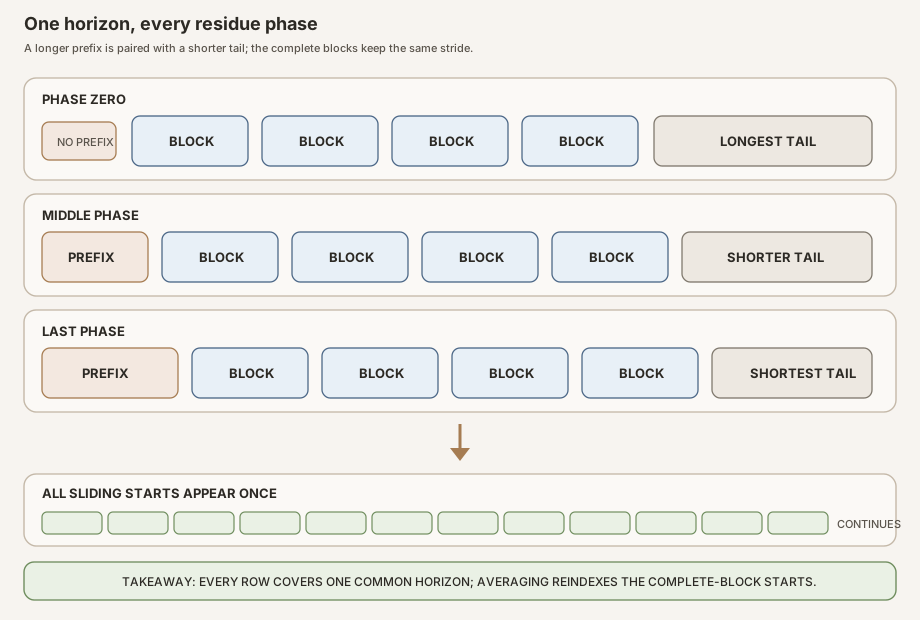
\[ s,\quad s+b,\quad s+2b,\quad\ldots,\quad s+(q-1)b. \]Let \(s\) run through every residue phase from zero to \(b-1\). Every integer from zero through \(bq-1\) has exactly one representation \(s+bj\) with \(s\lt b\) and \(j\lt q\). Therefore the array of phase rows is just a different organization of the consecutive sliding starts.
The mathematical point is elementary, but it solves a serious proof-design problem. One can apply an ordinary Birkhoff theorem to the base map \(T\) without assuming that ergodicity passes from \(T\) to \(T^b\). Lalley’s blocking discussion highlights precisely that powered-map obstruction (Lalley). RMT-20 freezes only the finite reindexing and finite upper bound. It does not invoke the later Birkhoff limit.
The pure reindexing theorem is stronger than the real-valued application in one direction and weaker in another. It works for values in any additive commutative monoid, so subtraction, order, topology, and integration are absent. On the other hand, it says only that two finite sums are equal. The subadditive inequality and sign condition enter later.
One common horizon, three kinds of pieces
Fix \(b,q,r\in\mathbb N\) and a phase \(s\lt b\). Define
\[ N=bq+b+r. \]The phase-\(s\) decomposition has three parts:
- an initial prefix of length \(s\);
- \(q\) complete blocks, each of length \(b\); and
- a terminal gap of length \(b+r-s\).
The arithmetic closes exactly:
\[ s+bq+(b+r-s)=bq+b+r=N. \]Repeated shifted subadditivity first separates the prefix from the rest. It then applies the finite block-plus-remainder estimate to the trajectory starting at \(T^s\omega\). The result is
\[ \begin{aligned} X_N(\omega) &\le \operatorname{BS}_{T^b}(X_b,q,T^s\omega) \\ &\quad+ X_{b+r-s}\bigl((T^b)^q(T^s\omega)\bigr)+X_s(\omega). \end{aligned} \]This is the boundary-retaining theorem. It consumes only the raw shifted-subadditive inequality. It is the right theorem to inspect whenever the sign hypothesis is unavailable, because it displays exactly what must be controlled later.
Suppose now that
\[ n\ne0\quad\Longrightarrow\quad X_n(\omega)\le0 \]for every sample. When \(s\gt0\), the prefix length is positive. The terminal length is also positive because \(s\lt b\) implies \(b+r-s\gt0\). Both boundary values are therefore nonpositive and can be discarded.
The phase \(s=0\) needs different bookkeeping. The boundary-retaining formula would contain \(X_0(\omega)\), but the hypothesis deliberately says nothing about time zero. The proof instead invokes the terminal-remainder block bound directly:
\[ X_N(\omega) \le \operatorname{BS}_{T^b}(X_b,q,\omega) +X_{b+r}\bigl((T^b)^q\omega\bigr). \]Since \(s=0\lt b\), we know \(b\gt0\), hence \(b+r\gt0\). The sole remainder is nonpositive and can be removed. This branch is why RMT-20 obtains all phase inequalities without assuming \(X_0=0\).
The nonpositive subadditive reduction was established in RMT-19 and has lineage in broader multiplicative-ergodic arguments (Karlsson and Margulis). RMT-20 uses only its finite pointwise sign consequence. It does not import the asymptotic conclusion of that literature.
Why the horizon contains one extra block
The horizon \(bq+b+r\) is not a cosmetic choice. It is forced by the pieces shown above. The \(q\) complete blocks contribute \(bq\), while the prefix and terminal gap contribute
\[ s+(b+r-s)=b+r. \]Together they contribute \(bq+b+r\).
This matters because a standard teaching route contains a printed indexing mismatch. Lalley’s phase display labels its left side \(g_{nm+k}\), but each displayed row contains \(n\) blocks of length \(m\) together with \(k+m\) one-step boundary positions. Those displayed pieces total \((n+1)m+k\), not \(nm+k\). The following sentence counts at most \(k+m\le2m\) one-step terms in each row. Across \(m\) displayed rows, those boundary occurrences total \(m(k+m)\), not the later printed \(mk\) (the displayed argument in Lalley’s notes).
RMT-20 does not silently copy or silently repair that display. It states the correction explicitly and proves the finite theorem at horizon \(bq+b+r\). Under the correspondence \(b=m\), \(q=n\), and \(r=k\), this is exactly \((n+1)m+k\). Its phase sum contains exactly \(bq\) sliding-block starts.
Another coherent repair could keep the horizon \(nm+k\) and use only \(n-1\) complete \(m\)-blocks in each phase row. That is not the decomposition formalized here. RMT-20 keeps the displayed count of \(n\) complete blocks and therefore retains the extra block in the horizon.
The correction is narrow. It does not dispute Kingman’s theorem, Lalley’s overall asymptotic destination, or the valid observation that one must avoid assuming \(T^m\) is ergodic. It says only that the finite row displayed on that page has a count mismatch, and it replaces that row with checked arithmetic.
The parameter \(r\) remains unrestricted. Many asymptotic blocking arguments eventually choose \(r\) as a remainder with \(r\lt b\), but no such fact is needed for the RMT-20 inequality. Adding it to the signature would misdescribe the finite algebra. A later theorem may specialize \(r\) to a modulus and prove the strict bound where it is actually used.
The rectangular reindexing identity
For an observable \(g:\Omega\to M\) with values in an additive commutative monoid, define the phase rectangle
\[ R {} = \sum_{s=0}^{b-1} \sum_{j=0}^{q-1} g\bigl(T^{s+bj}\omega\bigr). \]Every pair \((s,j)\) determines the integer \(k=s+bj\). The residue condition \(s\lt b\) and block condition \(j\lt q\) put \(k\) in the range \(0\le k\lt bq\). Conversely, Euclidean division of such a \(k\) by \(b\) recovers one pair. Thus
\[ R {} = \sum_{k=0}^{bq-1}g\bigl(T^k\omega\bigr). \]Lean’s proof does not construct this bijection explicitly. It inducts on the
number of columns \(q\). The zero-column rectangle is empty on both sides. In
the successor step, birkhoffSum_succ peels the new value from
each phase row. The induction hypothesis handles the old rectangle, while
birkhoffSum_add splits the ordinary sliding sum into its first
\(bq\) positions and the next \(b\) positions. Natural-iterate identities
identify the new phase values with that tail. The finite Birkhoff-sum laws are
the pinned Mathlib interface used by the proof
(Mathlib Birkhoff sums); the iterate multiplication
and addition laws come from Mathlib’s function-iterate API
(Mathlib function iteration).
The theorem includes two useful degeneracies. If \(q=0\), every inner sum is empty and the ordinary horizon is zero. If \(b=0\), the outer phase sum is empty and \(bq=0\). Both sides reduce to the additive identity. This is real content about the finite sum definition, not an invitation to divide by zero later.
From every phase inequality to one sliding bound
After boundary removal, each \(s\lt b\) satisfies
\[ X_N(\omega) \le \operatorname{BS}_{T^b}(X_b,q,T^s\omega). \]Sum these \(b\) inequalities. The left side is a finite sum of the same real number, hence
\[ \sum_{s=0}^{b-1}X_N(\omega)=bX_N(\omega). \]The right side is the phase rectangle. Apply the reindexing identity:
\[ \begin{aligned} bX_N(\omega) &\le \sum_{s=0}^{b-1} \operatorname{BS}_{T^b}(X_b,q,T^s\omega) \\ &{} = \operatorname{BS}_{T}(X_b,bq,\omega). \end{aligned} \]Substituting \(N=bq+b+r\) gives the central multiplication theorem.
When \(b\gt0\), division preserves the inequality:
\[ X_{bq+b+r}(\omega) \le \frac{ \operatorname{BS}_{T}(X_b,bq,\omega) }{b}. \]The denominator is the number of phase rows, not the number \(bq\) of sliding starts. The right side can also be viewed as \(q\) times the ordinary average of \(X_b\) over \(bq\) starts, but RMT-20 deliberately does not introduce that reformulation. It would still be a finite identity, not a convergence statement.
Proof dependencies versus wrapper baggage
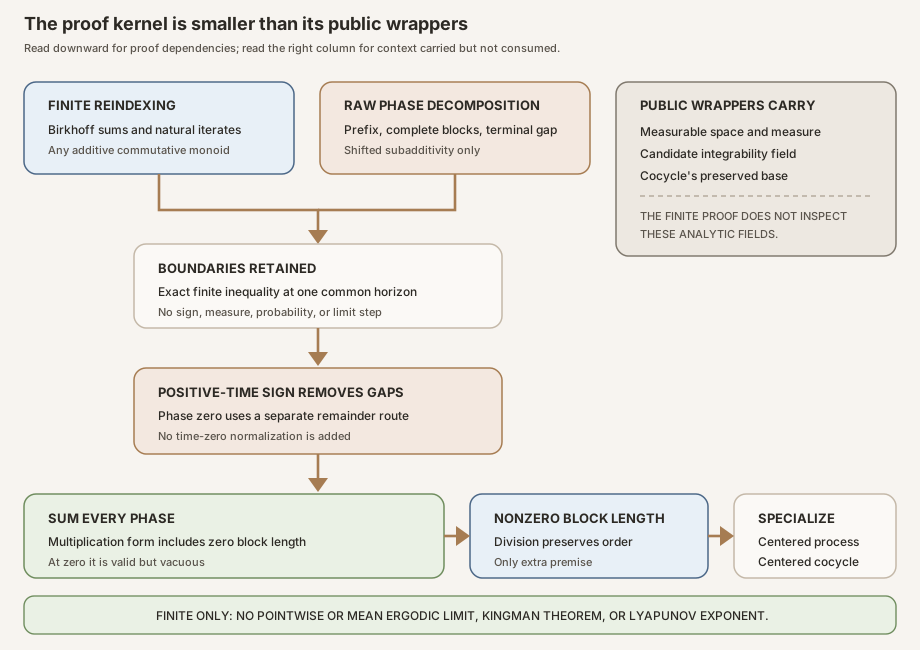
A theorem can live as a method on a rich structure even when its proof uses only one field. That distinction matters here.
| Layer | Present in the signature | Actually consumed by the proof |
|---|---|---|
| Pure reindexing | \(T\), \(g\), \(b\), \(q\), \(\omega\), additive commutative monoid | Birkhoff-sum and iterate identities |
| Private boundary estimate | Raw family \(X\) and shifted-subadditive inequality | Shifted subadditivity plus natural arithmetic |
| Private boundary removal | Raw shifted subadditivity and positive-horizon nonpositivity | Those two assumptions only |
| Public candidate methods | Measurable space, measure, integrable candidate wrapper | hX.add_le, plus derived centered-process sign where applicable |
| Cocycle specialization | A DiscreteMatrixCocycle, which already bundles a preserved base | Cocycle centered subadditivity and nonpositivity |
| Division forms | The corresponding multiplication theorem | The additional premise b ≠ 0 |
The candidate methods do retain a measurable space and an integrability object
in their signatures. More precisely, the proof does not inspect
hX.integrable, does not
take an additional hT, and does not use probability or
ergodicity. The private raw helpers make this dependency boundary explicit.
Likewise, a DiscreteMatrixCocycle already contains its base map,
measure, measurability data, and measure-preservation proof. The final theorem
takes only \(C\), with no separate
HasIntegrableGeneratorLogPlus argument. Its proof projects the
two pointwise centered laws and ignores the stored analytic fields.
This distinguishes API scope from proof dependence. The public API fits the project’s existing candidate and cocycle abstractions, while the prose reports the smaller proof kernel without claiming that the wrapper is logically minimal.
The complete source-order tour
The source interleaves public API declarations, private raw engines, and private edge-case witnesses. The order below matches the Lean file exactly.
Source item 1, public declaration 1: sum_phase_birkhoffSum
This theorem is the rectangular reindexing identity:
\[ \sum_{s=0}^{b-1} \operatorname{BS}_{T^b}(g,q,T^s\omega) {} = \operatorname{BS}_{T}(g,bq,\omega). \]Its value type is any AddCommMonoid. There is no order, real
scalar, measurable structure, or measure. The proof inducts on \(q\), expands
successor Birkhoff sums across every phase, invokes the induction hypothesis,
and identifies the new column with the final length-\(b\) segment of the
ordinary sum.
The commutativity requirement comes from organizing finite sums and using Mathlib’s Birkhoff-sum API in that setting. Nothing in the statement suggests an integral or limit.
Source item 2, private declaration 1: le_blocks_add_remainder_of_add_le
The first private engine repeats the terminal-remainder block induction at the raw algebra level:
\[ X_{bq+r}(\omega) \le \operatorname{BS}_{T^b}(X_b,q,\omega) +X_r\bigl((T^b)^q\omega\bigr). \]It takes only a function family and the shifted-subadditive inequality. It is private because RMT-18 already exposes the candidate-facing theorem. RMT-20 needs a raw version so later specializations can remain tied to the exact algebra they use.
The induction peels one block of length \(b\) from the beginning. The
successor Birkhoff identity with the first term exposed,
birkhoffSum_succ’, matches that direction.
Source item 3, private declaration 2: le_phase_birkhoffSum_add_boundaries_of_add_le
This engine creates the complete phase geometry. It rewrites the long horizon as
\[ bq+b+r=s+\bigl(bq+(b+r-s)\bigr), \]uses shifted subadditivity once at the prefix, then invokes private declaration 1 on the shifted sample \(T^s\omega\). The hypothesis \(s\lt b\) is stronger than the raw subtraction identity needs, but it is the natural residue-phase domain and guarantees all later positivity facts.
The result retains both \(X_s\) and \(X_{b+r-s}\). No sign hypothesis is present. This is the most informative finite inequality in the file because it exposes the exact error terms before any favorable sign is used.
Source item 4, private declaration 3: le_phase_birkhoffSum_of_add_le_nonpos
The third private engine discards the boundaries. Its sign premise is
\[ \forall n\ne0,\ \forall\omega,\quad X_n(\omega)\le0. \]The proof splits on \(s\). At zero phase it uses private declaration 1 with
the single positive remainder \(b+r\). At successor phase it uses private
declaration 2 and proves both \(s+1\) and \(b+r-(s+1)\) are nonzero. Lean’s
omega tactic certifies those natural-number facts, while
linarith combines the real inequalities.
This split is not proof noise. It is the precise reason \(X_0=0\) is absent.
Source item 5, private declaration 4: natCast_mul_le_birkhoffSum_phase_average_of_add_le_nonpos
The fourth private engine sums private declaration 3 over
Finset.range b. Finset.sum_le_sum lifts the pointwise
phase inequalities. The left sum becomes \(b\) times a constant through
Finset.sum_const, Finset.card_range, and
nsmul_eq_mul. Public declaration 1 rewrites the right sum.
Because an empty finite sum is valid, this raw theorem includes \(b=0\). The result is then \(0\le0\). That boundary is intentionally retained in the multiplication API.
Source item 6, public declaration 2: le_phase_birkhoffSum_add_boundaries
The first candidate method exposes private declaration 2 through
hX.add_le. It carries the full
IsIntegrableSubadditiveProcessCandidate wrapper, but never reads
hX.integrable.
Its role is diagnostic as well as reusable. A future theorem with a different boundary-control hypothesis can start from this exact inequality rather than rebuilding the phase decomposition.
Source item 7, public declaration 3: le_phase_birkhoffSum
This method adds positive-horizon nonpositivity and returns the boundary-free phase estimate. Its arguments still include \(s\lt b\). It does not need \(X_0=0\), measure preservation, probability, or ergodicity.
The theorem is pointwise in \(\omega\). It does not say the inequality holds only almost everywhere, nor does it integrate either side.
Source item 8, public declaration 4: natCast_mul_le_birkhoffSum_phase_average
This is the generic multiplication form:
\[ bX_{bq+b+r}(\omega) \le \operatorname{BS}_{T}(X_b,bq,\omega). \]The Lean name begins with natCast because the natural block length
is cast into the reals before multiplication. This declaration is total at
\(b=0\). Its documentation explicitly calls the resulting \(0\le0\) statement
vacuous.
Source item 9, public declaration 5: le_birkhoffSum_phase_average_div
The division form takes exactly one additional premise:
hb : b ≠ 0. Lean converts that natural nonzero fact into
positivity of the real cast, applies le_div_iff₀, and reuses public
declaration 4 after commuting multiplication.
This separation prevents totalized real division from disguising the zero-block boundary. There is no theorem at \(b=0\) whose right side is an informative average.
Source item 10, public declaration 6: centeredProcess_natCast_mul_le_birkhoffSum_phase_average
RMT-19 defined centeredProcess T X by subtracting the additive
one-step orbit majorant. It proved two raw facts needed here: shifted
subadditivity and nonpositivity at every nonzero horizon. Public declaration 6
passes those facts directly to private declaration 4.
No \(X_0=0\) premise is added. No MeasurePreserving T μ μ
argument is added. The surrounding candidate wrapper remains because the two
facts are methods of that wrapper, but its integrability field is unused.
Source item 11, public declaration 7: centeredProcess_le_birkhoffSum_phase_average_div
This is the positive-block division form for the centered process. It adds
only b ≠ 0 to public declaration 6. The result remains finite and
pointwise.
It is tempting to call the right side a predictor of a limiting exponent. That interpretation is not in the theorem. It is one finite sliding Birkhoff sum divided by the number of phase rows.
Source item 12, public declaration 8: centeredLogPlusNormObservable_natCast_mul_le_birkhoffSum_phase_average
The last public theorem specializes the multiplication form to a discrete
matrix cocycle’s centered log-positive norm observable. It takes \(C\)
directly. The proof supplies
C.centeredLogPlusNormObservable_add_le and
C.centeredLogPlusNormObservable_nonpos to the raw private engine.
There is no HasIntegrableGeneratorLogPlus premise, no probability
or ergodicity assumption, and no Nonempty ι premise. The cocycle
object itself already bundles a measure-preserving base, but that field is not
consumed by this proof.
Only the multiplication specialization is public. A cocycle division wrapper would be a one-line consequence when \(b\ne0\), but it is not needed by the next dependency and would enlarge the API without adding a new proof boundary.
Source item 13, private declaration 5: positiveAtZeroProcess
The edge-case section defines a process on the one-point space:
\[ P_n {} = \begin{cases} 1,&n=0,\\ -n,&n\gt0. \end{cases} \]This private witness makes the time-zero boundary concrete. Positive horizons are nonpositive, but \(P_0=1\). The base is the identity and the measure will be zero.
Source item 14, private declaration 6: positiveAtZeroProcess_add_le
The next private theorem proves shifted subadditivity for \(P\). The identity base removes orbit geometry, but the proof still audits the cases \(m=0\) and \(n=0\) separately. When both are positive, the inequality is equality because \(-(m+n)=-m-n\).
This witness refutes any claim that positive-horizon nonpositivity plus subadditivity automatically forces \(X_0=0\).
Source item 15, private declaration 7: positiveAtZeroCandidate
The final private named declaration packages \(P\) as an integrable candidate over the zero measure. Every real-valued function is integrable against that measure, and private declaration 6 supplies the algebraic field.
The succeeding unnamed declarations specialize \(P_0=1\) and the phase-average theorem at concrete block, count, and tail values. This specialization shows that the public theorem permits a positive time-zero value.
Degenerate cases are part of the theorem
Boundary probes are not decorative tests. They determine which assumptions belong in the API.
Zero block length
Set \(b=0\) in the multiplication theorem. The horizon becomes \(r\), the left coefficient becomes zero, and the Birkhoff-sum length becomes zero:
\[ 0\cdot X_r(\omega) \le \operatorname{BS}_T(X_0,0,\omega). \]Both sides are zero. The statement is valid for every \(q\) and \(r\), but it contains no comparison involving \(X_r\). The division form correctly refuses this boundary.
Zero block count
Set \(q=0\). The theorem says
\[ bX_{b+r}(\omega)\le0. \]If \(b\gt0\), then \(b+r\gt0\), so this follows from positive-horizon nonpositivity. If \(b=0\), the inequality is again \(0\le0\), with no block term surviving the empty Birkhoff sum.
Unit block length
Set \(b=1\). There is only phase zero, and the division theorem becomes
\[ X_{q+1+r}(\omega) \le \operatorname{BS}_T(X_1,q,\omega). \]The extra one in the horizon is the terminal positive gap used to delete the remainder. This specialization is a quick way to detect the missing-block index error.
Identity base and zero measure
The positive-at-zero model uses the identity base. Its phase theorem remains valid because the proof is finite pointwise algebra. Packaging it over the zero measure shows that probability normalization is absent. The zero measure does not cause the inequality; it merely satisfies the unused candidate integrability field with the weakest possible analytic environment.
Empty matrix dimension
The cocycle smoke test instantiates the matrix index with Empty.
No proof selects a coordinate, vector, or matrix entry. The theorem therefore
survives dimension zero, where the prior log-positive observable has already
been defined consistently.
Unrestricted tail parameter
The theorem accepts every \(r\in\mathbb N\). Even a tail longer than a block is legal. Calling \(r\) a “remainder” can suggest \(r\lt b\), but that inequality is not part of this API. In this chapter, “tail parameter” is often the more literal phrase. A quotient-and-modulus specialization could later supply the strict bound.
Assumption ledger
| Result | Shifted subadditivity | Positive-horizon nonpositivity | Candidate integrability present | Additional measure preservation | \(X_0=0\) | \(b\ne0\) | Probability or ergodicity |
|---|---|---|---|---|---|---|---|
| Phase reindexing identity | No | No | No | No | No | No | No |
| Boundary-retaining phase bound | Yes | No | Wrapper only | No | No | No | No |
| Boundary-free phase bound | Yes | Yes | Wrapper only | No | No | No | No |
| Multiplication phase average | Yes | Yes | Wrapper only | No | No | No | No |
| Division phase average | Yes | Yes | Wrapper only | No | No | Yes | No |
| Centered multiplication form | Derived from candidate | Derived from candidate | Wrapper only | No | No | No | No |
| Centered division form | Derived from candidate | Derived from candidate | Wrapper only | No | No | Yes | No |
| Cocycle multiplication form | Established cocycle law | Established cocycle law | No \(hC\) argument | No additional premise | No | No | No |
“Wrapper only” means the public method receives an integrable candidate, so the field exists, but the proof projects no integrability fact. “No additional premise” for the cocycle means the theorem does not take a separate measure-preservation argument; the cocycle structure still carries its base preservation field.
How Lean executes the finite proof
Induct on columns, not on phases
The reindexing proof inducts on \(q\). Adding one to \(q\) appends one value to
every phase row, which is exactly what birkhoffSum_succ exposes.
Induction on \(b\) would change both the number of rows and the stride, making
the iterate arithmetic less local.
Rewrite natural multiplication before orbit iteration
The successor step changes \(bq\) to \(b(q+1)\). Lean first rewrites this with
Nat.mul_succ. The new orbit exponents then reduce through
Function.iterate_mul and
Function.iterate_add_apply. Keeping arithmetic and function
iteration as separate rewrite stages makes elaboration predictable.
Let omega certify the indexing geometry
The source uses omega for Presburger arithmetic facts such as
under the relevant inequalities, and for proving the terminal boundary length is nonzero. The tactic is not proving subadditivity. It is certifying the natural-number bookkeeping around the mathematical inequality.
Let linarith remove nonpositive boundaries
Once Lean has the boundary-retaining real inequality and proofs that the
boundary values are at most zero, linarith performs the ordered
ring step. The conceptual proof remains visible because the exact inequalities
are passed to the tactic explicitly.
Sum pointwise inequalities before simplifying
The phase-average helper first builds
\[ \sum_s X_N(\omega) \le \sum_s \operatorname{BS}_{T^b}(X_b,q,T^s\omega) \]with Finset.sum_le_sum. Only then does simpa use the
constant-sum, cardinality, scalar-multiplication, and phase-reindexing laws.
This order mirrors the paper proof and keeps the finite combinatorics auditable.
Separate multiplication from division
The division theorem begins with le_div_iff₀. Its positivity proof
comes from Nat.pos_of_ne_zero hb, transported to the reals with
exact_mod_cast. The prior multiplication theorem then closes the
goal. This API split keeps the zero-block theorem true without narrating it as
an average.
Compile through both the leaf and the root
A leaf theorem can compile while its aggregator import is missing. The
milestone therefore runs the leaf with warnings fatal, builds its object file,
and checks RandomCocycles, Random, and the root
NonlinearDynamics aggregator. The public smoke block below catches
namespace drift as well.
Common wrong turns
Replacing \(bq+b+r\) with \(bq+r\)
That loses a full block of boundary positions. Write the prefix and terminal lengths beside the complete blocks, then sum them before choosing the horizon.
Calling the correction a new theorem of Kingman
The correction concerns one finite displayed decomposition in lecture notes. It neither alters nor reproves Kingman’s subadditive ergodic theorem.
Dropping \(X_0\) in the phase-zero branch
Positive-horizon nonpositivity says nothing at zero. Use the terminal-remainder bound directly when \(s=0\), exactly as the private helper does.
Adding \(X_0=0\) to avoid the branch split
That would make the proof shorter and the public theorem weaker. The public theorem does not assume \(X_0=0\), and the positive-at-zero model instantiates it with \(X_0=1\).
Assuming \(r\lt b\)
No quotient or modulus appears in the theorem. The finite inequality accepts an arbitrary tail parameter. Add a strict remainder bound only in a later specialization that proves it.
Dividing at \(b=0\)
Real division is total in Lean, but a totalized formula would hide the fact
that there are no phases. Keep the informative division form behind
b ≠ 0.
Reading \(0\le0\) as a zero-block estimate for \(X_r\)
At \(b=0\), multiplication annihilates the process value. The theorem is valid but vacuous. It does not imply a sign or bound for \(X_r\).
Applying a Birkhoff limit theorem to \(T^b\)
The whole phase device is motivated by the fact that ergodicity of \(T\) need not pass to \(T^b\). RMT-20 uses only finite Birkhoff sums and no ergodicity at all.
Calling a Birkhoff sum an expectation
The right side samples one orbit. It is not a space integral and does not require a measure to be defined.
Saying the candidate theorems have no integrability assumptions
Their signatures take an integrable candidate. The precise statement is that the proofs do not consume its integrability field.
Saying the cocycle theorem has no preserved base
The cocycle object already bundles one. The precise claim is that no additional preservation hypothesis is passed and the proof does not inspect the field.
Requiring HasIntegrableGeneratorLogPlus
The cocycle specialization is pointwise. Its inputs are the centered subadditive law and sign theorem already attached to \(C\). Generator integrability would be unused baggage.
Adding a positive matrix dimension
No coordinate is selected. The empty-index smoke compiles and should remain supported.
Treating the phase sum as independent samples
The phase rows are deterministic shifts of the same orbit. There is no independence claim and no probabilistic averaging in the theorem.
Concluding convergence from a finite inequality
An inequality for every finite \(b,q,r\) does not by itself justify a limsup, exchange a limit with an integral, or identify a samplewise rate. Each passage needs its own hypotheses and theorem.
Claiming the log-positive bound is a signed Lyapunov estimate
The cocycle observable uses \(\log^+\), which clips contraction and exact collapse. A finite upper bound for that envelope is not a signed exponent.
What phase averaging still does not prove
RMT-20 proves finite identities and pointwise finite inequalities. It proves none of the following:
- a pointwise Birkhoff ergodic theorem;
- a mean Birkhoff ergodic theorem;
- convergence almost everywhere;
- convergence in probability or measure;
- convergence in \(L^1\) or any \(L^p\) space;
- convergence of normalized centered values;
- a limsup inequality obtained by passing \(q\to\infty\);
- a liminf inequality;
- Kingman’s subadditive ergodic theorem;
- a maximal inequality;
- a dominated-convergence or uniform-integrability argument;
- an exchange of limit and integral;
- an invariant samplewise limit;
- constancy of a limit under ergodicity;
- an equality between a samplewise limit and a deterministic Fekete rate;
- ergodicity of \(T^b\);
- measure preservation as a conclusion of finite reindexing;
- independence or mixing of the phase rows;
- a probability statement;
- expectation centering or mean zero;
- a bound uniform in \(b\), \(q\), or \(r\);
- a strict tail bound \(r\lt b\);
- a rate of convergence;
- the complementary finite lower estimate;
- an ordered-disjoint-interval packing theorem;
- a covering or density lemma for favorable orbit positions;
- a signed logarithmic cocycle observable;
- negative-tail integrability;
- a Furstenberg-Kesten exponent;
- a Lyapunov exponent;
- singular-value growth;
- invertibility of the base map or matrices;
- exterior-power cocycles; or
- an Oseledets splitting.
Kingman’s original theorem is the historical asymptotic destination (Kingman, 1968). RMT-20 contributes one corrected finite upper-bound mechanism that may enter a future formal proof. It does not claim that the remaining analytic and combinatorial layers are automatic.
Exercises with solutions
Exercise 1: list one phase row
For \(b=4\), \(q=3\), and phase \(s=2\), list the three block starts.
Solution. They are \(2\), \(6\), and \(10\), given by \(s+bj\) for \(j=0,1,2\).
Exercise 2: list all sliding starts
For the same \(b\) and \(q\), what starts appear after all phases are used?
Solution. Phases zero through three produce every integer from \(0\) through \(11\), exactly the range of length \(bq=12\).
Exercise 3: check the common horizon
Let \(b=4\), \(q=3\), \(r=2\), and \(s=3\). Compute the prefix, block, and terminal lengths.
Solution. The prefix has length \(3\), the complete blocks have total length \(12\), and the terminal gap has length \(4+2-3=3\). Their sum is \(18=4\cdot3+4+2\).
Exercise 4: detect the missing block
Why would the horizon \(bq+r\) fail in Exercise 3?
Solution. It would be \(14\), while the displayed pieces total \(18\). The discrepancy is one full block of length \(b=4\).
Exercise 5: prove the terminal gap is positive
Assume \(s\lt b\). Show \(b+r-s\ne0\).
Solution. Since \(s\lt b\), \(s+1\le b\). Hence \(1\le b-s\le b+r-s\), so the terminal length is positive.
Exercise 6: find the phase-zero obstruction
Which boundary term in the two-boundary formula is not controlled by positive-horizon nonpositivity when \(s=0\)?
Solution. The prefix term is \(X_0(\omega)\). The proof avoids it by using the one-remainder block theorem directly.
Exercise 7: repair phase zero
What terminal length replaces the two boundaries at phase zero?
Solution. The direct block-plus-remainder theorem uses one terminal remainder of length \(b+r\). Since \(0\lt b\), this length is positive.
Exercise 8: expand a powered-map sum
Expand \(\operatorname{BS}_{T^b}(g,3,T^s\omega)\).
Solution. It is
\[ g(T^s\omega)+g(T^{s+b}\omega)+g(T^{s+2b}\omega). \]Exercise 9: prove uniqueness of a phase representation
Suppose \(s+bj=s'+bj'\) with \(s,s'\lt b\). Why must the pairs agree?
Solution. Reducing modulo \(b\) gives \(s=s'\). Cancellation then gives \(bj=bj'\). If \(b\gt0\), cancellation gives \(j=j'\). At \(b=0\), no phase satisfies \(s\lt b\), so the domain is empty.
Exercise 10: audit the monoid assumption
Why does public declaration 1 not require real numbers?
Solution. It only rearranges finite additions. No subtraction, order, or scalar division occurs, so an additive commutative monoid is sufficient.
Exercise 11: choose the induction variable
Why is induction on \(q\) natural for the reindexing theorem?
Solution. Increasing \(q\) appends one block observation to every phase row and appends one segment of length \(b\) to the ordinary Birkhoff sum. The successor laws match both changes directly.
Exercise 12: identify the iterate law
Which identity relates repeated application of \(T^b\) to application of \(T\) for \(bq\) steps?
Solution. Function.iterate_mul identifies
\((T^b)^q\) with \(T^{bq}\), up to the orientation used by the rewrite.
Exercise 13: retain the boundaries
Write the complete phase inequality before using signs.
Solution.
\[ \begin{aligned} X_{bq+b+r}(\omega) &\le \operatorname{BS}_{T^b}(X_b,q,T^s\omega) \\ &\quad+X_{b+r-s}\bigl((T^b)^q(T^s\omega)\bigr)+X_s(\omega). \end{aligned} \]Exercise 14: remove a nonpositive boundary
If \(A\le B+C\) and \(C\le0\), what follows?
Solution. \(A\le B\), because \(B+C\le B\). In Lean the final linear
combination is discharged by linarith.
Exercise 15: sum the phases
What does the sum of the identical left side over range b
become?
Solution. It is \(b\) copies of \(X_N(\omega)\), represented first as a natural scalar multiplication and then simplified to real multiplication \(bX_N(\omega)\).
Exercise 16: interpret the right side
After summing phases, how many ordinary sliding starts occur?
Solution. There are \(bq\), because \(b\) phases each contribute \(q\) block observations and the reindexing theorem shows every start appears once.
Exercise 17: set \(b=0\)
What information does the multiplication theorem provide?
Solution. None about \(X_r\). It reduces to \(0\le0\). This is a valid but vacuous totalized boundary.
Exercise 18: set \(q=0\)
Simplify the multiplication theorem.
Solution. It becomes \(bX_{b+r}(\omega)\le0\). For positive \(b\), this follows from the sign of the positive-horizon value. For \(b=0\), it is vacuous.
Exercise 19: set \(b=1\)
Simplify the division theorem.
Solution. It becomes
\[ X_{q+1+r}(\omega) \le \operatorname{BS}_{T}(X_1,q,\omega). \]There is only one residue phase.
Exercise 20: locate the only division premise
Which public declarations require b ≠ 0?
Solution. Public declarations 5 and 7, the generic and centered division forms. Both multiplication forms remain total at zero.
Exercise 21: locate integrability use
Which RMT-20 proof reads hX.integrable?
Solution. None. The candidate methods carry the field in their wrapper but project only the shifted-subadditive law and previously derived centered facts.
Exercise 22: locate measure preservation
Does a centered candidate theorem take hT : MeasurePreserving T μ μ?
Solution. No. RMT-19 needed that premise to prove integrability of the centered family. RMT-20’s finite phase inequalities do not transport integrability and add no such argument.
Exercise 23: audit the cocycle premise
Why is HasIntegrableGeneratorLogPlus absent from public
declaration 8?
Solution. The theorem uses only centered shifted subadditivity and nonpositivity, both already proved directly from the cocycle’s finite algebra. It neither integrates nor takes a limit.
Exercise 24: test the empty index
What assumption would exclude the empty matrix dimension?
Solution. Nonempty ι would exclude it. RMT-20 assumes only
Fintype ι and DecidableEq ι, so Empty
remains valid.
Exercise 25: inspect the positive-at-zero process
Compute \(P_0\), \(P_1\), and \(P_4\).
Solution. They are \(1\), \(-1\), and \(-4\). Thus every positive horizon is nonpositive while time zero is positive.
Exercise 26: verify its subadditivity at a zero input
Take \(m=0\). What does the inequality say?
Solution. It says \(P_n\le P_n+P_0=P_n+1\), which holds. The case \(n=0\) is analogous.
Exercise 27: verify its positive-positive case
Take \(m,n\gt0\). What does the inequality become?
Solution. Both sides equal \(-(m+n)\), because the identity base does not change the sample.
Exercise 28: separate source correction from theorem scope
Does repairing Lalley’s displayed finite horizon prove the limsup estimate in the notes?
Solution. No. It supplies a correct finite inequality. Passing to a limsup still needs a suitable Birkhoff theorem, normalization, remainder control, and a justified limiting argument.
Exercise 29: reject independence
Are the phase rows independent random samples?
Solution. No. They are deterministic shifts along one orbit. The theorem uses finite addition, not independence.
Exercise 30: reject expectation language
Why is division by \(b\) not an expectation?
Solution. It averages finitely many phase inequalities at one sample. No measure integral appears. The result is a deterministic finite average over residue classes.
Exercise 31: design a quotient specialization
How could a later theorem obtain \(r\lt b\)?
Solution. For \(b\gt0\), choose \(r=N\bmod b\) and invoke
Nat.mod_lt. RMT-20 keeps \(r\) general because that specialization
is not required for its finite identity.
Exercise 32: name the complementary layer
What finite combinatorics remains before the lower side of a Kingman-style argument?
Solution. One needs an ordered-disjoint-interval packing or covering layer that selects favorable finite blocks along the orbit while controlling uncovered positions. Phase averaging itself proves the upper finite estimate, not that packing theorem. RMT-21 now supplies the separate finite layer in Pack the Marked Starts.
Exercise 33: write the referee correction
Correct the sentence “Averaging phases proves the centered cocycle converges to its Lyapunov exponent.”
Solution. Averaging phases proves a finite pointwise upper bound for the centered log-positive cocycle observable. It uses shifted subadditivity and nonpositivity, adds no generator-integrability hypothesis, and proves no convergence or signed Lyapunov exponent.
Exercise 34: audit both source counts
Suppose a display has \(m\) phase rows and each row contains \(k+m\) one-step boundary occurrences. How many such occurrences are displayed in total, and how could one instead retain the horizon \(nm+k\)?
Solution. The displayed total is \(m(k+m)\), not \(mk\). A coherent alternative decomposition at horizon \(nm+k\) could use only \(n-1\) complete length-\(m\) blocks in each row. RMT-20 chooses the other repair: it keeps all \(n\) displayed complete blocks and changes the common horizon to \((n+1)m+k\).
Reproducibility and audit ledger
| Artifact | Role | Validation |
|---|---|---|
SubadditivePhaseAveraging.lean | Eight public declarations, four private proof engines, and three private smoke declarations | Direct warning-fatal Lean check and axiom audit |
RandomCocycles.lean | Aggregator import and scope summary | Warning-fatal aggregator checks through the root |
This index.md | Declaration-complete proof-to-prose map | Teaching source hygiene and Hugo warnings fatal |
phase-rows-become-sliding-starts.svg | Prose-only phase geometry | UTF-8 XML parse and rendered inspection |
rmt20-proof-and-wrapper-lanes.svg | Prose-only dependency boundary | UTF-8 XML parse and rendered inspection |
generate-card.sh | Deterministic featured-card generator | –verify byte comparison and 1200x630 dimension check |
From the repository root:
source "$HOME/.elan/env"
cd formalization
lake env lean -DwarningAsError=true \
  NonlinearDynamics/Random/RandomCocycles/SubadditivePhaseAveraging.lean
lake build NonlinearDynamics.Random.RandomCocycles.SubadditivePhaseAveraging
lake env lean -DwarningAsError=true \
  NonlinearDynamics/Random/RandomCocycles.lean
lake env lean -DwarningAsError=true NonlinearDynamics/Random.lean
lake env lean -DwarningAsError=true NonlinearDynamics.lean
cd ..
python3 scripts/check_teaching_source_hygiene.py
make site-check
The public-surface smoke test is:
import NonlinearDynamics

open NonlinearDynamics.Random.RandomCocycles

#check sum_phase_birkhoffSum
#check IsIntegrableSubadditiveProcessCandidate.le_phase_birkhoffSum_add_boundaries
#check IsIntegrableSubadditiveProcessCandidate.le_phase_birkhoffSum
#check IsIntegrableSubadditiveProcessCandidate.natCast_mul_le_birkhoffSum_phase_average
#check IsIntegrableSubadditiveProcessCandidate.le_birkhoffSum_phase_average_div
#check IsIntegrableSubadditiveProcessCandidate.centeredProcess_natCast_mul_le_birkhoffSum_phase_average
#check IsIntegrableSubadditiveProcessCandidate.centeredProcess_le_birkhoffSum_phase_average_div
#check DiscreteMatrixCocycle.centeredLogPlusNormObservable_natCast_mul_le_birkhoffSum_phase_average
The axiom audit reports only Lean and Mathlib’s standard
propext, Classical.choice, and
Quot.sound dependencies. The source contains no
sorry, admit, unsafe declaration, or
custom axiom.
The article publishes as an open working note with draft: false and
retains pro_reviewed: false. Automated checks do not replace human
mathematical, source, accessibility, and editorial review.
The next ridge
RMT-20 supplied the corrected finite upper mechanism. Every residue phase gives a complete-block inequality at one common horizon, and the sum of those powered-map rows becomes one ordinary sliding Birkhoff sum. The proof has kept its zero-block and time-zero boundaries visible.
RMT-21 now freezes the complementary finite direction, whose geometry is different. One must choose favorable finite intervals along a long orbit, make them ordered and disjoint, and cover every marked start. Lalley’s lower-estimate discussion describes such a leftmost-interval selection in prose (Lalley). Steele gives a separate conceptually algorithmic interval decomposition in a proof of Kingman’s theorem (Steele, 1989). The checked successor packs the marked starts by a leftmost greedy rule, keeps the weak empty-mark boundary separate from the strict nonempty-mark theorem, and imports neither complete limit proof. Its compact term is ordered interval packing , and its textbook treatment is Finite Ordered Interval Packing for Nonpositive Subadditive Processes.
Only after both finite directions exist should the project choose and encode the analytic convergence route. That later layer must distinguish pointwise from mean convergence, state probability and measure-preservation assumptions, identify where ergodicity is used, and justify every limit, integral, and invariance step. RMT-20’s finite Birkhoff sum is infrastructure for that work, not a substitute for it.
RMT-29 is the later checked consumer of this upper mechanism. It combines phase averaging with ordinary-map ergodic Birkhoff convergence to obtain an upper limsup estimate, while retaining the separate lower-bound and convergence gap.
For matrix cocycles, the signed-growth program remains farther away. The current observable is log-positive and therefore controls an expansion envelope. Signed Lyapunov exponents, singular values, exterior powers, and Oseledets splittings require additional definitions and integrability choices. The finite phase theorem does not settle them. Classical random-matrix-product growth supplies the motivation, not a theorem already obtained here (Furstenberg and Kesten).
References
The links below were checked on 2026-07-21. The pinned local Mathlib 4.32.0
checkout at commit
81a5d257c8e410db227a6665ed08f64fea08e997 is the exact authority for
Lean declarations.
Mathlib contributors. Birkhoff sums, Mathlib 4 documentation, with the pinned source. This official source defines the finite orbit sum and its zero, one, successor, and addition laws. RMT-20 uses those finite declarations and no convergence theorem.
Mathlib contributors. Function iteration, Mathlib 4 documentation, with the pinned addition and multiplication laws. These official declarations identify powered-map iterations with ordinary natural iterates in the phase-reindexing proof.
Steven P. Lalley. Kingman’s Subadditive Ergodic Theorem, University of Chicago lecture notes, undated, accessed 2026-07-21. Page 2 displays the multiple phase decompositions and states that \(T^m\) need not be ergodic; page 3 sketches the later interval selection. The displayed upper-bound rows combine \(n\) length-\(m\) blocks with \(k+m\) one-step boundary positions while retaining the label \(g_{nm+k}\); RMT-20 corrects only that finite count. These notes are a teaching source, not an upstream Lean dependency or the primary source for Kingman’s theorem.
J. F. C. Kingman. The ergodic theory of subadditive stochastic processes, Journal of the Royal Statistical Society: Series B 30(3), 499-510, 1968. This primary source is the historical asymptotic destination. RMT-20 proves a finite phase bound and does not claim to formalize Kingman’s theorem.
J. Michael Steele. Kingman’s subadditive ergodic theorem, Annales de l’Institut Henri Poincaré, Probabilités et Statistiques 25(1), 93-98, 1989, with the archival PDF. The paper develops a conceptually algorithmic proof and decomposes a finite integer interval into selected bounded intervals and controlled singleton classes. RMT-20 does not formalize that algorithm; it identifies finite interval packing as a separate successor layer.
Anders Karlsson and Gregory A. Margulis. A Multiplicative Ergodic Theorem and Nonpositively Curved Spaces, Communications in Mathematical Physics 208, 107-123, 1999. The paper uses a nonpositive subadditive reduction in a broader multiplicative-ergodic proof. RMT-20 inherits that finite sign setting from RMT-19 but proves no multiplicative-ergodic conclusion.
Harry Furstenberg and Harry Kesten. Products of Random Matrices, The Annals of Mathematical Statistics 31(2), 457-469, 1960. This primary source motivates the random-matrix-product destination. The present theorem is only a finite log-positive cocycle bound and does not establish a Furstenberg-Kesten exponent.
The exact upstream Lean revision audited for this chapter is Mathlib commit
81a5d257,
the revision pinned by formalization/lake-manifest.json.