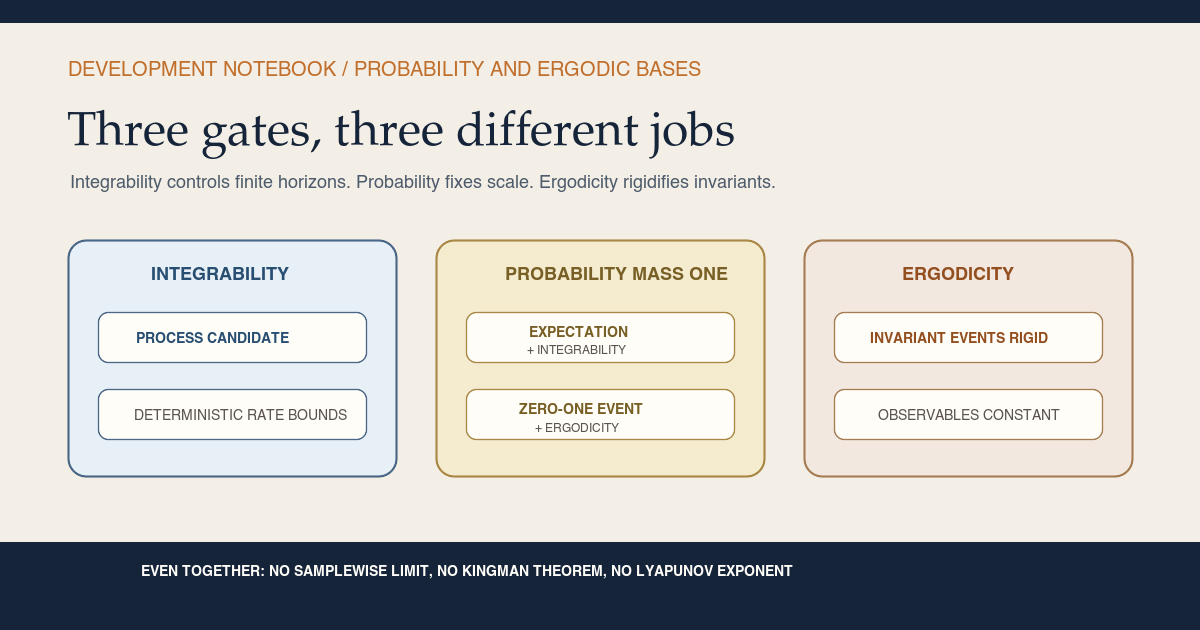
This is the proof-to-prose companion for
formalization/NonlinearDynamics/Random/RandomCocycles/ProbabilityErgodicBase.lean.
It covers all ten source-level public declarations in exact source order. The
two fields of the opening structure are covered explicitly with that
declaration. There are no private declarations in the module.
The immediate predecessor is Integrated Log-Positive Growth in Lean: Subadditivity and a Deterministic Fekete Limit. Its raw-measure integral and deterministic rate remain unchanged. Reusable foundations include one-sided discrete matrix cocycle , integrated log-positive growth rate , and ergodic probability base . The parallel textbook treatment is Probability Normalization and Ergodic Rigidity Before Kingman.
The immediate successor is Finite Blocks Before Limits: Birkhoff Bounds for Subadditive Cocycles in Lean. It turns the candidate’s shifted inequality into exact finite block-and-remainder bounds, keeps the zero-count normalization obstruction visible, and proves finite block-sum integrability without claiming a limit theorem.
A later analytic successor is Convergence Without Existence: Birkhoff Events and Ergodic Rigidity in Lean. It isolates the one-step Birkhoff convergence event, proves exact finite-prefix invariance, and derives conditional null-or-conull and probability-zero-or-one laws. It still proves no convergence existence or Kingman theorem.
Choose a route up
| Route | Begin | Destination |
|---|---|---|
| First encounter | Three gates, three jobs | Separate analytic control, measure scale, and invariant rigidity |
| Probability route | Mass one changes language, not the integral | Understand the guarded expectation alias |
| Ergodic route | Ergodicity is rigidity of invariant information | Reach zero-one events and constant observables |
| Example route | Four examples separate the assumptions | Test the missing implications on explicit examples |
| Rate route | The alternating flip cocycle | See nonmonotone normalized values and a strict one-step bound |
| Lean route | The complete declaration map | Audit all ten declarations in source order |
| API route | Why the package says candidate | Inspect the exact two-field process interface |
| Integrity route | Exactly what the module does not prove | Block Kingman, mixing, and Lyapunov overreads |
Learning objectives
By the summit, a reader should be able to:
- state the distinct formal jobs of integrability, probability normalization, measure preservation, and ergodicity;
- explain why
IsProbabilityMeasure μmeans the whole space has mass one; - explain why
Ergodic T μcontains measure preservation but not probability normalization; - read the two fields of
IsIntegrableSubadditiveProcessCandidateliterally; - identify the measurability and stationarity information not stored in that package;
- derive the cocycle candidate from one-step log-positive integrability;
- prove nonnegativity of a limit from convergence of nonnegative normalized values;
- read the deterministic rate as an infimum over positive horizons;
- explain why every positive horizon is an upper bound for that infimum;
- specialize the rate bound to the one-step raw integral;
- distinguish an expectation alias from a normalization procedure;
- explain why the expectation definition requires both mass one and integrability;
- apply the strict-invariance zero-one theorem to a measurable event;
- apply the almost-everywhere constancy theorem to a real observable;
- distinguish strict event invariance from almost-everywhere function invariance;
- use finite examples to show that probability and ergodicity are independent assumptions;
- explain why ergodic does not mean mixing or independent;
- calculate the alternating two-point cocycle’s first normalized values;
- explain why a subadditive normalized sequence need not be monotone;
- run the leaf module and compile a signature audit; and
- state the extra theorem still needed for a samplewise limit.
Lineage, contribution, and boundary
Mathlib defines a probability measure by the typeclass equation
\[ \mu(\Omega)=1. \]Its official probability-measure typeclass page is the direct API warrant for that interpretation (Mathlib probability typeclasses). Mathlib separately defines an ergodic map as a measure-preserving map whose strictly invariant measurable sets are almost empty or almost full (Mathlib ergodicity). The two concepts therefore enter through different interfaces.
Kingman’s original theorem concerns subadditive stochastic processes and derives an ergodic asymptotic conclusion under substantially richer hypotheses (Kingman, 1968). RMT-17 does not reprove a fragment under a new name. It prepares a small process predicate, exposes the exact upstream zero-one and invariant-function consequences already available in Mathlib, and records deterministic consequences of the preceding Fekete limit.
The local contribution has four parts:
- a generic two-field predicate for an integrable shifted-subadditive real process;
- a proof that the matrix-cocycle positive-log family satisfies it;
- a sharper API for the already proved deterministic integrated rate; and
- probability and ergodicity bridges whose assumptions advertise their exact semantics.
Not claimed:
- no almost-everywhere or pointwise convergence of \(G_k(\omega)/k\);
- no Kingman, Birkhoff, Furstenberg-Kesten, or Oseledets theorem;
- no mixing, independence, or decay of correlations;
- no signed logarithmic growth or Lyapunov exponent; and
- no conversion of an arbitrary raw measure into a probability measure.
Three gates, three jobs
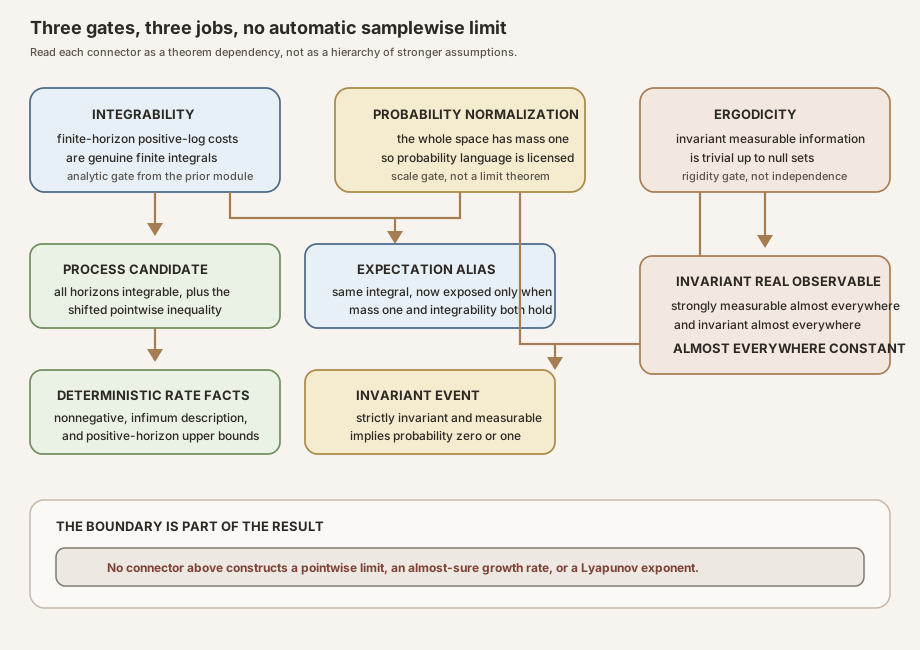
The shortest faithful mental model is a dependency table.
| Gate | Lean evidence | What it licenses | What it does not license |
|---|---|---|---|
| Finite-horizon integrability | C.HasIntegrableGeneratorLogPlus | genuine finite integrals, process candidate, deterministic rate facts | mass one, invariant rigidity, samplewise limit |
| Probability normalization | [IsProbabilityMeasure μ] | probability and expectation language | ergodicity, mixing, integrability |
| Ergodicity | hErg : Ergodic C.base μ | rigidity of invariant events and observables | mass one, independence, a process limit |
The cocycle itself already stores a fourth ingredient:
C.base_preserving. Measure preservation says that shifting the
base leaves \(\mu\) unchanged. Ergodicity includes a measure-preserving proof,
but it adds the invariant-information condition. Probability normalization
says nothing about a map. Integrability says something about a function under
a measure, not about invariant sets.
Mass one changes language, not the integral
The prior module deliberately named
\[ I_k=\int_\Omega G_k\,d\mu \]an integrated log-positive norm. The ambient measure was arbitrary. If \(\mu(\Omega)=2\), the integral of a constant doubles relative to its value under the corresponding mass-one measure. Calling that raw integral an expectation would hide the scale choice.
RMT-17 adds [IsProbabilityMeasure μ]. In Mathlib this typeclass is
precisely the proposition that μ univ = 1. It also supplies the
finite-measure infrastructure expected of a probability measure. The new
definition
finiteHorizonLogPlusExpectation uses the same integral expression
as integratedLogPlusNorm. It does not divide by total mass, call a
normalizer, or create a new measure.
The integrability proof remains a separate argument. This matters because
Mathlib’s real-valued Bochner integral is totalized: a nonintegrable function
still has a formal integral value. The definition therefore requires
hC even though its body does not use the proof computationally.
The unused proof parameter is an intentional public gate. It prevents the API
from using expectation language for a totalized fallback value.
The resulting equality
\[ \operatorname{Expectation}_\mu[G_k]=I_k \]is reflexive in Lean. Probability normalization changes the justified interpretation, while integrability changes the analytic status. Neither changes the bytes of the integral expression.
Ergodicity is rigidity of invariant information
Mathlib’s Ergodic T μ extends two structures:
MeasurePreserving T μ μ; andPreErgodic T μ.
The pre-ergodic component says a measurable set satisfying
\[ T^{-1}(s)=s \]is almost everywhere empty or almost everywhere the whole space. On a
probability space, almost-full is equivalent to probability one, so Mathlib
exports PreErgodic.prob_eq_zero_or_one. Declaration 9 is a thin
cocycle-facing wrapper around exactly that theorem
(Mathlib ergodicity).
Invariant functions express the same rigidity at a richer codomain. For a real observable \(g\), RMT-17 assumes
\[ g\circ T = g \quad\text{almost everywhere} \]and AEStronglyMeasurable g μ. Mathlib’s ergodic function API then
produces a real constant \(c\) such that \(g=c\) almost everywhere
(Mathlib invariant functions).
The function theorem needs no probability typeclass. Almost-everywhere
constancy is invariant under many harmless rescalings of a measure because
the null sets are unchanged. The event theorem’s numerical conclusion
μ s = 0 ∨ μ s = 1, however, needs mass one to turn “full” into
the number one.
Ergodicity is not independence. It does not say that finite-time matrix generators at different orbit positions are independent. It does not say correlations decay. A periodic two-cycle can be ergodic and still fail mixing.
Four examples separate the assumptions
Three finite spaces and one general observable example make the missing implications visible without asymptotic machinery. These are explanatory examples, not declarations in RMT-17.
Probability without ergodicity
Let \(\Omega=\{0,1\}\), give each point mass \(1/2\), and take the identity map. The measure has total mass one, and the identity preserves it. Yet the singleton \(\{0\}\) is measurable, strictly invariant, and has probability \(1/2\). The base is not ergodic.
This example blocks the inference
\[ \text{probability}+\text{measure preservation} \Longrightarrow \text{ergodicity}. \]Ergodicity without probability normalization
Let \(\Omega=\{\ast\}\), let the identity be the base map, and assign the
single point a finite mass \(q\) with \(q\gt0\) and \(q\ne1\). Every measurable
set is empty or full, so the identity is ergodic for this measure. The total
mass is \(q\), not one, so IsProbabilityMeasure μ does not hold.
This example blocks the reverse inference. It also explains why declaration 10 can omit the probability typeclass: invariant real observables on a one-point base are constant regardless of the finite positive scale.
Probability and ergodicity without mixing
Return to two equally weighted points, but let \(T\) swap them. The only strictly invariant subsets are empty and full, so the flip is ergodic. It is not mixing. For \(s=\{0\}\), the quantity
\[ \mu\bigl(s\cap T^{-n}s\bigr) \]alternates between \(1/2\) and \(0\), rather than converging to \(\mu(s)^2=1/4\).
Thus periodicity does not prevent ergodicity, and ergodicity does not imply mixing. RMT-17 formalizes neither a mixing predicate nor a correlation limit.
Probability and ergodicity without integrability
Take any probability ergodic base that supports an unbounded measurable real function with an infinite positive integral. The base assumptions constrain the measure and invariant sets, not the tails of that function. An arbitrary observable need not be integrable merely because the system is probability preserving and ergodic.
For the cocycle API, the repair is explicit:
C.HasIntegrableGeneratorLogPlus. No theorem in the module attempts
to infer it from probability or ergodicity.
The alternating flip cocycle
The two-point flip also gives a compact stress test for the deterministic rate API. Use one-by-one complex matrices, with generator value \(2\) at point zero and \(1/2\) at point one. The two-step product is the identity at either starting point because the orbit alternates the two factors.
Let \(a=\log 2\). Under the uniform probability measure,
\[ \begin{aligned} I_1 &= \frac{a}{2}, &Q_1 &= \frac{a}{2},\\ I_2 &= 0, &Q_2 &= 0,\\ I_3 &= \frac{a}{2}, &Q_3 &= \frac{a}{6},\\ I_4 &= 0, &Q_4 &= 0. \end{aligned} \]The even products have norm one, so their positive logarithm is zero. The odd products reproduce whichever one-step factor appears at the starting point, so the raw expectation is \(a/2\). The Fekete rate is zero because positive even horizons already attain normalized value zero.
This one example checks three reading rules:
- \(Q_k\) need not be monotone: \(Q_2=0\lt Q_3=a/6\);
- every positive \(Q_k\) is still an upper bound for the rate; and
- the one-step upper bound can be strict: \(0\lt I_1=a/2\).
The example is probability preserving and ergodic. Those facts do not create a new rate here. The deterministic Fekete rate was already available from integrability. Ergodicity becomes relevant only when a future theorem constructs a sample-dependent invariant limit whose constancy can then be deduced.
The complete declaration map
The module has ten source-level public declarations. The structure fields in declaration 1 also generate public projections, and both are included below. The order moves from a generic process interface, through deterministic rate facts, to probability semantics and ergodic rigidity.
| # | Lean declaration | Mathematical content | Exact assumption boundary |
|---|---|---|---|
| 1 | IsIntegrableSubadditiveProcessCandidate | package all finite-horizon integrability and the shifted pointwise inequality | no measure preservation, probability, or ergodicity field |
| 2 | HasIntegrableGeneratorLogPlus.isIntegrableSubadditiveProcessCandidate | instantiate the package with the cocycle positive-log family | hC only |
| 3 | HasIntegrableGeneratorLogPlus.integratedLogPlusGrowthRate_nonneg | \(0\le\gamma_+\) | hC only |
| 4 | HasIntegrableGeneratorLogPlus.integratedLogPlusGrowthRate_eq_sInf | rate equals the infimum of positive normalized horizons | hC only |
| 5 | HasIntegrableGeneratorLogPlus.integratedLogPlusGrowthRate_le_normalized | \(\gamma_+\le Q_k\) for \(k\ne0\) | hC and a positive-horizon witness |
| 6 | HasIntegrableGeneratorLogPlus.integratedLogPlusGrowthRate_le_oneStep | \(\gamma_+\le I_1\) | hC only |
| 7 | finiteHorizonLogPlusExpectation | expose the finite-horizon integral as an expectation | probability typeclass plus hC |
| 8 | finiteHorizonLogPlusExpectation_eq_integratedLogPlusNorm | expectation alias equals the raw integral | probability typeclass plus hC |
| 9 | ergodicBase_invariantEvent_prob_eq_zero_or_one | measurable strict invariant event has mass zero or one | probability typeclass plus hErg |
| 10 | ergodicBase_ae_eq_const_of_ae_invariant | measurable almost-everywhere invariant real observable is almost everywhere constant | hErg, no probability or hC |
The ambient cocycle variables remain:
variable {Ω : Type uΩ} {ι : Type uι} [MeasurableSpace Ω]
  [Fintype ι] [DecidableEq ι] {μ : Measure Ω}
The last two declarations explicitly omit the finite matrix-index instances
because their conclusions inspect only C.base. The matrix
dimension, generator, and finite-horizon observables play no role in those
two wrappers.
Declaration 1: package the finite-time process obligations
structure IsIntegrableSubadditiveProcessCandidate
    {Ω : Type uΩ} [MeasurableSpace Ω] (T : Ω → Ω) (μ : Measure Ω)
    (X : ℕ → Ω → ℝ) : Prop where
  integrable : ∀ k, Integrable (X k) μ
  add_le : ∀ m k ω, X (m + k) ω ≤ X k (T^[m] ω) + X m ω
The structure takes a base map \(T\), a measure \(\mu\), and a real process
\(X_k(\omega)\). It lives in Prop, so an inhabitant is evidence
that two obligations hold rather than data intended for computation.
The first field is the generated projection
IsIntegrableSubadditiveProcessCandidate.integrable. It states that
each fixed horizon \(X_k\) is integrable under \(\mu\). The quantifier is over
natural-number horizons, so time zero is included.
The second field is the generated projection
IsIntegrableSubadditiveProcessCandidate.add_le. It records the
shifted pointwise inequality
The shift is essential. The later \(k\)-block starts after \(m\) base steps. This is the process-level statement that later becomes ordinary subadditivity only after integration and use of measure preservation.
Why the package says candidate
The structure is intentionally smaller than a theorem-specific Kingman interface. It stores no proof that \(T\) preserves \(\mu\), no probability normalization, no ergodicity, no ordinary measurability of \(T\), no separate ordinary measurability field for \(X_k\), no stationarity theorem, and no limit. Integrability includes almost-everywhere strong measurability of each horizon, but the structure does not advertise a stronger pointwise measurability contract.
Calling it a “candidate” records that it has the two finite-time properties needed to approach a subadditive ergodic theorem. It does not claim that the pinned library already supplies such a theorem or that these two fields would be sufficient for every possible formulation.
The generic placement outside DiscreteMatrixCocycle is also
deliberate. A future non-matrix process can satisfy the same predicate. The
structure itself does not know what a norm, matrix product, or cocycle is.
Declaration 2: instantiate the candidate with cocycle growth
theorem HasIntegrableGeneratorLogPlus.isIntegrableSubadditiveProcessCandidate
    {C : DiscreteMatrixCocycle (ι := ι) μ}
    (hC : C.HasIntegrableGeneratorLogPlus) :
    IsIntegrableSubadditiveProcessCandidate C.base μ
      C.logPlusNormObservable where
  integrable := hC.integrable_logPlusNormObservable
  add_le := C.logPlusNormObservable_add_le
The theorem fills each structure field with an existing checked result.
hC.integrable_logPlusNormObservableis the RMT-15 propagation theorem from one-step integrability to every fixed horizon.C.logPlusNormObservable_add_leis the RMT-15 shifted pointwise inequality derived from the ordered cocycle law and matrix-norm submultiplicativity.
No new analysis occurs in the constructor. Its importance is interface alignment. A consumer can now request the generic process predicate without reopening the matrix-cocycle proof.
The cocycle stores measure preservation in C.base_preserving, but
the result does not copy that proof into the candidate. Probability and
ergodicity are absent from the theorem signature. The theorem therefore says
only that the finite-time process obligations hold.
Declaration 3: the deterministic rate is nonnegative
theorem HasIntegrableGeneratorLogPlus.integratedLogPlusGrowthRate_nonneg
    {C : DiscreteMatrixCocycle (ι := ι) μ}
    (hC : C.HasIntegrableGeneratorLogPlus) :
    0 ≤ C.integratedLogPlusGrowthRate hC := by
  apply ge_of_tendsto hC.tendsto_normalizedIntegratedLogPlusNorm
  exact Filter.Eventually.of_forall C.normalizedIntegratedLogPlusNorm_nonneg
The previous module proved
\[ Q_k\longrightarrow\gamma_+. \]It also proved \(Q_k\ge0\) for every horizon. Declaration 3 combines those
facts with ge_of_tendsto: a limit of an eventually nonnegative
real sequence is nonnegative.
The proof strengthens “eventually” by using
Filter.Eventually.of_forall. Every \(Q_k\), including the
totalized time-zero value, is nonnegative. The limit theorem comes from
hC.tendsto_normalizedIntegratedLogPlusNorm.
This argument concerns a deterministic sequence of real integrals. It needs the integrability proof that supports the preceding Fekete theorem. It needs neither mass one nor ergodicity. Nonnegativity is also a consequence of using the positive logarithm; it would not hold for a signed logarithmic growth rate in general.
Declaration 4: expose the positive-horizon infimum
theorem HasIntegrableGeneratorLogPlus.integratedLogPlusGrowthRate_eq_sInf
    {C : DiscreteMatrixCocycle (ι := ι) μ}
    (hC : C.HasIntegrableGeneratorLogPlus) :
    C.integratedLogPlusGrowthRate hC =
      sInf (C.normalizedIntegratedLogPlusNorm '' Ici 1) := by
  rw [integratedLogPlusGrowthRate, Subadditive.lim]
  rfl
Mathlib defines Subadditive.lim as the infimum of the normalized
values over Set.Ici 1, the natural horizons at least one
(Mathlib subadditive sequences). The project rate
is that library definition applied to the integrated sequence.
After rewriting both definitions, the theorem is reflexive. Its mathematical content is still worth exporting because users should not have to unfold the library implementation to learn what the rate means:
\[ \gamma_+ {} = \inf_{k\ge1} Q_k. \]Time zero is excluded. The infimum need not be attained, although the alternating flip example happens to attain it at every positive even horizon. The theorem does not say \(Q_k\) is decreasing. It only identifies the limit with the greatest lower bound of all positive-horizon normalized values.
Declaration 5: every positive horizon bounds the rate
theorem HasIntegrableGeneratorLogPlus.integratedLogPlusGrowthRate_le_normalized
    {C : DiscreteMatrixCocycle (ι := ι) μ}
    (hC : C.HasIntegrableGeneratorLogPlus) {k : ℕ} (hk : k ≠ 0) :
    C.integratedLogPlusGrowthRate hC ≤
      C.normalizedIntegratedLogPlusNorm k := by
  simpa [integratedLogPlusGrowthRate, normalizedIntegratedLogPlusNorm] using
    hC.subadditive_integratedLogPlusNorm.lim_le_div
      C.bddBelow_normalizedIntegratedLogPlusNorm hk
For a natural number, k ≠ 0 is the proof-relevant way to say the
horizon is positive. Mathlib’s Subadditive.lim_le_div says the
subadditive limit lies below \(I_k/k\) at every nonzero horizon. The call needs
three ingredients:
- the integrability-backed proof that \(I\) is subadditive;
- the prior theorem that the normalized range is bounded below; and
- the witness
hkexcluding division at time zero.
The simpa step unfolds the project names and aligns the library
ratio with normalizedIntegratedLogPlusNorm.
The conclusion is an upper bound on the asymptotic deterministic rate. It is not a convergence-rate estimate. It does not quantify how close \(Q_k\) is to \(\gamma_+\), and a poor finite horizon may be a very loose upper bound.
Declaration 6: specialize the bound to one step
theorem HasIntegrableGeneratorLogPlus.integratedLogPlusGrowthRate_le_oneStep
    {C : DiscreteMatrixCocycle (ι := ι) μ}
    (hC : C.HasIntegrableGeneratorLogPlus) :
    C.integratedLogPlusGrowthRate hC ≤ C.integratedLogPlusNorm 1 := by
  simpa [normalizedIntegratedLogPlusNorm] using
    hC.integratedLogPlusGrowthRate_le_normalized (k := 1) one_ne_zero
Declaration 6 calls declaration 5 at \(k=1\). The denominator simplifies to one, so \(Q_1=I_1\). This yields
\[ \gamma_+\le I_1. \]The bound is often convenient because the hypothesis itself is stated at one step and because the one-step integral may be easier to estimate. It can be strict, as the alternating flip cocycle exhibits.
The theorem still uses a raw-measure integral. Without probability
normalization, \(I_1\) is not an expectation. The theorem is invariant under
none of the semantic relabeling introduced later; it records the
deterministic inequality already supported by hC.
Declaration 7: expose a guarded expectation
def finiteHorizonLogPlusExpectation [IsProbabilityMeasure μ]
    (C : DiscreteMatrixCocycle (ι := ι) μ)
    (_hC : C.HasIntegrableGeneratorLogPlus) (k : ℕ) : ℝ :=
  ∫ ω, C.logPlusNormObservable k ω ∂μ
The definition introduces the first probability-specific name in the module. Its two gates are visible:
[IsProbabilityMeasure μ]establishes \(\mu(\Omega)=1\);_hCestablishes integrability of every finite-horizon observable, including the requested horizon \(k\).
The leading underscore acknowledges that the proof is not used in the definition body. It remains part of the type so a caller cannot obtain an “expectation” value without presenting the analytic evidence. Proof irrelevance ensures that different proofs of the same integrability proposition do not create mathematically different expectations.
The body is an ordinary integral rather than special notation. The module does not import an expectation-notation layer. This keeps the dependency small and the equality with the raw integral transparent.
At time zero, the observable is zero, so the expectation is zero. For every positive horizon it is the expected positive-log norm of the finite cocycle product. It is not the expectation of a samplewise limit, and it does not assert that a limit and expectation can be exchanged.
Declaration 8: the expectation alias is the raw integral
@[simp] theorem finiteHorizonLogPlusExpectation_eq_integratedLogPlusNorm
    [IsProbabilityMeasure μ]
    {C : DiscreteMatrixCocycle (ι := ι) μ}
    (hC : C.HasIntegrableGeneratorLogPlus) (k : ℕ) :
    C.finiteHorizonLogPlusExpectation hC k = C.integratedLogPlusNorm k := by
  rfl
Both sides unfold to the same integral, so the proof is rfl. The
@[simp] attribute lets downstream proofs erase the semantic alias
when the raw integrated API is more convenient.
This theorem is not a normalization identity. No factor involving \(\mu(\Omega)\) appears because the left side can only be formed after Lean has already accepted mass one. If a caller starts with a finite measure of mass two, the repair is not to apply this theorem. The caller must deliberately construct or select a probability measure, then prove the cocycle assumptions for that measure.
The equality also explains why the deterministic rate did not need to be redefined. Under probability normalization, every \(I_k\) already is the corresponding finite-horizon expectation. The previous rate can therefore be interpreted as the limit of normalized expectations without changing its Lean definition. That statement remains a limit of expectations, not an expectation of a samplewise limit.
Declaration 9: strictly invariant events have probability zero or one
omit [Fintype ι] [DecidableEq ι] in
theorem ergodicBase_invariantEvent_prob_eq_zero_or_one
    [IsProbabilityMeasure μ]
    (C : DiscreteMatrixCocycle (ι := ι) μ)
    (hErg : Ergodic C.base μ) {s : Set Ω}
    (hs : MeasurableSet s) (hinv : C.base ⁻¹' s = s) :
    μ s = 0 ∨ μ s = 1 :=
  hErg.toPreErgodic.prob_eq_zero_or_one hs hinv
The theorem takes a measurable event \(s\) and strict invariance under one base step. The conclusion is a disjunction in the extended nonnegative real measure values: the event has probability zero or probability one.
The proof delegates directly to Mathlib. From hErg it projects
toPreErgodic, then applies
PreErgodic.prob_eq_zero_or_one with the measurability and
invariance proofs. The probability typeclass converts the “almost full”
alternative into numerical mass one.
Three boundaries control the scope.
First, hs is required. The wrapper does not make a statement about
arbitrary nonmeasurable subsets. Second, hinv is literal set
equality, not almost-everywhere equality. Mathlib has richer related APIs, but
this wrapper chooses the smallest strict form needed now. Third,
hErg is an ordinary proof argument rather than a typeclass. A
caller chooses and supplies the ergodicity theorem explicitly.
The omit command removes the finite-index instances from the
declaration’s local context. Because the checked declaration elaborates
without them, it does not require finite matrix indexing. The cocycle serves
only as a typed route to its base map. No generator, product, norm, or
integrability hypothesis appears in the proof.
Declaration 10: invariant real observables are almost everywhere constant
omit [Fintype ι] [DecidableEq ι] in
theorem ergodicBase_ae_eq_const_of_ae_invariant
    (C : DiscreteMatrixCocycle (ι := ι) μ)
    (hErg : Ergodic C.base μ) {g : Ω → ℝ}
    (hg : AEStronglyMeasurable g μ)
    (hinv : g ∘ C.base =ᵐ[μ] g) :
    ∃ c : ℝ, g =ᵐ[μ] Function.const Ω c :=
  hErg.ae_eq_const_of_ae_eq_comp_ae hg hinv
The theorem moves from events to real observables. Its invariance premise is oriented exactly as the Mathlib declaration requires:
\[ g\circ T = g \quad\mu\text{-almost everywhere}. \]The output provides a real number \(c\) and an almost-everywhere equality between \(g\) and the constant function with value \(c\).
The proof is again a direct wrapper, this time around
Ergodic.ae_eq_const_of_ae_eq_comp_ae. The official Mathlib page
states the general principle for almost-everywhere strongly measurable maps
into metrizable spaces; RMT-17 specializes the codomain to the real numbers
(Mathlib invariant functions).
No probability typeclass occurs. Ergodicity already supplies the qualitative
almost-everywhere rigidity needed for constancy. Without mass one, the module
cannot turn an almost-full invariant event into the numerical conclusion
μ s = 1, but it can still say that an invariant real observable
has only one value outside a null set.
The theorem does not compute \(c\), identify it with an integral, or say that \(g\) arose as a limit. A future Kingman theorem might produce an invariant limit function and then call this result to prove that the limit is constant under ergodicity. RMT-17 constructs only the rigidity bridge, not that future limit.
Proof dependency architecture
The ten declarations form three branches rather than one ladder:
RMT-15 one-step integrability
  |
  +--> all finite horizons integrable
  |       |
  |       +--> integrable shifted-subadditive-process candidate
  |
  +--> RMT-16 deterministic Fekete convergence
          |
          +--> nonnegative rate
          +--> positive-horizon infimum description
          +--> every positive normalized horizon is an upper bound
                    |
                    +--> one-step raw integral is an upper bound

probability normalization + finite-horizon integrability
  |
  +--> guarded finite-horizon expectation alias
          |
          +--> reflexive equality with the raw integral

probability normalization + ergodicity
  |
  +--> strict invariant measurable event has probability zero or one

ergodicity alone
  |
  +--> almost-everywhere invariant measurable real observable
       is almost everywhere constant
The branches share vocabulary but not hidden proofs. In particular, the rate
facts do not use hErg, and the ergodic wrappers do not use
hC. This separation makes a future theorem’s obligations easy to
audit: if a samplewise result needs all three gates, its signature must bring
all three together explicitly.
The assumption matrix
The following table is useful when reading a downstream goal. A check mark means the declaration requires the item directly or through its named input.
| Declaration family | Integrability | Probability mass one | Ergodicity | Strict event invariance | Almost-everywhere function invariance |
|---|---|---|---|---|---|
| Process candidate constructor | ✓ | ||||
| Deterministic rate facts | ✓ | ||||
| Finite-horizon expectation alias | ✓ | ✓ | |||
| Invariant-event zero-one law | ✓ | ✓ | ✓ | ||
| Invariant-observable constancy | ✓ | ✓ |
Measure preservation is stored by DiscreteMatrixCocycle and is
also contained in Ergodic. The candidate structure itself does
not store it. Event measurability and almost-everywhere strong measurability
are additional row-specific premises, not consequences of the checked boxes.
Run and audit the Lean module
The project pins Lean and the documented Mathlib 4.32.0 release. Run these commands from the repository root. The first command loads the Elan-installed toolchain on macOS or Linux when Elan used its default location.
source "$HOME/.elan/env"
cd formalization
lake env lean -DwarningAsError=true NonlinearDynamics/Random/RandomCocycles/ProbabilityErgodicBase.lean
lake build NonlinearDynamics.Random.RandomCocycles.ProbabilityErgodicBase
lake build NonlinearDynamics.Random.RandomCocycles
lake build NonlinearDynamics.Random
lake build NonlinearDynamics
The direct Lean invocation checks the leaf file while promoting every warning to an error. The named builds then verify the public import chain through the random-cocycle aggregator, the random-dynamics aggregator, and the project root.
For a signature-only audit, remain in formalization/, create a
temporary file, and compile it exactly as follows:
tee /tmp/RMT17Smoke.lean >/dev/null <<'LEAN'
import NonlinearDynamics.Random.RandomCocycles.ProbabilityErgodicBase

open MeasureTheory Set Filter

#check NonlinearDynamics.Random.RandomCocycles.IsIntegrableSubadditiveProcessCandidate
#check NonlinearDynamics.Random.RandomCocycles.IsIntegrableSubadditiveProcessCandidate.integrable
#check NonlinearDynamics.Random.RandomCocycles.IsIntegrableSubadditiveProcessCandidate.add_le
#check NonlinearDynamics.Random.RandomCocycles.DiscreteMatrixCocycle.HasIntegrableGeneratorLogPlus.isIntegrableSubadditiveProcessCandidate
#check NonlinearDynamics.Random.RandomCocycles.DiscreteMatrixCocycle.HasIntegrableGeneratorLogPlus.integratedLogPlusGrowthRate_nonneg
#check NonlinearDynamics.Random.RandomCocycles.DiscreteMatrixCocycle.HasIntegrableGeneratorLogPlus.integratedLogPlusGrowthRate_eq_sInf
#check NonlinearDynamics.Random.RandomCocycles.DiscreteMatrixCocycle.HasIntegrableGeneratorLogPlus.integratedLogPlusGrowthRate_le_normalized
#check NonlinearDynamics.Random.RandomCocycles.DiscreteMatrixCocycle.HasIntegrableGeneratorLogPlus.integratedLogPlusGrowthRate_le_oneStep
#check NonlinearDynamics.Random.RandomCocycles.DiscreteMatrixCocycle.finiteHorizonLogPlusExpectation
#check NonlinearDynamics.Random.RandomCocycles.DiscreteMatrixCocycle.finiteHorizonLogPlusExpectation_eq_integratedLogPlusNorm
#check NonlinearDynamics.Random.RandomCocycles.DiscreteMatrixCocycle.ergodicBase_invariantEvent_prob_eq_zero_or_one
#check NonlinearDynamics.Random.RandomCocycles.DiscreteMatrixCocycle.ergodicBase_ae_eq_const_of_ae_invariant
LEAN

lake env lean -DwarningAsError=true /tmp/RMT17Smoke.lean
The twelve #check commands include the ten source-level
declarations and the two generated structure projections. Success prints
their inferred signatures and no diagnostics.
For an axiom audit of the eight theorem declarations, append these commands to the same temporary file before compiling:
#print axioms NonlinearDynamics.Random.RandomCocycles.DiscreteMatrixCocycle.HasIntegrableGeneratorLogPlus.isIntegrableSubadditiveProcessCandidate
#print axioms NonlinearDynamics.Random.RandomCocycles.DiscreteMatrixCocycle.HasIntegrableGeneratorLogPlus.integratedLogPlusGrowthRate_nonneg
#print axioms NonlinearDynamics.Random.RandomCocycles.DiscreteMatrixCocycle.HasIntegrableGeneratorLogPlus.integratedLogPlusGrowthRate_eq_sInf
#print axioms NonlinearDynamics.Random.RandomCocycles.DiscreteMatrixCocycle.HasIntegrableGeneratorLogPlus.integratedLogPlusGrowthRate_le_normalized
#print axioms NonlinearDynamics.Random.RandomCocycles.DiscreteMatrixCocycle.HasIntegrableGeneratorLogPlus.integratedLogPlusGrowthRate_le_oneStep
#print axioms NonlinearDynamics.Random.RandomCocycles.DiscreteMatrixCocycle.finiteHorizonLogPlusExpectation_eq_integratedLogPlusNorm
#print axioms NonlinearDynamics.Random.RandomCocycles.DiscreteMatrixCocycle.ergodicBase_invariantEvent_prob_eq_zero_or_one
#print axioms NonlinearDynamics.Random.RandomCocycles.DiscreteMatrixCocycle.ergodicBase_ae_eq_const_of_ae_invariant
The expected output may mention standard foundational principles used by
Mathlib. It must not reveal sorryAx or a project-specific axiom.
The two definitions and the structure are inspected by unfolding and
signature checking rather than by #print axioms.
Failure modes worth learning
| Tempting move | Why it fails | Checked repair |
|---|---|---|
| Treat probability as a dynamical property | Mass one constrains the measure, not the map | Supply hErg : Ergodic C.base μ separately |
| Infer probability from ergodicity | Ergodic contains preservation and pre-ergodicity, not total mass one | Add [IsProbabilityMeasure μ] where a numerical probability conclusion needs it |
| Infer integrability from probability and ergodicity | Tail control is independent of invariant-set rigidity | Carry C.HasIntegrableGeneratorLogPlus explicitly |
| Call every raw integral an expectation | An arbitrary measure may have any total mass | Use finiteHorizonLogPlusExpectation only under the mass-one typeclass |
Remove _hC because the definition body ignores it | Mathlib’s integral is totalized outside the integrable case | Keep the proof as a semantic and analytic gate |
| Read the process candidate as a Kingman theorem | It stores only finite-time integrability and a shifted inequality | Treat it as input infrastructure for a future theorem |
| Add measure preservation to the candidate by assumption | The generic package deliberately separates process properties from base dynamics | Obtain preservation from the cocycle or a future theorem-specific wrapper |
| Use the rate bound at time zero | The Fekete infimum and division theorem use positive horizons | Supply hk : k ≠ 0 |
| Infer monotonicity from subadditivity | Normalized ratios can rise after falling | Claim an infimum and convergence, not stepwise decrease |
| Call ergodicity independence | An ergodic periodic flip has deterministic dependence across time | State only invariant-information rigidity |
| Call ergodicity mixing | Ergodicity does not force correlation limits | Introduce and prove a separate mixing interface if needed |
| Drop event measurability | The zero-one theorem is about measurable events | Supply hs : MeasurableSet s |
| Replace strict event invariance by almost invariance silently | Declaration 9 takes literal preimage equality | Use the exact wrapper or choose a verified stronger upstream theorem explicitly |
| Replace a.e. function invariance by pointwise invariance in the statement | Declaration 10 is intentionally null-set stable | Provide the a.e. equality in the orientation g ∘ C.base =ᵐ[μ] g |
| Identify the constant with an integral | The theorem exports only existence of an a.e. constant | Prove any formula for that constant separately |
| Apply constancy to a limit that has not been constructed | Rigidity cannot manufacture its own invariant observable | First prove existence, measurability, and invariance of the candidate limit |
| Call the deterministic integrated rate a Lyapunov exponent | It clips negative logarithmic growth and takes a limit after integration | Keep the descriptive positive-log integrated rate name |
A typeclass failure to recognize
Suppose Lean reports that it cannot synthesize
IsProbabilityMeasure μ when calling the expectation definition or
the zero-one event theorem. A proof that μ is finite is not enough.
A proof that the base preserves μ is not enough. A proof of
Ergodic C.base μ is not enough. The missing goal is specifically
that the total mass equals one.
The successful repair is to construct or invoke the precise probability instance for the chosen measure. Do not insert an unsafe local instance unless the mass-one proof is available. The typeclass error is exposing a genuine normalization gap.
An invariance-orientation failure to recognize
Declaration 10 expects
hinv : g ∘ C.base =ᵐ[μ] g
A hypothesis written in the reverse orientation is mathematically equivalent
because almost-everywhere equality is symmetric, but Lean will not always use
that symmetry automatically in the intended argument position. Apply
hinv.symm when needed. A hypothesis about
g (C.base ω) = g ω for every point can be promoted to an
almost-everywhere equality, but that conversion should be explicit.
Boundary cases
Zero measure
The zero measure cannot satisfy IsProbabilityMeasure because the
whole space has mass zero rather than one. Mathlib can nevertheless regard a
measurable map as ergodic for the zero measure: every statement holds almost
everywhere vacuously. Declaration 10 then says every suitable real observable
is almost everywhere constant, also vacuously.
This edge case is a useful warning. Almost-everywhere constancy is a statement relative to a measure. Without nonzero or probability normalization, it need not identify observable values at any actual point.
Finite nonunit mass
Multiplying a finite ergodic measure by a strictly positive finite scalar preserves its null sets and qualitative ergodicity in the usual setting, but changes the total mass. Declaration 10 remains the right qualitative tool. Declaration 9 is unavailable until a mass-one instance is provided, because “full measure” would numerically mean the new total mass rather than one.
RMT-17 exports no general scalar-rescaling theorem. The point is the signature boundary, not a new formal law about scaled measures.
Empty matrix dimension
The rate branch permits an empty finite matrix index type. Earlier project conventions make the relevant log-positive norm observables zero in that dimension, so the deterministic rate facts remain valid.
Declarations 9 and 10 go further: they use omit [Fintype ι]
[DecidableEq ι]. Their proofs do not inspect matrix coordinates at all.
They are base-dynamics theorems presented in a cocycle namespace.
Time zero
The process candidate includes integrability and the shifted inequality at
time zero. The expectation alias can also be formed at time zero and equals
zero. The rate upper-bound theorem deliberately rejects time zero with
k ≠ 0 because the Fekete ratio is a positive-horizon concept.
Periodic ergodic bases
The two-point flip is both periodic and ergodic under the uniform measure. Its invariant real observables are constant on the entire two-cycle, but its time-separated events oscillate. This is the cleanest finite warning that ergodicity does not imply mixing.
Strictly invariant events versus almost-invariant functions
Declaration 9 accepts C.base ⁻¹’ s = s. Declaration 10 accepts an
almost-everywhere equality. This is not an inconsistency. They wrap different
upstream theorems with different convenient interfaces. Downstream code must
not silently transfer one equality notion to the other.
Nonunique constants under degenerate measures
Declaration 10 returns an existential constant. Under the zero measure, every constant satisfies the conclusion because all functions are almost everywhere equal. On a nonzero measure, additional reasoning can often show uniqueness, but RMT-17 neither needs nor exports such a theorem.
Physical interpretation and the missing asymptotic bridge
In smooth dynamics, a derivative cocycle transports tangent perturbations along an orbit. In random matrix products, a cocycle transports vectors through a sequence of random linear maps. Integrability of positive logarithmic norm is a familiar upper-tail hypothesis in both traditions. Furstenberg and Kesten’s original random-matrix product work studies normalized logarithmic growth under probabilistic assumptions (Furstenberg and Kesten, 1960). Oseledets’ theorem organizes Lyapunov exponents and invariant splittings under a multiplicative ergodic framework (Oseledets, 1968).
RMT-17 formalizes neither physical bridge. The generator remains an arbitrary measurable complex matrix field. There is no nonlinear map with a derivative, no tangent bundle, no chain rule, no singular-value filtration, and no exterior-power construction.
The ergodic constancy theorem explains one future proof pattern. If a genuine subadditive ergodic theorem constructs a real samplewise limit \(g(\omega)\), and if that limit is almost-everywhere strongly measurable and invariant, then declaration 10 can make it almost everywhere constant under ergodicity. Every “if” in that sentence names work not done here. Constancy is the final rigidity step, not the existence theorem.
The positive logarithm is another independent boundary. Even a successful samplewise theorem for \(G_k/k\) would yield a positive-growth envelope. It would not automatically become the signed top Lyapunov exponent, because strict contraction and singular collapse have already been clipped to zero.
Exactly what the module does not prove
RMT-17 does not prove any of the following:
- probability normalization from finite measure, measure preservation, or ergodicity;
- ergodicity from probability normalization or measure preservation;
- integrability from probability, ergodicity, bounded measure, or finite matrix dimension;
- a canonical normalization of an arbitrary raw measure;
- expectation notation or a new numerical expectation operator;
- a samplewise limit of \(G_k(\omega)/k\);
- almost-everywhere convergence of a subadditive process;
- convergence in probability, in measure, or in \(L^1\);
- an exchange between a limit and an integral;
- identification of an expected samplewise limit with the deterministic integrated Fekete rate;
- Kingman’s subadditive ergodic theorem;
- Birkhoff’s pointwise ergodic theorem;
- the Furstenberg-Kesten theorem;
- a Lyapunov exponent or Lyapunov spectrum;
- an Oseledets filtration or splitting;
- mixing, weak mixing, strong mixing, exactness, or decay of correlations;
- independence or identical distribution of generator values along an orbit;
- monotonicity of the normalized integrated sequence;
- a quantitative convergence rate;
- attainment of the positive-horizon infimum;
- a zero-one law for arbitrary nonmeasurable sets;
- a zero-one wrapper for merely almost-invariant events;
- a formula for the constant in declaration 10;
- uniqueness of that constant under every permitted measure;
- ordinary pointwise constancy of an almost-everywhere invariant observable;
- a nonlinear derivative cocycle or tangent-dynamics interpretation; or
- entropy, stability, bifurcation, sensitivity, or chaos.
The module proves useful bridges. Each name and signature says which conclusion follows and which theorem must still be built.
Exercises with solutions
Exercise 1: classify the gates
Which assumption licenses expectation language, and which assumption makes invariant measurable information rigid?
Solution. [IsProbabilityMeasure μ] licenses probability and
expectation language by asserting mass one. Ergodic C.base μ
makes invariant measurable events and observables rigid. Integrability is a
third gate that makes the finite-horizon integral analytically meaningful.
Exercise 2: inspect the candidate
Does IsIntegrableSubadditiveProcessCandidate T μ X imply that
\(T\) preserves \(\mu\)?
Solution. No. Its fields state only that every \(X_k\) is integrable and that the shifted pointwise subadditive inequality holds. Measure preservation must come from the cocycle or a separate theorem-specific hypothesis.
Exercise 3: locate the shift
Why does the process inequality contain \(X_k(T^m\omega)\) rather than \(X_k(\omega)\)?
Solution. The later \(k\)-step block begins after the first \(m\) base steps. The shift is part of the one-sided cocycle law. It can disappear after integration under a measure-preserving map, but not pointwise in general.
Exercise 4: challenge the probability implication
Why is the identity on two equally weighted points not ergodic?
Solution. Either singleton is measurable, strictly invariant under the identity, and has probability \(1/2\). An ergodic probability base would force such an event to have probability zero or one.
Exercise 5: challenge the reverse implication
Can an identity map be ergodic when the total mass is not one?
Solution. Yes, on a one-point space. Every measurable set is empty or full, so the map is ergodic for any chosen measure. If the single point has a finite positive mass other than one, the measure is not a probability measure.
Exercise 6: separate ergodicity from mixing
Why is the uniform two-point flip ergodic but not mixing?
Solution. Only the empty set and whole space are strictly invariant, so it is ergodic. A singleton returns to itself at even times and swaps to the other singleton at odd times, so its self-intersection probability oscillates rather than converging to the product of probabilities.
Exercise 7: read the nonnegative limit proof
Which two facts does declaration 3 combine?
Solution. Every normalized integrated value \(Q_k\) is nonnegative, and the sequence \(Q_k\) converges to the deterministic integrated rate. A limit of an eventually nonnegative real sequence is nonnegative.
Exercise 8: interpret the infimum
Does declaration 4 say some finite horizon realizes the rate?
Solution. No. It identifies the rate with an infimum over positive horizons. An infimum need not be attained, although special examples may attain it.
Exercise 9: reject monotonicity
In the alternating flip example, which values disprove monotonic decrease of \(Q_k\)?
Solution. \(Q_2=0\) while \(Q_3=(\log 2)/6\), so the normalized sequence rises from time two to time three. Subadditivity still yields convergence to the infimum.
Exercise 10: inspect the one-step bound
Why can declaration 6 be strict?
Solution. One-step positive-log expansion may be canceled by later contracting factors in the matrix product. In the alternating flip example, the one-step integral is \((\log 2)/2\), while every even product is neutral and the deterministic rate is zero.
Exercise 11: explain the unused proof parameter
Why does finiteHorizonLogPlusExpectation accept
_hC if its body is just an integral?
Solution. Mathlib’s real integral is a total function and returns a formal value even outside the integrable case. The proof parameter makes the expectation name available only when the finite-horizon observable has a genuine finite integral.
Exercise 12: compare the two event equalities
What equality does declaration 9 require, and what equality does declaration 10 require?
Solution. Declaration 9 requires strict set equality
C.base ⁻¹’ s = s. Declaration 10 requires almost-everywhere
function equality g ∘ C.base =ᵐ[μ] g.
Exercise 13: remove an irrelevant assumption
Why can declarations 9 and 10 omit Fintype ι and
DecidableEq ι?
Solution. Their proofs use only the cocycle’s base map and an ergodicity proof. No matrix coordinate, product, norm, or finite sum appears.
Exercise 14: interpret the constant
Does declaration 10 show that the constant is the expectation of \(g\)?
Solution. No. It proves only existence of a real \(c\) with \(g=c\) almost everywhere. A formula involving an integral would require additional hypotheses and a separate proof.
Exercise 15: place the future Kingman theorem
If a future theorem produces an almost-everywhere invariant samplewise limit, which RMT-17 declaration could make that limit deterministic under ergodicity?
Solution. Declaration 10, once the future limit is shown to be almost-everywhere strongly measurable and invariant in the required orientation. Declaration 10 cannot produce the limit itself.
Exercise 16: inspect the zero measure
Why is declaration 10 potentially vacuous for \(\mu=0\)?
Solution. Under the zero measure, every pointwise exception lies in a null set, so any two functions are almost everywhere equal. The theorem remains formally true but need not constrain values at any point.
Exercise 17: compare two asymptotic objects
What is the difference between \(\lim_k \int G_k/k\,d\mu\) and \(\int \lim_k G_k/k\,d\mu\)?
Solution. The first is a limit of real numbers after each horizon is integrated. RMT-16 proves that kind of deterministic limit. The second assumes a samplewise limit exists and then integrates it. RMT-17 proves neither that existence nor an interchange between the two operations.
Exercise 18: reject the Lyapunov label
Why would even a samplewise limit of \(G_k/k\) not automatically be a signed Lyapunov exponent?
Solution. \(G_k\) uses the positive logarithm. Norms below one, including strict contraction and zero products, all contribute zero rather than a negative logarithm. The observable has already discarded the information a signed exponent would need.
The next ridge
The prerequisite interfaces are now explicit. The later RMT-22 chapter, Convergence Without Existence: Birkhoff Events and Ergodic Rigidity in Lean, uses them to make one analytic bridge precise: the finite-real convergence event of one-step Birkhoff averages is measurable or null-measurable, exactly invariant under a one-term orbit shift, and therefore conditionally null or conull under the matching ergodic interface.
That bridge does not close the samplewise gap. RMT-22 proves no point belongs to the event, no almost-everywhere convergence, and no Kingman theorem. The next existence step must formalize suitable maximal and pointwise ergodic machinery, or deliberately leave this branch and advance another dependency-ordered part of the nonlinear dynamics roadmap. Another alias or assumption package would not substitute for the missing theorem.
A Kingman-style formalization must first choose an exact statement. Versions differ in their indexing conventions, integrability hypotheses, invariant sigma-algebra conclusions, finite versus extended-real limits, and whether ergodicity is assumed at the theorem or used later to prove constancy. The chosen statement must match the project’s shifted inequality without silently reversing time or product order.
At minimum, the proof path must keep these objects distinct:
- the sample process \(X_k(\omega)\);
- its normalized sample values \(X_k(\omega)/k\);
- any almost-everywhere limit function;
- the integral of that limit, when defined;
- the deterministic Fekete rate of the integrated sequence; and
- a constant value supplied by ergodicity, if the limit is invariant.
Only a checked theorem can connect those rows. Probability sets the unit of measure. Ergodicity controls invariant information. Integrability controls finite-horizon analytic legitimacy. None of the three is a synonym for the missing connection.
For a true Lyapunov theorem, the observable layer must also change. Signed or extended logarithmic growth, singular values, exterior powers, negative-tail control, and possibly invertibility must be selected before an Oseledets-style claim can be stated with exact hypotheses.
RMT-17 therefore completes the interface audit before the difficult theorem. The project now records exactly which assumptions perform which jobs, which upstream Mathlib results can be reused, and where the proof gap actually begins.
References
The links below were checked on 2026-07-21. The pinned local Mathlib 4.32.0 checkout remains the exact API authority for the Lean declarations.
Mathlib contributors.
Mathlib 4.32.0 release,
2026. This is the dependency release selected by
formalization/lakefile.toml.
Mathlib contributors.
Probability-measure typeclasses,
Mathlib 4 documentation. This official page defines
IsProbabilityMeasure μ by μ univ = 1 and documents
the surrounding finite and probability measure instances.
Mathlib contributors.
Ergodic maps and measures,
Mathlib 4 documentation. This official page defines PreErgodic
and Ergodic and exposes
PreErgodic.prob_eq_zero_or_one, the upstream theorem used by
declaration 9.
Mathlib contributors. Functions invariant under an ergodic map, Mathlib 4 documentation. This official page states the almost-everywhere constancy theorem used directly by declaration 10.
Mathlib contributors.
Subadditive sequences,
Mathlib 4 documentation. This official page defines
Subadditive.lim, its positive-index infimum, and the
lim_le_div bound used in declarations 4 through 6.
J. F. C. Kingman. “The Ergodic Theory of Subadditive Stochastic Processes”, Journal of the Royal Statistical Society: Series B 30(3), 499-510, 1968. This primary source is cited for the sample-dependent subadditive ergodic theorem that motivates the process candidate. RMT-17 does not formalize that theorem.
Harry Furstenberg and Harry Kesten. “Products of Random Matrices”, The Annals of Mathematical Statistics 31(2), 457-469, 1960. This original paper provides historical context for normalized logarithmic growth of random matrix products. Its probabilistic limit theorem is not formalized here.
V. I. Oseledets. “A multiplicative ergodic theorem. Characteristic Ljapunov exponents of dynamical systems”, Transactions of the Moscow Mathematical Society 19, 197-231, 1968. This primary source provides the multiplicative-ergodic context for Lyapunov exponents and invariant splittings. RMT-17 proves neither.