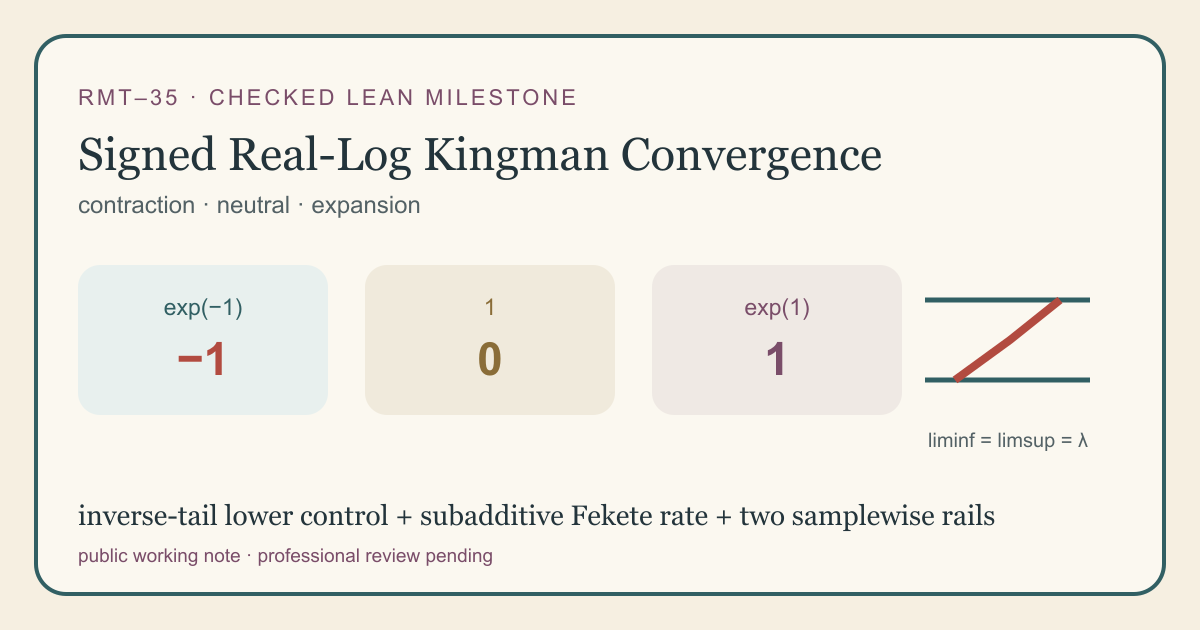
Start with the exact scalar boundary
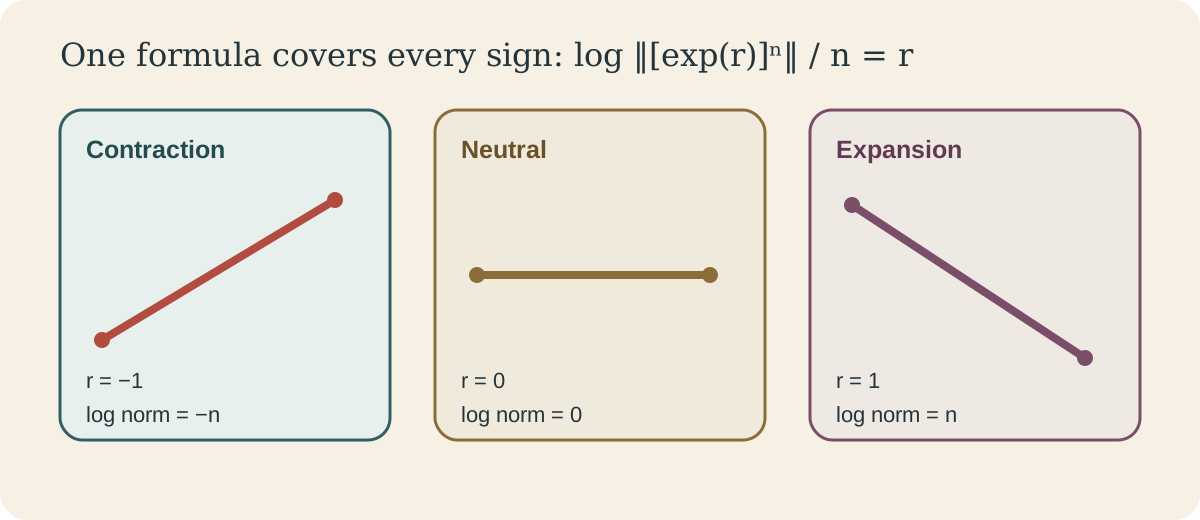
Fix a real number \(r\). On the one-point probability space, use the identity base map and the one-by-one generator
\[ A=\begin{bmatrix}e^r\end{bmatrix}. \]At horizon \(n\), the cocycle value is \(A^n=[e^{nr}]\). Its selected operator norm is \(e^{nr}\), so
\[ \frac{\log\lVert A^n\rVert}{n}=r \qquad(n\ge1). \]Thus \(r=-1\) gives exact contraction, \(r=0\) gives neutral growth, and \(r=1\) gives exact expansion. These are not numerical experiments. The private Lean atlas checks the matrix power, its norm, the real logarithm, the integrability package, and the resulting Fekete rate for an arbitrary real \(r\), then instantiates all three signs.
The signed observable matters because the older positive-log observable clips contraction:
\[ \log^+ \lVert [e^{-n}]\rVert=0, \qquad \log \lVert [e^{-n}]\rVert=-n. \]RMT-35 therefore uses the real-valued family
\[ X_n(\omega)=\log\lVert C_n(\omega)\rVert \]constructed in RMT-34. Pointwise invertibility prevents a finite product from being zero, while integrable forward and inverse one-step tails control the positive and negative sides.
The deterministic ledger
Define the signed integral and its normalized version by
\[ a_n=\int X_n\,d\mu, \qquad \bar a_n=\frac{a_n}{n}. \]The Lean names are integratedRealLogNorm and
normalizedIntegratedRealLogNorm. Time zero is totalized as zero, but the
Fekete infimum uses only positive horizons. The lemmas
integratedRealLogNorm_zero,
integratedRealLogNorm_eq_zero_of_isEmpty,
normalizedIntegratedRealLogNorm_zero, and
normalizedIntegratedRealLogNorm_eq_zero_of_isEmpty record those boundary
values.
Measure preservation removes a shifted base iterate from an integral through
integral_realLogNormObservable_at_base_iterate_eq. RMT-34 supplies signed
pointwise subadditivity and finite-horizon integrability. Their integrated
form is
HasIntegrableGeneratorLogTails.integratedRealLogNorm_add_le; the packaged
sequence result is
HasIntegrableGeneratorLogTails.subadditive_integratedRealLogNorm.
The lower budget is the one-step integral
integratedInverseGeneratorLogPlusNorm. Its nonnegativity is
integratedInverseGeneratorLogPlusNorm_nonneg. The definitional bridge
birkhoffSum_inverseGeneratorLogPlusNormObservable_eq identifies the abstract
Birkhoff sum with the cocycle’s inverse-orbit sum, while
integral_inverseOrbitLogPlusSum_eq evaluates its integral as \(n\) times the
one-step integral.
Consequently,
HasIntegrableGeneratorLogTails.neg_nat_mul_integratedInverseGeneratorLogPlusNorm_le_integratedRealLogNorm
gives
The upper comparisons are
HasIntegrableGeneratorLogTails.integratedRealLogNorm_le_integratedLogPlusNorm
and HasIntegrableGeneratorLogTails.integratedRealLogNorm_le_nat_mul.
After division by \(n\), the lower result becomes
HasIntegrableGeneratorLogTails.neg_integratedInverseGeneratorLogPlusNorm_le_normalizedIntegratedRealLogNorm;
HasIntegrableGeneratorLogTails.bddBelow_normalizedIntegratedRealLogNorm
packages boundedness below.
The finite real number
integratedRealLogGrowthRate is Mathlib’s Fekete limit for this subadditive
sequence. The convergence theorem is
HasIntegrableGeneratorLogTails.tendsto_normalizedIntegratedRealLogNorm, and
HasIntegrableGeneratorLogTails.integratedRealLogGrowthRate_eq_sInf
identifies the rate with the infimum of \(\bar a_n\) over \(n\ge1\).
The comparison API consists of
HasIntegrableGeneratorLogTails.integratedRealLogGrowthRate_le_normalized,
HasIntegrableGeneratorLogTails.integratedRealLogGrowthRate_le_oneStep,
HasIntegrableGeneratorLogTails.neg_integratedInverseGeneratorLogPlusNorm_le_integratedRealLogGrowthRate,
and
HasIntegrableGeneratorLogTails.integratedRealLogGrowthRate_le_integratedLogPlusGrowthRate.
hC.tendsto_normalizedIntegratedRealLogNorm\nhC.integratedRealLogGrowthRate_eq_sInf\nhC.integratedRealLogGrowthRate_le_normalized hkhC stores pointwise invertibility and both integrable one-step tails.
Tendsto ... atTop (𝓝 λ) is ordinary sequence convergence to the
neighborhood filter of λ. sInf is the greatest lower bound. The argument
hk : k ≠ 0 excludes the totalized time-zero quotient.The two samplewise rails
The deterministic rate must next be compared with each normalized sample
path. The lower rail uses the centered lower-deviation theorem. Its exact
input is
HasIntegrableGeneratorLogTails.centeredRealLogFeketeOffset_le_normalizedIntegral;
its endpoint is
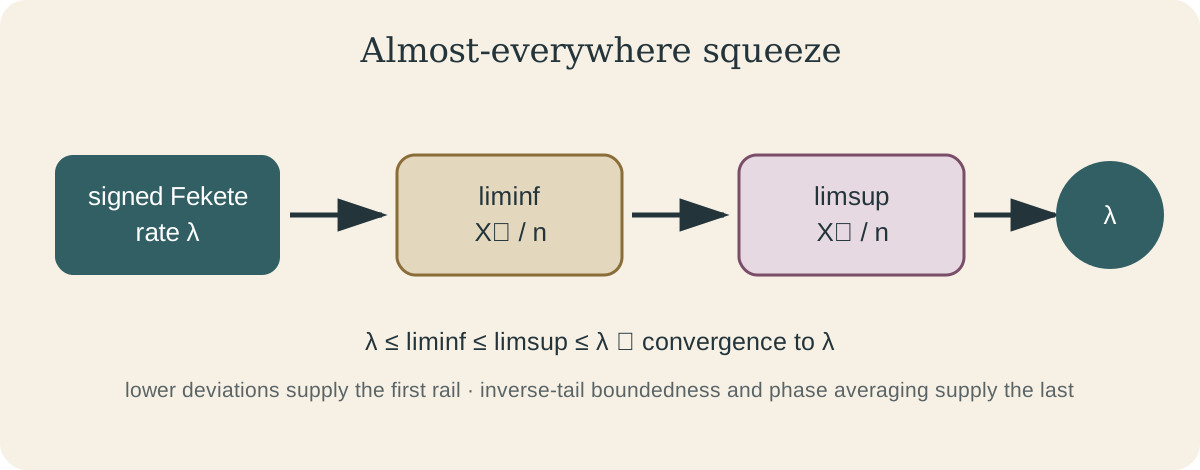
HasIntegrableGeneratorLogTails.ae_integratedRealLogGrowthRate_le_liminf_normalized.
In symbols, for almost every \(\omega\),
The upper rail cannot assume nonnegativity: contraction makes that false.
IsPointwiseInvertible.neg_birkhoffAverage_inverseGenerator_le_normalizedRealLogNorm
instead places the negative inverse-tail average below normalized signed
growth. Ordinary pointwise Birkhoff convergence makes that lower comparison
eventually bounded; the packaged statement is
IsPointwiseInvertible.ae_isBoundedUnder_ge_normalizedRealLogNormObservable.
That hypothesis is exactly what the generalized RMT-29 phase-averaging
theorem requires. The resulting endpoint is
HasIntegrableGeneratorLogTails.ae_limsup_normalized_le_integratedRealLogGrowthRate:
The squeeze is visual rather than an extra assumption:
The principal theorem is
HasIntegrableGeneratorLogTails.ae_tendsto_normalizedRealLogNormObservable.
It assumes IsProbabilityMeasure μ and PreErgodic C.base μ; preservation is
already part of the cocycle. It concludes almost-everywhere convergence to
C.integratedRealLogGrowthRate hC.
HasIntegrableGeneratorLogTails.integratedRealLogGrowthRate_eq_zero_of_isEmpty
records that empty matrix dimension has rate zero. Finally,
HasIntegrableGeneratorLogTails.integratedRealLogGrowthRate_eq_integratedLogPlusGrowthRate_of_pos
identifies the signed and positive-log deterministic rates when the latter is
strictly positive. That proof uses uniqueness of the two almost-everywhere
sample limits, not an exchange of a limit with an integral.
A lightweight standalone tutorial
This small file imports only Std. It checks the arithmetic shape of the
scalar atlas without matrices or measure theory:
import Std

def signedPrefix (rate : Int) (n : Nat) : Int :=
  (n : Int) * rate

example (n : Nat) : signedPrefix (-1) n = -(n : Int) := by
  simp [signedPrefix]

example (n : Nat) : signedPrefix 0 n = 0 := by
  simp [signedPrefix]

example (n : Nat) : signedPrefix 1 n = n := by
  simp [signedPrefix]
Save it as SignedRateTutorial.lean, then run on macOS or Linux:
lean SignedRateTutorial.lean
This standalone tutorial checks integer identities only. It does not import the repository definitions or establish any probabilistic convergence claim.
lake env lean with the repository’s pinned
toolchain and dependency manifest.cd formalization
lake env lean -DwarningAsError=true NonlinearDynamics/Random/RandomCocycles/RealLogNormKingman.leanResource note: this exact file uses the repository's
pinned Lean and Mathlib dependencies. Initial project setup can require
substantial disk space and build time. For a lightweight first step on
macOS or Linux, use the page's standalone Lean-core or Std
tutorial.
Complete public declaration map
| Layer | Public declarations |
|---|---|
| Signed integrals | integratedRealLogNorm; integratedRealLogNorm_zero; integratedRealLogNorm_eq_zero_of_isEmpty; integral_realLogNormObservable_at_base_iterate_eq; HasIntegrableGeneratorLogTails.integratedRealLogNorm_add_le; HasIntegrableGeneratorLogTails.subadditive_integratedRealLogNorm |
| Inverse and forward controls | integratedInverseGeneratorLogPlusNorm; integratedInverseGeneratorLogPlusNorm_nonneg; birkhoffSum_inverseGeneratorLogPlusNormObservable_eq; integral_inverseOrbitLogPlusSum_eq; HasIntegrableGeneratorLogTails.neg_nat_mul_integratedInverseGeneratorLogPlusNorm_le_integratedRealLogNorm; HasIntegrableGeneratorLogTails.integratedRealLogNorm_le_integratedLogPlusNorm; HasIntegrableGeneratorLogTails.integratedRealLogNorm_le_nat_mul |
| Normalization and Fekete rate | normalizedIntegratedRealLogNorm; normalizedIntegratedRealLogNorm_zero; normalizedIntegratedRealLogNorm_eq_zero_of_isEmpty; HasIntegrableGeneratorLogTails.neg_integratedInverseGeneratorLogPlusNorm_le_normalizedIntegratedRealLogNorm; HasIntegrableGeneratorLogTails.bddBelow_normalizedIntegratedRealLogNorm; integratedRealLogGrowthRate; HasIntegrableGeneratorLogTails.tendsto_normalizedIntegratedRealLogNorm; HasIntegrableGeneratorLogTails.integratedRealLogGrowthRate_eq_sInf; HasIntegrableGeneratorLogTails.integratedRealLogGrowthRate_le_normalized; HasIntegrableGeneratorLogTails.integratedRealLogGrowthRate_le_oneStep; HasIntegrableGeneratorLogTails.neg_integratedInverseGeneratorLogPlusNorm_le_integratedRealLogGrowthRate; HasIntegrableGeneratorLogTails.integratedRealLogGrowthRate_le_integratedLogPlusGrowthRate |
| Kingman rails | HasIntegrableGeneratorLogTails.centeredRealLogFeketeOffset_le_normalizedIntegral; IsPointwiseInvertible.neg_birkhoffAverage_inverseGenerator_le_normalizedRealLogNorm; IsPointwiseInvertible.ae_isBoundedUnder_ge_normalizedRealLogNormObservable; HasIntegrableGeneratorLogTails.ae_integratedRealLogGrowthRate_le_liminf_normalized; HasIntegrableGeneratorLogTails.ae_limsup_normalized_le_integratedRealLogGrowthRate; HasIntegrableGeneratorLogTails.ae_tendsto_normalizedRealLogNormObservable |
| Boundary and rate comparison | HasIntegrableGeneratorLogTails.integratedRealLogGrowthRate_eq_zero_of_isEmpty; HasIntegrableGeneratorLogTails.integratedRealLogGrowthRate_eq_integratedLogPlusGrowthRate_of_pos |
Exact nonclaims
RMT-35 proves pointwise almost-everywhere convergence. It does not prove \(L^1\) convergence, uniform integrability of the normalized signed family, interchange of limit and integral, a quantitative convergence rate, a concentration inequality, a conorm or singular-value limit, a Lyapunov spectrum, invariant subspaces, an Oseledets splitting, a derivative-cocycle bridge, or a stable-manifold theorem. It also does not claim that the deterministic rate equals an individual sample rate without the probability and pre-ergodicity assumptions in the endpoint.
References
- J. F. C. Kingman, “The Ergodic Theory of Subadditive Stochastic Processes,” Journal of the Royal Statistical Society: Series B 30(3), 499–510 (1968), doi:10.1111/j.2517-6161.1968.tb00749.x.
- RMT-34: Real Log-Norm Integrability from Forward and Inverse Tails in Lean.
- RMT-29: Subadditive Upper Limsup from Phase Averaging in Lean.
- Integrated real-log growth rate.
- Integrated Real-Log Growth and Signed Kingman Convergence.