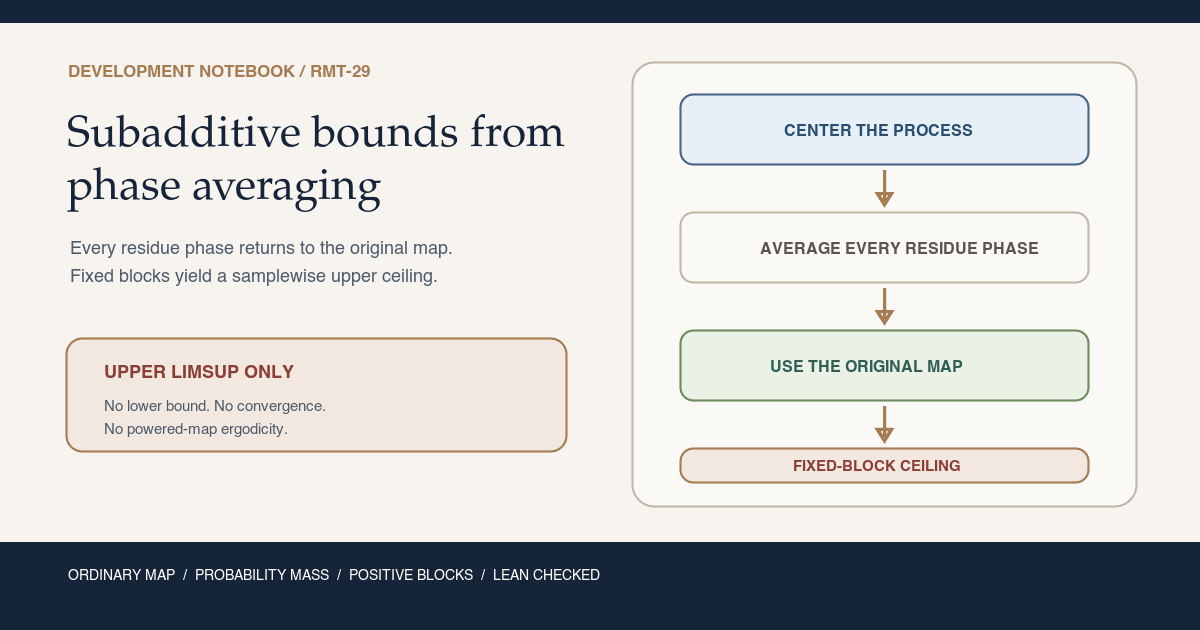
For reusable terminology, see limit superior , phase averaging , Birkhoff sums , and integrated log-positive growth rate . The textbook companion is Subadditive Upper Limsup Bounds Before Kingman Convergence.
Why this milestone exists
RMT-20 established the finite combinatorial inequality needed to average all block phases (RMT-20 record). RMT-28 established that ordinary Birkhoff averages converge to the raw integral on ergodic probability systems (RMT-28 record), through the modern checked form of Birkhoff’s individual ergodic theorem (Birkhoff 1931). RMT-29 is the first layer to compose those results into a samplewise asymptotic bound for a genuinely subadditive family.
That composition matters because the most direct proof route is unsound.
Fix a block \(b\), follow \(X_b\) at times \(0,b,2b,\ldots\), and one obtains
an orbit sum for \(T^b\). But Ergodic T μ does not imply
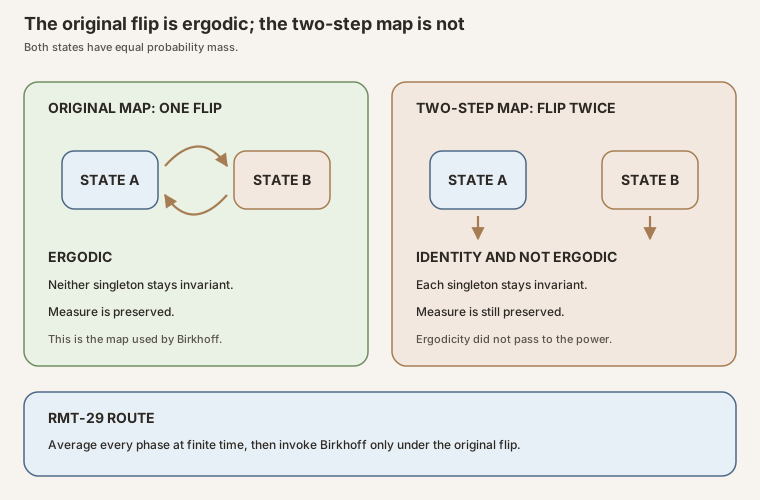
Ergodic (T^[b]) μ. The uniform two-point flip is the smallest example:
the flip is ergodic, while its square is the identity and has nontrivial
invariant events.
The corrected route averages all phases before taking limits. That finite average becomes one Birkhoff sum of the block observable under \(T\), not a Birkhoff sum under \(T^b\). Every asymptotic call therefore uses exactly the ergodicity present in the theorem statement.
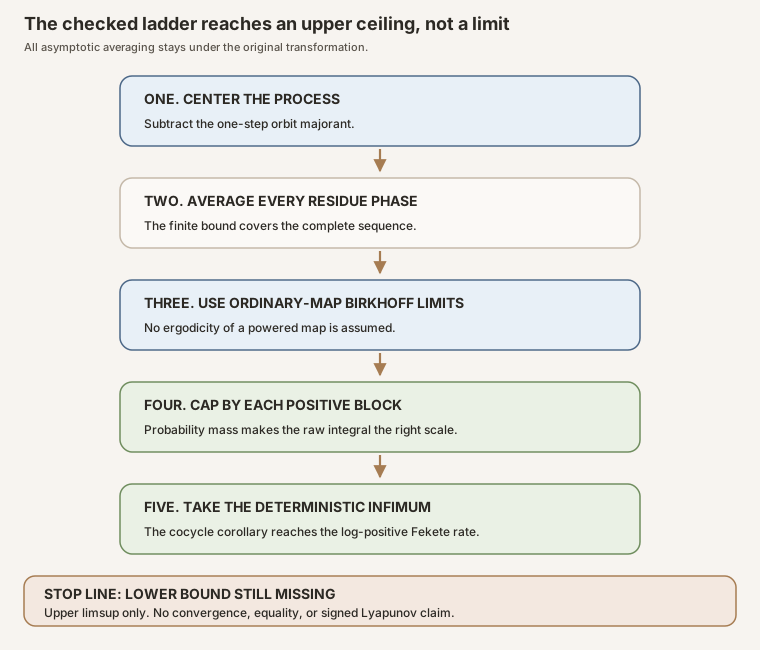
The mathematical proof ladder
Step 1: integrate finite Birkhoff sums exactly
For a measure-preserving map and an integrable real observable \(f\),
\[ \int_\Omega S_n f\,d\mu {} = n\int_\Omega f\,d\mu. \]The proof expands the finite sum, uses integral_finsetSum, and applies
measure preservation to every iterate. Integrability is propagated through
the composed iterates. No probability or ergodicity assumption is needed.
Step 2: compute the centered integral
Define
\[ Y_n=X_n-S_n(X_1). \]The integrable-candidate interface makes both terms integrable. Therefore
\[ \int Y_b {} = \int X_b-b\int X_1. \]This identity is the algebraic hinge of the asymptotic proof. After block averaging, the \(X_1\) contribution cancels exactly.
Step 3: get an almost-everywhere Birkhoff set
For each fixed positive block \(b\), RMT-28 gives a full-measure set on which both
\[ A_n(Y_b)(\omega)\to\int Y_b \]and
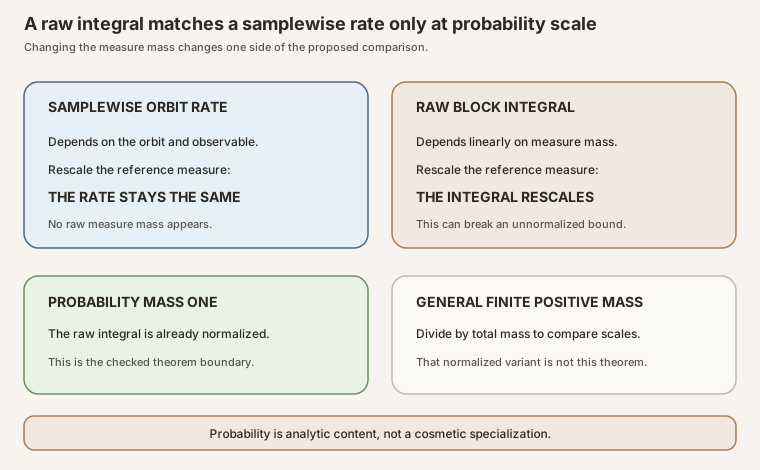
\[ A_n(X_1)(\omega)\to\int X_1 \]hold. Probability is used here to make the limits raw integrals. On a general finite nonzero measure they would be normalized space averages.
Step 4: establish the limsup bounds needed by Mathlib
The public generic theorem assumes
\[ 0\le X_n(\omega) \]pointwise. Hence \(0\le X_n(\omega)/n\) for every natural \(n\), including
Lean’s totalized time-zero value. This supplies the lower boundedness needed
by the real limsup_le_iff interface
(pinned Mathlib source).
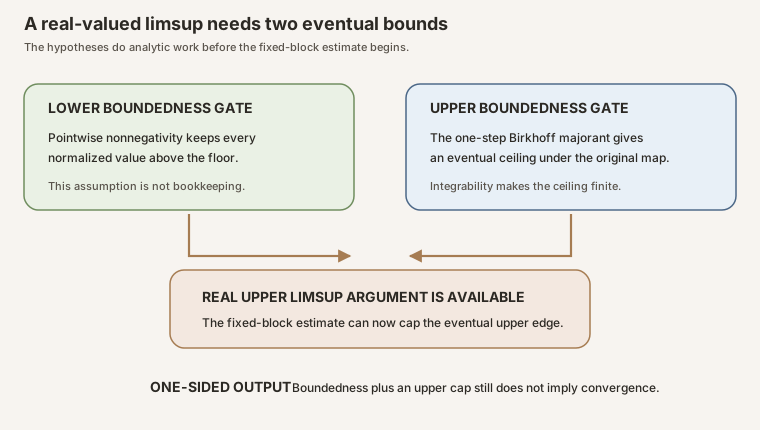
limsup_le_iff route needs both order bounds. The reusable theorem accepts eventual lower boundedness directly; the compatibility wrapper derives it from nonnegativity. The upper bound comes from the one-step majorant and Birkhoff convergence.For upper boundedness, the candidate’s one-step majorant gives, eventually at positive times,
\[ \frac{X_n(\omega)}n\le A_n(X_1)(\omega). \]The right side converges on the chosen full-measure set and is therefore bounded.
Step 5: work one residue at a time
Fix a residue \(r\lt b\) and write \(n=ba+r\). For \(a\ge2\), let
\[ m=b(a-1). \]The RMT-20 phase-average theorem gives
\[ Y_{ba+r}(\omega) \le \frac{S_m(Y_b)(\omega)}b. \]After division by \(ba+r\), the right side becomes
\[ A_m(Y_b)(\omega) \frac{m}{b(ba+r)}. \]As \(a\to\infty\), one has \(m\to\infty\), \(ba+r\to\infty\), and
\[ \frac{m}{b(ba+r)}\to\frac1b. \]Adding the Birkhoff average of \(X_1\) reconstructs the normalized original process. The limiting target simplifies to
\[ \frac{1}{b}\int Y_b+\int X_1 {} = \frac1b\int X_b. \]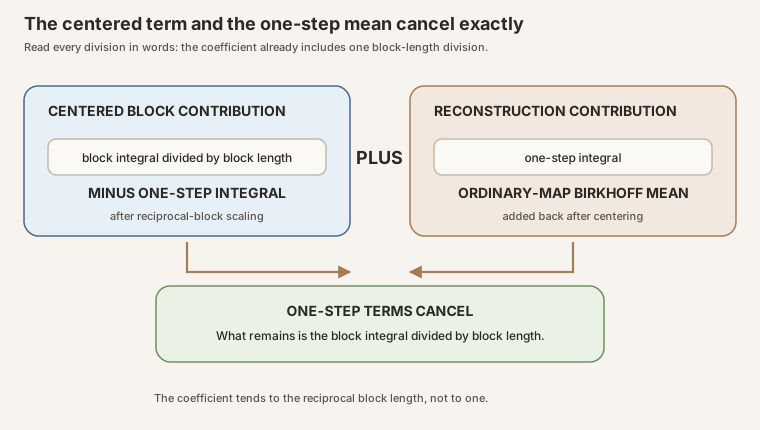
Step 6: recover every large time
Eventually.atTop_of_arithmetic says that an eventual statement holds on
all natural times once it holds eventually along every residue progression
for a positive modulus. This is the exact bridge from the finite family of
residue arguments to the complete sequence
(pinned Mathlib source).
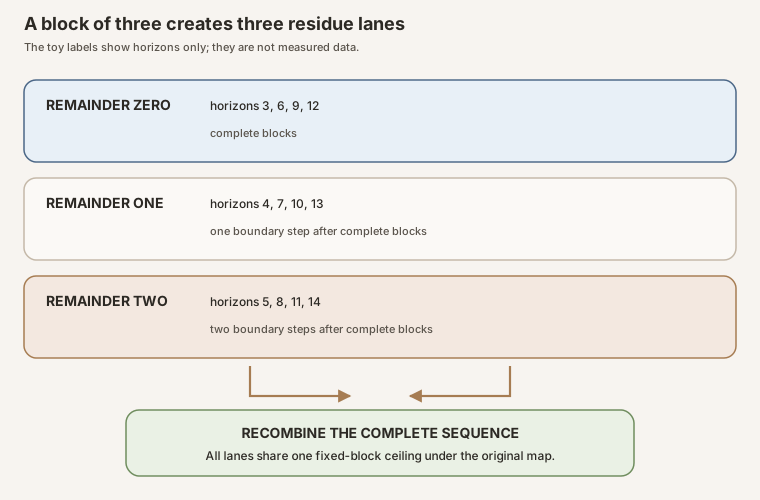
Eventually.atTop_of_arithmetic to recombine them without invoking ergodicity of a powered map.Step 7: optimize the cocycle endpoint
The cocycle log-positive observable is pointwise nonnegative. The generic
theorem therefore gives the block bound for every positive natural \(b\).
After taking a countable intersection of full-measure sets, the samplewise
limsup is below every normalized integrated block value. The earlier Fekete
identity identifies their infimum with
integratedLogPlusGrowthRate hC.
Public declaration surface
The module’s five public declarations appear in this order. The receiver namespace variables already in scope in the Lean source are suppressed in snippets 2 through 5; the theorem names, explicit premises, and conclusions are source-faithful.
1. integral_birkhoffSum_eq_nat_mul
theorem integral_birkhoffSum_eq_nat_mul
    {Ω : Type uΩ} [MeasurableSpace Ω] {T : Ω → Ω} {μ : Measure Ω}
    {f : Ω → ℝ} (hT : MeasurePreserving T μ μ) (hf : Integrable f μ)
    (n : ℕ) :
    (∫ ω, birkhoffSum T f n ω ∂μ) = n * ∫ ω, f ω ∂μ
The multiplier on the right is coerced into \(\mathbb R\). The theorem is finite and exact. It needs neither finite total mass nor ergodicity.
2. IsIntegrableSubadditiveProcessCandidate.integral_centeredProcess
theorem IsIntegrableSubadditiveProcessCandidate.integral_centeredProcess
    {X : ℕ → Ω → ℝ}
    (hX : IsIntegrableSubadditiveProcessCandidate T μ X)
    (hT : MeasurePreserving T μ μ) (b : ℕ) :
    (∫ ω, centeredProcess T X b ω ∂μ) =
      (∫ ω, X b ω ∂μ) - b * ∫ ω, X 1 ω ∂μ
This receiver-style theorem exposes the exact centering cancellation needed later. Its horizon is unrestricted, so the time-zero specialization compiles.
3. IsIntegrableSubadditiveProcessCandidate.ae_limsup_normalized_le_blockIntegral_of_ae_isBoundedUnder_ge
theorem ae_limsup_normalized_le_blockIntegral_of_ae_isBoundedUnder_ge
    [IsProbabilityMeasure μ]
    (hX : IsIntegrableSubadditiveProcessCandidate T μ X)
    (hT : Ergodic T μ)
    (hXlower : ∀ᵐ ω ∂μ,
      IsBoundedUnder (· ≥ ·) atTop (fun n ↦ X n ω / (n : ℝ)))
    (b : ℕ) (hb : b ≠ 0) :
    ∀ᵐ ω ∂μ,
      limsup (fun n ↦ X n ω / (n : ℝ)) atTop ≤
        (∫ x, X b x ∂μ) / (b : ℝ)
This is the reusable theorem. hXlower states the exact lower-boundedness
gate used by the real limsup argument. It permits signed processes when
another estimate, such as RMT-35’s inverse-tail Birkhoff rail, supplies that
gate.
4. IsIntegrableSubadditiveProcessCandidate.ae_limsup_normalized_le_blockIntegral
theorem IsIntegrableSubadditiveProcessCandidate.ae_limsup_normalized_le_blockIntegral
    [IsProbabilityMeasure μ] {X : ℕ → Ω → ℝ}
    (hX : IsIntegrableSubadditiveProcessCandidate T μ X)
    (hT : Ergodic T μ) (hXnonneg : ∀ n ω, 0 ≤ X n ω)
    (b : ℕ) (hb : b ≠ 0) :
    ∀ᵐ ω ∂μ,
      limsup (fun n ↦ X n ω / (n : ℝ)) atTop ≤
        (∫ x, X b x ∂μ) / (b : ℝ)
This compatibility wrapper derives the generic theorem’s lower-bound premise
from pointwise nonnegativity. Every remaining premise has a distinct job:
candidate integrability supports the two
Birkhoff calls, ergodicity supplies preservation and integral-valued limits,
probability removes total-mass normalization, pointwise nonnegativity supplies
the real lower bound, and hb legitimizes the fixed-block phase argument.
5. DiscreteMatrixCocycle.HasIntegrableGeneratorLogPlus.ae_limsup_normalized_le_integratedLogPlusGrowthRate
theorem DiscreteMatrixCocycle.HasIntegrableGeneratorLogPlus.
    ae_limsup_normalized_le_integratedLogPlusGrowthRate
    [Fintype ι] [DecidableEq ι] [IsProbabilityMeasure μ]
    {C : DiscreteMatrixCocycle (ι := ι) μ}
    (hC : C.HasIntegrableGeneratorLogPlus) (hT : Ergodic C.base μ) :
    ∀ᵐ ω ∂μ,
      limsup
          (fun n ↦ C.logPlusNormObservable n ω / (n : ℝ)) atTop ≤
        C.integratedLogPlusGrowthRate hC
The integrability receiver supplies the generic candidate instance and the Fekete identity. No nonempty index assumption is present.
Private helper ledger
The core private helpers occur after the finite Birkhoff-sum integration theorem and before the namespace containing the candidate receiver theorems.
| Source item | Role |
|---|---|
blockPrefix | Defines \(b(a-1)\), the phase-compatible Birkhoff horizon |
tendsto_blockPrefix | Proves that prefix tends to infinity for \(b\ne0\) |
tendsto_arithmetic | Proves \(ba+r\to\infty\) for \(b\ne0\) |
tendsto_blockCoefficient | Proves the residual real coefficient tends to \(b^{-1}\) |
These helpers are private because they package proof geometry rather than a stable mathematical API. The coefficient proof uses Mathlib’s affine-ratio limit and then reconciles natural subtraction with real arithmetic after restricting eventually to \(a\ge1\).
Boundary-support and probe ledger
After the five public declarations, the source contains a private compiled
boundary section. It defines rmt29ZeroProcess, proves
rmt29ZeroProcess_candidate, defines rmt29Flip and
rmt29TwoCycleMeasure, and installs a private probability instance for that
measure. The remaining named theorems are
rmt29Flip_measurePreserving_twoCycle,
rmt29Flip_preErgodic_twoCycle, rmt29Flip_ergodic_twoCycle,
rmt29Flip_square_eq_id, and rmt29Flip_square_not_ergodic.
Three anonymous example probes then compile the intended boundaries:
- the finite Birkhoff-sum integral theorem at horizon zero;
- the generic upper-limsup theorem for the totalized zero process at block one; and
- the same theorem under the ergodic flip at block two, alongside the fact that the squared map is not ergodic.
The exact named boundary sub-order is reconciled in the source-order audit below. These are compiled protections against accidentally strengthening future APIs, not additional exported theorems.
Complete source-order map
| Order | Kind | Source item |
|---|---|---|
| 1 | Public theorem | integral_birkhoffSum_eq_nat_mul |
| 2 | Private definition | blockPrefix |
| 3 | Private theorem | tendsto_blockPrefix |
| 4 | Private theorem | tendsto_arithmetic |
| 5 | Private theorem | tendsto_blockCoefficient |
| 6 | Public receiver theorem | IsIntegrableSubadditiveProcessCandidate.integral_centeredProcess |
| 7 | Public receiver theorem | IsIntegrableSubadditiveProcessCandidate.ae_limsup_normalized_le_blockIntegral_of_ae_isBoundedUnder_ge |
| 8 | Public receiver theorem | IsIntegrableSubadditiveProcessCandidate.ae_limsup_normalized_le_blockIntegral |
| 9 | Public receiver theorem | DiscreteMatrixCocycle.HasIntegrableGeneratorLogPlus.ae_limsup_normalized_le_integratedLogPlusGrowthRate |
| 10 | Private boundary definition | rmt29ZeroProcess |
| 11 | Private boundary theorem | rmt29ZeroProcess_candidate |
| 12 | Private boundary definition | rmt29Flip |
| 13 | Private boundary definition | rmt29TwoCycleMeasure |
| 14 | Private boundary instance | IsProbabilityMeasure rmt29TwoCycleMeasure |
| 15 | Private boundary theorem | rmt29Flip_measurePreserving_twoCycle |
| 16 | Private boundary theorem | rmt29Flip_preErgodic_twoCycle |
| 17 | Private boundary theorem | rmt29Flip_ergodic_twoCycle |
| 18 | Private boundary theorem | rmt29Flip_square_eq_id |
| 19 | Private boundary theorem | rmt29Flip_square_not_ergodic |
| 20 | Anonymous example | integral_birkhoffSum_eq_nat_mul specialized at horizon zero |
| 21 | Anonymous example | ae_limsup_normalized_le_blockIntegral for the zero process at block one |
| 22 | Anonymous example | Ergodic flip, nonergodic square, and zero-process block-two bound |
| 23 | Axiom audit | #print axioms integral_birkhoffSum_eq_nat_mul |
| 24 | Axiom audit | #print axioms IsIntegrableSubadditiveProcessCandidate.integral_centeredProcess |
| 25 | Axiom audit | #print axioms IsIntegrableSubadditiveProcessCandidate.ae_limsup_normalized_le_blockIntegral_of_ae_isBoundedUnder_ge |
| 26 | Axiom audit | #print axioms IsIntegrableSubadditiveProcessCandidate.ae_limsup_normalized_le_blockIntegral |
| 27 | Axiom audit | #print axioms DiscreteMatrixCocycle.HasIntegrableGeneratorLogPlus.ae_limsup_normalized_le_integratedLogPlusGrowthRate |
Axiom audit
The five final axiom reports are:
'NonlinearDynamics.Random.RandomCocycles.integral_birkhoffSum_eq_nat_mul'
depends on axioms: [propext, Classical.choice, Quot.sound]

'NonlinearDynamics.Random.RandomCocycles.IsIntegrableSubadditiveProcessCandidate.integral_centeredProcess'
depends on axioms: [propext, Classical.choice, Quot.sound]

'NonlinearDynamics.Random.RandomCocycles.IsIntegrableSubadditiveProcessCandidate.ae_limsup_normalized_le_blockIntegral_of_ae_isBoundedUnder_ge'
depends on axioms: [propext, Classical.choice, Quot.sound]

'NonlinearDynamics.Random.RandomCocycles.IsIntegrableSubadditiveProcessCandidate.ae_limsup_normalized_le_blockIntegral'
depends on axioms: [propext, Classical.choice, Quot.sound]

'NonlinearDynamics.Random.RandomCocycles.DiscreteMatrixCocycle.HasIntegrableGeneratorLogPlus.ae_limsup_normalized_le_integratedLogPlusGrowthRate'
depends on axioms: [propext, Classical.choice, Quot.sound]
These are the standard logical and quotient principles inherited through Mathlib. No project-specific axiom is introduced.
Boundary probes in depth
Positive additive one-point sharpness
Status: explanatory sharpness model, not one of the three compiled anonymous examples in this module.
Let \(X_n=cn\) on a one-point probability space, with \(c\ge0\). Then \(X\) is additive and hence subadditive. For every \(n\gt0\),
\[ X_n/n=c. \]For every positive block \(b\),
\[ (\int X_b)/b=c. \]Thus the fixed-block bound is sharp. The theorem is not losing a constant through its phase average.
Zero process and totalized time zero
Status: compiled boundary model and example.
For rmt29ZeroProcess, every finite value, integral, centered value, and
normalized positive-time value vanishes. At time zero, real division is
totalized to zero. The proof does not interpret this as growth over zero
time; it moves eventually to positive horizons.
Nonnegativity is a real boundary
Status: explanatory countermodel, not one of the three compiled anonymous examples in this module.
The scalar family \(X_n=-n^2\) on a one-point probability space is integrable
and subadditive, while \(X_n/n=-n\) for positive \(n\) is unbounded below. In
the extended reals its limsup is \(-\infty\), but Mathlib’s conditionally
complete real Filter.limsup is totalized here to sInf univ = 0, because
every real is eventually an upper bound. For every positive block \(b\), the
proposed right side is \((\int X_b)/b=-b\), so deleting nonnegativity would
make the theorem claim \(0\le-b\). Thus this model refutes the
hypothesis-deleted theorem, not merely this proof route. The log-positive
cocycle process satisfies nonnegativity canonically.
The uniform flip avoids a powered-map assumption
Status: compiled boundary model and example.
For this Boolean system, the checked declarations establish both
Ergodic rmt29Flip rmt29TwoCycleMeasure
and
¬ Ergodic (rmt29Flip^[2]) rmt29TwoCycleMeasure.
The generic theorem nevertheless applies at block \(2\). This is executable
evidence that the proof consumes only Ergodic rmt29Flip, not ergodicity of
the squared map.
Empty matrix dimension
Status: explanatory signature audit, not one of the three compiled anonymous examples in this module.
The cocycle endpoint assumes Fintype ι and DecidableEq ι, but not
Nonempty ι. Its argument does not choose a coordinate. Empty finite matrix
dimensions therefore remain inside the theorem’s formal boundary.
Assumption ledger
| Assumption | First use | What it does not imply |
|---|---|---|
MeasurePreserving T μ μ | Finite sum integration | Ergodicity or probability |
| Candidate integrability | Centered integrability and Birkhoff calls | Nonnegativity |
Ergodic T μ | RMT-28 convergence under \(T\) | Ergodicity of \(T^b\) |
IsProbabilityMeasure μ | Raw-integral Birkhoff target | Independence or mixing |
∀ n ω, 0 ≤ X n ω | Lower boundedness for real limsup | Convergence |
b ≠ 0 | Arithmetic progressions and division | A uniform choice of block |
HasIntegrableGeneratorLogPlus | Cocycle candidate and Fekete rate | Signed log integrability |
Common wrong turns
Calling this Kingman’s theorem
Kingman’s full theorem supplies a samplewise limit under a broader structural argument. RMT-29 proves only the upper-limsup comparison. The lower-bound half has not been formalized here.
Applying Birkhoff to T^[b]
This inserts an unavailable hypothesis. The source uses finite phase averaging and Birkhoff convergence under \(T\).
Dropping pointwise nonnegativity as bookkeeping
In this real-valued implementation, nonnegativity supplies a lower bound required by the limsup API. The candidate interface alone permits processes such as \(-n^2\).
Calling a raw integral an expectation before probability
The fixed-block target is a raw integral because the theorem assumes a probability measure. Without mass one, the ergodic Birkhoff constant is the normalized space average.
Reading log-positive growth as signed growth
Positive clipping erases contraction. The theorem cannot identify a negative Lyapunov exponent and does not construct invariant subspaces.
Claiming a limit-integral interchange
The proof takes Birkhoff limits of fixed observables and compares the samplewise limsup to a separately established infimum of finite integrals. It does not integrate a samplewise limit.
What prior work supplies
Kingman’s 1968 paper is the primary historical destination for subadditive stochastic processes (Kingman 1968). Steele’s 1989 paper gives a conceptually algorithmic full proof, beginning with a Birkhoff-based centering reduction and then using an interval-decomposition argument (Steele 1989). Lalley’s short lecture notes motivate phase averaging specifically because powers of an ergodic transformation need not remain ergodic (Lalley notes). They are pedagogical context, not a primary theorem source, and RMT-20 audits a finite indexing inconsistency in the displayed phase rows.
The repository contribution is narrower and checkable. RMT-20 repaired and formalized the finite phase estimate with its boundary terms. RMT-28 supplied ordinary-map ergodic Birkhoff limits with probability specialization. RMT-29 connects them, formalizes the exact real-limsup boundedness obligations, and exports a cocycle endpoint tied to the already checked deterministic Fekete rate.
Contribution and nonclaims
The new contribution is the first checked almost-everywhere samplewise subadditive upper asymptotic bound in this development. It is reusable at three levels: a generic integrable-process theorem with an explicit eventual lower-bound gate, a nonnegative compatibility wrapper for any positive block, and a matrix-cocycle theorem optimized over all blocks.
It does not establish:
- a lower liminf estimate;
- convergence of the normalized process;
- equality with the integrated rate;
- integrability of a samplewise limit;
- convergence in mean;
- a signed logarithmic growth rate;
- a Lyapunov exponent or Oseledets splitting;
- powered-map ergodicity;
- mixing, independence, stationarity beyond the preserved dynamical base; or
- a quantitative convergence rate.
Those are the boundaries of RMT-29 itself. The later RMT-33 Notebook supplies the guarded lower-liminf half and obtains convergence for the log-positive cocycle observable without retroactively strengthening any declaration in this module.
Twenty-four solved exercises
Exercise 1: integrate one iterate
Show why \(\int f\circ T^j=\int f\).
Solution. The iterate of a measure-preserving map is measure preserving, so its mapped measure is \(\mu\); the mapped-integral identity gives equality.
Exercise 2: count the sum
Why does integrating \(S_nf\) produce the factor \(n\)?
Solution. The finite range has cardinality \(n\), and every summand has the same integral by Exercise 1.
Exercise 3: specialize to zero
What does the first public theorem say at \(n=0\)?
Solution. The empty Birkhoff sum integrates to zero and the right side is zero times the integral, so both sides are zero.
Exercise 4: compute the center
Derive \(\int Y_b=\int X_b-b\int X_1\).
Solution. Integrate the defining subtraction and use the first public theorem for the one-step Birkhoff sum.
Exercise 5: find the center’s sign
What gives \(Y_n\le0\) for positive \(n\)?
Solution. The candidate’s one-step Birkhoff majorant \(X_n\le S_n(X_1)\).
Exercise 6: reconstruct normalized \(X\)
Write \(X_n/n\) using \(Y_n\).
Solution. It is \(Y_n/n+A_n(X_1)\) for positive \(n\).
Exercise 7: choose the prefix
For \(n=ba+r\), which prefix is used?
Solution. blockPrefix b a = b * (a - 1).
Exercise 8: explain positivity
Why restrict eventually to \(a\ge2\)?
Solution. Then \(a-1\gt0\), so the prefix and the reconstructed horizon are positive and the required real divisions are order-safe.
Exercise 9: take the coefficient limit
What is the limit of the block coefficient?
Solution. It is \(1/b\), because its numerator has leading coefficient \(b\) and its denominator leading coefficient \(b^2\).
Exercise 10: combine limits
What is the limit after adding the one-step average?
Solution. \((\int Y_b)/b+\int X_1=(\int X_b)/b\).
Exercise 11: cover the sequence
Why are finitely many residue arguments sufficient?
Solution. Every natural has one residue in \(\{0,\ldots,b-1\}\), and
Eventually.atTop_of_arithmetic recombines their eventual tails.
Exercise 12: locate nonnegativity
Which proof obligation uses hXnonneg?
Solution. The lower boundedness of the normalized real sequence for
limsup_le_iff.
Exercise 13: test \(-n^2\)
Why does this example not fit the theorem?
Solution. It is subadditive but not pointwise nonnegative, and its normalized values are unbounded below.
Exercise 14: locate probability
Why is IsProbabilityMeasure μ present?
Solution. It turns the RMT-28 normalized space-average limit into the raw integral used by the block target.
Exercise 15: reject power ergodicity
Give the two-point counterexample.
Solution. The uniform Bool flip is ergodic, while its second iterate is the identity and is not ergodic.
Exercise 16: audit the actual map
Which map appears in both Birkhoff limits?
Solution. The original map \(T\), for observables \(Y_b\) and \(X_1\).
Exercise 17: sharpen on one point
Evaluate the bound for \(X_n=cn\).
Solution. Both sides equal \(c\) for every positive block.
Exercise 18: optimize blocks
How does the cocycle theorem pass from each block to the rate?
Solution. Intersect the countably many full-measure events, then apply the Fekete identity for the infimum of positive-block normalized integrals.
Exercise 19: witness the infimum set
Why is it nonempty?
Solution. The normalized integral at block one is a member.
Exercise 20: inspect the empty index
Which theorem premise would force a coordinate to exist?
Solution. Nonempty ι, and it is deliberately absent.
Exercise 21: reject convergence
What does a limsup upper bound leave open?
Solution. The liminf may be smaller, so oscillation and nonconvergence remain possible.
Exercise 22: reject a Lyapunov claim
Why can positive clipping hide contraction?
Solution. If the signed logarithmic rate is negative, its positive part can still be identically zero.
Exercise 23: list the five public roles
Name them without Lean syntax.
Solution. Finite Birkhoff-sum integration, centered-block integration, generic lower-bounded fixed-block upper limsup, its nonnegative wrapper, and the cocycle all-block integrated-rate bound.
Exercise 24: state the next missing theorem
What is the next analytic ridge toward Kingman convergence?
Solution. A complementary lower-liminf mechanism strong enough to meet the upper bound and establish the samplewise limit, with its own exact integrability and invariance obligations. RMT-33 later discharges that ridge for the log-positive cocycle observable.
Reproduction and audit
Build the leaf module with warnings fatal:
cd formalization
lake env lean -DwarningAsError=true \
  NonlinearDynamics/Random/RandomCocycles/SubadditiveUpperLimsup.lean
Starting from the repository root, build the complete formalization and check the public teaching content:
cd formalization
lake build

cd ..
make content-hygiene
make site-check
The source’s final four #print axioms commands provide the theorem-specific
logical audit. The coverage manifest connects this module to this Notebook.
Discussion
RMT-29 changes the epistemic status of one part of the planned Kingman route. Before this module, the project had a corrected finite phase inequality and a separate ergodic Birkhoff endpoint. It did not yet have a checked theorem that combined them into a samplewise asymptotic statement for subadditive data. The new module closes exactly that upper-bound gap.
The formal proof also exposes which textbook shortcuts are unsafe. Powered-map ergodicity is not inherited automatically. Probability normalization is not synonymous with preservation. A real limsup proof has boundedness obligations. Centering is not cosmetic because it creates the sign needed by the finite phase theorem and the cancellation needed by the limiting constant.
The correct downgrade is equally important. This milestone does not make the full subadditive ergodic theorem checked in the repository. It establishes one direction of the asymptotic comparison for a lower-bounded normalized process, and its original cocycle application concerns a positive-log envelope. Any prose claiming a samplewise limit, equality, signed exponent, or invariant splitting would outrun the formal artifact.
The next ridge
The next checked layer is Finite Centered Bad-Block Measure Control in Lean. It counts visits to finite strict centered sublevel sets, feeds one witnessing length per visit into RMT-21’s greedy interval packing, and integrates the result into a real-measure ratio. That bridge still does not prove a lower liminf.
The following layers must first pass to the all-length bad set, then define an asymptotic lower-deviation event with the correct one-sided almost invariance and apply ergodic zero-one rigidity. The raw all-length union is not silently declared invariant. A full Kingman endpoint would then need to identify the liminf, prove equality with the deterministic rate under the intended hypotheses, and state any integrability or convergence-in-mean consequences separately. Only after a signed cocycle observable and its samplewise limit are established should the development speak about ordinary Lyapunov exponents. Oseledets splittings require still more multiplicative and invariant-subspace structure.
References
J. F. C. Kingman. The ergodic theory of subadditive stochastic processes, Journal of the Royal Statistical Society: Series B 30(3), 499-510, 1968, doi:10.1111/j.2517-6161.1968.tb00749.x. This primary source is the historical destination for the full theorem. RMT-29 proves only the upper-limsup layer stated here.
J. Michael Steele. Kingman’s subadditive ergodic theorem, Annales de l’Institut Henri Poincaré, Probabilités et Statistiques 25(1), 93-98, 1989. Steele gives a conceptually algorithmic full proof, beginning with a Birkhoff-based centering reduction and then using an interval-decomposition argument.
Steven P. Lalley. Kingman’s Subadditive Ergodic Theorem, University of Chicago lecture notes, undated, accessed 2026-07-22. The notes motivate phase averaging to avoid powered-map ergodicity. They are a teaching source, not a primary source or Lean dependency; RMT-20 audits their finite display boundary separately.
George D. Birkhoff. Proof of the Ergodic Theorem, Proceedings of the National Academy of Sciences 17(12), 656-660, 1931. This is the historical source for the individual ergodic theorem. RMT-29 uses the repository’s modern checked RMT-28 interface.
Mathlib contributors.
Liminf and limsup,
Mathlib commit 81a5d257. The pinned source contains limsup_le_iff.
Mathlib contributors.
Filters at top on finite ordered types,
Mathlib commit 81a5d257. The pinned source contains
Eventually.atTop_of_arithmetic.
This project. Phase-Averaged Sliding-Block Bounds for Subadditive Cocycles, RMT-20. This checked predecessor supplies the corrected finite phase-average inequality used here.
This project. When Invariant Information Becomes One Number, RMT-28. This checked predecessor supplies ordinary-map Birkhoff convergence to the integral on ergodic probability systems.