Start with an exact scalar perturbation
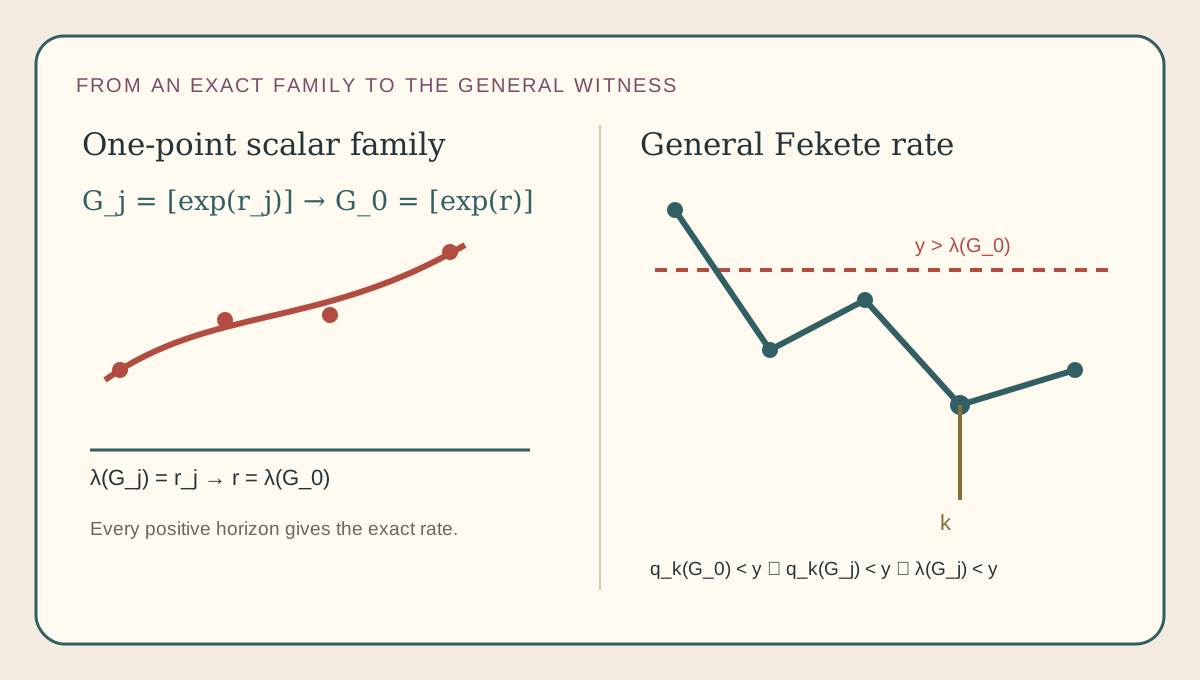
Let the probability space contain one point, let the base map be the identity, and choose one-by-one generators
\[ G_j=[e^{r_j}],\qquad G_0=[e^r], \qquad r_j\longrightarrow r. \]At horizon \(k\),
\[ G_j^k=[e^{kr_j}], \qquad \frac1k\log\lVert G_j^k\rVert=r_j. \]Thus the signed integrated growth rate is exactly \(\lambda(G_j)=r_j\), and these rates converge to \(\lambda(G_0)=r\). If all \(r_j\) lie in a bounded interval, then both \(\lVert G_j\rVert\) and \(\lVert G_j^{-1}\rVert\) have common bounds.
This family establishes that the assumptions are compatible with contraction, neutrality, and expansion. It also exhibits full continuity in one commuting scalar family. It does not establish continuity for arbitrary matrix cocycles.
The selected meaning of stochastic stability
The phrase stochastic stability is used for several different questions. RMT-36 makes one precise choice:
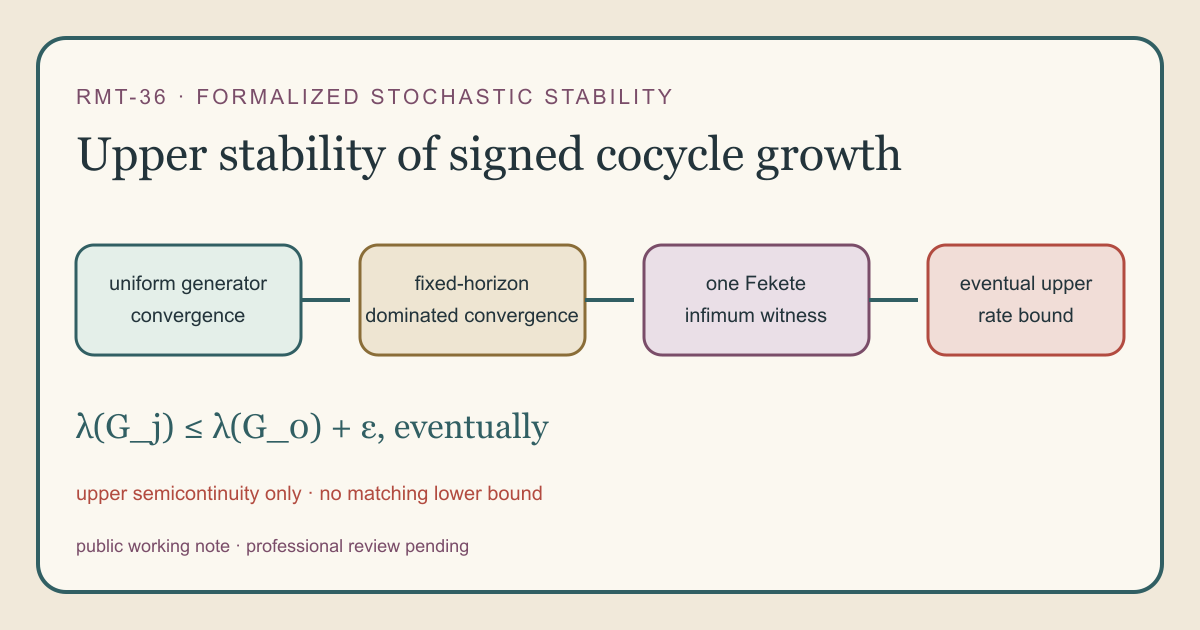
Sequential upper semicontinuity of the signed integrated real-log growth rate as the matrix generator varies uniformly over a fixed probability-preserving base.
The base map \(T\), probability measure \(\mu\), matrix dimension, and norm are fixed. For real constants \(M,K\), every generator in the sequence satisfies
\[ \lVert G_j(\omega)\rVert\le M,\qquad \lVert G_j(\omega)^{-1}\rVert\le K \]at every sample point, and every \(G_j(\omega)\) is invertible. Uniform convergence means
\[ \sup_\omega\lVert G_j(\omega)-G_0(\omega)\rVert\longrightarrow0. \]The conclusion is
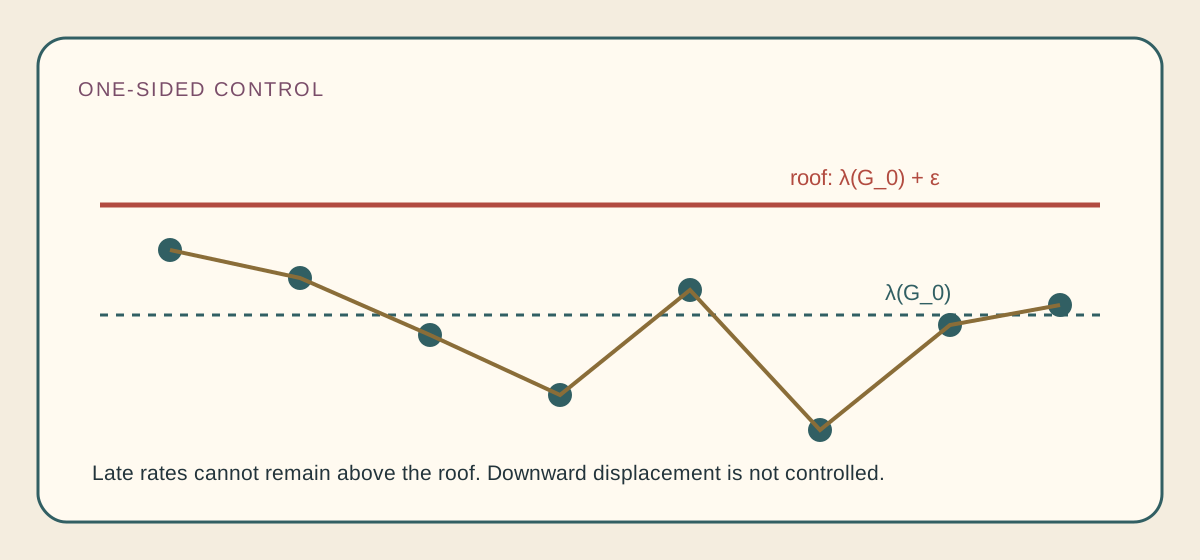
\[ \forall\varepsilon\gt0,\quad \lambda(G_j)\le\lambda(G_0)+\varepsilon \quad\text{for all sufficiently large }j. \]Equivalently, \(\limsup_j\lambda(G_j)\le\lambda(G_0)\). This is an upper bound on perturbed rates. It is not a matching lower bound.
Why fixed horizons converge
The cocycle product at horizon \(k\) is
\[ C_j^k(\omega)= G_j(T^{k-1}\omega)\cdots G_j(T\omega)G_j(\omega). \]For a fixed \(k\), uniform generator convergence gives convergence of each factor at each of the finitely many orbit points. Continuity of matrix multiplication then gives
\[ C_j^k(\omega)\longrightarrow C_0^k(\omega). \]This is
UniformlyBoundedInvertibleGenerator.tendsto_value_of_tendstoUniformly.
Pointwise invertibility makes every finite product nonzero, so continuity of
the real logarithm yields
The Lean declaration is
UniformlyBoundedInvertibleGenerator.tendsto_realLogNormObservable_of_tendstoUniformly.
Pointwise convergence is not enough to move through the integral. The common two-sided generator bounds give the horizon-\(k\) estimate
\[ \left|\log\lVert C_j^k(\omega)\rVert\right| \le k\bigl(\log^+M+\log^+K\bigr). \]This is
UniformlyBoundedInvertibleGenerator.abs_realLogNormObservable_le.
The right side is a constant integrable function on a finite measure space.
Dominated convergence therefore gives
formalized as
UniformlyBoundedInvertibleGenerator.tendsto_integratedRealLogNorm_of_tendstoUniformly.
tendsto_integratedRealLogNorm_of_tendstoUniformly\n (hT : MeasurePreserving T μ μ)\n (hG : TendstoUniformly\n (fun n ↦ (G n : Ω → Matrix ι ι ℂ)) G₀ atTop)\n (k : ℕ)TendstoUniformly is convergence uniform in ω. k is fixed before the
limit in the perturbation index n is taken. The common constants M and
K are parameters of the generator bundle, so the dominator does not depend
on n.Why an infimum gives only the upper half
RMT-35 identifies the signed rate with a positive-horizon Fekete infimum:
\[ \lambda(G)=\inf_{k\ge1} \frac1k\int\log\lVert C_G^k(\omega)\rVert\,d\mu(\omega). \]Given a real \(y\gt\lambda(G_0)\), convergence of the normalized finite-horizon sequence for \(G_0\) supplies some positive \(k\) with
\[ \frac1k\int\log\lVert C_0^k\rVert\,d\mu\lt y. \]Fixed-horizon dominated convergence makes the same strict inequality true for \(G_j\) once \(j\) is large. Since an infimum is no larger than any one of its terms,
\[ \lambda(G_j) \le \frac1k\int\log\lVert C_j^k\rVert\,d\mu \lt y. \]That argument is
UniformlyBoundedInvertibleGenerator.eventually_integratedRealLogGrowthRate_lt.
Choosing \(y=\lambda(G_0)+\varepsilon\) gives
UniformlyBoundedInvertibleGenerator.eventually_integratedRealLogGrowthRate_le_add.
The formal interface
UniformlyBoundedInvertibleGenerator packages a measurable generator,
pointwise matrix invertibility, the bound by M, and the inverse bound by
K. Its coercion lets the bundle be used as a function.
UniformlyBoundedInvertibleGenerator.toCocycle installs the generator over a
fixed measure-preserving base.
UniformlyBoundedInvertibleGenerator.hasIntegrableGeneratorLogTails
derives the RMT-35 two-sided one-step integrability package on a finite measure
space.
UniformlyBoundedInvertibleGenerator.integratedRealLogGrowthRate then names
the signed integrated Fekete rate of the resulting cocycle.
theorem eventually_integratedRealLogGrowthRate_le_add\n [IsProbabilityMeasure μ]\n (hT : MeasurePreserving T μ μ)\n (hG : TendstoUniformly\n (fun n ↦ (G n : Ω → Matrix ι ι ℂ)) G₀ atTop)\n {ε : ℝ} (hε : 0 < ε) :\n ∀ᶠ n in atTop,\n (G n).integratedRealLogGrowthRate hT ≤\n G₀.integratedRealLogGrowthRate hT + ε∀ᶠ n in atTop means that the property holds for every sufficiently large
natural number n. The theorem is sequential because perturbations are
indexed by ℕ. IsProbabilityMeasure μ fixes total mass one.A lightweight standalone tutorial
The following Std file checks the scalar perturbation arithmetic without
matrices, topology, or measure theory:
import Std

def scalarRate (r : Int) : Int := r

example (j : Nat) : scalarRate (5 - (j : Int)) = 5 - (j : Int) := by
  rfl

example (ε : Nat) (hε : 0 < ε) :
    scalarRate 2 ≤ scalarRate 2 + (ε : Int) := by
  simp [scalarRate, Int.ofNat_pos.mpr hε]
Save it as UpperStabilityTutorial.lean, then run on macOS or Linux:
lean UpperStabilityTutorial.lean
This standalone tutorial checks only integer identities modeling an exact scalar rate and a positive upper tolerance. It does not establish uniform matrix convergence, dominated convergence, or a Fekete-rate theorem.
lake env lean from the repository’s formalization
directory with warnings treated as errors.cd formalization
lake env lean -DwarningAsError=true NonlinearDynamics/Random/RandomCocycles/GrowthRateStability.leanResource note: this exact file uses the repository's
pinned Lean and Mathlib dependencies. Initial project setup can require
substantial disk space and build time. For a lightweight first step on
macOS or Linux, use the page's standalone Lean-core or Std
tutorial.
Complete public declaration map
| Layer | Public declarations |
|---|---|
| Perturbation bundle | UniformlyBoundedInvertibleGenerator; UniformlyBoundedInvertibleGenerator.toCocycle; UniformlyBoundedInvertibleGenerator.hasIntegrableGeneratorLogTails; UniformlyBoundedInvertibleGenerator.integratedRealLogGrowthRate |
| Fixed products and observables | UniformlyBoundedInvertibleGenerator.tendsto_value_of_tendstoUniformly; UniformlyBoundedInvertibleGenerator.tendsto_realLogNormObservable_of_tendstoUniformly; UniformlyBoundedInvertibleGenerator.abs_realLogNormObservable_le; UniformlyBoundedInvertibleGenerator.tendsto_integratedRealLogNorm_of_tendstoUniformly |
| Upper stability | UniformlyBoundedInvertibleGenerator.eventually_integratedRealLogGrowthRate_lt; UniformlyBoundedInvertibleGenerator.eventually_integratedRealLogGrowthRate_le_add |
Decision ledger and exact nonclaims
The selected theorem concerns the growth-rate functional of a random matrix cocycle under perturbation of its generator. It does not formalize the zero-noise convergence of stationary measures sometimes called stochastic stability. It also does not formalize upper semicontinuity of random attractors in a set distance. Those are different state spaces, outputs, and hypotheses.
Within the selected cocycle setting, RMT-36 supplies no lower semicontinuity, full continuity, quantitative modulus, convergence rate, varying base map, varying probability measure, singular generator limit, infinite-dimensional operator result, Lyapunov spectrum, Oseledets splitting, invariant subspace stability, or random-attractor statement.
The shared inverse bound is not decorative. It prevents finite products from approaching singular collapse without control and supplies the negative half of the dominated-convergence envelope. Pointwise invertibility is still recorded separately because Lean’s total matrix inverse is defined even for a singular matrix.
References
- J. F. C. Kingman, “The Ergodic Theory of Subadditive Stochastic Processes,” Journal of the Royal Statistical Society: Series B 30(3), 499–510 (1968), doi:10.1111/j.2517-6161.1968.tb00749.x.
- J. Bochi, “Genericity of zero Lyapunov exponents,” Ergodic Theory and Dynamical Systems 22(6), 1667–1696 (2002), doi:10.1017/S0143385702001165. The paper provides a continuous-cocycle setting in which integrated top exponents are treated as an upper-semicontinuous functional.
- L. Backes, A. Brown, and C. Butler, “Continuity of Lyapunov exponents for cocycles with invariant holonomies,” Journal of Modern Dynamics 12, 223–260 (2018), doi:10.3934/jmd.2018009.
- M. Viana and J. Yang, “Continuity of Lyapunov exponents in the \(C^0\) topology,” Israel Journal of Mathematics 229, 461–485 (2019), doi:10.1007/s11856-018-1809-7. References 3 and 4 illustrate that stronger continuity conclusions require additional dynamical structure or hypotheses absent from RMT-36.
- J. F. Alves, V. Araújo, and C. H. Vásquez, “Stochastic stability of diffeomorphisms with dominated splitting,” arXiv:math/0404160. This is a primary-source example of the distinct zero-noise stationary-measure usage.
- J. C. Robinson, “Stability of random attractors under perturbation and approximation,” Journal of Differential Equations 186(2), 652–669 (2002), doi:10.1016/S0022-0396(02)00038-4. This reference represents a distinct attractor upper-semicontinuity setting, not the cocycle-rate theorem formalized here.
- Upper semicontinuity.
- Upper Stability of Signed Integrated Cocycle Growth.