A finite basin before the topology
Consider three states with the update rule
| current state | next state |
|---|---|
| low | low |
| middle | low |
| high | middle |
Starting at high gives
Every start reaches low by time two and remains there. The basin of low is
therefore the whole three-state space. The first two iterates differ across
starts; attraction is a statement about the eventual tail, not equality of
finite prefixes.
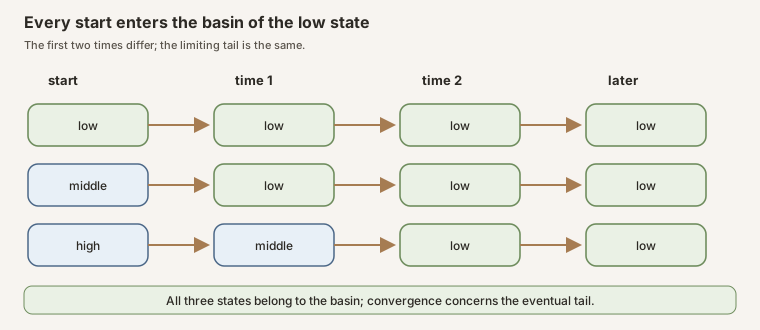
The bundled standalone tutorial encodes this exact state machine and proves
the three cases exhaustively using Lean and Std.
Point attraction and its basin
For a self-map \(f:X\to X\), the orbit from \(x\) is attracted to \(p\) when
\[ f^n(x)\longrightarrow p\qquad(n\to\infty). \]The definition uses the natural-number atTop filter and the neighborhood
filter of \(p\):
def IsAttractedTo [TopologicalSpace X]
    (f : X → X) (x p : X) : Prop :=
  Tendsto (fun n : ℕ ↦ f^[n] x) atTop (𝓝 p)
IsAttractedTo deliberately does not require \(f(p)=p\). If the map is
continuous at \(p\) in a Hausdorff space, convergence of the shifted orbit
forces fixedness; the theorem
IsAttractedTo.isFixedPt_of_continuousAt records exactly those gates.
The point basin is
\[ B_f(p)=\{x\in X:f^n(x)\to p\}. \]def basinOfAttraction [TopologicalSpace X]
(f : X → X) (p : X) : Set X :=
{x | IsAttractedTo f x p}
IsAttractedTo f x p :=\n Tendsto (fun n : ℕ ↦ f^[n] x) atTop (𝓝 p)f^[n] x is the state after n updates. atTop sends the natural-number
index toward arbitrarily large times. 𝓝 p is the filter of neighborhoods of
the target. Tendsto says every target neighborhood contains all sufficiently
late iterates.In a pseudo-metric space, isAttractedTo_iff_dist gives the equivalent scalar
statement
Local, global, and asymptotic
A locally attracting fixed point satisfies two conditions:
- \(f(p)=p\);
- \(B_f(p)\) is a neighborhood of \(p\).
The second condition means that some whole neighborhood of initial states converges to \(p\). It is stronger than the tautological fact that a fixed point’s own constant orbit converges to itself.
Global attraction replaces the neighborhood condition with \(B_f(p)=X\), expressed by quantifying over every start.
Asymptotic stability keeps the earlier stability predicate separate:
\[ \text{asymptotically stable} \quad\Longleftrightarrow\quad \text{Lyapunov stable and locally attracting}. \]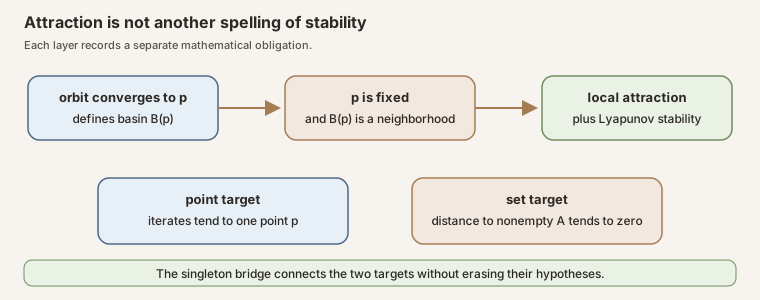
The theorem isAsymptoticallyStableFixedPoint_iff checks the displayed
decomposition against the definitions.
Contraction supplies both halves
Mathlib defines ContractingWith K f as a Lipschitz estimate with (K<1).
On a nonempty complete metric space, its Banach fixed-point theorem
constructs ContractingWith.fixedPoint f hf and proves that every orbit
converges to it.
The project packages that result twice:
isGloballyAttractingFixedPoint_fixedPointrecords global attraction;isAsymptoticallyStableFixedPoint_fixedPointcombines global attraction with the prior nonexpansive stability theorem.
The stability proof weakens (K<1) to a Lipschitz constant at most one. The attraction proof uses Mathlib’s convergence theorem. No new Banach fixed-point argument is reimplemented here.
Nonempty set targets
For a set \(A\subseteq X\), the selected orbit-level statement is
\[ A\ne\varnothing \quad\text{and}\quad \operatorname{dist}(f^n(x),A)\longrightarrow0. \]Nonemptiness is part of IsAttractedToSet. This is not cosmetic: Mathlib
defines Metric.infDist x ∅ = 0. Without the explicit gate, every orbit would
be attracted to the empty set by totalization.
A locally attracting set is nonempty, forward invariant, and has a set basin that is a neighborhood of each target point. Forward invariance means \(f(A)\subseteq A\); equality invariance is not claimed.
The set interface is pointwise in its initial condition. It does not assert uniform attraction of all bounded subsets, Hausdorff convergence, or compactness. Those stronger forms need additional definitions and hypotheses.
For \(A=\{p\}\), Mathlib’s Metric.infDist_singleton rewrites the set distance
to (d(\cdot,p)). The source proves:
isAttractedToSet_singleton_iff;basinOfAttractionSet_singleton;isLocallyAttractingSet_singleton_iff.
These theorems make the point and set APIs meet without treating a general set as if it selected one limiting point.
Declaration-complete source map
The source introduces the following public declarations:
| Declaration | Role |
|---|---|
IsAttractedTo | orbit convergence to one point |
basinOfAttraction | point basin |
IsLocallyAttractingFixedPoint | fixedness plus basin neighborhood |
IsGloballyAttractingFixedPoint | fixedness plus attraction from every start |
IsAsymptoticallyStableFixedPoint | Lyapunov stability plus local attraction |
mem_basinOfAttraction | point-basin membership unfolding |
isAttractedTo_iff_dist | point attraction as distance convergence |
IsFixedPt.isAttractedTo | a fixed point attracts its own orbit |
IsAttractedTo.isFixedPt_of_continuousAt | continuity-gated fixedness consequence |
IsGloballyAttractingFixedPoint.isLocallyAttractingFixedPoint | global-to-local bridge |
isAsymptoticallyStableFixedPoint_iff | stability-attraction decomposition |
isGloballyAttractingFixedPoint_fixedPoint | contraction gives global attraction |
isAsymptoticallyStableFixedPoint_fixedPoint | contraction gives both halves |
isGloballyAttractingFixedPoint_const | constant-map example |
IsAttractedToSet | nonempty distance-to-set convergence |
basinOfAttractionSet | set basin |
IsLocallyAttractingSet | nonempty forward-invariant local target |
mem_basinOfAttractionSet | set-basin membership unfolding |
isAttractedToSet_singleton_iff | point/set orbit bridge |
basinOfAttractionSet_singleton | point/set basin bridge |
isLocallyAttractingSet_singleton_iff | point/set local bridge |
Six #print axioms commands audit the main bridges and contraction endpoints.
The formal gate must show no sorryAx before this milestone is called green.
Reproduce the checks
The finite state machine is a standalone tutorial importing only Std:
elan run leanprover/lean4:v4.32.0 lean \
  site/content/knowledge-base/deep-dives/attraction-basins-and-asymptotic-stability-in-discrete-time/finite-basin.lean
The exact source is a full project check using the pinned Lean and Mathlib dependencies:
git clone https://github.com/tdj28/nonlinear-dynamics-lean.git
cd nonlinear-dynamics-lean/formalization
lake env lean -DwarningAsError=true \
  NonlinearDynamics/Deterministic/Discrete/Attraction.lean
lake env lean selects the pinned project environment, and
-DwarningAsError=true rejects warnings. The command is portable across macOS
and Linux after the project dependencies are installed.
Lean’s elaborator constructs proof terms and its kernel checks them against the formal statements. That check does not by itself establish that the chosen definitions match every convention called an attractor in the literature; the scope decisions and references still require mathematical review.
What this milestone does not claim
It proves no convergence rate beyond the imported contraction theorem, no uniform attraction of sets of initial conditions, no compact global attractor, no Hausdorff convergence, no invariant-set Lyapunov stability, no periodic orbit interface, no robustness under perturbation, and no stable-manifold theorem.
The next Lyapunov Functions Research Note explains how scalar sublevels can supply the separate stability and attraction obligations without identifying weak descent with convergence. The later Conjugacies and Semiconjugacies Research Note records the continuity and inverse-continuity gates needed to transport point basins and attracting fixed points between state spaces.
References
- J. P. LaSalle, “Difference Equations. Discrete Semidynamical Systems,” Chapter 1 of The Stability of Dynamical Systems, SIAM CBMS 25 (1976), pages 1–25, DOI 10.1137/1.9781611970432.ch1.
- Jack K. Hale, Asymptotic Behavior of Dissipative Systems, AMS Mathematical Surveys and Monographs 25 (1988), especially Chapter 2 on discrete dynamical systems, DOI 10.1090/surv/025.
- Mathlib 4.32.0, pinned revision
81a5d257,Topology.MetricSpace.Contracting,Topology.MetricSpace.HausdorffDistance, andDynamics.FixedPoints.Topology.