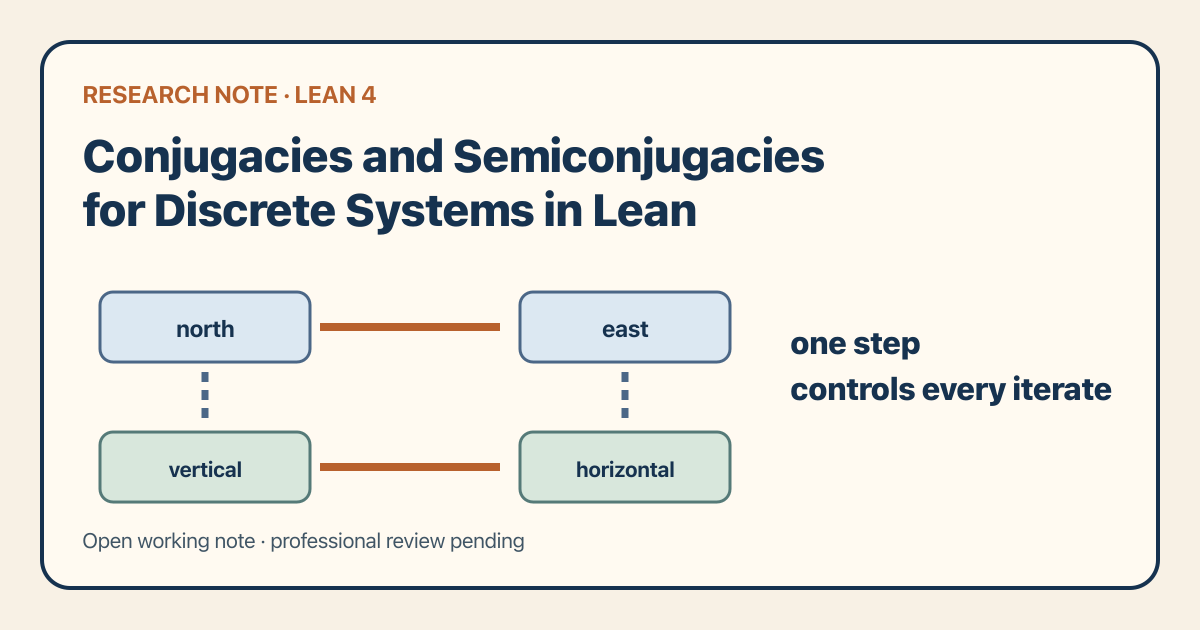
Start with a projection that forgets direction
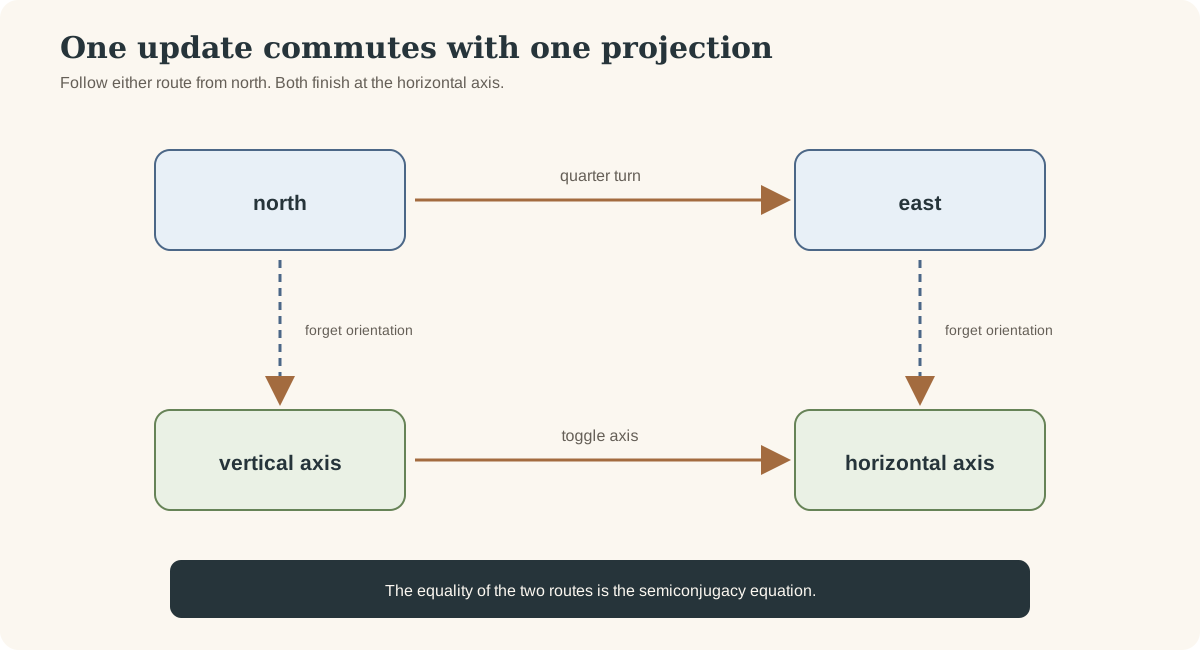
Let four compass directions update by one clockwise quarter turn:
| current | next | axis | next axis |
|---|---|---|---|
| north | east | vertical | horizontal |
| east | south | horizontal | vertical |
| south | west | vertical | horizontal |
| west | north | horizontal | vertical |
Project north and south to vertical, and east and west to horizontal.
The target system toggles its axis. For every direction \(d\),
The four rows exhaust the finite source type, so the calculation establishes this equation for the model. North and south have the same image, however. The projection retains the axis alternation and discards orientation.
The accompanying Deep Dive packages this model as a standalone tutorial
using only Lean and Std. The project module begins with Mathlib’s general
Function.Semiconj relation instead of defining a second algebraic predicate.
Four interfaces, not one overloaded word
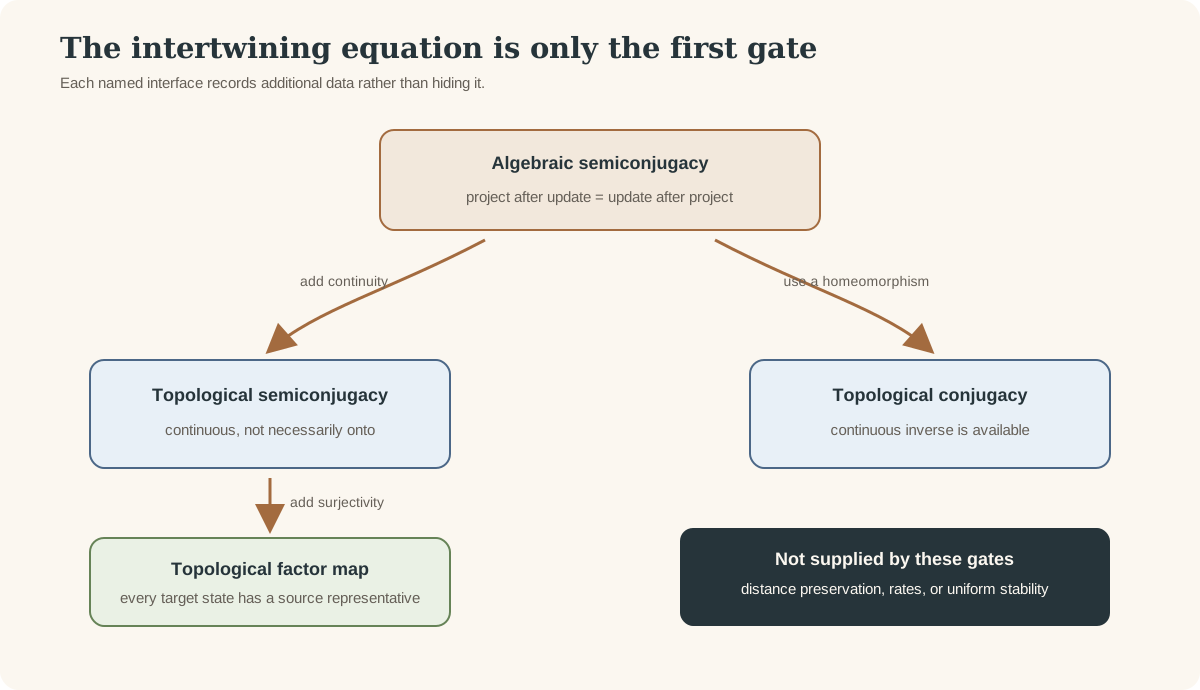
For maps \(f : X \to X\), \(g : Y \to Y\), and \(\varphi : X \to Y\), the algebraic relation is
\[ \varphi(f(x))=g(\varphi(x))\qquad(x\in X). \]Mathlib names it Function.Semiconj φ f g. The new module then records three
topological refinements and one existential relation:
def IsTopologicalSemiconjugacy (φ : X → Y) (f : X → X) (g : Y → Y) : Prop :=
  Continuous φ ∧ Semiconj φ f g

def IsTopologicalFactorMap (φ : X → Y) (f : X → X) (g : Y → Y) : Prop :=
  IsTopologicalSemiconjugacy φ f g ∧ Surjective φ

def IsTopologicalConjugacy (e : X ≃ₜ Y) (f : X → X) (g : Y → Y) : Prop :=
  Semiconj e f g

def AreTopologicallyConjugate (f : X → X) (g : Y → Y) : Prop :=
  ∃ e : X ≃ₜ Y, IsTopologicalConjugacy e f g
Continuous φ supplies the limit-preservation gate. Surjective φ says that
each target state has a source representative. X ≃ₜ Y is a homeomorphism:
a bijection whose forward and inverse maps are continuous. The specified
predicate keeps the coordinate change visible; the existential relation says
only that some such change exists.
One step controls every iterate
The theorem semiconj_iterate_apply states
It delegates the induction to Mathlib’s Function.Semiconj.iterate_right.
Time zero is included: both iterates are identities. No continuity,
injectivity, or surjectivity enters this algebraic proof.
theorem semiconj_iterate_apply\n (h : Semiconj φ f g) (n : ℕ) (x : X) :\n φ (f^[n] x) = g^[n] (φ x)f^[n] and g^[n] are function iterates. h.iterate_right n lifts the
one-step relation to the two iterate families, and .eq x evaluates the
result at the chosen state.This identity also sends fixed and specified-period points forward. A many-to-one projection may merge distinct periodic points, so forward mapping does not by itself recover the source point or its least period.
Continuity transports attraction forward
Suppose \(f^n(x) \to p\). The iterate identity rewrites the projected sequence as \(g^n(\varphi(x))\). If \(\varphi\) is continuous at \(p\), then
\[ g^n(\varphi(x)) =\varphi(f^n(x)) \longrightarrow\varphi(p). \]IsAttractedTo.map_semiconj records exactly these two hypotheses:
ContinuousAt φ p and Semiconj φ f g. The wrapper
IsTopologicalSemiconjugacy.map_isAttractedTo projects continuity from the
bundled topological semiconjugacy.
Surjectivity enters only when a conclusion quantifies over every target
state. IsTopologicalFactorMap.map_isGloballyAttractingFixedPoint starts with
a target state \(y\), selects \(x\) with
\(\varphi(x)=y\), and transports global
attraction from that representative. It also maps the source fixed point to a
target fixed point using the semiconjugacy equation.
This direction is one-way. A factor can forget distinctions in the source, so target attraction does not automatically lift through an arbitrary factor.
A homeomorphism supplies the return path
For a specified conjugacy \(e : X \simeq_{\mathrm{top}} Y\),
IsTopologicalConjugacy.symm proves that e.symm intertwines \(g\) with \(f\).
IsTopologicalConjugacy.trans composes two coordinate changes. At the
existential level, areTopologicallyConjugate_refl,
AreTopologicallyConjugate.symm, and AreTopologicallyConjugate.trans show
that topological conjugacy is reflexive, symmetric, and transitive across
possibly different state types.
The inverse equation gives two-way statements:
IsTopologicalConjugacy.isFixedPt_iffidentifies corresponding fixed points;IsTopologicalConjugacy.isPeriodicPt_iffidentifies points having a specified natural-number period;IsTopologicalConjugacy.isAttractedTo_iffidentifies attraction of corresponding point orbits;IsTopologicalConjugacy.basin_preimagedescribes the source basin as an exact preimage;IsTopologicalConjugacy.image_basindescribes the target basin as an exact image;IsTopologicalConjugacy.isLocallyAttractingFixedPoint_ifftransports the basin-neighborhood condition in both directions; andIsTopologicalConjugacy.isGloballyAttractingFixedPoint_ifftransports global attraction in both directions.
The periodic theorem uses IsPeriodicPt f n p, which says that \(n\) is a
period. It does not assert that \(n\) is the least positive period. Conjugacy
does preserve the displayed specified-period statement exactly.
Declaration-complete source map
The source candidate contains twenty public declarations:
| Declaration | Role |
|---|---|
IsTopologicalSemiconjugacy | continuity plus algebraic semiconjugacy |
IsTopologicalFactorMap | continuous surjective semiconjugacy |
IsTopologicalConjugacy | specified homeomorphism intertwining two maps |
AreTopologicallyConjugate | existence of a specified conjugacy |
semiconj_iterate_apply | all-iterate orbit identity |
IsAttractedTo.map_semiconj | continuity-at-limit attraction transport |
IsTopologicalSemiconjugacy.map_isAttractedTo | bundled forward attraction map |
IsTopologicalFactorMap.map_isGloballyAttractingFixedPoint | global attractor descends to a factor |
IsTopologicalConjugacy.symm | inverse homeomorphism conjugates back |
IsTopologicalConjugacy.trans | specified conjugacies compose |
IsTopologicalConjugacy.isFixedPt_iff | corresponding fixed points |
IsTopologicalConjugacy.isPeriodicPt_iff | corresponding specified periods |
IsTopologicalConjugacy.isAttractedTo_iff | corresponding point attraction |
IsTopologicalConjugacy.basin_preimage | exact basin preimage |
IsTopologicalConjugacy.image_basin | exact basin image |
IsTopologicalConjugacy.isLocallyAttractingFixedPoint_iff | local attraction equivalence |
IsTopologicalConjugacy.isGloballyAttractingFixedPoint_iff | global attraction equivalence |
areTopologicallyConjugate_refl | reflexivity |
AreTopologicallyConjugate.symm | symmetry |
AreTopologicallyConjugate.trans | transitivity |
Six #print axioms commands audit the iterate theorem, factor endpoint,
specified-period equivalence, attraction equivalence, local-attraction
equivalence, and existential transitivity. Warning-fatal project validation must
show no sorryAx before the milestone is recorded as green.
Reproduce the checks
The finite quarter-turn model is a standalone tutorial importing only
Std:
elan run leanprover/lean4:v4.32.0 lean \
  site/content/knowledge-base/deep-dives/conjugacy-semiconjugacy-and-orbit-transport-in-discrete-time/quarter-turn-factor.lean
The exact module is a full project check using pinned Lean and Mathlib dependencies. Initial setup may require substantial disk space and build time:
git clone https://github.com/tdj28/nonlinear-dynamics-lean.git
cd nonlinear-dynamics-lean/formalization
lake env lean -DwarningAsError=true \
  NonlinearDynamics/Deterministic/Discrete/Conjugacy.lean
lake env lean selects the pinned environment. Lean’s elaborator constructs
candidate proof terms and the kernel checks them against the formal
statements. That check does not by itself establish that this interface covers
every convention called a factor or conjugacy in the literature.
The paired Deep Dive develops the finite model and syntax gradually. The Semiconjugacy and conjugacy glossary chapter gives a shorter first pass. The later Bifurcation Interfaces Research Note uses conjugacy invariance to turn selected fixed- and periodic-point existence changes into sufficient bifurcation witnesses.
Exact nonclaims
The module proves no preservation theorem for forward stability , uniform equicontinuity, distances, Lipschitz constants, or convergence rates. A homeomorphism preserves topology, not a chosen metric. The module also proves no entropy, transitivity, mixing, chaos, symbolic coding, structural stability, parameter robustness, measure conjugacy, stochastic result, time-reparameterized orbit equivalence, ODE result, or algorithm for finding a conjugacy.
A semiconjugacy need not be injective or surjective. A factor map is surjective but may still lose information. A specified-period statement does not identify the least period. Dynamical conjugacy here is not matrix similarity, complex conjugation, or the unitary-conjugacy relation used elsewhere in the random-matrix track.
References
- Volodymyr Nekrashevych, Groups and Topological Dynamics, Graduate Studies in Mathematics 223, AMS (2022), Chapter 1, section 1.1, Definition 1.1.4, page 7 (author PDF page 10), DOI 10.1090/gsm/223.
- Richard A. Holmgren, A First Course in Discrete Dynamical Systems, chapter “The Logistic Function, Part II: Topological Conjugacy,” pages 95–103, DOI 10.1007/978-1-4684-0222-3.
- Mathlib 4.32.0, pinned revision
81a5d257,Logic.Function.Conjugate,Logic.Function.Iterate,Dynamics.FixedPoints.Basic,Dynamics.PeriodicPts.Defs, andTopology.Homeomorph.Lemmas.