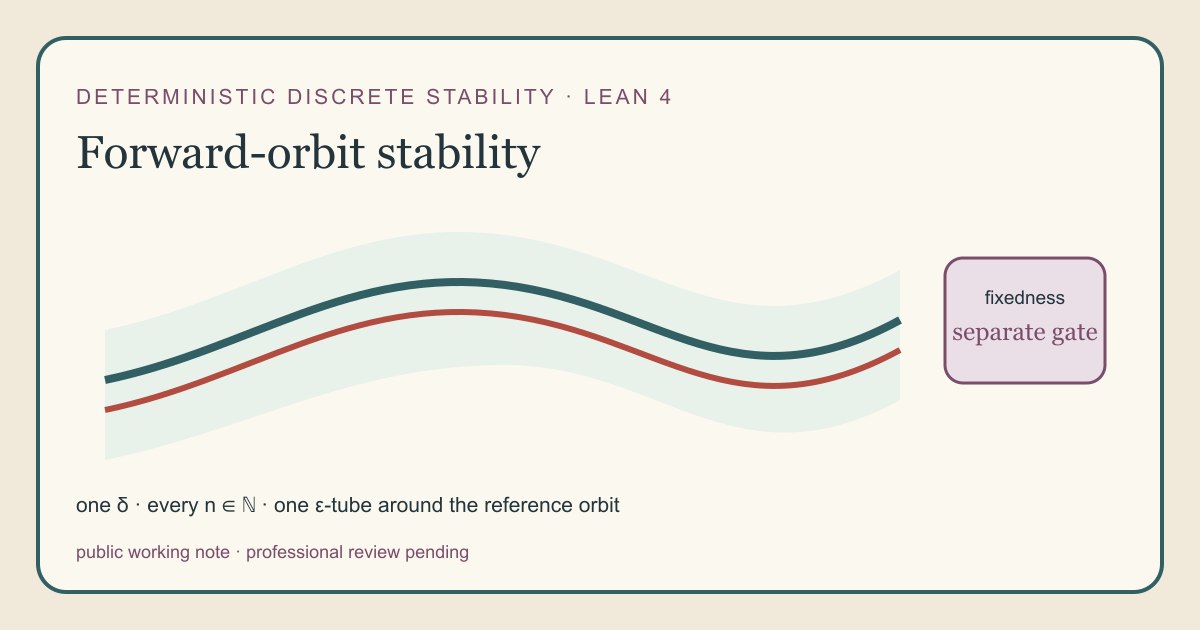
Begin with a moving reference orbit
Let \(f(x)=x+3\) on the real line. Start one trajectory at \(p=10\) and a nearby trajectory at \(x=10.2\).
| time \(n\) | \(f^n(p)\) | \(f^n(x)\) | separation |
|---|---|---|---|
| 0 | 10 | 10.2 | 0.2 |
| 1 | 13 | 13.2 | 0.2 |
| 2 | 16 | 16.2 | 0.2 |
| 3 | 19 | 19.2 | 0.2 |
For every natural number \(n\),
\[ f^n(x)-f^n(p)=x-p. \]The reference point is not fixed: \(f(10)=13\). Nevertheless, every nearby trajectory remains exactly as close to the reference trajectory as it was at time zero. This example refutes any universal identification of orbit stability with fixed-point stability.
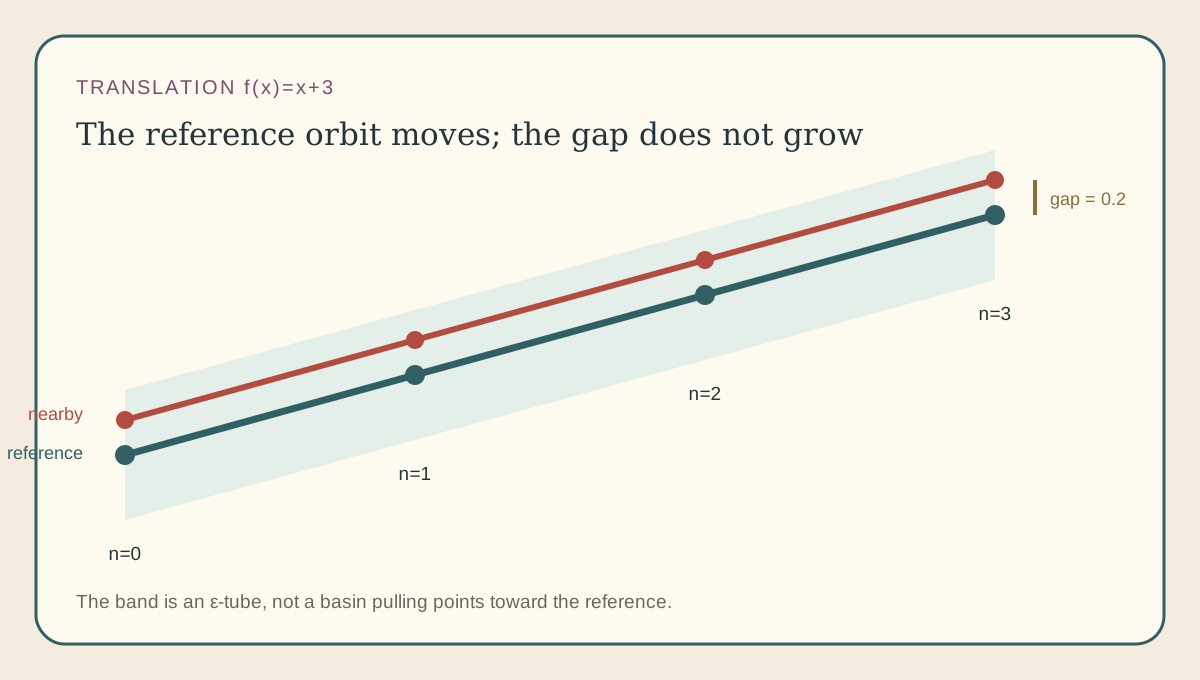
The calculation exhibits a forward-stable reference orbit that is not a fixed point. It does not establish attraction, robustness under changing the map, or a classification of all stable systems.
The interface decision
The module makes four choices explicit:
- The reference object is a point together with its entire forward orbit.
- Time is indexed by \(\mathbb N\), so time zero is included and no inverse map is assumed.
- The primary definition is uniform-space equicontinuity of the iterate family.
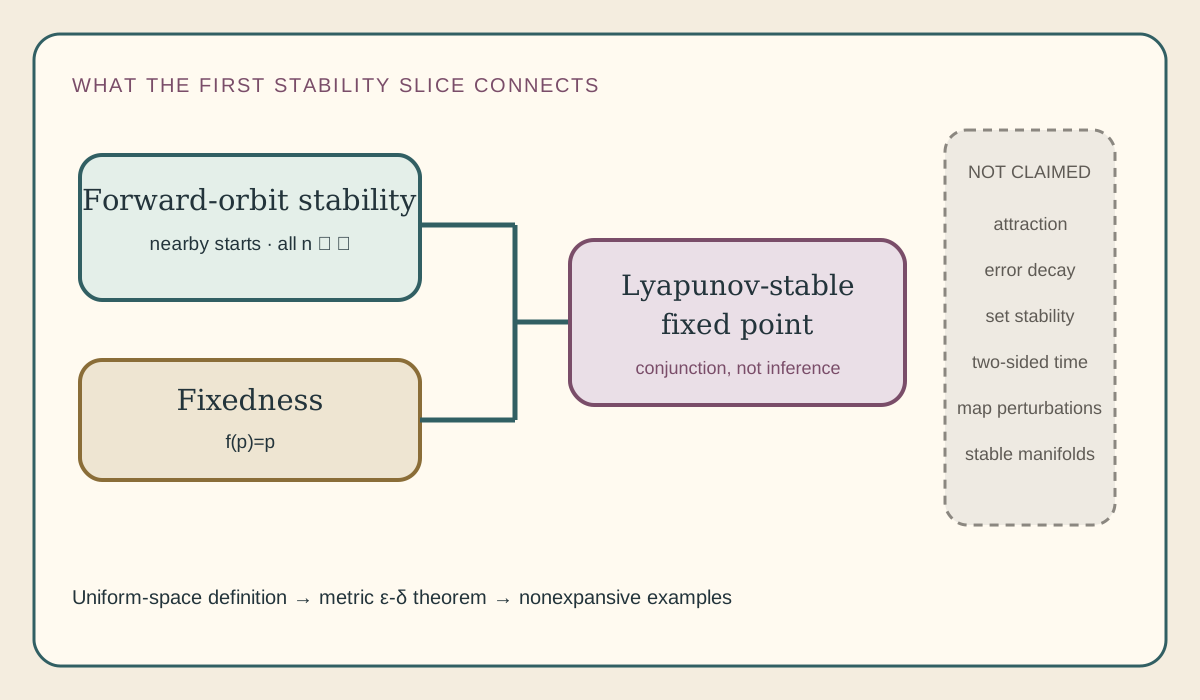
- Fixedness is an additional conjunct, not a consequence of orbit stability.
The core definition is
def IsForwardStableAt [UniformSpace X]
    (f : X → X) (p : X) : Prop :=
  EquicontinuousAt (fun n : ℕ ↦ f^[n]) p
Here f^[n] is the \(n\)-fold function iterate. EquicontinuousAt requires
one neighborhood of p that works simultaneously for every member of the
family indexed by n.
The fixed-point specialization is separate:
def IsLyapunovStableFixedPoint [UniformSpace X]
    (f : X → X) (p : X) : Prop :=
  IsFixedPt f p ∧ IsForwardStableAt f p
IsFixedPt f p means f p = p. The conjunction records two independent
facts: the reference orbit is stationary, and nearby forward orbits remain
close to it.
theorem isForwardStableAt_iff [UniformSpace X] :\n IsForwardStableAt f p ↔\n ∀ U ∈ 𝓤 X, ∀ᶠ x in nhds p, ∀ n : ℕ,\n (f^[n] p, f^[n] x) ∈ U𝓤 X is the uniformity filter. ∀ᶠ x in nhds p means the claim holds for
every x in some neighborhood of p. The neighborhood may depend on U, but
it may not depend on the later time n.The metric theorem
In a pseudo-metric space, the definition becomes
\[ \forall \varepsilon\gt0\;\exists\delta\gt0\;\forall x, d(x,p)\lt\delta\Longrightarrow \forall n\in\mathbb N, d(f^n(p),f^n(x))\lt\varepsilon. \]This is isForwardStableAt_iff_dist. A pseudo-metric is sufficient because
the proof uses distances but never needs distinct points to have positive
distance.
theorem isForwardStableAt_iff_dist [PseudoMetricSpace X] :\n IsForwardStableAt f p ↔\n ∀ ε > 0, ∃ δ > 0, ∀ x, dist x p < δ →\n ∀ n : ℕ, dist (f^[n] p) (f^[n] x) < εδ works for all n. Allowing a separate δ n would describe
continuity of individual iterates, not uniform forward stability.At a fixed point, Function.iterate_fixed rewrites \(f^n(p)\) to \(p\).
isLyapunovStableFixedPoint_iff_dist therefore yields the usual stationary
form
Both directions retain IsFixedPt f p. The distance estimate at time zero
cannot manufacture fixedness.
Consequences and examples
The iterate at index one is f, so
IsForwardStableAt.continuousAt extracts ordinary one-step continuity at the
reference point. This implication is one-way; the source never claims that
one-step continuity controls every iterate uniformly.
If \(f\) is nonexpansive,
\[ d(f(x),f(y))\le d(x,y), \]then Mathlib’s LipschitzWith.iterate gives
\(d(f^n(x),f^n(y))\le d(x,y)\) for every \(n\). Taking
\(\delta=\varepsilon\) proves
isForwardStableAt_of_lipschitzWith_one.
The wrapper isLyapunovStableFixedPoint_of_lipschitzWith_one adds an explicit
fixed-point hypothesis. The endpoint examples are
isForwardStableAt_id, isForwardStableAt_add_const,
forwardStableAt_add_const_not_fixed, and
isLyapunovStableFixedPoint_const. Identity and the constant map supply fixed
points; nonzero translation supplies a stable moving orbit.
Declaration-complete source map
The frozen source contains twelve public declarations:
| Declaration | Role |
|---|---|
IsForwardStableAt | primary uniform-space definition |
IsLyapunovStableFixedPoint | fixedness plus forward stability |
isForwardStableAt_iff | entourage/neighborhood unfolding |
isForwardStableAt_iff_dist | metric epsilon-delta equivalence |
isLyapunovStableFixedPoint_iff_dist | fixed-point metric equivalence |
IsForwardStableAt.continuousAt | one-step continuity consequence |
isForwardStableAt_of_lipschitzWith_one | nonexpansive sufficient condition |
isLyapunovStableFixedPoint_of_lipschitzWith_one | fixed-point wrapper |
isForwardStableAt_id | identity example |
isForwardStableAt_add_const | real-translation example |
forwardStableAt_add_const_not_fixed | stable but nonfixed witness |
isLyapunovStableFixedPoint_const | constant-map fixed-point example |
Six #print axioms commands audit the central equivalences, consequence, and
examples. Every report is exactly [propext, Classical.choice, Quot.sound];
none contains sorryAx.
Reproduce the project check
This is a full project check using the pinned Lean and Mathlib dependencies. It may require substantial disk space and build time.
git clone https://github.com/tdj28/nonlinear-dynamics-lean.git
cd nonlinear-dynamics-lean/formalization
lake env lean -DwarningAsError=true \
  NonlinearDynamics/Deterministic/Discrete/Stability.lean
lake env lean selects the project environment. -DwarningAsError=true
rejects warnings. The command is portable across macOS and Linux once the
pinned dependencies are installed. The paired Forward-Orbit and Fixed-Point
Stability Deep Dive also supplies a small standalone tutorial importing only Std. The
Forward Stability glossary chapter gives a shorter first pass.
Exact nonclaims
The module proves no attraction result: translated trajectories retain their
gap rather than converging. It proves no asymptotic or exponential stability,
invariant-set stability, basin theorem, Lyapunov-function criterion,
two-sided-time result, structural stability, robustness under perturbing f,
or stable-manifold theorem. It also does not claim that continuity implies
forward stability.
These are interface boundaries. Attraction needs a distance-to-target limit
or comparable neighborhood condition. Two-sided time needs invertibility or a
\(\mathbb Z\)-action. Perturbation stability compares different maps, whereas
IsForwardStableAt fixes one map and varies only the initial condition.
The later Lyapunov Functions Research Note supplies a scalar-certificate criterion while preserving this module’s separation between stability and attraction. The Conjugacies and Semiconjugacies Research Note explains why topology alone does not automatically transport this uniform-space forward-stability predicate.
References
- Ethan Akin, “On Chain Continuity,” Discrete and Continuous Dynamical Systems 2(1), 111–120 (1996), doi:10.3934/dcds.1996.2.111.
- Saber Elaydi and H. R. Farran, “On Variation of Equicontinuity in Dynamical Systems,” Bulletin of the Australian Mathematical Society 42(3), 391–397 (1990), doi:10.1017/S0004972700028550.
- J. P. LaSalle, “Difference Equations and Discrete Semidynamical Systems,” Chapter 1 of The Stability of Dynamical Systems, SIAM CBMS 25 (1976), doi:10.1137/1.9781611970432.ch1.
- Mathlib,
Topology.UniformSpace.Equicontinuity, pinned revision81a5d257. - Mathlib,
Topology.MetricSpace.Equicontinuity, pinned revision81a5d257.