Start with a descending calculation
Let
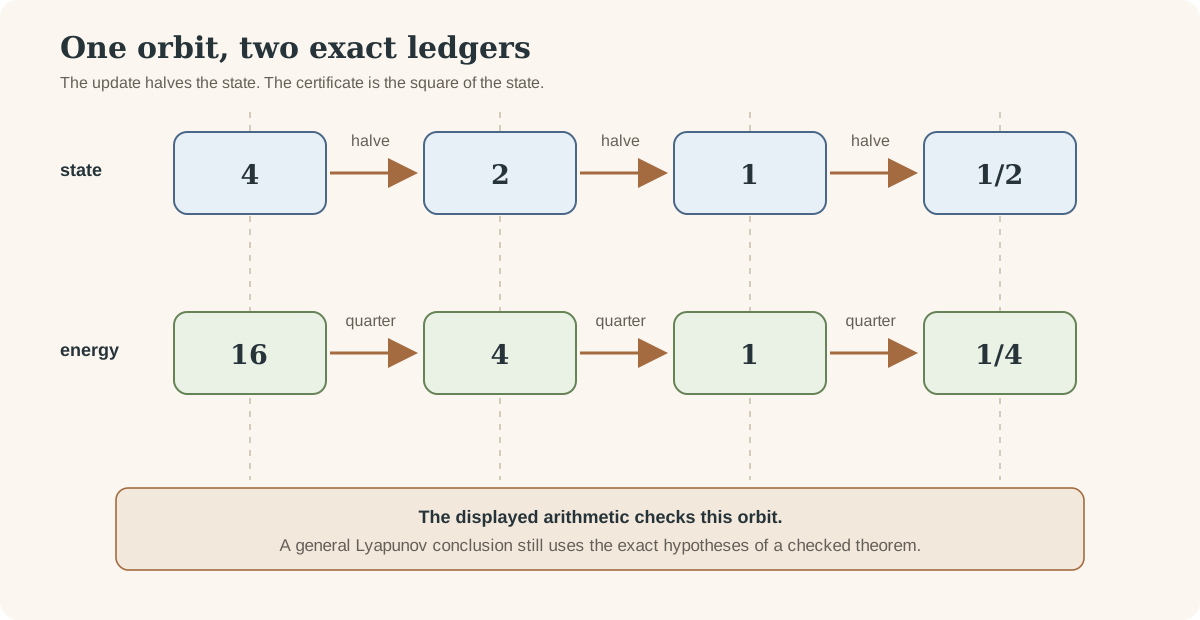
\[ f(x)=\frac{x}{2},\qquad p=0,\qquad V(x)=x^2. \]Starting at \(x=4\) gives
| time \(n\) | state \(f^n(4)\) | certificate \(V(f^n(4))\) |
|---|---|---|
| 0 | \(4\) | \(16\) |
| 1 | \(2\) | \(4\) |
| 2 | \(1\) | \(1\) |
| 3 | \(1/2\) | \(1/4\) |
The identities
\[ V(0)=0,\qquad V(x)\gt0\text{ for }x\ne0,\qquad V(f(x))=\frac14V(x) \]show three different facts. The first identifies the reference value. The second is positive definiteness. The third is a quantified descent estimate. Together with the explicit orbit formula, this example exhibits convergence to zero. It does not establish a theorem for arbitrary maps or certificates.
Five ingredients, kept separate
For a region \(S\subseteq X\), the module records:
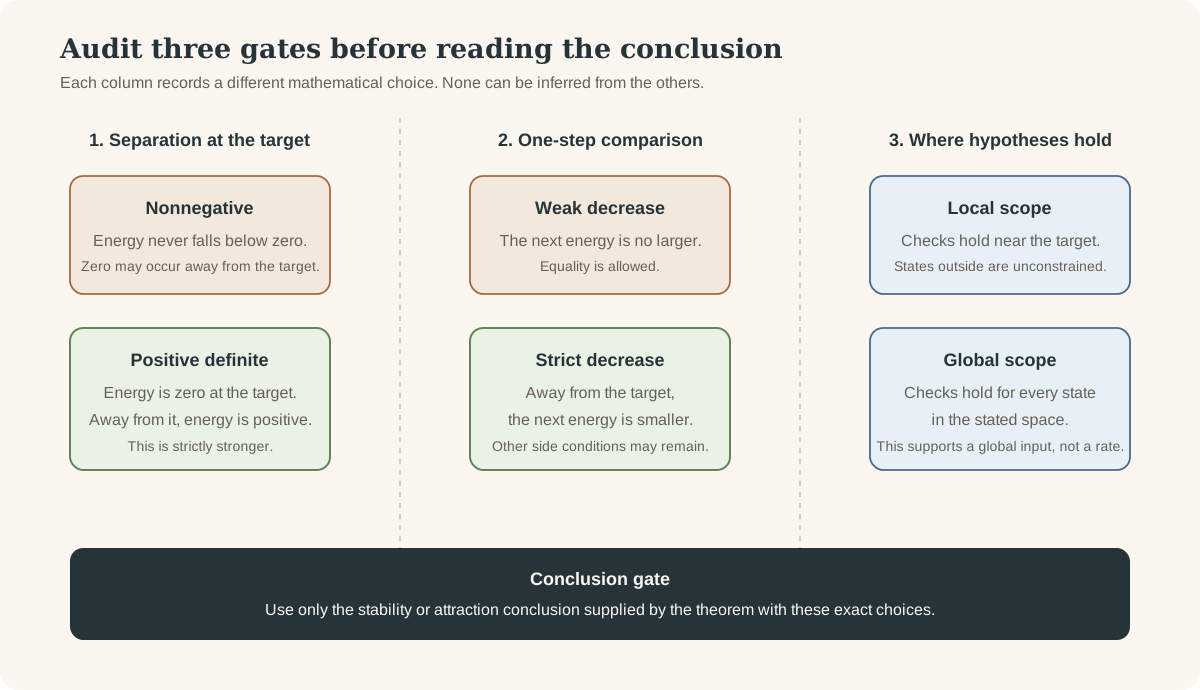
IsNonnegativeOn V S: \(0\le V(x)\) for \(x\in S\);IsPositiveDefiniteOn V p S: \(p\in S\), \(V(p)=0\), and \(V(x)\gt0\) for \(x\in S\setminus\{p\}\);IsWeakLyapunovDecreaseOn f V S: \(V(f(x))\le V(x)\) on \(S\);IsStrictLyapunovDecreaseOn f V p S: \(V(f(x))\lt V(x)\) on \(S\setminus\{p\}\);HasSublevelControlAt V p: every requested metric ball around \(p\) contains some positive open sublevel of \(V\).
The first and second conditions are not synonyms. The constant zero function is nonnegative, but it cannot distinguish \(p\) from any other state. The third and fourth conditions are also different. The identity map makes every certificate weakly decrease by equality, yet a nonfixed starting state never approaches \(p\).
The region parameter prevents a local calculation from being narrated as a global conclusion. Forward invariance is not hidden in either descent predicate. It is supplied separately whenever the proof follows an orbit through \(S\).
Difference notation and Mathlib minima
The source defines
def lyapunovDifference (f : X → X) (V : X → ℝ) (x : X) : ℝ :=
  V (f x) - V x
Thus weak descent is equivalent to \(\Delta V(x)\le0\), checked by
isWeakLyapunovDecreaseOn_iff_difference_nonpos. Strict descent away from
the reference point is equivalent to \(\Delta V(x)\lt0\), checked by
isStrictLyapunovDecreaseOn_iff_difference_neg.
IsPositiveDefiniteOn.isNonnegativeOn proves the one-way sign implication.
IsPositiveDefiniteOn.isMinOn connects the project predicate to Mathlib’s
weak IsMinOn. If the selected region is a neighborhood,
IsPositiveDefiniteOn.isLocallyPositiveDefiniteAt yields the local project
predicate, and IsLocallyPositiveDefiniteAt.isLocalMin yields Mathlib’s weak
local-minimum predicate. Mathlib’s minimum predicates do not encode strict
positivity away from one point, so the project retains that information in a
separate definition.
If \(p\) is fixed, strict descent away from \(p\) implies weak descent on the
same region. The checked theorem is
IsStrictLyapunovDecreaseOn.isWeakLyapunovDecreaseOn. Fixedness is necessary
to handle the missing case \(x=p\): strict descent deliberately says nothing
there.
Sublevels trap the scalar sequence
Suppose \(f(S)\subseteq S\) and \(V(f(x))\le V(x)\) for \(x\in S\). Then the closed sublevel
\[ S\cap\{x:V(x)\le c\} \]and the open sublevel \(S\cap\{x:V(x)\lt c\}\) are forward invariant. The source
names these results IsWeakLyapunovDecreaseOn.mapsTo_closedSublevel and
IsWeakLyapunovDecreaseOn.mapsTo_openSublevel.
Induction gives
\[ V(f^n(x))\le V(x) \]for every start \(x\in S\); this is
IsWeakLyapunovDecreaseOn.iterate_le. The stronger order statement
IsWeakLyapunovDecreaseOn.antitone_orbit says that
is antitone. It proves monotonicity of scalar values, not convergence of states. An antitone nonnegative sequence has a scalar limit, but that limit need not be zero.
The stability bridge
Pointwise positive definiteness is not enough to manufacture a uniform lower bound away from \(p\) on an arbitrary noncompact or infinite-dimensional space. The module therefore names the needed comparison explicitly:
def HasSublevelControlAt [PseudoMetricSpace X]\n (V : X → ℝ) (p : X) : Prop :=\n ∀ ε > 0, ∃ c > 0, ∀ x, V x < c → dist x p < εc may depend on the requested ε. The implication applies to every state,
so the sublevel is contained in the metric ball. This is a quantitative
geometry condition, not another spelling of positive definiteness.The theorem
isLyapunovStableFixedPoint_of_continuousAt_of_sublevelControl assumes:
- \(p\) is fixed;
- \(V(p)=0\);
- \(V\) is continuous at \(p\);
HasSublevelControlAt V p;- weak decrease on the whole state space.
Continuity makes each positive sublevel a neighborhood of \(p\). Weak descent
keeps later iterates inside the same sublevel. Sublevel control places that
trapped orbit inside the requested epsilon ball. The conclusion is the
existing IsLyapunovStableFixedPoint f p, not attraction.
Attraction needs a zero limit
The theorem isAttractedTo_of_tendsto_lyapunov begins with an additional
fact:
Sublevel control then turns eventual smallness of the scalar value into
\(d(f^n(x),p)\to0\). This conclusion concerns one selected start. If the
zero-limit premise holds for every start,
isGloballyAttractingFixedPoint_of_tendsto_lyapunov gives the existing global
attraction predicate. Finally,
isAsymptoticallyStableFixedPoint_of_lyapunov combines the stability bridge
with universal zero-energy convergence. Its conclusion is asymptotic
stability; its premises still display the two separate obligations.
Strict one-step descent is not substituted for the zero-limit premise. On a noncompact space, a strictly decreasing scalar sequence may converge to a positive number. Compact trapping, coercive sublevels, comparison functions, or a discrete LaSalle argument can close that gap in later modules.
Declaration-complete source map
| Declaration | Role |
|---|---|
lyapunovDifference | one-step scalar difference |
IsNonnegativeOn | nonnegativity on a region |
IsPositiveDefiniteOn | region contains p, with zero there and positivity away |
IsLocallyPositiveDefiniteAt | neighborhood form of positive definiteness |
IsWeakLyapunovDecreaseOn | weak one-step descent on a region |
IsStrictLyapunovDecreaseOn | strict descent away from p on a region |
IsPositiveDefiniteOn.isNonnegativeOn | positive-definite to nonnegative bridge |
IsPositiveDefiniteOn.isMinOn | region minimum bridge |
IsPositiveDefiniteOn.isLocallyPositiveDefiniteAt | region-to-local bridge |
IsLocallyPositiveDefiniteAt.isLocalMin | local Mathlib minimum bridge |
isWeakLyapunovDecreaseOn_iff_difference_nonpos | weak difference form |
isStrictLyapunovDecreaseOn_iff_difference_neg | strict difference form |
IsStrictLyapunovDecreaseOn.isWeakLyapunovDecreaseOn | fixed-point strict-to-weak bridge |
IsWeakLyapunovDecreaseOn.mapsTo_closedSublevel | closed-sublevel invariance |
IsWeakLyapunovDecreaseOn.mapsTo_openSublevel | open-sublevel invariance |
IsWeakLyapunovDecreaseOn.iterate_le | initial-value orbit bound |
IsWeakLyapunovDecreaseOn.antitone_orbit | antitone orbit values |
HasSublevelControlAt | quantitative sublevel geometry |
isLyapunovStableFixedPoint_of_continuousAt_of_sublevelControl | stability endpoint |
isAttractedTo_of_tendsto_lyapunov | point-attraction endpoint |
isGloballyAttractingFixedPoint_of_tendsto_lyapunov | global-attraction endpoint |
isAsymptoticallyStableFixedPoint_of_lyapunov | combined endpoint |
Six #print axioms commands audit the main order, stability, and attraction
bridges. The warning-fatal full project check must report no sorryAx before
this milestone is called checked.
Reproduce the checks
The countdown worksheet in the paired Deep Dive is a standalone tutorial
that imports only Std:
elan run leanprover/lean4:v4.32.0 lean \
  site/content/knowledge-base/deep-dives/lyapunov-functions-and-the-direct-method-in-discrete-time/countdown-energy.lean
The authoritative source is a full project check using pinned Lean and Mathlib dependencies and may require substantial disk space or setup time:
git clone https://github.com/tdj28/nonlinear-dynamics-lean.git
cd nonlinear-dynamics-lean/formalization
lake env lean -DwarningAsError=true \
  NonlinearDynamics/Deterministic/Discrete/Lyapunov.lean
lake env lean selects the pinned project environment. The warning option
rejects warnings. The command is portable across macOS and Linux after the
dependencies are installed.
Lean’s elaborator constructs candidate proof terms and its kernel checks them against the formal statements. That process does not by itself establish that one certificate models a physical energy, nor that these definitions cover every convention in stability theory.
Exact nonclaims
This slice proves no compact LaSalle invariance principle, converse Lyapunov theorem, exponential rate, uniqueness theorem, invariant-set or periodic-orbit criterion, stable-manifold result, ODE theorem, derivative criterion, structural or stochastic robustness theorem, or Lyapunov-exponent statement. A local certificate gives no global basin conclusion. Weak descent does not imply attraction. Strict descent alone is not promoted to attraction without an explicit zero-limit, compactness, coercivity, or comparison argument.
The next Conjugacies and Semiconjugacies Research Note studies when a coordinate map transports iterates and attraction. It does not assume that a Lyapunov certificate or numerical decay rate survives an arbitrary change of coordinates.
References
- J. P. LaSalle, “Difference Equations. Discrete Semidynamical Systems,” especially sections 6, 7, and 10, in The Stability of Dynamical Systems, SIAM CBMS 25 (1976), pages 1–25, DOI 10.1137/1.9781611970432.ch1.
- Saber Elaydi, “Stability Theory,” Chapter 4 of An Introduction to Difference Equations, third edition, especially Theorems 4.20 and 4.24, DOI 10.1007/0-387-27602-5_4.
- S. P. Gordon, “On Converses to the Stability Theorems for Difference Equations,” SIAM Journal on Control 10(1), 76–81 (1972), DOI 10.1137/0310007.
- Mathlib 4.32.0, pinned revision
81a5d257, especiallyTopology.Order.LocalExtr,Order.Filter.Extr,Topology.MetricSpace.Pseudo.Defs,Data.Set.Function, andLogic.Function.Iterate.