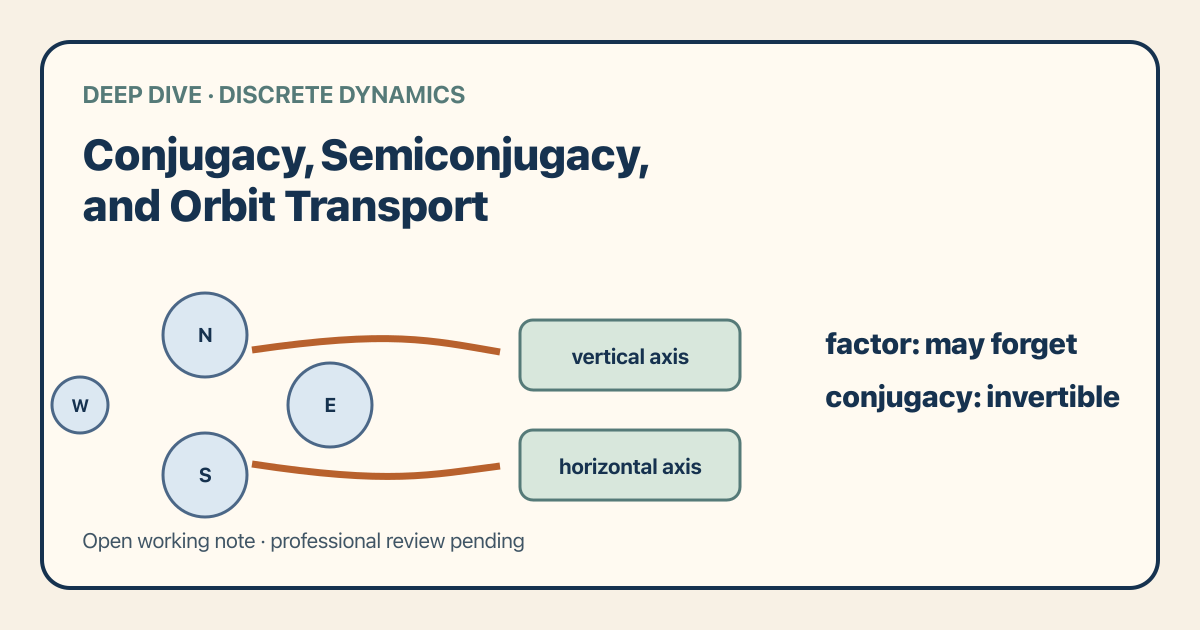
Start with a four-state factor
Consider the clockwise cycle
\[ \text{north}\mapsto\text{east}\mapsto\text{south} \mapsto\text{west}\mapsto\text{north}. \]Now keep only the axis. North and south become vertical; east and west
become horizontal. The target update toggles between these two labels.
| source state | source next | projected state | target next |
|---|---|---|---|
| north | east | vertical | horizontal |
| east | south | horizontal | vertical |
| south | west | vertical | horizontal |
| west | north | horizontal | vertical |
Every row says that update-then-project agrees with project-then-update. Because the rows exhaust the source type, they establish the one-step relation for this finite model.
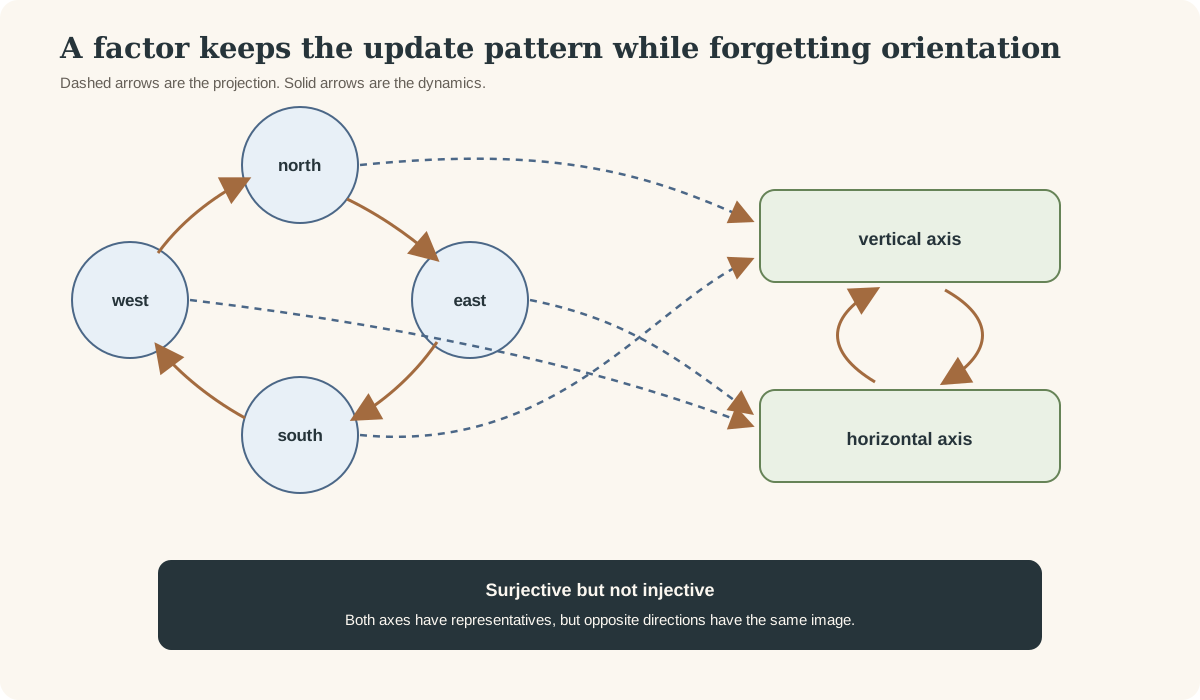
This is a semiconjugacy. It is also a factor in the finite discrete topology because the projection is continuous and onto. It is not a conjugacy: there is no inverse that reconstructs which opposite direction was present.
Read the commuting equation
Let \(f : X \to X\) and \(g : Y \to Y\) be update rules. A map \(\varphi : X \to Y\) semiconjugates \(f\) to \(g\) when
\[ \varphi\circ f=g\circ\varphi. \]Evaluated at \(x \in X\), this is
\[ \varphi(f(x))=g(\varphi(x)). \]The equation has a direction. It sends source dynamics through \(\varphi\) to target dynamics. Nothing in it says that \(\varphi\) is continuous, injective, or surjective.
Function.Semiconj φ f g :=\n ∀ x, φ (f x) = g (φ x)Semiconj comes from Mathlib. The first argument is the map between state
spaces. The next two arguments are the source and target self-maps. A proof
can be applied directly to a state x.Repeat the square along the orbit
One commuting square gives all natural-number iterates:
\[ \varphi(f^n(x))=g^n(\varphi(x)). \]At time zero, both sides reduce to
\(\varphi(x)\). For the induction step,
apply the one-step equation after the induction hypothesis. Mathlib already
packages this induction as Semiconj.iterate_right; the project theorem
semiconj_iterate_apply exposes the evaluated identity.
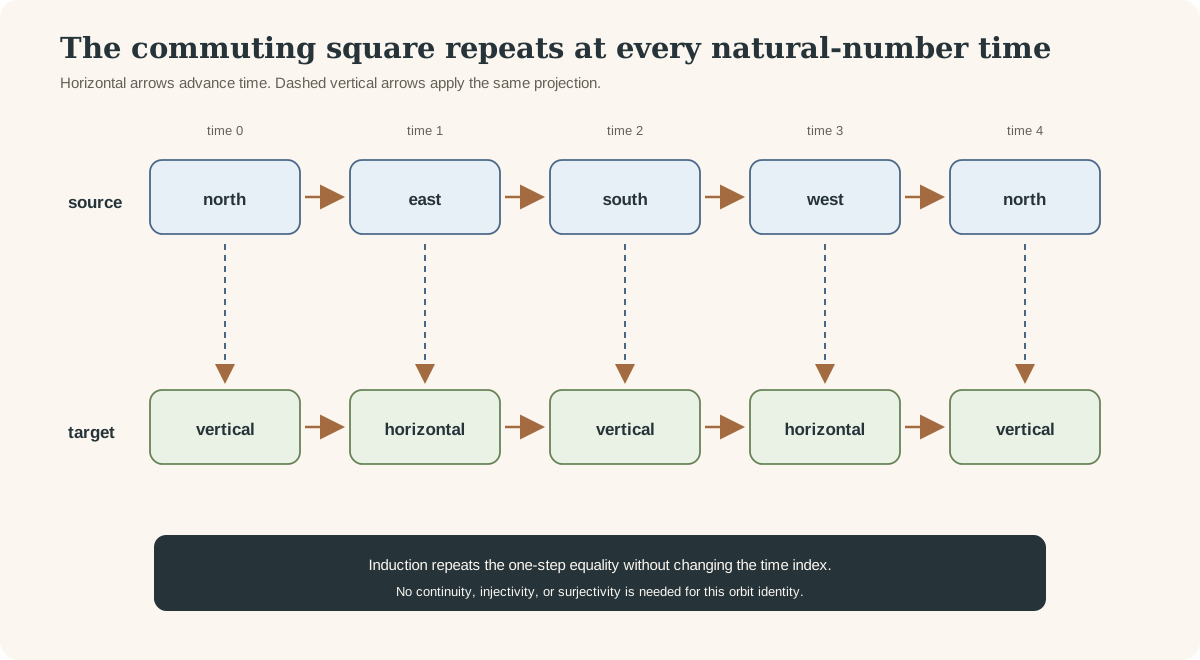
The ladder also explains a limitation. The target sequence records only axes. It cannot distinguish the north start from the south start. All-iterate transport does not undo information loss.
Add topology only when limits enter
An orbit approaching a point is a topological statement. Suppose
\[ f^n(x)\longrightarrow p. \]The algebraic identity identifies the projected sequence, but the conclusion
\[ g^n(\varphi(x))\longrightarrow\varphi(p) \]also needs
\(\varphi\) to be continuous at \(p\). This is the exact split in
IsAttractedTo.map_semiconj: one hypothesis supplies the limit, one supplies
continuity at the limit point, and one supplies orbit intertwining.
The definition IsTopologicalSemiconjugacy packages global continuity with
the algebraic relation. Its method map_isAttractedTo uses continuity at the
needed point. It does not add surjectivity.
A topological factor map adds surjectivity. That gate matters for a global
claim about every target start. Given \(y \in Y\), surjectivity supplies
\(x \in X\) with
\(\varphi(x)=y\). If every source orbit approaches a fixed
point \(p\), then every target orbit approaches
\(\varphi(p)\). The theorem
IsTopologicalFactorMap.map_isGloballyAttractingFixedPoint formalizes this
argument.
Conjugacy adds a reversible coordinate change
A homeomorphism \(e : X \simeq_{\mathrm{top}} Y\) is a bijection with a continuous forward map and continuous inverse. The project calls it a topological conjugacy when
\[ e(f(x))=g(e(x)). \]The inverse satisfies the reverse equation. This is
IsTopologicalConjugacy.symm. Specified conjugacies compose through
IsTopologicalConjugacy.trans.
In the standalone worksheet, the two axis labels are encoded as Bool:
vertical becomes false, horizontal becomes true. A decoding function
returns the original axis, and both inverse identities are checked by cases.
That finite encoding is invertible and intertwines the two toggles. It models
conjugacy without claiming a nontrivial topological theorem.
At the existential level,
def AreTopologicallyConjugate (f : X → X) (g : Y → Y) : Prop :=
  ∃ e : X ≃ₜ Y, IsTopologicalConjugacy e f g
the source proves reflexivity, symmetry, and transitivity. Those relations compare systems across possibly different state types.
What the inverse lets us transport
The source proves the following equivalences for corresponding points:
- fixedness via
IsTopologicalConjugacy.isFixedPt_iff; - having a specified natural-number period via
IsTopologicalConjugacy.isPeriodicPt_iff; - point attraction via
IsTopologicalConjugacy.isAttractedTo_iff; - local attraction via
IsTopologicalConjugacy.isLocallyAttractingFixedPoint_iff; and - global attraction via
IsTopologicalConjugacy.isGloballyAttractingFixedPoint_iff.
The basin identities retain set-level information:
\[ e^{-1}(B_g(e(p)))=B_f(p), \qquad e(B_f(p))=B_g(e(p)). \]They appear as IsTopologicalConjugacy.basin_preimage and
IsTopologicalConjugacy.image_basin. The local-attraction proof uses the fact
that a homeomorphism is an open map, so the image of a basin neighborhood is a
neighborhood of the image point.
The specified-period theorem is deliberately narrow. IsPeriodicPt f n p
means that \(n\) is a period. It does not say that \(n\) is the least positive
period. Under a noninjective semiconjugacy, a least period may collapse; the
two-way conjugacy theorem only states the exact predicate present in the
source.
Standalone Lean tutorial
The bundled quarter-turn-factor.lean is a standalone tutorial importing
only Std. It proves the commuting square by cases, proves all-iterate
transport by induction, exhibits noninjectivity, and checks the inverse axis
encoding.
theorem axisOf_directionOrbit (d : Direction) :
    ∀ n, axisOf (directionOrbit d n) = axisOrbit (axisOf d) n := by
  intro n
  induction n with
  | zero => rfl
  | succ n ih =>
      simp only [directionOrbit, axisOrbit, axisOf_quarterTurn, ih]

theorem axisOf_not_injective : ¬Function.Injective axisOf := by
  intro h
  exact north_ne_south (h rfl)
Run it on macOS or Linux with the pinned compiler:
elan run leanprover/lean4:v4.32.0 lean \
  site/content/knowledge-base/deep-dives/conjugacy-semiconjugacy-and-orbit-transport-in-discrete-time/quarter-turn-factor.lean
The worksheet has finite types and recursive natural-number orbits. It does
not define TopologicalSpace, continuity, filters, or homeomorphisms.
Try the full project interface
The following is a full project check using pinned Lean and Mathlib dependencies. Initial setup may require substantial disk space and build time.
import NonlinearDynamics.Deterministic.Discrete.Conjugacy

#check IsTopologicalSemiconjugacy
#check IsTopologicalFactorMap
#check IsTopologicalConjugacy
#check semiconj_iterate_apply
#check IsTopologicalConjugacy.isAttractedTo_iff
#check IsTopologicalConjugacy.image_basin
NonlinearDynamics/Deterministic/Discrete/Conjugacy.lean; the command below
checks the complete module in the repository’s pinned environment.cd formalization
lake env lean -DwarningAsError=true NonlinearDynamics/Deterministic/Discrete/Conjugacy.leanResource note: this exact file uses the repository's
pinned Lean and Mathlib dependencies. Initial project setup can require
substantial disk space and build time. For a lightweight first step on
macOS or Linux, use the page's standalone Lean-core or Std
tutorial.
Boundaries
This interface supplies no preservation theorem for forward stability , distances, Lipschitz constants, or rates. Topological conjugacy keeps open sets, convergence, and neighborhood structure; it need not keep a chosen metric. The source also proves no entropy, mixing, transitivity, chaos, symbolic coding, structural stability, parameter robustness, measurable conjugacy, stochastic statement, ODE result, or algorithm for constructing a conjugacy.
Semiconjugacy is directional. A target conclusion does not lift without inverse data. A factor map is onto but may remain many-to-one. Dynamical conjugacy is also distinct from matrix similarity, complex conjugation, and the unitary-conjugacy orbits used in random-matrix theory.
Continue with the shorter Semiconjugacy and conjugacy glossary chapter or inspect the declaration-complete Research Note. The next Deep Dive, Parameter Families, Branches, and Bifurcation in Discrete Time, uses fixed- and specified-period preservation as conjugacy obstructions.
References
- Volodymyr Nekrashevych, Groups and Topological Dynamics, Graduate Studies in Mathematics 223, AMS (2022), Chapter 1, section 1.1, Definition 1.1.4, page 7 (author PDF page 10), DOI 10.1090/gsm/223.
- Richard A. Holmgren, A First Course in Discrete Dynamical Systems, chapter “The Logistic Function, Part II: Topological Conjugacy,” pages 95–103, DOI 10.1007/978-1-4684-0222-3.
- Mathlib 4.32.0, pinned revision
81a5d257,Logic.Function.Conjugate,Logic.Function.Iterate,Dynamics.FixedPoints.Basic,Dynamics.PeriodicPts.Defs, andTopology.Homeomorph.Lemmas.