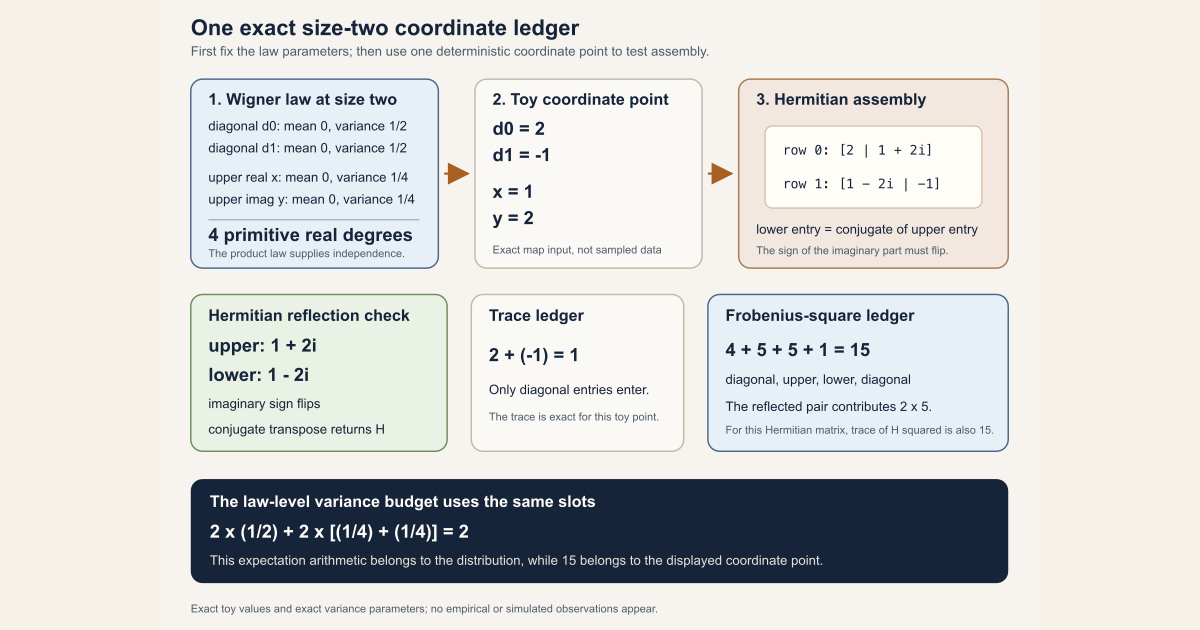
Start with one exact size-two ledger
A Gaussian unitary ensemble (GUE) is a probability law on complex matrices whose realizations are Hermitian . Hermitian means that reflecting an entry across the diagonal also takes its complex conjugate. The word unitary belongs to the classical symmetry of the law, not to a claim that each matrix entry is a unitary number.
Begin at matrix size \(n=2\). There are two diagonal locations and one strict upper-triangular location. The repository’s Wigner scale is
\[ s_2=\frac12. \]The diagonal variables use variance \(s_2\), while each real Cartesian component of the complex upper variable uses half of that variance. Name the four primitive real variables
\[ d_0,\qquad d_1,\qquad x,\qquad y. \]Their exact parameter ledger is
| Primitive coordinate | Exact law | Mean | Variance |
|---|---|---|---|
| first diagonal \(d_0\) | real Gaussian \(N(0,1/2)\) | \(0\) | \(1/2\) |
| second diagonal \(d_1\) | real Gaussian \(N(0,1/2)\) | \(0\) | \(1/2\) |
| upper real part \(x\) | real Gaussian \(N(0,1/4)\) | \(0\) | \(1/4\) |
| upper imaginary part \(y\) | real Gaussian \(N(0,1/4)\) | \(0\) | \(1/4\) |
Here \(N(0,v)\) means a real Gaussian law with mean zero and variance \(v\). Its standard deviation is \(\sqrt v\), so the two quantities must not be interchanged. The repository builds a nested product law: \(d_0,d_1\) are the real diagonal block, \(x+iy\) is the complex upper block, the two blocks are independent , and \(x\) and \(y\) are independent inside the Cartesian complex law. Independence means that joint event probabilities factor; it does not mean realized values must differ.
The count of primitive real degrees of freedom is
\[ 2+2\binom22=2+2=4=2^2. \]The first \(2\) counts the real diagonal. The second \(2\) counts the real and imaginary parts of the single strict-upper coordinate. The reflected lower entry contributes no new freedom.
Assemble one deterministic coordinate point
A law assigns mass to measurable subsets of its value space. To test the deterministic assembly map, choose one exact toy coordinate point:
\[ (d_0,d_1,x,y)=(2,-1,1,2). \]This tuple is not an estimate, sample statistic, or claim that a continuous Gaussian experiment hits this exact point with positive probability. It is a fixed input used to check the map. Set \(u=x+iy=1+2i\). Hermitian assembly produces
\[ H= \begin{bmatrix} 2 & 1+2i \\ 1-2i & -1 \end{bmatrix}. \]The conjugate transpose swaps the off-diagonal entries and conjugates them. Since \(\overline{1+2i}=1-2i\),
\[ H^*=H. \]The ordinary, unnormalized matrix trace is the diagonal sum:
\[ \operatorname{Tr}(H)=2+(-1)=1. \]The squared Frobenius norm is the sum of the squared magnitudes of all four entries:
\[ \begin{aligned} \lVert H\rVert_{\mathrm F}^2 &=|2|^2+|1+2i|^2+|1-2i|^2+|-1|^2\\ &=4+5+5+1\\ &=15. \end{aligned} \]For a Hermitian matrix, \(H^*H=H^2\), so this same number is \(\operatorname{Tr}(H^2)\). Notice the two copies of \(5\): the single primitive complex upper coordinate appears twice in the assembled matrix.
The law-level variance budget uses the same slots but answers a different question. Centering makes each expected square equal its variance, so
\[ \begin{aligned} \mathbb E\lVert H\rVert_{\mathrm F}^2 &=2\left(\frac12\right) +2\left(\frac14+\frac14\right)\\ &=2. \end{aligned} \]The number \(15\) belongs to the displayed deterministic point; the number
\(2\) belongs to the chosen distribution. RMT-06 fixes the exact coordinate
laws but does not itself prove this expectation identity. The later checked
module
NonlinearDynamics.Random.RandomMatrices.GaussianUnitaryEnsembleMoments
proves the corresponding all-dimensional statement
\(\mathbb E[\operatorname{Tr}(H^2)]=n\).
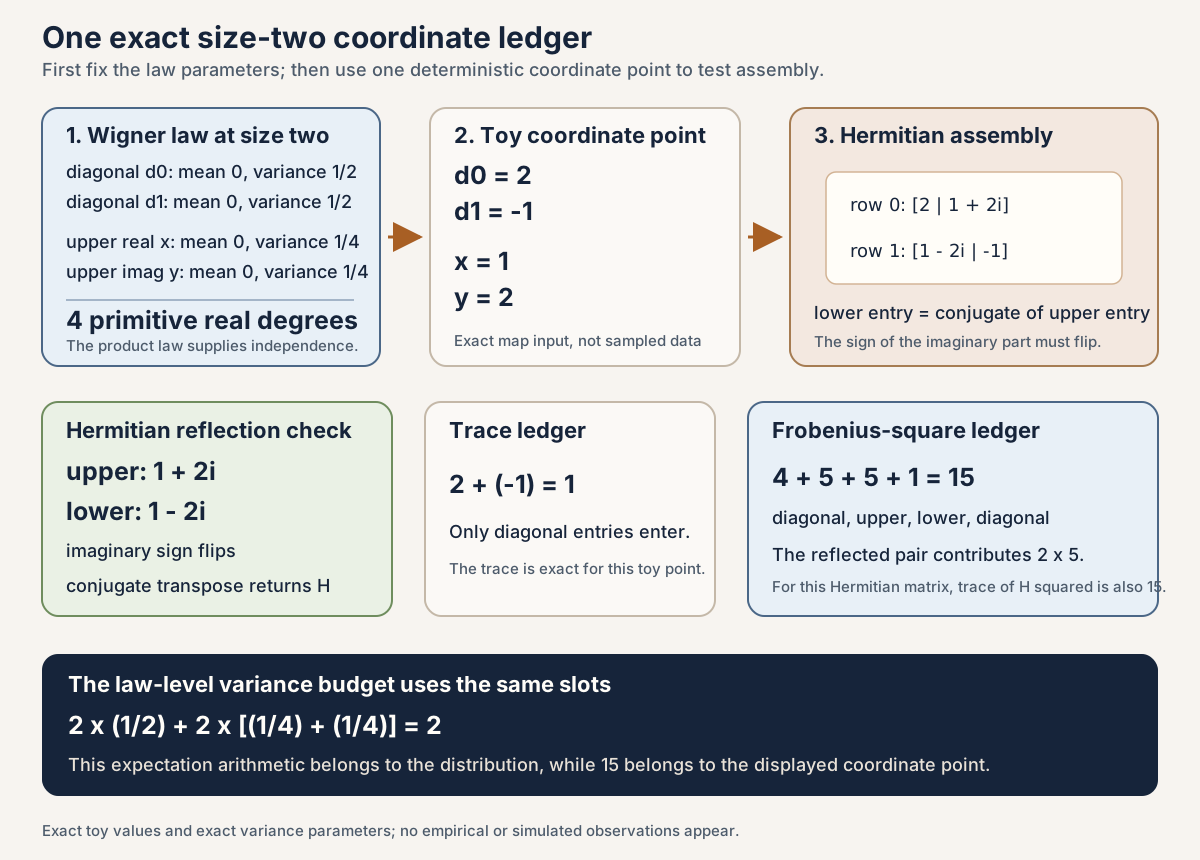
In Lean: expose the size-two Wigner scale
(GUE.diagonalVariance_succ 1, GUE.upperCartesianVariance_succ 1)GUEis the namespace containing the repository’s selected finite ensemble convention.diagonalVariance_succ 1specializes the positive-size diagonal formula to \(1+1=2\).upperCartesianVariance_succ 1specializes the upper real-part and imaginary-part formula to the reciprocal of \(2(1+1)=4\).- The surrounding parentheses form one Lean pair of proof terms. They do not pair the two variances into an undocumented single “complex variance.”
- Both results live in \(\mathbb R_{\ge0}\), written
ℝ≥0, so a negative variance cannot be supplied.
Two near-misses identify the required conditions
Near-miss A: copy the upper entry without conjugating it
Replace the lower-left entry by another copy of \(1+2i\):
\[ K= \begin{bmatrix} 2 & 1+2i \\ 1+2i & -1 \end{bmatrix}. \]This matrix still satisfies
\[ \operatorname{Tr}(K)=1, \qquad \lVert K\rVert_{\mathrm F}^2=15. \]Those two scalar checks do not see the sign error. But \(K^*\ne K\), because its lower-left entry should be \(1-2i\). A constructor that merely copies the upper triangle has failed before probability enters.
Near-miss B: keep the map but remove the Wigner scale
Suppose all four primitive real coordinates instead have variance one. The same Hermitian assembly map is still valid, but its expected squared Frobenius budget becomes
\[ 2(1)+2(1+1)=6, \]not \(2\). This defines a legitimate Gaussian Hermitian matrix law, but it is
not GUE.matrixLaw 2 under this repository’s normalization. A map
does not remember which source law was pushed through it.
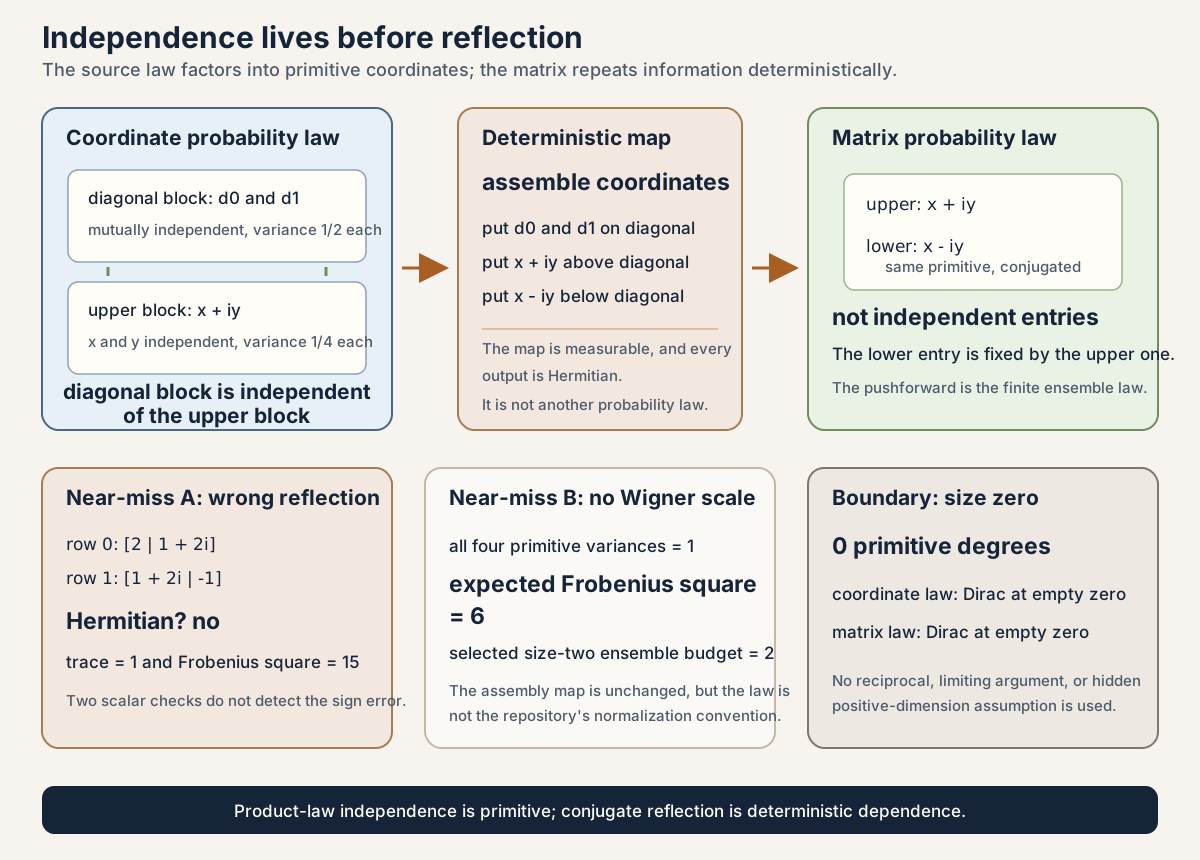
In Lean: the deterministic map owns the reflection rule
RandomMatrix.hermitianFromCoordinates d ud : Fin n → ℝis the real diagonal function.u : StrictUpperIndex n → ℂstores only positions with \(i\lt j\).hermitianFromCoordinatesbranches on the comparison between the row and column. The lower branch usesstar, complex conjugation.- The theorem
RandomMatrix.hermitianFromCoordinates_isHermitian d uchecks Hermiticity for every input. It needs no Gaussian law or independence. - This expression returns a matrix. It is not
GUE.matrixLaw n, which is a measure on matrices.
Full project check. After installing the repository’s pinned dependencies, place the following source in a temporary project scratch file:
import NonlinearDynamics.Random.RandomMatrices.HermitianCoordinates

open Matrix
open NonlinearDynamics.Random

#print StrictUpperIndex
#print HermitianCoordinateSpace
#print RandomMatrix.hermitianFromCoordinates
#check RandomMatrix.hermitianFromCoordinates_apply_diag
#check RandomMatrix.hermitianFromCoordinates_apply_upper
#check RandomMatrix.hermitianFromCoordinates_apply_lower
#check RandomMatrix.hermitianFromCoordinates_isHermitian
#check RandomMatrix.measurable_hermitianCoordinateMap
#check RandomMatrix.hermitianCoordinateMap_zero
#print exposes a definition. #check
elaborates an existing declaration and displays its type. The full project
command rendered below checks the exact Mathlib-backed project module.
cd formalization
lake env lean -DwarningAsError=true NonlinearDynamics/Random/RandomMatrices/HermitianCoordinates.lean
Resource note: this exact file uses the repository's
pinned Lean and Mathlib dependencies. Initial project setup can require
substantial disk space and build time. For a lightweight first step on
macOS or Linux, use the page's standalone Lean-core or Std
tutorial.
Type the complete finite ledger with Lean and Std
The exact Gaussian measures and matrix libraries need Mathlib, so they are full
project checks and may require substantial disk space and memory. The size-two
arithmetic and reflection logic fit in a standalone worksheet importing only
Lean’s Std library. Save this exact file as
/tmp/GUEN2Ledger.lean on a normal macOS or Linux host:
import Std

namespace GUEN2Ledger

structure ComplexInt where
  re : Int
  im : Int
deriving Repr, DecidableEq

def conj (z : ComplexInt) : ComplexInt :=
  { re := z.re, im := -z.im }

def normSq (z : ComplexInt) : Nat :=
  z.re.natAbs ^ 2 + z.im.natAbs ^ 2

structure Matrix2 where
  h00 : ComplexInt
  h01 : ComplexInt
  h10 : ComplexInt
  h11 : ComplexInt
deriving Repr, DecidableEq

def assemble (d0 d1 x y : Int) : Matrix2 :=
  let upper : ComplexInt := { re := x, im := y }
  { h00 := { re := d0, im := 0 }
    h01 := upper
    h10 := conj upper
    h11 := { re := d1, im := 0 } }

def wrongReflection (d0 d1 x y : Int) : Matrix2 :=
  let upper : ComplexInt := { re := x, im := y }
  { h00 := { re := d0, im := 0 }
    h01 := upper
    h10 := upper
    h11 := { re := d1, im := 0 } }

def isHermitian (H : Matrix2) : Bool :=
  H.h00.im == 0 && H.h11.im == 0 && H.h10 == conj H.h01

def trace (H : Matrix2) : ComplexInt :=
  { re := H.h00.re + H.h11.re, im := H.h00.im + H.h11.im }

def frobeniusLedger (H : Matrix2) : List Nat :=
  [normSq H.h00, normSq H.h01, normSq H.h10, normSq H.h11]

def frobeniusSq (H : Matrix2) : Nat :=
  (frobeniusLedger H).sum

def strictUpperCount (n : Nat) : Nat :=
  n * (n - 1) / 2

def realDegrees (n : Nat) : Nat :=
  n + 2 * strictUpperCount n

def varianceScale (n : Nat) : Rat :=
  if n = 0 then 0 else 1 / n

def diagonalVariance (n : Nat) : Rat :=
  varianceScale n

def upperCartesianVariance (n : Nat) : Rat :=
  varianceScale n / 2

def expectedFrobeniusFromLedger
    (n : Nat) (diagVar upperPartVar : Rat) : Rat :=
  n * diagVar + 2 * strictUpperCount n * (2 * upperPartVar)

def H : Matrix2 := assemble 2 (-1) 1 2
def K : Matrix2 := wrongReflection 2 (-1) 1 2

#eval (varianceScale 0, strictUpperCount 0, realDegrees 0)
#eval [varianceScale 2, diagonalVariance 2, upperCartesianVariance 2]
#eval [strictUpperCount 2, realDegrees 2]
#eval H
#eval [isHermitian H, isHermitian K]
#eval trace H
#eval frobeniusLedger H
#eval frobeniusSq H
#eval [expectedFrobeniusFromLedger 2 (1 / 2) (1 / 4),
  expectedFrobeniusFromLedger 2 1 1]

example : diagonalVariance 2 = 1 / 2 := by native_decide
example : upperCartesianVariance 2 = 1 / 4 := by native_decide
example : varianceScale 0 = 0 := by native_decide
example : realDegrees 0 = 0 := by decide
example : realDegrees 2 = 4 := by decide
example : isHermitian H = true := by decide
example : isHermitian K = false := by decide
example : trace H = { re := 1, im := 0 } := by decide
example : frobeniusLedger H = [4, 5, 5, 1] := by decide
example : frobeniusSq H = 15 := by decide
example : expectedFrobeniusFromLedger 2 (1 / 2) (1 / 4) = 2 := by
  native_decide
example : expectedFrobeniusFromLedger 2 1 1 = 6 := by native_decide

end GUEN2Ledger
Type these commands exactly:
source "$HOME/.elan/env"
elan run leanprover/lean4:v4.32.0 lean /tmp/GUEN2Ledger.lean
This exact worksheet was executed successfully with Lean 4.32.0. It printed:
(0, 0, 0)
[(1 : Rat)/2, (1 : Rat)/2, (1 : Rat)/4]
[1, 4]
{ h00 := { re := 2, im := 0 }, h01 := { re := 1, im := 2 }, h10 := { re := 1, im := -2 }, h11 := { re := -1, im := 0 } }
[true, false]
{ re := 1, im := 0 }
[4, 5, 5, 1]
15
[2, 6]
The first line is the size-zero scale, strict-upper count, and real-degree count. The second line is the size-two scale, diagonal variance, and upper component variance. The third line is the single strict-upper location followed by four real degrees. The matrix record makes the conjugate sign visible. The Boolean pair confirms that the correct matrix is Hermitian and the copied-sign near-miss is not. The remaining lines give trace, the four-entry Frobenius ledger, its sum, and the selected-versus-unscaled expected budgets.
ComplexInt is a tiny tutorial-only pair of integer coordinates;
it is not Lean’s full complex-number type and carries no Gaussian law.
Rat stores exact rational numbers, so the variance output preserves
\(1/2\) and \(1/4\) rather than rounding them to floating-point decimals.
native_decide evaluates rational equalities using Lean’s native
decision procedure; decide suffices for the finite integer and
Boolean checks. This worksheet checks only the finite data transformations
it defines. It does not define a Gaussian measure, prove independence, or replace
the full Mathlib-backed module checks.
A finite GUE matrix can now be summarized in one sentence: choose independent centered Gaussian free coordinates at the Wigner scale, assemble a Hermitian matrix, and push the coordinate law through that measurable map. The rest of the chapter expands each phrase without confusing a coordinate point, a sample map, a deterministic assembly map, and a probability law.
The sixth random-matrix-theory milestone (RMT-06) answers the finite law-construction questions with 26 checked declarations. It fixes one normalization, constructs one canonical coordinate probability measure, proves its exact laws and independence structure, pushes it through measurable Hermitian assembly, transfers exact diagonal and upper entry laws, and proves a Dirac boundary in dimension zero.
This chapter does not silently import the rest of random-matrix theory. A classical density, eigenvalue density, semicircle law, and universality remain outside RMT-06. Later checked project modules now prove that the Hermitian set has full measure, unitary-conjugation invariance, the first two trace expectations, and finite spectral-measure interfaces. Those later results are identified as such rather than retroactively attributed to the constructor module.
Choose a route up
| Route | Begin with | Destination |
|---|---|---|
| First encounter | The exact size-two ledger | Compute every variance, reflected entry, degree count, trace, and Frobenius term |
| Hands-on Lean route | The standalone Std worksheet | Execute the finite arithmetic without Mathlib or Lake |
| Type route | Name the three spaces | Distinguish coordinates, assembly, and a matrix law |
| Normalization route | The Wigner ledger | Derive every variance and the factor of two |
| Probability route | Build the coordinate measure | See why a product law contains dependence information |
| Independence route | Three scopes of independence | Separate block, within-block, and cross-coordinate claims |
| Transport route | Push the law through assembly | Follow the measurable map into matrix space |
| Lean route | The checked declaration map | Audit all 26 public declarations |
| Boundary route | Dimension zero | Understand the total zero-size policy |
Learning objectives
By the summit, you should be able to:
- reproduce the exact \(n=2\) law ledger, four-degree count, assembled matrix, trace \(1\), and Frobenius square \(15\);
- explain why the wrong-reflection matrix fails even though its trace and Frobenius square match the correct toy matrix;
- state the complete positive-dimensional GUE normalization ledger used here;
- derive \(\mathbb E|H_{ij}|^2=1/n\) from two component variances;
- derive the factor of two in \(\operatorname{Tr}(H^2)\) from Hermitian reflection;
- distinguish a coordinate point, assembly map, coordinate law, and matrix law;
- distinguish scalar marginals from a finite joint product law;
- identify block independence, mutual independence within each block, and cross-block coordinate independence as separate theorem shapes;
- explain why measurable assembly is the bridge from coordinates to a matrix law;
- state the full Cartesian complex law of a diagonal matrix entry, including its zero imaginary variance;
- explain why reflected upper and lower entries are not independent primitive coordinates;
- compute the unique zero-dimensional coordinate and matrix laws; and
- separate all 26 checked declarations from later density, invariance, spectral, moment, and asymptotic work.
The construction in one picture
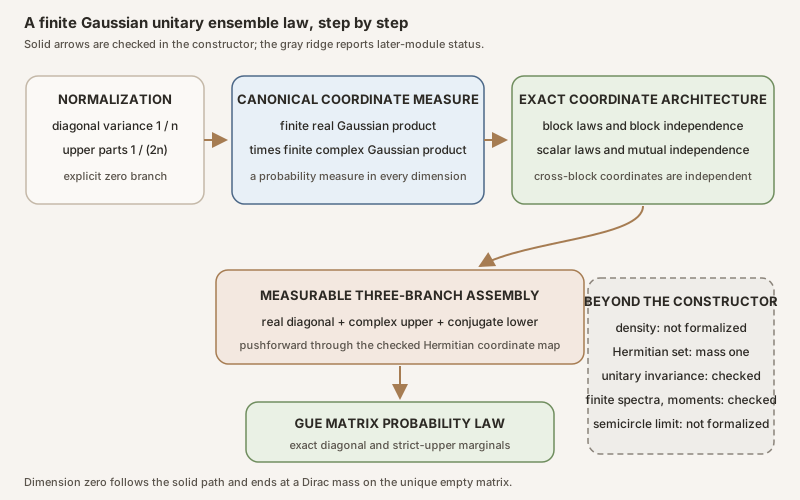
Base camp: name the three spaces
Fix a natural number \(n\). Three spaces play different roles.
First is the Hermitian coordinate space
\[ \mathcal C_n =(\operatorname{Fin}(n)\to\mathbb R) \times (I_n^{\lt}\to\mathbb C), \]where \(I_n^{\lt}\) contains index pairs \((i,j)\) with \(i\lt j\). A point \(c=(d,u)\) stores a real diagonal \(d\) and a complex strict upper triangle \(u\). It is not yet random.
Second is the ambient matrix space
\[ \mathcal M_n =\operatorname{Matrix}(\operatorname{Fin}(n),\operatorname{Fin}(n),\mathbb C). \]The deterministic assembly map \(A_n:\mathcal C_n\to\mathcal M_n\) is
\[ (A_n(d,u))_{ij} {} = \begin{cases} u_{ij},&i\lt j,\\ d_i,&i=j,\\ \overline{u_{ji}},&j\lt i. \end{cases} \]Every output is Hermitian , and RMT-05 proved this map measurable.
Third is a space of probability measures. A coordinate law \(\nu_n\) is a measure on \(\mathcal C_n\). A matrix law \(\mu_n\) is a measure on \(\mathcal M_n\). RMT-06 defines
\[ \mu_n=(A_n)_*\nu_n. \]This distinction prevents a common category error. A coordinate point is not a sample map; an assembly function is not a law; a law is not a realized matrix. Each layer needs its own definition and proof.
Camp one: the Wigner ledger
The project stores variances in \(\mathbb R_{\ge0}\), Lean’s nonnegative real type. Define the total scale
\[ s_n= \begin{cases} 0,&n=0,\\ 1/n,&n\gt0. \end{cases} \]The zero branch is a definition, not an interpretation of division by zero. For positive \(n\), the coordinate ledger is
\[ \operatorname{Var}(d_i)=s_n=\frac1n, \]and, writing \(u_{ij}=x_{ij}+iy_{ij}\),
\[ \operatorname{Var}(x_{ij}) =\operatorname{Var}(y_{ij}) =\frac{s_n}{2} =\frac{1}{2n}. \]All means are zero. Real and imaginary parts inside one Cartesian complex law are independent by its product-law definition. The upper complex coordinates are mutually independent. The diagonal real coordinates are mutually independent. The two entire blocks are independent.
Lean gives the scale three names:
noncomputable def varianceScale : ℕ → ℝ≥0
  | 0 => 0
  | n + 1 => (((n + 1 : ℕ) : ℝ≥0))⁻¹

noncomputable def diagonalVariance (n : ℕ) : ℝ≥0 :=
  varianceScale n

noncomputable def upperCartesianVariance (n : ℕ) : ℝ≥0 :=
  varianceScale n / 2
The successor formulas expose the positive-dimensional meaning without a side condition:
\[ \begin{aligned} s_{n+1}&=\frac{1}{n+1},\\ d_{n+1}&=\frac{1}{n+1},\\ a_{n+1}&=\frac{1}{2(n+1)}. \end{aligned} \]Here \(d_n\) abbreviates the diagonal variance and \(a_n\) the variance of each displayed real coordinate of an upper entry. Named zero formulas expose all three values at \(n=0\).
The complex second-moment check
For a strict-upper entry \(u_{ij}=x_{ij}+iy_{ij}\),
\[ |u_{ij}|^2=x_{ij}^2+y_{ij}^2. \]The components are centered, so for positive \(n\),
\[ \begin{aligned} \mathbb E|u_{ij}|^2 &=\mathbb E[x_{ij}^2]+\mathbb E[y_{ij}^2]\\ &=\operatorname{Var}(x_{ij})+\operatorname{Var}(y_{ij})\\ &=\frac{1}{2n}+\frac{1}{2n}\\ &=\frac1n. \end{aligned} \]This is why the number \(1/(2n)\) belongs to each real Cartesian part. Saying merely that an upper entry has variance \(1/n\) is ambiguous unless “variance” is explicitly defined as total complex squared magnitude.
RMT-06 does not prove this expectation identity. It checks both exact component laws. The expectation calculation is a direct mathematical consequence once the existing complex-Gaussian integrability and second-moment interfaces are combined, but that combination has no named theorem here.
Camp two: the factor-of-two geometry
The Wigner ledger is also the coordinate form of the conventional quadratic GUE density. The bridge is a geometric identity.
For a Hermitian matrix \(H\),
\[ \operatorname{Tr}(H^2) =\sum_i(H^2)_{ii} =\sum_i\sum_j H_{ij}H_{ji}. \]Hermiticity gives \(H_{ji}=\overline{H_{ij}}\), hence
\[ H_{ij}H_{ji}=|H_{ij}|^2. \]The diagonal terms appear once. Every unordered off-diagonal pair \(\{i,j\}\) appears twice, once as \((i,j)\) and once as \((j,i)\). Therefore
\[ \operatorname{Tr}(H^2) =\sum_i H_{ii}^2 +2\sum_{i\lt j}|H_{ij}|^2. \]Writing \(H_{ii}=d_i\) and \(H_{ij}=x_{ij}+iy_{ij}\) above the diagonal gives
\[ \operatorname{Tr}(H^2) =\sum_i d_i^2 +2\sum_{i\lt j}(x_{ij}^2+y_{ij}^2). \]Now consider, as mathematical context, the density shape
\[ \exp\!\left(-\frac n2\operatorname{Tr}(H^2)\right). \]In free coordinates its exponent is
\[ -\sum_i\frac n2d_i^2 -\sum_{i\lt j}n(x_{ij}^2+y_{ij}^2). \]A centered real Gaussian with variance \(v\) has exponent \(-x^2/(2v)\). Comparing coefficients gives \(v=1/n\) on the diagonal and \(v=1/(2n)\) for each upper real part. The apparently asymmetric ledger is exactly what the Hermitian trace geometry requires.
This derivation also identifies a formal boundary. To prove a matrix density in Lean, the project will need a concrete real-linear model of Hermitian matrices, a reference volume, an equivalence with coordinates, and a change-of-variables argument. RMT-06 defines no density and proves no Jacobian. It uses the coordinate product law directly.
Camp three: build the coordinate measure
Let
\[ \gamma_{0,v} \]denote the centered real Gaussian measure with variance \(v\). For the diagonal block, form the finite indexed product
\[ D_n=\bigotimes_{i\in\operatorname{Fin}(n)}\gamma_{0,d_n}. \]For one strict-upper index \(q\), the Cartesian complex law is the image of
\[ \gamma_{0,a_n}\otimes\gamma_{0,a_n} \]under \((x,y)\mapsto x+iy\). Form the finite product of these complex laws:
\[ U_n=\bigotimes_{q\in I_n^{\lt}} \operatorname{CGauss}_{\mathrm{cart}}(0;a_n,a_n). \]The coordinate measure is the product of the two blocks:
\[ \nu_n=D_n\otimes U_n. \]The Lean definition mirrors this formula:
noncomputable def coordinateMeasure (n : ℕ) :
    Measure (HermitianCoordinateSpace n) :=
  (gaussianProductMeasure
      (fun _ : Fin n => 0)
      (fun _ => diagonalVariance n)).prod
    (cartesianComplexGaussianProductMeasure
      (fun _ : StrictUpperIndex n => 0)
      (fun _ => upperCartesianVariance n)
      (fun _ => upperCartesianVariance n))
Every scalar factor is a probability measure. A finite product of probability
measures is a probability measure, and a binary product of probability
measures is again one. The instance
instIsProbabilityMeasureCoordinateMeasure records this for every
\(n\), including zero.
The definition has no arbitrary sample enumeration. It is a canonical law on the function spaces themselves. Coordinate evaluation is the random-variable map. This makes exact marginals and independence accessible through Mathlib’s finite product-measure application programming interface (API).
Camp four: three scopes of independence
The word “independent” can describe several families at different levels. RMT-06 proves each needed scope explicitly.
Scope one: the two blocks
Under \(\nu_n=D_n\otimes U_n\), the projections
\[ \pi_D(d,u)=d, \qquad \pi_U(d,u)=u \]have laws \(D_n\) and \(U_n\). The theorems
coordinateMeasure_hasLaw_diagonalBlock and
coordinateMeasure_hasLaw_upperBlock state those exact full-vector
laws. The theorem
coordinateMeasure_indepFun_diagonal_upper states that the two
projection functions are independent.
This is stronger than saying a particular \(d_i\) is independent of one \(u_q\). It is independence of the sigma-algebras generated by the whole vectors.
Scope two: coordinates inside each block
Theorems
coordinateMeasure_diagonal_iIndepFun and
coordinateMeasure_upper_iIndepFun state mutual independence of
the evaluation families
and
\[ q\longmapsto((d,u)\mapsto u_q). \]Mutual independence is the finite-family property needed for arbitrary finite subcollections, not merely pairwise independence.
Scope three: one coordinate across blocks
For every diagonal index \(i\) and strict-upper index \(q\), the theorem
coordinateMeasure_diagonal_indepFun_upper proves
This theorem follows by composing block independence with measurable coordinate evaluations. It is exposed because scalar cross-block independence is often the exact hypothesis a later calculation needs.
In Lean: independence is stored on the source law
GUE.coordinateMeasure_indepFun_diagonal_upper ncoordinateMeasureis the probability measure \(\nu_n\) on the pair of coordinate blocks.Prod.fstandProd.snd, implicit in the theorem’s result, are the two block projections \(\pi_D\) and \(\pi_U\).IndepFunstates independence of the functions under a named measure. It does not say the two output values are unequal or unrelated pointwise.- The theorem is stronger than one selected diagonal-upper pair. Separate theorems expose mutual independence within each block and any one cross-block pair.
- The theorem is about primitive coordinate blocks before assembly. It makes no independence claim about \(H_{01}\) and \(H_{10}\).
What independence does not apply to
After assembly, \(H_{ji}=\overline{H_{ij}}\). These two reflected entries are deterministically related. They are not separate primitive coordinates and are not claimed independent. Similarly, the real and imaginary components inside one upper entry are independent because its Cartesian complex law is a product, but the matrix-level module does not restate that fact as a separate entry-component theorem.
Camp five: exact scalar coordinate laws
Full block laws imply exact marginal laws by evaluation.
For every \(i:\operatorname{Fin}(n)\),
\[ d_i\sim\gamma_{0,d_n}. \]This is
coordinateMeasure_diagonal_hasLaw, an exact
HasRealGaussianLaw statement. It does not merely say
“qualitatively Gaussian.”
For every \(q:I_n^{\lt}\),
\[ u_q\sim \operatorname{CGauss}_{\mathrm{cart}}(0;a_n,a_n). \]This is coordinateMeasure_upper_hasLaw, an exact
HasCartesianComplexGaussianLaw statement. The two equal variance
arguments remain visible. No undifferentiated “complex variance” appears.
For \(n\gt0\), substitution gives
\[ d_i\sim N(0,1/n) \]and
\[ \operatorname{Re}u_q,\operatorname{Im}u_q \sim N(0,1/(2n)) \]with independent Cartesian parts. At \(n=0\), there is no \(i\) or \(q\) at which to instantiate these theorems. The total measure still exists and is handled separately.
Camp six: push the law through assembly
RMT-05 proved that the deterministic coordinate map \(A_n\) is measurable. RMT-06 can therefore define the pushforward
\[ \mu_n=(A_n)_*\nu_n \]without an extra measurability hypothesis from the caller.
In Lean:
noncomputable def matrixLaw (n : ℕ) :
    Measure (Matrix (Fin n) (Fin n) ℂ) :=
  RandomMatrix.law
    (RandomMatrix.hermitianCoordinateMap n)
    (RandomMatrix.measurable_hermitianCoordinateMap n)
    (coordinateMeasure n)
In Lean: finite GUE begins at the pushed-forward matrix law
GUE.matrixLaw_eq_map nGUE.matrixLaw nis aMeasureon ambient \(n\)-by-\(n\) complex matrices. This is where the repository names the finite ensemble.Measure.mapis Mathlib’s pushforward operation. It transports mass through a function; it does not execute a pseudorandom sampler.RandomMatrix.hermitianCoordinateMap nis the deterministic map \(A_n\).GUE.coordinateMeasure nis the nested Gaussian product law \(\nu_n\).- The theorem is an equality between measures. A particular matrix such as the opening \(H\) is a point in the target space, not either side of this equality.
The theorem matrixLaw_eq_map exposes the definitional identity
with Measure.map. The instance
instIsProbabilityMeasureMatrixLaw proves the pushforward retains
total mass one.
Why define the law on the full ambient matrix type rather than a Hermitian subtype? The existing project law API, measurable matrix entries, congruence maps, and observables live on that ambient space. Assembly guarantees every realized output is Hermitian pointwise, but RMT-06 does not yet package the full-mass theorem saying the Hermitian set has measure one and its complement has measure zero.
That missing full-mass declaration does not invalidate the construction. It marks the difference between a sample map whose outputs satisfy a property and a named theorem evaluating its pushforward law on the Hermitian set.
The follow-up RMT-07 module now supplies that named mass-one theorem. It also proves symmetry of the intrinsic standard Gaussian on Hermitian Frobenius space, while leaving the coordinate-to-intrinsic comparison for RMT-08; see Intrinsic Hermitian Gaussian Symmetry and Matrix-Law Support.
Camp seven: transfer matrix-entry laws
The diagonal and upper entry maps composed with assembly reduce to coordinate evaluations. That fact transfers exact laws from \(\nu_n\) to \(\mu_n\).
The full diagonal entry, not just its real part
A diagonal entry is complex-valued in the ambient matrix type even though assembly inserts a real coordinate. The strongest justified law statement is
\[ H_{ii}\sim \operatorname{CGauss}_{\mathrm{cart}}(0;d_n,0). \]The real coordinate has variance \(d_n\). The imaginary coordinate has
variance zero, so its law is Dirac at zero. This is exactly
matrixLaw_diagonal_hasLaw.
For positive \(n\), \(d_n=1/n\). The theorem therefore records both Gaussian diagonal scaling and concentration of each diagonal entry on the real axis at the scalar law level. It does not prove a density on the full matrix space.
A strict-upper entry
For \(i\lt j\),
\[ H_{ij}\sim \operatorname{CGauss}_{\mathrm{cart}}(0;a_n,a_n), \]which is matrixLaw_upper_hasLaw. For positive \(n\), both
component variances are \(1/(2n)\).
The theorem requires a proof \(i\lt j\), exactly matching the branch where assembly copies the primitive upper coordinate. There is no named lower-entry law theorem in RMT-06. A later result may derive it by conjugation, but it must not present the lower slot as a new independent Gaussian input.
In Lean: transfer the exact strict-upper law
GUE.matrixLaw_upper_hasLaw n hijhij : i < jis evidence selecting the strict-upper branch.matrixLaw_upper_hasLawis an exactHasCartesianComplexGaussianLawstatement, not only a mean or variance calculation.- Both displayed variance arguments are
GUE.upperCartesianVariance n. Equality of those component scales is visible in the result. - The source measure in the conclusion is
GUE.matrixLaw n, so the theorem concerns evaluation on the assembled matrix law rather than the earlier coordinate product law. - No lower-triangular independence follows. The lower entry is the conjugate of this same upper coordinate.
What the transfer does not prove
The two matrix-entry marginal theorems do not by themselves expose the full matrix joint law. That joint law is already \(\mu_n\), the pushforward of the coordinate product measure. Nor do the current declarations restate mutual independence of matrix diagonal and strict-upper entry maps after transport. Such theorems are mathematically reachable through assembly identities but are not public RMT-06 claims.
Camp eight: dimension zero is a Dirac law
At \(n=0\), both Fin 0 and
StrictUpperIndex 0 are empty. A function from either empty type
has one possible value. Consequently, \(\mathcal C_0\) is a singleton.
Each finite indexed product over an empty type is a Dirac measure on the unique empty function. Their binary product is a Dirac measure on the unique coordinate pair:
\[ \nu_0=\delta_{0_{\mathcal C_0}}. \]This is coordinateMeasure_zero.
The assembly map sends that unique coordinate to the unique empty matrix. Mapping a Dirac measure through a measurable function gives a Dirac measure at the image:
\[ \mu_0=\delta_{0_{\mathcal M_0}}. \]This is matrixLaw_zero.
The proof does not evaluate \(1/n\), appeal to a limiting argument, or leave a partial constructor. The pattern-matched scale and the empty product agree on one executable boundary policy.
In Lean: the zero-size law is a Dirac mass
GUE.matrixLaw_zeromatrixLaw 0still has a well-formed ambient matrix type,Matrix (Fin 0) (Fin 0) ℂ.Fin 0has no indices, so that matrix type has one element.Measure.dirac 0is the point mass at the unique empty matrix.- The companion theorem
GUE.coordinateMeasure_zeroproves the same Dirac boundary before assembly. - This theorem is not the limit of positive-dimensional laws as \(n\) tends to zero. Natural-number dimension is pattern matched exactly.
The checked declaration map
The module
NonlinearDynamics.Random.RandomMatrices.GaussianUnitaryEnsemble,
in namespace NonlinearDynamics.Random.GUE, exports exactly 26
public declarations.
| Declaration | Checked content | Explicit boundary |
|---|---|---|
varianceScale | Total Wigner variance scale on natural dimensions | Pattern matches zero; no division-by-zero claim |
diagonalVariance | Names the real diagonal variance | Does not create a law |
upperCartesianVariance | Names each upper real/imaginary component variance as half the scale | Does not name total complex variance |
varianceScale_zero | \(s_0=0\) | Not a positive-size reciprocal formula |
varianceScale_succ | \(s_{n+1}=1/(n+1)\) | No asymptotic statement |
diagonalVariance_zero | Diagonal scale is zero at size zero | There is no diagonal index at size zero |
diagonalVariance_succ | Positive-size diagonal variance is \(1/(n+1)\) | No density theorem |
upperCartesianVariance_zero | Upper component scale is zero at size zero | There is no upper index at size zero |
upperCartesianVariance_succ | Positive-size component variance is \(1/[2(n+1)]\) | No complex second-moment theorem |
coordinateMeasure | Product of the real diagonal and Cartesian complex upper product measures | No matrix assembly yet |
instIsProbabilityMeasureCoordinateMeasure | Coordinate measure has total mass one | No sample algorithm or empirical claim |
coordinateMeasure_hasLaw_diagonalBlock | First projection has the exact finite real Gaussian product law | Not merely scalar marginals |
coordinateMeasure_hasLaw_upperBlock | Second projection has the exact finite complex Gaussian product law | No lower-triangle family |
coordinateMeasure_indepFun_diagonal_upper | Full diagonal and upper projections are independent | Does not assert unitary symmetry |
coordinateMeasure_diagonal_hasLaw | Every selected diagonal coordinate has exact centered real Gaussian law | No matrix-entry theorem yet |
coordinateMeasure_upper_hasLaw | Every selected upper coordinate has exact centered Cartesian complex law | Both component variances remain explicit |
coordinateMeasure_diagonal_iIndepFun | Diagonal evaluations are mutually independent | Stronger scope than pairwise only |
coordinateMeasure_upper_iIndepFun | Upper evaluations are mutually independent | Reflected lower entries are absent |
coordinateMeasure_diagonal_indepFun_upper | Any diagonal evaluation is independent of any upper evaluation | No claim about reflected matrix entries |
matrixLaw | Law on ambient complex matrices obtained through checked assembly | Does not define a density or spectrum |
matrixLaw_eq_map | Exposes the exact measurable pushforward formula | No invariance under a second map |
instIsProbabilityMeasureMatrixLaw | Matrix law has total mass one | No Hermitian-set mass-one theorem |
matrixLaw_diagonal_hasLaw | Full complex diagonal entry has real variance \(d_n\) and imaginary variance zero | Not just a real-part marginal |
matrixLaw_upper_hasLaw | Strict-upper entry has equal component variances \(a_n\) | Requires the strict inequality branch |
coordinateMeasure_zero | Zero-dimensional coordinate law is Dirac at the unique zero coordinate | No reciprocal reasoning |
matrixLaw_zero | Zero-dimensional matrix law is Dirac at the empty zero matrix | No positive-dimensional limit |
All 26 declarations compile under Lean 4.32.0 and the pinned Mathlib 4.32.0
dependency. The module contains no sorry or admit.
Full project check of the exact finite-law interfaces
The authoritative source is
formalization/NonlinearDynamics/Random/RandomMatrices/GaussianUnitaryEnsemble.lean.
After installing the repository’s pinned dependencies, put these lines in a
temporary project scratch file:
import NonlinearDynamics.Random.RandomMatrices.GaussianUnitaryEnsemble

open Matrix MeasureTheory ProbabilityTheory
open scoped ENNReal NNReal ProbabilityTheory Matrix
open NonlinearDynamics.Random

#print GUE.varianceScale
#print GUE.diagonalVariance
#print GUE.upperCartesianVariance
#check GUE.varianceScale_zero
#check GUE.varianceScale_succ
#check GUE.diagonalVariance_zero
#check GUE.diagonalVariance_succ
#check GUE.upperCartesianVariance_zero
#check GUE.upperCartesianVariance_succ
#print GUE.coordinateMeasure
#check GUE.instIsProbabilityMeasureCoordinateMeasure
#check GUE.coordinateMeasure_hasLaw_diagonalBlock
#check GUE.coordinateMeasure_hasLaw_upperBlock
#check GUE.coordinateMeasure_indepFun_diagonal_upper
#check GUE.coordinateMeasure_diagonal_hasLaw
#check GUE.coordinateMeasure_upper_hasLaw
#check GUE.coordinateMeasure_diagonal_iIndepFun
#check GUE.coordinateMeasure_upper_iIndepFun
#check GUE.coordinateMeasure_diagonal_indepFun_upper
#print GUE.matrixLaw
#check GUE.matrixLaw_eq_map
#check GUE.instIsProbabilityMeasureMatrixLaw
#check GUE.matrixLaw_diagonal_hasLaw
#check GUE.matrixLaw_upper_hasLaw
#check GUE.coordinateMeasure_zero
#check GUE.matrixLaw_zero
The full project command rendered below checks the authoritative module with Lean 4.32.0 and pinned Mathlib 4.32.0. It type-checks definitions and proofs; it does not sample a matrix, estimate eigenvalues, or test an asymptotic claim. It may require substantial disk space and memory.
cd formalization
lake env lean -DwarningAsError=true NonlinearDynamics/Random/RandomMatrices/GaussianUnitaryEnsemble.lean
Resource note: this exact file uses the repository's
pinned Lean and Mathlib dependencies. Initial project setup can require
substantial disk space and build time. For a lightweight first step on
macOS or Linux, use the page's standalone Lean-core or Std
tutorial.
Checked construction versus classical context
The classical finite GUE admits several equivalent descriptions. One uses the independent Gaussian free entries chosen here. Another uses a density on the real vector space of Hermitian matrices proportional to
\[ \exp\!\left(-\frac n2\operatorname{Tr}(H^2)\right). \]Another emphasizes invariance under
\[ H\longmapsto UHU^* \]for every deterministic unitary \(U\). Diagonalization then leads to an eigenvalue density with a squared Vandermonde factor.
These equivalences are mathematics, not definitional shortcuts. RMT-06 chooses the coordinate presentation as its definition. The broader repository has since proved some, but not all, of the later characterizations.
| Layer | RMT-06 status | Current broader-project status |
|---|---|---|
| Variance ledger | Checked | Still the governing normalization |
| Coordinate product probability law | Checked | Reused by later geometry and moment proofs |
| Coordinate marginals and independence | Checked | Whole normalized product transport is checked later |
| Measurable Hermitian assembly pushforward | Checked | Measure-one Hermitian locus is checked in RMT-07 |
| Matrix diagonal and upper marginals | Checked | Integrability is supplied by imported Gaussian interfaces and later observables |
| Hermitian-space density | Not checked | Still unformalized; no reference-volume or Jacobian theorem |
| Unitary invariance | Not checked here | Checked in RMT-08 for GUE.matrixLaw n |
| Finite spectral law | Not checked here | Ordered eigenvalues and empirical spectral laws are checked in RMT-10A through RMT-10C |
| First two trace expectations | Not checked here | Checked in RMT-09, with \(\mathbb E\operatorname{Tr}(H)=0\) and \(\mathbb E\operatorname{Tr}(H^2)=n\) |
| Semicircle behavior | Not checked | Still requires an asymptotic empirical-measure theorem |
The phrase “GUE matrix law” in RMT-06 refers to the explicit standard coordinate construction. It does not claim that every classical characterization has already been proved equivalent in Lean.
Inspect the later checked boundary without importing it into RMT-06
The later moments module imports the geometry and invariance continuation, so one full project scratch file can verify the exact theorem names that mark the current boundary:
import NonlinearDynamics.Random.RandomMatrices.GaussianUnitaryEnsembleMoments

open Matrix MeasureTheory ProbabilityTheory
open scoped ENNReal NNReal ProbabilityTheory Matrix
open NonlinearDynamics.Random

#check GUE.matrixLaw_hermitianSet
#check GUE.matrixLaw_ae_isHermitian
#check GUE.matrixLaw_isUnitaryConjugationInvariant
#check GUE.integrable_tracePower_one
#check GUE.integral_tracePower_one
#check GUE.integrable_tracePower_two
#check GUE.integral_tracePower_two
These are checked later-module theorems about the same finite matrix law. No
density, eigenvalue density, semicircle limit, universality, or quantum-chaos
observable follows merely from these #check lines.
cd formalization
lake env lean -DwarningAsError=true NonlinearDynamics/Random/RandomMatrices/GaussianUnitaryEnsembleMoments.lean
Resource note: this exact file uses the repository's
pinned Lean and Mathlib dependencies. Initial project setup can require
substantial disk space and build time. For a lightweight first step on
macOS or Linux, use the page's standalone Lean-core or Std
tutorial.
Physics window: why the unitary class matters
In finite-dimensional quantum mechanics, a Hamiltonian \(H=H^*\) has real expectation values and generates unitary evolution \(e^{-itH}\). Random-matrix models do not replace a microscopic Hamiltonian; they model statistical spectral features after detailed system-specific structure is suppressed.
Dyson organized three symmetry classes associated with real, complex, and quaternionic structures. The unitary class is the complex Hermitian class appropriate when the relevant time-reversal constraint is absent. In the classical GUE, conjugating by a deterministic unitary changes the basis but not the law. This makes the ensemble a natural basis-neutral reference model for that class.
RMT-06 proves the complex Hermitian coordinate law but not its basis
invariance. RMT-08 later proves that exact invariance theorem for the same
matrixLaw. The project still does not formalize Hamiltonians,
time-reversal operators, matrix exponentials, energy levels, level spacing,
spectral form factors, or quantum chaos at this point in the dependency chain.
The physical motivation informs later theorem sequences; it does not supply
proofs by naming the ensemble.
The Wigner \(1/n\) variance scale keeps typical eigenvalues order one as dimension grows. Classical results then place the limiting spectral mass on \([-2,2]\) under the chosen convention. That statement is not a consequence of the finite probability instance alone. It requires a measurable empirical spectral measure and a large-\(n\) convergence proof. The former now exists in later finite-dimensional modules; the latter remains unformalized.
Common wrong turns
Calling Hermiticity a distribution
Hermiticity constrains entries pointwise. It does not choose Gaussian laws, variance, independence, or any measure. RMT-05 supplies assembly; RMT-06 supplies the source probability law.
Giving each upper component variance \(1/n\)
That choice would give \(\mathbb E|H_{ij}|^2=2/n\). The selected convention uses \(1/(2n)\) for each component so their sum is \(1/n\).
Treating upper and lower entries as independent
They obey \(H_{ji}=\overline{H_{ij}}\). Only the strict upper triangle is a primitive complex family.
Listing Gaussian marginals without a joint law
Dependent variables can have the same Gaussian marginals as independent ones. The coordinate product measure and independence theorems carry indispensable joint information.
Reading HasLaw as a generated sample
A law is a pushforward identity between measures. It does not run a random number generator or record an observed realization.
Calling the matrix law unitarily invariant by its name
The classical GUE has this symmetry. RMT-06 has not proved the measure equality under unitary conjugation. RMT-08 builds it. The later geometry and transport argument proves the theorem; the namespace alone implies no such result.
Deriving a density without choosing reference volume
A density is relative to a measure. Hermitian-space coordinates, real-linear geometry, and the factor-of-two quadratic form must be formalized before the entrywise product law can be converted into the invariant density.
Letting \(n=0\) fall through a reciprocal
The definition pattern matches zero, and the empty product laws are Dirac. This is a total boundary policy, not a limiting slogan.
Claiming an order-one spectrum from the probability instance
Total mass one says nothing about eigenvalue scale. The spectral statement requires estimates or asymptotic theorems not present here.
Exercises
- Ledger. For \(n=4\), list the variance of every diagonal coordinate and every real Cartesian upper coordinate.
- Energy. Compute \(\mathbb E|H_{12}|^2\) from the two component variances when \(n=4\).
- Geometry. Expand \(\operatorname{Tr}(H^2)\) for a \(2\times2\) Hermitian matrix and locate the off-diagonal factor of two.
- Density context. Match the coefficient of \(x^2\) in \(e^{-nx^2}\) with a centered real Gaussian variance.
- Scopes. Give an example showing why scalar marginals do not imply independence.
- Transport. Mathlib’s
Measure.mapis total even for a nonmeasurable function. State the measurability hypothesis needed to use \((A_n)_*\nu_n\) as the intended pushforward and apply map evaluation or composition theorems. - Diagonal law. Explain why the exact complex law of \(H_{ii}\) has imaginary variance zero rather than omitting the imaginary coordinate.
- Reflection. Explain why no independent lower-coordinate block belongs in \(\nu_n\).
- Boundary. Prove on paper that the function space \(\operatorname{Fin}(0)\to\mathbb R\) has one element.
- Lean. Find which declaration exposes the matrix law as a
Measure.map. - Later theorem. Write the unitary-invariance measure equality and find the later project declaration that now proves it.
- Roadmap. List the new definitions needed before a semicircle theorem can even be stated precisely.
Summit register
RMT-06 fixes a Wigner-scale ledger with an explicit zero branch. It builds the canonical product law on real diagonal and complex strict-upper coordinates, proves that law is probabilistic, exposes full block laws, exact scalar laws, mutual independence within both blocks, and independence across blocks. It then pushes the law through the checked measurable Hermitian assembly map, proves the resulting matrix law is probabilistic, transfers exact diagonal and strict-upper entry laws, and identifies both zero-dimensional laws as Dirac.
The result is the first checked finite named matrix ensemble in the project. It is also deliberately bounded. RMT-06 itself adds no density, matrix-level Hermitian-set mass-one theorem, unitary-invariance theorem, eigenvalue law, expectation, trace moment, empirical spectral law, semicircle limit, or universality theorem.
The broader project has climbed several of those finite-dimensional steps. RMT-07 proves that the Hermitian set has measure one, RMT-08 proves unitary invariance, RMT-09 proves the first two trace expectations, and RMT-10A through RMT-10C build finite spectral laws and expected first two empirical moments. A Hermitian-space density, a joint eigenvalue density, a semicircle limit, universality, and quantum-chaos observables remain outside the checked claims of this chapter.
Where to continue
Use the Gaussian unitary ensemble glossary entry for the compact definition and normalization ledger. Finite Hermitian Matrices from Coordinates derives the deterministic assembly map.
Finite Product Probability Spaces and Independent Gaussian Fields explains the finite product and independence APIs, while Complex Gaussian Coordinates and Geometry develops the exact two-variance complex law. Read normalization convention , pushforward measure , and unitary invariance for the three boundaries this construction makes most visible.
References
Alice Guionnet. Rare Events in Random Matrix Theory, in Proceedings of the International Congress of Mathematicians 2022, volume 2, European Mathematical Society Press, 2022, doi:10.4171/ICM2022/174, pp. 1008-1052. Section 1.1.1 states the GUE diagonal variance \(1/n\), upper real and imaginary variances \(1/(2n)\), and the Gaussian-ensemble density \(\exp[-\beta n\operatorname{Tr}(H^2)/4]\). For \(\beta=2\), this is the density context used in the factor-of-two derivation. Density remains unformalized in the project. Unitary invariance is absent from RMT-06 but is proved for the same matrix law in RMT-08.
Freeman J. Dyson. Statistical Theory of the Energy Levels of Complex Systems. I, Journal of Mathematical Physics 3 (1962), 140-156. This primary paper develops the symmetry-class framework and its quantum-spectral motivation.
Terence Tao and Van Vu. Random Matrices: Sharp Concentration of Eigenvalues, arXiv:1201.4789, 2012. The normalization \(W_n=M_n/\sqrt n\) and the order-one spectral window provide context for the scale selected here. No spectral statement from that paper is claimed as checked by RMT-06.
Mathlib contributors. Gaussian distributions over the reals, indexed product measures, independence, and measure maps, Mathlib 4 documentation. These official API references underlie the exact Gaussian, finite product, independence, and pushforward proofs.
The exact upstream Lean source audited for this chapter is Mathlib commit
81a5d257,
the revision pinned by formalization/lake-manifest.json.