Start with four integers and one forced reflection
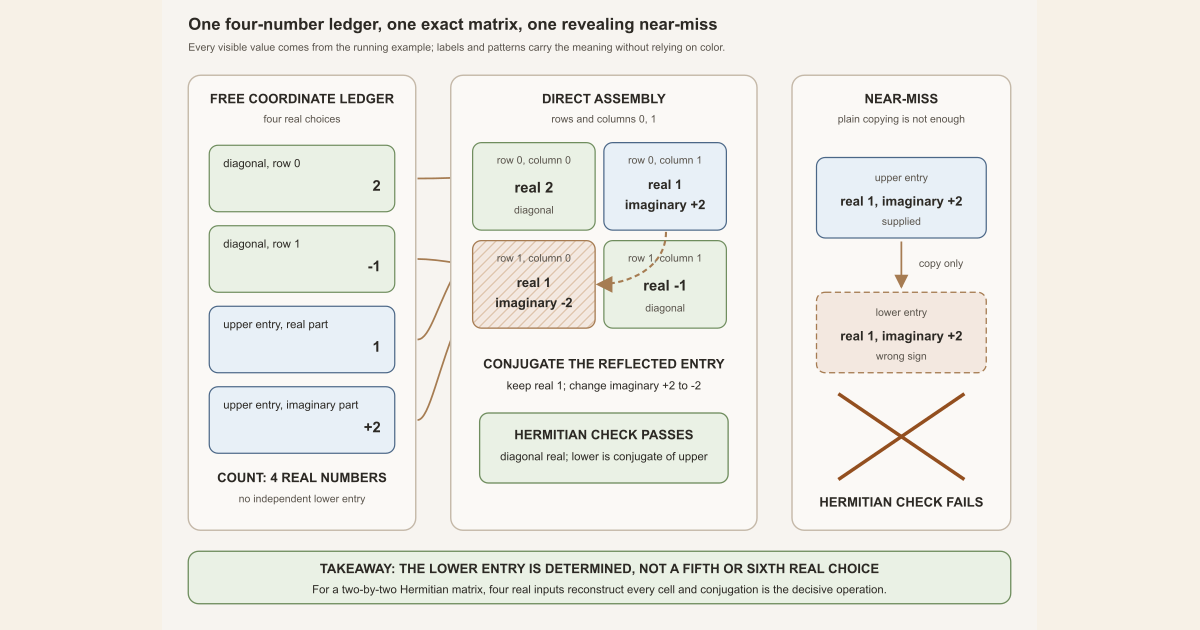
Take two real diagonal coordinates and one complex strict-upper coordinate:
\[ d_0=2, \qquad d_1=-1, \qquad u_{01}=1+2i. \]The subscripts record destinations. The number \(d_0\) goes in row 0, column 0; \(d_1\) goes in row 1, column 1; and \(u_{01}\) goes in row 0, column 1. The remaining cell is not a fourth matrix-entry choice. It is forced to be the complex conjugate \(\overline{u_{01}}=1-2i\):
\[ H= \begin{bmatrix} 2 & 1+2i\\ 1-2i & -1 \end{bmatrix}. \]Check the defining symmetry entry by entry. The diagonal values are real, and the off-diagonal pair obeys
\[ H_{10}=1-2i=\overline{1+2i}=\overline{H_{01}}. \]Therefore the conjugate transpose of \(H\) is \(H\) itself. The four real numbers
\[ q=(d_0,d_1,\operatorname{Re}u_{01},\operatorname{Im}u_{01}) =(2,-1,1,2) \]are enough to reconstruct all four complex matrix positions. This tuple \(q\) is the running example for the whole chapter.
Now copy the upper entry into the lower slot without changing the sign of its imaginary part:
\[ M= \begin{bmatrix} 2 & 1+2i\\ 1+2i & -1 \end{bmatrix}. \]This near-miss is not Hermitian because \(M_{10}=1+2i\ne1-2i=\overline{M_{01}}\). Reflection alone is not enough; reflection and complex conjugation are the rule.
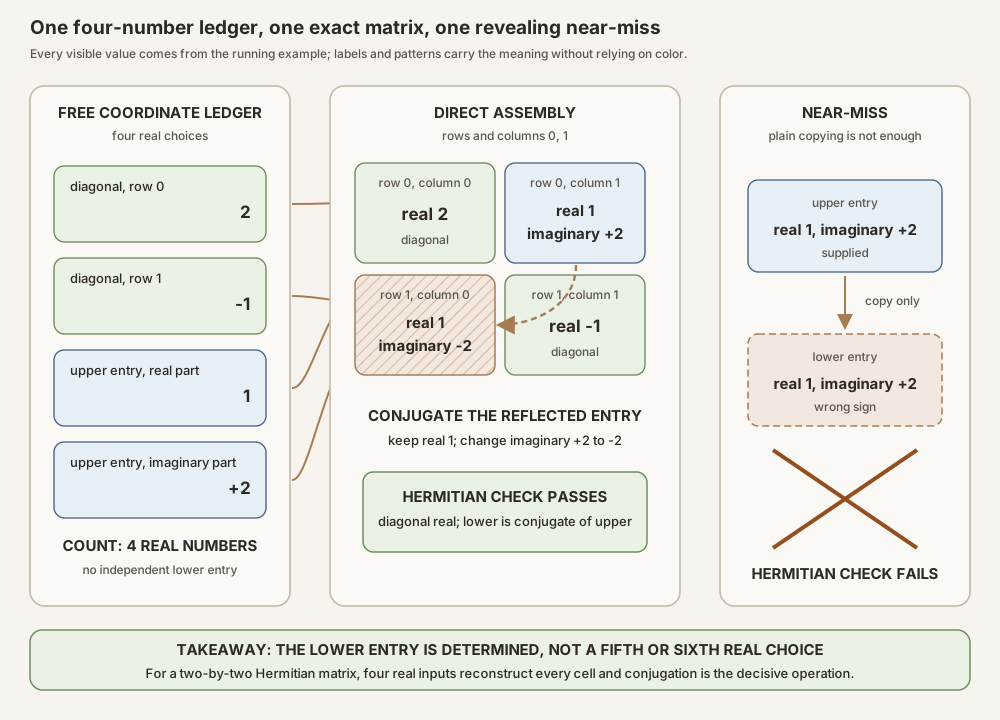
A finite complex Hermitian matrix satisfies the compact equation \(H^*=H\). The example shows what that equation means operationally: diagonal entries are real, strict-upper entries are free, and strict-lower entries are determined. This chapter turns that geometry into a deterministic program, then separates what the checked Lean module proves from later dimension, Euclidean-geometry, probability, and spectral layers.
No probability measure enters this construction. No coordinate is declared Gaussian or independent. No Gaussian unitary ensemble (GUE) normalization, matrix law, unitary invariance, spectral statistic, or asymptotic theorem is selected. The chapter builds the deterministic bridge that those later layers may use.
Choose a route up
| Route | Begin with | Destination |
|---|---|---|
| First encounter | The symmetry constraint removes redundant data | Read a Hermitian matrix as free coordinates plus reflection |
| Dimension route | Count the real degrees of freedom | Derive the \(n^2\) real-coordinate count |
| Construction route | Insert coordinates directly | Understand the diagonal, upper, and lower branches |
| Geometry route | Reflection changes the coordinate metric | Compute norms and an inner product from the same raw ledger |
| Proof route | Hermiticity is a three-case proof | Follow the exact entrywise argument used in Lean |
| Measurability route | Measurability reduces to scalar coordinates | See why no measure or law is required |
| Hands-on Lean route | Type the running example yourself | Run a bounded Std worksheet on Mac or Linux |
| Project Lean route | The checked declaration map | Audit all 17 public declarations with the pinned project dependencies |
| Boundary route | Dimension zero is not an exception | Understand the unique empty coordinate point and matrix |
Learning objectives
By the summit, you should be able to:
- identify the real diagonal and complex strict upper triangle as the free coordinates of a finite Hermitian matrix;
- derive the \(n^2\) real-degree-of-freedom count;
- explain why the lower triangle is determined rather than independently supplied;
- evaluate the direct assembly map in all three index-order cases;
- show why an \(X+X^*\) implementation doubles a supplied real diagonal;
- compute the running matrix’s Frobenius square and its inner product with a second matrix from the raw coordinate ledger;
- explain why raw upper coordinates receive weight two in matrix geometry;
- prove Hermiticity entry by entry using order trichotomy;
- reduce matrix-valued measurability to scalar coordinate maps;
- distinguish assembly from a bundled measurable Hermitian random matrix;
- run the bounded
Stdreconstruction and near-miss worksheet; - explain the zero-dimensional coordinate and matrix spaces; and
- separate the 17 checked Lean declarations from unproved dimension, inverse, probability, and spectral statements.
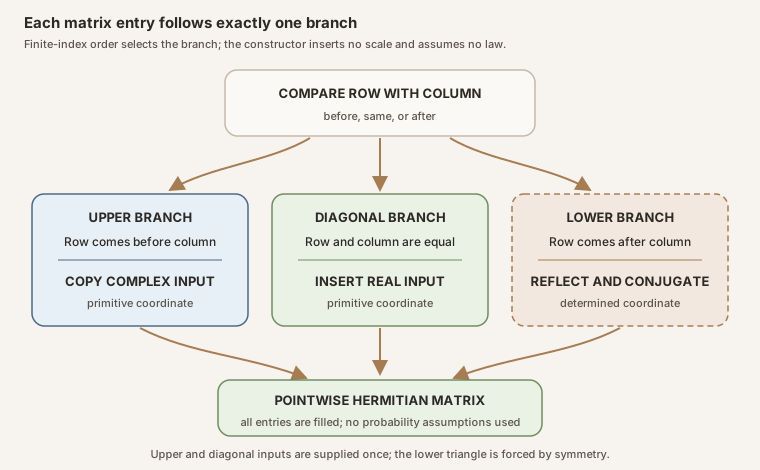
The assembly program in one picture
Base camp: the symmetry constraint removes redundant data
For a complex matrix \(H\), the conjugate transpose is defined by
\[ (H^*)_{ij}=\overline{H_{ji}}. \]The matrix is Hermitian when \(H^*=H\). Entrywise, this is
\[ \overline{H_{ji}}=H_{ij} \qquad\text{for every }i,j. \]Set \(i=j\). Then \(H_{ii}=\overline{H_{ii}}\), which means that the diagonal entry is real. Now take \(i\ne j\). Choosing \(H_{ij}\) determines \(H_{ji}=\overline{H_{ij}}\). The two reflected off-diagonal slots carry one complex coordinate together, not two unrelated complex coordinates.
This distinction matters before probability appears. Independently supplied nondegenerate upper and lower variables cannot also satisfy the deterministic Hermitian reflection constraint. A Hermitian construction identifies each lower entry with the conjugate of its upper partner, so the pair is generally dependent. The safest representation records only the primitive positions and performs reflection deterministically. Degenerate constant coordinates can make independence and a deterministic relation coexist, but they do not justify treating both slots as separate free data.
For size \(n\), let
\[ I_n^{\lt}=\{(i,j):0\le i\lt n,\ 0\le j\lt n,\ i\lt j\} \]be the strict-upper positions. A coordinate point is a pair
\[ (d,u) \in (\operatorname{Fin}(n)\to\mathbb R) \times (I_n^{\lt}\to\mathbb C). \]Here \(d_i\) is intended for the \(i\)-th diagonal slot, and \(u_{ij}\) is intended for the strict-upper slot \((i,j)\). The lower triangle is absent from the input type because Hermiticity already determines it.
Camp one: count the real degrees of freedom
The coordinate representation exposes the real dimension of the Hermitian space. The diagonal contributes \(n\) real coordinates. The number of strict-upper positions is
\[ \lvert I_n^{\lt}\rvert =\binom n2 =\frac{n(n-1)}2. \]Every strict-upper coordinate is complex, so it contributes two real coordinates. Therefore
\[ \begin{aligned} n+2\lvert I_n^{\lt}\rvert &=n+2\binom n2\\ &=n+n(n-1)\\ &=n^2. \end{aligned} \]This is the real dimension of the vector space of \(n\times n\) complex Hermitian matrices.
For \(n=1\), there is one real diagonal value and no strict-upper position. For \(n=2\), there are two real diagonal values and one complex upper value:
\[ H= \begin{bmatrix} d_0 & u_{01}\\ \overline{u_{01}} & d_1 \end{bmatrix}. \]The running ledger \(q=(2,-1,1,2)\) is exactly this case. Its first two numbers are the real diagonal; its last two are the real and imaginary parts of the one complex upper value. Thus it has
\[ 2+2\binom22=2+2=4=2^2 \]real coordinates. The lower-left matrix cell consumes no new degree of freedom. For \(n=3\), three real diagonal coordinates and three complex upper coordinates give \(3+2\cdot3=9=3^2\).
These counts are mathematical context. The RMT-05 Lean module does not define
a basis, prove the cardinality formula for StrictUpperIndex, or
package a real-linear equivalence. Its checked interface defines the
coordinate type and proves direct assembly, entry formulas, Hermiticity, and
measurability.
Camp two: make the strict upper triangle a type
Lean’s finite index type Fin n contains natural numbers smaller
than \(n\), together with the proof of that bound. The project defines
def StrictUpperIndex (n : ℕ) :=
  {ij : Fin n × Fin n // ij.1 < ij.2}
This is a subtype. A value contains a pair \((i,j)\) and evidence that \(i\lt j\). Thus a function
u : StrictUpperIndex n → ℂ
can only be evaluated at a genuine strict-upper position. There is no need to assign dummy values on or below the diagonal and later prove they are ignored.
The module supplies three instances:
StrictUpperIndex.instFintypeproves the index type is finite;StrictUpperIndex.instDecidableEqdecides equality of two strict-upper positions; andStrictUpperIndex.instIsEmptyZerorecords that no such position exists when \(n=0\).
The full coordinate type is deliberately simple:
abbrev HermitianCoordinateSpace (n : ℕ) :=
  (Fin n → ℝ) × (StrictUpperIndex n → ℂ)
It is an abbreviation for a product of function spaces. It does not carry proof fields, a measure, or a normalization ledger.
In Lean: the input type records only free entries
(Fin n → ℝ) × (StrictUpperIndex n → ℂ)Fin nis the type of row or column indices from zero through \(n-1\), with the bound carried in the value.→is a function type. ThusFin n → ℝassigns one real number to each diagonal position.StrictUpperIndex ncontains pairs together with a proof that the row is strictly smaller than the column.×is a product type. A coordinate point contains both families.- There is no strict-lower factor. Its omission is the type-level expression of conjugate reflection.
Camp three: insert coordinates directly
For a real diagonal \(d\) and a complex strict upper triangle \(u\), define \(H=\operatorname{assemble}(d,u)\) by
\[ H_{ij}= \begin{cases} u_{ij}, & i\lt j,\\ \overline{u_{ji}}, & j\lt i,\\ d_i, & i=j. \end{cases} \]Lean implements the same rule:
def hermitianFromCoordinates {n : ℕ} (d : Fin n → ℝ)
    (u : StrictUpperIndex n → ℂ) : Matrix (Fin n) (Fin n) ℂ :=
  fun i j ↦
    if hij : i < j then
      u ⟨(i, j), hij⟩
    else if hji : j < i then
      star (u ⟨(j, i), hji⟩)
    else
      d i
The first branch builds a subtype value from \((i,j)\) and the proof
hij. The second uses the reflected pair \((j,i)\) and applies
star, which is complex conjugation here. If neither strict
inequality holds, order forces \(i=j\), so the last branch inserts \(d_i\),
coerced from \(\mathbb R\) into \(\mathbb C\).
Three simplification theorems expose the behavior:
\[ \begin{aligned} \operatorname{assemble}(d,u)_{ii} &=d_i,\\ \operatorname{assemble}(d,u)_{ij} &=u_{ij} &&\text{when }i\lt j,\\ \operatorname{assemble}(d,u)_{ij} &=\overline{u_{ji}} &&\text{when }j\lt i. \end{aligned} \]Their Lean names are
hermitianFromCoordinates_apply_diag,
hermitianFromCoordinates_apply_upper, and
hermitianFromCoordinates_apply_lower.
Reconstruct the running matrix one branch at a time
For \(q=(2,-1,1,2)\), the diagonal function returns \(d_0=2\) and \(d_1=-1\). The strict-upper function has one input, the pair \((0,1)\), and returns \(u_{01}=1+2i\). The three branches now give
\[ \begin{aligned} H_{00}&=d_0=2,\\ H_{01}&=u_{01}=1+2i,\\ H_{10}&=\overline{u_{01}}=1-2i,\\ H_{11}&=d_1=-1. \end{aligned} \]Reading those four results by rows reconstructs the opening matrix exactly. Nothing is sampled, averaged, or scaled during this computation.
In Lean: a lower entry is the conjugate of a proved upper position
RandomMatrix.hermitianFromCoordinates d u i j = star (u ⟨(j, i), hji⟩)hji : j < iis evidence that the reflected pair really lies in the strict upper triangle.⟨(j, i), hji⟩packages the pair and its proof as oneStrictUpperIndex nvalue.u …retrieves the supplied complex coordinate.staris complex conjugation in this type.- The exact project theorem is
RandomMatrix.hermitianFromCoordinates_apply_lower; the displayed equation is its conclusion after the variables are instantiated.
Camp four: why \(X+X^*\) is the wrong insertion map
Given any square complex matrix \(X\), the matrix \(X+X^*\) is Hermitian. But a universal repair map and a coordinate insertion map have different jobs. Build an upper-triangular temporary matrix from the intended coordinates:
\[ X_{ij}= \begin{cases} u_{ij}, & i\lt j,\\ d_i, & i=j,\\ 0, & j\lt i. \end{cases} \]Above the diagonal, \((X+X^*)_{ij}=u_{ij}\). On the diagonal,
\[ \begin{aligned} (X+X^*)_{ii} &=X_{ii}+\overline{X_{ii}}\\ &=d_i+d_i\\ &=2d_i. \end{aligned} \]The diagonal is doubled. Using \((X+X^*)/2\) repairs the diagonal but turns the upper coordinate into \(u_{ij}/2\). Supplying \(d_i/2\) only on the temporary diagonal could compensate, but then a hidden scaling convention lives inside the constructor.
Direct assembly inserts \(d_i\), \(u_{ij}\), and \(\overline{u_{ij}}\) exactly where intended. Later probability code can scale primitive coordinates explicitly.
Geometry ridge: reflection changes the coordinate metric
The running ledger is a perfect encoding, but its ordinary unweighted dot product is not yet the Frobenius geometry of the assembled matrix. The reason is visible: one strict-upper complex coordinate occupies two matrix cells.
The squared Frobenius norm adds the squared magnitude of every entry. For the running matrix,
\[ \begin{aligned} \lVert H\rVert_F^2 &=|2|^2+|-1|^2+|1+2i|^2+|1-2i|^2\\ &=4+1+5+5\\ &=15. \end{aligned} \]By contrast, the unweighted square of the four-number ledger is
\[ \lVert q\rVert_{\mathrm{raw}}^2 =2^2+(-1)^2+1^2+2^2 =10. \]The missing \(5\) is the second matrix copy of the upper entry. If a raw coordinate is written \((d_0,d_1,a,b)\), the matrix-induced squared norm is
\[ \lVert(d_0,d_1,a,b)\rVert_{\mathrm{weighted}}^2 =d_0^2+d_1^2+2(a^2+b^2). \]That weight also controls cross inner products. Compare \(H\) with the Hermitian matrix encoded by
\[ r=(1,3,-2,1), \qquad K= \begin{bmatrix} 1 & -2+i\\ -2-i & 3 \end{bmatrix}. \]The real Frobenius inner product is the real part of the entrywise complex inner product:
\[ \langle H,K\rangle_{F,\mathbb R} =\operatorname{Re}\!\left( \sum_{i,j}\overline{H_{ij}}K_{ij} \right). \]In raw coordinates it becomes
\[ \begin{aligned} \langle q,r\rangle_{\mathrm{weighted}} &=2\cdot1+(-1)\cdot3 +2\bigl(1\cdot(-2)+2\cdot1\bigr)\\ &=2-3+2(0)\\ &=-1. \end{aligned} \]The same ledger gives \(\lVert K\rVert_F^2=1+9+2(4+1)=20\). Thus the three exact geometric outputs for this pair are
\[ \lVert H\rVert_F^2=15, \qquad \langle H,K\rangle_{F,\mathbb R}=-1, \qquad \lVert K\rVert_F^2=20. \]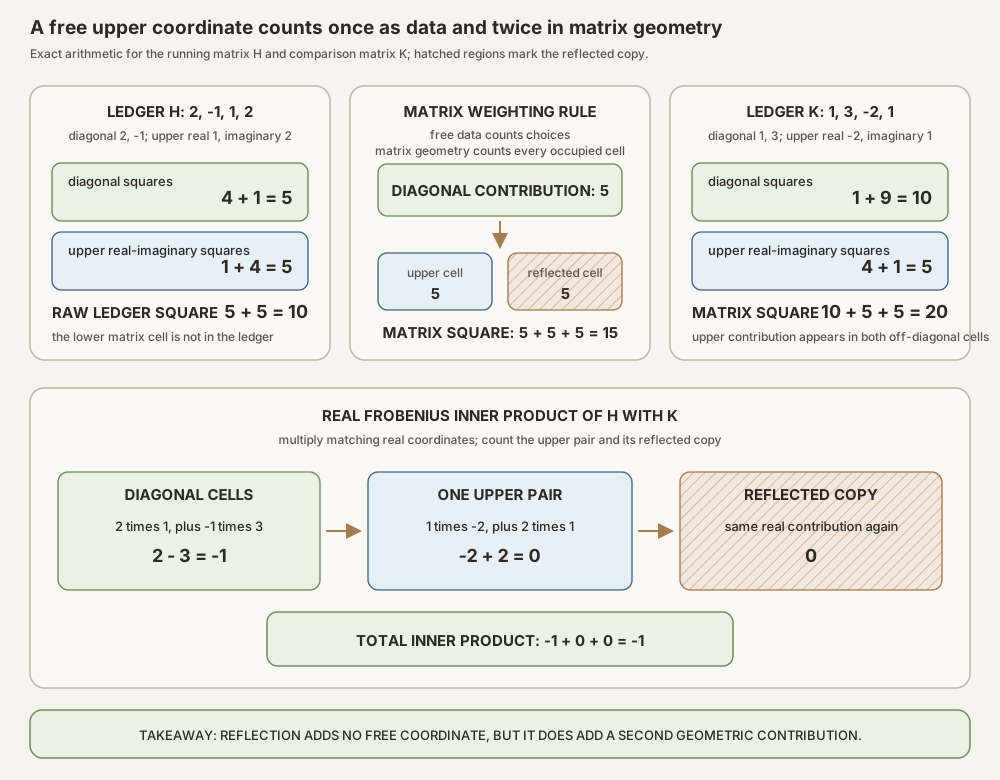
There are two equivalent ways to remember the factor of two:
- keep the raw upper real and imaginary parts \((a,b)\) and use the weighted inner product above; or
- replace them by \((\sqrt2a,\sqrt2b)\), after which the ordinary Euclidean dot product has the right size.
For the running example, the second convention stores \((2,-1,\sqrt2,2\sqrt2)\), whose ordinary squared length is \(4+1+2+8=15\). The RMT-05 module in this chapter does not formalize this inner-product structure or the normalized-coordinate equivalence. Those are later checked layers explained in normalized Hermitian coordinates and Hermitian Frobenius geometry . The present module supplies the unscaled assembly map on which that geometry is built.
Camp five: Hermiticity is a three-case proof
Mathlib defines Matrix.IsHermitian H by \(H^*=H\). Its entrywise
criterion asks for
Fix indices \(i\) and \(j\). A finite linear order gives exactly three cases.
Case one: \(i\lt j\)
The forward entry is strict upper and the reflected entry is lower:
\[ H_{ij}=u_{ij}, \qquad H_{ji}=\overline{u_{ij}}. \]Therefore
\[ \overline{H_{ji}} =\overline{\overline{u_{ij}}} =u_{ij} =H_{ij}. \]Case two: \(i=j\)
The diagonal entry is the complex coercion of a real number:
\[ H_{ii}=d_i. \]Real numbers are fixed by complex conjugation, so
\[ \overline{H_{ii}}=\overline{d_i}=d_i=H_{ii}. \]This is why the diagonal input type is \(\mathbb R\), not \(\mathbb C\). A putative diagonal value \(2+i\) would become \(2-i\) under conjugation and would fail the diagonal equation. The type rules out that near-miss before a proof starts.
Case three: \(j\lt i\)
This is the reflected version of case one:
\[ H_{ij}=\overline{u_{ji}}, \qquad H_{ji}=u_{ji}. \]Conjugating the second equation gives exactly the first.
The Lean theorem
RandomMatrix.hermitianFromCoordinates_isHermitian follows this
architecture. It rewrites Hermiticity to the entrywise criterion, splits with
lt_trichotomy i j, and applies the three entry simplification
theorems. There is no probability space and no almost-everywhere qualifier.
The result holds for every coordinate input.
In Lean: assembly is Hermitian for every input
(RandomMatrix.hermitianFromCoordinates d u).IsHermitian- The parentheses first build the matrix from
dandu. .IsHermitianis Mathlib’s predicate that the conjugate transpose equals the original matrix.- The exact theorem
RandomMatrix.hermitianFromCoordinates_isHermitian d uproduces a proof of this proposition. - No symbol for a measure, an outcome, or “almost every” occurs. The claim is pointwise in the coordinate input.
- In the proof source,
lt_trichotomy i jcreates the upper, diagonal, and lower cases used in the hand argument.
Physics window: reality and conjugate couplings
Hermiticity is the finite-dimensional algebra behind two central physics facts. Let \(\psi\in\mathbb C^n\) be a column vector and let \(\psi^\dagger\) be its conjugate transpose. The quadratic form of a Hermitian matrix is real:
\[ \begin{aligned} \overline{\psi^\dagger H\psi} &=\psi^\dagger H^*\psi\\ &=\psi^\dagger H\psi. \end{aligned} \]In quantum mechanics, when \(H\) is a Hamiltonian, this reality is the algebraic prerequisite for real expectation values. The paired entries \(H_{ij}\) and \(H_{ji}=\overline{H_{ij}}\) are conjugate coupling matrix elements between the two basis directions. They are not themselves transition amplitudes or probabilities, and the relationship does not say that matrix coordinates are statistically independent.
Hermiticity also turns \(-iH\) into a skew-Hermitian generator:
\[ (-iH)^*=iH^*=iH=-(-iH). \]Consequently, in finite dimensions and in units where \(\hbar=1\), the exponential \(U(t)=\exp(-itH)\) is unitary, which preserves inner products during Schrödinger evolution. This paragraph is mathematical and physical context. The present Lean module formalizes neither state vectors, quadratic forms, matrix exponentials, spectra, quantum measurement, nor time evolution. It checks only deterministic coordinate assembly, Hermiticity, and measurability.
Camp six: measurability reduces to scalar coordinates
Let the coordinate data vary with an outcome \(\omega\) in a measurable space \(\Omega\):
\[ d:\Omega\to(\operatorname{Fin}(n)\to\mathbb R), \qquad u:\Omega\to(I_n^{\lt}\to\mathbb C). \]For each fixed diagonal index \(i\), assume \(\omega\mapsto d(\omega)_i\) is measurable. For each fixed strict-upper index \(q\), assume \(\omega\mapsto u(\omega)_q\) is measurable. The assembled sample map is
\[ \omega\longmapsto \operatorname{assemble}\bigl(d(\omega),u(\omega)\bigr). \]The project’s matrix measurable space is entrywise: a matrix-valued function is measurable exactly when every fixed entry is measurable. Fix \(i,j\) and reuse the order branches.
- If \(i\lt j\), the output entry is the assumed measurable map \(\omega\mapsto u(\omega)_{ij}\).
- If \(j\lt i\), the output is the conjugate of \(\omega\mapsto u(\omega)_{ji}\). Complex conjugation is continuous and therefore measurable.
- Otherwise the output is the assumed measurable real diagonal map, followed by the continuous inclusion \(\mathbb R\to\mathbb C\).
This is
RandomMatrix.measurable_hermitianFromCoordinates. Its hypotheses
are ordinary coordinatewise Measurable statements. It needs no
measure on \(\Omega\), and it infers no laws, moments, or independence.
The canonical coordinate map
Package the two coordinate functions as one point \(x=(d,u)\) of the Hermitian coordinate space . The project defines
def hermitianCoordinateMap (n : ℕ) :
    HermitianCoordinateSpace n → Matrix (Fin n) (Fin n) ℂ :=
  fun x ↦ hermitianFromCoordinates x.1 x.2
The theorem measurable_hermitianCoordinateMap n proves this map
measurable. Coordinate evaluation on each function-space factor is measurable;
composition with the product projections supplies the hypotheses of the
general assembly theorem.
This named map is the eventual transport bridge. A later module may place a
probability measure on the coordinate space and push it forward through
hermitianCoordinateMap. RMT-05 does not perform that pushforward
or choose a source measure.
In Lean: coordinatewise measurability lifts through assembly
Measurable fun ω ↦ RandomMatrix.hermitianFromCoordinates (d ω) (u ω)fun ω ↦ …is an anonymous function of the outcomeω.d ωandu ωare the two coordinate families at that outcome.Measurableis a predicate on the whole matrix-valued function.- The theorem
RandomMatrix.measurable_hermitianFromCoordinates hd huproves the displayed proposition from coordinatewise hypotheseshdandhu. - A measurable space tells Lean which preimages are legitimate events. No measure, probability mass, density, or expectation is introduced here.
Camp seven: bundle the sample map without adding a law
The existing HermitianRandomMatrix structure packages a matrix
sample map with two proofs:
- the sample map is measurable; and
- every realized matrix is Hermitian.
The constructor HermitianRandomMatrix.ofCoordinates takes the
coordinate processes \(d\) and \(u\), together with their coordinatewise
measurability proofs. Its underlying matrix is direct assembly. The
measurability field is filled by
measurable_hermitianFromCoordinates, and the pointwise symmetry
field is filled by hermitianFromCoordinates_isHermitian.
The theorem HermitianRandomMatrix.ofCoordinates_apply exposes the
bundle at an outcome:
The word random in the carrier name does not add a probability measure. The bundle is a measurable Hermitian sample map on a measurable outcome space. Its law becomes meaningful only after a measure is supplied separately.
The separation keeps the constructor reusable. The same assembly works for Gaussian coordinates, bounded coordinates, empirical inputs, or fully deterministic functions. Hermiticity and measurability do not depend on which later probability model is chosen.
Camp eight: dimension zero is not an exception
When \(n=0\), Fin 0 has no values. Consequently:
- the diagonal index type is empty;
StrictUpperIndex 0is empty;- there is exactly one diagonal function from
Fin 0to \(\mathbb R\); - there is exactly one strict-upper function into \(\mathbb C\); and
- a matrix indexed by
Fin 0in both directions has no entries.
Two functions with an empty domain are equal because there is no input on which they can differ. The coordinate product therefore contains one point. The matrix space also contains one matrix, represented by the zero matrix.
The theorem hermitianFromCoordinates_zero proves that every
zero-dimensional input assembles to this unique zero matrix. The theorem
hermitianCoordinateMap_zero states the same fact for the named
coordinate map.
The proofs do not divide by \(n\), appeal to a density, or special-case a random law. They eliminate the impossible row index. This settles the deterministic boundary. A later dimension-dependent ensemble still needs its own explicit \(n=0\) probability policy.
Type the running example yourself with Lean and Std
The project theorem uses Mathlib’s complex numbers, matrices, measurable
spaces, and Hermitian predicate. Before loading that machinery, a learner can
model the same finite bookkeeping with two small structures. The worksheet
below imports only Lean’s Std library. It is intentionally bounded
and suitable for an ordinary macOS or Linux machine.
Create a scratch directory outside formalization/. Save the exact
block below as HermitianCoordinatesTutorial.lean:
import Std

namespace HermitianCoordinatesTutorial

structure ComplexInt where
  re : Int
  im : Int
  deriving Repr, DecidableEq

def ComplexInt.conj (z : ComplexInt) : ComplexInt :=
  { re := z.re, im := -z.im }

structure Hermitian2Coordinates where
  d0 : Int
  d1 : Int
  upper : ComplexInt
  deriving Repr, DecidableEq

structure Matrix2 where
  a00 : ComplexInt
  a01 : ComplexInt
  a10 : ComplexInt
  a11 : ComplexInt
  deriving Repr, DecidableEq

def Matrix2.IsHermitian (A : Matrix2) : Prop :=
  A.a00.im = 0 ∧
  A.a11.im = 0 ∧
  A.a10 = A.a01.conj

instance (A : Matrix2) : Decidable (Matrix2.IsHermitian A) := by
  unfold Matrix2.IsHermitian
  infer_instance

def assemble (x : Hermitian2Coordinates) : Matrix2 :=
  { a00 := { re := x.d0, im := 0 }
    a01 := x.upper
    a10 := x.upper.conj
    a11 := { re := x.d1, im := 0 } }

def extract (A : Matrix2) : Hermitian2Coordinates :=
  { d0 := A.a00.re
    d1 := A.a11.re
    upper := A.a01 }

def rawLedgerSq (x : Hermitian2Coordinates) : Int :=
  x.d0 * x.d0 + x.d1 * x.d1 +
    x.upper.re * x.upper.re + x.upper.im * x.upper.im

def frobeniusSq (x : Hermitian2Coordinates) : Int :=
  x.d0 * x.d0 + x.d1 * x.d1 +
    2 * (x.upper.re * x.upper.re + x.upper.im * x.upper.im)

def frobeniusInner
    (x y : Hermitian2Coordinates) : Int :=
  x.d0 * y.d0 + x.d1 * y.d1 +
    2 * (x.upper.re * y.upper.re + x.upper.im * y.upper.im)

def q : Hermitian2Coordinates :=
  { d0 := 2
    d1 := -1
    upper := { re := 1, im := 2 } }

def r : Hermitian2Coordinates :=
  { d0 := 1
    d1 := 3
    upper := { re := -2, im := 1 } }

def nearMiss : Matrix2 :=
  { a00 := { re := 2, im := 0 }
    a01 := { re := 1, im := 2 }
    a10 := { re := 1, im := 2 }
    a11 := { re := -1, im := 0 } }

#eval [decide (extract (assemble q) = q),
  decide (Matrix2.IsHermitian (assemble q)),
  decide (Matrix2.IsHermitian nearMiss)]

#eval [rawLedgerSq q, frobeniusSq q,
  frobeniusInner q r, frobeniusSq r]

example : extract (assemble q) = q := by decide
example : Matrix2.IsHermitian (assemble q) := by decide
example : ¬ Matrix2.IsHermitian nearMiss := by decide
example : rawLedgerSq q = 10 := by decide
example : frobeniusSq q = 15 := by decide
example : frobeniusInner q r = -1 := by decide
example : frobeniusSq r = 20 := by decide

end HermitianCoordinatesTutorial
Open a terminal in that scratch directory and type:
source "$HOME/.elan/env"
elan run leanprover/lean4:v4.32.0 lean HermitianCoordinatesTutorial.lean
This exact worksheet was executed successfully with Lean 4.32.0 while editing this chapter. Its output was
[true, true, false]
[10, 15, -1, 20]
Read the first line as: extraction reconstructs \(q\); assembled \(q\) is
Hermitian; the copied-without-conjugating near-miss is not. Read the second as
the raw ledger square, \(H\)’s Frobenius square, the real Frobenius inner
product of \(H\) with \(K\), and \(K\)’s Frobenius square. Each
example is a kernel-checked proof of the corresponding equality.
This miniature uses integer real-imaginary pairs, not Mathlib’s
ℂ or Matrix. It does not prove the general
dimension count, measurable assembly, or the project theorem. Most
importantly, the command loads only the pinned Lean compiler and
Std; it does not run Lake, import Mathlib, or compile this project.
The checked declaration map
The module
NonlinearDynamics.Random.RandomMatrices.HermitianCoordinates
exports 17 public declarations. The table separates checked content from
interpretations that the declaration does not add.
| Declaration | Checked content | Does not add |
|---|---|---|
StrictUpperIndex | Finite pairs whose row is less than their column | A cardinality formula or random coordinates |
StrictUpperIndex.instFintype | Finiteness of the strict-upper index type | An ordering of random variables |
StrictUpperIndex.instDecidableEq | Decidable equality of strict-upper indices | Independence or identical distributions |
StrictUpperIndex.instIsEmptyZero | No strict-upper index exists at size zero | A matrix law |
HermitianCoordinateSpace | Real diagonal paired with complex strict upper triangle | Proof fields, a measure, or a scale |
RandomMatrix.hermitianFromCoordinates | Direct three-branch matrix assembly | Gaussianity or normalization |
RandomMatrix.hermitianFromCoordinates_apply_diag | Diagonal entry is the supplied real coordinate | A diagonal distribution |
RandomMatrix.hermitianFromCoordinates_apply_upper | Upper entry is the supplied complex coordinate | An upper-coordinate distribution |
RandomMatrix.hermitianFromCoordinates_apply_lower | Lower entry is the conjugate of the reflected upper coordinate | A free lower coordinate |
RandomMatrix.hermitianFromCoordinates_isHermitian | Every assembled matrix is Hermitian | Unitary invariance of a law |
RandomMatrix.measurable_hermitianFromCoordinates | Coordinatewise measurable processes assemble measurably | A probability measure or almost-everywhere repair |
RandomMatrix.hermitianCoordinateMap | Named map from coordinate space to matrices | An inverse or linear equivalence |
RandomMatrix.measurable_hermitianCoordinateMap | The named map is measurable | Measure preservation |
RandomMatrix.hermitianFromCoordinates_zero | Zero-dimensional assembly is the zero matrix | A zero-dimensional ensemble law |
RandomMatrix.hermitianCoordinateMap_zero | The named zero-dimensional map is constantly zero | A Dirac-law theorem |
HermitianRandomMatrix.ofCoordinates | Bundled measurable pointwise-Hermitian sample map | A base probability measure |
HermitianRandomMatrix.ofCoordinates_apply | Bundle evaluation reduces to direct assembly | Any law or moment statement |
The repository’s recorded project validation compiled all 17 declarations
under Lean 4.32.0 and the pinned Mathlib 4.32.0 dependency. The module contains
no sorry or admit.
The full project command below is the exact route for a fresh replay.
Inspect and check the exact project interfaces
The authoritative source is
formalization/NonlinearDynamics/Random/RandomMatrices/HermitianCoordinates.lean.
After installing the repository’s pinned dependencies, put these exact lines
in a temporary project scratch file:
import NonlinearDynamics.Random.RandomMatrices.HermitianCoordinates

open Matrix MeasureTheory
open scoped Matrix
open NonlinearDynamics.Random

#check StrictUpperIndex
#check HermitianCoordinateSpace
#print RandomMatrix.hermitianFromCoordinates
#check RandomMatrix.hermitianFromCoordinates_apply_diag
#check RandomMatrix.hermitianFromCoordinates_apply_upper
#check RandomMatrix.hermitianFromCoordinates_apply_lower
#check RandomMatrix.hermitianFromCoordinates_isHermitian
#check RandomMatrix.measurable_hermitianFromCoordinates
#check RandomMatrix.hermitianCoordinateMap
#check RandomMatrix.measurable_hermitianCoordinateMap
#check RandomMatrix.hermitianFromCoordinates_zero
#check RandomMatrix.hermitianCoordinateMap_zero
#check HermitianRandomMatrix.ofCoordinates
#check HermitianRandomMatrix.ofCoordinates_apply
import loads the exact project module and its pinned Mathlib
dependencies. #print shows the constructor body, while each
#check elaborates an existing declaration and reports
its type. These commands neither sample a random matrix nor establish any
probability law. The full project command below checks the authoritative
source file.
cd formalization
lake env lean -DwarningAsError=true NonlinearDynamics/Random/RandomMatrices/HermitianCoordinates.lean
Resource note: this exact file uses the repository's
pinned Lean and Mathlib dependencies. Initial project setup can require
substantial disk space and build time. For a lightweight first step on
macOS or Linux, use the page's standalone Lean-core or Std
tutorial.
Checked Lean and mathematical context are different layers
The \(n^2\) count suggests a bijection between \(\mathcal C_n\) and the real vector space of Hermitian matrices. Read a Hermitian matrix’s real diagonal and strict upper triangle, then assemble them back. Conversely, assemble coordinates and extract those same positions.
That paper argument is useful context, but RMT-05 does not package it as a Lean inverse, equivalence, real-linear equivalence, topology theorem, or dimension theorem. The forward measurable map is the smallest interface needed by the next probability milestone. If later proofs need Jacobians, densities, or an intrinsic Euclidean structure, the inverse and linear geometry should become explicit declarations rather than being assumed from the count.
Likewise, measurability means that a source measure can be transported through the assembly map. It does not identify the source measure, prove a pushforward identity in this module, or establish invariance under unitary conjugation.
| Layer | Available now | Still separate |
|---|---|---|
| Algebraic coordinates | Strict-upper type, coordinate product, entry insertion | Extractor, inverse, real-linear equivalence |
| Coordinate geometry | Exact paper calculation for the running two-by-two ledgers | RMT-05 has no norm, inner-product, isometry, or dimension declaration |
| Symmetry | Pointwise Hermiticity for every input | Spectral applications in this module |
| Measurability | Coordinatewise assembly and canonical map | A base measure or probability law |
| Boundary | Unique zero-dimensional output is zero | A zero-dimensional ensemble policy |
| Probability | No claim | Coordinate laws, independence, pushforward law |
| Ensemble symmetry | No claim | Nontrivial unitary invariance |
The ridge toward a finite Gaussian matrix law
At the RMT-05 boundary, the deterministic map made a later probability construction possible without making it automatic. That law-level module still needed to:
- choose real random coordinates for the diagonal;
- choose complex random coordinates for the strict upper triangle;
- state their complete joint law and dependence structure;
- select the diagonal variance and both real component variances of every complex upper coordinate;
- state every dimension-dependent scale and the \(n=0\) policy;
- define the coordinate probability measure;
- push that measure through the measurable assembly map;
- prove that the resulting law has Hermitian support; and
- separately prove any nontrivial unitary-invariance or moment theorem.
The existing independent Cartesian complex Gaussian family can eventually supply the upper-coordinate side of such a ledger. It does not supply the real diagonal family or decide the matrix normalization. The normalization convention entry tracks the choices that remain open.
The lower triangle will never be an independent primitive family in this route. Its entries are deterministic functions of upper coordinates. This does not prevent the full matrix from having a rich law; it identifies the correct primitive building blocks before assembly.
RMT-06 has now completed items 1 through 7 with a Wigner-scale coordinate product law and an explicit zero branch. Measure-level Hermitian support, unitary invariance, and moments remain separate. Continue to Finite GUE from Independent Gaussian Coordinates for the completed probability bridge.
Common wrong turns
Treating every matrix slot as a primitive coordinate
This conflicts with Hermitian reflection unless lower entries are identified with conjugates of upper entries. Use the strict upper triangle as the primitive complex index type.
Letting diagonal coordinates be arbitrary complex numbers
Hermitian diagonals must be real. A real-valued input type enforces this before the proof begins.
Using \(X+X^*\) without tracking the diagonal
Universal symmetrization doubles a real diagonal. It is not a transparent insertion of already named coordinates.
Giving the raw ledger the ordinary Euclidean dot product
The raw upper real and imaginary coordinates each appear in two matrix cells. Without a factor of two in the coordinate metric, the running ledger has squared length 10 while its assembled matrix has Frobenius square 15. Use the weighted metric, or rescale upper coordinates by \(\sqrt2\), and state which convention is active.
Calling measurability a probability law
A measurable function has well-formed preimages. It has no distribution until a measure on its domain is supplied.
Calling the primitive coordinates independent
RMT-05 contains no independence assumption or theorem. It works for arbitrary coordinate functions, including deterministically dependent ones.
Inferring a GUE law from Hermiticity
Hermiticity is an algebraic support constraint. It fixes neither a Gaussian law nor a dimension scale nor invariance under unitary conjugation.
Ignoring \(n=0\) until a reciprocal appears
The deterministic coordinate map is well-defined at size zero. A later model that uses \(1/n\) or \(1/\sqrt n\) must state its own boundary policy.
Assuming the dimension count is already formalized
The count is correct mathematical context, but the module has no named cardinality or dimension theorem. Cite the checked forward map for checked claims and label the count as context.
Exercises
- Count. Derive the real-coordinate count for \(n=4\), then compare it with \(n^2\).
- Assemble. Write the matrix produced from a real diagonal \((a,b)\) and one complex strict-upper coordinate \(x+iy\).
- Reflect. Verify the entrywise Hermitian equation for \(j\lt i\) without citing the upper case.
- Geometry. Recompute \(\lVert H\rVert_F^2=15\) directly from the four matrix entries, then recover the same answer from the weighted ledger.
- Cross term. Expand \(\operatorname{Re}\sum_{i,j}\overline{H_{ij}}K_{ij}\) and verify that the two off-diagonal contributions have real part zero.
- Diagnose. Build the upper-triangular temporary matrix for the worked example and compute the diagonal of \(X+X^*\).
- Measure. Explain why conjugating a measurable complex coordinate preserves measurability but need not leave its law unchanged.
- Boundary. Prove that any two matrices indexed by
Fin 0are equal. - Lean. Change
nearMiss.a10.imfrom 2 to -2 in the standalone worksheet and predict which output changes before rerunning it. - Project Lean. Locate the branch in
measurable_hermitianFromCoordinateswhere conjugation is used. - Design. State the type of an inverse that extracts coordinates from a Hermitian matrix subtype.
- Scope. Separate the hypotheses for a pushforward probability law from those needed for unitary invariance.
Summit register
The checked module provides a finite strict-upper index type, a normalization-free coordinate space, direct assembly, exact entry formulas, pointwise Hermiticity, coordinatewise and canonical measurability, an explicit zero-dimensional result, and a bundled measurable Hermitian sample map.
The mathematical count explains \(n^2\) real degrees of freedom, and the
running example explains the weighted norm and inner product. Neither is a
named theorem in this RMT-05 module. The standalone Std worksheet
checks only its finite integer model. The project module does not define an
inverse, dimension theorem, Frobenius isometry, probability measure,
coordinate law, independence, Gaussian ensemble, density, normalization,
unitary invariance, eigenvalue map, trace expectation, or asymptotic result.
That boundary is the achievement. A later probability module can now make every distributional choice visibly rather than hiding one in matrix bookkeeping.
Where to continue
Use the Hermitian coordinate space entry for the compact definition, degree count, and boundary checklist. Random Matrices: From Outcomes to Spectra develops the surrounding sample-map, Hermiticity, law, and observable layers.
Finite Product Probability Spaces and Independent Gaussian Fields provides exact finite product laws for independent complex coordinates. Gaussian Laws, Independence, and Normalization and Complex Gaussian Coordinates and Geometry explain scalar laws and visible variance ledgers a later ensemble may use.
Read probability law and pushforward measure before transporting a coordinate measure. Read unitary invariance for the separate law-level symmetry claim that direct assembly does not prove.
The next checked layer is Finite GUE from Independent Gaussian Coordinates, which supplies the Wigner ledger, canonical product measure, exact independence architecture, and matrix pushforward.
References
Lean contributors.
Subtypes,
The Lean Language Reference. This official reference explains the
value-plus-proof packaging used by StrictUpperIndex and the
notation {x : α // p x}.
Mathlib contributors.
Hermitian matrices,
Mathlib 4 documentation. This official API defines
Matrix.IsHermitian and its entrywise criterion.
Mathlib contributors. Measurable spaces and measurable functions, Mathlib 4 documentation. This is the official foundation for measurable spaces, measurable maps, and composition.
Mathlib contributors.
Finite index types,
Mathlib 4 documentation. This documents Fin n and the empty
Fin 0 type used in the boundary proofs.
John von Neumann. Mathematical Foundations of Quantum Mechanics, Princeton University Press, English translation first published in 1955. This foundational source supplies the broader operator-theoretic physics context for Hermitian observables and unitary evolution. The present Lean module does not formalize that quantum-mechanical layer.
Terence Tao. Topics in Random Matrix Theory, Graduate Studies in Mathematics 132, American Mathematical Society, 2012. This monograph supplies broader context, not an unproved law for this module.
Greg W. Anderson, Alice Guionnet, and Ofer Zeitouni. An Introduction to Random Matrices, Cambridge Studies in Advanced Mathematics 118, Cambridge University Press, 2010. This monograph provides systematic context for Hermitian coordinate models and Gaussian ensembles. The present chapter stops before those probability choices.
The exact upstream Lean source audited for this chapter is
Mathlib commit 81a5d257,
the revision pinned by formalization/lake-manifest.json.