Begin with two atoms and one first witness
Let
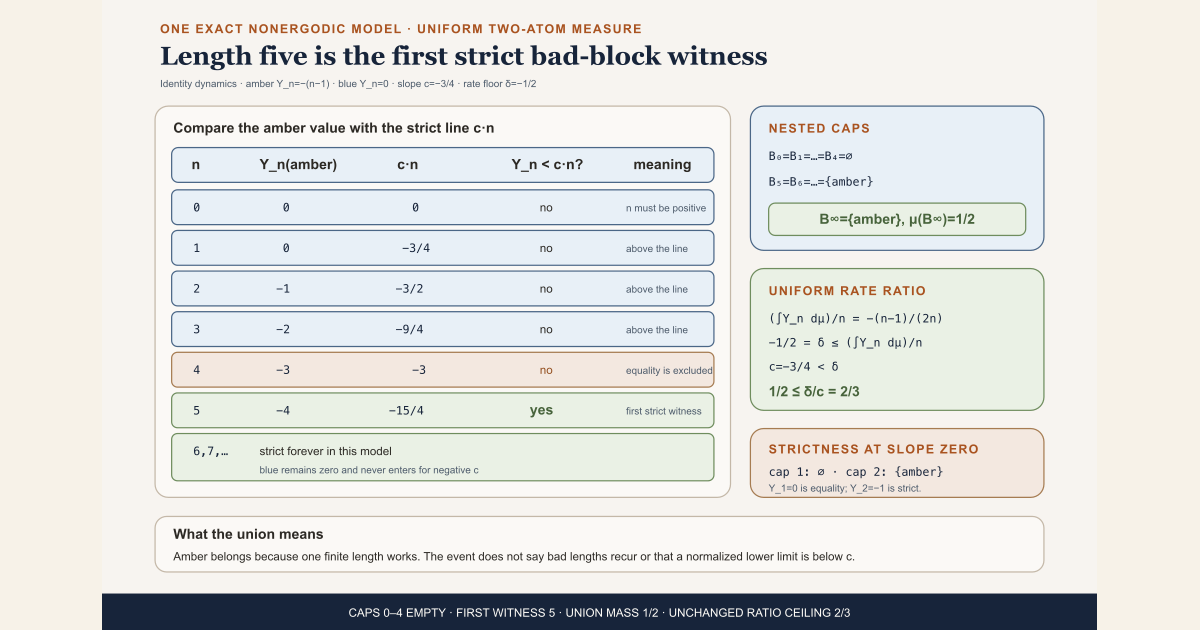
\[ \Omega=\{\text{amber},\text{blue}\} \]carry the uniform probability measure, so each atom has mass \(1/2\). Let the base map be the identity. This system preserves the measure but is not ergodic: each singleton is invariant and has nonzero, nonfull mass.
Use the centered process
\[ Y_n(\text{amber})=-(n-1), \qquad Y_n(\text{blue})=0. \]Natural-number subtraction is truncated, so \(Y_0(\text{amber})=0\), and \(Y_1=0\) at both atoms. Choose the slope
\[ c=-\frac34. \]A positive length \(n\) is a strict bad-block witness at \(x\) when
\[ Y_n(x)\lt cn. \]For blue this never happens: \(0\) cannot lie below the negative number \(-3n/4\). For amber, the complete first ledger is:
| \(n\) | \(Y_n(\text{amber})\) | \(cn\) | strict witness? | reason |
|---|---|---|---|---|
| \(0\) | \(0\) | \(0\) | no | witnesses must have positive length |
| \(1\) | \(0\) | \(-3/4\) | no | the value lies above the line |
| \(2\) | \(-1\) | \(-3/2\) | no | the value lies above the line |
| \(3\) | \(-2\) | \(-9/4\) | no | the value lies above the line |
| \(4\) | \(-3\) | \(-3\) | no | equality is not strict |
| \(5\) | \(-4\) | \(-15/4\) | yes | first strict witness |
| \(6\) | \(-5\) | \(-9/2\) | yes | the point remains discoverable |
| \(7\) | \(-6\) | \(-21/4\) | yes | the point remains discoverable |
The algebra isolates the same boundary:
\[ -(n-1)\lt-\frac34n \quad\Longleftrightarrow\quad 1\lt\frac14n \quad\Longleftrightarrow\quad 4\lt n. \]If \(B_m(c)\) searches only lengths \(1,\ldots,m\), then
\[ B_0(c)=B_1(c)=\cdots=B_4(c)=\varnothing, \]while
\[ B_5(c)=B_6(c)=\cdots=\{\text{amber}\}. \]Removing the cap does not create an infinite witness. It merely permits the finite witness \(n=5\):
\[ B_\infty(c) {} = \bigcup_{m\in\mathbb N}B_m(c) =\{\text{amber}\}, \qquad \mu(B_\infty(c))=\frac12. \]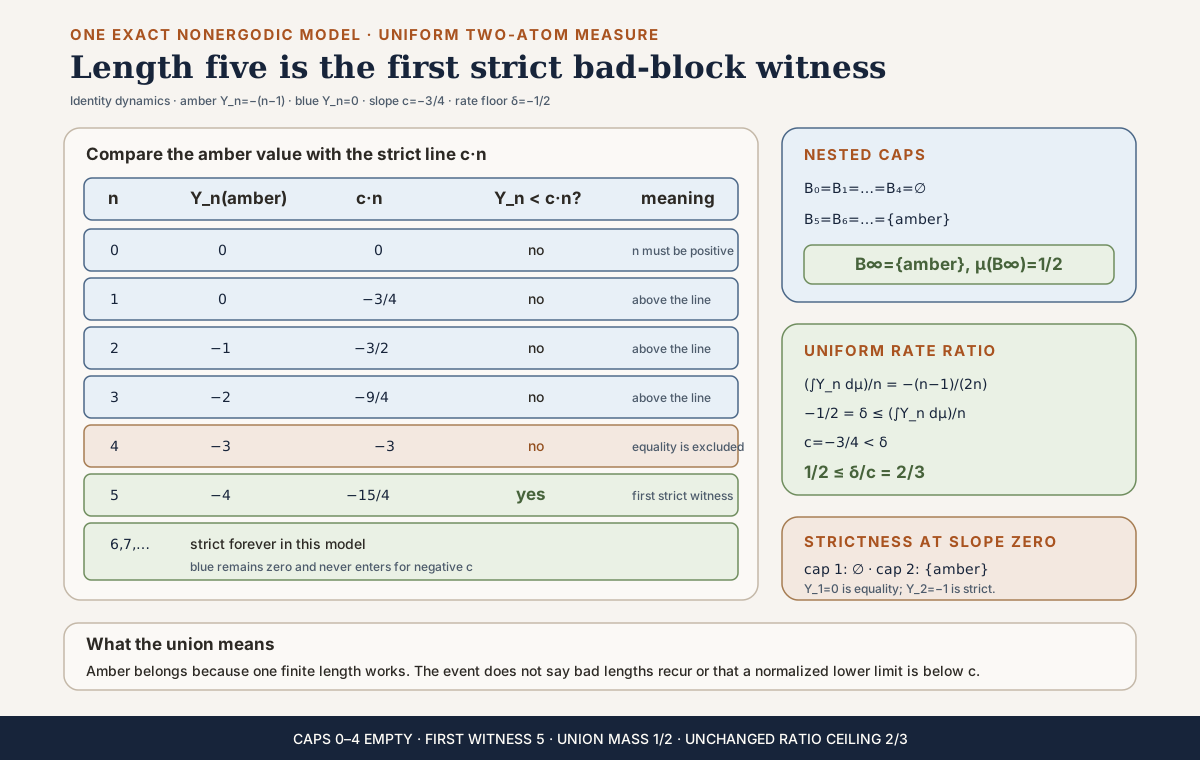
See the rate premise numerically
Uniform integration gives, for every positive \(n\),
\[ \int_\Omega Y_n\,d\mu {} = \frac12\bigl(-(n-1)\bigr)+\frac12\cdot0 =-\frac{n-1}{2}. \]After normalization,
\[ \frac{\int_\Omega Y_n\,d\mu}{n} =-\frac{n-1}{2n} =-\frac12+\frac{1}{2n}. \]Set
\[ \delta=-\frac12. \]Then \(\delta\) is a lower bound for every positive normalized integral, and
\[ c=-\frac34\lt-\frac12=\delta. \]The generic RMT-31 conclusion becomes
\[ \mu(B_\infty(c)) =\frac12 \le \frac{\delta}{c} =\frac{-1/2}{-3/4} =\frac23. \]The theorem does not need ergodicity, and this identity model is explicitly nonergodic. It also does not need probability normalization; the uniform probability is used here only because it makes every number transparent.
Let equality fail first and strictness succeed later
Set the slope to zero while keeping the same process. At length one,
\[ Y_1(\text{amber})=0=0\cdot1, \]so the strict comparison fails. At length two,
\[ Y_2(\text{amber})=-1\lt0\cdot2, \]so amber enters. Therefore
\[ B_1(0)=\varnothing, \qquad B_2(0)=\{\text{amber}\}. \]This nearby boundary prevents two common mistakes: replacing strict \(\lt\) by non-strict \(\le\), or deciding the uncapped event from length one alone.
Separate one bad length from recurrence and invariance
Now use a different two-atom model. Let the base map collapse both atoms to blue:
\[ T(\text{amber})=\text{blue}, \qquad T(\text{blue})=\text{blue}. \]The Dirac measure at blue is preserved. Define a one-shot centered process by
\[ Y_n(\text{blue})=0 \]for every \(n\), and
\[ Y_1(\text{amber})=0, \qquad Y_n(\text{amber})=-1\quad(n\ge2). \]Choose \(c=-2/5\). Amber is strict at exactly one positive length:
| \(n\) | \(Y_n(\text{amber})\) | \(cn\) | strict? |
|---|---|---|---|
| \(1\) | \(0\) | \(-2/5\) | no |
| \(2\) | \(-1\) | \(-4/5\) | yes |
| \(3\) | \(-1\) | \(-6/5\) | no |
| \(4\) | \(-1\) | \(-8/5\) | no |
For \(n\ge3\), the line keeps moving downward while the one-shot value stays at \(-1\), so there are no arbitrarily late witnesses. Nevertheless,
\[ B_\infty(-2/5)=\{\text{amber}\} \]because the raw event asks for one witness. The collapse map never lands at amber, hence
\[ T^{-1}\bigl(B_\infty(-2/5)\bigr)=\varnothing \ne \{\text{amber}\}=B_\infty(-2/5). \]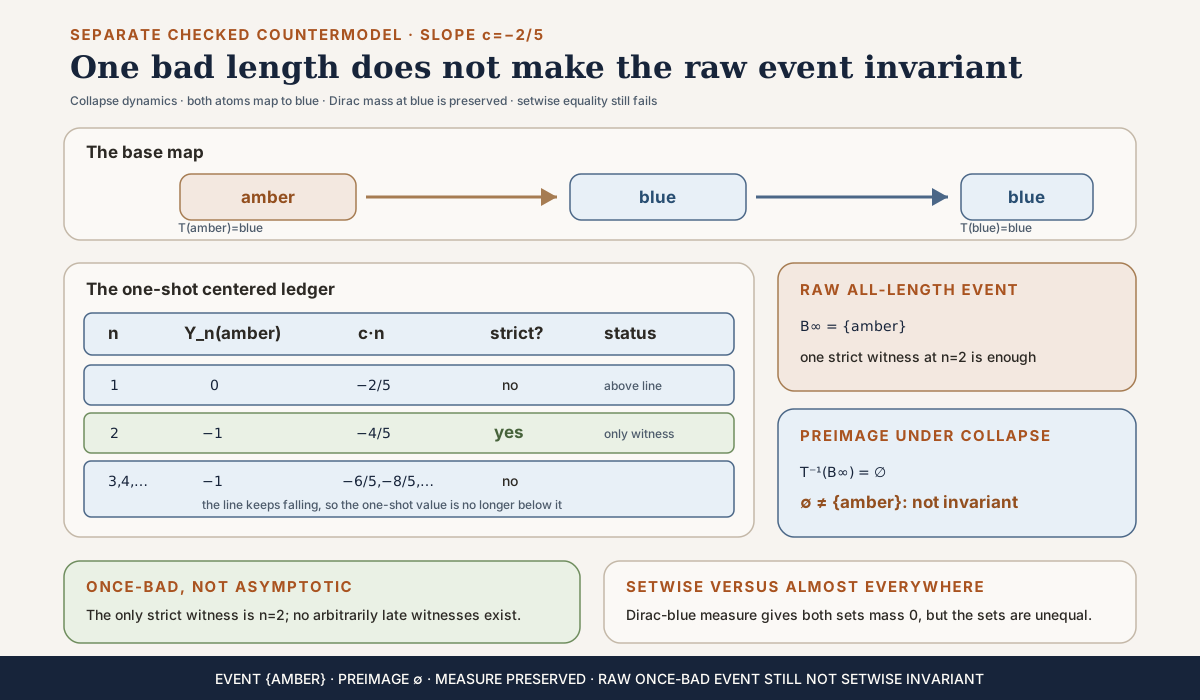
The two models serve different purposes. The identity model checks nested caps, the first strict witness, the uniform rate premise, and the \(1/2\le2/3\) ratio. The collapse model checks that a one-witness union can be setwise noninvariant even for a preserved finite measure and a valid shifted-subadditive process.
RMT-30 fixes a natural-number cap \(m\) and controls the points at which some centered block of length at most \(m\) falls strictly below a line. RMT-31 removes the cap. Three operations must remain separate:
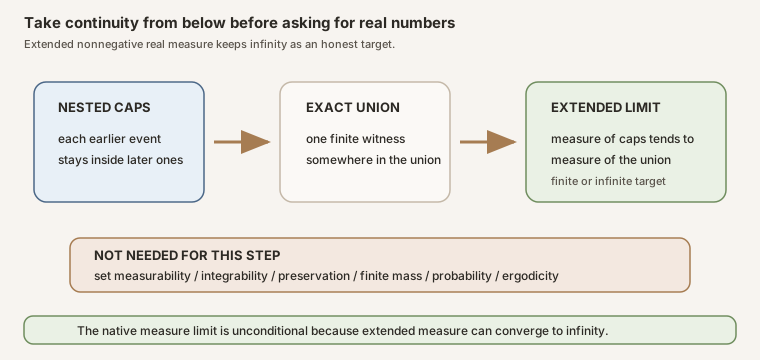
- identify the all-length event exactly as a nested union;
- take the limit in the native extended measure type; and
- project to real measure only after ruling out an infinite target.
The last operation is where finite mass enters. It is not needed for the set identity, null measurability, or extended-measure continuity. Once the real limit is justified, the same upper bound that RMT-30 proves for every cap passes to the union by closedness of an upper interval.
This is one measure-theoretic bridge inside Kingman’s much stronger subadditive ergodic theorem (Kingman 1968). The finite interval-decomposition perspective is also visible in Steele’s exposition (Steele 1989); neither source is claimed to contain this repository’s Lean interface.
This chapter is the textbook companion to the RMT-31 Development Notebook. Its input comes from Finite Bad-Block Measure Bounds Before Kingman Lower Liminf. Useful compact references are orbit-majorant centering , finite orbit-visit count , and integrated log-positive growth rate .
Choose a route up
| Route | Begin | Destination |
|---|---|---|
| Event | Start with finite caps | Separate one witness from recurrent failure |
| Set | Nest the caps | Prove the exact increasing union |
| Regularity | Take the countable null-measurable union | See why finite mass is absent |
| Measure | Use extended measure first | Apply unconditional continuity from below |
| Projection | Cross the real-projection cliff | Isolate local finiteness |
| Bound | Transport the uniform RMT-30 ratio | Preserve the ratio without loss |
| Cocycle | Specialize to log-positive cocycles | Discharge the generic rate premise |
| Boundary | The raw event need not be invariant | Read the checked countermodel |
| Next layer | Continue into the checked RMT-32 event | Reach ergodic null selection without claiming a liminf bridge |
| Practice | Thirty solved exercises | Rebuild every bridge |
Common setup and notation
Let \(\Omega\) be a type, \(\mu\) a measure, and \(T:\Omega\to\Omega\) a map. An integrable shifted-subadditive candidate is a family \(X_n:\Omega\to\mathbb R\) satisfying
\[ X_{a+b}(\omega)\le X_b(T^a\omega)+X_a(\omega). \]The repository centers it by subtracting the one-step orbit sum:
\[ Y_n(\omega) {} := X_n(\omega)-\sum_{j=0}^{n-1}X_1(T^j\omega). \]This is pointwise orbit-majorant centering , not expectation centering. It gives \(Y_1=0\), preserves shifted subadditivity, and makes \(Y_n\le0\) for positive \(n\). A block is bad at \(\omega\) when \(Y_n(\omega)\lt cn\). Equality is not a witness.
Start with finite caps
For \(m\in\mathbb N\), RMT-30 defines
\[ B_m(c) {} := \bigcup_{1\le n\le m}\{\omega:Y_n(\omega)\lt cn\}. \]The cap-zero set is empty. At a positive cap, membership means at least one allowed length works, not that every length works. RMT-31 defines
\[ B_\infty(c):=\bigcup_{m\in\mathbb N}B_m(c). \]The infinity symbol describes the search range. Every actual witness is finite. The checked membership theorem is
\[ \omega\in B_\infty(c) \quad\Longleftrightarrow\quad \exists n\in\mathbb N,\quad 0\lt n\ \text{and}\ Y_n(\omega)\lt cn. \]This is a once-bad event. It does not mean failures occur infinitely often, eventually, or along an unbounded sequence.
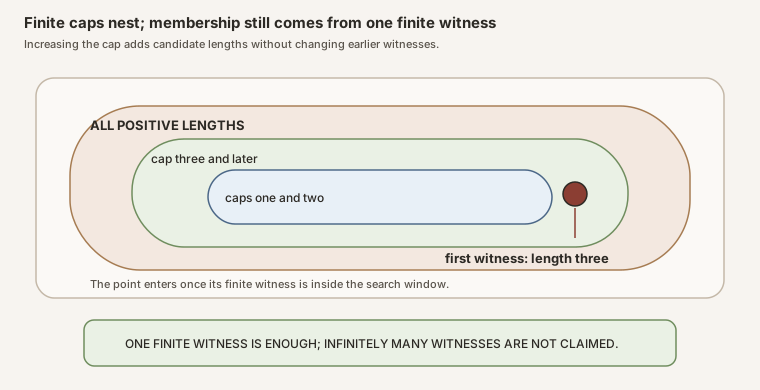
The compiled two-point process calibrates strictness. It has \(Y_1=0\) at both points, while one point has \(Y_2=-1\). At slope \(c=0\), equality at time one contributes nothing but time two is a strict witness. The all-length event can therefore be nonempty when the cap-one event is empty.
Nest the caps
If \(m\le M\), every witness with \(1\le n\le m\) also satisfies \(1\le n\le M\). Thus \(B_m(c)\subseteq B_M(c)\). This is monotonicity of the search window, not a claim that \(Y_m(\omega)\le Y_M(\omega)\).
The all-length definition is already the union, so
centeredAllLengthBadBlockSet_eq_iUnion_finite is proved by
rfl. The theorem
finiteCenteredBadBlockSet_subset_allLength packages inclusion of
any cap. Conversely, given an uncapped witness \(n\), choose cap \(m=n\). No
compactness, limiting witness, supremum, or infinite maximizing time is
involved.
Take the countable null-measurable union
Assume \(X\) is an integrable shifted-subadditive candidate and \(T\) preserves \(\mu\). RMT-30 proves every \(B_m(c)\) null measurable. RMT-31 uses Mathlib’s closure under countable null-measurable unions to prove
\[ \operatorname{NullMeasurableSet}_\mu(B_\infty(c)). \]Integrability supplies almost-everywhere measurability; it need not make the
chosen representatives ordinarily measurable. The theorem does not claim an
ordinary MeasurableSet certificate. Finite total mass,
probability, and ergodicity are absent. Preservation transports integrability
through the dynamics; it does not make this raw union invariant.
Use extended measure first
Lean measures take values in \(\mathbb R_{\ge0\infty}\). Since the caps increase and their union is exact, continuity from below gives
\[ \mu(B_m(c))\longrightarrow\mu(B_\infty(c)). \]tendsto_measure_finiteCenteredBadBlockSet needs no measurability
of the events, integrability, subadditivity, preservation, finite mass,
probability, or ergodicity. Mathlib’s
tendsto_measure_iUnion_atTop
consumes only the increasing-set geometry and permits an infinite target.
Cross the real-projection cliff
Mathlib’s real-valued measure view is
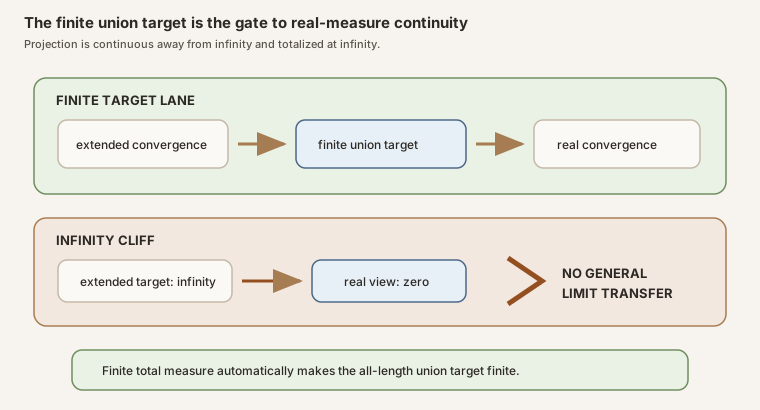
\[ \mu_{\mathbb R}(S):=\operatorname{toReal}(\mu(S)). \]At infinity, \(\operatorname{toReal}(\infty)=0\), so this projection is not continuous there. RMT-31 therefore assumes the local gate
\[ \mu(B_\infty(c))\ne\infty \]before composing
ENNReal.tendsto_toReal with
extended continuity.
The result is
The gate concerns one event, not all of \(\Omega\). A finite measure space is
a convenient stronger interface because every subset has measure at most the
finite total mass; Lean discharges the target by finiteness.
Transport the uniform RMT-30 ratio
Assume \(\mu\) is finite, \(T\) preserves \(\mu\), and \(X\) is an integrable shifted-subadditive candidate. Suppose
\[ \delta\le \frac{\int_\Omega Y_n\,d\mu}{n} \qquad\text{for every }n\ne0, \]and choose \(c\lt\delta\). RMT-30 proves for every cap \(m\) that
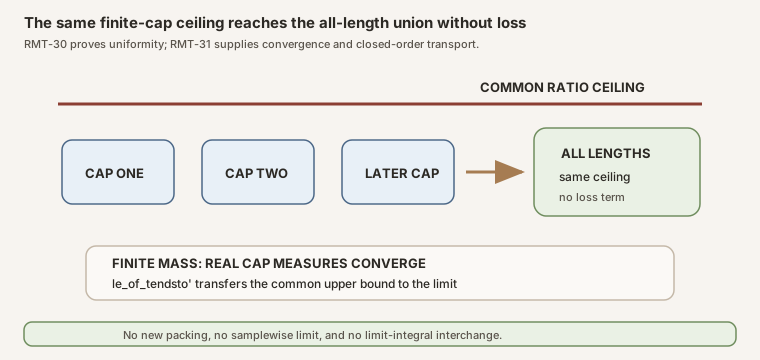
\[ \mu_{\mathbb R}(B_m(c))\le\frac{\delta}{c}. \]The right side is independent of \(m\). Finite mass gives real convergence of
the cap measures. Lean’s
le_of_tendsto’ then says that the limit
of values below one fixed ceiling remains below that ceiling:
The limit passage loses no factor and introduces no error term. It does not repeat interval packing. RMT-30 has done the finite combinatorics; RMT-31 transports the cap-uniform conclusion. Since \(Y_1=0\), the rate premise forces \(\delta\le0\), and \(c\lt\delta\) forces \(c\lt0\).
Finite mass need not mean probability
The theorem uses IsFiniteMeasure μ, not probability. The source
checks a measure of total mass two. Under rescaling, event mass and raw
integrals scale, so a compatible \(\delta\) scales too. A two-atom identity
example is nonergodic, has bad set exactly one atom of mass \(1/2\), and
satisfies the displayed estimate \(1/2\le2/3\).
Specialize to log-positive cocycles
For a discrete matrix cocycle \(C\), take
\(X_n(\omega)=\log^+\lVert C(n,\omega)\rVert_\infty\). The named event is
DiscreteMatrixCocycle.centeredLogPlusAllLengthBadBlockSet.
The hypothesis C.HasIntegrableGeneratorLogPlus packages the
generic candidate and one-step integrability. Define
where \(\gamma^+_\mu(C)\) is the integrated log-positive growth rate . The deterministic Fekete interface supplies the uniform rate premise. For every \(c\lt\delta_C\),
\[ \mu_{\mathbb R}(B_\infty^C(c))\le\frac{\delta_C}{c}. \]The theorem assumes no ergodicity and no positive-dimension premise; it compiles with an empty finite matrix index. It concerns log-positive norm, not signed logarithmic growth or a Lyapunov exponent.
The raw event need not be invariant
An all-length union is not automatically invariant. It records one bad block starting now, and moving the origin can erase that witness.
The source compiles a countermodel on Bool:
- the base map sends both points to
true; - the Dirac mass at
trueis preserved; - the one-shot process is zero at
true; - at
false, it is zero before length two and \(-1\) thereafter; - at slope \(-2/5\), the bad event is exactly
{false}.
The preimage of that singleton is empty, so
\[ T^{-1}B_\infty(-2/5)\ne B_\infty(-2/5). \]The source checks the integrable shifted-subadditive candidate and preservation before proving non-invariance.
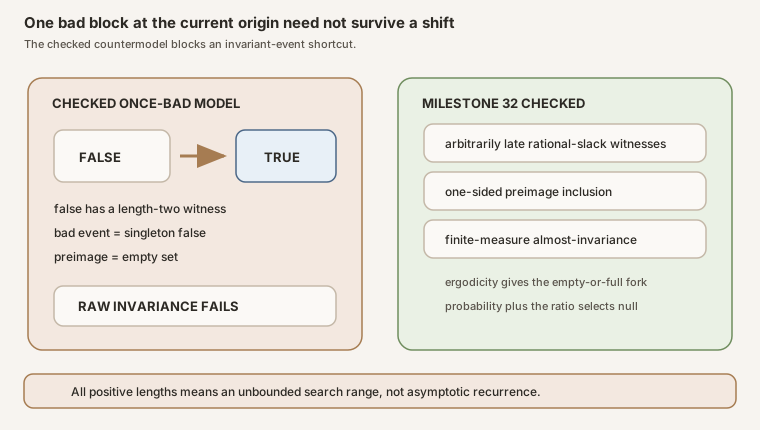
Null measurability does not imply invariance. Measure preservation does not make every dynamically defined set invariant. A subunit bound cannot become a zero-one conclusion until the right event is invariant or almost invariant and the matching ergodic hypothesis is present.
RMT-32 now supplies the event layer
RMT-32 does not merely add ergodicity to \(B_\infty(c)\). It replaces one positive witness by an asymptotic statement: an intersection over starting cutoffs of unions over later positive lengths. To represent strict lower deviation with a durable strict gap, it chooses one rational margin \(q\lt c\).
The checked change is from
\[ \exists n\gt0,\quad Y_n(\omega)\lt cn \]to a statement like
\[ q\in\mathbb Q,\quad q\lt c,\qquad \forall N,\ \exists n\ge N,\quad 0\lt n\ \text{and}\ Y_n(\omega)\lt qn. \]The strict rational slack matters. A sequence can lie below \(c\) infinitely often while approaching \(c\), so those witnesses alone do not prove that its lower liminf is strictly below \(c\).
The new Rational-Slack Lower-Deviation Events and Ergodic Null Selection chapter follows the completed proof. RMT-32 establishes countable null measurability, a threshold-relaxed fixed-slope preimage inclusion, rational density at the target, and almost-invariance under preservation plus finite mass. Finite-measure ergodicity yields an almost-empty or almost-full dichotomy. Probability is not needed for that fork; probability normalization and RMT-31’s strict subunit ratio select the null branch.
The exact equivalence with a library-level real lower limit remains RMT-33’s job. RMT-31 supplies the quantitative once-bad ceiling used in branch selection, while RMT-32 supplies the distinct asymptotic event and rigidity layer.
Seven bridges from the two-atom ledgers to Lean
The finite tables used lists of atoms and exact rational comparisons. The project module states the same architecture for arbitrary sets, measures, and centered subadditive processes. Each bridge aligns ordinary language, paper mathematics, exact Lean syntax, and the tokens that carry the proof.
Bridge 1: remove the cap without inventing an infinite witness
mem_centeredAllLengthBadBlockSet_iffcenteredAllLengthBadBlockSet T X cis the union over natural caps.centeredProcess T X n ωis the centered value \(Y_n(\omega)\).- The witness carries
0 < n; cap zero contributes nothing. - The comparison remains strict. No “infinitely often,” limit, supremum, or infinite length appears.
Bridge 2: enlarge only the search window
finiteCenteredBadBlockSet_mono hmM chmM : m ≤ Mis the only premise.- A witness supplies
1 ≤ nandn ≤ m; transitivity givesn ≤ M. - Neither a measurable space nor a measure is needed.
- This theorem does not compare \(Y_m\) and \(Y_M\); the process itself need not be monotone in time.
Bridge 3: take the countable null-measurable union
hX.nullMeasurableSet_centeredAllLengthBadBlockSet hT chX : IsIntegrableSubadditiveProcessCandidate T μ Xsupplies the RMT-30 regularity for each cap.hT : MeasurePreserving T μ μtransports integrability along the dynamics.NullMeasurableSet.iUnioncloses the countable union.- No finite-mass, probability, ergodicity, or ordinary
MeasurableSetpremise is added.
Bridge 4: take continuity in extended measure first
tendsto_measure_finiteCenteredBadBlockSet (T := T) (μ := μ) X cμ (…)is an extended nonnegative real value, so \(\infty\) remains legitimate.atTopmeans that the natural cap tends upward without bound.nhdsidentifies the target neighborhood filter.tendsto_measure_iUnion_atTopconsumes only the cap monotonicity and exact union; event measurability and finite mass are absent.
Bridge 5: cross to Measure.real only at a finite target
tendsto_measureReal_finiteCenteredBadBlockSet (T := T) (μ := μ) X c hfinitehfinite : μ (centeredAllLengthBadBlockSet T X c) ≠ ∞is local to the target event.Measure.realisENNReal.toRealapplied to a measure value.- Since
toReal ∞ = 0, continuity cannot be composed through the infinity cliff withouthfinite. [IsFiniteMeasure μ]is a convenient stronger assumption used later to discharge this local gate automatically.
Bridge 6: preserve the finite-cap ratio at the union
hX.measureReal_centeredAllLengthBadBlockSet_le_rateRatio hT δ c hδ hchδis the lower bound for every nonzero normalized centered integral.hc : c < δis the strict slope separation.- RMT-30 supplies the same ceiling
δ / cfor every cap. le_of_tendsto’carries that closed upper bound through the real-measure limit with no extra factor or error term.
Bridge 7: specialize the generic bridge to a matrix cocycle
hC.measureReal_centeredLogPlusAllLengthBadBlockSet_le_rateRatio c hchC : C.HasIntegrableGeneratorLogPlussupplies the generic candidate, preservation, and the needed integrability.C.integratedLogPlusGrowthRate hCis the deterministic integrated log-positive growth rate.C.integratedLogPlusNorm 1is the one-step integral.- The theorem adds neither ergodicity nor a nonempty matrix index and still asserts only a once-bad measure bound.
Type-check the exact project interface
For a full project check, place this probe in a project scratch file after installing the repository’s pinned dependencies:
import NonlinearDynamics.Random.RandomCocycles.SubadditiveAllLengthBadBlockMeasure

open NonlinearDynamics.Random.RandomCocycles

#check centeredAllLengthBadBlockSet
#check mem_centeredAllLengthBadBlockSet_iff
#check finiteCenteredBadBlockSet_mono
#check centeredAllLengthBadBlockSet_eq_iUnion_finite
#check finiteCenteredBadBlockSet_subset_allLength
#check IsIntegrableSubadditiveProcessCandidate.nullMeasurableSet_centeredAllLengthBadBlockSet
#check tendsto_measure_finiteCenteredBadBlockSet
#check tendsto_measureReal_finiteCenteredBadBlockSet
#check IsIntegrableSubadditiveProcessCandidate.measureReal_centeredAllLengthBadBlockSet_le_rateRatio
#check DiscreteMatrixCocycle.centeredLogPlusAllLengthBadBlockSet
#check DiscreteMatrixCocycle.HasIntegrableGeneratorLogPlus.measureReal_centeredLogPlusAllLengthBadBlockSet_le_rateRatio
From the repository root, type:
cd formalization
lake env lean NonlinearDynamics/Random/RandomCocycles/SubadditiveAllLengthBadBlockMeasure.lean
This is a full project check. It may compile substantial dependencies and therefore may require substantial disk space and memory. It validates the authoritative 481-line source.
cd formalization
lake env lean -DwarningAsError=true NonlinearDynamics/Random/RandomCocycles/SubadditiveAllLengthBadBlockMeasure.lean
Resource note: this exact file uses the repository's
pinned Lean and Mathlib dependencies. Initial project setup can require
substantial disk space and build time. For a lightweight first step on
macOS or Linux, use the page's standalone Lean-core or Std
tutorial.
Run both two-atom ledgers with Std
The following file imports only Lean’s Std library. It computes the nested
caps, first witness, union mass, ratio, slope-zero strictness boundary, and
collapse-map preimage with exact rational arithmetic. It neither imports
Mathlib nor opens this project. Save the block byte for byte as
/tmp/AllLengthBadBlockDeepDiveTutorial.lean:
import Std

namespace AllLengthBadBlockDeepDiveTutorial

inductive Atom where
  | amber
  | blue
  deriving Repr, DecidableEq

def atoms : List Atom := [.amber, .blue]

def atomName : Atom → String
  | .amber => "amber"
  | .blue => "blue"

def centered (n : Nat) : Atom → Rat
  | .amber => -((n - 1 : Nat) : Rat)
  | .blue => 0

def slope : Rat := -(3 : Rat) / 4

def strictBadAt (n : Nat) (x : Atom) : Bool :=
  decide (0 < n ∧ centered n x < slope * (n : Rat))

def capEvent (cap : Nat) : List Atom :=
  atoms.filter fun x =>
    (List.range (cap + 1)).any fun n => strictBadAt n x

def firstWitness (x : Atom) : Option Nat :=
  ((List.range 12).map (· + 1)).find? fun n => strictBadAt n x

def eventMass (event : List Atom) : Rat :=
  (event.length : Rat) / 2

structure CapRow where
  cap : Nat
  event : List String
  mass : Rat
  deriving Repr, DecidableEq

def capRow (cap : Nat) : CapRow :=
  let event := capEvent cap
  { cap := cap
    event := event.map atomName
    mass := eventMass event }

def strictAtSlope (c : Rat) (n : Nat) (x : Atom) : Bool :=
  decide (0 < n ∧ centered n x < c * (n : Rat))

def capEventAtSlope (c : Rat) (cap : Nat) : List Atom :=
  atoms.filter fun x =>
    (List.range (cap + 1)).any fun n => strictAtSlope c n x

def collapse : Atom → Atom
  | .amber => .blue
  | .blue => .blue

def oneShotCentered (n : Nat) : Atom → Rat
  | .amber => if 2 ≤ n then -1 else 0
  | .blue => 0

def oneShotBadAt (n : Nat) (x : Atom) : Bool :=
  decide (0 < n ∧
    oneShotCentered n x < (-(2 : Rat) / 5) * (n : Rat))

def oneShotEvent (cap : Nat) : List Atom :=
  atoms.filter fun x =>
    (List.range (cap + 1)).any fun n => oneShotBadAt n x

def oneShotPreimage (cap : Nat) : List Atom :=
  atoms.filter fun x => (oneShotEvent cap).contains (collapse x)

#eval (List.range 9).map capRow
#eval atoms.map fun x => (atomName x, firstWitness x)
#eval (capEvent 12).map atomName
#eval (eventMass (capEvent 12), (-(1 : Rat) / 2) / slope)
#eval ((capEventAtSlope 0 1).map atomName,
  (capEventAtSlope 0 2).map atomName)
#eval ((oneShotEvent 12).map atomName,
  (oneShotPreimage 12).map atomName)

example : ((List.range 8).map fun n => strictBadAt n .amber) =
    [false, false, false, false, false, true, true, true] := by
  native_decide

example : capEvent 4 = [] := by native_decide
example : capEvent 5 = [.amber] := by native_decide
example : eventMass (capEvent 12) = (1 : Rat) / 2 := by
  native_decide
example : eventMass (capEvent 12) ≤ (-(1 : Rat) / 2) / slope := by
  native_decide
example : capEventAtSlope 0 1 = [] := by native_decide
example : capEventAtSlope 0 2 = [.amber] := by native_decide
example : oneShotEvent 12 = [.amber] := by native_decide
example : oneShotPreimage 12 = [] := by native_decide

end AllLengthBadBlockDeepDiveTutorial
Important syntax:
inductive Atomcreates exactly the two named atoms;Ratkeeps the slopes, masses, and ratio exact;List.range (cap + 1)searches lengths zero through the cap, whilestrictBadAtseparately requires positive length;List.anyimplements existence of one witness;List.filtermaterializes the finite event;find?returnssome 5for amber andnonefor blue; and- each
native_decideexample supplies a kernel-checked proof of a displayed boundary or inequality.
With the pinned compiler installed, a human types:
source "$HOME/.elan/env"
elan run leanprover/lean4:v4.32.0 lean \
  /tmp/AllLengthBadBlockDeepDiveTutorial.lean
This is a standalone tutorial suitable for a normal macOS or Linux
host. It imports only Std, enumerates two atoms, and does not compile Mathlib
or this project. Successful execution prints exactly:
[{ cap := 0, event := [], mass := 0 },
 { cap := 1, event := [], mass := 0 },
 { cap := 2, event := [], mass := 0 },
 { cap := 3, event := [], mass := 0 },
 { cap := 4, event := [], mass := 0 },
 { cap := 5, event := ["amber"], mass := (1 : Rat)/2 },
 { cap := 6, event := ["amber"], mass := (1 : Rat)/2 },
 { cap := 7, event := ["amber"], mass := (1 : Rat)/2 },
 { cap := 8, event := ["amber"], mass := (1 : Rat)/2 }]
[("amber", some 5), ("blue", none)]
["amber"]
((1 : Rat)/2, (2 : Rat)/3)
([], ["amber"])
(["amber"], [])
The first output is the increasing cap sequence. The next three outputs
identify the first witness, union, mass, and ratio. The final two certify the
slope-zero strictness boundary and the collapse model’s unequal raw event and
preimage. These finite computations do not model extended nonnegative real
measure, Measure.real, null measurability, or filter convergence; those are
the responsibilities of the project module.
The eleven-declaration interface
The frozen 481-line source exposes exactly eleven public declarations in
source order. Its SHA-256 is
53438522344c078d64473316a594570993d694ada909a33184579cec6a996fb7.
| No. | Declaration | Exact responsibility |
|---|---|---|
| 1 | centeredAllLengthBadBlockSet | Defines the union of every finite centered bad-block cap |
| 2 | mem_centeredAllLengthBadBlockSet_iff | Rewrites membership as one positive finite strict witness |
| 3 | finiteCenteredBadBlockSet_mono | Proves monotonicity in the search cap |
| 4 | centeredAllLengthBadBlockSet_eq_iUnion_finite | Restates the definitional union exactly |
| 5 | finiteCenteredBadBlockSet_subset_allLength | Embeds each fixed cap in the all-length event |
| 6 | IsIntegrableSubadditiveProcessCandidate.nullMeasurableSet_centeredAllLengthBadBlockSet | Takes the countable null-measurable union under preservation |
| 7 | tendsto_measure_finiteCenteredBadBlockSet | Gives unconditional continuity from below in extended measure |
| 8 | tendsto_measureReal_finiteCenteredBadBlockSet | Projects the limit to real measure under local target finiteness |
| 9 | IsIntegrableSubadditiveProcessCandidate.measureReal_centeredAllLengthBadBlockSet_le_rateRatio | Transfers the cap-uniform generic ratio through the real limit |
| 10 | DiscreteMatrixCocycle.centeredLogPlusAllLengthBadBlockSet | Names the cocycle’s log-positive all-length event |
| 11 | DiscreteMatrixCocycle.HasIntegrableGeneratorLogPlus.measureReal_centeredLogPlusAllLengthBadBlockSet_le_rateRatio | Specializes the unchanged ratio to the cocycle Fekete offset |
Fifteen private support items
These source-local declarations build boundary models without enlarging the public API:
| No. | Private item | Role |
|---|---|---|
| 1 | rmt31ZeroProcess | Defines the identically zero process |
| 2 | rmt31ZeroProcess_candidate | Certifies integrability and shifted subadditivity of the zero process |
| 3 | rmt31TwoPointProbability | Defines the equal-weight measure on Bool |
| 4 | private IsProbabilityMeasure rmt31TwoPointProbability instance | Proves that the two weights sum to one |
| 5 | rmt31Id_not_preErgodic | Proves identity on the two-atom probability space is not pre-ergodic |
| 6 | rmt31TwoPointProcess | Defines zero on blue/true and \(-(n-1)\) on amber/false |
| 7 | rmt31TwoPointProcess_candidate | Certifies the displayed process as an integrable shifted-subadditive candidate |
| 8 | rmt31MassTwoMeasure | Defines a finite measure of total mass two on Unit |
| 9 | private IsFiniteMeasure rmt31MassTwoMeasure instance | Supplies its finite-measure certificate |
| 10 | rmt31Collapse | Sends both Boolean points to true |
| 11 | rmt31OneShotProcess | Defines the zero/negative-one one-shot process |
| 12 | rmt31_iterate_collapse_true | Shows every iterate keeps true fixed |
| 13 | rmt31_iterate_collapse_of_ne_zero | Shows every positive iterate sends either point to true |
| 14 | rmt31OneShotProcess_candidate | Certifies the one-shot process as an integrable shifted-subadditive candidate |
| 15 | rmt31Collapse_preserving | Proves the collapse map preserves the Dirac measure at true |
Ten anonymous compiled examples
The examples are checked propositions but do not create public names:
| Probe | Exact boundary checked |
|---|---|
| 1 | Every cap-zero event is empty |
| 2 | Every finite cap embeds in the all-length union |
| 3 | The zero process has no strict witness below a negative slope |
| 4 | Every all-length event has real measure zero under the zero measure |
| 5 | The nonergodic uniform two-point identity model has event mass \(1/2\) and satisfies \(1/2\le2/3\) |
| 6 | Equality at length one for slope zero is excluded, while length two gives a later strict witness |
| 7 | The cap-one event for the two-point process is the whole space exactly when \(0\lt c\), and is empty otherwise |
| 8 | The generic ratio theorem works for a finite measure of total mass two, not only a probability |
| 9 | The cocycle theorem compiles with an empty matrix index |
| 10 | The preserved collapse-map model has a raw event unequal to its preimage |
Seven axiom reports
The source prints the axiom footprints of:
mem_centeredAllLengthBadBlockSet_iff;finiteCenteredBadBlockSet_mono;IsIntegrableSubadditiveProcessCandidate.nullMeasurableSet_centeredAllLengthBadBlockSet;tendsto_measure_finiteCenteredBadBlockSet;tendsto_measureReal_finiteCenteredBadBlockSet;IsIntegrableSubadditiveProcessCandidate.measureReal_centeredAllLengthBadBlockSet_le_rateRatio; andDiscreteMatrixCocycle.HasIntegrableGeneratorLogPlus.measureReal_centeredLogPlusAllLengthBadBlockSet_le_rateRatio.
Assumption and nonclaim ledger
| Layer | Required | Absent or unproved |
|---|---|---|
| Definition | Map, process, slope | Measurable space, measure, subadditivity |
| Union | Natural witness bounds | Every analytic premise |
| Null measurability | Candidate, preservation | Finite mass, probability, ergodicity |
| Extended limit | Increasing caps, union | Set measurability, preservation, finite mass |
| Real limit | Finite measure of union | Finite total mass as such |
| Generic ratio | Finite measure, preservation, candidate, uniform rate, \(c\lt\delta\) | Probability, ergodicity, invariance |
| Cocycle ratio | Finite measure, finite decidable matrix index, cocycle with bundled base preservation, integrable log-positive generator | Nonempty matrix index, probability, ergodicity, signed log growth |
| Future | Not in RMT-31 | Lower liminf, zero-one rigidity, Kingman convergence |
The module proves no lower-liminf inequality, almost-everywhere convergence, \(L^1\) convergence, signed logarithmic growth, Lyapunov exponent, or Oseledets splitting.
Thirty solved exercises
Exercise 1: unpack membership
What does \(\omega\in B_\infty(c)\) mean?
Solution. One finite \(n\) satisfies \(0\lt n\) and \(Y_n(\omega)\lt cn\). There is no predetermined cap.
Exercise 2: reject recurrence
Does membership imply infinitely many bad lengths?
Solution. No. A single existential witness suffices.
Exercise 3: compute cap zero
What is \(B_0(c)\)?
Solution. It is empty because no positive length is at most zero.
Exercise 4: recover a cap
Given an uncapped witness \(n\), which cap works?
Solution. Choose \(m=n\); then \(n\le m\) by reflexivity.
Exercise 5: prove finite inclusion
Why is \(B_m(c)\subseteq B_\infty(c)\)?
Solution. It is one term of the defining union.
Exercise 6: prove monotonicity
Why does \(m\le M\) imply \(B_m(c)\subseteq B_M(c)\)?
Solution. Reuse the witness and compose \(n\le m\) with \(m\le M\).
Exercise 7: reject process monotonicity
Does Exercise 6 prove \(Y_m(\omega)\le Y_M(\omega)\)?
Solution. No. Search windows grow; terminal process values need not.
Exercise 8: test equality
If \(Y_n(\omega)=cn\), is \(n\) a bad witness?
Solution. No. The definition requires strict inequality.
Exercise 9: use a later witness
Can equality at time one coexist with all-length membership?
Solution. Yes. A later length can be strictly bad; the compiled example uses time two at slope zero.
Exercise 10: classify the union
Is equality with the cap union only almost everywhere?
Solution. No. It is exact set equality and is definitional.
Exercise 11: build null measurability
Why is the all-length event null measurable?
Solution. Every cap is null measurable and countable unions preserve that property.
Exercise 12: avoid stronger regularity
May this be restated as ordinary measurability?
Solution. Not generally. Null measurability permits a null-set difference from a measurable representative.
Exercise 13: remove finite mass
Where is finite mass used in Exercise 11?
Solution. Nowhere. Countable-union closure has no finiteness premise.
Exercise 14: state native continuity
Which limit is unconditional?
Solution. \(\mu(B_m(c))\to\mu(B_\infty(c))\) in extended measure, even at an infinite target.
Exercise 15: locate set measurability
Does that continuity theorem require measurable caps?
Solution. No. The Mathlib theorem used here accepts increasing sets without that premise.
Exercise 16: compute the cliff
What is \(\operatorname{toReal}(\infty)\)?
Solution. Zero. The projection loses the extended infinity information.
Exercise 17: state the local gate
What permits real-measure convergence?
Solution. The target event’s extended measure must differ from infinity.
Exercise 18: compare finiteness notions
Can the real theorem apply when \(\mu(\Omega)=\infty\)?
Solution. Yes, if this particular union event has finite measure.
Exercise 19: discharge the gate
Why does a finite measure instance suffice?
Solution. The event measure is bounded by the finite total mass.
Exercise 20: transfer a ceiling
If \(x_m\to x\) and \(x_m\le C\), why is \(x\le C\)?
Solution. The closed interval ending at \(C\) contains every term and
therefore its limit. Lean uses le_of_tendsto’.
Exercise 21: locate the finite input
What does RMT-30 contribute?
Solution. It proves the same ratio ceiling for every finite cap.
Exercise 22: avoid new packing
Why is interval packing absent from RMT-31?
Solution. Packing already proved the uniform finite theorem; RMT-31 only transports it through a limit.
Exercise 23: force the rate sign
Why is \(\delta\le0\)?
Solution. Apply the rate premise at time one, where \(Y_1=0\).
Exercise 24: force the slope sign
Why is \(c\lt0\)?
Solution. Combine \(c\lt\delta\) with \(\delta\le0\).
Exercise 25: remove probability
Does the generic theorem require total mass one?
Solution. No. It requires finite mass and compiles for mass two.
Exercise 26: remove ergodicity
What does the two-atom identity model show?
Solution. A nonergodic system has a half-mass bad event satisfying \(1/2\le2/3\).
Exercise 27: identify the cocycle rate
What plays the role of \(\delta\)?
Solution. The integrated log-positive Fekete rate minus the one-step log-positive integral.
Exercise 28: permit an empty index
Why can the matrix index be empty?
Solution. The proof uses a bundled norm-process interface and never chooses a coordinate.
Exercise 29: diagnose non-invariance
Why is the singleton event not invariant?
Solution. The collapse map sends both points to true, so the
preimage of {false} is empty.
Exercise 30: design RMT-32
What must replace one-witness membership?
Solution. Arbitrarily late witnesses with suitable rational slack, a lower-liminf interpretation, a proved one-sided preimage inclusion, and an almost-invariance upgrade using preservation plus finite mass.
Choose the appropriate runnable path
There are two deliberately separate runnable paths.
- The
Stdworksheet is a tiny two-atom arithmetic tutorial suitable for an ordinary macOS or Linux host. - The exact project import, extended-measure API,
Measure.real, filter limits, candidate interface, and source check use the full project command in Type-check the exact project interface.
The distinction is about resource use, not pedagogy. Readers should type, run, and modify the standalone tutorial. The Mathlib-backed proof remains fully visible; checking it may require substantial disk space and memory.
The paired Development Notebook gives the implementation ledger and review history.
Continue the learning path
Finite Bad-Block Measure Bounds Before Kingman Lower Liminf derives the uniform finite-cap ratio.
From Finite Maximal Bounds to an Infinite Weak Estimate develops the analogous increasing-union and real-projection bridge.
Infinite-horizon Birkhoff-average exceedance event is a comparison for another one-witness event. Birkhoff sum and almost everywhere review language used in the regularity and future asymptotic layers.
References
These primary sources and library references use Mathlib 4.32.0 at pinned
commit 81a5d257c8e410db227a6665ed08f64fea08e997.
J. F. C. Kingman. The ergodic theory of subadditive stochastic processes, JRSS Series B 30(3), 499-510, 1968, doi:10.1111/j.2517-6161.1968.tb00749.x. This is the primary source for the full theorem RMT-31 does not claim.
J. Michael Steele. Kingman’s subadditive ergodic theorem, Annales de l’Institut Henri Poincare 25(1), 93-98, 1989. Its interval decomposition motivates the finite machinery; RMT-31 isolates the union step.
Mathlib contributors. Continuity from below, Mathlib 4.32.0. It supplies the unconditional extended-measure limit.
Mathlib contributors. Continuity of ENNReal.toReal away from infinity, Mathlib 4.32.0. RMT-31 uses it only at a finite target.
Mathlib contributors. Definition of Measure.real, Mathlib 4.32.0. The definition totalizes infinite mass to zero.
Mathlib contributors. Null-measurable sets, Mathlib 4.32.0. The proof uses countable-union closure here.
Mathlib contributors.
Closed-order limit lemmas,
Mathlib 4.32.0. The ratio proof uses le_of_tendsto’ to retain a
common upper bound at the real-measure limit.