Start with three sequences you can calculate by hand
Before filters, null sets, or cocycles enter, write down three exact rational sequences. They isolate three logically different questions that are often conflated.
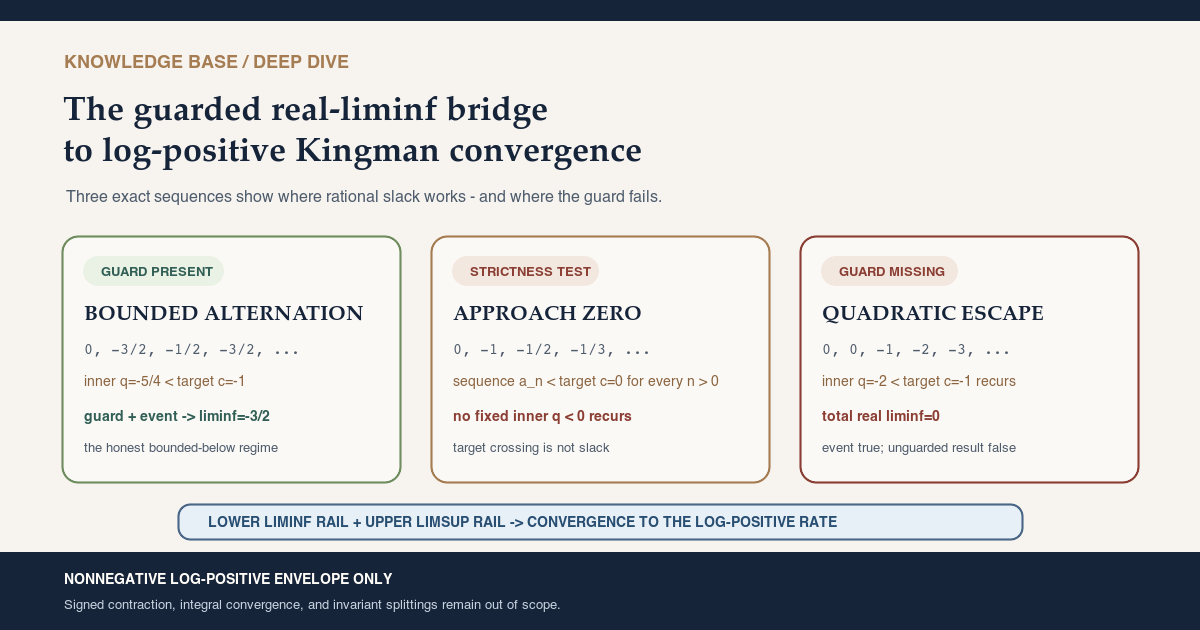
The guarded sequence: the rational event and liminf agree
Define
\[ u_0=0,\qquad u_n= \begin{cases} -\frac32,&n\text{ odd},\\[2mm] -\frac12,&n\text{ positive and even}. \end{cases} \]Take the event target \(c=-1\) and the rational witness \(q=-5/4\). The first eleven values are
| \(n\) | 0 | 1 | 2 | 3 | 4 | 5 | 6 | 7 | 8 | 9 | 10 |
|---|---|---|---|---|---|---|---|---|---|---|---|
| \(u_n\) | \(0\) | \(-3/2\) | \(-1/2\) | \(-3/2\) | \(-1/2\) | \(-3/2\) | \(-1/2\) | \(-3/2\) | \(-1/2\) | \(-3/2\) | \(-1/2\) |
| \(u_n\lt q\)? | no | yes | no | yes | no | yes | no | yes | no | yes | no |
Every odd time is a witness beyond any proposed cutoff, so \(u_n\lt q\) occurs frequently. At the same time,
\[ -\frac32\le u_n\le0 \]for every \(n\). The eventual-lower-bound guard is therefore present, and the ordinary answer is informative:
\[ \liminf_nu_n=-\frac32\lt-\!1=c. \]At the strict boundary \(c=-3/2\), however, there is no rational \(q\lt c\) crossed frequently: the sequence never goes below \(-3/2\). Equality with the liminf does not enter a strict lower-deviation event.
The strictness near-miss: crossing the target is not enough
Now take
\[ a_0=0,\qquad a_n=-\frac1n\quad(n\gt0). \]Every positive term satisfies \(a_n\lt0\), but for the sample margin \(q=-1/4\), the strict inequality \(a_n\lt q\) holds only at \(n=1,2,3\); equality at \(n=4\) does not count. The same phenomenon holds for every fixed rational \(q\lt0\): eventually \(q\lt a_n\lt0\). Thus
\[ \liminf_na_n=0, \qquad a_n\lt0\text{ frequently}, \qquad \nexists q\in\mathbb Q,\ q\lt0\text{ and }a_n\lt q\text{ frequently}. \]This is why the event stores a durable rational margin below the target, not just arbitrarily late strict crossings of the target itself.
The guard near-miss: a real totalization can hide escape to \(-\infty\)
The project source uses the genuine subadditive process \(X_n=-n^2\) on the one-point probability space. After subtracting its one-step orbit sum and normalizing, its exact values are
\[ e_0=0,\qquad e_n=1-n\quad(n\gt0): \qquad 0,0,-1,-2,-3,-4,\ldots \]At target \(c=-1\), choose \(q=-2\). Then \(q\lt c\) and \(e_n\lt q\) for every \(n\ge4\), so the rational lower-deviation event really occurs. But no real number lies below all sufficiently late values. For example, the candidate bound \(-10\) survives through \(n=11\), where \(e_{11}=-10\), and fails at \(n=12\), where \(e_{12}=-11\). Every other finite candidate fails in the same way.
The defining set of eventual real lower bounds is empty. In the pinned real-order implementation, its supremum is totalized:
\[ \operatorname{liminf}_{\mathbb R}e =\sup\varnothing =0. \]Consequently the unguarded implication
\[ \bigl(\exists q\lt c,\ e_n\lt q\text{ frequently}\bigr) \Longrightarrow \operatorname{liminf}_{\mathbb R}e\lt c \]would demand the false statement \(0\lt-1\). This is not a hypothetical arbitrary-sequence objection: the paired Lean module checks the subadditive candidate, event membership, absence of the guard, and totalized value.
A finite squeeze that says exactly what the final theorem says
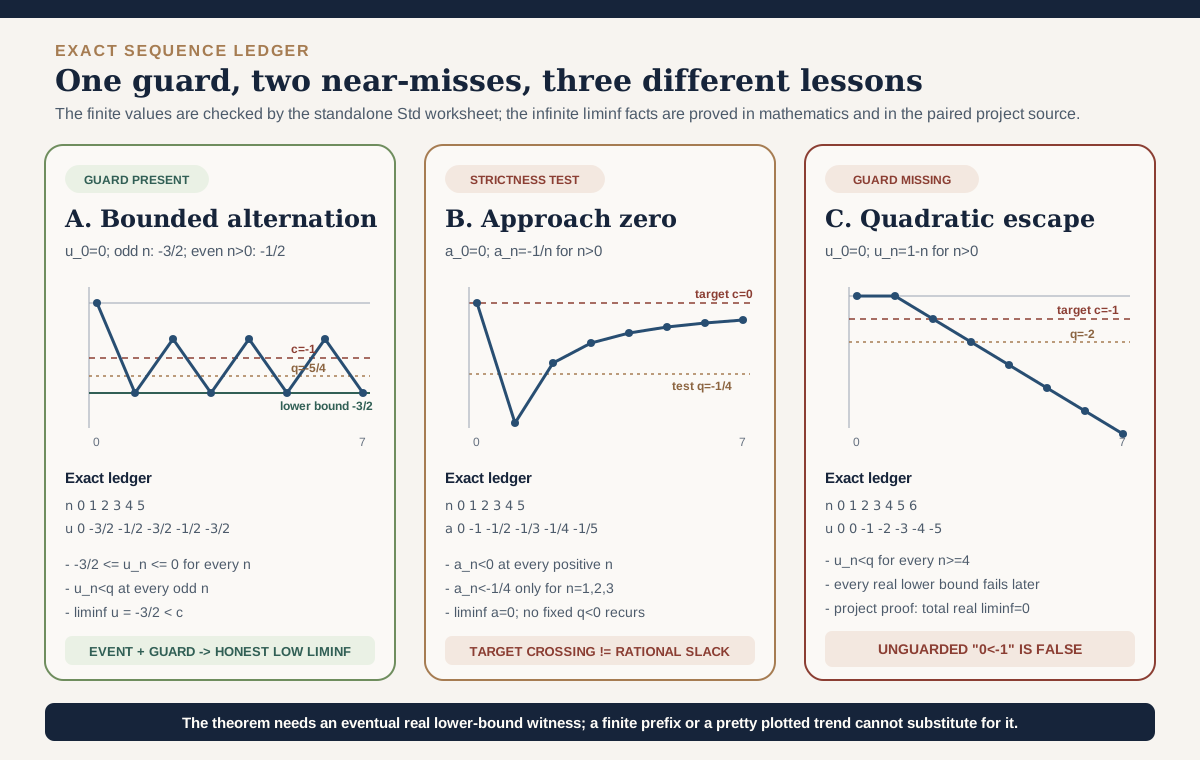
For a second hand-check, set
\[ \gamma_+=\frac32,\qquad L_k=\gamma_+-\frac1k,\qquad U_k=\gamma_++\frac1k, \]and let \(s_k\) alternate between the upper and lower rails. Then
\[ L_k\le s_k\le U_k, \qquad U_k-L_k=\frac2k\longrightarrow0, \]so \(s_k\to\gamma_+\). This is a finite-arithmetic picture of the final proof architecture, with one essential provenance label on each rail:
- this module supplies the lower rail \(\gamma_+\le\liminf a_n(\omega)\);
- the earlier RMT-29 module supplies the upper rail \(\limsup a_n(\omega)\le\gamma_+\); and
- actual lower and upper boundedness let Mathlib turn those two inequalities into convergence.
The conclusion concerns
\[ a_n(\omega) =\frac{\log^+\lVert C_n(\omega)\rVert}{n}\ge0. \]It does not manufacture a signed logarithm. The nearby zero-rate sequence \(1/k\to0\) is a faithful endpoint: \(\gamma_+\) can be zero, while a constant contraction can simultaneously have a negative signed rate that the log-positive observable erases.
The actual paired-source zero probe is even simpler: its normalized process is identically zero, its real liminf is zero, and its strict lower-liminf deviation set at target zero is empty. The \(1/k\) row is only a visual model of approaching the same permitted endpoint; it is not being attributed to that source probe.
The last step of a long proof is often described as a squeeze:
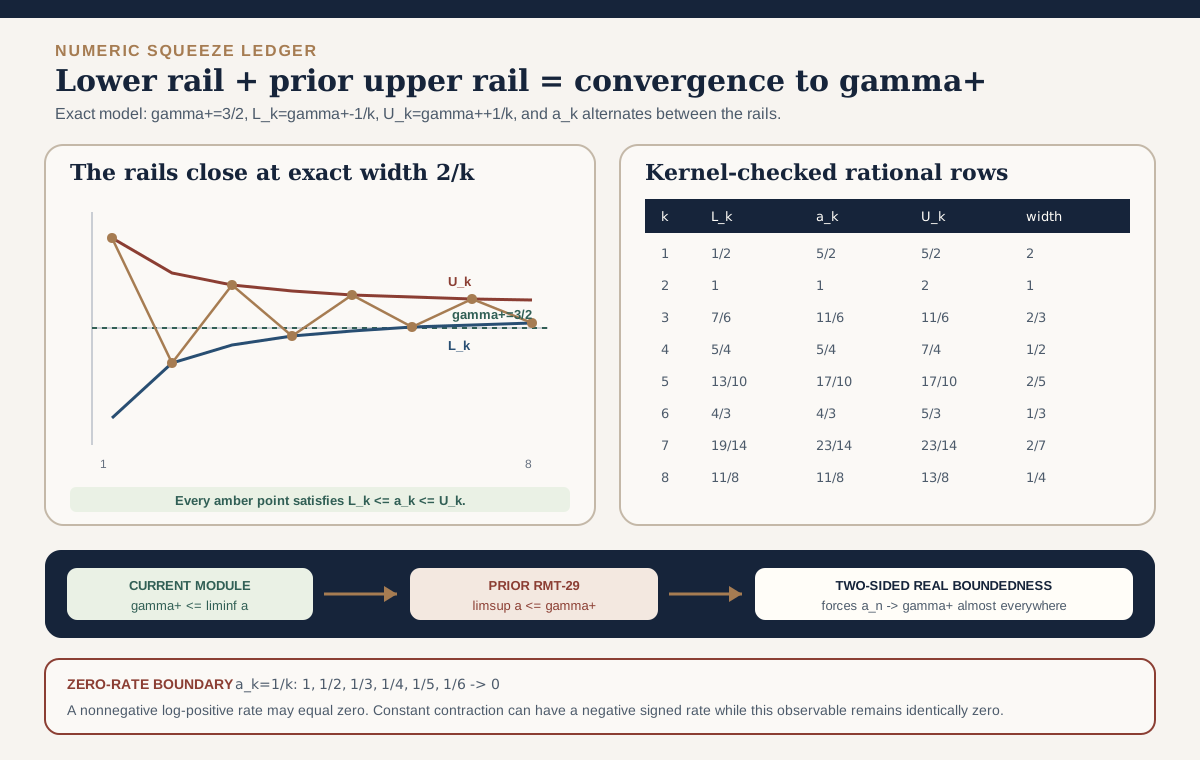
\[ \gamma \le \liminf_{n\to\infty} a_n(\omega) \le \limsup_{n\to\infty} a_n(\omega) \le \gamma. \]That line is correct for the endpoint of RMT-33, but it hides the hardest formal question. What does the middle real limit inferior (liminf) mean when the codomain is only conditionally complete? Mathlib gives it a value for every real sequence, even one that escapes to negative infinity. In such a case the set of eventual real lower bounds is empty, and its real supremum is totalized to zero. A naked inequality involving that value can therefore say something very different from the intended extended asymptotic statement.
RMT-33 solves the problem constructively. It does not merely show that the bad lower-liminf set is null. Off a related countable rational null set, it extracts one fixed rational number below all sufficiently late normalized centered values. That witness certifies that the real lower limit is being used in its standard bounded-below regime.
The proof then adds back a convergent one-step Birkhoff average, identifies the centered offset with the integrated Fekete rate, and combines the lower estimate with the upper-limsup theorem from RMT-29. The result is the project’s first almost-everywhere Kingman-style convergence theorem:
\[ \frac{\log^+\lVert C_n(\omega)\rVert}{n} \longrightarrow \gamma_+ \qquad\text{for almost every }\omega. \]The subscript \(+\) is essential. The limit sees expansion above norm one and forgets contraction below norm one.
This chapter continues Rational-Slack Lower-Deviation Events and Ergodic Null Selection and Subadditive Upper-Limsup Bounds Before Kingman Convergence. The deterministic rate was constructed in Integrated Log-Positive Cocycle Growth and the Fekete Limit.
Choose a route up
| Route | Begin | Destination |
|---|---|---|
| Overview | See the whole summit route | Understand why the proof has five bridges |
| Semantics | Why real liminf needs a guard | Distinguish a total value from an extended lower limit |
| Events | Translate arbitrarily late blocks into frequency | Read the exact event-to-filter bridge |
| Slack | Spend two rational margins | Build a countable cover without asking for \(\delta\lt\delta\) |
| Nullity | Make one null cover do two jobs | Obtain both an inequality and eventual boundedness |
| Transfer | Add back the Birkhoff average | Move the centered lower estimate to the original process |
| Endpoint | Close the log-positive squeeze | Read the final almost-everywhere convergence theorem |
| Scope | Separate log-positive growth from signed growth | Avoid a false Lyapunov interpretation |
| Lean | Audit every checked interface | Match mathematical jobs to declarations and hypotheses |
| History | Place the result beside the classical theorems | Cite Kingman, Steele, Ruelle, and Fekete cautiously |
| Practice | Forty solved exercises | Reconstruct the proof and test its boundaries |
Common setup and notation
Let \((\Omega,\mu)\) be a probability space and let \(T:\Omega\to\Omega\) preserve \(\mu\). A real process \(X=(X_n)_{n\in\mathbb N}\) is shifted-subadditive in the convention used by the repository when
\[ X_{m+n}(\omega) \le X_n(T^m\omega)+X_m(\omega) \]for all natural \(m,n\) and all \(\omega\). Every slice \(X_n\) is assumed integrable.
The one-step orbit sum is
\[ S_nX_1(\omega) :=\sum_{j=0}^{n-1}X_1(T^j\omega). \]The centered process is
\[ Y_n(\omega):=X_n(\omega)-S_nX_1(\omega). \]Centering is pointwise and dynamical. It subtracts an orbit sum, not an expectation. At every positive horizon, the one-step majorant inherited from subadditivity gives
\[ X_n(\omega)\le S_nX_1(\omega), \qquad Y_n(\omega)\le 0. \]After total normalization, \(u_0=0\), so \(u_n\le0\) holds at every natural time even when the unnormalized generic value \(Y_0\) is not assumed nonpositive.
Lean packages total normalization as
\[ \operatorname{Norm}(X,n,\omega):=\frac{X_n(\omega)}{n}. \]At \(n=0\), real division is total and returns zero. Thus the normalized process is defined at every natural time even when \(X_0\) is arbitrary. For positive time this is ordinary division, and removing the zero term does not change either lower or upper asymptotics along natural infinity.
Write
\[ u_n(\omega):=\frac{Y_n(\omega)}{n}, \qquad v_n(\omega):=\frac{S_nX_1(\omega)}{n}. \]With the total convention at time zero, the exact identity is
\[ \frac{X_n(\omega)}{n}=u_n(\omega)+v_n(\omega) \]for every \(n\in\mathbb N\), including zero.
For the matrix-cocycle specialization, let \(C_n(\omega)\) be the ordered finite product and set
\[ X_n(\omega):=\log^+\lVert C_n(\omega)\rVert, \qquad \log^+r:=\max\{0,\log r\}. \]The deterministic integrated sequence is
\[ A_n:=\int_\Omega X_n\,d\mu, \]and its Fekete rate is
\[ \gamma_+ :=\lim_{n\to\infty}\frac{A_n}{n} =\inf_{n\ge1}\frac{A_n}{n}. \]The equality with the positive-horizon infimum is already checked in the repository. RMT-33 proves that the samplewise normalized process converges to that same real number almost everywhere.
See the whole summit route
The proof has five bridges. Each one changes the language of the statement.
- A bad block becomes a frequent inequality along the filter at natural infinity.
- A strict real lower-liminf deviation enters a countable union of rational bad events.
- Nullity of that union supplies both a lower-liminf inequality and an eventual lower bound.
- The centered estimate is added to a convergent Birkhoff average.
- A prior upper-limsup estimate and explicit boundedness close the convergence squeeze.
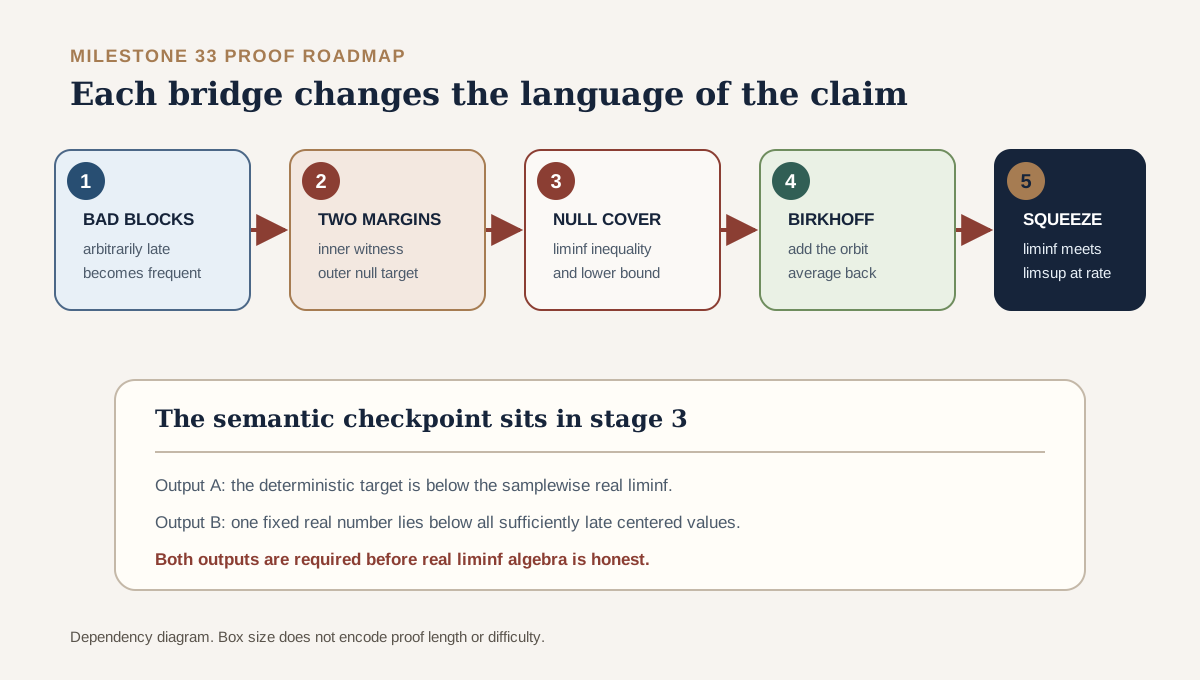
The central design choice is visible at stage three. A theorem that returned only
\[ \delta\le\liminf_n u_n(\omega) \]would be numerically useful but semantically incomplete. RMT-33 returns the conjunction
\[ \left( u_n(\omega)\text{ is eventually bounded below} \right) \quad\text{and}\quad \left( \delta\le\liminf_n u_n(\omega) \right). \]That stronger interface prevents later proofs from silently treating a totalized real lower limit as an extended-real one.
Why real liminf needs a guard
Mathlib’s real lower limit
For a real sequence \(a:\mathbb N\to\mathbb R\), the pinned Mathlib definition can be read as
\[ \liminf a {} = \sup\left\{ b\in\mathbb R: b\le a_n\text{ eventually} \right\}. \]The word eventually means that there is some cutoff after which the inequality always holds. The set inside the supremum is the set of eventual real lower bounds.
The real numbers are conditionally complete, not complete as an order. If the
sequence has no eventual lower bound, that set is empty. Mathlib nevertheless
keeps liminf total. In the pinned release,
Real.sSup_empty states
Consequently, the formal real lower limit of an unbounded-below sequence can be zero.
A checked countermodel
The module uses the process
\[ X_n=-n^2 \]on the one-point probability space. It is subadditive because
\[ -(m+n)^2\le -m^2-n^2. \]Its centered process is
\[ Y_n=-n^2+n, \]so for positive \(n\),
\[ u_n=\frac{-n^2+n}{n}=1-n. \]This sequence crosses every fixed negative slope eventually and has no
eventual real lower bound. The intended extended lower limit is negative
infinity. Yet the set of eventual real lower bounds is empty, so Mathlib’s
total real liminf is zero.
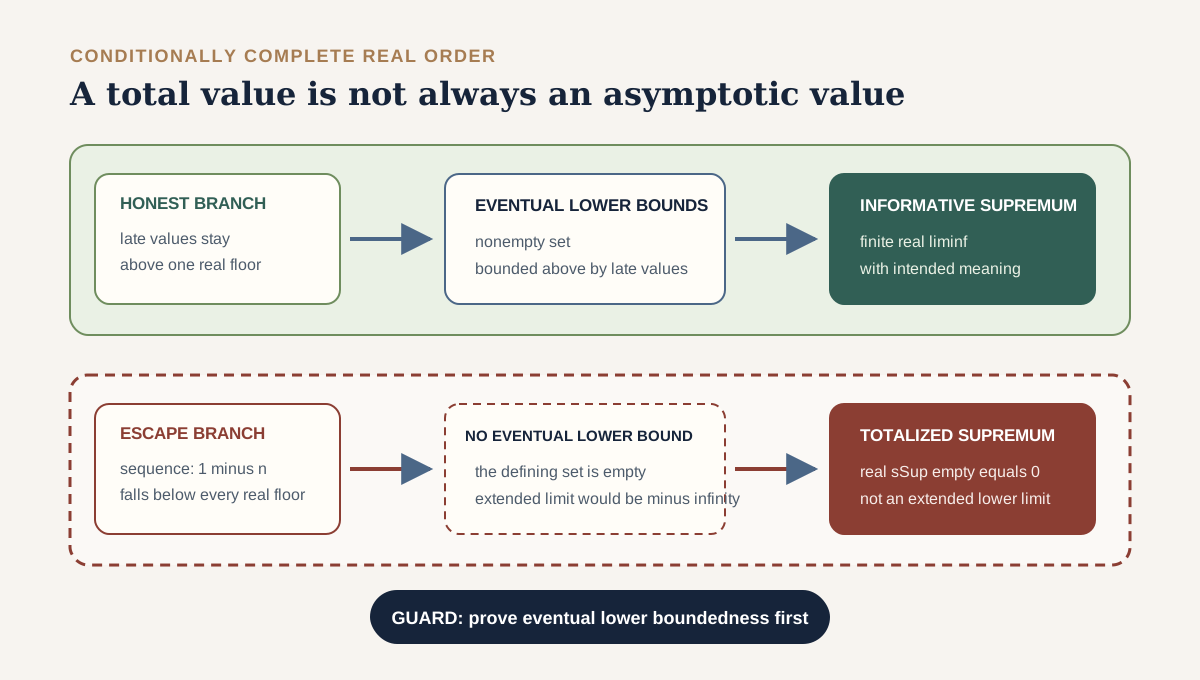
liminf is always syntactically available, but it represents the usual finite lower asymptotic value only after eventual lower boundedness is established. For \(1-n\), the formal value zero is a totalization artifact, not its extended lower limit. The diagram compares logical branches and does not plot quantitative data.The countermodel refutes the statement with the lower-boundedness guard removed. Without it, membership in a rational strict lower-deviation event need not force the total real lower limit below the event target.
Read the guard in filter language
The Lean proposition
IsBoundedUnder (· ≥ ·) atTop a
means that \(a_n\) is eventually bounded below. Explicitly, there exists \(b\in\mathbb R\) such that
\[ b\le a_n \]for every sufficiently large \(n\).
The orientation may appear reversed because the relation is written \((\cdot\ge\cdot)\). The reliable reading is to expand the definition and ask which side of \(a_n\) receives the witness. In this case the witness lies below the eventual values.
The companion proposition
IsBoundedUnder (· ≤ ·) atTop a
means eventual upper boundedness.
Time zero is not the problem
At time zero,
\[ \frac{X_0(\omega)}{0}=0 \]under Lean’s total division. This convention does not contaminate asymptotic
limits. The theorem liminf_nat_add removes a finite natural
prefix, and RMT-33 exposes the specialized equality
The theorem normalizedProcess_update_zero goes farther:
replacing the entire time-zero slice by any function leaves every normalized
value unchanged. The genuine semantic hazard is unbounded escape at late
times, not division at the first index.
Translate arbitrarily late blocks into frequency
RMT-32 defined an arbitrarily-late centered bad-block event at slope \(q\):
\[ A_q := \left\{ \omega: \forall N,\ \exists n\ge N,\ n\gt0,\ Y_n(\omega)\lt qn \right\}. \]On natural time, a property \(P(n)\) holds frequently along
atTop exactly when
Positive witnesses make division legitimate, so RMT-33 proves the exact translation
\[ \omega\in A_q \quad\Longleftrightarrow\quad \exists^\infty_{\mathrm{atTop}} n,\ u_n(\omega)\lt q. \]The symbol on the right means frequently along natural infinity. It does not mean eventually always.
The rationally generated strict event at a real target \(c\) is
\[ D_c := \bigcup_{\substack{q\in\mathbb Q\\q\lt c}}A_q. \]Its membership theorem becomes
\[ \omega\in D_c \quad\Longleftrightarrow\quad \exists q\in\mathbb Q,\quad q\lt c \quad\text{and}\quad \exists^\infty_{\mathrm{atTop}}n,\ u_n(\omega)\lt q. \]This says that one durable rational margin below \(c\) is crossed arbitrarily late.
The guarded equivalence
Suppose \(u(\omega)\) is eventually bounded below. If \(\omega\in D_c\), then
some rational \(q\lt c\) is crossed frequently. The Mathlib theorem
liminf_le_of_frequently_le yields
Conversely, suppose
\[ \liminf_nu_n(\omega)\lt c. \]Choose a rational \(q\) strictly between the lower limit and \(c\). Since the
normalized centered sequence is pointwise nonpositive, it has the coboundedness gate
needed by frequently_lt_of_liminf_lt. That theorem gives
frequent crossings below \(q\), hence membership in \(D_c\).
Therefore, under the explicit eventual-lower-bound guard,
\[ \omega\in D_c \quad\Longleftrightarrow\quad \liminf_nu_n(\omega)\lt c. \]The two directions use different order hypotheses:
| Direction | Needed fact | Reason |
|---|---|---|
| Frequent crossings imply low liminf | Eventual lower bound | Prevents empty eventual-lower-bound set |
| Low liminf implies frequent crossings | A suitable coboundedness condition | Allows values below every level above the liminf |
For the centered candidate, pointwise nonpositivity supplies the second gate. The first gate must be constructed almost everywhere.
Why one rational margin is not enough
Consider
\[ a_n=-\frac{1}{n}. \]It converges to zero and is strictly negative at every positive time. Thus
\[ \exists^\infty_{\mathrm{atTop}}n,\ a_n\lt0. \]However, for every fixed rational \(q\lt0\), the sequence is eventually above \(q\). Hence
\[ \neg\left( \exists^\infty_{\mathrm{atTop}}n,\ a_n\lt q \right). \]Strict crossings at the target do not provide a durable strict gap below the target. This is why the event is generated by rational slopes below \(c\), not by the slope \(c\) itself.
The checked module includes formal proofs of the three properties exhibited by this example:
\[ \liminf a_n=0, \qquad a_n\lt0\text{ frequently}, \qquad \text{no fixed rational }q\lt0\text{ is crossed frequently}. \]That triple is the smallest counterexample to the tempting same-threshold shortcut.
Spend two rational margins
Let
\[ L(\omega):=\liminf_nu_n(\omega) \]and fix a desired lower bound \(\delta\). We want to cover the exceptional set
\[ E_\delta:=\{\omega:L(\omega)\lt\delta\} \]by RMT-32 events known to be null.
RMT-32 proves nullity of \(D_c\) when its event target \(c\) is strictly below a deterministic lower bound \(\delta\) for all positive normalized centered integrals. It cannot be invoked with \(c=\delta\), because that would require the false hypothesis \(\delta\lt\delta\).
The repair uses two rational margins.
If \(L(\omega)\lt\delta\), choose an outer target \(c\in\mathbb Q\) with
\[ L(\omega)\lt c\lt\delta. \]To prove \(\omega\in D_c\), choose an inner witness slope \(q\in\mathbb Q\) with
\[ L(\omega)\lt q\lt c. \]
The outer target makes RMT-32 applicable because \(c\lt\delta\). The inner slope supplies the durable strict margin required by membership in \(D_c\). The two numbers have different logical jobs and cannot safely be identified.
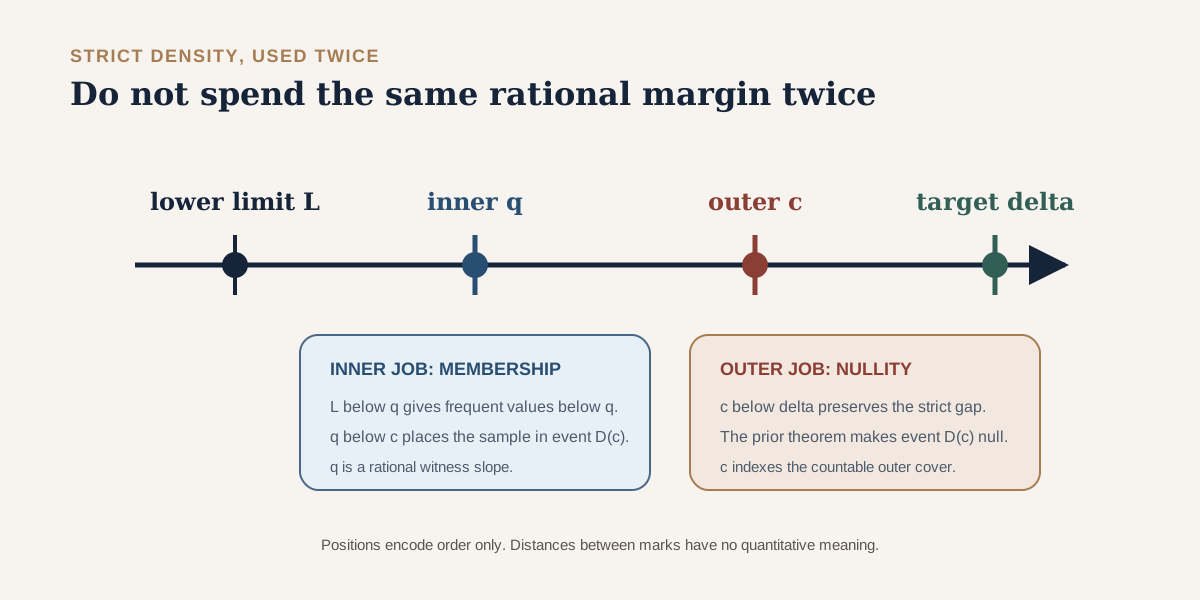
The outer exhaustion is the countable set
\[ R_\delta := \bigcup_{\substack{c\in\mathbb Q\\c\lt\delta}}D_c. \]The two-margin argument proves
\[ E_\delta\subseteq R_\delta. \]Since the rational numbers are countable, RMT-32 nullity of every \(D_c\) implies \(\mu(R_\delta)=0\), and monotonicity gives \(\mu(E_\delta)=0\).
Make one null cover do two jobs
The exhaustion \(R_\delta\) supports two distinct conclusions.
Deliverable one: the lower-liminf inequality
Because \(E_\delta\subseteq R_\delta\) and \(R_\delta\) is null,
\[ \delta\le L(\omega) \]for almost every \(\omega\).
This is the numerical conclusion needed for the final squeeze.
Deliverable two: an actual eventual lower bound
Take \(\omega\notin R_\delta\). Choose rationals
\[ q\lt c\lt\delta. \]Since \(\omega\notin D_c\), it cannot cross \(q\) frequently. The negation of
frequency along atTop is eventual negation, so
for all sufficiently large \(n\). Thus \(q\) is a concrete eventual lower bound.
Notice that this construction does not infer boundedness from the numerical real-liminf inequality. It builds boundedness directly from the complement of the rational event. That direction is robust against totalization.
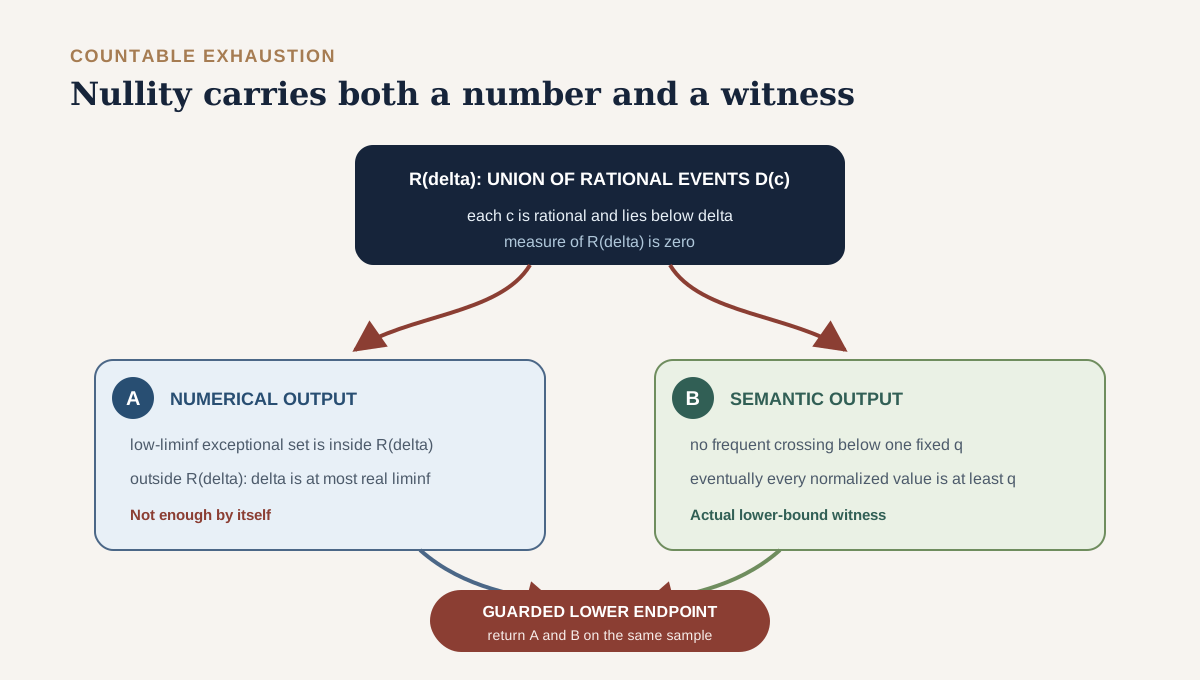
The generic centered endpoint is therefore
\[ \text{for almost every }\omega,\qquad \begin{cases} u(\omega)\text{ is eventually bounded below},\\ \delta\le\liminf_nu_n(\omega). \end{cases} \]This is the correctly scoped lower half of the theorem.
Where the hypotheses enter
Suppose that for every positive \(n\),
\[ \delta \le \frac{1}{n}\int_\Omega Y_n\,d\mu. \]Then each outer event \(D_c\) with \(c\lt\delta\) is null by RMT-32. That earlier theorem uses integrability, shifted subadditivity, a measure-preserving ergodic probability base, and the strict separation \(c\lt\delta\). RMT-33 adds no independence assumption.
Add back the Birkhoff average
The exact normalized decomposition is
\[ \frac{X_n(\omega)}{n}=u_n(\omega)+v_n(\omega), \]where
\[ v_n(\omega) {} = \frac{1}{n}\sum_{j=0}^{n-1}X_1(T^j\omega). \]On an ergodic probability base, the project’s pointwise Birkhoff theorem gives
\[ v_n(\omega) \longrightarrow \int_\Omega X_1\,d\mu \]for almost every \(\omega\).
For such a sample:
- \(u_n\) is eventually bounded below by the null-cover construction;
- \(u_n\le0\) pointwise by centering;
- \(v_n\) is eventually bounded below and above because it converges;
- convergence also gives the coboundedness condition required by the liminf-of-sum theorem.
The pinned Mathlib theorem le_liminf_add then yields
Since \(v_n\) converges,
\[ \liminf_nv_n=\int_\Omega X_1\,d\mu. \]Combining this equality with the centered lower estimate gives
\[ \delta+\int_\Omega X_1\,d\mu \le \liminf_n\frac{X_n(\omega)}{n}. \]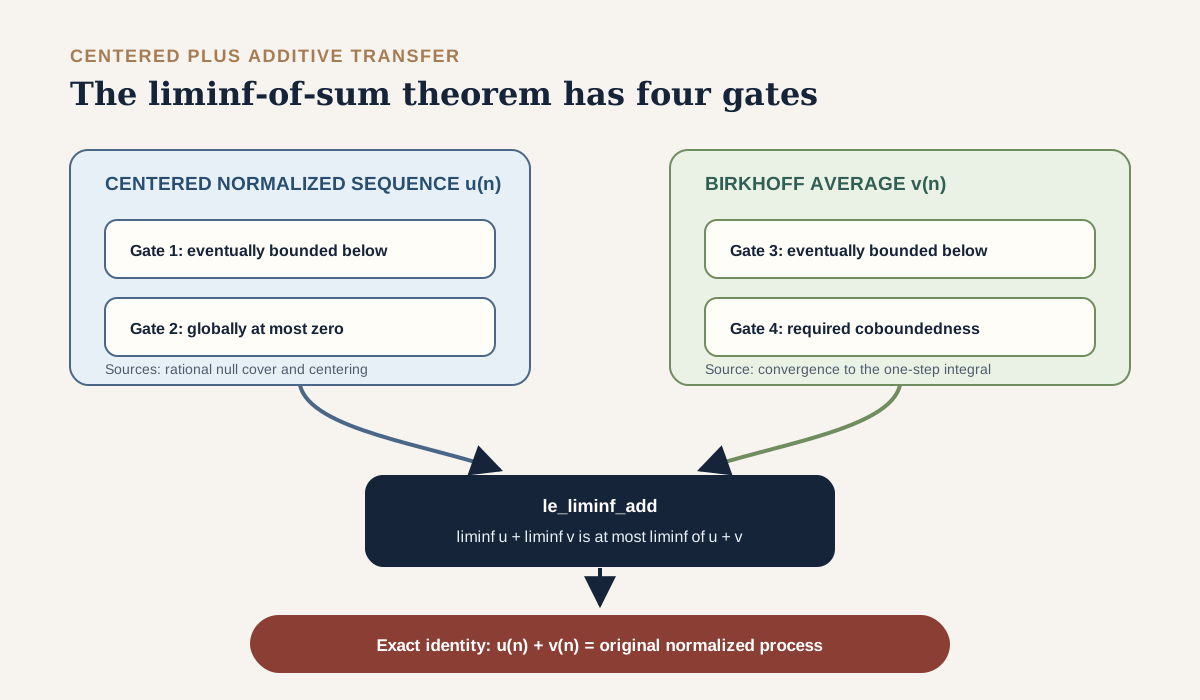
le_liminf_add is not a bare algebraic inequality over arbitrary real sequences. RMT-33 supplies all four order-side conditions explicitly: two-sided boundedness for the centered and Birkhoff components in the orientations required by the pinned theorem, plus the exact centered-additive identity.This step explains why the proof centered by the one-step orbit sum rather than by a constant expectation. The orbit sum produces both pointwise nonpositivity of \(Y_n\) and an exact additive component governed by Birkhoff.
Specialize the centered offset to the Fekete rate
For the log-positive cocycle process, set
\[ I_1:=\int_\Omega X_1\,d\mu. \]The deterministic rate \(\gamma_+\) lies below every positive-horizon normalized integral:
\[ \gamma_+\le\frac{1}{n}\int_\Omega X_n\,d\mu. \]The centered integral satisfies
\[ \int_\Omega Y_n\,d\mu {} = \int_\Omega X_n\,d\mu-nI_1. \]Therefore
\[ \gamma_+-I_1 \le \frac{1}{n}\int_\Omega Y_n\,d\mu \]for every positive \(n\). Choose
\[ \delta:=\gamma_+-I_1. \]The generic transfer theorem gives
\[ (\gamma_+-I_1)+I_1 \le \liminf_n\frac{X_n(\omega)}{n}. \]After cancellation,
\[ \gamma_+ \le \liminf_n\frac{X_n(\omega)}{n} \]almost everywhere.
This cancellation is why the centered Fekete offset appears throughout RMT-30 to RMT-33. It is not an additional rate. It is exactly the original rate expressed in centered coordinates.
Close the log-positive squeeze
RMT-29 already proved
\[ \limsup_n\frac{X_n(\omega)}{n} \le\gamma_+ \]almost everywhere. Intersect its full-measure set with the RMT-33 lower set and the full-measure set on which the one-step Birkhoff average converges.
The pointwise normalized log-positive process is nonnegative:
\[ 0\le\frac{X_n(\omega)}{n}. \]This supplies an eventual lower bound. The one-step orbit majorant gives, for positive \(n\),
\[ \frac{X_n(\omega)}{n} \le \frac{1}{n}\sum_{j=0}^{n-1}X_1(T^j\omega). \]The right side converges, so it is eventually bounded above. Hence the normalized process is eventually bounded above as well.
Now the pinned theorem
tendsto_of_le_liminf_of_limsup_le applies:
together with explicit eventual upper and lower bounds, imply
\[ \frac{X_n(\omega)}{n}\longrightarrow\gamma_+. \]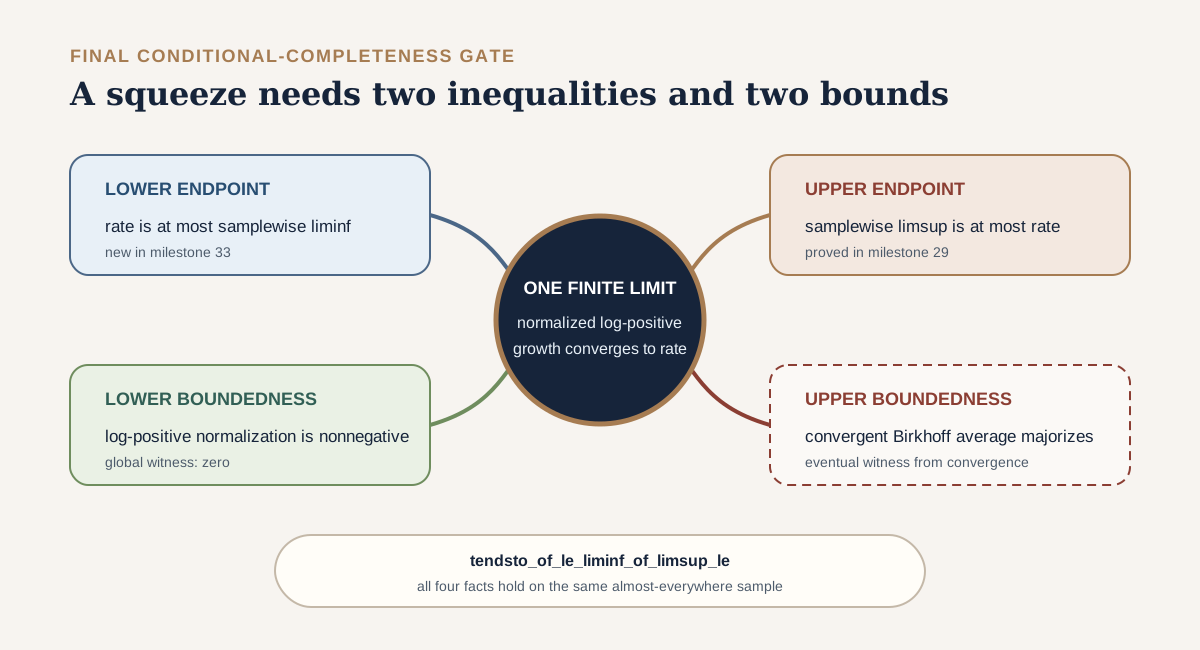
The checked endpoint is:
\[ \text{for almost every }\omega,\qquad \frac{\log^+\lVert C_n(\omega)\rVert}{n} \longrightarrow \gamma_+. \]No independent or identically distributed hypothesis appears. Dependence is organized by a deterministic measure-preserving base transformation and the cocycle law.
Separate log-positive growth from signed growth
The positive logarithm is
\[ \log^+r=\max\{0,\log r\}. \]It has three behaviors that matter here:
\[ \log^+r= \begin{cases} 0,&0\le r\le1,\\ \log r,&r\gt1. \end{cases} \]In Mathlib, \(\log^+0=0\). Thus the observable records expansion above one and erases contraction and singular collapse.
By contrast, a signed logarithmic growth theorem studies
\[ \frac{1}{n}\log\lVert C_n(\omega)\rVert, \]usually in an extended-real setting because the norm can vanish. Ruelle’s 1979 matrix-product corollary permits a limit in \(\mathbb R\cup\{-\infty\}\). RMT-33 does not.
Constant contraction test
Let
\[ C_n=a^nI, \qquad 0\lt a\lt1. \]Then the signed normalized growth is
\[ \frac{1}{n}\log\lVert C_n\rVert=\log a\lt0. \]But
\[ \frac{1}{n}\log^+\lVert C_n\rVert=0 \]at every positive time. RMT-33 returns \(\gamma_+=0\), not \(\log a\).
Zero-product test
If a finite product is the zero matrix, its signed logarithm naturally points to negative infinity. The log-positive observable is instead zero. It carries no record of the collapse.
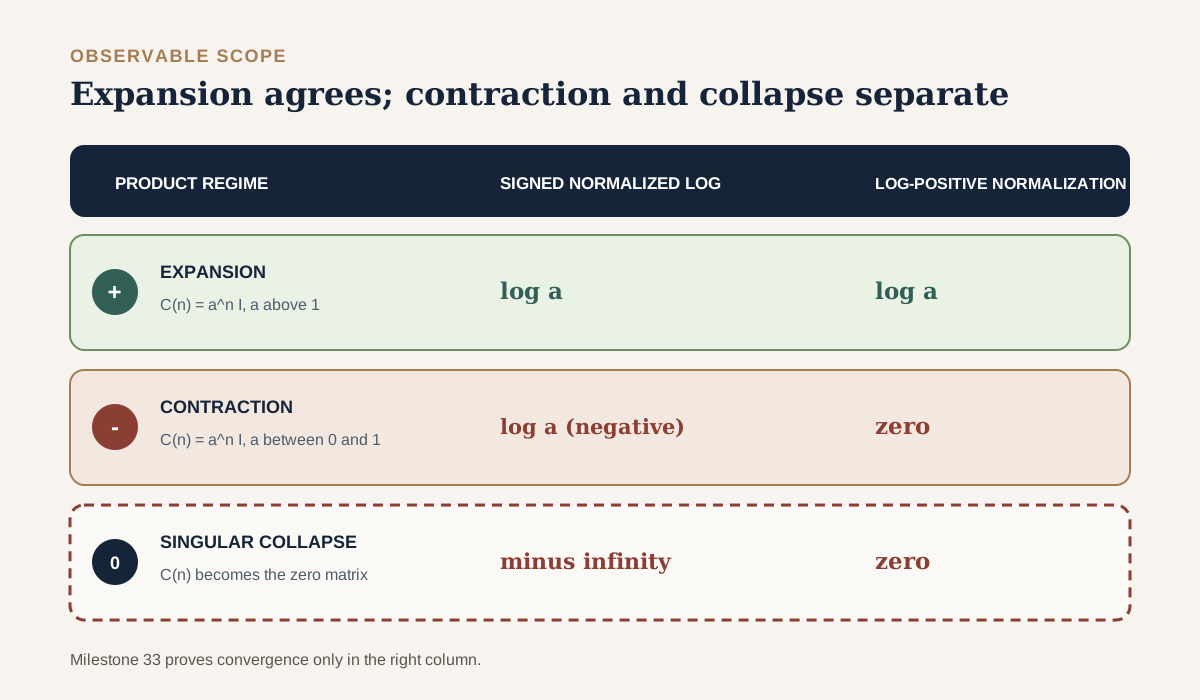
The phrase log-positive Kingman endpoint is therefore a scope label. It says that the proof architecture is subadditive and Kingman-style while the observable is the nonnegative envelope chosen by this project.
Seven bridges from the sequence ledger to Lean
Each bridge below has four layers: the sentence a mathematician says, the paper formula, the exact checked Lean interface, and a token map. Read them in order once; afterward the declaration names become a compact proof roadmap. The literal full project command appears after bridge seven.
Bridge 1: normalize at every natural time
normalizedProcess X n ωnormalizedProcessis the project definition being applied.Xis the whole time-indexed real process, not one slice.nis a natural horizon whose cast is the real denominator.ωis the sample point.normalizedProcess_zerochecks the zero-time statement, whilenormalizedProcess_update_zeroproves that changingX 0changes no normalized value.
Bridge 2: expose the durable rational witness
mem_centeredStrictLowerDeviationSet_iff_exists_frequently_normalized_ltcenteredStrictLowerDeviationSet T X cis \(D_c\).∃ q : ℚkeeps the generator countable.(q : ℝ) < cis the strict rational slack.∃ᶠ n in atTopmeans “beyond every cutoff there is another witness,” not “all sufficiently large times are witnesses.”normalizedCenteredProcess T X n ω < (q : ℝ)is the checked crossing.
Bridge 3: pass from the event to liminf only through the guard
liminf_normalizedCenteredProcess_lt_of_mem_centeredStrictLowerDeviationSet hlower hωhlowerhas exact typeIsBoundedUnder (· ≥ ·) atTop (fun n ↦ …).- The relation
(· ≥ ·)means that a fixed witness lies below the late sequence values. hωsupplies the rational \(q\) and its frequent crossings.liminf_le_of_frequently_leconsumeshlower; the theorem is deliberately not callable without it.- The quadratic-escape ledger shows the false statement that would result if this first argument were erased.
Bridge 4: spend an outer rational target as well as an inner witness
hX.centeredLowerLiminfDeviationSet_subset_rationalExhaustion δhXis the integrable shifted-subadditive candidate; its centered normalization is nonpositive.δis the deterministic centered Fekete offset.exists_rat_btwnfirst chooses an outer \(c\) between the low liminf and \(\delta\).- The event membership theorem chooses or exposes an inner \(q\lt c\).
- Two strict margins avoid the impossible request \(\delta\lt\delta\), while the rational index keeps the union countable.
Bridge 5: make the null cover return two deliverables
hX.ae_isBoundedUnder_ge_and_le_liminf_normalizedCenteredProcess hT δ hδhT : Ergodic T μdrives the prior event-nullity result.hδsays \(\delta\) lies below every positive normalized centered integral.- The first component of the returned conjunction is the semantic guard.
- The second component is the numerical lower rail.
- The private helper constructs the first component from nonmembership in the rational exhaustion; the public theorem exposes it instead of hiding it.
Bridge 6: add back the convergent Birkhoff average
hX.ae_add_oneStepIntegral_le_liminf_normalized hT δ hδnormalized_eq_normalizedCenteredProcess_add_birkhoffAveragesupplies the pointwise decomposition \(X_n/n=u_n+v_n\).- The rational null cover supplies the lower bound on \(u\).
normalizedCenteredProcess_nonpossupplies an upper bound on \(u\).- Birkhoff convergence supplies lower and upper bounds on \(v\) and identifies its liminf with \(\int X_1\,d\mu\).
le_liminf_addconsumes all four order gates before addition.
Bridge 7: squeeze the nonnegative log-positive observable
hC.ae_tendsto_normalizedLogPlusNormObservable hThC : C.HasIntegrableGeneratorLogPluscontrols the one-step positive logarithmic envelope.- This module’s
ae_integratedLogPlusGrowthRate_le_liminf_normalizedis the lower rail \(\gamma_+\le\liminf a\). - The imported RMT-29 declaration
ae_limsup_normalized_le_integratedLogPlusGrowthRateis the prior upper rail \(\limsup a\le\gamma_+\). - Global nonnegativity supplies the lower bound on \(a\); the convergent one-step Birkhoff majorant supplies its eventual upper bound.
tendsto_of_le_liminf_of_limsup_lecloses the squeeze.- No token here names the signed quantity
Real.log ‖C n ω‖; contractions and zero products remain intentionally invisible.
Type-check the exact project interface
Full project check: pinned project plus Mathlib. Put the following probe
in a temporary file inside formalization/:
import NonlinearDynamics.Random.RandomCocycles.SubadditiveKingman

open MeasureTheory Set Filter Topology
open NonlinearDynamics.Random.RandomCocycles

#check normalizedProcess
#check normalizedProcess_zero
#check normalizedProcess_update_zero
#check liminf_normalizedProcess_succ
#check mem_centeredStrictLowerDeviationSet_iff_exists_frequently_normalized_lt
#check liminf_normalizedCenteredProcess_lt_of_mem_centeredStrictLowerDeviationSet
#check IsIntegrableSubadditiveProcessCandidate.mem_centeredStrictLowerDeviationSet_iff_liminf_normalizedCenteredProcess_lt
#check IsIntegrableSubadditiveProcessCandidate.centeredLowerLiminfDeviationSet_subset_rationalExhaustion
#check IsIntegrableSubadditiveProcessCandidate.ae_isBoundedUnder_ge_and_le_liminf_normalizedCenteredProcess
#check IsIntegrableSubadditiveProcessCandidate.ae_add_oneStepIntegral_le_liminf_normalized
#check DiscreteMatrixCocycle.HasIntegrableGeneratorLogPlus.ae_integratedLogPlusGrowthRate_le_liminf_normalized
#check DiscreteMatrixCocycle.HasIntegrableGeneratorLogPlus.ae_tendsto_normalizedLogPlusNormObservable
From the repository root, type:
cd formalization
lake env lean NonlinearDynamics/Random/RandomCocycles/SubadditiveKingman.lean
This authoritative project/Mathlib check uses the repository’s pinned dependencies and checks the complete 627-line source. It may compile substantial dependencies and therefore may require substantial disk space and memory.
cd formalization
lake env lean -DwarningAsError=true NonlinearDynamics/Random/RandomCocycles/SubadditiveKingman.lean
Resource note: this exact file uses the repository's
pinned Lean and Mathlib dependencies. Initial project setup can require
substantial disk space and build time. For a lightweight first step on
macOS or Linux, use the page's standalone Lean-core or Std
tutorial.
Run the exact finite ledger with Lean and Std
The project theorem needs Mathlib’s filters, measures, liminf, Birkhoff
theorem, and cocycle hierarchy. Its numerical spine can be explored without
building any of that. The following standalone worksheet imports only Lean’s
Std library and uses exact rationals throughout.
Save this block byte for byte as
/tmp/GuardedRealLiminfTutorial.lean:
import Std

namespace GuardedRealLiminfTutorial

structure SequenceRow where
  n : Nat
  value : Rat
  belowInnerQ : Bool
  deriving Repr, DecidableEq

def boundedAlternation (n : Nat) : Rat :=
  if n = 0 then 0
  else if n % 2 = 1 then (-3 : Rat) / 2
  else (-1 : Rat) / 2

def boundedRows : List SequenceRow :=
  (List.range 11).map fun n =>
    { n := n
      value := boundedAlternation n
      belowInnerQ := decide (boundedAlternation n < (-5 : Rat) / 4) }

def approachZero (n : Nat) : Rat :=
  if n = 0 then 0 else (-1 : Rat) / n

def approachRows : List SequenceRow :=
  (List.range 9).map fun n =>
    { n := n
      value := approachZero n
      belowInnerQ := decide (approachZero n < (-1 : Rat) / 4) }

def quadraticEscapeNormalized (n : Nat) : Rat :=
  if n = 0 then 0 else 1 - n

def escapeRows : List SequenceRow :=
  (List.range 9).map fun n =>
    { n := n
      value := quadraticEscapeNormalized n
      belowInnerQ := decide (quadraticEscapeNormalized n < (-2 : Rat)) }

structure EscapeBoundary where
  target : Rat
  innerQ : Rat
  innerBelowTarget : Bool
  bound : Rat
  boundHoldsThrough : Nat
  valueThere : Rat
  firstDisplayedFailure : Nat
  valueAtFailure : Rat
  boundFailsThere : Bool
  sourceProvedTotalizedRealLiminf : Rat
  unguardedConclusion : Bool
  deriving Repr, DecidableEq

def escapeBoundary : EscapeBoundary :=
  { target := -1
    innerQ := -2
    innerBelowTarget := decide ((-2 : Rat) < -1)
    bound := -10
    boundHoldsThrough := 11
    valueThere := quadraticEscapeNormalized 11
    firstDisplayedFailure := 12
    valueAtFailure := quadraticEscapeNormalized 12
    boundFailsThere := decide (quadraticEscapeNormalized 12 < (-10 : Rat))
    sourceProvedTotalizedRealLiminf := 0
    unguardedConclusion := decide ((0 : Rat) < -1) }

structure SqueezeRow where
  k : Nat
  lowerRail : Rat
  sample : Rat
  upperRail : Rat
  width : Rat
  insideRails : Bool
  deriving Repr, DecidableEq

def gamma : Rat := 3 / 2

def lowerRail (k : Nat) : Rat := gamma - 1 / k

def upperRail (k : Nat) : Rat := gamma + 1 / k

def squeezedSample (k : Nat) : Rat :=
  if k % 2 = 0 then lowerRail k else upperRail k

def squeezeRow (k : Nat) : SqueezeRow :=
  { k := k
    lowerRail := lowerRail k
    sample := squeezedSample k
    upperRail := upperRail k
    width := upperRail k - lowerRail k
    insideRails := decide
      (lowerRail k ≤ squeezedSample k ∧ squeezedSample k ≤ upperRail k) }

def squeezeRows : List SqueezeRow :=
  (List.range 8).map fun n => squeezeRow (n + 1)

def zeroRateRows : List (Nat × Rat) :=
  (List.range 6).map fun n =>
    let k := n + 1
    (k, 1 / (k : Rat))

#eval boundedRows
#eval approachRows
#eval escapeRows
#eval escapeBoundary
#eval squeezeRows
#eval zeroRateRows

example : boundedAlternation 0 = 0 := by native_decide
example : boundedAlternation 9 = (-3 : Rat) / 2 := by native_decide
example : boundedAlternation 10 = (-1 : Rat) / 2 := by native_decide
example : (List.range 11).all fun n =>
    decide ((-3 : Rat) / 2 ≤ boundedAlternation n ∧
      boundedAlternation n ≤ 0) := by native_decide
example : (List.range 5).all fun j =>
    decide (boundedAlternation (2 * j + 1) < (-5 : Rat) / 4) := by
  native_decide
example : (List.range 11).all fun n =>
    decide (¬ boundedAlternation n < (-3 : Rat) / 2) := by native_decide

example : (List.range 8).all fun n =>
    decide (approachZero (n + 1) < 0) := by native_decide
example : (List.range 5).all fun n =>
    decide (¬ approachZero (n + 4) < (-1 : Rat) / 4) := by
  native_decide

example : quadraticEscapeNormalized 11 = -10 := by native_decide
example : quadraticEscapeNormalized 12 = -11 := by native_decide
example : (List.range 5).all fun j =>
    decide (quadraticEscapeNormalized (j + 4) < (-2 : Rat)) := by
  native_decide
example : escapeBoundary.unguardedConclusion = false := by native_decide

example : (List.range 8).all fun n =>
    (squeezeRow (n + 1)).insideRails := by native_decide
example : (List.range 8).all fun n =>
    decide ((squeezeRow (n + 1)).width = 2 / ((n + 1 : Nat) : Rat)) := by
  native_decide
example : (List.range 6).all fun n =>
    decide (0 < (zeroRateRows[n]!).2) := by native_decide

end GuardedRealLiminfTutorial
Open a terminal and type:
source "$HOME/.elan/env"
elan run leanprover/lean4:v4.32.0 lean \
  /tmp/GuardedRealLiminfTutorial.lean
Standalone tutorial: Lean 4.32.0 plus Std, suitable for an ordinary macOS
or Linux host. This exact file ran in 3.4 seconds and printed the following
complete transcript:
[{ n := 0, value := 0, belowInnerQ := false },
 { n := 1, value := (-3 : Rat)/2, belowInnerQ := true },
 { n := 2, value := (-1 : Rat)/2, belowInnerQ := false },
 { n := 3, value := (-3 : Rat)/2, belowInnerQ := true },
 { n := 4, value := (-1 : Rat)/2, belowInnerQ := false },
 { n := 5, value := (-3 : Rat)/2, belowInnerQ := true },
 { n := 6, value := (-1 : Rat)/2, belowInnerQ := false },
 { n := 7, value := (-3 : Rat)/2, belowInnerQ := true },
 { n := 8, value := (-1 : Rat)/2, belowInnerQ := false },
 { n := 9, value := (-3 : Rat)/2, belowInnerQ := true },
 { n := 10, value := (-1 : Rat)/2, belowInnerQ := false }]
[{ n := 0, value := 0, belowInnerQ := false },
 { n := 1, value := -1, belowInnerQ := true },
 { n := 2, value := (-1 : Rat)/2, belowInnerQ := true },
 { n := 3, value := (-1 : Rat)/3, belowInnerQ := true },
 { n := 4, value := (-1 : Rat)/4, belowInnerQ := false },
 { n := 5, value := (-1 : Rat)/5, belowInnerQ := false },
 { n := 6, value := (-1 : Rat)/6, belowInnerQ := false },
 { n := 7, value := (-1 : Rat)/7, belowInnerQ := false },
 { n := 8, value := (-1 : Rat)/8, belowInnerQ := false }]
[{ n := 0, value := 0, belowInnerQ := false },
 { n := 1, value := 0, belowInnerQ := false },
 { n := 2, value := -1, belowInnerQ := false },
 { n := 3, value := -2, belowInnerQ := false },
 { n := 4, value := -3, belowInnerQ := true },
 { n := 5, value := -4, belowInnerQ := true },
 { n := 6, value := -5, belowInnerQ := true },
 { n := 7, value := -6, belowInnerQ := true },
 { n := 8, value := -7, belowInnerQ := true }]
{ target := -1,
  innerQ := -2,
  innerBelowTarget := true,
  bound := -10,
  boundHoldsThrough := 11,
  valueThere := -10,
  firstDisplayedFailure := 12,
  valueAtFailure := -11,
  boundFailsThere := true,
  sourceProvedTotalizedRealLiminf := 0,
  unguardedConclusion := false }
[{ k := 1, lowerRail := (1 : Rat)/2, sample := (5 : Rat)/2, upperRail := (5 : Rat)/2, width := 2, insideRails := true },
 { k := 2, lowerRail := 1, sample := 1, upperRail := 2, width := 1, insideRails := true },
 { k := 3,
   lowerRail := (7 : Rat)/6,
   sample := (11 : Rat)/6,
   upperRail := (11 : Rat)/6,
   width := (2 : Rat)/3,
   insideRails := true },
 { k := 4,
   lowerRail := (5 : Rat)/4,
   sample := (5 : Rat)/4,
   upperRail := (7 : Rat)/4,
   width := (1 : Rat)/2,
   insideRails := true },
 { k := 5,
   lowerRail := (13 : Rat)/10,
   sample := (17 : Rat)/10,
   upperRail := (17 : Rat)/10,
   width := (2 : Rat)/5,
   insideRails := true },
 { k := 6,
   lowerRail := (4 : Rat)/3,
   sample := (4 : Rat)/3,
   upperRail := (5 : Rat)/3,
   width := (1 : Rat)/3,
   insideRails := true },
 { k := 7,
   lowerRail := (19 : Rat)/14,
   sample := (23 : Rat)/14,
   upperRail := (23 : Rat)/14,
   width := (2 : Rat)/7,
   insideRails := true },
 { k := 8,
   lowerRail := (11 : Rat)/8,
   sample := (11 : Rat)/8,
   upperRail := (13 : Rat)/8,
   width := (1 : Rat)/4,
   insideRails := true }]
[(1, 1), (2, (1 : Rat)/2), (3, (1 : Rat)/3), (4, (1 : Rat)/4), (5, (1 : Rat)/5), (6, (1 : Rat)/6)]
Read the output as four separate ledgers:
- the alternating sequence repeatedly crosses \(-5/4\) and remains between \(-3/2\) and zero;
- \(-1/n\) is negative at every displayed positive time but stops strictly crossing \(-1/4\) at equality \(n=4\);
- \(1-n\) keeps crossing \(-2\), defeats the displayed lower bound one step after equality, and makes the proposed unguarded conclusion false; and
- the exact squeeze rows lie between their two rails with width \(2/k\), while the positive zero-rate rows \(1/k\) approach the allowed endpoint zero.
The example declarations kernel-check every recorded finite
identity and Boolean window. The field
sourceProvedTotalizedRealLiminf := 0 is an explicit reference to
the paired Mathlib proof, not a reimplementation of liminf in Std.
The infinite frequency, eventual boundedness, totalized real-liminf, null-set,
Birkhoff, and cocycle claims remain exactly the full project interfaces above.
Audit every checked interface
RMT-33 declaration ledger
| Declaration | Mathematical job | Essential gate |
|---|---|---|
normalizedProcess | Total normalization \(X_n/n\) | Division at zero is intentionally total |
normalizedProcess_zero | Proves the zero-time value is zero | None |
normalizedProcess_update_zero | Shows time-zero data is completely forgotten | Function extensionality and a zero/nonzero split |
normalizedCenteredProcess | Normalizes the centered process | Inherits total normalization |
normalizedCenteredProcess_zero | Proves centered normalization also vanishes at time zero | Reduces to total normalization |
liminf_normalizedProcess_succ | Removes the finite zero-time prefix | liminf_nat_add |
normalized_eq_normalizedCenteredProcess_add_birkhoffAverage | Gives the exact centered plus additive identity | Holds at every natural time |
mem_centeredArbitrarilyLateBadBlockSet_iff_frequently_normalized_lt | Converts block witnesses into filter frequency | Positive witness removes division boundary |
mem_centeredStrictLowerDeviationSet_iff_exists_frequently_normalized_lt | Exposes one durable rational margin | Countable rational generator |
liminf_normalizedCenteredProcess_lt_of_mem_centeredStrictLowerDeviationSet | Sends event membership to low real liminf | Explicit eventual lower bound |
centeredRationalLowerDeviationExhaustionSet | Unions RMT-32 events over rational targets below \(\delta\) | Countability |
mem_centeredRationalLowerDeviationExhaustionSet_iff | Exposes one rational outer target below \(\delta\) and membership in its strict event | Subtype-indexed union membership |
centeredLowerLiminfDeviationSet | Names the strict real-liminf exceptional set | Total real liminf is used deliberately |
mem_centeredLowerLiminfDeviationSet_iff | Rewrites exceptional-set membership as its defining strict liminf inequality | Definitional equivalence |
normalizedCenteredProcess_nonpos | Supplies a pointwise centered upper bound | Candidate shifted subadditivity |
mem_centeredStrictLowerDeviationSet_of_liminf_normalizedCenteredProcess_lt | Sends low liminf to a rational event | Nonpositivity supplies coboundedness |
mem_centeredStrictLowerDeviationSet_iff_liminf_normalizedCenteredProcess_lt | States the guarded equivalence | Eventual lower bound remains visible |
centeredLowerLiminfDeviationSet_subset_rationalExhaustion | Implements the two-margin cover | Rational density twice |
measure_centeredRationalLowerDeviationExhaustionSet_eq_zero | Makes the outer exhaustion null | Probability, ergodicity, integral lower bound |
measure_centeredLowerLiminfDeviationSet_eq_zero | Makes strict lower-liminf deviation null | Set inclusion plus null monotonicity |
ae_isBoundedUnder_ge_and_le_liminf_normalizedCenteredProcess | Returns both semantic guard and lower inequality | Complement of the rational exhaustion |
ae_add_oneStepIntegral_le_liminf_normalized | Transfers the centered bound to \(X_n/n\) | Birkhoff convergence and four le_liminf_add gates |
ae_integratedLogPlusGrowthRate_le_liminf_normalized | Identifies the cocycle lower endpoint | Centered Fekete offset and full ergodicity assembled |
ae_tendsto_normalizedLogPlusNormObservable | Proves almost-everywhere convergence to \(\gamma_+\) | Lower bound, upper bound, and explicit two-sided boundedness |
The private helper
ae_isBoundedUnder_ge_normalizedCenteredProcess is intentionally
not public. Its content is exposed through the stronger public conjunction
theorem.
Complete paired-source manifest
The authoritative paired file is
formalization/NonlinearDynamics/Random/RandomCocycles/SubadditiveKingman.lean.
At this chapter revision it has 627 lines and SHA-256 digest
55680bc2afa18d0a195a7fa7426e6afb2b55fcbb3f588d3474bc6f52764025ef.
It imports exactly:
NonlinearDynamics.Random.RandomCocycles.SubadditiveLowerDeviation; andNonlinearDynamics.Random.RandomCocycles.SubadditiveUpperLimsup.
The 24 public declarations appear in source order in the ledger above. The remaining named private surface is complete in the following table.
| Private source item | Role |
|---|---|
ae_isBoundedUnder_ge_normalizedCenteredProcess | Extracts one eventual rational lower-bound witness off the null exhaustion |
rmt33ZeroProcess | Defines the zero-process boundary |
rmt33ApproachZeroFromBelow | Defines the total sequence \((-1)/n\), with value zero at time zero |
rmt33ApproachZeroFromBelow_tendsto | Proves convergence to zero |
rmt33ApproachZeroFromBelow_frequently_neg | Proves strict negative crossings are frequent |
rmt33ApproachZeroFromBelow_not_frequently_below | Proves every fixed rational \(q\lt0\) eventually stops being crossed |
rmt33QuadraticEscapeProcess | Defines the one-point process \(X_n=-n^2\) |
rmt33QuadraticEscapeProcess_candidate | Checks integrability and shifted subadditivity of that process |
rmt33QuadraticEscape_centered | Computes its centered numerator as \(-n^2+n\) |
rmt33QuadraticEscape_mem | Checks event membership at target \(-1\) using rational witness \(-2\) |
rmt33QuadraticEscape_liminf | Proves the pinned total real liminf is zero because the eventual-lower-bound set is empty |
Five anonymous example probes then test the public boundary:
| Probe, in source order | Exact checked boundary |
|---|---|
| 1 | The zero process has liminf zero and an empty strict deviation set at target zero |
| 2 | Replacing the arbitrary time-zero slice leaves normalized liminf unchanged |
| 3 | \((-1)/n\) has liminf zero and is frequently negative, but crosses no fixed rational \(q\lt0\) frequently |
| 4 | The quadratic candidate belongs to the rational event at \(-1\), has no eventual lower bound, and does not have total real liminf below \(-1\) |
| 5 | The final convergence theorem remains well typed for the empty matrix-index type |
Finally, the source contains exactly 11 explicit axiom-audit probes:
#print axioms normalizedProcess_update_zero
#print axioms liminf_normalizedProcess_succ
#print axioms mem_centeredArbitrarilyLateBadBlockSet_iff_frequently_normalized_lt
#print axioms liminf_normalizedCenteredProcess_lt_of_mem_centeredStrictLowerDeviationSet
#print axioms IsIntegrableSubadditiveProcessCandidate.mem_centeredStrictLowerDeviationSet_of_liminf_normalizedCenteredProcess_lt
#print axioms IsIntegrableSubadditiveProcessCandidate.centeredLowerLiminfDeviationSet_subset_rationalExhaustion
#print axioms IsIntegrableSubadditiveProcessCandidate.measure_centeredLowerLiminfDeviationSet_eq_zero
#print axioms IsIntegrableSubadditiveProcessCandidate.ae_isBoundedUnder_ge_and_le_liminf_normalizedCenteredProcess
#print axioms IsIntegrableSubadditiveProcessCandidate.ae_add_oneStepIntegral_le_liminf_normalized
#print axioms DiscreteMatrixCocycle.HasIntegrableGeneratorLogPlus.ae_integratedLogPlusGrowthRate_le_liminf_normalized
#print axioms DiscreteMatrixCocycle.HasIntegrableGeneratorLogPlus.ae_tendsto_normalizedLogPlusNormObservable
These lines are part of the source manifest, not a substitute for the full project check. Their printed results come from the checked build rather than from text inspection alone.
Pinned Mathlib API ledger
The repository pins Mathlib tag v4.32.0, commit
81a5d257c8e410db227a6665ed08f64fea08e997. These declarations are
the exact library interfaces used or audited for the bridge.
| Pinned file | Declaration | Role in the proof |
|---|---|---|
Mathlib/Order/LiminfLimsup.lean | Filter.liminf | Supremum of eventual lower bounds |
| same | liminf_congr | Rewrites under eventual equality |
| same | liminf_nat_add | Removes a finite natural prefix |
| same | liminf_le_of_frequently_le | Frequent lower crossings bound liminf, with lower boundedness |
| same | frequently_lt_of_liminf_lt | A strict liminf gap produces frequent crossings, with coboundedness |
| same | le_liminf_iff | Characterizes lower bounds under boundedness and coboundedness gates |
Mathlib/Algebra/Order/Archimedean/Real/Basic.lean | Real.sSup_empty | Explains totalization of an empty lower-bound set |
Mathlib/Topology/Order/LiminfLimsup.lean | Filter.Tendsto.liminf_eq | Identifies liminf of the convergent Birkhoff term |
| same | Filter.Tendsto.isBoundedUnder_ge | Extracts eventual lower boundedness from convergence |
| same | Filter.Tendsto.isBoundedUnder_le | Extracts eventual upper boundedness from convergence |
| same | tendsto_of_le_liminf_of_limsup_le | Closes the final squeeze with two boundedness gates |
Mathlib/Topology/Algebra/Order/LiminfLimsup.lean | le_liminf_add | Transfers centered and Birkhoff lower limits through addition |
Mathlib/Order/Filter/IsBounded.lean | isBoundedUnder_of | Packages a global bound as a filter bound |
| same | IsBoundedUnder.mono_le | Transfers an upper bound through an eventual majorant |
| same | IsBoundedUnder.isCoboundedUnder_ge | Supplies the required dual order gate |
| same | isCoboundedUnder_ge_of_le | Uses the global centered upper bound |
Mathlib/Order/Filter/AtTopBot/Basic.lean | frequently_atTop | Expands frequency into arbitrarily late witnesses |
Mathlib/MeasureTheory/OuterMeasure/Basic.lean | measure_iUnion_null | Makes the countable rational union null |
| same | measure_mono_null | Transfers nullity to the lower-liminf exceptional subset |
Mathlib/MeasureTheory/OuterMeasure/AE.lean | measure_eq_zero_iff_ae_notMem | Moves from nullity to an almost-everywhere complement |
Mathlib/Algebra/Order/Archimedean/Basic.lean | exists_rat_lt | Chooses an outer lower rational |
| same | exists_rat_btwn | Chooses strict inner and outer rational margins |
Mathlib/Analysis/Subadditive.lean | Subadditive.lim | Defines the deterministic Fekete rate |
| same | Subadditive.lim_le_div | Places the rate below each positive normalized horizon |
| same | Subadditive.tendsto_lim | Proves convergence of normalized integrated growth |
Mathlib/Analysis/SpecialFunctions/Log/PosLog.lean | Real.posLog | Defines \(\log^+r=\max\{0,\log r\}\) |
| same | Real.posLog_mul | Supports log-positive subadditivity |
Mathlib/Dynamics/Ergodic/Ergodic.lean | PreErgodic | Records ergodic rigidity without preservation |
| same | Ergodic | Bundles preservation with pre-ergodicity |
Assumption ledger
| Assumption | Where it is obtained | What it licenses | What it does not license |
|---|---|---|---|
| Measurable space on \(\Omega\) | Ambient setup | Integrals, almost-everywhere statements, measurable dynamics | Probability normalization |
| Integrability of every \(X_n\) | Candidate structure | Centering, finite integrals, Birkhoff input at \(n=1\) | Independence or convergence by itself |
| Shifted subadditivity | Candidate structure | One-step orbit majorant, centered nonpositivity, prior bad-block estimates | Additivity |
| Measure preservation | Bundled in the discrete cocycle, explicit in generic ergodic input | Integral transport and Birkhoff theory | Ergodic rigidity |
| Pre-ergodicity | Final cocycle hypothesis | Combines with bundled preservation to form Ergodic | Preservation on its own |
| Probability normalization | Typeclass hypothesis | Expectation semantics and the RMT-32 null-branch selection | Independence |
| One-step log-positive integrability | HasIntegrableGeneratorLogPlus | Integrability at every horizon via the orbit majorant | Signed log integrability |
| Eventual lower boundedness | Constructed off the rational null cover | Standard real-liminf algebra | A signed or extended-real conclusion |
| Eventual upper boundedness | Centered nonpositivity or convergent Birkhoff majorant | Conditional-completeness liminf and final convergence lemmas | A uniform bound over all samples |
| Rational countability | Type-level property of \(\mathbb Q\) | Nullity of the exhaustion union | A quantitative rate of convergence |
| Rational density | Archimedean order | Two strict margins | Any probabilistic approximation |
The final theorem asks for
PreErgodic C.base μ, not a bare
Ergodic C.base μ, because the cocycle already stores
C.base_preserving. The proof constructs
from those two pieces. Pre-ergodicity alone would not be sufficient for an arbitrary map.
Checked nonclaim ledger
RMT-33 does not prove any of the following:
- convergence in \(L^1\);
- convergence in probability as a separately packaged theorem;
- equality obtained by interchanging a samplewise limit and an integral;
- convergence of normalized integrals as a consequence of the samplewise theorem, although the deterministic Fekete convergence was proved earlier;
- convergence of the signed quantity \(n^{-1}\log\lVert C_n(\omega)\rVert\);
- detection of negative growth rates;
- a Lyapunov exponent in the usual signed sense;
- inverse-cocycle integrability or control;
- invertibility or nonzero determinant of the matrices;
- an Oseledets filtration, splitting, or multiplicity theorem;
- independence, identical distribution, or stationarity formulated as a stochastic-process law;
- a rate of convergence, concentration bound, or finite-sample confidence statement;
- a claim that the original 1923 Fekete paper states Mathlib’s modern general subadditive-sequence theorem verbatim;
- the full matrix-product corollary stated by Ruelle in 1979;
- a nondegenerate matrix dimension requirement. The Lean theorem deliberately retains the empty-index boundary.
Boundary audits
Zero process
For \(X_n=0\), centering, normalization, liminf, limsup, and the integrated rate are all zero. The strict lower-liminf deviation set at target zero is empty. This checks strictness at the endpoint.
Arbitrary time-zero replacement
Changing \(X_0\) to any function changes no normalized value because division at zero returns zero. It therefore changes no lower limit and no convergence statement.
Approach zero from below
The sequence \(-1/n\) crosses zero strictly at every positive time but no fixed rational slope below zero frequently. It checks the necessity of durable rational slack.
Quadratic escape
The centered normalized sequence \(1-n\) belongs to strict rational lower-deviation events but has no eventual lower bound. Its formal real liminf is zero because the eventual-lower-bound set is empty. It checks the necessity of the guard.
Empty matrix dimension
When the matrix index type is empty, the operator norm observable is formalized so that every log-positive value is zero. The final theorem still typechecks and yields convergence to zero. This is a Lean boundary guarantee, not a classical theorem’s advertised matrix regime.
Constant expansion and contraction
For \(C_n=a^nI\) with \(a\gt1\), log-positive and signed normalized growth both equal \(\log a\). For \(0\lt a\lt1\), the signed rate is \(\log a\), while the log-positive rate is zero. This pair checks exactly where the two observables agree and separate.
Place the result beside the classical theorems
The historical sources illuminate the architecture, but their statements should not be substituted for the checked Lean theorem.
Kingman 1968
J. F. C. Kingman’s “The Ergodic Theory of Subadditive Stochastic Processes” appeared in volume 30, issue 3 of the Journal of the Royal Statistical Society, Series B, pp. 499 to 510. Section 1 on p. 500 introduces the stationary subadditive setting and the deterministic time constant as an infimum of normalized expectations. Theorem 1 on p. 501 handles an upper asymptotic quantity and mean behavior. Theorem 3 on p. 504 identifies the invariant limit structure, and Theorem 5 on p. 506 gives existence of the almost-sure normalized limit.
RMT-33 shares the subadditive, measure-preserving, ergodic architecture. It does not reproduce all of Kingman’s conclusions, especially mean convergence. The publisher PDF was access-restricted during this audit; exact anchors were checked against a scan, while the publisher landing page confirms the bibliographic record.
Steele 1989
J. Michael Steele’s “Kingman’s subadditive ergodic theorem” gives an accessible compact proof in Annales de l’Institut Henri Poincaré, Probabilités et Statistiques 25(1), pp. 93 to 98. The theorem is stated on pp. 93 to 94. Section 2 centers by a one-step orbit sum on p. 94. The interval-decomposition and bad-set estimates occupy pp. 94 to 96, and equation (2.5) on p. 96 closes the limsup versus liminf argument.
Steele is a useful conceptual map for the project’s RMT-30 through RMT-33 sequence. It is not a line-by-line source for the Lean declarations, whose event encodings and totalized real-order guards are specific to the pinned library.
Ruelle 1979
David Ruelle’s “Ergodic theory of differentiable dynamical systems” appeared in Publications Mathématiques de l’IHÉS 50, pp. 27 to 58. The open PDF states a subadditive theorem as Theorem 1.1 on p. 29. Corollary 1.2 on pp. 29 to 30 treats products of real matrices under integrability of the one-step positive log norm.
That corollary concludes convergence of the signed, extended-real normalized log norm and includes a normalized-integral formula. RMT-33 proves the narrower real-valued log-positive envelope theorem. Constant contractions and zero products show why the two statements are not interchangeable.
Fekete 1923
Michael Fekete’s 1923 paper, DOI 10.1007/BF01504345, contains at Theorem II on printed p. 233 a multiplicative convergence argument for extremal polynomial quantities using a block and remainder decomposition. It is a historical antecedent of the lemma now bearing his name.
The exact modern formal source used here is instead
Mathlib/Analysis/Subadditive.lean, whose
Subadditive.lim, Subadditive.lim_le_div, and
Subadditive.tendsto_lim state the general real-sequence interface
needed by the project.
Furstenberg and Kesten 1960
H. Furstenberg and H. Kesten’s “Products of Random Matrices” appeared in The Annals of Mathematical Statistics 31, pp. 457 to 469. The original full text was not accessible in this source audit, so this chapter does not assign an unchecked theorem number or exact assumption list to it. Ruelle’s introduction on p. 28 provides an accessible primary historical connection between the matrix-product result and Kingman’s subadditive theorem.
What the proof teaches beyond this theorem
Several reusable formalization principles emerge.
- A total operation needs a semantic certificate. Total definitions are convenient for rewriting, but their intended mathematical interpretation may require side conditions.
- Countable event design is theorem design. Rational margins make the exceptional set both expressive enough for real strict inequalities and small enough for countable measure closure.
- A null set can carry constructive data. Its complement may produce an eventual numerical witness, not merely a proposition with measure one.
- Centering should match the available convergence theorem. Subtracting the one-step orbit sum creates a nonpositive residual and an additive Birkhoff component.
- Conditional completeness should remain visible at public interfaces. RMT-33 returns boundedness beside the lower-limit inequality instead of burying it inside a private proof.
- Boundary models are part of the theorem specification. The \(-1/n\), quadratic escape, contraction, zero-product, and empty-dimension examples each reject a different overclaim.
Forty solved exercises
The exercises are arranged in eight ropes of five. Each rope begins with a direct reconstruction and ends with a boundary or design problem.
Rope I: total normalization and filter time
Exercise 1: prove that time-zero replacement is invisible
Let \(X:\mathbb N\to\Omega\to\mathbb R\), let \(z:\Omega\to\mathbb R\), and replace \(X_0\) by \(z\). Prove pointwise that the total normalized process is unchanged.
Solution. Fix \(n\) and \(\omega\). If \(n=0\), both normalized values are
zero because division by zero in \(\mathbb R\) is totalized to zero. The
numerators may differ, but neither survives normalization. If \(n\ne0\), a
function update at index zero does not change the \(n\)-th slice, so the
numerators and denominators agree. The two cases prove equality for every
\(n,\omega\), and function extensionality proves equality of the normalized
processes. This is the argument checked by
normalizedProcess_update_zero.
The result is stronger than finite-prefix invariance of a limit. It says every normalized value is identical before any asymptotic operation is applied.
Exercise 2: expand frequency at natural infinity
Show that
\[ \exists^\infty_{\mathrm{atTop}}n,\ P(n) \]is equivalent to
\[ \forall N\in\mathbb N,\ \exists n\in\mathbb N,\quad N\le n\ \text{and}\ P(n). \]Solution. A property is frequent in a filter when its negation is not
eventual. For the natural-number atTop filter, eventual \(Q(n)\)
means that there is a cutoff \(N\) such that \(Q(n)\) holds whenever
\(N\le n\). Negating “eventually not \(P\)” gives: for every proposed cutoff
\(N\), there is some \(n\ge N\) at which \(P(n)\) holds. Mathlib packages this
equivalence as frequently_atTop.
It expresses arbitrarily late recurrence. It does not say there is a cutoff after which \(P\) always holds.
Exercise 3: separate frequent from eventual
Let \(P(n)\) mean that \(n\) is even. Prove that \(P\) and its negation are both frequent along natural infinity, while neither is eventual.
Solution. Given any cutoff \(N\), the number \(2N\) is at least \(N\) and even, so \(P\) is frequent. The number \(2N+1\) is at least \(N\) and odd, so \(\neg P\) is frequent. If \(P\) were eventual, its frequent negation would be impossible. Likewise, if \(\neg P\) were eventual, frequent \(P\) would be impossible.
This model explains why an arbitrarily-late bad-block event can coexist with arbitrarily late good blocks. RMT-33 needs only recurrent strict crossings at one fixed rational slope.
Exercise 4: remove a finite prefix
Suppose \(a,b:\mathbb N\to\mathbb R\) agree for every \(n\ge17\). Under the usual library side conditions needed for real lower limits, explain why they have the same liminf.
Solution. Agreement from index 17 onward is eventual equality along
atTop. The declaration liminf_congr says eventual
equality is enough to identify lower limits. One may also shift each sequence
by 17 and use liminf_nat_add, then identify the shifted
sequences pointwise.
For RMT-33 the first route proves that the exact centered-plus-Birkhoff identity may be rewritten under liminf. The second route proves that the totalized time-zero term has no asymptotic effect.
Exercise 5: decode the relation orientation
Translate the following filter propositions into ordinary quantified sentences:
\[ \operatorname{IsBoundedUnder}(\ge,\mathrm{atTop},a), \qquad \operatorname{IsBoundedUnder}(\le,\mathrm{atTop},a). \]Solution. The first means there is \(b\in\mathbb R\) such that eventually \(b\le a_n\). It is eventual lower boundedness. The second means there is \(B\in\mathbb R\) such that eventually \(a_n\le B\). It is eventual upper boundedness.
A reliable Lean-reading method is to ignore the English word “under,” expand the relation, and locate the fixed witness. With relation \(\ge\), the eventual assertion has the form \(a_n\ge b\), so \(b\) lies below the sequence. With relation \(\le\), it has the form \(a_n\le B\), so \(B\) lies above it.
Rope II: the guarded real lower limit
Exercise 6: compute the totalized liminf of \(1-n\)
Let \(a_n=1-n\). Show that the set of eventual real lower bounds of \(a\) is empty, then compute Mathlib’s real liminf.
Solution. Fix any \(b\in\mathbb R\). By the Archimedean property, choose a natural \(n\) with \(n\gt1-b\). Then \(1-n\lt b\). The same argument works beyond every proposed cutoff by increasing \(n\), so \(b\le1-n\) cannot hold eventually. Since \(b\) was arbitrary, there is no eventual real lower bound.
The defining set for real liminf is therefore empty. In the pinned real-order
implementation, Real.sSup_empty gives
\(\sup\varnothing=0\). Hence the formal real liminf is zero. The extended-real
lower limit would be negative infinity, so the two notions intentionally
diverge outside the bounded-below regime.
Exercise 7: prove event membership forces a low liminf under the guard
Assume \(u\) is eventually bounded below and there is a rational \(q\lt c\) such that \(u_n\lt q\) frequently. Prove
\[ \liminf_nu_n\lt c. \]Solution. Frequent strict inequality implies frequent weak inequality
\(u_n\le q\). The theorem liminf_le_of_frequently_le, supplied
with the eventual lower-bound hypothesis, gives
Composing this weak inequality with \(q\lt c\) yields the desired strict inequality. The rational nature of \(q\) is not used by the liminf theorem. It is used earlier to keep the event family countable.
Exercise 8: prove a low liminf creates a rational event
Assume \(u_n\le0\) for every \(n\) and
\[ \liminf_nu_n\lt c. \]Explain how to prove membership in \(D_c\).
Solution. Rational density gives \(q\in\mathbb Q\) satisfying
\[ \liminf_nu_n\lt q\lt c. \]The global upper bound \(u_n\le0\) supplies the order-coboundedness hypothesis
needed by frequently_lt_of_liminf_lt. Applying that theorem to
the first strict inequality gives frequent \(u_n\lt q\). The second strict
inequality and the event membership characterization then give
\(\omega\in D_c\).
The proof uses an upper bound, not the eventual lower bound from Exercise 7. This asymmetry is a feature of conditionally complete liminf APIs.
Exercise 9: locate the false unguarded implication
Use \(u_n=1-n\) and \(c=-1\) to refute
\[ \omega\in D_c \quad\Longrightarrow\quad \liminf_nu_n\lt c \]when no eventual lower bound is assumed.
Solution. The sequence is eventually below every fixed rational slope. For example, \(q=-2\) satisfies \(q\lt c\), and \(1-n\lt-2\) for every \(n\gt3\). Thus the point belongs to \(D_{-1}\).
Exercise 6 computed the total real liminf as zero. The claimed conclusion would be \(0\lt-1\), which is false. This counterexample is also compatible with subadditivity after using the checked quadratic-escape process, so the problem cannot be dismissed as an artifact of an unrelated arbitrary sequence.
Exercise 10: compare a real and extended-real design
What would change if the entire proof used \(\mathbb R\cup\{-\infty,+\infty\}\) for lower limits?
Solution. An extended-real liminf can represent unbounded negative escape as negative infinity, so the empty-eventual-lower-bound totalization issue would disappear. Event membership could imply a low extended liminf without first constructing a finite real lower bound.
Several other costs would appear. The centered-plus-Birkhoff identity would mix extended and real arithmetic. Addition near opposing infinities requires care. The final target \(\gamma_+\) is real, so one would still need to prove finiteness before using a real convergence theorem. Existing project APIs for the Birkhoff average and integrated Fekete rate are real-valued. RMT-33’s guarded-real design keeps those interfaces aligned and makes the required finiteness witness explicit. Neither design is universally superior; the right choice depends on whether negative-infinite behavior is part of the intended theorem.
Rope III: rational margins and countable event design
Exercise 11: construct the two margins
Given real numbers \(L\lt\delta\), prove that there are rationals \(q,c\) such that
\[ L\lt q\lt c\lt\delta. \]Solution. First use rational density to choose \(c\in\mathbb Q\) with \(L\lt c\lt\delta\). Apply rational density again to the strict interval \((L,c)\) to choose \(q\in\mathbb Q\) with \(L\lt q\lt c\). Combining the inequalities yields the required chain.
The order of construction matters conceptually. The first choice secures an event target where the prior nullity theorem applies. The second choice secures a witness slope for membership in that event.
Exercise 12: prove the exceptional-set inclusion
Let
\[ E_\delta=\{\omega:L(\omega)\lt\delta\}, \qquad R_\delta=\bigcup_{\substack{c\in\mathbb Q\\c\lt\delta}}D_c. \]Assuming the normalized centered process is nonpositive, prove \(E_\delta\subseteq R_\delta\).
Solution. Fix \(\omega\in E_\delta\), so \(L(\omega)\lt\delta\). Exercise 11 provides rational \(q,c\) with
\[ L(\omega)\lt q\lt c\lt\delta. \]Normalized centered nonpositivity supplies the coboundedness gate for
frequently_lt_of_liminf_lt. Therefore \(u_n(\omega)\lt q\)
frequently. Since \(q\lt c\), the event characterization gives
\(\omega\in D_c\). Since \(c\lt\delta\), this particular \(D_c\) is one member
of the outer union, so \(\omega\in R_\delta\).
Exercise 13: pass nullity through the exhaustion
Suppose \(\mu(D_c)=0\) for every rational \(c\lt\delta\). Prove \(\mu(R_\delta)=0\).
Solution. The index type
\[ \{c\in\mathbb Q:(c:\mathbb R)\lt\delta\} \]is a subtype of the countable type \(\mathbb Q\), hence countable. The set
\(R_\delta\) is a countable union of null sets. The measure theorem
measure_iUnion_null gives zero measure for the union.
No disjointness is needed. No summability estimate is needed either, because every summand is exactly null. The countability of the rational generator is the decisive closure property.
Exercise 14: diagnose the \(\delta\lt\delta\) failure
Why is the inclusion \(E_\delta\subseteq D_\delta\) insufficient for invoking RMT-32 at target \(\delta\)?
Solution. The RMT-32 nullity theorem separates two parameters. A deterministic \(\delta\) is assumed to lie below every positive normalized centered integral, while the event target \(c\) must satisfy \(c\lt\delta\). This strict gap is what makes the earlier measure ratio strictly below one and selects the null branch.
Calling the theorem with \(c=\delta\) would demand \(\delta\lt\delta\), an impossible hypothesis. The outer rational \(c\) is not proof bureaucracy. It preserves the strict separation on which the prior argument depends.
Exercise 15: replace rationals by another set
Could the proof use dyadic rationals instead of all rationals?
Solution. Yes, provided the chosen set is countable and order-dense in \(\mathbb R\). Dyadic rationals of the form \(k/2^m\) are countable and dense, so both rational choices can be replaced by dyadic choices. Countability still closes the null union, and density still detects every strict real gap.
The current Lean proof uses \(\mathbb Q\) because Mathlib already provides
exists_rat_lt and exists_rat_btwn, and the RMT-32
event was defined with rational slopes. A dyadic redesign would add encoding
work without strengthening the theorem.
Rope IV: one null cover, two outputs
Exercise 16: extract a concrete eventual lower bound
Fix \(\omega\notin R_\delta\). Choose rationals \(q\lt c\lt\delta\). Prove that \(q\le u_n(\omega)\) eventually.
Solution. Since \(c\lt\delta\), the event \(D_c\) is included in the union \(R_\delta\). Therefore \(\omega\notin D_c\). If \(u_n(\omega)\lt q\) held frequently, then \(q\lt c\) and the membership theorem would put \(\omega\) in \(D_c\), a contradiction.
Thus \(u_n(\omega)\lt q\) is not frequent. In any filter,
not_frequently converts this to eventual negation. Eventually
it is not true that \(u_n(\omega)\lt q\), which in a linear order is exactly
\(q\le u_n(\omega)\). The rational \(q\) is now an explicit witness for
eventual lower boundedness.
Exercise 17: extract the lower-liminf inequality
Assume \(\mu(E_\delta)=0\). Prove
\[ \delta\le L(\omega) \]almost everywhere.
Solution. A null set has an almost-everywhere complement. Outside
\(E_\delta\), the defining statement \(L(\omega)\lt\delta\) is false. Linear
order turns \(\neg(L(\omega)\lt\delta)\) into
\(\delta\le L(\omega)\). In Lean,
measure_eq_zero_iff_ae_notMem crosses from measure-zero language
to almost-everywhere nonmembership, and simplification of the set definition
finishes the order step.
Exercise 18: explain why Exercise 17 cannot replace Exercise 16
Why not derive eventual lower boundedness directly from the almost-everywhere inequality \(\delta\le L(\omega)\)?
Solution. Because \(L\) is the total real liminf. For \(u_n=1-n\), the formal value is zero even though no eventual lower bound exists. Taking \(\delta=-1\) makes the numerical inequality \(-1\le0\) true, but it provides no lower-bound witness.
Exercise 16 instead uses the logical content of avoiding a frequent rational crossing. That content survives totalization and produces a fixed number below all late values. The proof must therefore retain the rational exhaustion even after it has already shown the lower-liminf exceptional set null.
Exercise 19: combine the almost-everywhere statements safely
Suppose \(P(\omega)\) holds almost everywhere and \(Q(\omega)\) holds almost everywhere. Explain why the conjunction holds almost everywhere and apply this to RMT-33’s generic centered endpoint.
Solution. Filters are closed under finite intersection. The
almost-everywhere filter associated with \(\mu\) therefore contains the set
where both \(P\) and \(Q\) hold. Lean’s filter_upwards tactic
packages this operation.
Take \(P\) to be eventual lower boundedness from the complement of
\(R_\delta\). Take \(Q\) to be
\(\delta\le\liminf u\) from the complement of \(E_\delta\). Their conjunction
is the public theorem
ae_isBoundedUnder_ge_and_le_liminf_normalizedCenteredProcess.
The theorem records that both facts hold at the same sample, which is required
before applying le_liminf_add.
Exercise 20: identify the minimal data retained from nullity
Could the helper return only a Boolean statement that the sequence is bounded below?
Solution. The proposition
IsBoundedUnder (· ≥ ·) atTop u is existential. Its proof contains
a lower-bound witness and an eventual proof, although later theorems normally
consume only the packaged proposition. A plain Boolean flag would lose the
logical witness and would not satisfy Mathlib’s order APIs.
The proof specifically obtains a rational \(q\) and an eventual statement
\(q\le u_n\). Packaging that pair into IsBoundedUnder preserves
exactly the information required by liminf_le_of_frequently_le,
le_liminf_add, and the final squeeze.
Rope V: centering and Birkhoff transfer
Exercise 21: derive centered nonpositivity
Starting from shifted subadditivity, prove for every positive \(n\) that
\[ X_n(\omega)\le\sum_{j=0}^{n-1}X_1(T^j\omega), \]then conclude \(Y_n(\omega)\le0\).
Solution. Write a positive horizon as \(n+1\) and induct on \(n\). At the first positive horizon, the orbit sum is \(X_1(\omega)\), so the inequality is equality. For the successor step, use the candidate split:
\[ X_{n+1}(\omega) \le X_1(T^n\omega)+X_n(\omega). \]Apply the induction hypothesis to the earlier positive horizon, then recognize the successor orbit sum. Subtracting that sum from both sides gives \(Y_n(\omega)\le0\) at positive \(n\). Division by a positive natural cast preserves nonpositivity, while normalized time zero is separately zero by totalization. No sign claim about a generic unnormalized \(Y_0\) is needed.
Exercise 22: verify the normalized decomposition at zero
The identity
\[ \frac{X_n}{n}=\frac{Y_n}{n}+\frac{S_nX_1}{n} \]follows directly for positive \(n\). Why does it also hold at \(n=0\) in Lean?
Solution. Each quotient has denominator zero, so every quotient is zero. The right side is \(0+0\), and the left side is zero. No assertion about \(X_0\), \(Y_0\), or the empty orbit sum needs to be divided algebraically by a nonzero number.
This total identity is valuable because liminf_congr can rewrite
the sum without carrying an eventual positivity guard. The positive-time
meaning is recovered separately when inequalities are divided by \(n\).
Exercise 23: list the four gates of le_liminf_add
For \(u_n=Y_n/n\) and \(v_n=S_nX_1/n\), identify the four hypotheses supplied in RMT-33.
Solution. The pinned declaration requires:
- eventual lower boundedness of \(u\);
- eventual upper boundedness of \(u\);
- eventual lower boundedness of \(v\);
- the appropriate lower-side coboundedness condition for \(v\).
The rational null cover supplies item 1. Centered nonpositivity supplies the global upper bound zero for item 2. Birkhoff convergence supplies eventual lower and upper bounds for \(v\); the upper bound yields the needed coboundedness statement for item 4 through the filter-order helper used in the proof.
The theorem then concludes
\[ \liminf u+\liminf v\le\liminf(u+v). \]Exercise 24: prove convergence supplies eventual two-sided bounds
If \(v_n\to\ell\) in \(\mathbb R\), construct explicit eventual bounds.
Solution. Use the open interval \((\ell-1,\ell+1)\), a neighborhood of \(\ell\). Convergence implies \(v_n\in(\ell-1,\ell+1)\) eventually. Hence eventually
\[ \ell-1\le v_n\le\ell+1. \]Mathlib exposes the same conclusion abstractly through
Filter.Tendsto.isBoundedUnder_ge and
Filter.Tendsto.isBoundedUnder_le. RMT-33 uses those interfaces
instead of selecting radius one manually.
Exercise 25: derive the generic transferred lower bound
Assume almost everywhere that
\[ \delta\le\liminf_nu_n, \qquad v_n\to I_1, \]and that the gates from Exercise 23 hold. Prove
\[ \delta+I_1 \le \liminf_n\frac{X_n}{n}. \]Solution. Convergence gives \(\liminf v=I_1\). Add the assumed centered inequality to equality on the second coordinate:
\[ \delta+I_1 \le \liminf u+\liminf v. \]Apply le_liminf_add to bound the right side by
\(\liminf(u+v)\). Finally use eventual, in fact pointwise, equality
and liminf_congr to rewrite the last lower limit. Chaining the
three inequalities gives the result.
Rope VI: deterministic Fekete rate and cocycle specialization
Exercise 26: prove integrated subadditivity
Let
\[ X_n(\omega)=\log^+\lVert C_n(\omega)\rVert. \]Explain why
\[ A_{m+n}\le A_m+A_n \]for \(A_n=\int X_n\,d\mu\).
Solution. Cocycle multiplication and submultiplicativity of the operator norm give a shifted pointwise inequality
\[ X_{m+n}(\omega) \le X_n(T^m\omega)+X_m(\omega). \]The log-positive product inequality is the scalar bridge. Integrate both sides. Measure preservation of \(T^m\) gives
\[ \int X_n(T^m\omega)\,d\mu {} = \int X_n(\omega)\,d\mu=A_n. \]The remaining term integrates to \(A_m\). Finite-horizon integrability licenses integral monotonicity and addition. Thus \(A_{m+n}\le A_n+A_m\), which is the same scalar inequality by commutativity.
Exercise 27: compute the centered Fekete offset
Let
\[ \delta=\gamma_+-I_1, \qquad I_1=\int X_1\,d\mu. \]Prove for positive \(n\) that
\[ \delta\le\frac{1}{n}\int Y_n\,d\mu. \]Solution. The deterministic Fekete property gives
\[ \gamma_+\le\frac{1}{n}\int X_n\,d\mu. \]Measure preservation and finite-sum integration give
\[ \int S_nX_1\,d\mu=nI_1. \]Therefore
\[ \frac{1}{n}\int Y_n\,d\mu {} = \frac{1}{n}\int X_n\,d\mu-I_1. \]Subtract \(I_1\) from the Fekete inequality to obtain
\[ \gamma_+-I_1 \le \frac{1}{n}\int Y_n\,d\mu. \]The left side is \(\delta\).
Exercise 28: propagate one-step integrability
Assume \(X_1\) is integrable and
\[ 0\le X_n(\omega)\le\sum_{j=0}^{n-1}X_1(T^j\omega). \]Why is every \(X_n\) integrable?
Solution. Measure preservation makes every pullback \(X_1\circ T^j\) integrable. A finite sum of integrable functions is integrable, so the orbit majorant is integrable. The observable \(X_n\) is measurable, nonnegative, and bounded above by that integrable majorant. The domination theorem for integrability then gives integrability of \(X_n\).
For the cocycle, one-step integrability is exactly
HasIntegrableGeneratorLogPlus. It controls the positive
logarithmic envelope only. It does not imply integrability of the negative
part of the signed logarithm.
Exercise 29: explain why independence is absent
Identify the mechanism replacing independent increments in the proof.
Solution. The process is generated along one deterministic dynamical orbit. Dependence is controlled by three structural properties:
- the cocycle law splits a long product at a deterministic time;
- the base transformation preserves the measure, so shifted observables have the same integrals;
- ergodicity makes long additive orbit averages converge to their space average and drives the earlier invariant-event dichotomy.
None of these statements asserts independence. A strongly dependent stationary process realized over an ergodic base fits the architecture. The theorem is dynamical, not an independent-sampling limit theorem.
Exercise 30: audit the empty-index boundary
Why does the final theorem remain valid when the matrix index type is empty?
Solution. The prior matrix-observable layer explicitly proves that the norm observable and log-positive observable reduce to their degenerate values for an empty index. In particular,
\[ X_n(\omega)=0 \]for every \(n,\omega\). One-step integrability is automatic, every integrated value is zero, and \(\gamma_+=0\). The normalized process is identically zero, so it converges to zero.
The final theorem quantifies over any finite index type and does not add a nonemptiness hypothesis. This is a formal boundary supported by the definitions. It should not be attributed to a classical source as an advertised zero-dimensional matrix theorem.
Rope VII: the final squeeze and the observable boundary
Exercise 31: prove global lower boundedness of the final process
Show that
\[ 0\le\frac{\log^+\lVert C_n(\omega)\rVert}{n} \]for every natural \(n\), including zero.
Solution. The numerator is nonnegative by
Real.posLog_nonneg. The natural cast of \(n\) is also
nonnegative. Division of two nonnegative reals is nonnegative. At \(n=0\),
the quotient is zero by total division, consistent with the same inequality.
Thus zero is a global lower bound, stronger than the eventual lower bound required by the final convergence theorem.
Exercise 32: produce the final upper bound
Assume
\[ \frac{X_n(\omega)}{n}\le v_n(\omega) \]for all positive \(n\), and \(v_n(\omega)\to I_1\). Prove the normalized process is eventually bounded above.
Solution. Convergence makes \(v_n\) eventually bounded above, say by
\(B\). The majorant inequality is eventual because every sufficiently large
natural is positive. Therefore the normalized process is eventually at most
\(B\). In Lean, the proof packages the majorant as an eventual relation and
uses IsBoundedUnder.mono_le to transfer the Birkhoff sequence’s
upper-boundedness certificate.
This upper bound is not inferred from the limsup inequality alone. It is constructed from an actual convergent majorant.
Exercise 33: close convergence from four hypotheses
Let \(a:\mathbb N\to\mathbb R\). Assume
\[ \gamma\le\liminf a, \qquad \limsup a\le\gamma, \]and that \(a\) is eventually bounded both below and above. Prove \(a_n\to\gamma\).
Solution. General order gives
\[ \liminf a\le\limsup a \]under the relevant boundedness regime. Combining all inequalities forces
\[ \liminf a=\gamma=\limsup a. \]A real sequence with equal finite lower and upper limits converges to their
common value. The pinned declaration
tendsto_of_le_liminf_of_limsup_le packages the entire argument
and asks for the two boundedness witnesses explicitly.
RMT-33 instantiates \(a_n=X_n(\omega)/n\) and \(\gamma=\gamma_+\) on a common almost-everywhere set.
Exercise 34: compute constant-contraction limits
Let \(C_n=a^nI\) with \(0\lt a\lt1\) and \(\lVert I\rVert=1\). Compute the signed and log-positive normalized limits.
Solution. The norm is \(a^n\). For positive \(n\),
\[ \frac{1}{n}\log\lVert C_n\rVert {} = \frac{1}{n}\log(a^n) =\log a\lt0. \]Since \(a^n\le1\),
\[ \log^+\lVert C_n\rVert=0. \]Therefore
\[ \frac{1}{n}\log^+\lVert C_n\rVert=0 \]for every positive \(n\), and its limit is zero.
This example refutes any claim that RMT-33 recovers negative Lyapunov exponents.
Exercise 35: compute the zero-product observables
Suppose \(C_n(\omega)=0\) for all \(n\ge N\). Compare the signed extended log and the real log-positive observable.
Solution. The norm is zero after \(N\). In an extended signed convention,
\[ \log0=-\infty, \]so the normalized signed value is negative infinity after the collapse. In Mathlib’s real positive logarithm,
\[ \log^+0=0. \]Thus the log-positive normalized observable is zero after \(N\).
The two observables answer different questions. Signed growth detects collapse. Log-positive growth records only expansion above one. RMT-33 is correct for the latter and silent about the former.
Rope VIII: assumptions, sources, and next formalizations
Exercise 36: assemble full ergodicity
The final theorem assumes
PreErgodic C.base μ. Explain why Birkhoff may nevertheless use a
full Ergodic C.base μ instance.
Solution. A DiscreteMatrixCocycle stores
C.base_preserving. In pinned Mathlib,
PreErgodic supplies the rigidity condition but not preservation,
while Ergodic extends both MeasurePreserving and
PreErgodic. The proof constructs the full structure from the
bundled preservation proof and the explicit pre-ergodicity hypothesis.
For an arbitrary map without bundled preservation, pre-ergodicity alone would not license integral transport or the pointwise Birkhoff theorem used here.
Exercise 37: explain why almost-sure convergence does not prove \(L^1\)
convergence
RMT-33 proves \(a_n\to\gamma_+\) almost everywhere. Why can it not conclude
\[ \int|a_n-\gamma_+|\,d\mu\to0 \]from that statement alone?
Solution. Almost-everywhere convergence does not control the size of rare large deviations. \(L^1\) convergence would follow from additional hypotheses such as domination by one integrable function or uniform integrability, but neither is established for the normalized sequence in RMT-33. The one-step Birkhoff majorant is samplewise useful and convergent almost everywhere, yet the theorem does not package an integrable dominator uniform in \(n\).
Classical versions of Kingman’s theorem may prove mean convergence under their assumptions. That historical fact cannot be imported into the narrower checked theorem without a formal proof.
Exercise 38: compare the four cited sources
Assign one careful role to each of Kingman 1968, Steele 1989, Ruelle 1979, and Fekete 1923.
Solution.
- Kingman 1968 is the primary source for the subadditive ergodic theorem and its stationary process architecture.
- Steele 1989 gives a compact accessible proof organized around one-step centering, finite interval decomposition, bad sets, and a final limsup-liminf comparison.
- Ruelle 1979 supplies a primary matrix-cocycle specialization, but for the signed extended-real logarithm and with conclusions stronger than RMT-33.
- Fekete 1923 is a historical multiplicative antecedent of normalized
subadditive convergence. The exact modern general theorem used by Lean is
Mathlib’s
Analysis/SubadditiveAPI.
These roles avoid claiming that any source states the present formal theorem word for word.
Exercise 39: map proof moves to pinned declarations
Choose declarations for the following jobs: remove time zero, turn low liminf into frequent crossings, turn frequent crossings into low liminf, nullify a countable union, transfer lower limits through addition, and close convergence.
Solution.
| Job | Declaration |
|---|---|
| Remove time zero | liminf_nat_add |
| Low liminf to frequent crossings | frequently_lt_of_liminf_lt |
| Frequent crossings to low liminf | liminf_le_of_frequently_le |
| Countable union of null sets | measure_iUnion_null |
| Addition lower-limit transfer | le_liminf_add |
| Final squeeze | tendsto_of_le_liminf_of_limsup_le |
The middle two order declarations have different side conditions. A correct proof audit must record those conditions rather than treating the declarations as unconditional converses.
Exercise 40: design the next signed theorem
List the new mathematical interfaces needed to turn the project from log-positive convergence toward a signed Lyapunov growth theorem.
Solution. At minimum, the project would need:
- a signed or extended-real log-norm observable that represents zero norms without real totalization;
- integrability assumptions controlling the positive part, and a clear policy for the negative part;
- extended-real liminf, limsup, addition, and measurability interfaces, or a proof that the relevant norms stay positive and the signed rate stays finite;
- a signed subadditive convergence theorem with its samplewise and integral conclusions stated precisely;
- boundary tests for singular products and contractions;
- additional inverse-cocycle hypotheses if the goal includes finite two-sided exponents;
- substantially more linear algebra and invariant-subspace machinery for an Oseledets filtration or splitting.
RMT-33 provides none of these merely by changing notation. Its reusable contribution is the event, centering, rational-cover, and boundedness architecture.
Final theorem card
Under a probability measure, a discrete finite-dimensional matrix cocycle whose base preserves the measure and is pre-ergodic, and whose one-step log-positive generator norm is integrable, satisfies
\[ \frac{\log^+\lVert C_n(\omega)\rVert}{n} \longrightarrow \inf_{k\ge1} \frac{1}{k} \int_\Omega\log^+\lVert C_k(\eta)\rVert\,d\mu(\eta) \]for almost every \(\omega\).
The proof is valid because the rational null cover establishes not only the lower-liminf inequality but also the eventual lower boundedness needed to interpret and manipulate the real lower limit under its exact hypotheses.
The limit is nonnegative and expansion-only. It need not equal the signed top Lyapunov exponent.
The next checked layer is The Forward-and-Inverse Tail Sandwich for Finite-Time Real Log Norms. It supplies pointwise unit and inverse-tail hypotheses that make every finite-time signed real-log observable integrable and subadditive. It also isolates the strictly positive-rate case where the theorem above can be unclipped without those hypotheses. That successor still does not prove a general signed almost-everywhere limit or an Oseledets splitting.