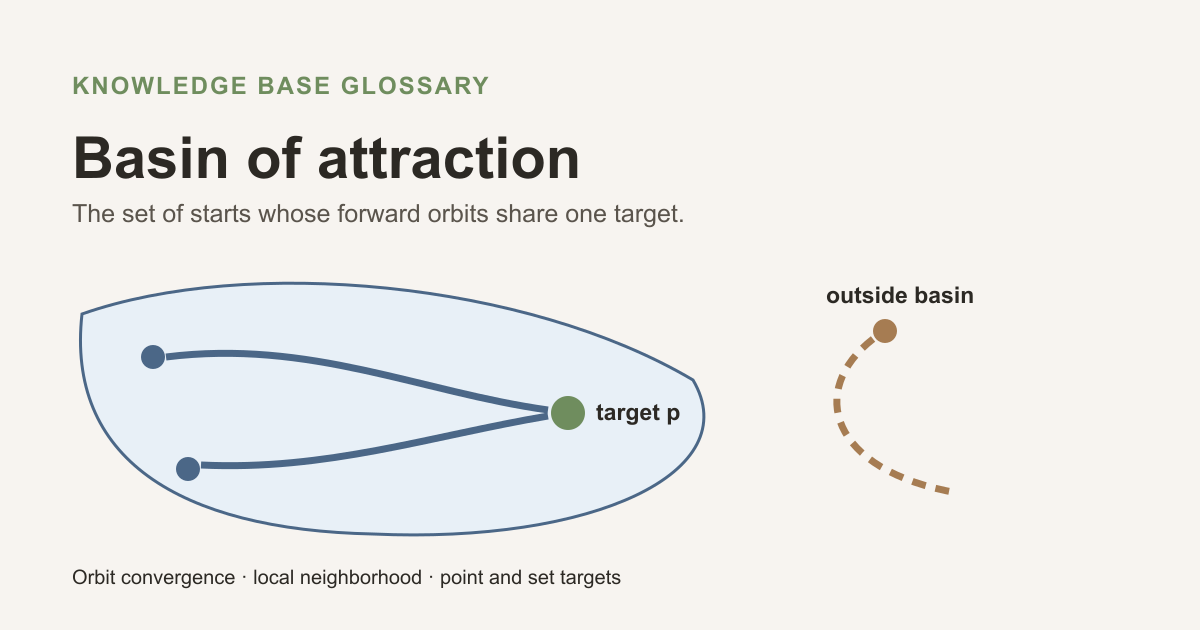
A basin of attraction collects the initial states whose forward orbits approach a specified target.
For a point target \(p\) and self-map \(f:X\to X\), the basin is
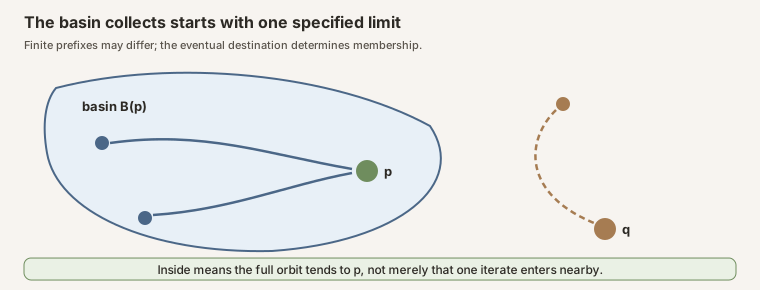
\[ B_f(p)=\{x\in X:f^n(x)\to p\text{ as }n\to\infty\}. \]The target matters. One initial state may belong to the basin of \(p\), while another converges to a different fixed point (q) and therefore lies outside \(B_f(p)\).
A three-state basin
Take the finite update rule
\[ \text{high}\mapsto\text{middle},\qquad \text{middle}\mapsto\text{low},\qquad \text{low}\mapsto\text{low}. \]The three orbits are
| start | orbit tail |
|---|---|
| low | low, low, low, … |
| middle | middle, low, low, … |
| high | high, middle, low, low, … |
Every start eventually has the constant low tail. Since these rows exhaust
the state type, the basin of low is the entire three-state space.
A nearby non-example changes the rule to keep high fixed. Then the orbit
from high never converges to low, so that one state leaves the basin.
Eventual entry is not enough
Suppose an orbit reaches \(p\) once and then leaves. That single visit does not place the start in \(B_f(p)\). Convergence requires every neighborhood of \(p\) to contain all sufficiently late iterates.
If \(p\) is fixed, then reaching \(p\) does suffice because every later iterate also equals \(p\). Fixedness is a reason for the constant tail; it is not part of the raw orbit-convergence relation.
The checked theorem IsFixedPt.isAttractedTo records that a fixed point
attracts its own orbit. The converse needs more care: if some orbit converges
to \(p\), then \(p\) is fixed when \(f\) is continuous at \(p\) and the space
is Hausdorff. Without those gates, the module does not infer fixedness.
Local and global basins
A fixed point is locally attracting when its basin contains a neighborhood of the point:
\[ f(p)=p \quad\text{and}\quad B_f(p)\in\mathcal N(p). \]The basin may be much larger than that one neighborhood. Local attraction sets a lower bound on its size near \(p\); it does not impose an upper bound.
A globally attracting fixed point has \(B_f(p)=X\). Global attraction therefore implies local attraction.
Neither term alone says that nearby orbits stayed close to \(p\) during their transient. The separate page on forward stability explains the all-time closeness requirement. An asymptotically stable fixed point satisfies both stability and local attraction.
Point and set targets
For a nonempty set \(A\subseteq X\), the corresponding basin is defined by
\[ B_f(A)=\{x\in X:\operatorname{dist}(f^n(x),A)\to0\}. \]This statement does not select one point of \(A\). An orbit may approach different parts of \(A\) while its distance to the set tends to zero.
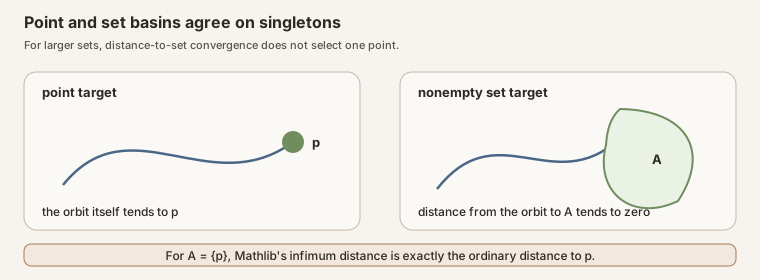
The nonempty condition is essential in the formal interface. Mathlib totalizes the infimum distance at the empty set by
\[ \operatorname{dist}(x,\varnothing)=0. \]If nonemptiness were omitted, every orbit would satisfy the numerical limit
for the empty target. IsAttractedToSet records A.Nonempty explicitly to
block that vacuous boundary.
In Lean
The point basin is a set comprehension over orbit convergence:
def basinOfAttraction [TopologicalSpace X]\n (f : X → X) (p : X) : Set X :=\n {x | IsAttractedTo f x p}Set X is a set of states. {x | ...} is set-builder notation.
IsAttractedTo f x p expands to Tendsto (fun n : ℕ ↦ f^[n] x) atTop (𝓝 p). The membership theorem mem_basinOfAttraction exposes this
definition directly.For a pseudo-metric space, the point relation has the distance form:
theorem isAttractedTo_iff_dist [PseudoMetricSpace X] :
    IsAttractedTo f x p ↔
      Tendsto (fun n : ℕ ↦ dist (f^[n] x) p) atTop (𝓝 0)
The set basin uses Metric.infDist. The singleton bridge is literal:
theorem basinOfAttractionSet_singleton [PseudoMetricSpace X] :
    basinOfAttractionSet f {p} = basinOfAttraction f p
Try it in the repository
Create a small file after cloning the repository:
import NonlinearDynamics.Deterministic.Discrete.Attraction

#check IsAttractedTo
#check basinOfAttraction
#check IsLocallyAttractingFixedPoint
#check basinOfAttractionSet_singleton
This is a full project check with pinned Lean and Mathlib dependencies. The initial setup may require substantial disk space and build time:
NonlinearDynamics/Deterministic/Discrete/Attraction.lean; the command below
checks that complete module with the repository’s pinned environment.cd formalization
lake env lean -DwarningAsError=true NonlinearDynamics/Deterministic/Discrete/Attraction.leanResource note: this exact file uses the repository's
pinned Lean and Mathlib dependencies. Initial project setup can require
substantial disk space and build time. For a lightweight first step on
macOS or Linux, use the page's standalone Lean-core or Std
tutorial.
For a smaller standalone tutorial, use the finite-basin.lean file in the
paired Deep Dive. It imports only Std and checks the three-state model
without Mathlib.
Common boundary mistakes
- Entering the target once is not the same as converging to it.
- Attraction is not the same as Lyapunov stability.
- Point attraction selects one limiting point; set attraction need not.
- A set-distance definition needs an explicit nonempty target under Mathlib’s
totalized
Metric.infDist. - Pointwise attraction of every start is not automatically uniform attraction of a whole set of starts.
What this term does not claim
A basin definition alone gives no attraction rate, no compactness, no Hausdorff convergence, no robustness under perturbation, no stable manifold, and no algorithm for computing the basin in a nonlinear model.
References
- J. P. LaSalle, “Difference Equations. Discrete Semidynamical Systems,” in The Stability of Dynamical Systems, SIAM CBMS 25 (1976), pages 1–25, DOI 10.1137/1.9781611970432.ch1.
- Jack K. Hale, Asymptotic Behavior of Dissipative Systems, AMS Surveys and Monographs 25 (1988), Chapter 2, DOI 10.1090/surv/025.
- Mathlib 4.32.0, pinned revision
81a5d257, especiallyTopology.MetricSpace.HausdorffDistanceandTopology.MetricSpace.Contracting.