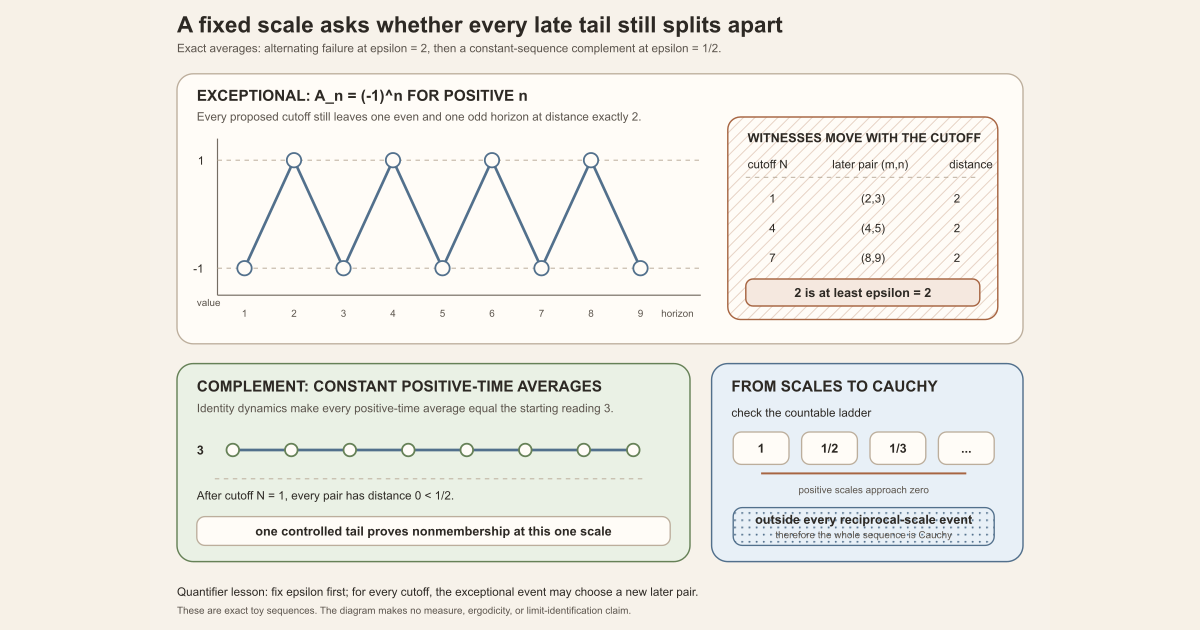
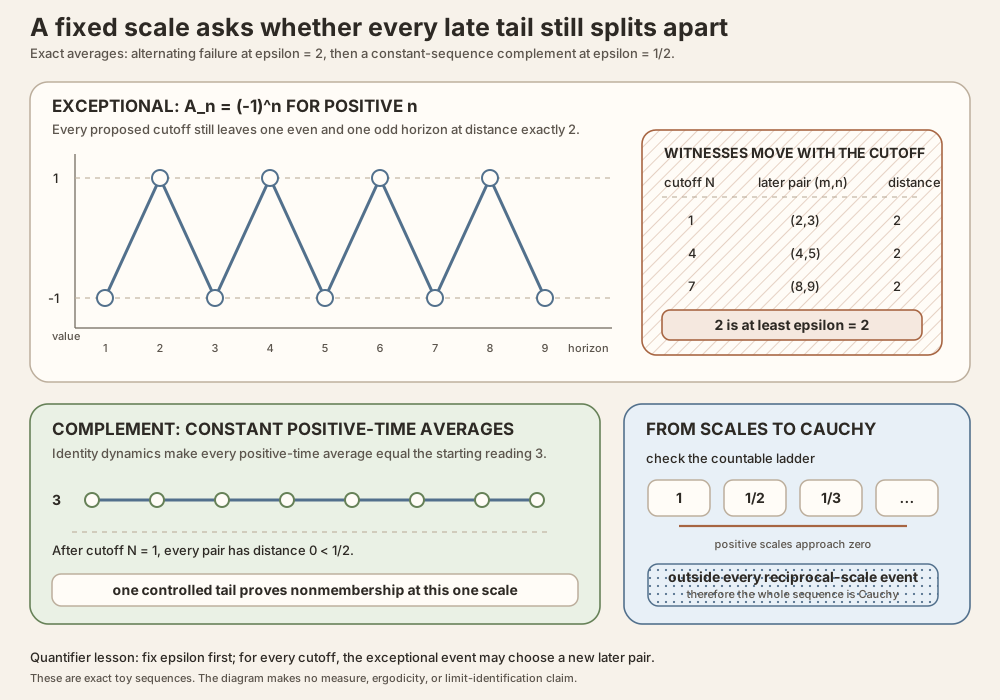
Start with a sequence of positive-time orbit averages that alternates forever:
\[ A_1=-1,\quad A_2=1,\quad A_3=-1,\quad A_4=1,\quad\ldots \]Fix the separation scale \(\varepsilon=2\). No proposed tail cutoff repairs the oscillation. After any cutoff \(N\ge1\), choose an even \(m\ge N\) and the next odd horizon \(n=m+1\). Then
\[ |A_m-A_n|=|1-(-1)|=2\ge\varepsilon. \]For example, cutoffs \(1,4,7\) admit witness pairs \((2,3),(4,5),(8,9)\). The witnesses move later when the cutoff moves later; the fixed scale stays the same. This starting point is exceptional at scale \(2\).
Now compare identity dynamics with a constant reading \(3\). Every positive-time average is \(3\), so after cutoff \(1\) every pair has distance \(0\lt1/2\). That point is not exceptional at scale \(1/2\). The two exact sequences expose both sides of the definition before any measure or ergodic theorem enters. A concrete observable producing the alternating sequence is derived below.
A Birkhoff Cauchy exceptional set is a fixed-scale failure event for one sequence of orbit averages. A starting point belongs to the set when, no matter how far into the sequence one moves, two still later averages remain separated by at least the chosen scale. It converts the qualitative question “does this sequence converge?” into countably measurable events that can be bounded one scale at a time.
Random-matrix-theory milestone 26 (RMT-26) uses these sets to close the gap between a dense class of observables with known pointwise convergence and all real integrable observables. The complete checked narrative is The Missing Step Closes: Pointwise Birkhoff by Maximal Control in Lean. The textbook treatment is Pointwise Birkhoff from Maximal Control and Dense Good Functions.
Exact operational definition
Let Ω be a state space, let \(T:\Omega\to\Omega\) be a discrete-time map, and let \(f:\Omega\to\mathbb R\) be a real observable. For a starting point \(\omega\in\Omega\) and horizon \(n\in\mathbb N\), write
\[ A_n f(\omega) {} = \frac{1}{n}\sum_{0\le j\lt n} f\bigl(T^j\omega\bigr). \]This is the normalized Birkhoff sum . Lean totalizes the inverse of zero, so \(A_0f(\omega)=0\). That finite convention will not affect any tail statement.
Fix a real scale \(\varepsilon\). The exceptional set is
\[ D_\varepsilon(T,f) {} = \left\{\omega:\ \forall N\in\mathbb N,\ \exists m\ge N,\ \exists n\ge N,\ \varepsilon\le \left|A_mf(\omega)-A_nf(\omega)\right| \right\}. \]The checked Lean definition preserves that quantifier order:
def birkhoffCauchyExceptionalSet
    (T : Ω → Ω) (f : Ω → ℝ) (ε : ℝ) : Set Ω :=
  {ω | ∀ N : ℕ, ∃ m ≥ N, ∃ n ≥ N,
    ε ≤ |birkhoffAverage ℝ T f m ω -
      birkhoffAverage ℝ T f n ω|}
Three details are structural.
First, \(\varepsilon\) is fixed before the tail cutoff \(N\). The set does not require one pair of averages to defeat every tolerance. Second, the two witness horizons may depend on \(N\). Persistent oscillation can therefore move farther out as the requested tail moves. Third, the exceptional comparison is non-strict. Its logical complement is the strict tail estimate
\[ \omega\notin D_\varepsilon(T,f) \quad\Longleftrightarrow\quad \exists N\ \forall m,n\ge N,\ \left|A_mf(\omega)-A_nf(\omega)\right|\lt\varepsilon. \]That strict inequality is exactly the form used by the metric Cauchy criterion.
Worked example: averages prescribed to alternate
The definition itself needs no measure or measurability, so it can be tested directly on a divergent orbit. Let \(\Omega=\mathbb N\), let \(T(k)=k+1\), and start at \(0\). Define
\[ f(k) {} = (k+1)(-1)^{k+1}-k(-1)^k. \]For every positive \(n\), the orbit sum telescopes:
\[ \begin{aligned} \sum_{k=0}^{n-1}f(k) &=\sum_{k=0}^{n-1} \left((k+1)(-1)^{k+1}-k(-1)^k\right) \\ &=n(-1)^n. \end{aligned} \]Consequently,
\[ A_nf(0)=(-1)^n \qquad\text{for every }n\ge1. \]Given any cutoff \(N\), choose \(m=2(N+1)\) and \(n=2(N+1)+1\). Both horizons are at least \(N\), while
\[ \left|A_mf(0)-A_nf(0)\right| {} = |1-(-1)|=2. \]Thus \(0\in D_\varepsilon(T,f)\) for every \(0\lt\varepsilon\le2\). If \(\varepsilon\gt2\), choose the tail cutoff \(N=1\). All later averages are either \(1\) or \(-1\), so every later pair has distance at most \(2\lt\varepsilon\). Hence \(0\notin D_\varepsilon(T,f)\) at those larger scales.
This example checks both inclusions at the threshold \(2\). It is not an application of the pointwise ergodic theorem: the observable is unbounded and is not integrable for counting measure on \(\mathbb N\). Its job is to test the raw event definition.
From one scale to the Cauchy property
A real sequence is Cauchy when every positive tolerance eventually controls every pair in one common tail. It would be inconvenient to intersect over all positive real tolerances because that family is uncountable. The reciprocal natural scales
\[ r_k=\frac{1}{k+1},\qquad k\in\mathbb N, \]solve the problem. They are positive, countable, and approach zero. If a point avoids every \(D_{r_k}(T,f)\), then for a requested \(r\gt0\) one can choose \(k\) with \(r_k\lt r\). Nonmembership at scale \(r_k\) gives a tail whose pairs are closer than \(r_k\), hence closer than \(r\). Therefore the average sequence is Cauchy.
Because the real numbers are complete, the Cauchy sequence converges to some real limit. This yields membership in the Birkhoff convergence event . It does not yet say what the limit is.
Measurability and representatives
If \(T\) and \(f\) are measurable, each finite average is measurable. The event can then be expanded as
\[ D_\varepsilon(T,f) {} = \bigcap_{N\in\mathbb N} \bigcup_{\substack{m\in\mathbb N\\N\le m}} \bigcup_{\substack{n\in\mathbb N\\N\le n}} \left\{\omega: \varepsilon\le|A_mf(\omega)-A_nf(\omega)| \right\}. \]Countable intersections and unions preserve measurability, and the innermost
set is the inverse image of a closed real ray under a measurable function.
This is the architecture of
measurableSet_birkhoffCauchyExceptionalSet.
An integrable observable in Mathlib is represented by an ordinary function that is only guaranteed to be measurable almost everywhere. If \(f=g\) almost everywhere , and \(T\) is quasi-measure-preserving, the equality can be pulled back along every finite iterate of \(T\). The two average sequences then agree almost everywhere at every natural horizon. Since the horizon family is countable, the two exceptional sets agree almost everywhere.
This representative transport proves null measurability from either an almost-everywhere measurable or an integrable representative. It does not claim literal equality of the two sets. Changing a function on a null set may change membership at individual starting points even though it cannot change the event modulo a null set under the stated dynamics.
Why maximal control makes the event small
Suppose \(g\) is an approximating observable whose averages converge at \(\omega\). Its average sequence is then Cauchy. For late horizons \(m,n\), insert the two approximating averages:
\[ \begin{aligned} |A_mf-A_nf| &\le |A_mf-A_mg| +|A_mg-A_ng| +|A_ng-A_nf| \\ &=|A_m(f-g)| +|A_mg-A_ng| +|A_n(f-g)|. \end{aligned} \]At a positive scale \(\varepsilon\), the middle term is eventually strictly below \(\varepsilon/3\). If neither endpoint error ever strictly exceeds \(\varepsilon/3\), each endpoint term is at most that value. The total is then strictly below \(\varepsilon\), contradicting a witness for \(D_\varepsilon(T,f)\). RMT-26 packages this as
\[ D_\varepsilon(T,f) \subseteq M_{\varepsilon/3}(T,f-g) \cup \operatorname{Conv}(T,g)^c, \]where \(M_a\) is the absolute positive-time maximal exceedance event and \(\operatorname{Conv}(T,g)\) is the convergence event of \(g\).
If \(\mu\) is finite, \(T\) preserves \(\mu\), \(f-g\) is integrable, and \(g\) converges almost everywhere, the weak-type (1,1) maximal bound gives
\[ \mu_{\mathbb R}\bigl(D_\varepsilon(T,f)\bigr) \le \frac{\displaystyle\int_\Omega|f-g|\,d\mu} {\varepsilon/3}. \]Here \(\mu_{\mathbb R}\) is Mathlib’s real-valued view of the finite measure. If pointwise-good approximants exist at arbitrarily small integrable distance, the right side can be made smaller than every positive real number. The exceptional set therefore has measure zero. Intersecting the complements over all reciprocal scales gives one conull set, meaning a set whose complement has measure zero, on which the complete average sequence is Cauchy and hence convergent.
This is a Banach-principle closure argument. Banach’s 1926 paper established an early general extension principle for almost-everywhere convergence from a dense class. Yosida’s 1940 proof of an ergodic theorem explicitly combines a closure lemma attributed to Banach with convergence on a bounded dense class. RMT-26 follows that architecture through its own checked maximal estimate and does not claim to formalize either historical theorem word for word.
Boundary cases and nonclaims
- The scale must be positive in the closure theorem. At \(\varepsilon=0\), every point is exceptional: for each \(N\), take \(m=n=N\), so \(0\le|A_mf-A_nf|=0\). The same argument covers negative scales. The raw set is still defined, but it carries no Cauchy information.
- Horizon zero is harmless. The set quantifies over all natural horizons, yet a tail cutoff can always be increased past one. RMT-26 does exactly that before invoking a positive-time maximal event. The totalized value \(A_0f=0\) is never used as a lasting convergence constraint.
- Identity dynamics are not exceptional at positive scales. For \(T=\operatorname{id}\), every positive-time average equals \(f(\omega)\). Choosing \(N=1\) shows that \(D_\varepsilon(T,f)\) is empty for every \(\varepsilon\gt0\), even before measurability is discussed.
- Zero measure does not make the raw set empty. It makes every set null. An almost-everywhere conclusion over the zero measure is valid but vacuous.
- Probability and ergodicity are absent. Finite total mass need not be one, and the closure theorem does not assume that invariant events are null or conull.
- No invertibility is hidden. Measure preservation supplies measurable forward iteration. Injectivity, surjectivity, a measurable inverse, and an equivalence structure are not premises.
Membership in one positive-scale exceptional set proves that the average sequence is not Cauchy, but nonmembership in one such set does not prove convergence. One must avoid a cofinal family of scales. Conversely, nullity of each scale separately becomes an almost-everywhere convergence statement only after a countable intersection. None of these steps identifies the limit, proves integrable-norm convergence, establishes an ergodic constant, or proves Kingman’s subadditive ergodic theorem, a Lyapunov exponent, or an Oseledets splitting.
In Lean: fixed-scale membership
mem_birkhoffCauchyExceptionalSet_iffω ∈ birkhoffCauchyExceptionalSet T f εis membership of one starting point in one fixed-scale event.∀ N : ℕmeans that the tail cutoff is arbitrary.- The nested witnesses
∃ m ≥ N, ∃ n ≥ Nmay change with that cutoff; one fixed pair is not required to work forever. - The final comparison is non-strict
ε ≤ |…|. Negating it produces the strict tail inequality required by the metric Cauchy test. - The theorem is proved by
rfl: it exposes the definition without adding measurability, a measure, or convergence.
In Lean: maximal control bounds one bad scale
measureReal_birkhoffCauchyExceptionalSet_le hT hfg hgood hεhT : MeasurePreserving T μ μsupplies the dynamical transport.hfg : Integrable (f - g) μmakes the approximation error an \(L^1\) input.hgood : ∀ᵐ ω ∂μ, ω ∈ birkhoffConvergenceSet T gsays the approximant’s averages converge outside a null set.hε : 0 < εmakes all three error budgets positive and licenses division byε / 3.- The ambient
[IsFiniteMeasure μ]instance makesμ.reala faithful real-valued mass in this argument. - This is event-measure control, not a pointwise bound on every orbit.
In Lean: reciprocal scales give the full Cauchy property
cauchySeq_birkhoffAverage_of_not_mem_exceptional ω hωhω : ∀ k : ℕ, ω ∉ …is countable scale-by-scale nonmembership.- Lean writes the scale as
1 / ((k : ℝ) + 1); the cast puts the natural index into the real denominator. CauchySeqis the metric Cauchy property for the entire natural sequence, not a subsequence.exists_nat_one_div_ltchooses a reciprocal scale strictly below any requested positive tolerance.- Completeness of \(\mathbb R\) is a later step from
CauchySeqto existence of a finite real limit.
Exact declaration ledger
The RMT-26 declarations attached directly to this term are:
birkhoffCauchyExceptionalSetandmem_birkhoffCauchyExceptionalSet_iff, the set and its exact witness interface;measurableSet_birkhoffCauchyExceptionalSet, the ordinary measurable route;birkhoffCauchyExceptionalSet_ae_eq_of_ae_eq, representative transport under quasi-measure preservation;nullMeasurableSet_birkhoffCauchyExceptionalSet_of_aemeasurableandnullMeasurableSet_birkhoffCauchyExceptionalSet_of_integrable, the two null-measurable routes;birkhoffCauchyExceptionalSet_subset_exceedance_union_compl, the three-error pointwise containment;measureReal_birkhoffCauchyExceptionalSet_le, its quantitative finite-measure estimate;measure_birkhoffCauchyExceptionalSet_eq_zero_of_dense_good, the dense-good nullity theorem; andcauchySeq_birkhoffAverage_of_not_mem_exceptional, the reciprocal scale bridge to the metric Cauchy criterion.
The later theorem ae_mem_birkhoffConvergenceSet_of_dense_good
assembles those declarations into almost-everywhere convergence.
Standalone tutorial
Standalone tutorial. This complete file constructs
integer partial sums whose positive-time averages alternate exactly between
\(-1\) and \(1\). It then computes the moving witnesses for cutoffs
\(1,4,7\) and contrasts the constant-average complement. It imports only
Lean’s Std library; it does not define measures or the general
Cauchy event.
Save it as BirkhoffCauchyScratch.lean:
import Std

namespace BirkhoffCauchyScratch

def targetSum (n : Nat) : Int :=
  if n % 2 = 0 then Int.ofNat n else -Int.ofNat n

def reading (k : Nat) : Int :=
  targetSum (k + 1) - targetSum k

def orbitSum (n : Nat) : Int :=
  (List.range n).foldl (fun total k => total + reading k) 0

def average (n : Nat) : Int :=
  if n = 0 then 0 else orbitSum n / Int.ofNat n

def evenAtOrAfter (N : Nat) : Nat :=
  if N % 2 = 0 then N else N + 1

def witness (N : Nat) : Nat × Nat :=
  let m := evenAtOrAfter (max N 1)
  (m, m + 1)

def witnessDistance (N : Nat) : Nat :=
  let pair := witness N
  (average pair.1 - average pair.2).natAbs

#eval (List.range 9).map (fun j => average (j + 1))
#eval [witness 1, witness 4, witness 7]
#eval [witnessDistance 1, witnessDistance 4, witnessDistance 7]

example : (List.range 6).map (fun j => average (j + 1)) =
    [-1, 1, -1, 1, -1, 1] := by decide
example : witness 1 = (2, 3) := by decide
example : witness 4 = (4, 5) := by decide
example : witness 7 = (8, 9) := by decide
example : witnessDistance 1 = 2 := by decide
example : witnessDistance 4 = 2 := by decide
example : witnessDistance 7 = 2 := by decide
example : ((3 : Int) - 3).natAbs < 1 := by decide

end BirkhoffCauchyScratch
Run it on an ordinary Mac or Linux machine with the pinned compiler:
source "$HOME/.elan/env"
elan run leanprover/lean4:v4.32.0 lean BirkhoffCauchyScratch.lean
This exact worksheet was executed successfully with Lean 4.32.0 while editing
this page. The average row was
[-1, 1, -1, 1, -1, 1, -1, 1, -1]. The witness rows should be
[(2, 3), (4, 5), (8, 9)] and [2, 2, 2].
The last theorem checks the constant-sequence distance \(0\lt1\), an
integer-scaled version of the \(0\lt1/2\) complement example. The finite
program audits the arithmetic; the parity argument above proves witnesses
exist beyond every cutoff.
Try the exact declarations in the project
Full project check. This uses the repository’s pinned Lean and Mathlib dependencies and may require substantial disk space and memory. Create a temporary project worksheet containing:
import NonlinearDynamics.Random.RandomCocycles.PointwiseBirkhoff

open MeasureTheory Filter
open NonlinearDynamics.Random.RandomCocycles

#check birkhoffCauchyExceptionalSet
#check mem_birkhoffCauchyExceptionalSet_iff
#check measurableSet_birkhoffCauchyExceptionalSet
#check birkhoffCauchyExceptionalSet_ae_eq_of_ae_eq
#check nullMeasurableSet_birkhoffCauchyExceptionalSet_of_integrable
#check birkhoffCauchyExceptionalSet_subset_exceedance_union_compl
#check measureReal_birkhoffCauchyExceptionalSet_le
#check measure_birkhoffCauchyExceptionalSet_eq_zero_of_dense_good
#check cauchySeq_birkhoffAverage_of_not_mem_exceptional
#check ae_mem_birkhoffConvergenceSet_of_dense_good
Each #check asks the pinned elaborator for an exact declaration
type. The full-project command rendered below checks the authoritative RMT-26
module. It uses the repository’s pinned dependencies and may require substantial
disk space and memory.
cd formalization
lake env lean -DwarningAsError=true NonlinearDynamics/Random/RandomCocycles/PointwiseBirkhoff.lean
Resource note: this exact file uses the repository's
pinned Lean and Mathlib dependencies. Initial project setup can require
substantial disk space and build time. For a lightweight first step on
macOS or Linux, use the page's standalone Lean-core or Std
tutorial.
Related concepts
- Birkhoff sum supplies the finite sums and normalized averages used in the event.
- Birkhoff convergence event records the existence of a finite real limit after the Cauchy step.
- Infinite-horizon Birkhoff-average exceedance event is the one-sided positive-time event from which absolute error control is derived.
- Almost everywhere explains why representative changes and countable conull intersections must be tracked explicitly.
- Koopman coboundary describes one component of the dense pointwise-good core used by RMT-26.
References
Stefan Banach. Sur la convergence presque partout de fonctionnelles linéaires, Bulletin des Sciences Mathématiques 50, 27-32 and 36-43, 1926. Theorems I and III develop continuity in measure and extension of almost-everywhere convergence from a dense subset. RMT-26 uses the strategy, not Banach’s exact statement.
Kôsaku Yosida. Ergodic theorems of Birkhoff-Khintchine’s type, Japanese Journal of Mathematics 17, 31-36, 1940. Pages 33-34 combine a closure lemma attributed to Banach with convergence on a bounded dense class.
Michael Keane and Karl Petersen. Easy and Nearly Simultaneous Proofs of the Ergodic Theorem and Maximal Ergodic Theorem, IMS Lecture Notes-Monograph Series 48, 248-251, 2006, with arXiv:math/0608251. The paper gives a closely related maximal-to-pointwise route for a possibly noninvertible measure-preserving transformation on a probability space. RMT-26 instead states its convergence theorem for an arbitrary finite measure.
Mathlib contributors. Metric Cauchy sequences, almost-everywhere countable quantification, and the pinned Mathlib 4.32.0 tree at commit 81a5d257. The local checkout, rather than these broad source links, is the exact interface authority for the checked declaration signatures.
Nonlinear Dynamics in Lean contributors.
PointwiseBirkhoff.lean,
the checked source defining and using the event.