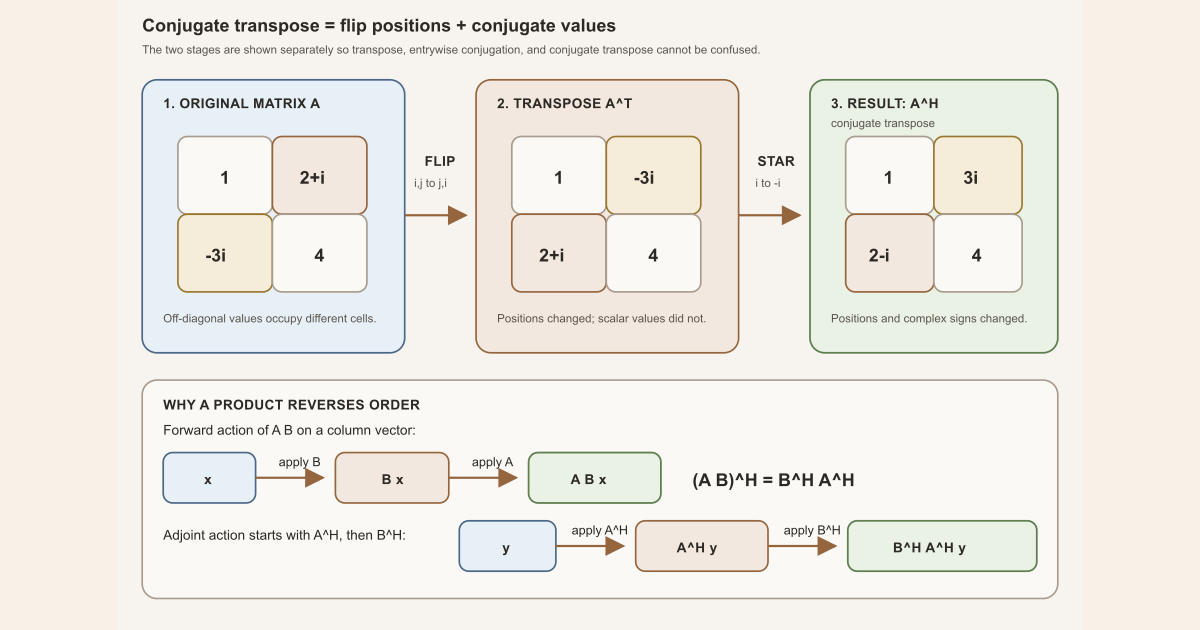
The conjugate transpose of a complex matrix combines two familiar moves:
flip the matrix across its main diagonal, then replace every complex entry by
its complex conjugate. It is commonly written \(A^*\), \(A^\dagger\), or
\(A^{\mathrm H}\). This project and Mathlib use the Lean notation
Aᴴ.
Start with one complex 2 by 2 matrix
Take
\[ A= \begin{bmatrix} 1&2+i\\ -3i&4 \end{bmatrix}. \]First transpose: exchange row and column positions without changing the scalar values.
\[ A^{\mathsf T}= \begin{bmatrix} 1&-3i\\ 2+i&4 \end{bmatrix}. \]Then conjugate each entry. Complex conjugation changes \(i\) to \(-i\), so \(\overline{-3i}=3i\) and \(\overline{2+i}=2-i\):
\[ A^{\mathrm H} {} = \overline{A^{\mathsf T}} {} = \begin{bmatrix} 1&3i\\ 2-i&4 \end{bmatrix}. \]Entry by entry, the rule is
\[ \left(A^{\mathrm H}\right)_{ji}=\overline{A_{ij}}, \]or, after renaming the two indices,
\[ \left(A^{\mathrm H}\right)_{ij}=\overline{A_{ji}}. \]Both displays say the same thing: the entry moves across the diagonal and is then conjugated.
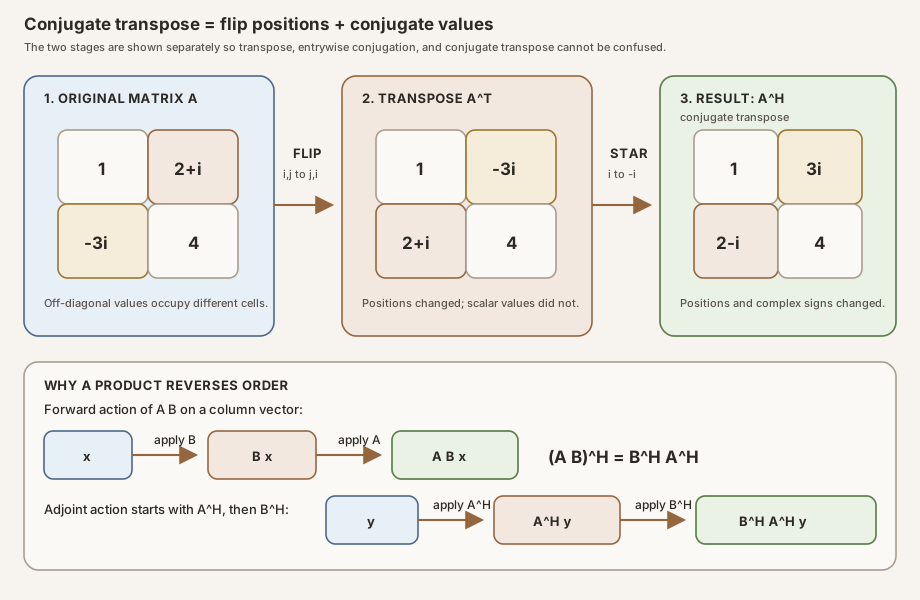
Transpose, conjugation, and conjugate transpose
The three operations answer different questions.
| Operation | What happens to positions? | What happens to scalar values? | Result for the example |
|---|---|---|---|
| Transpose \(A^{\mathsf T}\) | Swap row and column indices | Leave values unchanged | \(\left[\begin{smallmatrix}1&-3i\\2+i&4\end{smallmatrix}\right]\) |
| Entrywise conjugation \(\overline A\) | Leave positions unchanged | Replace \(i\) by \(-i\) | \(\left[\begin{smallmatrix}1&2-i\\3i&4\end{smallmatrix}\right]\) |
| Conjugate transpose \(A^{\mathrm H}\) | Swap row and column indices | Conjugate every value | \(\left[\begin{smallmatrix}1&3i\\2-i&4\end{smallmatrix}\right]\) |
Transposition and entrywise conjugation commute, so one may conjugate first and transpose second. Keeping the two stages conceptually separate still prevents the most common sign and index mistakes.
For a real matrix, complex conjugation changes nothing. Its conjugate transpose is therefore its ordinary transpose.
Why multiplication order reverses
Suppose \(A\) and \(B\) have compatible dimensions. Then
\[ (AB)^{\mathrm H}=B^{\mathrm H}A^{\mathrm H}. \]The reversal is not cosmetic. Acting on a column vector, \(AB\) means apply \(B\) first and \(A\) second:
\[ x\longmapsto Bx\longmapsto A(Bx). \]The adjoint route reverses those stages:
\[ y\longmapsto A^{\mathrm H}y \longmapsto B^{\mathrm H}\!\left(A^{\mathrm H}y\right). \]The matrix dimensions enforce the same order. If \(A\) is \(m\) by \(n\) and \(B\) is \(n\) by \(\ell\), then \(B^{\mathrm H}\) is \(\ell\) by \(n\) and \(A^{\mathrm H}\) is \(n\) by \(m\), so \(B^{\mathrm H}A^{\mathrm H}\) is \(\ell\) by \(m\), exactly the shape of \((AB)^{\mathrm H}\). Writing \(A^{\mathrm H}B^{\mathrm H}\) would generally have the wrong intermediate dimensions.
Two other useful identities are
\[ \left(A^{\mathrm H}\right)^{\mathrm H}=A, \qquad (A+B)^{\mathrm H}=A^{\mathrm H}+B^{\mathrm H}. \]The first says the operation is an involution: applying it twice returns the original matrix.
Hermitian and non-Hermitian boundaries
A matrix is Hermitian precisely when \(A^{\mathrm H}=A\). The running example is not Hermitian. Its upper-right entry is \(A_{12}=2+i\), but the corresponding entry in \(A^{\mathrm H}\) is \(3i\). Equivalently, \(A_{21}=-3i\) is not the conjugate \(2-i\) of \(A_{12}\).
The transformation
\[ A\longmapsto A+A^{\mathrm H} \]does produce a Hermitian matrix. For the example,
\[ A+A^{\mathrm H} {} = \begin{bmatrix} 2&2+4i\\ 2-4i&8 \end{bmatrix}. \]The project uses exactly this unnormalized symmetrization for a random matrix . Dividing by two gives the usual Hermitian part over \(\mathbb C\), but that factor is not hidden in the project constructor. In particular, the unnormalized map sends an already Hermitian matrix \(H\) to \(2H\), not to \(H\).
Do not confuse the conjugate transpose with an inverse. The equality \(U^{\mathrm H}=U^{-1}\) is an additional unitary condition, not an identity for every complex matrix.
In Lean
Mathlib’s entrywise theorem is the direct translation of “flip, then conjugate.”
Matrix.conjTranspose_apply A i j : Aᴴ j i = star (A i j)Aᴴis Mathlib’s scoped notation forMatrix.conjTranspose A.A i jreads the entry in rowiand columnj. Matrices act like two-argument functions in Lean.- The indices appear as
j ion the left because transposition swaps their positions. staris Mathlib’s general scalar involution. Onℂ, it is complex conjugation.- The colon means that
Matrix.conjTranspose_apply A i jis a proof of the equality written after it.
Try the entry arithmetic locally
The project theorem below uses Mathlib’s general matrix and complex-number
interfaces. Before importing those dependencies, a reader can reproduce the
opening calculation with integer real-and-imaginary pairs. Save this file as
ConjugateTransposeScratch.lean in a scratch directory outside
formalization/:
import Std

structure GaussianInt where
  re : Int
  im : Int
  deriving DecidableEq, Repr

def GaussianInt.conj (z : GaussianInt) : GaussianInt :=
  { re := z.re, im := -z.im }

structure Mat2 where
  a11 : GaussianInt
  a12 : GaussianInt
  a21 : GaussianInt
  a22 : GaussianInt
  deriving DecidableEq, Repr

def Mat2.conjTranspose (M : Mat2) : Mat2 :=
  { a11 := M.a11.conj
    a12 := M.a21.conj
    a21 := M.a12.conj
    a22 := M.a22.conj }

def A : Mat2 :=
  { a11 := { re := 1, im := 0 }
    a12 := { re := 2, im := 1 }
    a21 := { re := 0, im := -3 }
    a22 := { re := 4, im := 0 } }

def AH : Mat2 :=
  { a11 := { re := 1, im := 0 }
    a12 := { re := 0, im := 3 }
    a21 := { re := 2, im := -1 }
    a22 := { re := 4, im := 0 } }

def entries (M : Mat2) : List (Int × Int) :=
  [(M.a11.re, M.a11.im), (M.a12.re, M.a12.im),
   (M.a21.re, M.a21.im), (M.a22.re, M.a22.im)]

#eval entries A.conjTranspose
#eval [decide (A.conjTranspose = AH),
       decide (Mat2.conjTranspose (Mat2.conjTranspose A) = A)]

example : A.conjTranspose = AH := by decide
example : Mat2.conjTranspose (Mat2.conjTranspose A) = A := by decide
The four pairs list entries in row order as
(real part, imaginary part). Run the file with exactly:
source "$HOME/.elan/env"
elan run leanprover/lean4:v4.32.0 lean ConjugateTransposeScratch.lean
This exact worksheet was executed successfully with Lean 4.32.0 and printed:
[(1, 0), (0, 3), (2, -1), (4, 0)]
[true, true]
This bounded file imports only Std, so it is suitable for a normal
Mac or Linux machine. It checks the exact four-entry ledger and involution for
this example. It does not import Mathlib, define its general
Matrix.conjTranspose, or prove measurability. Those exact project
obligations use the full project workflow below.
The project’s random-matrix foundation contains this exact checked theorem:
theorem measurable_conjTranspose {X : RandomMatrix Ω ι κ ℂ}
    (hX : Measurable X) :
    Measurable fun ω ↦ (X ω)ᴴ := by
  rw [measurable_iff_entries]
  intro j i
  change Measurable (star ∘ fun ω ↦ X ω i j)
  exact continuous_star.measurable.comp (measurable_entry hX i j)
The proof exposes both parts of the operation. After the transpose, the target
entry has indices j i. It is the composition of the original
coordinate function with star, and complex conjugation is
continuous, hence measurable.
Full project check
The following scratch file imports the real project module, asks Lean for the relevant theorem types, and then proves the product and involution identities by applying those declarations.
import NonlinearDynamics.Random.RandomMatrices.Basic

open scoped Matrix

universe u v w

variable {m : Type u} {n : Type v} {l : Type w} [Fintype n]
variable (A : Matrix m n ℂ) (B : Matrix n l ℂ)

#check Matrix.conjTranspose_apply
#check Matrix.conjTranspose_mul
#check Matrix.conjTranspose_conjTranspose
#check NonlinearDynamics.Random.RandomMatrix.measurable_conjTranspose

example : (A * B)ᴴ = Bᴴ * Aᴴ := by
  exact Matrix.conjTranspose_mul A B

example : (Aᴴ)ᴴ = A := by
  exact Matrix.conjTranspose_conjTranspose A
The open scoped Matrix line enables the postfix
ᴴ notation. The three types m, n, and
l keep the rectangular dimensions visible. The
[Fintype n] assumption makes the shared multiplication index
finite, which matrix multiplication needs here.
measurable_conjTranspose declaration is the exact checked project
source. Put the worksheet in a temporary .lean file inside a clone
with the repository’s pinned dependencies
installed. The full-project command
below checks the authoritative module itself.cd formalization
lake env lean -DwarningAsError=true NonlinearDynamics/Random/RandomMatrices/Basic.leanResource note: this exact file uses the repository's
pinned Lean and Mathlib dependencies. Initial project setup can require
substantial disk space and build time. For a lightweight first step on
macOS or Linux, use the page's standalone Lean-core or Std
tutorial.
Boundaries and nonclaims
- Conjugate transpose is not entrywise conjugation alone and is not transpose alone when entries are genuinely complex.
- The factor order in \((AB)^{\mathrm H}\) must reverse. The operation is an adjoint-like anti-homomorphism, not an order-preserving multiplication map.
- The condition \(A^{\mathrm H}=A\) defines Hermitian matrices. It does not define unitary matrices, which instead satisfy inverse identities involving \(A^{\mathrm H}\).
- The map \(A\mapsto A+A^{\mathrm H}\) is unnormalized. It proves Hermiticity of the output but does not preserve an already Hermitian input.
- Measurability of \(\omega\mapsto X(\omega)^{\mathrm H}\) follows from measurability of \(X\). It does not by itself choose a probability law or prove independence or integrability.
Where to continue
The Hermitian coordinate space uses conjugation on the reflected lower triangle so each free complex coordinate is supplied once. The Hermitian Frobenius geometry uses \(A^{\mathrm H}B\) in its inner-product formulas. The unitary-invariance page explains why congruence by \(U\) uses \(UAU^{\mathrm H}\).
Further reading
Mathlib’s conjugate-transpose source documents the entry rule, involution, and reversed-product theorem. Its Hermitian-matrix module uses conjugate transpose in the core fixed-point definition.