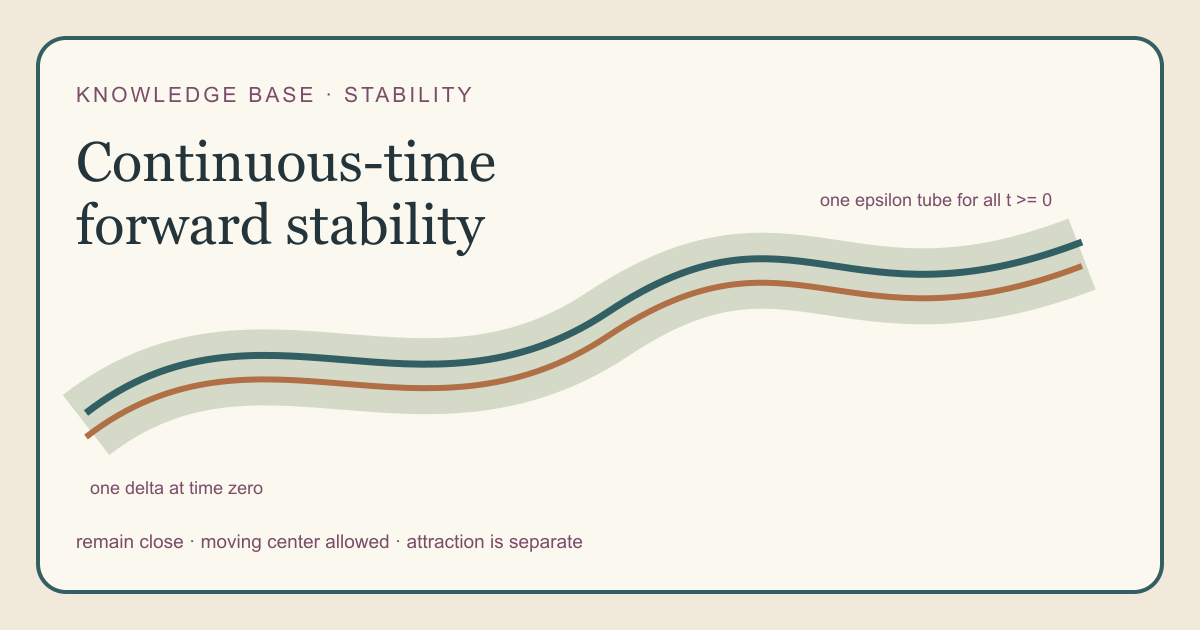
Continuous-time forward stability means that one sufficiently small initial perturbation remains uniformly small relative to a reference trajectory at every nonnegative real time.
Start with translation
For the real flow
\[ \Phi(t,x)=x+2t, \]take \(p=4\) and \(x=4.1\). Then
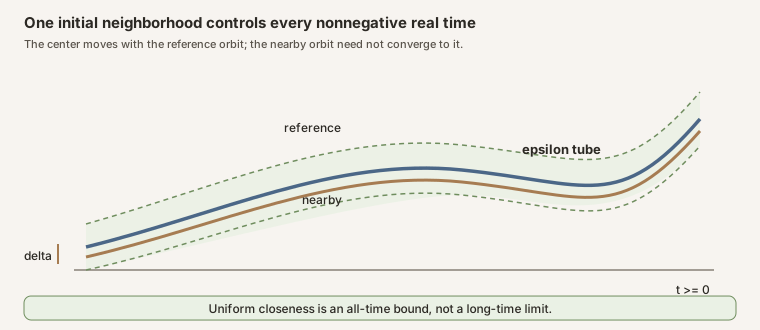
\[ |\Phi(t,x)-\Phi(t,p)|=0.1 \]for every real \(t\). More generally, choosing \(\delta=\varepsilon\) shows that every start satisfying \(|x-p|\lt\delta\) stays within \(\varepsilon\) of the moving reference orbit for every \(t\ge0\).
This establishes forward stability of this translation flow. When the velocity is nonzero, it is also a counterexample to the claim that a stable reference point must be an equilibrium.
Definition
For a metric-space flow \(\Phi\), forward stability at \(p\) is
\[ \forall\varepsilon\gt0\;\exists\delta\gt0\;\forall x, d(x,p)\lt\delta\Longrightarrow \forall t\ge0, d(\Phi(t,p),\Phi(t,x))\lt\varepsilon. \]The quantifier order is essential. One \(\delta\) must work for the entire continuum of forward times. A radius chosen separately for each \(t\) gives continuity of individual time maps, not forward stability.
In a uniform space, the same definition uses entourages rather than numeric distances. It is equicontinuity at \(p\) of all nonnegative-time maps.
Equilibrium and attraction are separate
An equilibrium satisfies \(\Phi(t,p)=p\) for every real \(t\). A Lyapunov-stable equilibrium is an equilibrium that is also forward stable.
Attraction instead asks for a limit:
\[ \Phi(t,x)\to p\qquad(t\to+\infty). \]The basin of attraction contains the starts with that limit. An asymptotically stable equilibrium has both Lyapunov stability and a basin containing a neighborhood of the equilibrium.
The identity flow is the nearby boundary case. Every point is a stable equilibrium, but a distinct constant orbit does not approach it. Thus stability does not imply attraction.
In Lean
def IsForwardStableAt [UniformSpace X] (ϕ : Flow ℝ X) (p : X) : Prop := EquicontinuousAt (fun t : AddSubmonoid.nonneg ℝ ↦ ϕ t) pFlow ℝ X is the jointly continuous real-time action.
AddSubmonoid.nonneg ℝ is the subtype of real numbers satisfying (0\le t).
EquicontinuousAt places one source neighborhood before the quantifier over
that subtype.The metric theorem isForwardStableAt_iff_dist translates this definition to
epsilon and delta. IsLyapunovStableEquilibrium adds IsEquilibrium as a
separate conjunct.
Try it in the repository
import NonlinearDynamics.Deterministic.ODE.Stability

open NonlinearDynamics.Deterministic.ODE

#check IsForwardStableAt
#check isForwardStableAt_iff_dist
#check IsEquilibrium
#check IsLyapunovStableEquilibrium
#check forwardStableAt_translationFlow_not_equilibrium
#check isAttractedTo_id_iff
This is a full project check on macOS or Linux. It uses the repository’s pinned Lean and Mathlib dependencies and may require substantial disk space or build time.
cd formalization
lake env lean -DwarningAsError=true NonlinearDynamics/Deterministic/ODE/Stability.lean
Resource note: this exact file uses the repository's
pinned Lean and Mathlib dependencies. Initial project setup can require
substantial disk space and build time. For a lightweight first step on
macOS or Linux, use the page's standalone Lean-core or Std
tutorial.
cd formalization
lake env lean -DwarningAsError=true \
  NonlinearDynamics/Deterministic/ODE/Stability.lean
Boundaries
- Forward time is \(t\ge0\), including zero; negative times are not part of the stability quantifier.
- The reference orbit may move.
- Stability means remaining close, not converging.
- The definition fixes one flow. Structural stability compares different flows, while stochastic stability needs an explicitly chosen random object and perturbation topology.
- No attraction rate, Lyapunov function, or physical-model validity follows from the definition.
Continue with Continuous-Time Stability, Attraction, and Equilibria or inspect the declaration-complete Development Notebook entry.
References
- N. P. Bhatia and G. P. Szegő, Dynamical Systems: Stability Theory and Applications, Lecture Notes in Mathematics 35, Springer, 1967, doi:10.1007/BFb0080630.
- J. P. LaSalle, The Stability of Dynamical Systems, SIAM CBMS 25, 1976, doi:10.1137/1.9781611970432.
- Mathlib contributors,
Mathlib.Dynamics.FlowandMetric equicontinuity, version 4.32.0.