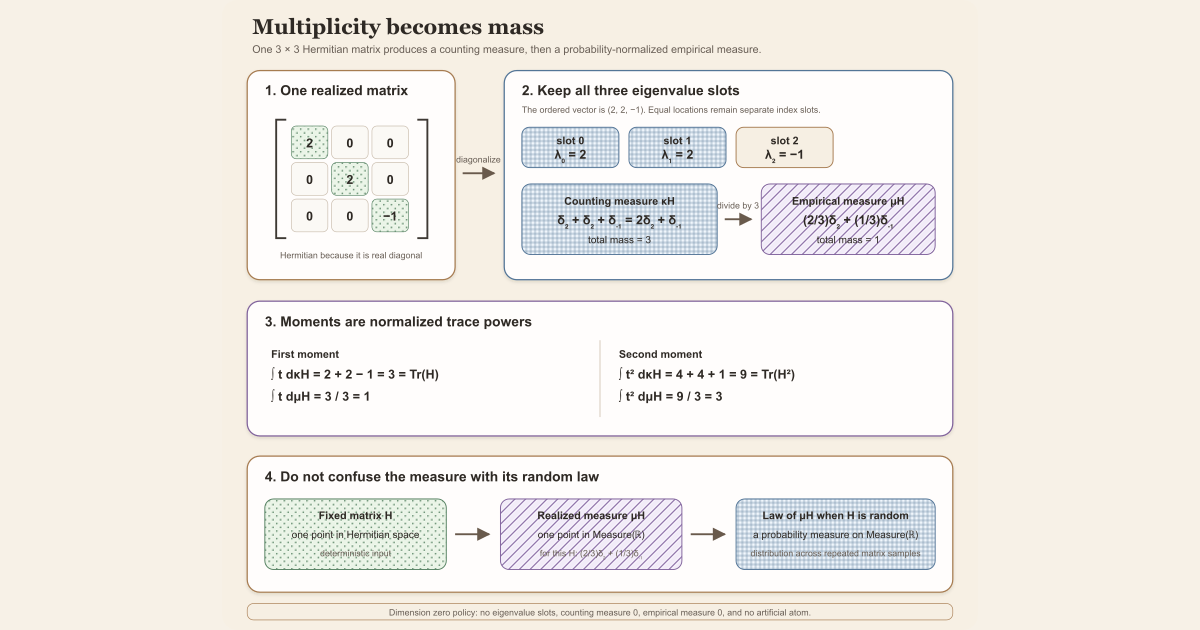
An empirical spectral measure turns the eigenvalues of one finite matrix into one measure on the number line. Every eigenvalue slot receives equal weight, and repeated eigenvalues contribute repeatedly.
For a positive-dimensional \(n\times n\) Hermitian matrix \(H\) with ordered real eigenvalues
\[ \lambda_0(H)\geq\lambda_1(H)\geq\cdots\geq\lambda_{n-1}(H), \]first form the spectral counting measure
\[ \kappa_H=\sum_{i=0}^{n-1}\delta_{\lambda_i(H)}. \]It has total mass \(n\). Then divide every atom by \(n\):
\[ \mu_H=\frac1n\kappa_H =\frac1n\sum_{i=0}^{n-1}\delta_{\lambda_i(H)}. \]The result has total mass one when \(n\gt0\). It is therefore a probability measure describing the fraction of eigenvalue slots in any measurable region.
A \(3\times3\) example with a repeated eigenvalue
Take the real diagonal, hence Hermitian, matrix
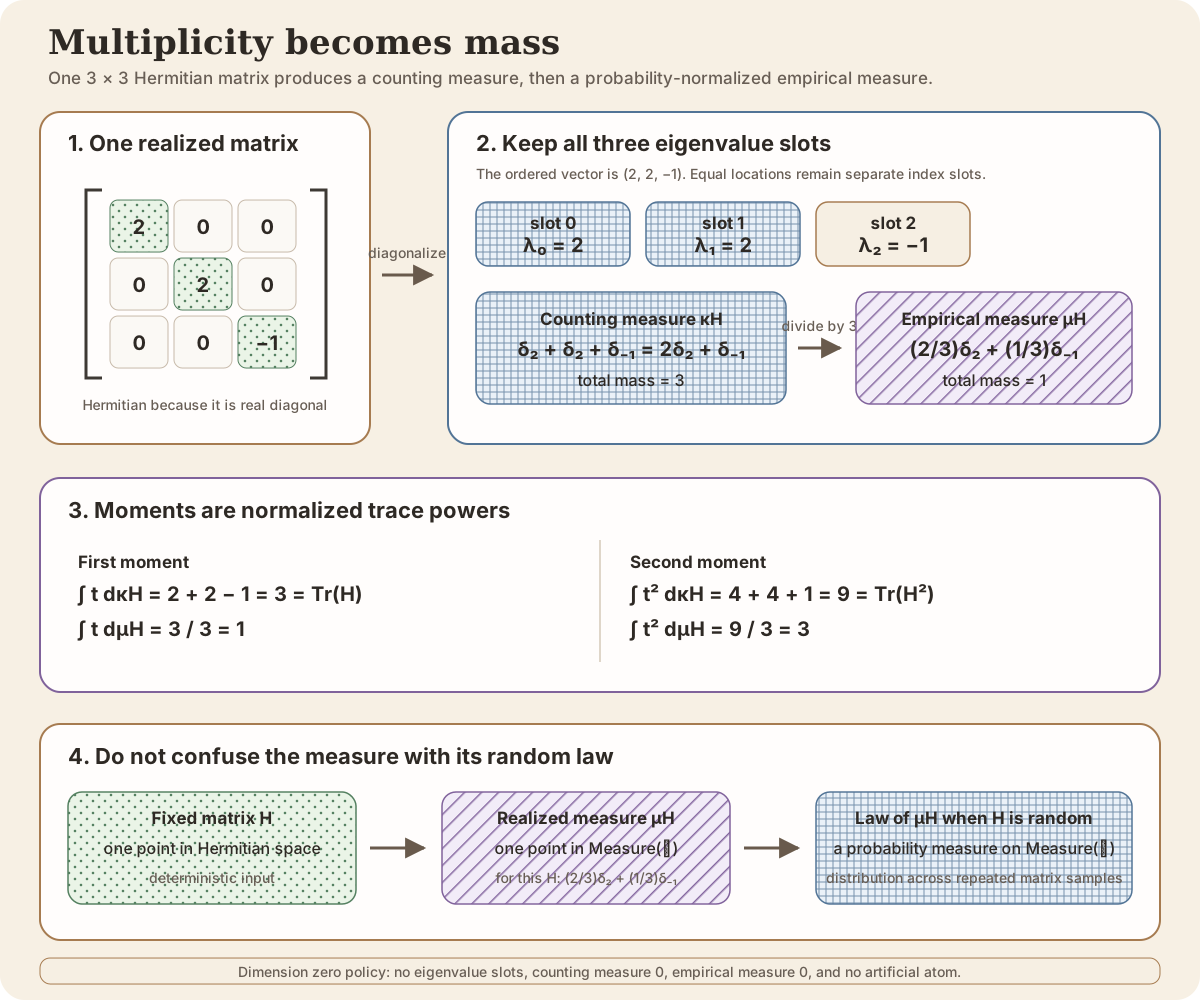
\[ H= \begin{bmatrix} 2&0&0\\ 0&2&0\\ 0&0&-1 \end{bmatrix}. \]Its decreasing eigenvalue vector is
\[ (\lambda_0,\lambda_1,\lambda_2)=(2,2,-1). \]The value \(2\) occurs in two different index slots. The spectral counting measure therefore is
\[ \begin{aligned} \kappa_H &=\delta_2+\delta_2+\delta_{-1}\\ &=2\delta_2+\delta_{-1}. \end{aligned} \]Its mass on the whole real line is
\[ \kappa_H(\mathbb R)=3. \]Normalize by the number of slots:
\[ \mu_H =\frac13\kappa_H =\frac23\delta_2+\frac13\delta_{-1}. \]Now
\[ \mu_H(\mathbb R)=1, \qquad \mu_H(\{2\})=\frac23, \qquad \mu_H(\{-1\})=\frac13. \]Replacing the eigenvalue vector by the set of distinct values \(\{2,-1\}\) would erase the multiplicity at \(2\). It would produce the wrong masses and the wrong moments.
First moment: normalized trace
Integrating the identity function against the counting measure adds all three eigenvalue slots:
\[ \begin{aligned} \int_{\mathbb R}t\,d\kappa_H(t) &=2+2-1\\ &=3\\ &=\operatorname{Tr}(H). \end{aligned} \]For the normalized empirical measure,
\[ \begin{aligned} \int_{\mathbb R}t\,d\mu_H(t) &=\frac13(2+2-1)\\ &=1\\ &=\frac13\operatorname{Tr}(H). \end{aligned} \]The first empirical spectral moment is the average eigenvalue, not the unnormalized trace.
Second moment: normalized trace square
The second counting-measure moment is
\[ \begin{aligned} \int_{\mathbb R}t^2\,d\kappa_H(t) &=2^2+2^2+(-1)^2\\ &=4+4+1\\ &=9. \end{aligned} \]Because
\[ H^2= \begin{bmatrix} 4&0&0\\ 0&4&0\\ 0&0&1 \end{bmatrix}, \]this is exactly
\[ \int_{\mathbb R}t^2\,d\kappa_H(t)=\operatorname{Tr}(H^2)=9. \]Normalize once more:
\[ \int_{\mathbb R}t^2\,d\mu_H(t) =\frac13\operatorname{Tr}(H^2) =3. \]The example has empirical mean \(1\) and empirical second moment \(3\). Its empirical variance is consequently \(3-1^2=2\), although the current project theorem names only the first two raw moments.
The exact general moment bridge
For any intrinsic \(n\times n\) Hermitian matrix, the project proves
\[ \int_{\mathbb R}(t:\mathbb C)\,d\kappa_H(t) =\operatorname{Tr}(H) \]and
\[ \int_{\mathbb R}(t:\mathbb C)^2\,d\kappa_H(t) =\operatorname{Tr}(H^2). \]The cast into \(\mathbb C\) matches the complex-valued matrix trace. Since all Hermitian eigenvalues are real, this changes the codomain, not the numerical values in the worked example.
The normalized sample moments are
\[ m_1(H)=n^{-1}\operatorname{Tr}(H), \qquad m_2(H)=n^{-1}\operatorname{Tr}(H^2), \]with the project’s zero-dimensional inverse convention included in the Lean theorems.
Ordering is useful even though measures discard order
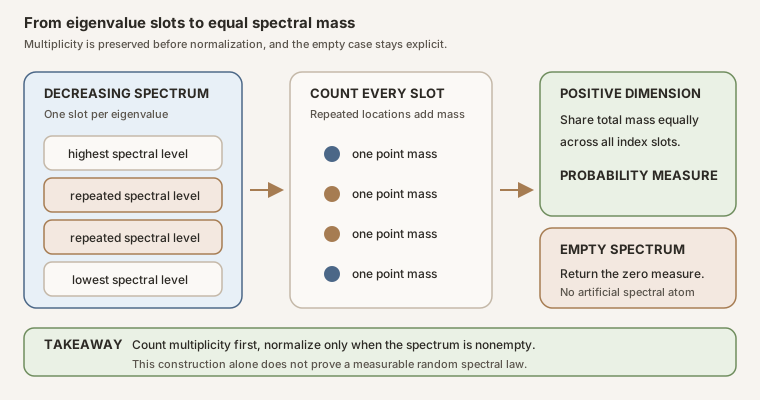
The sum of Dirac measures is unchanged if the eigenvalue vector is permuted. The project nevertheless starts with a decreasing vector because canonical coordinates support statements about the largest and smallest eigenvalues.
Pinned Mathlib supplies Matrix.IsHermitian.eigenvalues₀ in
decreasing order. The project transports that vector to the concrete index
type Fin n using an order-preserving cast and proves
orderedHermitianEigenvalues_antitone.
Multiplicity survives that ordering. In the example, the first two coordinates both equal \(2\); the measure then adds their two unit atoms at the same real location.
The \(n=0\) policy
At dimension zero, there are no eigenvalue slots. The finite sum defining the counting measure is empty, so
\[ \kappa_H=0. \]The project defines the empirical measure uniformly as
\[ \mu_H=(n:\mathbb R_{\geq0}^{\infty})^{-1}\,\kappa_H. \]When \(n=0\), the counting measure is already zero, and scalar multiplication of the zero measure remains zero. Thus
\[ \mu_H=0 \qquad(n=0). \]This zero measure has total mass zero, so it is not a probability measure on \(\mathbb R\). The project exposes:
empiricalSpectralMeasure_isZeroOrProbabilityin every dimension;empiricalSpectralMeasure_succ_isProbabilityfor dimensionn + 1; andempiricalSpectralProbability n Has a genuine bundled probability measure only in positive dimension.
No artificial eigenvalue at zero is inserted merely to make the empty case look probabilistic.
One realized measure is not its probability law
Suppose now that \(H(\omega)\) is random.
| Object | Type-level role | Meaning |
|---|---|---|
| \(H(\omega)\) | one Hermitian matrix | one realized sample |
| \(\mu_{H(\omega)}\) | one measure on \(\mathbb R\) | the realized empirical spectrum |
| \(\omega\mapsto\mu_{H(\omega)}\) | a measure-valued random variable | the empirical spectrum varies with the sample |
| \(\mathcal L(\mu_H)\) | a measure on the space of measures | the distribution of realized empirical measures |
| \(\mathbb E[\mu_H]\) | one averaged measure on \(\mathbb R\) | the barycenter of that distribution |
For finite GUE, the project names the distribution
GUE.empiricalSpectralLaw n. It is a probability measure on
Measure ℝ. In positive dimension it also offers a law valued in
ProbabilityMeasure ℝ.
This distinction is especially sharp at \(n=0\):
\[ \mu_H=0, \qquad \mathcal L(\mu_H)=\delta_0. \]The realized empirical measure is the zero measure on \(\mathbb R\). Its law is a Dirac probability measure on the space of measures. These live on different spaces and have different total masses.
In Lean: one matrix gives one measure
NonlinearDynamics.Random.RandomMatrix.empiricalSpectralMeasure HHis one value of typeRandomMatrix.HermitianEuclidean n.orderedHermitianEigenvalues H iis the real eigenvalue in sloti : Fin n.spectralCountingMeasure Hsums one Dirac measure per slot.empiricalSpectralMeasure Hscales that measure by the extended nonnegative-real reciprocal ofn.- The result has type
Measure ℝ. In positive dimension a theorem separately certifies total mass one.
In Lean: the second sample moment is a trace power
NonlinearDynamics.Random.RandomMatrix.empiricalSpectralMoment_two HempiricalSpectralMoment 2 His a complex-valued integral.hermitianToMatrix Hdiscards the intrinsic Hermitian wrapper without changing matrix entries.Matrix.trace ((hermitianToMatrix H) ^ 2)is the ordinary, unnormalized trace of the square.- The theorem’s reciprocal is totalized, so the same statement also covers \(n=0\).
- For the worked size-three matrix, the right side is \(3^{-1}\cdot9=3\).
In Lean: a random matrix gives a law of measures
NonlinearDynamics.Random.GUE.empiricalSpectralLaw 3GUE.intrinsicLaw 3is the source probability law on intrinsic Hermitian matrices.empiricalSpectralMeasureis the measurable map applied to each matrix.empiricalSpectralLaw 3is their pushforward and has typeMeasure (Measure ℝ).- Its samples are measures such as \(\mu_H\); it is not itself the empirical measure of one fixed matrix.
meanEmpiricalSpectralMeasure 3is yet another object, obtained by taking the Giry barycenter of this law.
Exact project excerpts
Full project check. This uses the repository’s pinned Lean and Mathlib
dependencies and may require substantial disk space and memory.
The authoritative deterministic
definitions are in
HermitianSpectrum.lean:
noncomputable def spectralCountingMeasure {n : ℕ}
    (H : HermitianEuclidean n) : Measure ℝ :=
  ∑ i, Measure.dirac (orderedHermitianEigenvalues H i)

noncomputable def empiricalSpectralMeasure {n : ℕ}
    (H : HermitianEuclidean n) : Measure ℝ :=
  (n : ℝ≥0∞)⁻¹ • spectralCountingMeasure H
The first line preserves multiplicity because the sum runs over all finite index slots, not over the set of distinct real values. The second line normalizes the complete counting measure.
The exact second counting-moment theorem is:
theorem integral_sq_complex_ofReal_spectralCountingMeasure {n : ℕ}
    (H : HermitianEuclidean n) :
    ∫ x : ℝ, (x : ℂ) ^ 2 ∂spectralCountingMeasure H =
      Matrix.trace ((hermitianToMatrix H) ^ 2) := by
  rw [spectralCountingMeasure]
  rw [integral_finsetSum_measure]
  · simp only [integral_dirac]
    exact (trace_sq_eq_sum_sq_orderedHermitianEigenvalues H).symm
  · intro i _
    exact integrable_dirac (by simp)
The proof expands the finite sum of Dirac measures, evaluates the integral at each atom, and invokes the checked eigenvalue power-sum identity.
The normalized moment layer in
GaussianUnitaryEnsembleSpectrum.lean
defines:
noncomputable def empiricalSpectralMoment {n : ℕ} (k : ℕ)
    (H : HermitianEuclidean n) : ℂ :=
  ∫ x : ℝ, (x : ℂ) ^ k ∂empiricalSpectralMeasure H

theorem empiricalSpectralMoment_two {n : ℕ} (H : HermitianEuclidean n) :
    empiricalSpectralMoment 2 H =
      (((n : ℕ) : ℝ)⁻¹ : ℂ) * Matrix.trace ((hermitianToMatrix H) ^ 2) := by
  rw [empiricalSpectralMoment, empiricalSpectralMeasure,
    integral_smul_measure, ENNReal.toReal_inv]
  rw [integral_sq_complex_ofReal_spectralCountingMeasure]
  norm_cast
Finally, the law of the random measure is a separate definition:
noncomputable def empiricalSpectralLaw (n : ℕ) : Measure (Measure ℝ) :=
  (intrinsicLaw n).map empiricalSpectralMeasure
The nested type Measure (Measure ℝ) is deliberate: the outer
measure describes how the inner realized measures vary.
Standalone tutorial: multiplicity worksheet
Standalone tutorial. This worksheet imports only
Std. It calculates the finite eigenvalue ledger using exact
rationals. It does not define Dirac measures, diagonalize matrices, or prove
the project trace theorems.
Save it as EmpiricalSpectrum3Scratch.lean:
import Std

def eigenvalueSlots : List Rat :=
  [2, 2, -1]

def countingMomentOf (xs : List Rat) (k : Nat) : Rat :=
  xs.foldl (fun total x => total + x ^ k) 0

def empiricalMomentOf (xs : List Rat) (k : Nat) : Rat :=
  match xs with
  | [] => 0
  | _ :: _ => countingMomentOf xs k / (xs.length : Rat)

#eval eigenvalueSlots.length
#eval eigenvalueSlots.count 2
#eval eigenvalueSlots.count (-1)
#eval countingMomentOf eigenvalueSlots 1
#eval empiricalMomentOf eigenvalueSlots 1
#eval countingMomentOf eigenvalueSlots 2
#eval empiricalMomentOf eigenvalueSlots 2
#eval empiricalMomentOf [] 2
Run it with:
elan run leanprover/lean4:v4.32.0 lean EmpiricalSpectrum3Scratch.lean
The outputs should be \(3,2,1,3,1,9,3,0\). The second output is the multiplicity of eigenvalue \(2\); the final output implements the explicit empty-list policy.
Try the exact declarations in the project
Full project check. This uses the repository’s pinned Lean and Mathlib dependencies and may require substantial disk space and memory. Create a temporary project worksheet containing:
import NonlinearDynamics.Random.RandomMatrices.GaussianUnitaryEnsembleSpectrum

#check NonlinearDynamics.Random.RandomMatrix.orderedHermitianEigenvalues
#check NonlinearDynamics.Random.RandomMatrix.orderedHermitianEigenvalues_antitone
#check NonlinearDynamics.Random.RandomMatrix.trace_eq_sum_orderedHermitianEigenvalues
#check NonlinearDynamics.Random.RandomMatrix.trace_sq_eq_sum_sq_orderedHermitianEigenvalues
#check NonlinearDynamics.Random.RandomMatrix.spectralCountingMeasure
#check NonlinearDynamics.Random.RandomMatrix.spectralCountingMeasure_zero
#check NonlinearDynamics.Random.RandomMatrix.spectralCountingMeasure_univ
#check NonlinearDynamics.Random.RandomMatrix.integral_complex_ofReal_spectralCountingMeasure
#check NonlinearDynamics.Random.RandomMatrix.integral_sq_complex_ofReal_spectralCountingMeasure
#check NonlinearDynamics.Random.RandomMatrix.empiricalSpectralMeasure
#check NonlinearDynamics.Random.RandomMatrix.empiricalSpectralMeasure_zero
#check NonlinearDynamics.Random.RandomMatrix.empiricalSpectralMeasure_isZeroOrProbability
#check NonlinearDynamics.Random.RandomMatrix.empiricalSpectralMeasure_succ_isProbability
#check NonlinearDynamics.Random.RandomMatrix.empiricalSpectralProbability
#check NonlinearDynamics.Random.RandomMatrix.measurable_empiricalSpectralMeasure
#check NonlinearDynamics.Random.RandomMatrix.empiricalSpectralMoment
#check NonlinearDynamics.Random.RandomMatrix.empiricalSpectralMoment_zero
#check NonlinearDynamics.Random.RandomMatrix.empiricalSpectralMoment_one
#check NonlinearDynamics.Random.RandomMatrix.empiricalSpectralMoment_two
#check NonlinearDynamics.Random.GUE.empiricalSpectralLaw
#check NonlinearDynamics.Random.GUE.empiricalSpectralLaw_zero
#check NonlinearDynamics.Random.GUE.meanEmpiricalSpectralMeasure
#check NonlinearDynamics.Random.GUE.meanEmpiricalSpectralMeasure_zero
#check NonlinearDynamics.Random.GUE.empiricalSpectralLaw_eq_map_matrixLaw_ambient
Each #check asks the pinned elaborator for an exact declaration
type. The imported leaf module reaches deterministic spectra, continuity and
measurability, GUE pushforwards, and normalized moments. The full-project
command below checks that complete module.
cd formalization
lake env lean -DwarningAsError=true NonlinearDynamics/Random/RandomMatrices/GaussianUnitaryEnsembleSpectrum.lean
Resource note: this exact file uses the repository's
pinned Lean and Mathlib dependencies. Initial project setup can require
substantial disk space and build time. For a lightweight first step on
macOS or Linux, use the page's standalone Lean-core or Std
tutorial.
Measurability is the bridge to a distribution
The formula for \(\mu_H\) makes sense pointwise before any probability space is introduced. To push a matrix law through
\[ H\longmapsto\mu_H, \]the map must also be measurable into the space of measures carrying Mathlib’s Giry measurable structure.
The project proves a Frobenius-norm Weyl perturbation bound for ordered
Hermitian eigenvalues, deduces continuity and coordinatewise measurability,
and then proves
measurable_empiricalSpectralMeasure. Only after that bridge is
available does the pushforward law become an unconditional checked object.
This separates two questions:
- Algebraic: what measure does a fixed matrix produce?
- Probabilistic: can a random matrix law be pushed through that map?
A correct pointwise formula does not automatically answer the second question.
Unitary basis changes preserve the realized measure
For a unitary matrix \(U\), intrinsic congruence sends
\[ H\longmapsto UHU^*. \]The project proves the complete ordered eigenvalue vector unchanged, and therefore proves
\[ \kappa_{UHU^*}=\kappa_H, \qquad \mu_{UHU^*}=\mu_H. \]This is a deterministic statement for each \(H\) and \(U\). It is different from unitary invariance of a random matrix law, although the two facts work together in GUE.
Distinctions and failure modes
| Tempting shortcut | What goes wrong | Correct repair |
|---|---|---|
| Replace repeated eigenvalues by a set of distinct values | Algebraic multiplicity disappears | Sum one Dirac mass per eigenvalue index |
| Call \(\kappa_H\) a probability measure | Its total mass is \(n\), not one | Divide by \(n\) when \(n\gt0\) |
| Call \(\mu_H\) the spectral law of random \(H\) | \(\mu_H\) is one realized measure | Push the matrix law through \(H\mapsto\mu_H\) |
| Confuse \(\mathcal L(\mu_H)\) with \(\mathbb E[\mu_H]\) | One is a distribution on measures; the other is one barycenter measure | Track the outer and inner carrier types |
| Insert \(\delta_0\) for an empty spectrum | It invents an eigenvalue that does not exist | Use the explicit zero-measure policy |
| Say the empirical measure is always probabilistic | At \(n=0\), its total mass is zero | Use zero-or-probability globally and probability only for positive dimension |
| Normalize the trace theorem itself | The checked counting moment uses ordinary trace | Apply \(n^{-1}\) at the empirical-measure layer |
| Infer a semicircle law from two moments | Two finite moments do not prove convergence or identify a limit | State asymptotic claims separately and prove them |
| Assume measurability from the formula | Eigenvalue selection requires an analytic continuity argument | Use the checked Weyl-continuity bridge |
Exercises
- Replace the example by \(H=\operatorname{diag}(3,3,-2,-2)\). Compute \(\kappa_H(\{3\})\), \(\mu_H(\{3\})\), and both first two empirical moments.
- Verify directly that permuting \((2,2,-1)\) leaves the sum of Dirac measures unchanged.
- Explain why \(\delta_0\) is the law of the zero empirical measure at \(n=0\), while it is not the zero empirical measure itself.
- Draw the carrier types for \(H\), \(\mu_H\), \(\mathcal L(\mu_H)\), and \(\mathbb E[\mu_H]\).
Where to continue
Finite Hermitian Spectra and Empirical Measures develops the ordered spectrum, multiplicity, counting measure, normalization, ambient totalization, and zero boundary in textbook detail. Hermitian Spectral Perturbation, Continuity, and Measurability proves the Weyl bound that turns this pointwise observable into a measurable map.
Finite Gaussian Unitary Ensemble Empirical Spectral Laws and Normalized Moments continues from one realized measure to its GUE distribution, Giry mean, and first two expected normalized moments. Read empirical spectral law for the outer probability law and finite matrix trace moment for the earlier ordinary-trace expectation layer.
References
Mathlib contributors. Spectral theory of Hermitian matrices, Mathlib 4 documentation. This official page defines the decreasingly sorted Hermitian eigenvalue vector and supplies the finite spectral theorem used by the project.
Mathlib contributors. Dirac measure and probability measures, Mathlib 4 documentation. These APIs underlie the finite atomic sum and the positive-dimensional probability wrapper.
Mathlib contributors. The Giry measurable structure on measures, Mathlib 4 documentation. This is the measure-space structure used when an empirical measure itself becomes a random output.
Terence Tao, Van Vu, with an appendix by Manjunath Krishnapur. Random matrices: Universality of ESDs and the circular law, The Annals of Probability 38 (2010), 2023-2065. This primary paper uses the normalized empirical spectral distribution convention for general complex matrices. Its non-Hermitian asymptotic results are context, not project theorems.
Nonlinear Dynamics in Lean contributors. HermitianSpectrum.lean, HermitianSpectrumContinuity.lean, and GaussianUnitaryEnsembleSpectrum.lean, the checked project sources for finite spectra, measure-valued measurability, random spectral laws, and normalized moments.
The upstream Mathlib revision audited for this entry is commit
81a5d257,
pinned by formalization/lake-manifest.json.