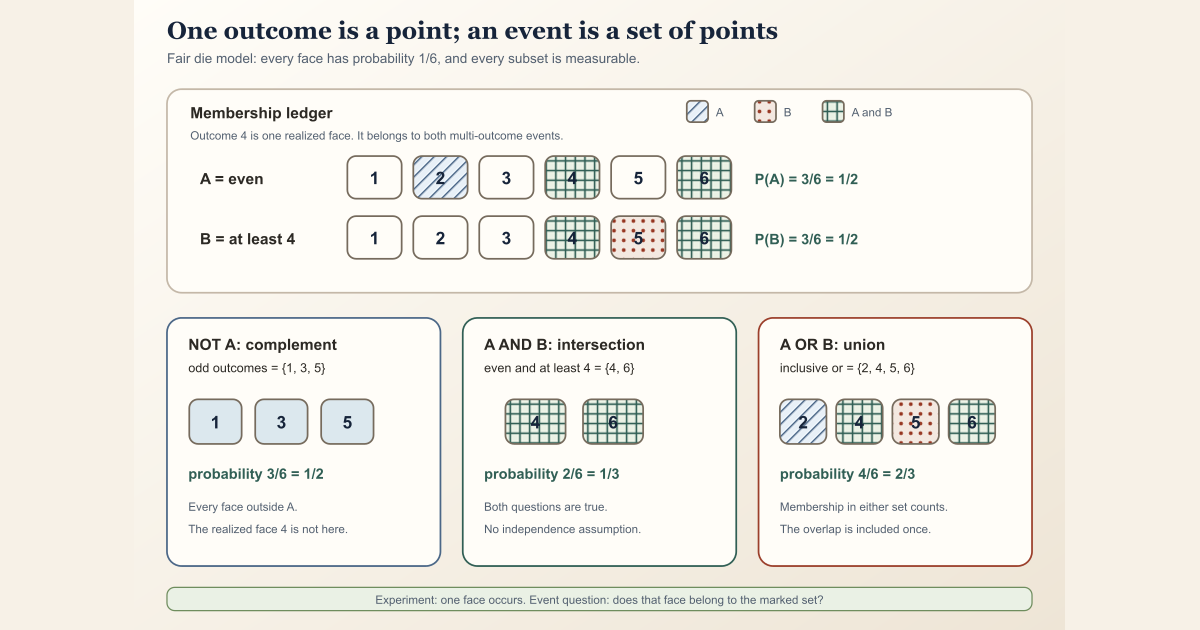
In a probability space \((\Omega,\mathcal F,\mathbb P)\), a probability event is a measurable subset \(A\in\mathcal F\) of the sample space \(\Omega\). After an outcome \(\omega\in\Omega\) is specified, the statement that \(A\) occurs means exactly
\[ \omega\in A. \]This is a set-membership statement. It does not assert \(\mathbb P(A)\gt0\): in a continuous model, a nonempty event may have probability zero.
The logical types are different:
- an outcome is one element \(\omega\in\Omega\);
- an event is a yes-or-no question represented by a set of results; and
- a probability is mass assigned to that measurable set.
Start with a fair die
Roll a fair six-sided die. The outcome space is
\[ \Omega=\{1,2,3,4,5,6\}, \]and every face has probability \(1/6\). Give this finite space the collection of all subsets as its measurable sets, so every subset is an event.
Define two events:
\[ A=\{2,4,6\} \quad\text{(the roll is even)}, \]and
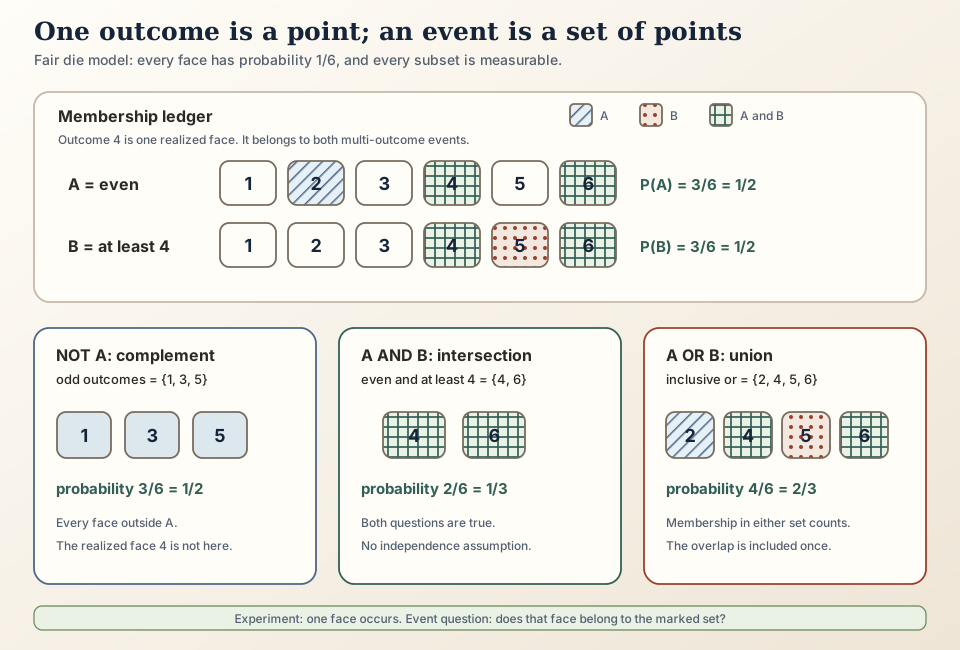
\[ B=\{4,5,6\} \quad\text{(the roll is at least four)}. \]If the die lands on \(4\), then the outcome is the single number \(4\). Both events occur because
\[ 4\in A \qquad\text{and}\qquad 4\in B. \]The event \(A\) is not the outcome \(4\). It is the three-element set \(\{2,4,6\}\). The singleton \(\{4\}\) is yet another event, with probability \(1/6\).
Complement means “not”
The complement of \(A\), written \(A^{\mathsf c}\), contains every outcome in \(\Omega\) that is not in \(A\):
\[ A^{\mathsf c}=\{1,3,5\}. \]For any probability measure,
\[ \mathbb P(A^{\mathsf c})=1-\mathbb P(A). \]Here \(\mathbb P(A)=3/6=1/2\), so
\[ \mathbb P(A^{\mathsf c})=1-\frac12=\frac12. \]Intersection means “and”
The intersection \(A\cap B\) contains outcomes that satisfy both questions:
\[ A\cap B=\{4,6\}. \]There are two equally likely faces in the intersection, hence
\[ \mathbb P(A\cap B)=\frac26=\frac13. \]The word “and” does not mean multiply probabilities automatically. The formula \(\mathbb P(A\cap B)=\mathbb P(A)\mathbb P(B)\) needs independence, which has not been assumed here. Indeed, its right-hand side would be \(1/4\), not the correct value \(1/3\).
Union means inclusive “or”
The union \(A\cup B\) contains outcomes that lie in \(A\), in \(B\), or in both:
\[ A\cup B=\{2,4,5,6\}. \]It has probability
\[ \mathbb P(A\cup B)=\frac46=\frac23. \]Adding \(\mathbb P(A)\) and \(\mathbb P(B)\) counts the overlap twice. The general two-event formula subtracts it once:
\[ \begin{aligned} \mathbb P(A\cup B) &=\mathbb P(A)+\mathbb P(B)-\mathbb P(A\cap B)\\ &=\frac12+\frac12-\frac13 =\frac23. \end{aligned} \]No independence hypothesis is needed for this inclusion-exclusion identity.
The exact definition and measurability gate
Let \(\Omega\) be an outcome space and let \(\mathcal F\) be a measurable collection of its subsets. An event is a set \(A\) satisfying
\[ A\subseteq\Omega \qquad\text{and}\qquad A\in\mathcal F. \]A probability measure \(\mathbb P\) then assigns \(A\) a number \(\mathbb P(A)\in[0,1]\). The collection \(\mathcal F\) contains the whole space and is closed under complements and countable unions. Consequently it is also closed under intersections and all the finite set operations used in the die example.
On a finite die, choosing every subset causes no trouble. On an uncountable space, probability theory usually selects a smaller measurable collection. There can be subsets outside that collection. They are still sets, but they are not events to which the probability model assigns an ordinary probability. The point is not to memorize a pathological example. It is to remember that “subset” and “measurable event” become different notions in general spaces.
Three special events
The whole space \(\Omega\) is the certain event and has probability one. The empty set \(\varnothing\) is the impossible event and has probability zero. A nonempty null event can also have probability zero in a continuous model, so zero probability and logical impossibility must not be identified.
For any event \(A\), these boundary identities hold:
\[ A\cap\varnothing=\varnothing, \qquad A\cup\varnothing=A, \qquad A\cap\Omega=A, \qquad A\cup\Omega=\Omega. \]In Lean: a set and its certificate are separate
Lean represents a subset of \(\Omega\) by Set Ω. It represents the
measurability gate by a separate proposition and proof.
(A : Set Ω) (hA : MeasurableSet A)Ωis the type of possible outcomes.Set Ωis the type of all subsets of those outcomes.A : Set Ωintroduces one particular subset.MeasurableSet Ais a proposition saying thatAbelongs to the measurable structure installed onΩ.hA :names evidence for that proposition. Lean keeps the set and the measurability proof distinct so a theorem cannot silently assume that every subset is measurable.- The whole expression is valid parameter syntax inside a Lean
example, definition, or theorem.
The elementary set operations translate directly:
| Paper | Lean | Read aloud |
|---|---|---|
| \(\omega\in A\) | ω ∈ A | outcome omega belongs to event A |
| \(A^{\mathsf c}\) | Aᶜ | the complement of A |
| \(A\cap B\) | A ∩ B | A and B |
| \(A\cup B\) | A ∪ B | A or B, including both |
| \(\{\omega\}\) | {ω} | the singleton event containing omega |
Mathlib’s measure object can be evaluated on an arbitrary Set Ω
through its outer-measure foundation. The usual probability interpretation
and exact measure identities are nevertheless stated with measurability gates
where needed. A raw set term does not manufacture
MeasurableSet A.
Small standalone tutorial: compute the die events
The set operations from the worked example can be checked without Mathlib.
Here a Boolean predicate decides whether each face belongs to an event. Create
/tmp/DieEvents.lean with these contents:
import Std

namespace DieEvents

def dieFaces : List Nat :=
  (List.range 6).map (fun k => k + 1)

def eventA (face : Nat) : Bool :=
  face % 2 == 0

def eventB (face : Nat) : Bool :=
  decide (4 ≤ face)

def select (P : Nat → Bool) : List Nat :=
  dieFaces.filter P

#eval select (fun face => !(eventA face))
#eval select (fun face => eventA face && eventB face)
#eval select (fun face => eventA face || eventB face)

example : select (fun face => !(eventA face)) = [1, 3, 5] := by decide
example : select (fun face => eventA face && eventB face) = [4, 6] := by decide
example : select (fun face => eventA face || eventB face) = [2, 4, 5, 6] := by
  decide

end DieEvents
From any directory on a normal macOS or Linux machine with the pinned compiler, type exactly:
source "$HOME/.elan/env"
elan run leanprover/lean4:v4.32.0 lean /tmp/DieEvents.lean
This exact worksheet was executed successfully with Lean 4.32.0 while repairing this page. It printed:
[1, 3, 5]
[4, 6]
[2, 4, 5, 6]
These are exactly \(A^{\mathsf c}\), \(A\cap B\), and \(A\cup B\) from the
figure. Their lengths are \(3\), \(2\), and \(4\), so dividing by six gives
the displayed probabilities \(1/2\), \(1/3\), and \(2/3\). This bounded
tutorial imports only Std; it does not install the project’s
Mathlib dependencies.
A real project event: convergence of orbit averages
The project does not reserve “event” for elementary experiments. In
BirkhoffConvergence.lean, an outcome \(\omega\) is a starting point
of a dynamical system. The event contains exactly those starting points whose
finite Birkhoff averages converge to some real number.
This is the exact checked definition:
def birkhoffConvergenceSet (T : Ω → Ω) (g : Ω → ℝ) : Set Ω :=
  {ω | ∃ c : ℝ, Tendsto (fun n ↦ birkhoffAverage ℝ T g n ω) atTop (nhds c)}
Read the set-builder from left to right. The braces construct a set of
starting points ω. Membership requires a real witness
c and a proof that the average sequence tends to c.
The definition does not claim that any starting point satisfies the property.
The same module separately proves the measurability gate:
theorem measurableSet_birkhoffConvergenceSet
    (hT : Measurable T) (hg : Measurable g) :
    MeasurableSet (birkhoffConvergenceSet T g) := by
  exact MeasureTheory.measurableSet_exists_tendsto
    (fun n ↦ measurable_birkhoffAverage hT hg n)
The event exists as a Set Ω without measurability assumptions.
The theorem needs hT and hg to prove that it is a
measurable event. This definition-theorem split is the general set-versus-event
distinction made explicit in code.
The authoritative checked source is
formalization/NonlinearDynamics/Random/RandomCocycles/BirkhoffConvergence.lean.
A human can type this worksheet in a scratch buffer inside a clone with the
repository’s pinned dependencies installed:
import NonlinearDynamics.Random.RandomCocycles.BirkhoffConvergence

open MeasureTheory Set Filter
open NonlinearDynamics.Random.RandomCocycles

#check birkhoffConvergenceSet
#check mem_birkhoffConvergenceSet_iff
#check measurableSet_birkhoffConvergenceSet
#check preimage_birkhoffConvergenceSet

example {Ω : Type*} [MeasurableSpace Ω]
    (A B : Set Ω) (hA : MeasurableSet A) (hB : MeasurableSet B) :
    MeasurableSet (Aᶜ ∩ B) :=
  hA.compl.inter hB
The four #check commands ask Lean to report the checked project
interfaces. In the final example, Lean’s kernel checks a proof
term stating that the complement of one measurable event intersected with
another remains measurable. The full-project command below checks the complete
project module containing the convergence event and its measurability theorem.
cd formalization
lake env lean -DwarningAsError=true NonlinearDynamics/Random/RandomCocycles/BirkhoffConvergence.lean
Resource note: this exact file uses the repository's
pinned Lean and Mathlib dependencies. Initial project setup can require
substantial disk space and build time. For a lightweight first step on
macOS or Linux, use the page's standalone Lean-core or Std
tutorial.
Boundaries that prevent common mistakes
| Tempting shortcut | Correct statement |
|---|---|
| “An outcome is an event.” | An outcome \(\omega\) is an element. The singleton \(\{\omega\}\) may be an event. |
| “Every subset automatically has a probability.” | Only measurable subsets are events in a general probability space. |
| “And means multiply.” | \(\mathbb P(A\cap B)=\mathbb P(A)\mathbb P(B)\) requires independence. |
| “Or excludes the overlap.” | Set union is inclusive; outcomes in both events remain in the union. |
| “Probability zero means empty.” | A nonempty event can be null under a continuous probability law. |
| “Defining a convergence event proves convergence.” | A set-builder records a membership condition; a later theorem must prove points or almost every point belongs. |
Where to continue
The measurable space entry explains the collection \(\mathcal F\) and why it is closed under the operations used here. The probability distribution (law) entry explains where probabilities on value-space events come from. The null set and almost-everywhere entries explain how zero-mass exceptions enter analysis.
For the project example, continue to the Birkhoff convergence event chapter and then to Birkhoff Convergence Events Before the Pointwise Ergodic Theorem. They separate event definition, measurability, invariance, zero-one rigidity, and actual convergence.
References
Olav Kallenberg. Foundations of Modern Probability, third edition, Springer, 2021. This is a standard reference for sample spaces, events, sigma algebras, and probability measures.
Mathlib contributors.
Measurable spaces and measurable sets,
Mathlib 4 documentation. This official reference documents
MeasurableSet and its closure operations.
Project source. BirkhoffConvergence.lean contains the checked convergence-set definition and measurability theorem used in the Lean section.