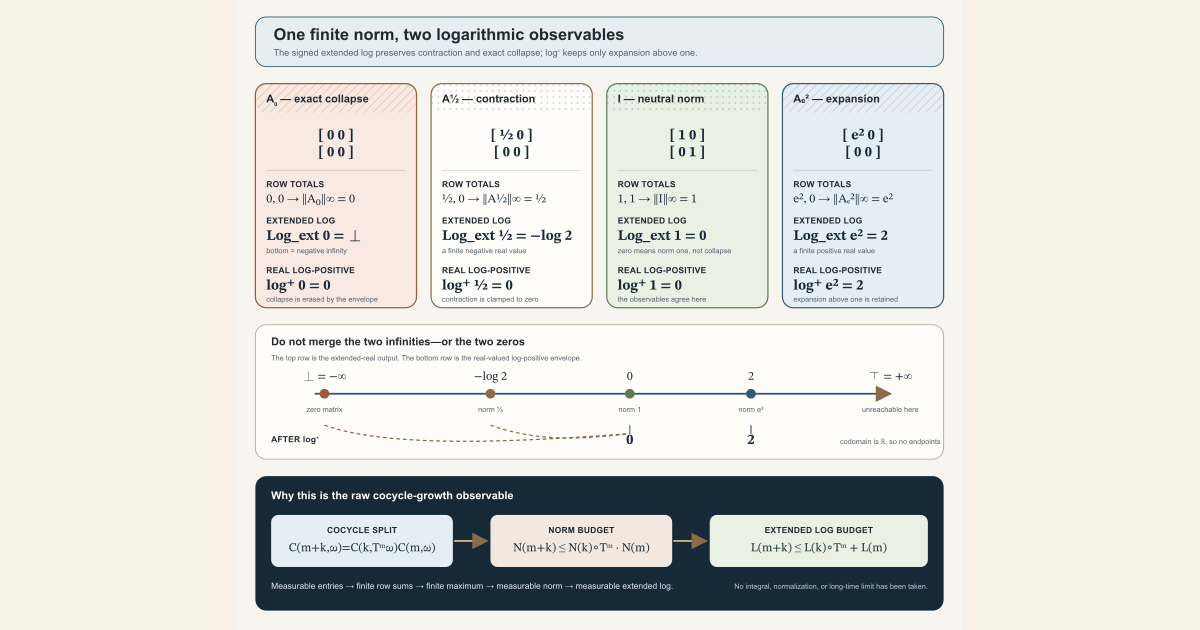
An extended log-norm observable answers a concrete question:
After \(k\) steps, how large is the cocycle matrix at the base state \(\omega\), measured on a logarithmic scale that still recognizes exact collapse?
For a one-sided discrete matrix cocycle \(C\), the project defines
\[ N_k(\omega)=\lVert C(k,\omega)\rVert_\infty \]and then
\[ L_k(\omega) {} = \operatorname{Log}_{\mathrm{ext}}\!\left(N_k(\omega)\right). \]The first observable \(N_k\) is a finite nonnegative real number. The second observable \(L_k\) takes values on the extended real line. It can therefore say all four of the following without ambiguity:
- \(\bot=-\infty\): exact matrix collapse;
- a finite negative number: strict norm contraction;
- \(0\): norm exactly one; and
- a finite positive number: norm expansion.
That four-way distinction is the main idea. The logarithm also converts the multiplicative estimate for cocycle norms into an additive estimate, which is the shape later ergodic theorems expect.
Start with four real matrices
Consider four \(2\times2\) diagonal matrices:
\[ A_0= \begin{bmatrix}0&0\\0&0\end{bmatrix},\qquad A_{1/2}= \begin{bmatrix}\tfrac12&0\\0&0\end{bmatrix},\qquad I= \begin{bmatrix}1&0\\0&1\end{bmatrix},\qquad A_{e^2}= \begin{bmatrix}e^2&0\\0&0\end{bmatrix}. \]The project uses the maximum absolute row-sum norm
\[ \lVert A\rVert_\infty=\max_i\sum_j|A_{ij}|. \]For a diagonal matrix, each row total equals the magnitude of its diagonal entry. We therefore obtain
| Matrix | Absolute row totals | \(\lVert A\rVert_\infty\) | Signed extended log | Real log-positive value |
|---|---|---|---|---|
| \(A_0\) | \(0,0\) | \(0\) | \(\bot=-\infty\) | \(0\) |
| \(A_{1/2}\) | \(1/2,0\) | \(1/2\) | \(\log(1/2)=-\log 2\) | \(0\) |
| \(I\) | \(1,1\) | \(1\) | \(0\) | \(0\) |
| \(A_{e^2}\) | \(e^2,0\) | \(e^2\) | \(2\) | \(2\) |
The two rightmost columns are deliberately different observables.
- The signed extended log preserves contraction and gives zero a genuine negative-infinity endpoint.
- The real log-positive observable \(\log^+ r=\max\{0,\log r\}\) keeps only expansion above one. It sends the first three rows of the table to zero.
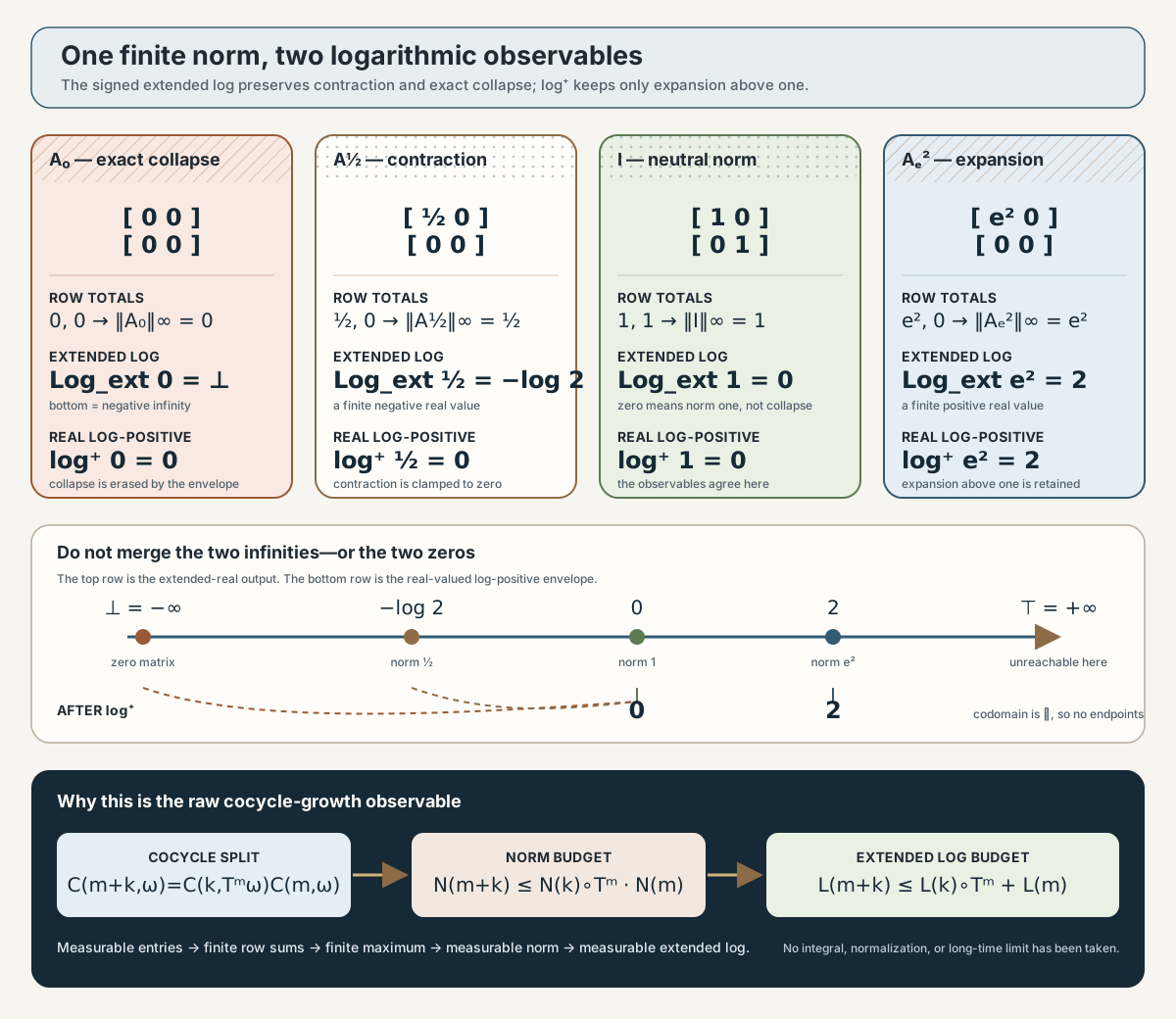
Work through each row
Zero matrix: collapse is bottom
For \(A_0\), both row sums vanish, so \(\lVert A_0\rVert_\infty=0\). The extended logarithm uses
\[ \operatorname{Log}_{\mathrm{ext}}(0)=\bot=-\infty. \]This is not an error, missing value, or failed proof. It is the intended record of exact collapse. The project proves the sharp statement
\[ L_k(\omega)=\bot \quad\Longleftrightarrow\quad C(k,\omega)=0. \]The real log-positive envelope gives \(\log^+0=0\). That is also intentional: the envelope does not record collapse; it isolates expansion above one for an integrability argument.
Norm one half: contraction is finite and negative
For \(A_{1/2}\), the row totals are \(1/2\) and \(0\), hence
\[ \lVert A_{1/2}\rVert_\infty=\frac12. \]Because the norm is positive and finite, the extended logarithm agrees with the ordinary logarithm:
\[ \operatorname{Log}_{\mathrm{ext}}(1/2) =\log(1/2) =-\log2\lt0. \]But \(\log^+(1/2)=0\). This is the cleanest example of why the two observables must not be used as synonyms: one records contraction and the other discards it.
Norm one: zero means neutral size
For the identity matrix, both row totals are one. Thus
\[ \operatorname{Log}_{\mathrm{ext}}\lVert I\rVert_\infty =\operatorname{Log}_{\mathrm{ext}}1 =0. \]Here zero means norm one, not zero matrix. Many nonidentity matrices also have operator norm one, so a zero log norm does not identify the matrix.
Norm \(e^2\): both observables retain expansion
For \(A_{e^2}\), the largest row total is \(e^2\). Therefore
\[ \operatorname{Log}_{\mathrm{ext}}(e^2)=2 \qquad\text{and}\qquad \log^+(e^2)=2. \]Above one, the ordinary log is nonnegative, so taking its positive part changes nothing.
Four logarithmic conventions that look deceptively similar
At a positive real input, all relevant signed logarithms agree. The zero input is where notation must be read carefully.
| Construction | Codomain | Value at \(0\) | Value at \(1/2\) | Purpose here |
|---|---|---|---|---|
| Ordinary mathematical \(\log r\) on \(r\gt0\) | \(\mathbb R\) | not defined; tends to \(-\infty\) from the right | \(-\log2\) | classical positive-input logarithm |
Mathlib Real.log | \(\mathbb R\) | \(0\), by totalization | \(-\log2\) | convenient total real function |
Mathlib ENNReal.log | EReal | \(\bot=-\infty\) | finite value \(-\log2\) | zero-faithful signed growth |
Mathlib Real.posLog, written log⁺ | \(\mathbb R\) | \(0\) | \(0\) | nonnegative expansion envelope |
Mathlib defines
\[ \log^+r=\max\{0,\operatorname{Real.log}r\}. \]Because Mathlib also has \(\operatorname{Real.log}0=0\), its log-positive function is continuous at zero and returns zero there. This is useful, but it does not repair the signed information that total real log loses at a zero norm.
Later, under a nonzero or pointwise-invertibility hypothesis and in nonempty matrix dimension, the project can identify the extended log with the coercion of the real signed log. Without such a hypothesis, they differ precisely at zero.
Bottom is not top
Two extended number systems appear in the Lean definition:
| Mathematical layer | Lean type | Endpoints | Role |
|---|---|---|---|
| finite nonnegative norm | ℝ | none | \(N_k(\omega)\) |
| extended nonnegative real | ENNReal, notation ℝ≥0∞ | \(0,+\infty\) | input type of ENNReal.log |
| extended real | EReal | \(\bot=-\infty,\ \top=+\infty\) | output type of the signed extended log |
The endpoint rules are
\[ \operatorname{ENNReal.log}(0)=\bot, \qquad \operatorname{ENNReal.log}(\top)=\top. \]The cocycle observable cannot reach the second branch. A finite matrix has a
finite real norm, and its extended norm notation ‖A‖ₑ embeds that
finite value into ENNReal; it is never ⊤. Therefore
logNormObservable can be bottom or a finite real value, but not
top.
That distinction prevents a common reading error:
⊥means negative infinity and comes from norm zero;⊤means positive infinity and would come from an infinite extended input; and- neither symbol is the real number zero.
Why this is the raw cocycle-growth observable
A one-sided cocycle satisfies the later-block-left split
\[ C(m+k,\omega)=C(k,T^m\omega)C(m,\omega). \]The induced infinity norm is submultiplicative, so
\[ N_{m+k}(\omega) \leq N_k(T^m\omega)N_m(\omega). \]The extended logarithm is monotone and turns products into sums, including at zero. Hence
\[ \boxed{ L_{m+k}(\omega) \leq L_k(T^m\omega)+L_m(\omega) }. \]This is the raw finite-time growth observable:
- it uses the actual \(k\)-step cocycle value;
- it is not divided by \(k\);
- it has not been integrated over the base space;
- it has not been replaced by a probability distribution; and
- no limit as \(k\to\infty\) has been taken.
The inequality can be strict. Matrix multiplication can produce cancellation, and two nonzero matrices can even have zero product. In that case the left side is bottom while the two terms on the right remain finite.
The log-positive envelope also satisfies a subadditive bound,
\[ \log^+N_{m+k}(\omega) \leq \log^+N_k(T^m\omega)+\log^+N_m(\omega), \]but it serves a different purpose: it is a nonnegative upper-tail quantity that can be integrated once a genuine integrability hypothesis is supplied.
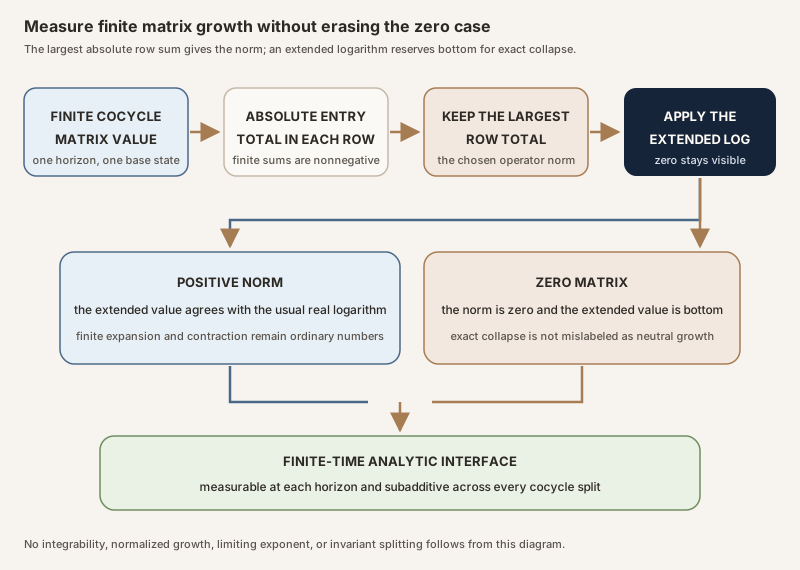
Measurability: build it from visible pieces
An observable must be measurable before measure-theoretic tools can use it. The project proves this from the finite row-sum formula rather than treating matrix norm notation as a black box.
For fixed \(k\):
- every coordinate map \(\omega\mapsto C(k,\omega)_{ij}\) is measurable;
- complex magnitude preserves measurability;
- a finite sum of measurable column terms is measurable;
- a finite maximum over the rows is measurable;
- the row-sum theorem identifies that maximum with \(N_k\); and
- composition with measurable
ENNReal.loggives measurable \(L_k\).
The log-positive observable is measurable by composing \(N_k\) with the
continuous real function Real.posLog.
Measurability is not integrability. A measurable growth observable can still have an infinite integral, a nonintegrable positive tail, or bottom on a set of positive measure. The later finite-horizon integrability module therefore introduces an explicit hypothesis on the one-step log-positive observable; it does not derive integrability from measurability or measure preservation.
Time zero and the empty-coordinate edge case
At time zero, a cocycle value is the identity. If the finite coordinate type \(\iota\) is nonempty, the familiar normalization holds:
\[ N_0(\omega)=1, \qquad L_0(\omega)=0. \]The hypothesis Nonempty ι matters. If \(\iota\) is empty, there
are no rows, so the supremum of the row totals is zero. The unique empty square
matrix is both the zero matrix and the identity matrix. Consequently,
for every \(k\) and \(\omega\) in that edge case. The real log-positive observable remains zero. The definitions, measurability results, and split inequalities all allow empty dimension; only the usual identity-norm normalization needs positive dimension.
A non-tight two-block calculation
Let an earlier block be
\[ B= \begin{bmatrix} 1&-1\\ 0&2 \end{bmatrix} \]and a shifted later block be
\[ D= \begin{bmatrix} 1&0\\ 3&1 \end{bmatrix}. \]Their maximum absolute row sums are
\[ \lVert B\rVert_\infty=2, \qquad \lVert D\rVert_\infty=4. \]Because the later block acts on the left,
\[ DB= \begin{bmatrix} 1&-1\\ 3&-1 \end{bmatrix}, \qquad \lVert DB\rVert_\infty=4. \]Thus
\[ 4\leq4\cdot2 \]and, since all three norms are positive,
\[ \log4\leq\log4+\log2. \]The estimate is deliberately a budget, not an equality. If \(D\) were zero, then \(DB=0\), both corresponding extended log norms would be bottom, and no special nonzero exception would be required.
In Lean: form the signed observable
C.logNormObservable k ωThe exact definition a human reads is:
def logNormObservable
    (C : DiscreteMatrixCocycle (ι := ι) μ) (k : ℕ) : Ω → EReal :=
  fun ω ↦ ENNReal.log ‖C.value k ω‖ₑ
In a Lean worksheet where C, k, and ω
have already been declared, the human types:
#check C.logNormObservable k ω
Read the tokens from the inside out:
C.value k ωis the matrix \(C(k,\omega)\);‖…‖ₑis its extended nonnegative norm value;ENNReal.logmaps that value intoEReal; andC.logNormObservable kis the whole function of \(\omega\).
In Lean: recognize exact collapse
C.logNormObservable_eq_bot_iff k ωA human asks Lean for the theorem’s type by typing:
#check C.logNormObservable_eq_bot_iff k ω
The returned proposition has two directions. The forward direction turns a bottom log value into a zero matrix; the reverse direction turns a zero matrix into bottom. No probability or almost-everywhere qualifier is involved.
In Lean: form the real log-positive envelope
C.logPlusNormObservable k ωThe project definition and the Mathlib expansion rule are:
def logPlusNormObservable
    (C : DiscreteMatrixCocycle (ι := ι) μ) (k : ℕ) : Ω → ℝ :=
  fun ω ↦ log⁺ (C.normObservable k ω)

#check Real.posLog_apply
#check C.logPlusNormObservable k ω
log⁺is notation forReal.posLog;Real.posLog_applyunfolds it tomax 0 (Real.log x);- the result is an ordinary real number, not an
EReal; and C.logPlusNormObservable_nonneg k ωproves the result is nonnegative.
In Lean: state measurability and the cocycle split
C.measurable_logNormObservable k; C.measurable_logPlusNormObservable kA human types the two proof terms separately:
#check C.measurable_logNormObservable k
#check C.measurable_logPlusNormObservable k
The first conclusion is
Measurable (C.logNormObservable k); the second has the analogous
real-valued function.
C.logNormObservable_add_le m k ωThe exact invocation is:
#check C.logNormObservable_add_le m k ω
#check C.logPlusNormObservable_add_le m k ω
Argument order matters: m is the length of the earlier block,
while k is the length of the later block evaluated at
C.base^[m] ω. The second line asks for the parallel inequality for
the real log-positive envelope.
Exact source excerpts
Full project check. This uses the repository’s pinned Lean and Mathlib
dependencies and may require substantial disk space and memory.
The zero-faithful observable,
collapse theorem, and measurability proof are in
NormObservables.lean:
def logNormObservable (C : DiscreteMatrixCocycle (ι := ι) μ) (k : ℕ) : Ω → EReal :=
  fun ω ↦ ENNReal.log ‖C.value k ω‖ₑ

@[simp] theorem logNormObservable_eq_bot_iff
    (C : DiscreteMatrixCocycle (ι := ι) μ) (k : ℕ) (ω : Ω) :
    C.logNormObservable k ω = ⊥ ↔ C.value k ω = 0 := by
  simp [logNormObservable]

theorem measurable_logNormObservable
    (C : DiscreteMatrixCocycle (ι := ι) μ) (k : ℕ) :
    Measurable (C.logNormObservable k) := by
  have hnorm : Measurable (C.normObservable k) := C.measurable_normObservable k
  unfold logNormObservable
  unfold normObservable at hnorm
  simpa only [ofReal_norm] using hnorm.ennreal_ofReal.ennreal_log
The subadditive result first uses matrix-norm submultiplicativity and then
Mathlib’s unconditional product rule ENNReal.log_mul_add:
theorem logNormObservable_add_le
    (C : DiscreteMatrixCocycle (ι := ι) μ) (m k : ℕ) (ω : Ω) :
    C.logNormObservable (m + k) ω ≤
      C.logNormObservable k (C.base^[m] ω) + C.logNormObservable m ω := by
  rw [logNormObservable, C.value_add]
  calc
    ENNReal.log ‖C.value k (C.base^[m] ω) * C.value m ω‖ₑ ≤
        ENNReal.log (‖C.value k (C.base^[m] ω)‖ₑ * ‖C.value m ω‖ₑ) := by
      apply ENNReal.log_monotone
      simpa only [enorm_eq_nnnorm, ← ENNReal.coe_mul, ENNReal.coe_le_coe] using
        (nnnorm_mul_le (C.value k (C.base^[m] ω)) (C.value m ω))
    _ = ENNReal.log ‖C.value k (C.base^[m] ω)‖ₑ +
        ENNReal.log ‖C.value m ω‖ₑ := ENNReal.log_mul_add
Full project check. This uses the repository’s pinned Lean and Mathlib
dependencies and may require substantial disk space and memory.
The nonnegative envelope is
defined separately in
LogPlusIntegrability.lean:
def logPlusNormObservable
    (C : DiscreteMatrixCocycle (ι := ι) μ) (k : ℕ) : Ω → ℝ :=
  fun ω ↦ log⁺ (C.normObservable k ω)

theorem measurable_logPlusNormObservable
    (C : DiscreteMatrixCocycle (ι := ι) μ) (k : ℕ) :
    Measurable (C.logPlusNormObservable k) :=
  Real.continuous_posLog.measurable.comp (C.measurable_normObservable k)
These excerpts establish definitions and finite-horizon infrastructure. They do not establish an asymptotic exponent.
Standalone tutorial: symbolic worksheet
Standalone tutorial. Transcendental real logarithms
belong to Mathlib, so this dependency-light worksheet uses an exact symbolic
four-case ledger. It checks the branch logic with only Std; it
does not implement EReal, matrix norms, or analytic logarithms.
Save it as LogNormFourCasesScratch.lean:
import Std

inductive NormCase where
  | zero
  | half
  | one
  | expTwo
deriving Repr, BEq

inductive ExtendedLogValue where
  | bottom
  | negLogTwo
  | zero
  | two
deriving Repr, BEq

def extendedLogTable : NormCase → ExtendedLogValue
  | .zero => .bottom
  | .half => .negLogTwo
  | .one => .zero
  | .expTwo => .two

def logPlusTable : NormCase → Nat
  | .zero => 0
  | .half => 0
  | .one => 0
  | .expTwo => 2

def cases : List NormCase :=
  [.zero, .half, .one, .expTwo]

#eval cases.map fun c => (c, extendedLogTable c, logPlusTable c)
#eval extendedLogTable .zero == .bottom
#eval extendedLogTable .half == .negLogTwo
#eval logPlusTable .half == 0
#eval logPlusTable .expTwo == 2
Run it with the repository’s pinned Lean version but outside the Mathlib project:
elan run leanprover/lean4:v4.32.0 lean LogNormFourCasesScratch.lean
The first output should list
(zero, bottom, 0),
(half, negLogTwo, 0),
(one, zero, 0), and
(expTwo, two, 2). The four Boolean checks should all print
true.
This worksheet is intentionally a teaching surrogate. The exact analytic facts are the pinned Mathlib and project declarations checked next.
Try the exact declarations in the project
Full project check. This uses the repository’s pinned Lean and Mathlib dependencies and may require substantial disk space and memory. Create a temporary project worksheet containing:
import NonlinearDynamics.Random.RandomCocycles.LogPlusIntegrability

open Matrix MeasureTheory
open scoped Matrix.Norms.Operator Real
open NonlinearDynamics.Random.RandomCocycles

#check ENNReal.log_zero
#check ENNReal.log_one
#check ENNReal.log_top
#check ENNReal.log_mul_add
#check ENNReal.log_eq_bot_iff
#check Real.posLog_apply
#check Real.posLog_zero
#check Real.posLog_one
#check Real.continuous_posLog
#check DiscreteMatrixCocycle.normObservable
#check DiscreteMatrixCocycle.normObservable_eq_rowSumSup
#check DiscreteMatrixCocycle.measurable_normObservable
#check DiscreteMatrixCocycle.logNormObservable
#check DiscreteMatrixCocycle.logNormObservable_eq_bot_iff
#check DiscreteMatrixCocycle.logNormObservable_zero
#check DiscreteMatrixCocycle.logNormObservable_one
#check DiscreteMatrixCocycle.measurable_logNormObservable
#check DiscreteMatrixCocycle.logNormObservable_add_le
#check DiscreteMatrixCocycle.logNormObservable_eq_bot_of_isEmpty
#check DiscreteMatrixCocycle.logPlusNormObservable
#check DiscreteMatrixCocycle.logPlusNormObservable_nonneg
#check DiscreteMatrixCocycle.logPlusNormObservable_zero
#check DiscreteMatrixCocycle.logPlusNormObservable_one
#check DiscreteMatrixCocycle.measurable_logPlusNormObservable
#check DiscreteMatrixCocycle.logPlusNormObservable_add_le
#check DiscreteMatrixCocycle.logPlusNormObservable_eq_zero_of_isEmpty
Each #check asks the pinned elaborator for the exact declaration
type; it does not execute a numerical simulation. The full-project command is:
cd formalization
lake env lean NonlinearDynamics/Random/RandomCocycles/LogPlusIntegrability.lean
This full project check uses the repository’s pinned Lean and Mathlib dependencies and may require substantial disk space and memory.
cd formalization
lake env lean -DwarningAsError=true NonlinearDynamics/Random/RandomCocycles/LogPlusIntegrability.lean
Resource note: this exact file uses the repository's
pinned Lean and Mathlib dependencies. Initial project setup can require
substantial disk space and build time. For a lightweight first step on
macOS or Linux, use the page's standalone Lean-core or Std
tutorial.
What has and has not been formalized here
The checked finite-time layer provides:
- the maximum-row-sum norm observable;
- its exact row-sum formula;
- a zero-faithful signed extended log observable;
- bottom exactly at a zero cocycle matrix;
- a real-valued nonnegative log-positive envelope;
- measurability of both logarithmic observables;
- subadditivity across every finite cocycle split;
- the positive-dimensional time-zero normalization; and
- explicit empty-dimensional behavior.
It does not yet provide:
- integrability merely from measurability;
- a probability assumption on the base measure;
- normalized growth \(k^{-1}L_k\);
- almost-everywhere or \(L^1\) convergence;
- a Lyapunov exponent or Lyapunov spectrum;
- an Oseledets invariant splitting;
- invertibility or negative-time dynamics;
- a lower singular-value estimate;
- a distribution of the observable; or
- an identification of the generator with a nonlinear Jacobian.
It is also not a matrix logarithm. Nor is it the distinct logarithmic norm or matrix measure used in some ODE stability arguments. Here the order is: take a scalar operator norm first, then apply a scalar logarithm.
Exercises
- Compute both logarithmic observables for \(\operatorname{diag}(1/4,0)\). Which information does \(\log^+\) discard?
- Compute both observables for \(2I\). Why is the infinity norm \(2\), not \(4\)?
- Explain in one sentence why
⊥cannot mean neutral growth. - Give two nonzero \(2\times2\) matrices whose product is zero. What are the three terms in the signed subadditive inequality?
- Starting from measurable entries, reconstruct the six-step measurability argument above.
- Why can this cocycle observable never equal
⊤even thoughENNReal.log ⊤ = ⊤? - Explain why
Real.log 0 = 0is convenient for total real functions but unsuitable for recording exact matrix collapse. - List the additional assumptions needed before a subadditive ergodic theorem could turn finite-time growth into an almost-sure asymptotic rate.
Where to continue
Finite-Horizon Log-Positive Cocycle Integrability develops the nonnegative envelope, its orbit-sum majorant, and the explicit one-step integrability hypothesis that propagates to finite horizons.
The Forward-and-Inverse Tail Sandwich for Finite-Time Real Log Norms returns to signed real logarithms. It explains exactly when a nonzero cocycle value lets the extended log be read as an ordinary real log and why inverse tails are needed to control contraction.
Finite-Time Norm and Extended-Log-Norm Observables for Matrix Cocycles derives the complete formal interface: row-sum measurability, zero-safe subadditivity, time-zero normalization, and the empty-dimension ledger.
The one-sided discrete matrix cocycle entry supplies the base orbit and later-block-left product law. The log-positive integrability envelope entry focuses on why contraction is deliberately removed.
References
Mathlib contributors. Norms on finite matrices, Mathlib 4 documentation. This official source defines the maximum absolute row-sum matrix norm and proves its product inequality and operator-norm interpretation.
Mathlib contributors.
Extended nonnegative-real logarithm,
Mathlib 4 documentation. This official source defines ENNReal.log,
including log 0 = ⊥, log ⊤ = ⊤, strict monotonicity,
and the unconditional product-to-sum identity.
Mathlib contributors. Extended logarithm and exponential, Mathlib 4 documentation. This official source packages the logarithm as an order isomorphism and homeomorphism and proves its measurability.
Mathlib contributors.
Positive part of the real logarithm,
Mathlib 4 documentation. This official source defines Real.posLog,
proves continuity and nonnegativity, and develops its product estimate.
Roger A. Horn and Charles R. Johnson. Matrix Analysis, second edition, Cambridge University Press, 2013, ISBN 978-0-521-54823-6. Chapter 5 develops induced matrix norms and submultiplicativity. The project selects the maximum absolute row-sum convention.
J. F. C. Kingman. The ergodic theory of subadditive stochastic processes, Journal of the Royal Statistical Society, Series B 30(3), 1968, 499–510. This primary source supplies a later asymptotic destination. The present page does not claim Kingman’s hypotheses or conclusions.
The exact upstream Lean source audited for this entry is Mathlib commit
81a5d257,
the revision pinned by formalization/lake-manifest.json.