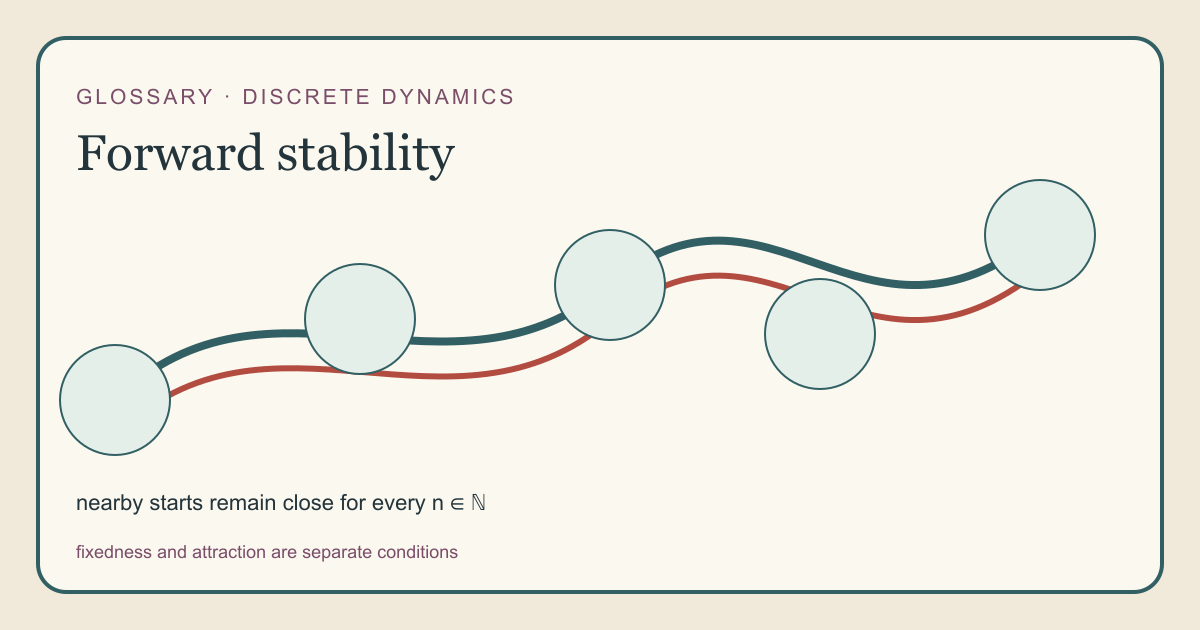
Forward stability at a point means that a small initial change stays small relative to the chosen reference orbit for every forward time.
Let \(f:X\to X\) be a discrete-time update rule and let \(p\in X\). In a metric space, \(p\) is forward stable when
\[ \forall\varepsilon\gt0,\quad \exists\delta\gt0,\quad d(x,p)\lt\delta\Longrightarrow d(f^n(x),f^n(p))\lt\varepsilon \]for every state \(x\) and every \(n\in\mathbb N\).
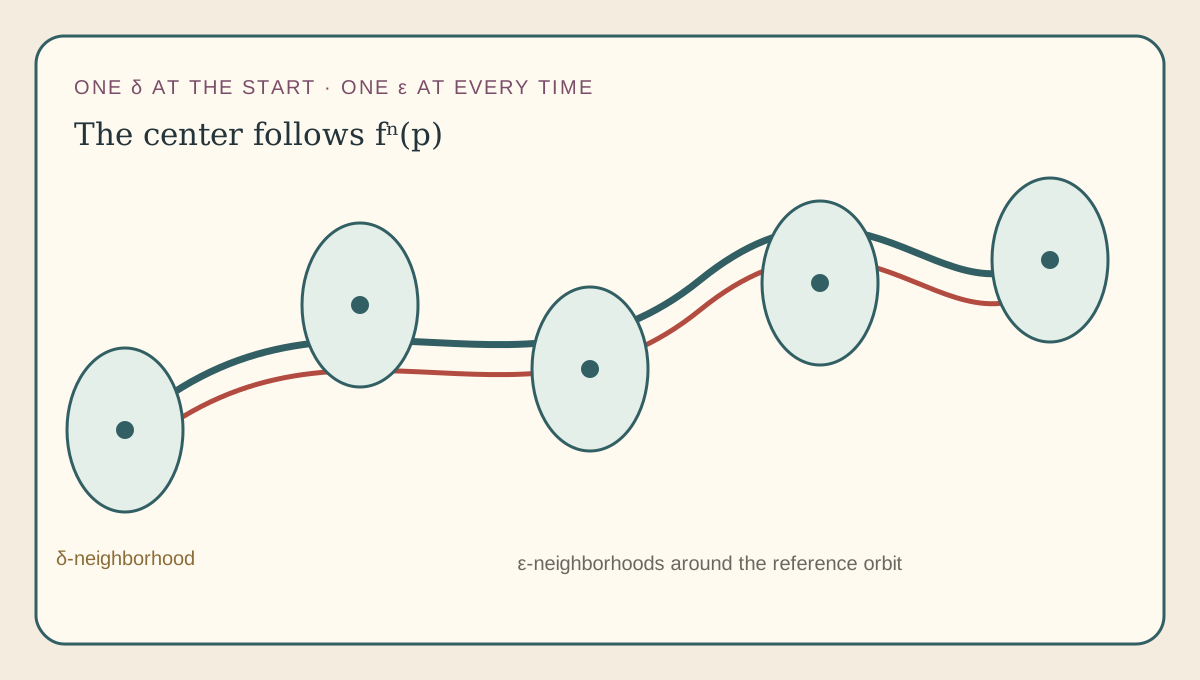
The center of the allowed epsilon ball is \(f^n(p)\). It may move with time. That feature distinguishes stability of a reference orbit from stability of a fixed point.
Start with translation
Take \(f(x)=x+5\) on the real line. If \(p=2\) and \(x=2.25\), then
\[ f^n(p)=2+5n,\qquad f^n(x)=2.25+5n. \]Their distance is always \(0.25\). Given any \(\varepsilon\gt0\), choosing \(\delta=\varepsilon\) works: if \(|x-p|\lt\delta\), then
\[ |f^n(x)-f^n(p)|=|x-p|\lt\varepsilon \]for every forward time.
This establishes forward stability for the translation map once the same identity is proved for arbitrary starts. It also exhibits why the reference point need not be fixed. If the translation amount is nonzero, then \(f(p)\ne p\) for every \(p\).
The quantifier order
The order
\[ \forall\varepsilon\;\exists\delta\;\forall x\;\forall n \]is part of the definition.
The radius \(\delta\) may depend on the requested tolerance \(\varepsilon\). It may not depend on \(x\), because every start in the initial ball must work. It may not depend on \(n\), because one initial radius controls the full forward orbit.
If one proves only
\[ \forall n\;\forall\varepsilon\;\exists\delta_n, \]then each iterate is continuous at \(p\), but the radii may collapse as time grows. That statement is not forward stability.
Time zero is included. At \(n=0\), both iterates are identities, so the condition includes \(d(x,p)\lt\varepsilon\). A proof can always reduce its chosen radius to be at most \(\varepsilon\).
Equicontinuity
Equicontinuity at \(p\) is the topological form of “one neighborhood works for every function in a family.” Consider the family
\[ F_n=f^n,\qquad n\in\mathbb N. \]Equicontinuity of this family at \(p\) is exactly forward stability.
Uniform spaces state this without choosing a numerical metric. An entourage is a set of pairs regarded as uniformly close. For each entourage \(U\), equicontinuity supplies a neighborhood of \(p\) such that
\[ (f^n(p),f^n(x))\in U \]for every \(n\). In a pseudo-metric space, the standard entourages are given by \(d(a,b)\lt\varepsilon\), recovering the epsilon-delta statement.
In Lean
The project reuses Mathlib’s equicontinuity interface:
def IsForwardStableAt [UniformSpace X]\n (f : X → X) (p : X) : Prop :=\n EquicontinuousAt (fun n : ℕ ↦ f^[n]) pUniformSpace X supplies uniform closeness and an induced topology.
fun n : ℕ ↦ … constructs the iterate family.
f^[n] applies the function \(n\) times.
EquicontinuousAt binds one source neighborhood before quantifying
over the family index.The metric bridge is
isForwardStableAt_iff_dist. The theorem
IsForwardStableAt.continuousAt selects the iterate at time one and
deduces continuity of \(f\) at \(p\). The converse is not claimed.
This is a full project check using pinned Lean and Mathlib dependencies. It may require substantial disk space and build time:
git clone https://github.com/tdj28/nonlinear-dynamics-lean.git
cd nonlinear-dynamics-lean/formalization
lake env lean -DwarningAsError=true \
  NonlinearDynamics/Deterministic/Discrete/Stability.lean
The command is portable across macOS and Linux after the dependencies are
installed. The paired Deep Dive includes a smaller standalone tutorial
that imports only Std.
Fixed-point stability adds a condition
A fixed point satisfies \(f(p)=p\), so its reference orbit never moves. In that case forward stability becomes
\[ d(x,p)\lt\delta\Longrightarrow d(f^n(x),p)\lt\varepsilon. \]The project calls the conjunction a Lyapunov-stable fixed point:
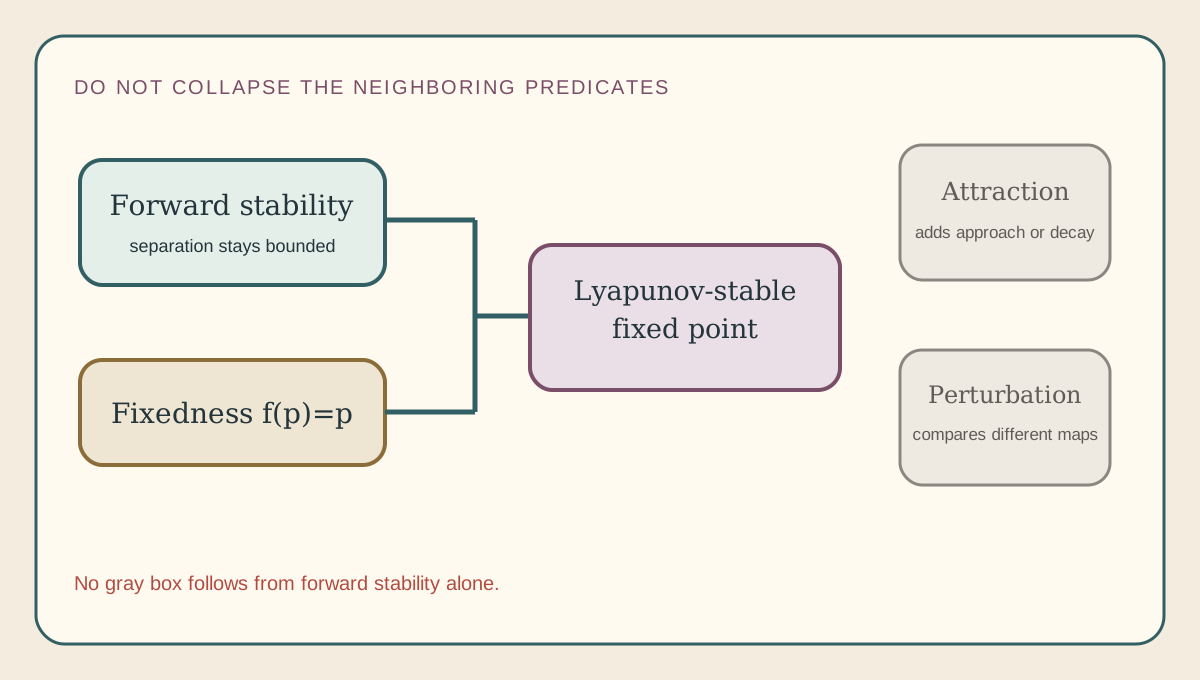
\[ f(p)=p \quad\text{and}\quad p\text{ is forward stable}. \]It does not define forward stability so that fixedness is hidden inside it. The checked nonzero-translation example is the boundary witness: forward stability holds, fixedness fails.
Nonexpansive maps
A self-map is nonexpansive when
\[ d(f(x),f(y))\le d(x,y). \]Repeating the estimate gives
\[ d(f^n(x),f^n(y))\le d(x,y). \]Thus every nonexpansive self-map is forward stable at every point. If such a map has a fixed point, that point is Lyapunov stable. The identity, real translations, and constant maps provide checked examples in the module.
Nonexpansive is sufficient, not necessary. The definition permits other maps whose iterates remain equicontinuous at selected points.
Not attraction or robustness
Forward stability says “remain close.” Attraction says “approach.” The translation example keeps a constant gap, so it is stable without attracting the nearby orbit. The basin of attraction collects starts whose orbits do approach a specified target.
Forward stability also fixes one map \(f\). Structural stability and many uses of stochastic stability compare different maps, invariant measures, or random systems. Those questions use different inputs and conclusions.
This glossary entry does not define invariant-set stability, asymptotic or exponential stability, two-sided-time stability, stable manifolds, or a Lyapunov-function criterion. The separate Lyapunov function chapter introduces that criterion without changing the meaning of forward stability.
Continue with the worked Forward-Orbit and Fixed-Point Stability Deep Dive, continue to Attraction, Basins, and Asymptotic Stability, continue to Lyapunov Functions and the Direct Method, or inspect the declaration-complete Research Note.
References
- Ethan Akin, “On Chain Continuity,” DCDS 2(1), 111–120 (1996), doi:10.3934/dcds.1996.2.111.
- Saber Elaydi and H. R. Farran, “On Variation of Equicontinuity in Dynamical Systems,” Bull. Aust. Math. Soc. 42(3), 391–397 (1990), doi:10.1017/S0004972700028550.
- J. P. LaSalle, The Stability of Dynamical Systems, Chapter 1, SIAM (1976), doi:10.1137/1.9781611970432.ch1.
- Mathlib, uniform-space equicontinuity source.