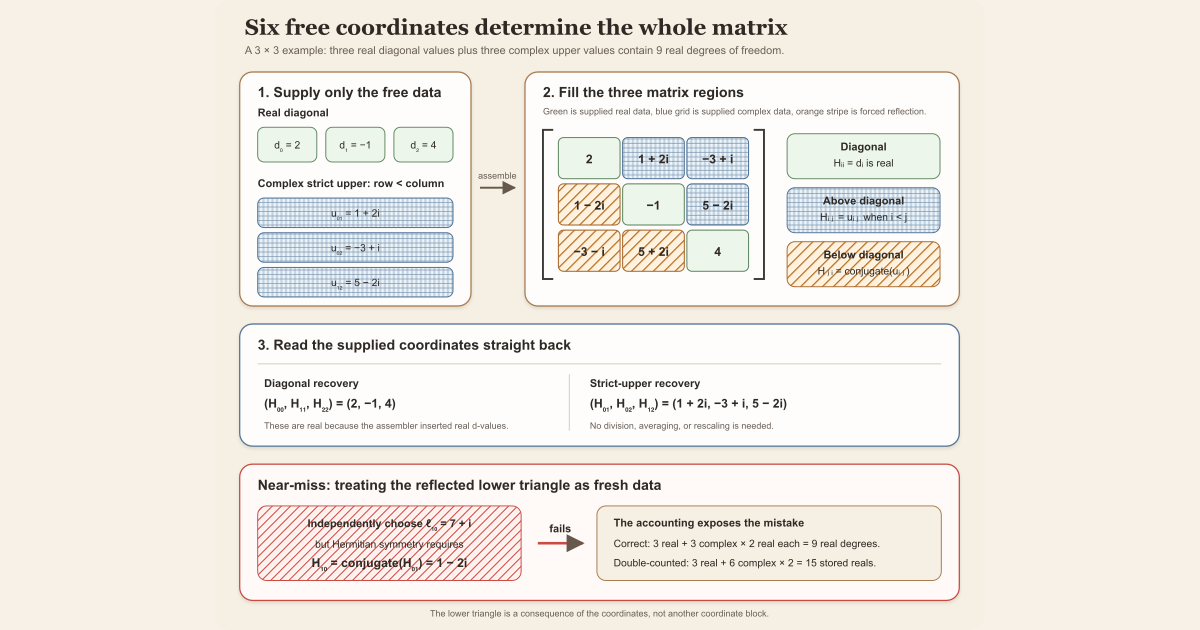
A Hermitian coordinate space records exactly the entries of a finite complex Hermitian matrix that can be chosen freely:
- one real number at every diagonal position; and
- one complex number at every position strictly above the diagonal.
Nothing is independently chosen below the diagonal. Hermitian symmetry fills that entry by conjugating its reflected partner above the diagonal.
This is bookkeeping before probability enters. The coordinate space alone does not say that the coordinates are random, Gaussian, independent, or normalized in any particular way.
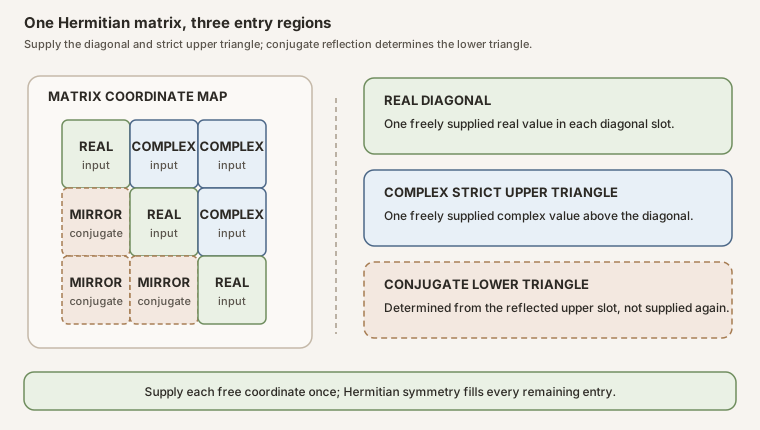
Start with one actual \(3\times3\) matrix
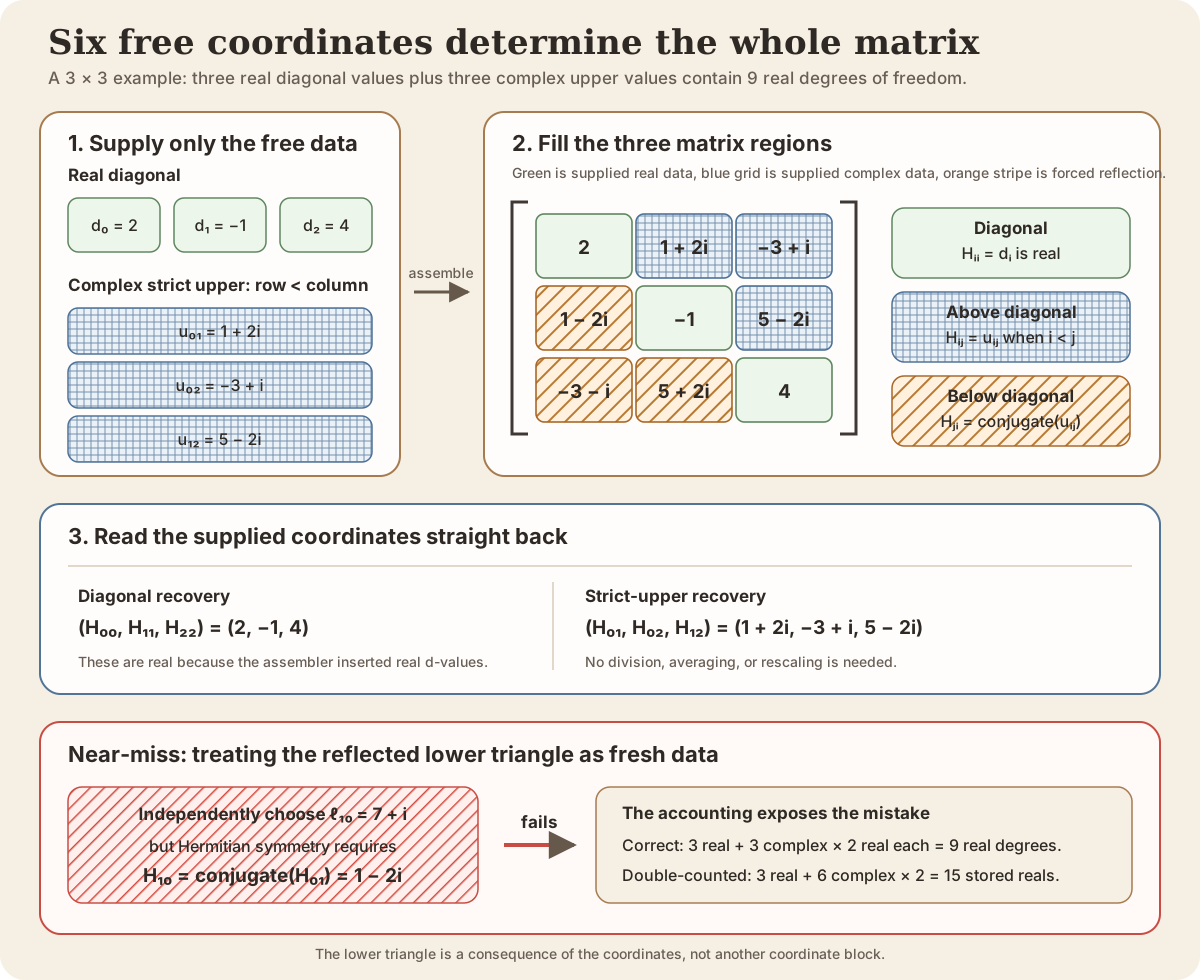
Use row and column labels \(0,1,2\). Supply the three real diagonal coordinates
\[ d_0=2, \qquad d_1=-1, \qquad d_2=4, \]and the three complex strict-upper coordinates
\[ u_{01}=1+2i, \qquad u_{02}=-3+i, \qquad u_{12}=5-2i. \]The phrase strict upper means that the row index is smaller than the column index. For size three, the complete list is
\[ (0,1),\ (0,2),\ (1,2). \]There are no other strict-upper positions.
Insert those six supplied coordinate objects into a matrix. Reflect each upper entry across the diagonal and conjugate it:
\[ H= \begin{bmatrix} 2 & 1+2i & -3+i\\ 1-2i & -1 & 5-2i\\ -3-i & 5+2i & 4 \end{bmatrix}. \]For example,
\[ H_{10}=\overline{H_{01}}=\overline{1+2i}=1-2i, \]and
\[ H_{21}=\overline{H_{12}}=\overline{5-2i}=5+2i. \]The diagonal entries are already real, so conjugating them changes nothing. Every entry therefore satisfies
\[ H_{ji}=\overline{H_{ij}}, \]which is the entrywise form of \(H^*=H\).
Recover the coordinates without solving anything
Read the diagonal and strict upper triangle of the assembled matrix:
\[ \begin{aligned} (H_{00},H_{11},H_{22})&=(2,-1,4),\\ (H_{01},H_{02},H_{12})&=(1+2i,-3+i,5-2i). \end{aligned} \]These are exactly the supplied \(d\)- and \(u\)-coordinates. Recovery needs no averaging, division, or rescaling. The project currently exposes this fact through separate diagonal and upper-entry simplification theorems. It does not yet package the recovery operation and assembly as a named equivalence.
Count the real degrees of freedom
For an \(n\times n\) matrix, there are \(n\) diagonal positions. Each stores one real degree of freedom.
There are
\[ \binom n2=\frac{n(n-1)}2 \]strict-upper positions. Each stores a complex number, hence two real degrees of freedom. The total is
\[ \begin{aligned} n+2\binom n2 &=n+n(n-1)\\ &=n^2. \end{aligned} \]For \(n=3\), this is
\[ 3+2\cdot3=9. \]The six named inputs in the example are not six real numbers. Three are real and three are complex, so they contain \(3+6=9\) real scalar components. This matches the real dimension of the vector space of \(3\times3\) complex Hermitian matrices.
The dimension count is mathematical context for the representation. The current project module defines the coordinate type and forward assembler, but does not yet prove a named real-dimension theorem.
Near-miss: counting the lower triangle twice
Suppose someone records the diagonal as real but treats all six off-diagonal positions as independent complex inputs. The storage count becomes
\[ 3+2\cdot6=15 \]real scalar slots instead of \(9\).
This creates two possible failures:
- If the lower values are genuinely independent choices, the result is usually not Hermitian. In the example, choosing \(\ell_{10}=7+i\) conflicts with \(\overline{u_{01}}=1-2i\).
- If constraints \(\ell_{ji}=\overline{u_{ij}}\) are imposed afterward, the representation can describe a Hermitian matrix, but it stores six redundant real scalar components and carries extra consistency proofs.
The lower triangle is not missing data. It is already encoded in the upper triangle.
There is another tempting construction. Start with an upper-triangular matrix \(X\) and form \(X+X^*\). This always produces a Hermitian matrix, but if the diagonal of \(X\) is the supplied real vector \(d\), then
\[ (X+X^*)_{ii}=d_i+\overline{d_i}=2d_i. \]The diagonal has been doubled. Dividing the whole result by two would also halve the supplied upper entries. The project’s direct three-branch assembler inserts every coordinate unchanged and keeps later normalization choices visible.
The abstract coordinate space
Let
\[ I_n^{\lt} =\{(i,j):0\leq i\lt n,\ 0\leq j\lt n,\ i\lt j\}. \]The project uses
\[ \mathcal C_n {}= (\{0,\ldots,n-1\}\to\mathbb R) \times (I_n^{\lt}\to\mathbb C). \]A point \(x=(d,u)\in\mathcal C_n\) is a pair of functions. The first function answers, “what real value belongs at diagonal index \(i\)?” The second answers, “what complex value belongs at strict-upper pair \((i,j)\)?”
The adjective strict matters. If the upper index set also contained the diagonal, those diagonal coordinates would be complex and an extra condition would be needed to force their imaginary parts to zero. A separate real diagonal makes the constraint true by the type itself.
In Lean: the coordinate point
x : NonlinearDynamics.Random.HermitianCoordinateSpace 3xis a human-chosen name for the whole coordinate point.3fixes three row and column labels, represented byFin 3.HermitianCoordinateSpace 3abbreviates a product. Its first projectionx.1has typeFin 3 → ℝ.- Its second projection
x.2has typeStrictUpperIndex 3 → ℂ. - A value of
StrictUpperIndex 3contains both a pair of finite indices and evidence that the first is strictly smaller than the second.
The exact project definitions are short enough to read directly:
def StrictUpperIndex (n : ℕ) := {ij : Fin n × Fin n // ij.1 < ij.2}

abbrev HermitianCoordinateSpace (n : ℕ) :=
  (Fin n → ℝ) × (StrictUpperIndex n → ℂ)
In the first line, braces form a subtype: a pair ij is admitted
only together with a proof of ij.1 < ij.2. That proof prevents a
diagonal or lower pair from being used as an upper-coordinate key.
In Lean: assemble and certify Hermiticity
On paper, the assembly rule is
\[ H_{ij}= \begin{cases} u_{ij}, & i\lt j,\\ \overline{u_{ji}}, & j\lt i,\\ d_i, & i=j. \end{cases} \]The three branches are exhaustive and disjoint. Lean implements exactly this case split.
hH : (NonlinearDynamics.Random.RandomMatrix.hermitianFromCoordinates d u).IsHermitian := NonlinearDynamics.Random.RandomMatrix.hermitianFromCoordinates_isHermitian d uhHis the name given to the resulting proof.hermitianFromCoordinates d uis the assembled matrix..IsHermitianis the proposition that the matrix equals its:=separates the claimed type from the term proving it.hermitianFromCoordinates_isHermitian d usupplies that proof; it has no probability, measurability, or normalization hypothesis.
Exact project excerpts
Full project check. This uses the repository’s pinned Lean and Mathlib
dependencies and may require substantial disk space and memory.
The authoritative source is
formalization/NonlinearDynamics/Random/RandomMatrices/HermitianCoordinates.lean.
The checked assembler is:
def hermitianFromCoordinates {n : ℕ} (d : Fin n → ℝ)
    (u : StrictUpperIndex n → ℂ) : Matrix (Fin n) (Fin n) ℂ :=
  fun i j ↦
    if hij : i < j then
      u ⟨(i, j), hij⟩
    else if hji : j < i then
      star (u ⟨(j, i), hji⟩)
    else
      d i
Read the nested conditional from top to bottom:
- if \(i\lt j\), use the supplied upper coordinate;
- otherwise, if \(j\lt i\), reverse the index pair and apply
star, which is complex conjugation here; and - otherwise the indices are equal, so use the real diagonal value, coerced into \(\mathbb C\) by the expected matrix-entry type.
The exact lower-entry recovery theorem is:
@[simp]
theorem hermitianFromCoordinates_apply_lower {n : ℕ} (d : Fin n → ℝ)
    (u : StrictUpperIndex n → ℂ) {i j : Fin n} (hji : j < i) :
    hermitianFromCoordinates d u i j = star (u ⟨(j, i), hji⟩) := by
  have hnot : ¬ i < j := not_lt_of_ge (le_of_lt hji)
  simp [hermitianFromCoordinates, hji, hnot]
The proof first rules out the upper branch, then simplifies the definition to
the reflected conjugate branch. Its hypothesis hji : j < i is
the typed evidence that the requested entry lies below the diagonal.
The pointwise Hermiticity theorem is:
theorem hermitianFromCoordinates_isHermitian {n : ℕ} (d : Fin n → ℝ)
    (u : StrictUpperIndex n → ℂ) :
    (hermitianFromCoordinates d u).IsHermitian := by
  rw [Matrix.IsHermitian.ext_iff]
  intro i j
  rcases lt_trichotomy i j with hij | rfl | hji
  · rw [hermitianFromCoordinates_apply_upper d u hij]
    rw [hermitianFromCoordinates_apply_lower d u hij]
    simp
  · simp
  · rw [hermitianFromCoordinates_apply_lower d u hji]
    rw [hermitianFromCoordinates_apply_upper d u hji]
The three goals correspond to upper, diagonal, and lower positions. This is a direct proof of the same trichotomy visible in the diagrams.
Standalone tutorial: coordinate worksheet
Standalone tutorial. This worksheet imports only
Std. It models the concrete size-three ledger with rational real
and imaginary parts. It checks the arithmetic, reflection, degree count, and
round trip, but it does not import Mathlib or prove the project’s matrix
theorem.
Save this as HermitianCoordinates3Scratch.lean:
import Std

structure ComplexRat where
  re : Rat
  im : Rat
deriving Repr, BEq

def ComplexRat.conj (z : ComplexRat) : ComplexRat :=
  { re := z.re, im := -z.im }

def ComplexRat.ofReal (x : Rat) : ComplexRat :=
  { re := x, im := 0 }

structure Coordinates3 where
  d0 : Rat
  d1 : Rat
  d2 : Rat
  u01 : ComplexRat
  u02 : ComplexRat
  u12 : ComplexRat
deriving Repr, BEq

structure Matrix3 where
  a00 : ComplexRat
  a01 : ComplexRat
  a02 : ComplexRat
  a10 : ComplexRat
  a11 : ComplexRat
  a12 : ComplexRat
  a20 : ComplexRat
  a21 : ComplexRat
  a22 : ComplexRat
deriving Repr

def assemble (c : Coordinates3) : Matrix3 :=
  { a00 := ComplexRat.ofReal c.d0
    a01 := c.u01
    a02 := c.u02
    a10 := c.u01.conj
    a11 := ComplexRat.ofReal c.d1
    a12 := c.u12
    a20 := c.u02.conj
    a21 := c.u12.conj
    a22 := ComplexRat.ofReal c.d2 }

def recover (A : Matrix3) : Coordinates3 :=
  { d0 := A.a00.re
    d1 := A.a11.re
    d2 := A.a22.re
    u01 := A.a01
    u02 := A.a02
    u12 := A.a12 }

def strictUpperCount (n : Nat) : Nat :=
  n * (n - 1) / 2

def realDegreesOfFreedom (n : Nat) : Nat :=
  n + 2 * strictUpperCount n

def exampleCoordinates : Coordinates3 :=
  { d0 := 2, d1 := -1, d2 := 4
    u01 := { re := 1, im := 2 }
    u02 := { re := -3, im := 1 }
    u12 := { re := 5, im := -2 } }

#eval realDegreesOfFreedom 3
#eval (assemble exampleCoordinates).a10
#eval (assemble exampleCoordinates).a21
#eval recover (assemble exampleCoordinates) == exampleCoordinates
Run it with:
elan run leanprover/lean4:v4.32.0 lean HermitianCoordinates3Scratch.lean
The outputs should report \(9\), then the conjugates \(1-2i\) and \(5+2i\)
as structures with rational re and im fields, then
true for the recovered-coordinate comparison.
Try the exact declarations in the project
Full project check. This uses the repository’s pinned Lean and Mathlib dependencies and may require substantial disk space and memory. Create a temporary project worksheet containing:
import NonlinearDynamics.Random.RandomMatrices.HermitianCoordinates

#check NonlinearDynamics.Random.StrictUpperIndex
#check NonlinearDynamics.Random.HermitianCoordinateSpace
#check NonlinearDynamics.Random.StrictUpperIndex.instFintype
#check NonlinearDynamics.Random.StrictUpperIndex.instDecidableEq
#check NonlinearDynamics.Random.RandomMatrix.hermitianFromCoordinates
#check NonlinearDynamics.Random.RandomMatrix.hermitianFromCoordinates_apply_diag
#check NonlinearDynamics.Random.RandomMatrix.hermitianFromCoordinates_apply_upper
#check NonlinearDynamics.Random.RandomMatrix.hermitianFromCoordinates_apply_lower
#check NonlinearDynamics.Random.RandomMatrix.hermitianFromCoordinates_isHermitian
#check NonlinearDynamics.Random.RandomMatrix.measurable_hermitianFromCoordinates
#check NonlinearDynamics.Random.RandomMatrix.hermitianCoordinateMap
#check NonlinearDynamics.Random.RandomMatrix.measurable_hermitianCoordinateMap
#check NonlinearDynamics.Random.RandomMatrix.hermitianFromCoordinates_zero
#check NonlinearDynamics.Random.RandomMatrix.hermitianCoordinateMap_zero
#check NonlinearDynamics.Random.HermitianRandomMatrix.ofCoordinates
Each #check asks the pinned elaborator to print an exact
declaration type. It does not run a simulation or establish an unstated
inverse or dimension theorem. The full-project command below checks the
complete source module.
cd formalization
lake env lean -DwarningAsError=true NonlinearDynamics/Random/RandomMatrices/HermitianCoordinates.lean
Resource note: this exact file uses the repository's
pinned Lean and Mathlib dependencies. Initial project setup can require
substantial disk space and build time. For a lightweight first step on
macOS or Linux, use the page's standalone Lean-core or Std
tutorial.
Measurability enters only when coordinates vary
For fixed \(d\) and \(u\), assembly is purely deterministic. If the coordinates depend on an outcome \(\omega\), then
\[ \omega\longmapsto \operatorname{assemble}\bigl(d(\omega),u(\omega)\bigr) \]is a matrix-valued sample map. The project proves it measurable when every coordinate function \(\omega\mapsto d_i(\omega)\) and \(\omega\mapsto u_{ij}(\omega)\) is measurable. Entrywise measurability is enough because every matrix entry is one coordinate, a coerced real coordinate, or the conjugate of one coordinate.
The named function RandomMatrix.hermitianCoordinateMap n
packages assembly on the complete product coordinate space. The theorem
measurable_hermitianCoordinateMap certifies its measurable
structure. Read
measurable space
for why
this is a well-formedness condition rather than a probability distribution.
The empty \(n=0\) boundary
At \(n=0\), both Fin 0 and
StrictUpperIndex 0 are empty. A function out of an empty type has
no values to choose, so the coordinate product has one point. A matrix indexed
by Fin 0 also has no entries and is the unique empty matrix,
written \(0\).
The checked theorems hermitianFromCoordinates_zero and
hermitianCoordinateMap_zero say that assembly returns that empty
matrix. No division by \(n\) occurs in this deterministic layer.
Distinctions and failure modes
| Tempting shortcut | What goes wrong | Correct repair |
|---|---|---|
| Store every lower entry independently | Most choices violate \(H_{ji}=\overline{H_{ij}}\) | Store only strict-upper entries and reflect them |
| Count six named inputs as six real degrees | Each \(u_{ij}\in\mathbb C\) contains two real components | Count \(3+2\cdot3=9\) for \(n=3\) |
| Include the diagonal in the complex upper block | Hermitian diagonal entries must be real | Give the diagonal its own \(\mathbb R\)-valued function |
| Assemble with \(X+X^*\) | A real diagonal already present in \(X\) is doubled | Use the direct diagonal, upper, lower case split |
| Call the coordinate point a random matrix | No outcome space or sample map has been supplied | Add a coordinate process and prove measurability |
| Infer independence from the product type | A product type describes data shape, not a probability law | Put a product measure or independence theorem in the probability layer |
| Claim a checked inverse | This module exposes coordinate-entry theorems but no packaged inverse equivalence | State recovery entrywise or formalize the equivalence separately |
| Ignore \(n=0\) | Informal index enumeration may silently assume a first entry | Use the explicit empty-index theorems |
Where to continue
Finite Hermitian Matrices from Coordinates develops this representation, its Hermiticity proof, and its measurable sample-map role in textbook detail. Read conjugate transpose for the symmetry operation and random matrix for the later probability-space layer.
Finite Product Probability Spaces and Independent Gaussian Fields explains how finite coordinate families acquire a joint law. The subsequent Finite GUE from Independent Gaussian Coordinates chooses the diagonal and upper Gaussian laws, fixes their scales and independence, and pushes that coordinate measure through this assembler.
References
Mathlib contributors.
Hermitian matrices,
Mathlib 4 documentation. This is the official API for
Matrix.IsHermitian, conjugate transpose, and the entrywise
criterion used by the checked proof.
Mathlib contributors.
Finite index types,
Mathlib 4 documentation. This documents Fin n, including the
empty zero-dimensional index type used by the boundary theorems.
Terence Tao. Topics in Random Matrix Theory, Graduate Studies in Mathematics 132, American Mathematical Society, 2012. This monograph supplies broader Hermitian and random-matrix context. It is not used to infer a probability law for the deterministic coordinate space.
Nonlinear Dynamics in Lean contributors. HermitianCoordinates.lean, the checked project source for the coordinate type, direct assembler, entrywise recovery lemmas, Hermiticity, measurability, and zero-dimensional boundary.
The upstream Mathlib revision audited for this entry is commit
81a5d257,
pinned by formalization/lake-manifest.json.