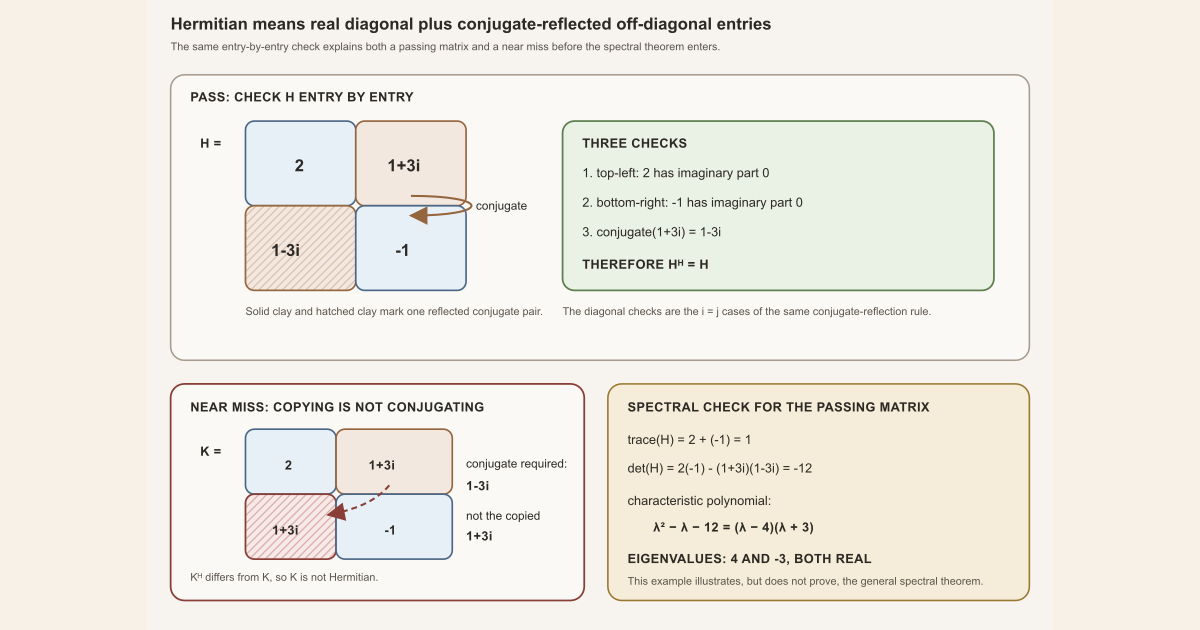
Consider the concrete complex matrix
\[ H= \begin{bmatrix} 2 & 1+3i\\ 1-3i & -1 \end{bmatrix}. \]It is Hermitian because reflecting its entries across the diagonal and taking their complex conjugates gives the same matrix back. This small example contains the whole entry-by-entry idea.
Check the example one entry at a time
On the diagonal, both entries are real:
\[ \overline{2}=2, \qquad \overline{-1}=-1. \]Across the diagonal, the two entries form a conjugate pair:
\[ \overline{1+3i}=1-3i, \qquad \overline{1-3i}=1+3i. \]The conjugate transpose of \(H\) is therefore
\[ H^{\mathrm H} {} = \begin{bmatrix} \overline{2} & \overline{1-3i}\\ \overline{1+3i} & \overline{-1} \end{bmatrix} {} = \begin{bmatrix} 2 & 1+3i\\ 1-3i & -1 \end{bmatrix} =H. \]That equality, \(H^{\mathrm H}=H\), is the definition of Hermitian.
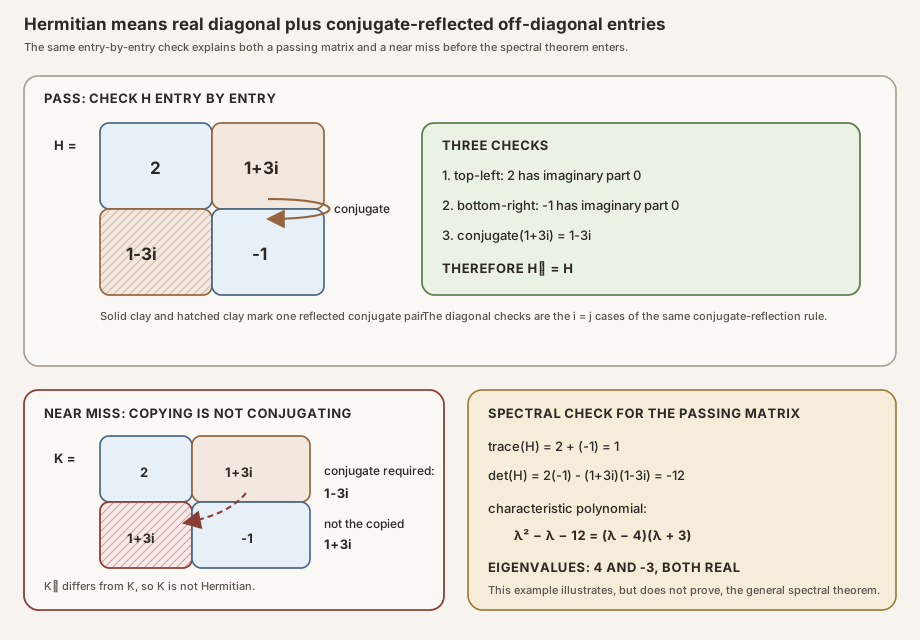
The general two-by-two pattern
A two-by-two complex matrix is Hermitian exactly when it has the form
\[ \begin{bmatrix} a & z\\ \overline z & b \end{bmatrix}, \qquad a,b\in\mathbb R, \quad z\in\mathbb C. \]The diagonal entries \(a\) and \(b\) each contribute one real degree of freedom. The upper entry \(z=x+iy\) contributes two more. The lower entry is then forced to be \(\overline z=x-iy\); it is not a new independent choice. Thus a two-by-two Hermitian matrix has four real degrees of freedom, not eight.
For a larger square matrix \(A=(A_{ij})\), the same rule is
\[ \overline{A_{ji}}=A_{ij} \qquad\text{for every pair }i,j. \]Putting \(i=j\) gives
\[ \overline{A_{ii}}=A_{ii}, \]so every diagonal entry has zero imaginary part. For \(i\ne j\), choosing one entry determines the reflected entry.
A near miss: copying is not conjugating
Now change only the lower-left entry:
\[ K= \begin{bmatrix} 2 & 1+3i\\ 1+3i & -1 \end{bmatrix}. \]The diagonal is still real, but
\[ \overline{K_{12}} =\overline{1+3i} =1-3i \ne 1+3i =K_{21}. \]Therefore \(K\) is not Hermitian. A matrix with real diagonal entries need not be Hermitian, and a complex Hermitian matrix need not be symmetric under an ordinary transpose. The conjugation is essential.
For real matrices, complex conjugation does nothing. In that special case, Hermitian is the same condition as symmetric.
Why the eigenvalues become real
For the example \(H\), its trace and determinant are
\[ \operatorname{tr}(H)=2+(-1)=1 \]and
\[ \det(H) =2(-1)-(1+3i)(1-3i) =-2-10 =-12. \]Its characteristic polynomial is therefore
\[ \lambda^2-\operatorname{tr}(H)\lambda+\det(H) =\lambda^2-\lambda-12 =(\lambda-4)(\lambda+3). \]The eigenvalues are \(4\) and \(-3\), both real. Their sum \(1\) matches the trace, and their product \(-12\) matches the determinant.
This calculation is evidence for one matrix, not a proof for every Hermitian matrix. The finite-dimensional spectral theorem supplies the general result: a complex Hermitian matrix has real eigenvalues and an orthonormal basis of eigenvectors. Equivalently, it can be diagonalized by a unitary change of basis, with real numbers on the diagonal.
The negative eigenvalue \(-3\) also gives an important boundary case. Hermitian does not mean positive semidefinite. Positivity would require all eigenvalues to be nonnegative, which this \(H\) fails.
Observables and random matrices
In finite-dimensional quantum models, a Hermitian matrix can represent an observable or Hamiltonian. Hermiticity makes its spectral values real. That statement does not by itself select a physical state, assign probabilities to the spectral values, or establish a complete physical model.
A random matrix is a function
\[ X:\Omega\longrightarrow \operatorname{Mat}_{n\times n}(\mathbb C). \]Saying that \(X\) is Hermitian everywhere means
\[ X(\omega)^{\mathrm H}=X(\omega) \qquad\text{for every }\omega\in\Omega. \]This is stronger than saying the equality holds almost everywhere , where failures on a null set are permitted. It is also distinct from measurability , which says that \(X\) respects the measurable structures on outcomes and matrices.
The project’s HermitianRandomMatrix bundles two facts:
- the outcome-to-matrix function is measurable; and
- every realized matrix is Hermitian.
It does not choose a source measure, a probability distribution , a Gaussian model, independent coordinates, unitary invariance, or a normalization. Those are additional layers.
A universal constructor, and its normalization
Every square complex matrix \(A\) produces a Hermitian matrix through
\[ H=A+A^{\mathrm H}. \]Indeed,
\[ H^{\mathrm H} =(A+A^{\mathrm H})^{\mathrm H} =A^{\mathrm H}+A =H. \]This is the unnormalized symmetrization used by the project’s base constructor. The more familiar Hermitian part
\[ \frac12(A+A^{\mathrm H}) \]has the same symmetry, but a different scale. If \(A\) is already Hermitian, the unnormalized constructor returns \(2A\), not \(A\). The factor therefore matters for eigenvalue scales and probability models even though it does not matter for Hermiticity itself.
When a construction begins with free coordinates, the project’s Hermitian coordinate space avoids that redundancy. It stores a real diagonal and a complex strict upper triangle, then fills the lower triangle by conjugate reflection.
In Lean
Mathlib writes the conjugate transpose of a matrix as Aᴴ and defines
Matrix.IsHermitian A by the literal equality Aᴴ = A.
H.IsHermitianH.IsHermitianis method notation forMatrix.IsHermitian H.- A type such as
H : Matrix ι ι ℂsays that rows and columns use the same index typeι, so the matrix is square, and that its entries lie in the complex numbersℂ. Hᴴis the conjugate transpose: transpose the matrix and applystarto each entry. On complex numbers,star zis complex conjugation.Hᴴ = His equality of matrices, so it can be checked entry by entry.- In
star (H j i) = H i j, the indices reverse fromi, jtoj, ibecause of the transpose, andstarsupplies the conjugation.
The following is the exact core definition and entrywise theorem from the pinned Mathlib source:
def IsHermitian (A : Matrix n n α) : Prop := Aᴴ = A

theorem IsHermitian.ext_iff {A : Matrix n n α} :
    A.IsHermitian ↔ ∀ i j, star (A j i) = A i j :=
  ⟨IsHermitian.apply, IsHermitian.ext⟩
Read ↔ as “if and only if,” ∀ i j as “for every row index i and column
index j,” and Prop as the type of propositions. The theorem says that the
single matrix equation and all of the entry equations express exactly the
same property.
The project lifts that definition to matrix-valued functions. These are exact excerpts from the checked module:
def IsHermitianEverywhere (X : RandomMatrix Ω ι ι ℂ) : Prop :=
  ∀ ω, (X ω).IsHermitian

theorem isHermitianEverywhere_iff_entries (X : RandomMatrix Ω ι ι ℂ) :
    IsHermitianEverywhere X ↔ ∀ ω i j, star (X ω j i) = X ω i j := by
  simp only [IsHermitianEverywhere, Matrix.IsHermitian.ext_iff]

theorem IsHermitianEverywhere.diagonal_im_eq_zero
    {X : RandomMatrix Ω ι ι ℂ} (hX : IsHermitianEverywhere X) (ω : Ω) (i : ι) :
    (X ω i i).im = 0 := by
  rw [← Complex.conj_eq_iff_im, ← Complex.star_def]
  exact hX.star_entry ω i i
Here ∀ ω means every outcome, X ω is the ordinary matrix realized at
that outcome, and .im = 0 is the real-diagonal conclusion. The theorem uses
the i = j case of conjugate reflection, as in the hand calculation.
A tiny standalone worksheet
The next program models the same two-by-two check with Gaussian integers,
numbers of the form \(a+bi\) with integer real and imaginary parts. It imports
only Lean’s Std library. It is a pedagogical miniature, not Mathlib’s
Matrix, ℂ, or the project’s checked definition.
Save the complete block as HermitianWorksheet.lean:
import Std

structure GaussianInt where
  re : Int
  im : Int
deriving Repr, DecidableEq

def GaussianInt.conj (z : GaussianInt) : GaussianInt :=
  { re := z.re, im := -z.im }

structure Matrix2 where
  a00 : GaussianInt
  a01 : GaussianInt
  a10 : GaussianInt
  a11 : GaussianInt
deriving Repr

def Matrix2.IsHermitian (A : Matrix2) : Prop :=
  A.a00.im = 0 ∧
  A.a11.im = 0 ∧
  A.a10 = GaussianInt.conj A.a01

instance (A : Matrix2) : Decidable (Matrix2.IsHermitian A) := by
  unfold Matrix2.IsHermitian
  infer_instance

def good : Matrix2 :=
  { a00 := { re := 2, im := 0 }
    a01 := { re := 1, im := 3 }
    a10 := { re := 1, im := (-3 : Int) }
    a11 := { re := (-1 : Int), im := 0 } }

def nearMiss : Matrix2 :=
  { a00 := { re := 2, im := 0 }
    a01 := { re := 1, im := 3 }
    a10 := { re := 1, im := 3 }
    a11 := { re := (-1 : Int), im := 0 } }

#eval decide (Matrix2.IsHermitian good)
#eval decide (Matrix2.IsHermitian nearMiss)

example : Matrix2.IsHermitian good := by decide
example : ¬ Matrix2.IsHermitian nearMiss := by decide
On any Mac or Linux machine with the pinned Lean toolchain available, a human types:
elan run leanprover/lean4:v4.32.0 lean HermitianWorksheet.lean
Lean prints true and then false for the two #eval lines. The two
example declarations ask the kernel to check the positive and negative proof
terms. This standalone command does not import Mathlib or build this project.
The authoritative project source is
formalization/NonlinearDynamics/Random/RandomMatrices/Hermitian.lean.
A learner can put these lines in a temporary scratch file inside the
formalization project in a clone with the repository’s pinned Lean and Mathlib dependencies
installed:
import NonlinearDynamics.Random.RandomMatrices.Hermitian

open scoped Matrix

#print Matrix.IsHermitian
#check Matrix.IsHermitian.ext_iff
#check NonlinearDynamics.Random.RandomMatrix.IsHermitianEverywhere
#check NonlinearDynamics.Random.RandomMatrix.isHermitianEverywhere_iff_entries
#check NonlinearDynamics.Random.HermitianRandomMatrix
import loads the exact project module and its pinned dependencies. #print
shows the definition behind a name. Each #check asks Lean to elaborate an
identifier and report its type; it does not assert a new theorem. The literal
full-project command below checks the authoritative project file itself.
cd formalization
lake env lean -DwarningAsError=true NonlinearDynamics/Random/RandomMatrices/Hermitian.lean
Resource note: this exact file uses the repository's
pinned Lean and Mathlib dependencies. Initial project setup can require
substantial disk space and build time. For a lightweight first step on
macOS or Linux, use the page's standalone Lean-core or Std
tutorial.
Distinctions that prevent common mistakes
| Do not infer | Why it does not follow from Hermiticity |
|---|---|
| Every entry is real | Only the diagonal must be real; \(1+3i\) is a valid off-diagonal entry in \(H\) |
| The matrix is positive semidefinite | The example \(H\) is Hermitian but has eigenvalue \(-3\) |
| The matrix is unitary | Hermitian means \(H^{\mathrm H}=H\); unitary means \(H^{\mathrm H}H=I\) |
| A random matrix is measurable | Hermiticity constrains each value; measurability constrains the outcome-to-value map |
| A random Hermitian matrix has a particular law | Hermiticity does not choose probabilities, a density, or a normalization |
| Its entries are independent or Gaussian | Those are separate assumptions, and conjugate-reflected entries are already linked |
| It is unitarily invariant | Support on Hermitian matrices and invariance of a probability law are different properties |
| An everywhere statement is only almost-sure | Everywhere is stronger; almost-sure statements may ignore a null set |
Where to continue
The conjugate transpose page builds the operation \(A\mapsto A^{\mathrm H}\) entry by entry. The matrix trace page develops the first scalar observable used above. The Hermitian coordinate space page explains how to store exactly the free coordinates.
For the construction and proof in context, continue to Finite Hermitian Matrices from Coordinates. For the probability layers that come afterward, continue to Random Matrices: From Outcomes to Spectra.
References
Mathlib contributors.
Matrix.IsHermitian,
Mathlib 4 documentation. This is the official implementation reference for
the definition and its entrywise interface.
Mathlib contributors. Hermitian matrices as analytic objects, Mathlib 4 documentation. This develops connections with self-adjoint linear maps and finite-dimensional spectral structure.
Greg W. Anderson, Alice Guionnet, and Ofer Zeitouni. An Introduction to Random Matrices, Cambridge University Press, 2010. This supplies the random-matrix context in which Hermitian support, probability laws, symmetry, and scaling must be kept as distinct layers.