On a one-point probability space, let a one-by-one matrix cocycle use the constant generator \([e^{-1}]\). At horizon \(n\), its value is \([e^{-n}]\), its norm is \(e^{-n}\), and its signed log norm is \(-n\). Therefore
\[ \frac1n\int\log\lVert C_n(\omega)\rVert\,d\mu(\omega)=-1 \qquad(n\ge1). \]The integrated real-log growth rate is the general version of that long-run signed number.
Definition
For a matrix cocycle \(C\), define
\[ a_n=\int \log\lVert C_n(\omega)\rVert\,d\mu(\omega). \]Under pointwise invertibility and integrable forward and inverse one-step log-positive norms, RMT-35 proves that \(a_n\) is subadditive and that \(a_n/n\) has a finite lower bound. Its integrated real-log growth rate is
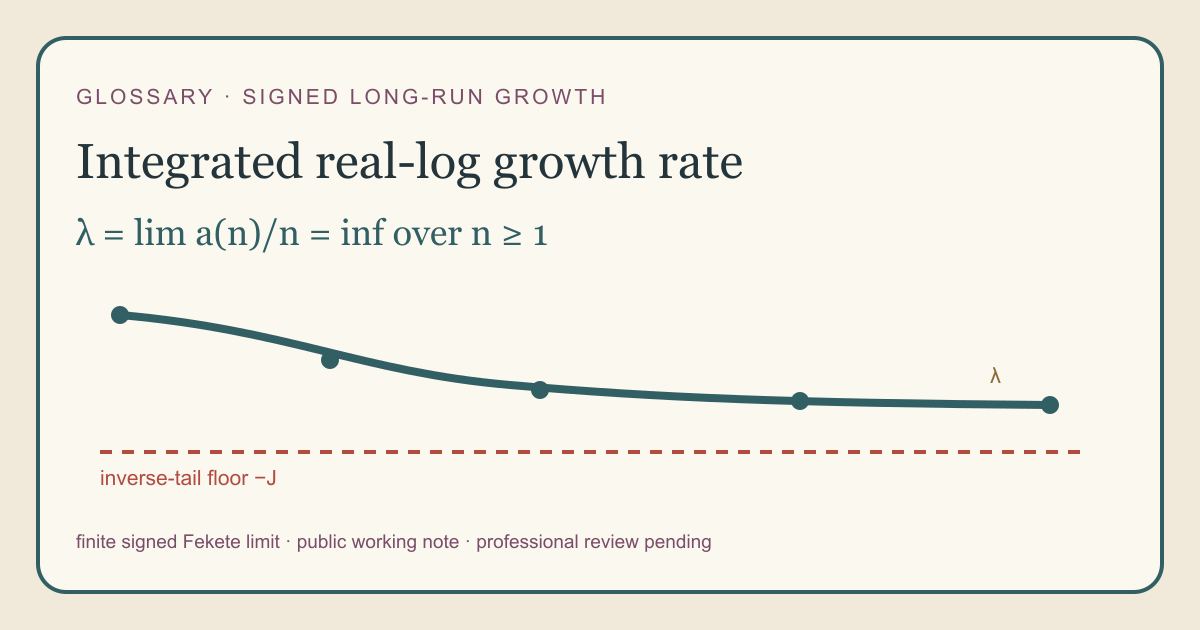
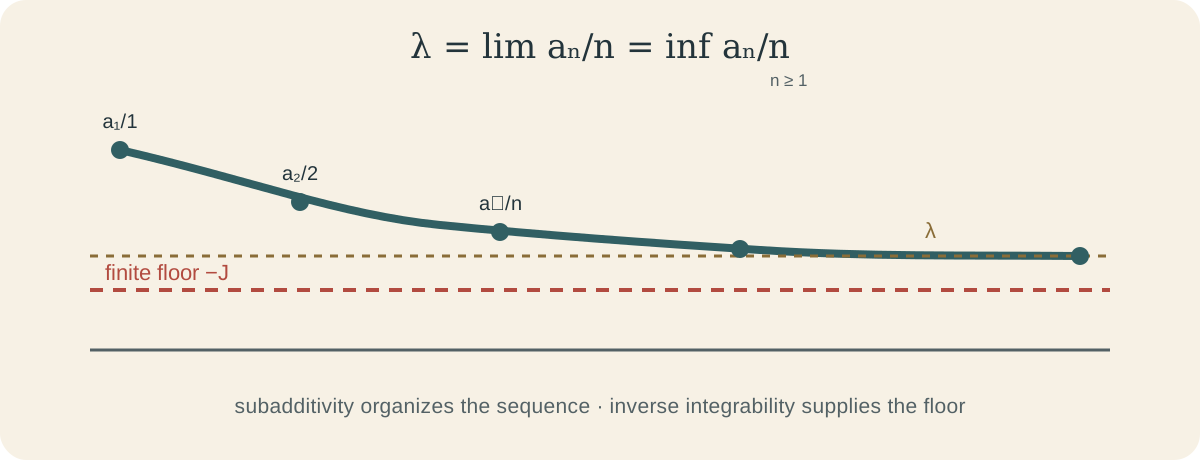
\[ \lambda_{\mathrm{real}} =\lim_{n\to\infty}\frac{a_n}{n} =\inf_{n\ge1}\frac{a_n}{n}. \]The word integrated means that each finite-horizon signed observable is integrated before taking the long-run limit. The word real-log distinguishes the signed logarithm from the clipped nonnegative quantity \(\log^+x=\max(0,\log x)\). The word growth includes negative contraction rates, zero neutral rates, and positive expansion rates.
Why an inverse tail appears
Forward log-positive control only sees expansion. For the running generator \([e^{-1}]\),
\[ \log^+\lVert[e^{-1}]\rVert=0 \]even though the signed value is \(-1\). Its inverse is \([e]\), whose log-positive norm is \(1\). In general the integrated inverse budget
\[ J=\int\log^+\lVert A(\omega)^{-1}\rVert\,d\mu(\omega) \]gives
\[ -J\le\frac{a_n}{n}. \]That finite floor is what prevents the real-valued Fekete sequence from escaping toward negative infinity.
In Lean
def integratedRealLogGrowthRate\n+ (C : DiscreteMatrixCocycle (ι := ι) μ)\n+ (hC : C.HasIntegrableGeneratorLogTails) : ℝ :=\n+ hC.subadditive_integratedRealLogNorm.limC is the cocycle. hC stores pointwise invertibility and the integrable
forward and inverse generator tails. The return type ℝ records that this is
a finite real rate. .lim is Mathlib’s Fekete limit for the checked
subadditive sequence.The exact convergence and infimum declarations are
HasIntegrableGeneratorLogTails.tendsto_normalizedIntegratedRealLogNorm and
HasIntegrableGeneratorLogTails.integratedRealLogGrowthRate_eq_sInf.
Under a pre-ergodic probability base,
HasIntegrableGeneratorLogTails.ae_tendsto_normalizedRealLogNormObservable
also identifies this deterministic rate with normalized sample growth almost
everywhere.
Std tutorial
in the linked Deep Dive.cd formalization
lake env lean -DwarningAsError=true NonlinearDynamics/Random/RandomCocycles/RealLogNormKingman.leanResource note: this exact file uses the repository's
pinned Lean and Mathlib dependencies. Initial project setup can require
substantial disk space and build time. For a lightweight first step on
macOS or Linux, use the page's standalone Lean-core or Std
tutorial.
Boundaries
- At time zero, the normalized expression is totalized as zero. The infimum defining the Fekete rate ranges over \(n\ge1\).
- In empty matrix dimension, the checked rate is zero.
- Singular generators are outside this signed theorem;
Real.log 0 = 0is a total-function convention, not a replacement for invertibility. - If the integrated log-positive growth rate is strictly positive, RMT-35 proves that it equals the signed rate.
- Almost-everywhere convergence does not imply \(L^1\) convergence or justify moving the limit through the integral.
Related trail markers
- Integrable generator log tails
- Integrated log-positive growth rate
- Integrated Real-Log Growth and Signed Kingman Convergence
- Signed Real-Log Kingman Convergence in Lean
Reference
J. F. C. Kingman, “The Ergodic Theory of Subadditive Stochastic Processes,” Journal of the Royal Statistical Society: Series B 30(3), 499–510 (1968), doi:10.1111/j.2517-6161.1968.tb00749.x.