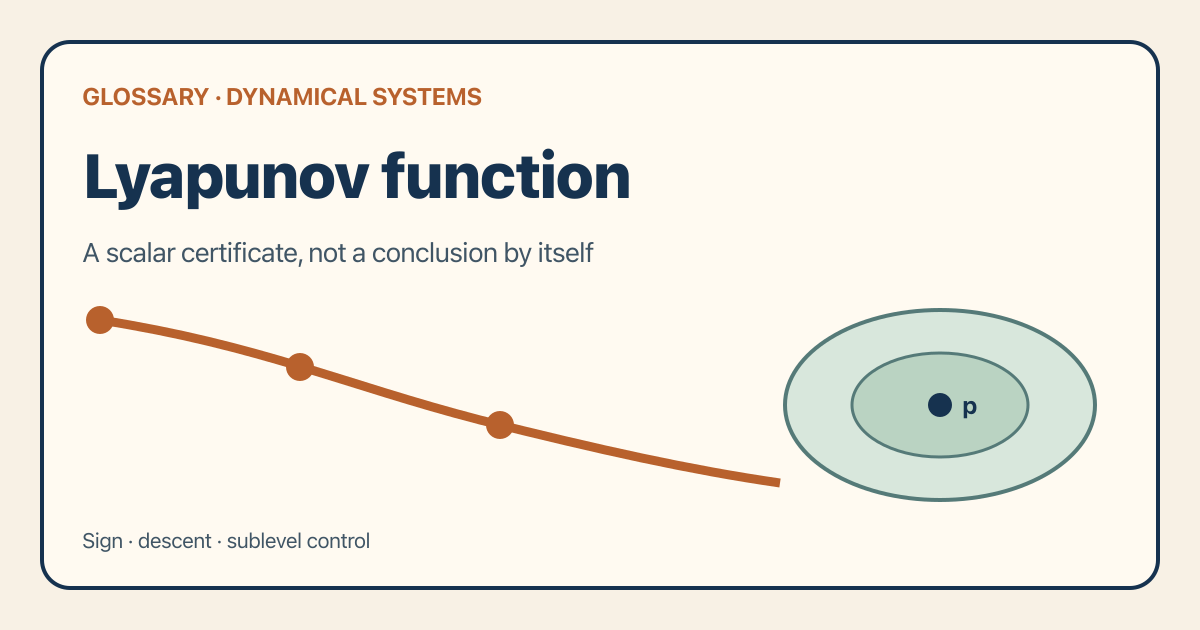
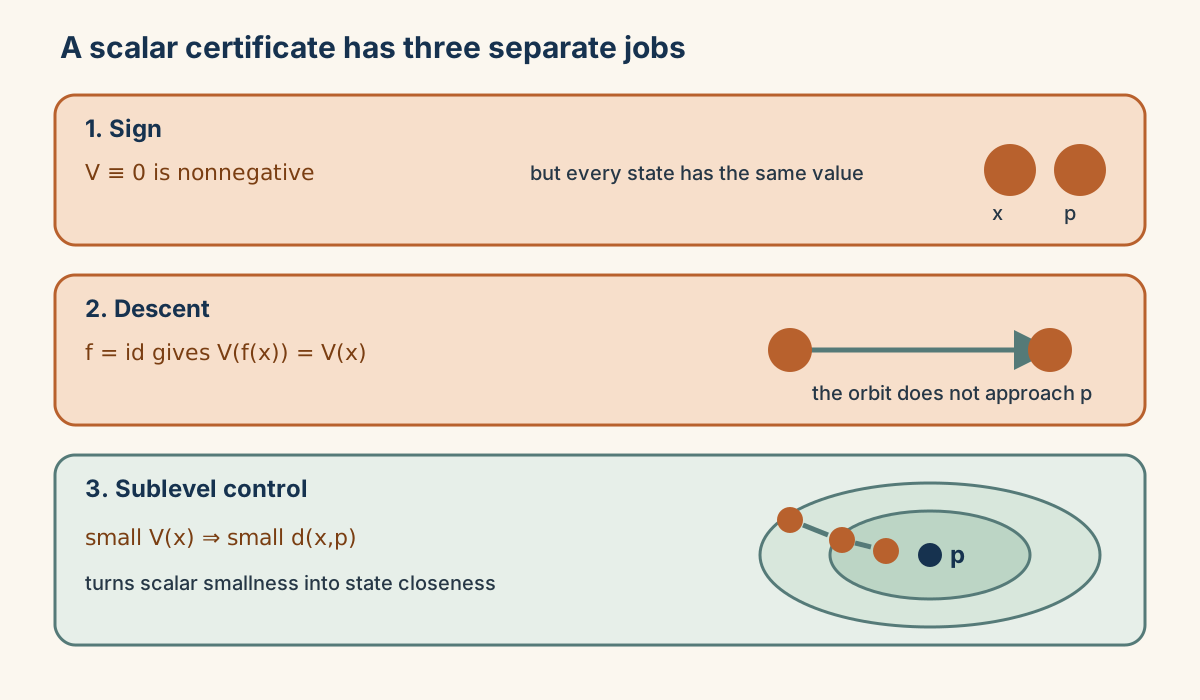
A Lyapunov function is a scalar-valued certificate used to study a dynamical system without first writing a closed formula for every orbit. Its usefulness comes from three separate kinds of information:
- where the function is zero and positive;
- whether it decreases after an update;
- whether its small sublevels force the state to be close to the reference.
No one item can silently replace the others.
Start with halving
For the discrete update \(f(x)=x/2\) on the real line, let \(p=0\) and \(V(x)=x^2\). Then
\[ V(0)=0,\qquad x\ne0\Rightarrow V(x)\gt0,\qquad V(f(x))=\frac14V(x). \]Starting at \(4\), the state values are \(4,2,1,1/2,\ldots\), while the certificate values are \(16,4,1,1/4,\ldots\). This example exhibits strict descent and convergence. A general theorem still has to say which hypotheses turn scalar descent into state stability or attraction.
Nonnegative is not positive definite
On a region \(S\), nonnegative means
\[ 0\le V(x)\quad(x\in S). \]Positive definite relative to \(p\) means that \(p\in S\), \(V(p)=0\), and \(V(x)\gt0\) for every other \(x\in S\). The zero function is nonnegative but not positive definite on any region containing a point besides \(p\). It therefore carries no information about distance to \(p\).
Weak and strict descent
The one-step Lyapunov difference is
\[ \Delta V(x)=V(f(x))-V(x). \]Weak descent means \(\Delta V(x)\le0\). Strict descent away from \(p\) means \(\Delta V(x)\lt0\) whenever \(x\ne p\). If \(p\) is fixed, strict descent away from \(p\) implies weak descent everywhere on the same region.
Weak descent does not imply attraction. Under the identity map, \(V(f(x))=V(x)\) for every \(V\), but a nonzero orbit is constant rather than converging to zero. Strict descent alone also needs care: a strictly decreasing real sequence may converge to a positive limit.
Sublevel control
An open sublevel is a set of states with \(V(x)\lt c\). The project uses the explicit condition
\[ \forall\varepsilon\gt0\;\exists c\gt0:\quad V(x)\lt c\Longrightarrow d(x,p)\lt\varepsilon. \]This says that sufficiently low values occur only close to \(p\). It is not automatic from pointwise positivity on an arbitrary noncompact space.
If \(V\) is continuous at \(p\), \(V(p)=0\), and weakly decreases, positive sublevels can trap nearby forward orbits. Sublevel control then turns that trap into Lyapunov stability . If the certificate along a selected orbit additionally tends to zero, sublevel control turns that scalar limit into attraction and hence membership in the basin of attraction .
In Lean
def IsPositiveDefiniteOn\n (V : X → ℝ) (p : X) (S : Set X) : Prop :=\n p ∈ S ∧ V p = 0 ∧\n ∀ x ∈ S, x ≠ p → 0 < V xSet X is a set of states. The first conjunct keeps the reference inside the
region. The second fixes its scalar value. The final implication supplies
strict positivity only when x ≠ p.The descent predicate remains separate:
def IsWeakLyapunovDecreaseOn
    (f : X → X) (V : X → ℝ) (S : Set X) : Prop :=
  ∀ x ∈ S, V (f x) ≤ V x
This is a full project check using pinned Lean and Mathlib dependencies; it may require substantial disk space and setup time:
git clone https://github.com/tdj28/nonlinear-dynamics-lean.git
cd nonlinear-dynamics-lean/formalization
lake env lean -DwarningAsError=true \
  NonlinearDynamics/Deterministic/Discrete/Lyapunov.lean
The command is portable across macOS and Linux after the project dependencies
are installed. The paired Deep Dive includes a smaller standalone tutorial
that imports only Std.
What this term does not claim
A Lyapunov function need not be physical energy. Decreasing \(V\) does not say that every state coordinate decreases. Weak descent alone gives no attraction, and a local certificate gives no global basin. Exponential rates require a quantified estimate. Compact LaSalle arguments, converse theorems, invariant sets, ODEs, stochastic robustness, and Lyapunov exponents are separate topics.
Continue with Lyapunov Functions and the Direct Method in Discrete Time or inspect the declaration-complete Research Note.
References
- J. P. LaSalle, “Difference Equations. Discrete Semidynamical Systems,” sections 6, 7, and 10, in The Stability of Dynamical Systems, SIAM CBMS 25 (1976), pages 1–25, DOI 10.1137/1.9781611970432.ch1.
- Saber Elaydi, “Stability Theory,” Chapter 4 of An Introduction to Difference Equations, third edition, DOI 10.1007/0-387-27602-5_4.
- Mathlib 4.32.0, pinned revision
81a5d257, and the project moduleNonlinearDynamics.Deterministic.Discrete.Lyapunov.