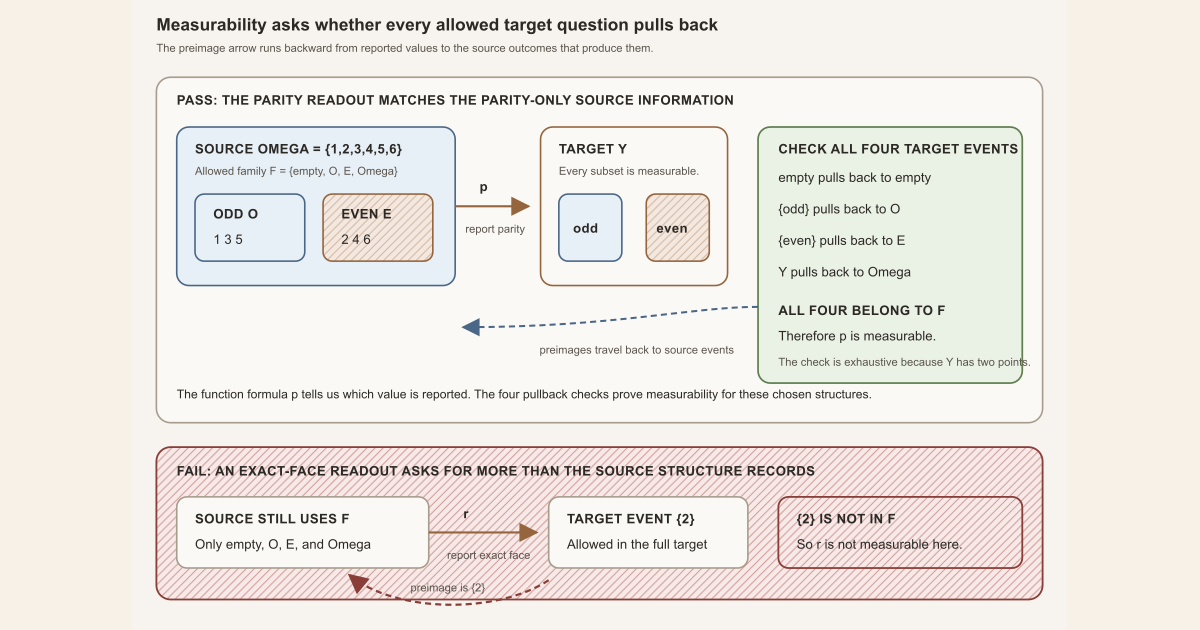
A measurable function respects the information declared observable on its source and target. Every allowed yes-or-no question about the reported value must turn into an allowed yes-or-no question about the original outcome.
The word refers to the measurable structures around a function, not merely to the formula used to compute it.
Start with a die-to-parity map
Let
\[ \Omega=\{1,2,3,4,5,6\} \]be the possible results of one die roll. Suppose the source records only parity. Write
\[ O=\{1,3,5\}, \qquad E=\{2,4,6\}, \]and give \(\Omega\) the event family
\[ \mathcal F=\{\varnothing,O,E,\Omega\}. \]This is the parity-only measurable space from the neighboring entry. Its four sets are the only source events available to this model.
Let the target be
\[ Y=\{\mathsf{odd},\mathsf{even}\}, \]with every subset of \(Y\) measurable. Define the parity function
\[ p:\Omega\longrightarrow Y \]by
\[ p(1)=p(3)=p(5)=\mathsf{odd}, \qquad p(2)=p(4)=p(6)=\mathsf{even}. \]There are only four target events, so we can check every one:
| Measurable target event \(B\) | Source preimage \(p^{-1}(B)\) | Is the preimage in \(\mathcal F\)? |
|---|---|---|
| \(\varnothing\) | \(\varnothing\) | Yes |
| \(\{\mathsf{odd}\}\) | \(O=\{1,3,5\}\) | Yes |
| \(\{\mathsf{even}\}\) | \(E=\{2,4,6\}\) | Yes |
| \(Y\) | \(\Omega\) | Yes |
Every allowed target question pulls back to an allowed source question. Therefore \(p\) is measurable for these chosen structures.
A contrasting exact-face readout
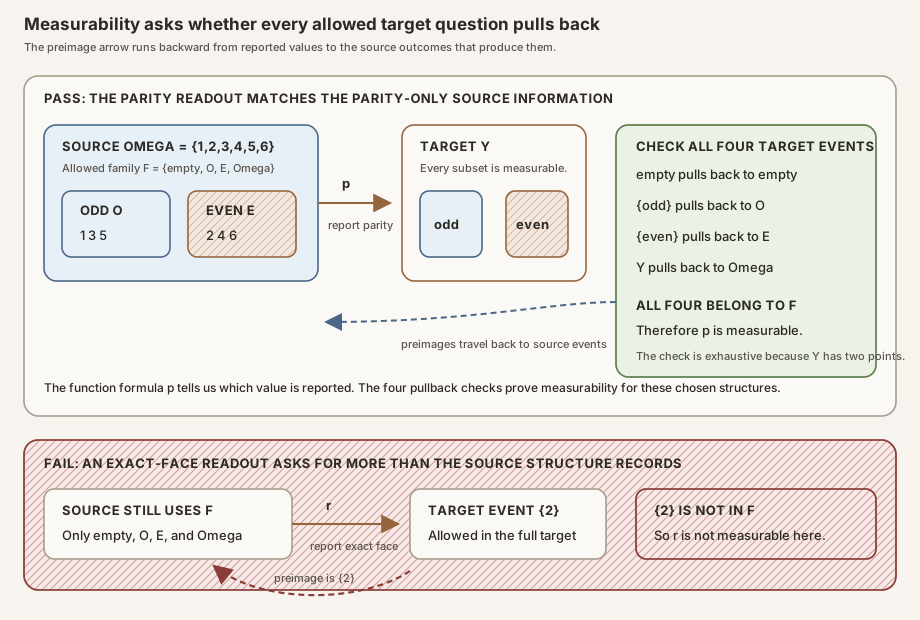
Keep the same parity-only source \((\Omega,\mathcal F)\). Let the target also be \(\Omega\), but give the target every subset as a measurable event. Define the exact-face readout
\[ r:\Omega\longrightarrow\Omega, \qquad r(\omega)=\omega. \]The formula is the identity. Nevertheless, the target singleton \(\{2\}\) is measurable while
\[ r^{-1}(\{2\})=\{2\}\notin\mathcal F. \]Thus \(r\) is not measurable from the parity-only source to the full exact-face target.
Nothing is wrong with the set \(\{2\}\), and nothing is wrong with the identity formula. The mismatch lies between the source and target information structures. If the source also carried every subset as a measurable event, the same identity formula would be measurable.
The definition
Let \((\Omega,\mathcal F)\) and \((Y,\mathcal G)\) be measurable spaces. A function
\[ f:\Omega\longrightarrow Y \]is measurable when
\[ B\in\mathcal G \quad\Longrightarrow\quad f^{-1}(B)\in\mathcal F \]for every target set \(B\). The preimage
\[ f^{-1}(B)=\{\omega\in\Omega:f(\omega)\in B\} \]collects the source outcomes that make the target event \(B\) occur.
The superscript \(-1\) in \(f^{-1}(B)\) does not assert that \(f\) has an inverse function. Every function has a preimage operation on sets, even when the function is many-to-one. The die parity map is many-to-one, yet its preimages are perfectly well-defined.
Measurability uses preimages rather than forward images because inverse images preserve complements and countable unions exactly:
\[ f^{-1}(Y\setminus B)=\Omega\setminus f^{-1}(B), \]and
\[ f^{-1}\!\left(\bigcup_{n=0}^{\infty}B_n\right) {} = \bigcup_{n=0}^{\infty}f^{-1}(B_n). \]Those identities align with the closure rules of sigma algebras.
A formula is not a measurability proof
Writing down \(f(\omega)\) defines a function. It does not by itself establish how target events pull back through the chosen measurable spaces.
| Layer | What it supplies | Die example |
|---|---|---|
| Function formula | One output for every input | \(p(\omega)\) reports odd or even |
| Source measurable space | Allowed questions about inputs | \(\mathcal F=\{\varnothing,O,E,\Omega\}\) |
| Target measurable space | Allowed questions about outputs | Every subset of \(Y\) |
| Measurability proposition | The pullback obligation | Every measurable \(B\subseteq Y\) has \(p^{-1}(B)\in\mathcal F\) |
| Measurability proof | Evidence that the obligation holds | The exhaustive four-row table |
This separation is explicit in Lean. A term
f : Ω → Y is the function. A separate term
hf : Measurable f is a proof about that function under the
measurable-space instances currently attached to Ω and
Y.
The project’s RandomMatrix base type follows the same pattern: it is only an outcome-to-matrix function. The theorem that the map is measurable is a distinct hypothesis or a field of a richer bundle.
Why probability laws need this condition
A pushforward measure assigns a target event \(B\) the source mass of \(f^{-1}(B)\). The familiar equation is
\[ (f_*\mu)(B)=\mu\bigl(f^{-1}(B)\bigr). \]For the right side to be available for every measurable target event, those preimages must be measurable source events. This is why the project’s probability-law interfaces carry measurability explicitly instead of treating an arbitrary function as though it automatically induced a probability distribution .
A measurable space alone chooses admissible sets. A measure later assigns sizes to them. Measurability of \(f\) does not itself choose either a source measure or a probability law.
Measurable is not the same as continuous or integrable
These properties answer different questions.
| Property | Main question | What extra structure it uses |
|---|---|---|
| Measurable | Do measurable target events pull back to measurable source events? | Measurable spaces |
| Continuous | Do nearby inputs produce nearby outputs? | Topologies |
| Integrable | Does the function have finite total magnitude under a chosen measure? | A measure plus analytic structure on the values |
In the usual Borel measurable spaces on \(\mathbb R\), the step function
\[ s(x)= \begin{cases} 0,&x\lt0,\\ 1,&x\ge0 \end{cases} \]is measurable but is not continuous at zero. Measurability permits this jump because the preimages of Borel target sets remain Borel.
For a different separation, put counting measure on \(\mathbb N\). The constant function \(g(n)=1\) is measurable because every subset is measurable, but it is not integrable over all of \(\mathbb N\):
\[ \sum_{n=0}^{\infty}|g(n)| {} = \sum_{n=0}^{\infty}1 {} = \infty. \]So measurability is necessary for ordinary integration theory, but it is not a finite-integral estimate.
In Lean
The pinned Mathlib definition is almost a word-for-word rendering of the paper definition.
Measurable fMeasurable fis a proposition about the functionfand the active measurable-space instances on its source and target.- In the unfolded definition below,
∀means “for every.” The braces in⦃B : Set β⦄make the target set an implicit argument, so Lean can infer it from the following proof. MeasurableSet Bsays that \(B\) belongs to the target sigma algebra.→means that a proof of target measurability must produce the source-side conclusion.f ⁻¹’ Bis Lean’s set-preimage notation. The prime is part of the notation and helps distinguish set preimage from other inverse-like operations.- The second
MeasurableSetis interpreted in the source type becausef ⁻¹’ Bis a set of source points.
Here is the exact definition from the pinned Mathlib source:
def Measurable [MeasurableSpace α] [MeasurableSpace β] (f : α → β) : Prop :=
  ∀ ⦃t : Set β⦄, MeasurableSet t → MeasurableSet (f ⁻¹' t)
The bridge uses the page’s names \(\Omega\), \(Y\), and \(B\); the library
uses generic type names α, β, and target-set name
t. Renaming bound variables does not change the proposition.
The random-matrix foundation then packages a structured use of this general definition. This is the exact checked project theorem:
theorem measurable_iff_entries (X : RandomMatrix Ω ι κ 𝕜) :
    Measurable X ↔ ∀ i j, Measurable fun ω ↦ X ω i j := by
  rw [measurable_comap_iff]
  change Measurable (fun ω i j ↦ X ω i j) ↔ _
  simp only [measurable_pi_iff]
It says that a matrix-valued function is measurable exactly when every scalar entry function is measurable. The target matrix measurable space is built entry by entry, so the theorem turns one structured pullback condition into a family of coordinate conditions.
Pull back all four parity events locally
Lean Core does not include Mathlib’s measure theory, but a small
Std program can compute the page’s complete finite preimage table.
Here false means odd and true means even. Save this as
/tmp/MeasurableFunctionScratch.lean on a normal Mac or Linux
computer:
import Std

namespace MeasurableFunctionScratch

def faces : List Nat := [1, 2, 3, 4, 5, 6]

def parity (face : Nat) : Bool :=
  face % 2 == 0

def preimage (event : Bool → Bool) : List Nat :=
  faces.filter (fun face => event (parity face))

def targetEvents : List (Bool → Bool) :=
  [fun _ => false,
   fun isEven => !isEven,
   fun isEven => isEven,
   fun _ => true]

def sourceAllowed (event : List Nat) : Bool :=
  event == [] ||
  event == [1, 3, 5] ||
  event == [2, 4, 6] ||
  event == faces

def pulledBackEvents : List (List Nat) :=
  targetEvents.map preimage

def exactFaceTwo : List Nat :=
  faces.filter (fun face => face == 2)

#eval pulledBackEvents
#eval pulledBackEvents.map sourceAllowed
#eval exactFaceTwo
#eval sourceAllowed exactFaceTwo

example : pulledBackEvents =
    [[], [1, 3, 5], [2, 4, 6], [1, 2, 3, 4, 5, 6]] := by decide
example : pulledBackEvents.map sourceAllowed =
    [true, true, true, true] := by decide
example : exactFaceTwo = [2] := by decide
example : sourceAllowed exactFaceTwo = false := by decide

end MeasurableFunctionScratch
Type these commands exactly:
source "$HOME/.elan/env"
elan run leanprover/lean4:v4.32.0 lean /tmp/MeasurableFunctionScratch.lean
This exact standalone worksheet was executed successfully with Lean 4.32.0. It printed:
[[], [1, 3, 5], [2, 4, 6], [1, 2, 3, 4, 5, 6]]
[true, true, true, true]
[2]
false
The first two lines exhaust every event in the two-value target and show that
all four preimages belong to the parity-only source family. The last two lines
reproduce the exact-face counterexample. This computes the finite set ledger;
it does not replace a proof of Mathlib’s general
Measurable f proposition.
Full project check
This Mathlib-backed file exposes the definition through a single target event and then asks Lean for the project’s coordinatewise theorem. This full project check uses the repository’s pinned Lean and Mathlib dependencies and may require substantial disk space and memory.
import NonlinearDynamics.Random.RandomMatrices.Basic

universe u v

variable {Ω : Type u} {Y : Type v}
variable [MeasurableSpace Ω] [MeasurableSpace Y]
variable (f : Ω → Y)

#check Measurable
#check MeasurableSet
#check Set.preimage
#check NonlinearDynamics.Random.RandomMatrix.measurable_iff_entries

example (hf : Measurable f) {B : Set Y} (hB : MeasurableSet B) :
    MeasurableSet (f ⁻¹' B) := by
  exact hf hB
Read the example from left to right. The input hf is the complete
measurability proof. The input hB certifies one target event.
Applying hf to hB returns the required proof that
the preimage is a measurable source event.
measurable_iff_entries declaration is exact project source. Put
the worksheet in a temporary .lean file inside
formalization. The full-project command below checks the
authoritative project module.cd formalization
lake env lean -DwarningAsError=true NonlinearDynamics/Random/RandomMatrices/Basic.leanResource note: this exact file uses the repository's
pinned Lean and Mathlib dependencies. Initial project setup can require
substantial disk space and build time. For a lightweight first step on
macOS or Linux, use the page's standalone Lean-core or Std
tutorial.
Boundaries and nonclaims
- Measurability is relative to both measurable spaces. The same underlying formula can be measurable for one pair and nonmeasurable for another.
- A preimage is not an inverse function. No bijectivity is required.
- Checking a few convenient target events is not generally enough. The die example is complete only because all four target events were listed.
- Measurability uses inverse images. Forward images of measurable sets need not be measurable without additional hypotheses.
- A measurable function need not be continuous or integrable.
- A proof of
Measurable fdoes not select a measure, assign probabilities, or prove an almost-everywhere statement.
Where to continue
The measurable space page builds the source and target event families used here. The pushforward measure page follows the preimage into the law construction. The almost-everywhere page explains what changes when a property may fail on a null set.
Further reading
Mathlib’s measurable-space definitions give the exact pinned definition used above. Olav Kallenberg’s Foundations of Modern Probability develops measurable mappings before using them to define random elements and their distributions.