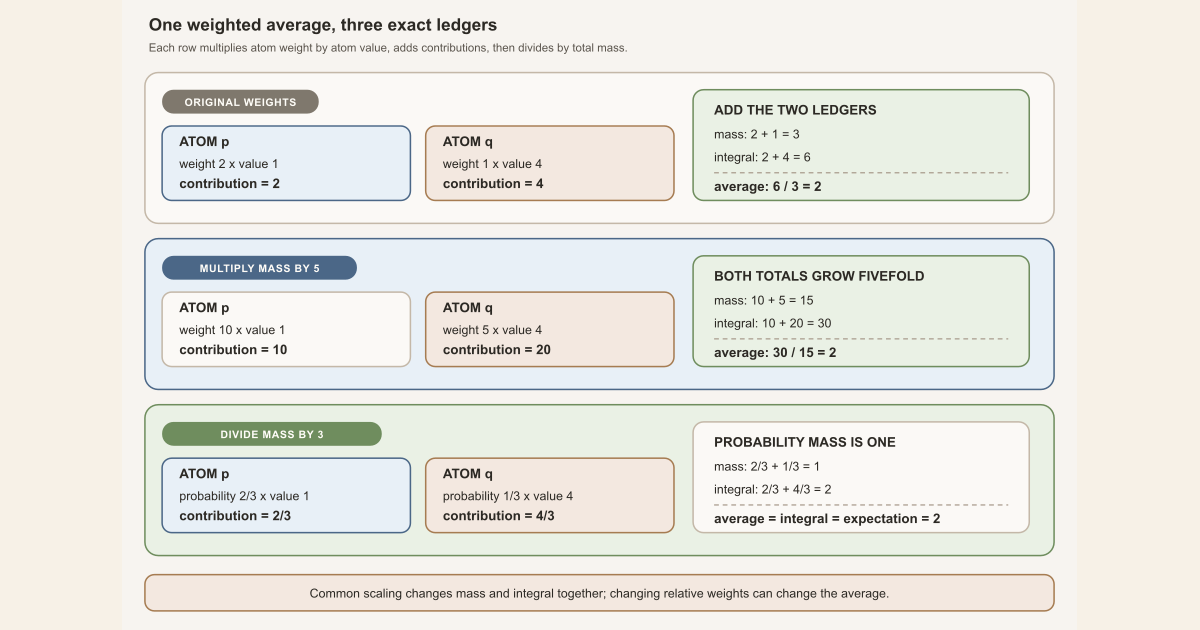
Start with a space containing exactly two atoms, \(p\) and \(q\). An atom here is one indivisible outcome to which a measure assigns a weight. Give the atoms weights
\[ \mu(\{p\})=2, \qquad \mu(\{q\})=1, \]and let the real-valued observable \(f\) report
\[ f(p)=1, \qquad f(q)=4. \]There are two ledgers to add. The mass ledger adds the weights:
\[ \mu(\{p,q\})=2+1=3. \]The integral ledger multiplies each value by its weight before adding:
\[ \int_{\{p,q\}} f\,d\mu {} = 2\cdot 1+1\cdot 4 {} = 2+4 {} = 6. \]The normalized space average is the integral divided by total mass:
\[ \operatorname{Avg}_{\mu}(f) {} = \frac{6}{3} {} = 2. \]The answer is not the unweighted average \((1+4)/2=5/2\). Atom \(p\) carries twice as much mass as atom \(q\), so its value \(1\) receives twice the weight.
Now multiply both atom weights by \(5\). The new measure \(5\mu\) has weights \(10\) and \(5\). Its two ledgers become
\[ \begin{aligned} (5\mu)(\{p,q\}) &=10+5=15,\\ \int_{\{p,q\}} f\,d(5\mu) &=10\cdot1+5\cdot4=10+20=30. \end{aligned} \]Both numerator and denominator grew by \(5\), so their ratio did not:
\[ \operatorname{Avg}_{5\mu}(f)=\frac{30}{15}=2. \]Finally, divide the original weights by their total mass \(3\). The resulting weights \(2/3\) and \(1/3\) add to \(1\), so they define a probability measure \(\widehat\mu\). Its ordinary integral is
\[ \int f\,d\widehat\mu {} = \frac23\cdot1+\frac13\cdot4 {} = \frac23+\frac43 {} = 2. \]For a probability measure, this integral is also called the expectation of \(f\).
The general definition
Let \(\Omega\) be a space, let \(\mu\) assign mass to its measurable subsets, and let \(f:\Omega\to\mathbb R\) be an observable. Assume:
- \(\mu\) is finite, meaning \(\mu(\Omega)\lt\infty\);
- \(\mu\) is nonzero, meaning \(\mu(\Omega)\gt0\); and
- \(f\) is integrable , meaning its absolute size has finite integral.
Then the normalized space average is
\[ \operatorname{Avg}_{\mu}(f) {} = \frac{1}{\mu(\Omega)}\int_{\Omega} f\,d\mu. \]The measure tells us how much weight each part of the space receives. The integral adds the weighted values. Dividing by total mass converts that total into a per-unit-mass average.
If \(c\gt0\), then the scaled measure \(c\mu\) satisfies
\[ (c\mu)(\Omega)=c\mu(\Omega), \qquad \int f\,d(c\mu)=c\int f\,d\mu. \]Therefore
\[ \operatorname{Avg}_{c\mu}(f) {} = \frac{c\int f\,d\mu}{c\mu(\Omega)} {} = \operatorname{Avg}_{\mu}(f). \]This cancellation requires one common positive scale factor. Changing the relative weights can change the answer. For example, changing the two-atom weights from \((2,1)\) to \((1,2)\) gives
\[ \frac{1\cdot1+2\cdot4}{1+2}=\frac93=3, \]not \(2\).
Why the denominator belongs in an ergodic theorem
Suppose a dynamical argument shows that a function is almost everywhere equal to a constant \(c\), and that its integral equals the integral of \(f\). Then
\[ \mu(\Omega)c=\int_{\Omega}f\,d\mu. \]For finite nonzero mass, cancellation identifies
\[ c=\frac{1}{\mu(\Omega)}\int_{\Omega}f\,d\mu. \]The denominator is not cosmetic. If \(\mu=2\delta_x\), twice the unit mass at one point \(x\), then
\[ \int h\,d\mu=2h(x), \qquad \operatorname{Avg}_{\mu}(h)=h(x). \]The orbit samples only the value \(h(x)\), not the arbitrarily doubled raw integral. The project’s twenty-eighth Random Matrix Theory milestone (RMT-28) includes this mass-two boundary probe.
In Lean: write the average notation
Mathlib, Lean’s community mathematics library, uses a slashed integral sign for the normalized average.
⨍ x, f x ∂μ⨍is Mathlib’s notation for an integral average, not an ordinary integral sign.xis a bound variable ranging over the underlying space.f xis the value contributed at \(x\).∂μsays that the measure is \(\mu\). The symbol after∂changes when the measure changes.- The notation elaborates to
MeasureTheory.average μ f.
The notation is compact, but it hides the denominator. The next theorem makes that normalization explicit.
In Lean: expose the reciprocal mass
MeasureTheory.average_eq (μ := μ) faverage_eqis the exact Mathlib rewrite theorem.(μ := μ)supplies the named measure argument explicitly.- In the theorem’s right-hand side,
μ.real univconverts the total extended nonnegative mass to a real scalar. Hereunivis the whole space \(\Omega\). - The postfix
⁻¹is multiplicative inverse. - The operator
•in the generic theorem is scalar multiplication. For real-valued \(f\), the project rewrites it as ordinary multiplication. - The equality is total and remains syntactically true in the fallback cases discussed below. It becomes the usual division formula only under the finite, nonzero, integrable interpretation.
The exact pinned generic theorem is
theorem MeasureTheory.average_eq (f : Ω → E) :
    ⨍ x, f x ∂μ = (μ.real Set.univ)⁻¹ • ∫ x, f x ∂μ
The codomain \(E\) may be more general than \(\mathbb R\); it is a normed additive commutative group with scalar multiplication by real numbers.
In Lean: probability mass one removes the denominator
MeasureTheory.average_eq_integral (μ := μ) faverage_eq_integralis a Mathlib theorem, not a new definition.- Its hidden typeclass premise
[IsProbabilityMeasure μ]records \(\mu(\Omega)=1\). ∫ x, f x ∂μis the ordinary Bochner integral. Calling it an expectation is appropriate when \(\mu\) is a probability measure and \(f\) is the random variable under discussion.- The theorem itself is total; a mathematically informative expectation still needs the usual measurability and integrability conditions.
The exact pinned theorem is
theorem MeasureTheory.average_eq_integral
    [IsProbabilityMeasure μ] (f : Ω → E) :
    ⨍ x, f x ∂μ = ∫ x, f x ∂μ
In Lean: the project theorem adds dynamics
The normalized average is a static quantity. RMT-28 proves a separate theorem that identifies it as the limit of time averages under explicit dynamical hypotheses.
ae_tendsto_birkhoffAverage_normalizedIntegral_of_ergodic (T := T) (f := f) hμ hT hfhμ : μ ≠ 0rules out zero total mass, while[IsFiniteMeasure μ]is an ambient instance ensuring finite mass.hT : Ergodic T μsupplies both measure preservation and ergodic rigidity for the map \(T\).hf : Integrable f μis the analytic hypothesis on \(f\).- The theorem’s conclusion begins
∀ᵐ ω ∂μ, read “for almost every \(\omega\) with respect to \(\mu\).” It does not say every starting point. Tendsto … atTop (nhds target)says the sequence converges as the natural-number horizon tends to infinity toward the displayed target.birkhoffAverage ℝ T f n ωaverages the first \(n\) observations along the orbit of \(\omega\).
Its exact declaration is
theorem ae_tendsto_birkhoffAverage_normalizedIntegral_of_ergodic
    [IsFiniteMeasure μ]
    (hμ : μ ≠ 0) (hT : Ergodic T μ) (hf : Integrable f μ) :
    ∀ᵐ ω ∂μ,
      Tendsto (fun n ↦ birkhoffAverage ℝ T f n ω) atTop
        (nhds ((μ.real univ)⁻¹ * ∫ x, f x ∂μ))
The theorem is stronger than the definition of an average and narrower than a general slogan about ergodicity: it is an almost-everywhere convergence result for integrable real observables under the exact listed assumptions.
A tiny standalone Lean worksheet a human can type
Standalone tutorial. This worksheet checks only the two finite integer ledgers. It does not import Mathlib, construct a measure, or prove an ergodic theorem.
Save the following as NormalizedAverageTutorial.lean:
import Std

inductive Atom where
  | p | q
deriving Repr, DecidableEq

def atoms : List Atom := [.p, .q]

def value : Atom → Nat
  | .p => 1
  | .q => 4

def originalWeight : Atom → Nat
  | .p => 2
  | .q => 1

def scaledWeight (scale : Nat) (x : Atom) : Nat :=
  scale * originalWeight x

def totalMass (weight : Atom → Nat) : Nat :=
  atoms.foldl (fun total x => total + weight x) 0

def weightedIntegral (weight : Atom → Nat) : Nat :=
  atoms.foldl (fun total x => total + weight x * value x) 0

def exactIntegerAverage (weight : Atom → Nat) : Nat :=
  weightedIntegral weight / totalMass weight

#eval [totalMass originalWeight,
       weightedIntegral originalWeight,
       exactIntegerAverage originalWeight]

#eval [totalMass (scaledWeight 5),
       weightedIntegral (scaledWeight 5),
       exactIntegerAverage (scaledWeight 5)]

example : totalMass originalWeight = 3 := by decide
example : weightedIntegral originalWeight = 6 := by decide
example : exactIntegerAverage originalWeight = 2 := by decide
example : totalMass (scaledWeight 5) = 15 := by decide
example : weightedIntegral (scaledWeight 5) = 30 := by decide
example : exactIntegerAverage (scaledWeight 5) = 2 := by decide
From the directory containing that file, type exactly:
source "$HOME/.elan/env"
elan run leanprover/lean4:v4.32.0 lean NormalizedAverageTutorial.lean
The two output rows should be [3, 6, 2] and
[15, 30, 2]. This command is suitable for an ordinary Mac or
Linux machine because the worksheet imports only Std.
The tutorial uses natural-number division only because \(6/3\) and \(30/15\) are exact integers. It stores the probability weights \(2/3\) and \(1/3\) as the common numerator ledger \((2,1)\) over denominator \(3\). It is a check of the finite arithmetic, not an implementation of real integration or rational probability measures. This exact worksheet was executed successfully with the pinned Lean 4.32.0 compiler.
Try the exact declarations in the project
Full project check. This uses the repository’s pinned Lean and Mathlib dependencies and may require substantial disk space and memory. Create a temporary project query containing:
import NonlinearDynamics.Random.RandomCocycles.ErgodicBirkhoffLimit
import Mathlib.MeasureTheory.Integral.Average

open MeasureTheory Set Filter
open NonlinearDynamics.Random.RandomCocycles

#check MeasureTheory.average
#check MeasureTheory.average_eq
#check MeasureTheory.average_eq_integral
#check condExp_invariants_ae_eq_average_of_preErgodic
#check condExp_invariants_ae_eq_normalizedIntegral_of_preErgodic
#check ae_tendsto_birkhoffAverage_normalizedIntegral_of_ergodic
#check ae_tendsto_birkhoffAverage_integral_of_ergodic
Each #check asks the pinned elaborator for the exact declaration
type. The full-project command below checks the authoritative RMT-28 source module,
not the standalone worksheet. It uses the repository’s pinned Lean and Mathlib
dependencies.
cd formalization
lake env lean -DwarningAsError=true NonlinearDynamics/Random/RandomCocycles/ErgodicBirkhoffLimit.lean
Resource note: this exact file uses the repository's
pinned Lean and Mathlib dependencies. Initial project setup can require
substantial disk space and build time. For a lightweight first step on
macOS or Linux, use the page's standalone Lean-core or Std
tutorial.
Totalized edge cases are conventions, not averages with evidence
Mathlib defines
noncomputable def MeasureTheory.average (μ : Measure Ω) (f : Ω → E) :=
  ∫ x, f x ∂(μ Set.univ)⁻¹ • μ
This is a total definition: Lean returns a value for every measure and function instead of leaving exceptional inputs undefined.
- Zero measure. The scaled measure is again zero, and the average is zero. There is no positive mass over which to average.
- Infinite total mass. The inverse of infinite extended mass is zero, so the normalized measure and average are zero. This is a library convention, not a claim that every infinite-volume mean physically equals zero.
- Nonintegrable function. Mathlib’s totalized Bochner integral returns zero outside its integrable regime, so the average does too. That zero does not certify integrability and should not be interpreted as cancellation of positive and negative contributions.
- Inverse of zero. In Lean’s field operations, the inverse of zero is
defined to be zero. Thus
average_eqremains a valid rewrite at zero mass, but the resulting identity has no ordinary division-by-positive- mass meaning.
These choices are valuable for algebraic rewriting because every expression
has a type and a value. The semantic theorem in this page deliberately adds
IsFiniteMeasure μ, μ ≠ 0, and
Integrable f μ before identifying an ergodic limit with a genuine
normalized average. The probability specialization supplies finite nonzero
mass automatically but still keeps the observable’s integrability premise.
Space average is not time average
The normalized space average uses the measure over the whole state space. A time average follows one orbit:
\[ \frac1n\sum_{j=0}^{n-1}f(T^j\omega). \]The two-atom arithmetic does not make these quantities equal. If \(T\) is the identity map, then a point starting at \(p\) reads \(1\) forever and a point starting at \(q\) reads \(4\) forever. Their time averages are \(1\) and \(4\), not the global normalized average \(2\). The identity map preserves the measure, but this two-positive-mass system is not ergodic .
RMT-27 first identifies the general Birkhoff limit as conditional expectation onto the invariant sigma algebra . RMT-28 adds ergodic rigidity, which makes that invariant target almost everywhere constant, and then the mass ledger identifies the constant as the normalized space average.
What this page does and does not establish
The two-atom calculation exhibits the particular rescaling
\[ (\text{mass},\text{integral})=(3,6) \quad\text{to}\quad (15,30) \]while preserving the ratio \(2\). The general scaling identity follows by cancelling a common positive factor in both the integral and the total mass. More generally, the definition records a weighted average per unit mass.
It does not establish any of the following by definition alone:
- that \(f\) is measurable or integrable;
- that a totalized zero is a meaningful mean;
- invariance under changing relative weights;
- measure preservation or ergodicity of a map;
- convergence of any orbit average;
- convergence at every starting point;
- a rate of convergence, mixing, independence, or decay of correlations;
- a subadditive cocycle limit, Lyapunov exponent, or Oseledets splitting; or
- an identity with normalized matrix trace without a separate theorem.
Where to continue
Ergodic Birkhoff Limits and Normalized Space Averages develops the conditional-expectation collapse and every RMT-28 assumption.
Birkhoff Limits, Invariant Sigma Algebras, and Conditional Expectation explains the nonergodic target that comes first.
The probability measure page derives the mass-one case. The expectation page explains when ordinary-integral language becomes probabilistic. The ergodic probability base page keeps probability normalization, measure preservation, ergodicity, and integrability as separate hypotheses.
References
Mathlib contributors.
Integral averages,
Mathlib 4.32.0 at pinned commit
81a5d257.
This source is authoritative for ⨍,
MeasureTheory.average, average_eq,
average_eq_integral, and the documented totalized cases.
Nonlinear Dynamics in Lean contributors. ErgodicBirkhoffLimit.lean, the checked project source for the pre-ergodic conditional-expectation identification and the finite-measure and probability Birkhoff endpoints.