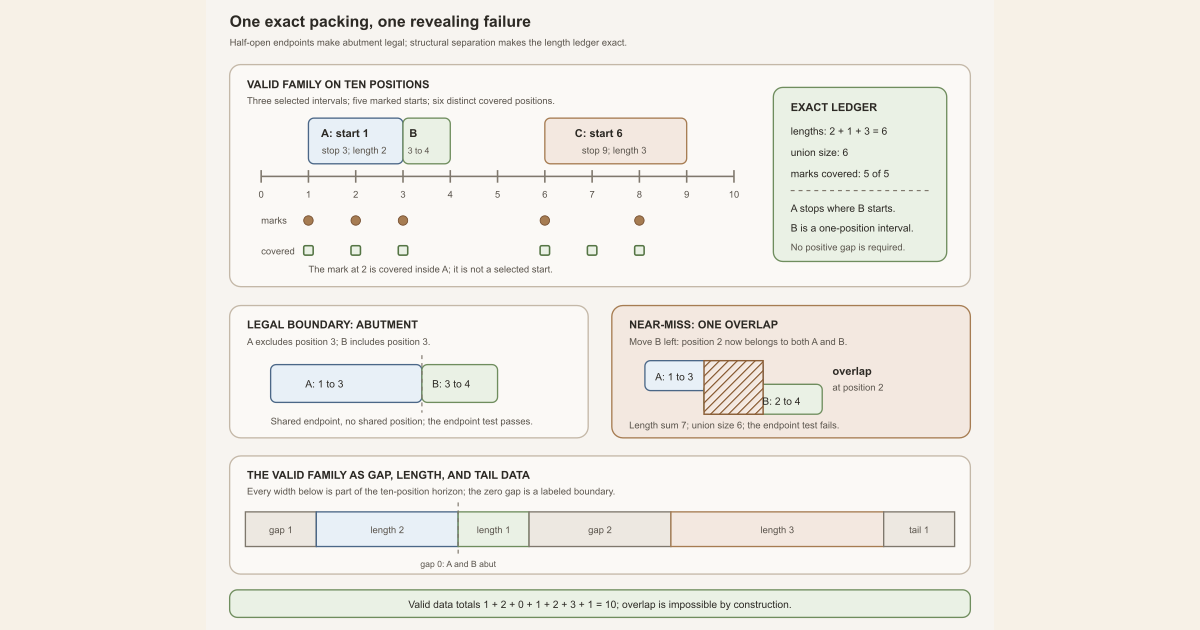
Start with a horizon of ten natural-number positions,
\[ \{0,1,2,3,4,5,6,7,8,9\}, \]and mark
\[ B=\{1,2,3,6,8\}. \]A marked start is a position eligible to begin a selected interval. The selector contract also promises to cover every mark, but a mark need not become the left endpoint of an interval. Select the three half-open intervals
\[ P=\bigl([1,3),[3,4),[6,9)\bigr). \]Half-open means “include the left endpoint and exclude the right endpoint.” The three intervals therefore cover
\[ \begin{aligned} [1,3)&=\{1,2\},\\ [3,4)&=\{3\},\\ [6,9)&=\{6,7,8\}. \end{aligned} \]Their union is
\[ U=\{1,2,3,6,7,8\}. \]Everything can be checked by hand:
- the lengths are \(2\), \(1\), and \(3\), so their sum is \(6\);
- the union \(U\) also has exactly \(6\) positions;
- the endpoint tests are \(3\le3\) and \(4\le6\), so the intervals are in chronological order and do not overlap; and
- \(B\subseteq U\), so all five marks are covered.
The equality \(3\le3\) is a boundary case, not an error. The first interval excludes \(3\), while the second includes it, so the intervals abut at \(3\) without sharing a position. The interval \([3,4)\) is also a legitimate one-position interval. Finally, the mark \(2\) is covered by \([1,3)\), even though no selected interval starts at \(2\).
Here is the tempting near-miss. Replace \([3,4)\) by \([2,4)\). The endpoint test would become \(3\le2\), which is false, and the two intervals would both contain position \(2\). Their lengths would add to
\[ 2+2+3=7, \]but their union would still have only the six positions \(\{1,2,3,6,7,8\}\). This one overlap destroys the exact equation “covered cardinality equals the sum of interval lengths.”
An ordered interval packing is a finite chronological family of positive-length half-open intervals inside a finite natural-number horizon. The twenty-first Random Matrix Theory milestone (RMT-21) encodes that family by the gaps before successive intervals rather than by an arbitrary list plus a separate proof that the list is valid.
The term has a narrow meaning here. A packing is not a probability distribution , an asymptotic density, a topological cover, or an assertion that the selected intervals are optimal. It is finite data with checked endpoint, coverage, and cardinality properties.
The construction continues the finite upper estimate developed by phase averaging . Phase averaging gathers fixed-block estimates. Ordered interval packing handles the complementary geometry in which different marked starts may choose different positive lengths.
The half-open convention
For natural endpoints \(a\) and \(b\), the half-open interval
\[ [a,b)=\{j\in\mathbb N:a\le j\lt b\} \]includes its left endpoint and excludes its right endpoint. If \(a\le b\), it contains \(b-a\) natural positions.
This convention makes adjacency exact. More generally, the intervals \([a,b)\) and \([c,d)\) are chronologically disjoint when
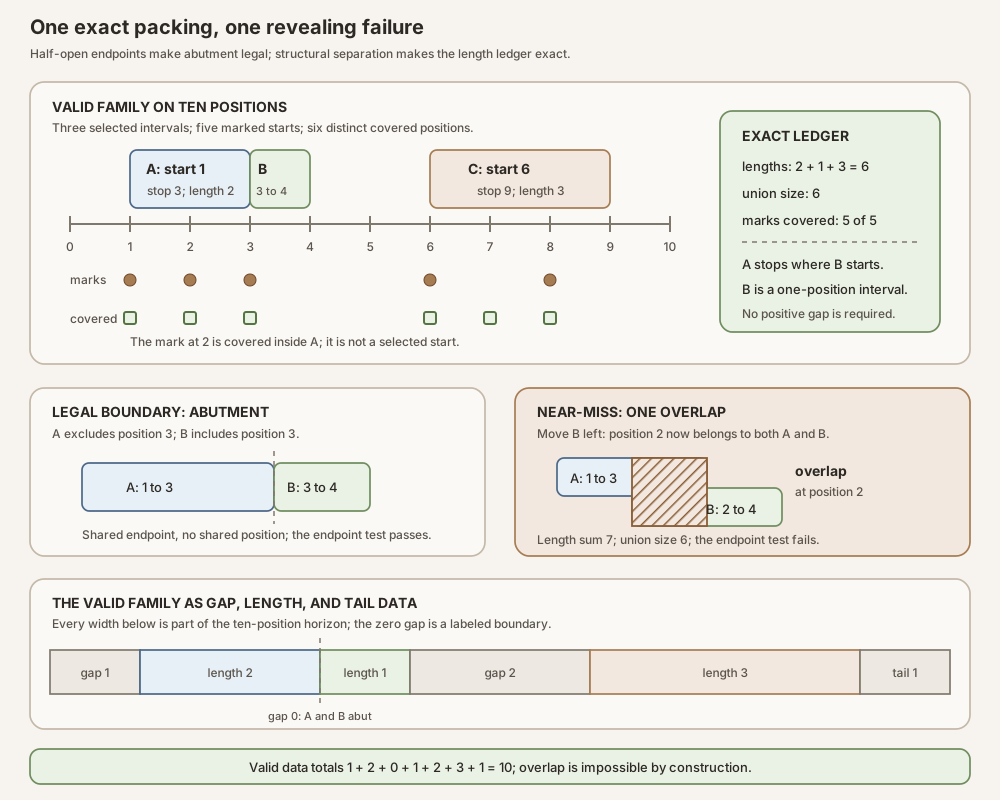
\[ b\le c. \]Equality is legal: when \(b=c\), the two intervals abut without sharing a point. In the figure, \([1,3)\) and \([3,4)\) abut at three, but three belongs only to the second interval.
A positive natural length may equal one. The interval \([3,4)\) is therefore a legal singleton. This corrects a small mismatch in the motivating inclusive display from Lalley’s notes: the displayed strict start-to-end comparison excludes length one, although the following selection permits \(1\le k\le m\) (Lalley).
Mathlib’s Finset.Ico is the finite-set implementation of this
half-open convention. Its natural-number cardinality is endpoint difference
(finite interval API).
The gap-length-tail representation
The Lean type is indexed by its total horizon:
inductive OrderedNatIntervalPacking : ℕ → Type
  | empty (horizon : ℕ) : OrderedNatIntervalPacking horizon
  | cons (gap length : ℕ) {tail : ℕ} (length_pos : 0 < length)
      (rest : OrderedNatIntervalPacking tail) :
      OrderedNatIntervalPacking (gap + length + tail)
An empty packing retains an ambient horizon but selects nothing. A cons node stores:
- a gap before the next interval, possibly zero;
- a strictly positive selected length; and
- a recursively valid tail beginning after that interval.
The final empty node records the terminal gap. An empty intermediate gap lets intervals abut. A positive selected length rules out empty intervals but not singletons.
Because the recursive tail begins after the current interval, every decoded later interval begins at or after the current endpoint. Ordering and disjointness are therefore structural consequences of the representation.
Four views of one packing
RMT-21 exposes four summaries:
| Name | Meaning |
|---|---|
intervalCount | number of selected intervals |
coveredLength | sum of selected interval lengths |
intervals | ordered list of absolute endpoint pairs |
coveredFinset | finite union of all covered natural positions |
The interval list retains boundaries. The covered finite set retains membership. They agree through two checked identities:
\[ \operatorname{length}(\operatorname{intervals}(P)) =\operatorname{intervalCount}(P), \]and
\[ |\operatorname{coveredFinset}(P)| =\operatorname{coveredLength}(P). \]The second equality depends on pairwise disjointness. Without it, union cardinality would count an overlap once while the sum of interval lengths would count it twice.
Membership also has an interval witness: a position belongs to
coveredFinset exactly when it lies between the endpoints of one
decoded half-open interval.
Coverage is not selection provenance
Let \(B\) be a finite set of marked starts. The predicate
\[ \operatorname{Covers}(P,B) \quad\Longleftrightarrow\quad B\subseteq\operatorname{coveredFinset}(P) \]says every mark lies somewhere in the selected union. It does not require every selected interval to start at a mark.
The separate predicate SelectedFrom says every selected interval
does begin at an eligible marked start and has exactly the prescribed length
there. It does not by itself say every mark is covered.
The greedy selector returns both:
\[ P\text{ covers }B \qquad\text{and}\qquad P\text{ is selected from }(B,\ell). \]The distinction is visible in the toy figure. The mark at two lies inside \([1,3)\), so it is covered, but it is not the start of a selected interval.
The leftmost selector
Suppose
\[ B\subseteq\{0,\ldots,H-1\} \]and each \(j\in B\) has a prescribed length with
\[ 0\lt\ell(j)\le m. \]The finite selector repeats the following rule:
- choose the least remaining marked start \(j\);
- keep \([j,j+\ell(j))\);
- remove every remaining mark already inside that interval; and
- continue with the first mark at or beyond the right endpoint.
Every removed mark is covered by the interval that removed it. Every retained future start lies at or to the right of that endpoint. Hence the selected intervals are ordered and disjoint while their union covers all original marks.
The output horizon is \(H+m\), not \(H\). A start may occur just before \(H\) and its chosen interval may extend by as much as \(m\). From \(j\lt H\) and \(\ell(j)\le m\), its right endpoint is strictly below \(H+m\).
The construction proves existence, not uniqueness or optimality. Another ordered subfamily could satisfy the same two contracts.
One complete selection and count
Take an old start horizon \(H=10\), a uniform length bound \(m=4\), and
\[ B=\{1,2,4,5,8,9\}. \]Prescribe the lengths
\[ \ell(1)=3,\qquad \ell(4)=2,\qquad \ell(8)=4, \]with any positive lengths at most four at the starts that will be deleted. The selector never needs to consult a deleted start’s length.
The first remaining start is one. Selecting \([1,4)\) covers the marks one and two. The mark four survives because a half-open interval excludes its right endpoint. It is the next leftmost start, and \([4,6)\) covers four and five. This interval abuts the first without overlapping it. The next survivor is eight. Its interval \([8,12)\) covers eight and nine. It passes the old horizon ten, so the selector takes the terminal branch rather than making a recursive call.
The final packing can be read directly as gap-length-tail data:
| Piece | Size | Meaning |
|---|---|---|
| initial gap | 1 | skip position zero |
| first length | 3 | select \([1,4)\) |
| next gap | 0 | permit immediate abutment |
| second length | 2 | select \([4,6)\) |
| next gap | 2 | skip positions six and seven |
| third length | 4 | select \([8,12)\) |
| terminal tail | 2 | finish the enlarged horizon at fourteen |
The arithmetic is exact:
\[ 1+3+0+2+2+4+2=14=H+m. \]Nothing asks all selected endpoints to remain below \(H\). The input starts are below \(H\); their bounded lengths put every endpoint below \(H+m\). Here the last endpoint is twelve, strictly below fourteen.
The six marked starts are contained in a covered set of nine positions:
\[ |B|=6 \le |\{1,2,3,4,5,8,9,10,11\}| =9 =\operatorname{coveredLength}(P). \]This comparison is deliberately one-sided. Three extra positions are covered without being marked.
Now let the local coefficient be \(c=-2\). Suppose the selected interval costs are bounded respectively by \(-6\), \(-4\), and \(-8\). Summing gives
\[ \operatorname{cost}(P)\le -18 =c\,\operatorname{coveredLength}(P). \]Since \(6\le9\) but \(c\le0\), multiplication reverses the cardinality comparison:
\[ -18=c\cdot9\le c\cdot6=-12. \]Thus a whole-horizon estimate bounded by the selected cost is also bounded by \(c|B|\). Replacing nine by six without this sign check would point the inequality in the wrong direction.
This example exposes four distinct acts in the proof: selection deletes already covered starts; structural packing proves disjointness; coverage compares two finite cardinalities; and the nonpositive coefficient reverses that comparison.
The endpoint translation dictionary
The motivating notes write an integer interval inclusively as \([j,j+k-1]\). The Lean development uses the extensionally equal half-open set \([j,j+k)\). Translating the set before translating the inequalities prevents two mistakes:
| Inclusive presentation | Half-open presentation | Boundary consequence |
|---|---|---|
| \([j,j+k-1]\) | \([j,j+k)\) | both contain exactly \(k\) integers |
| \(1\le k\le m\) | \(0\lt k\le m\) | \(k=1\) is a legal singleton |
| \(j+k-1\lt j'\) | \(j+k\le j'\) | equality permits abutment |
| last included point \(j+k-1\) | excluded endpoint \(j+k\) | cardinality is endpoint difference |
The strict comparison \(j\lt j+k-1\) appearing in Lalley’s displayed chain cannot hold when \(k=1\), even though the following prose permits that length. RMT-21 treats this as a source-translation repair, not as a new mathematical restriction. It preserves the allowed length range and records disjointness using the correct weak endpoint order.
Coverage gives a cardinality bound
If \(P\) covers \(B\), then
\[ |B| \le |\operatorname{coveredFinset}(P)| {} = \operatorname{coveredLength}(P). \]The inequality need not be equality. One selected interval can cover several marked starts. The frozen source includes a regression fixture in which marks zero and one are both covered by the single interval \([0,3)\), so
\[ 2\lt3. \]This is a toy theorem probe, not an empirical statistic.
If \(B\) is nonempty, coverage also proves the packing contains an interval. That implication is needed for strict cost summation.
From favorable starts to a process bound
Let \(X_n(\omega)\) be shifted-subadditive and nonpositive at every positive horizon. The packing cost adds one term for each selected interval:
\[ \operatorname{cost}(P) {} = \sum_{[j,j+k)\text{ selected}} X_k(T^j\omega). \]Repeated subadditivity splits the whole horizon around those intervals. Every uncovered positive gap contributes a nonpositive term and can be discarded. Zero gaps are not split off, so no sign condition on \(X_0\) is needed.
If every marked start satisfies
\[ X_{\ell(j)}(T^j\omega) \le c\,\ell(j) \]with \(c\le0\), SelectedFrom transports the bound to the selected
intervals and Covers supplies the count comparison. The final weak
greedy theorem gives
provided \(H+m\ne0\).
The direction of the last step comes from the sign. Coverage gives \(|B|\le L\). Multiplication by \(c\le0\) yields \(cL\le c|B|\).
Weak and strict have different boundaries
The weak theorem accepts \(B=\varnothing\). Its local hypothesis is vacuous, the selected packing may be empty, and the conclusion at positive horizon is \(X_{H+m}\le0\).
The strict theorem requires marked.Nonempty. This is necessary.
With no marks, strict local hypotheses are still vacuous, but an empty packing
has cost zero and marked cardinality zero. A universal strict conclusion could
reduce to \(0\lt0\).
Nonempty marks plus coverage force a nonempty positive-length packing. The strict theorem therefore derives positive horizon internally and needs no separate \(H+m\ne0\) premise.
A four-case boundary checklist
Before applying a packing theorem, test these cases:
- No marks. Coverage and selection provenance may both be vacuous. The weak marked-card theorem is meaningful at positive enlarged horizon, but strictness needs an explicit nonempty-mark premise.
- One selected position. Positive length includes one, so \([j,j+1)\) must remain legal. A representation that excludes it has an off-by-one error.
- Two adjacent intervals. An endpoint equality is allowed: \([a,b)\) and \([b,c)\) are disjoint. Requiring a positive intervening gap proves a narrower theorem.
- Zero ambient horizon. Positive-time nonpositivity says nothing about \(X_0\). A weak process theorem therefore needs a nonzero horizon unless another premise, such as nonempty coverage, derives positivity.
These tests separate structural validity from hypotheses belonging to the process layer. Empty horizons are valid indices for the packing type; they become problematic only when a theorem tries to control an unnormalized time-zero process value.
Time zero remains uncontrolled
The raw process theorem assumes only
\[ X_n\le0\quad\text{when }n\ne0. \]An empty packing at positive horizon is valid: it reduces the result to that sign premise. An empty packing at horizon zero is different. The frozen source uses a process with \(X_0=1\) and negative values later. Its empty horizon-zero packing has cost zero, so \(X_0\le\operatorname{cost}(P)\) is false.
This countermodel explains the explicit positive-horizon premise in the weak packing and greedy theorems. Adding \(X_0=0\) globally would hide the exact boundary and unnecessarily strengthen the useful positive-time result.
In Lean: a covered position has an interval witness
The first bridge connects the visible union of positions to the stored list of endpoint pairs.
P.mem_coveredFinset_iff_exists_intervalP : OrderedNatIntervalPacking Nis a packing whose complete ambient horizon has lengthN.j ∈ P.coveredFinsetis finite-set membership.↔means “if and only if”; Lean requires proofs in both directions.∃ I ∈ P.intervalsmeans “there exists an endpoint pairIin the decoded interval list.”- For a pair
I : ℕ × ℕ,I.1is its start andI.2is its excluded endpoint. - The strict comparison
j < I.2is where the half-open convention appears in syntax.
The exact checked declaration is:
theorem mem_coveredFinset_iff_exists_interval {N j : ℕ}
    (P : OrderedNatIntervalPacking N) :
    j ∈ P.coveredFinset ↔
      ∃ I ∈ P.intervals, I.1 ≤ j ∧ j < I.2
For the opening example, this theorem says that the witness for position \(2\) may be the pair \((1,3)\), while no witness exists for position \(4\).
In Lean: order allows equality at a shared boundary
The gap-length-tail representation makes a statement about every earlier and later decoded pair, not only consecutive pairs.
P.intervals_pairwiseP.intervalsis aList (ℕ × ℕ)in chronological order.List.Pairwiseapplies the supplied relation to each earlier-later pair in that list.fun I J => I.2 ≤ J.1is the relation: the first endpoint pair’s stop is at most the second pair’s start.- The token
≤, rather than<, admits abutting intervals. In the numeric example it accepts3 ≤ 3. intervals_pairwiseDisjoint_Icoturns this endpoint order into pairwise disjointness of the corresponding half-open sets.
Here are both exact project statements:
theorem intervals_pairwise {N : ℕ} (P : OrderedNatIntervalPacking N) :
    P.intervals.Pairwise (fun I J => I.2 ≤ J.1)

theorem intervals_pairwiseDisjoint_Ico {N : ℕ}
    (P : OrderedNatIntervalPacking N) :
    P.intervals.Pairwise
      (fun I J => Disjoint (Set.Ico I.1 I.2) (Set.Ico J.1 J.2))
The first statement is the arithmetic interface. The second is the set-level consequence. Neither says there must be a positive gap between intervals.
In Lean: disjoint lengths become exact covered cardinality
P.card_coveredFinset.cardcounts distinct elements of a finite set.coveredLengthrecursively adds each stored positive length.- The theorem’s proof uses the structural separation between the first half-open interval and the shifted tail, then applies finite disjoint-union cardinality.
- The near-miss family is intentionally not a value of this packing type: its overlap would make the left side \(6\) and the naive length sum \(7\).
The exact declaration has no extra disjointness hypothesis because valid values of the type already carry that geometry:
theorem card_coveredFinset {N : ℕ} (P : OrderedNatIntervalPacking N) :
    P.coveredFinset.card = P.coveredLength
Coverage then gives a one-sided count. If
hcover : P.Covers marked, the term
P.card_le_coveredLength_of_covers marked hcover
has type marked.card ≤ P.coveredLength. It need not be an
equality because one interval can cover several marked starts.
In Lean: the selector returns two different certificates
OrderedNatIntervalPacking.exists_orderedPacking_covering H m marked length hmarked hlengthhmarked : marked ⊆ Finset.range Hputs every eligible start in the old horizon.Finset.range Hcontains \(0\) through \(H-1\).hlengthproves both0 < length jandlength j ≤ mfor every markedj.∃ P : OrderedNatIntervalPacking (H + m)returns a packing in the enlarged horizon; it does not compute a canonical value exposed as a public function.P.Covers markedsays every mark lies in the selected union.P.SelectedFrom marked lengthsays every chosen interval starts at a mark and has that mark’s prescribed length.- The conjunction
∧matters. Neither certificate implies the other, and the theorem deliberately returns both.
The exact conclusion is:
∃ P : OrderedNatIntervalPacking (H + m),
  P.Covers marked ∧ P.SelectedFrom marked length
This is an existence theorem for a valid finite selection. It does not say the output has the fewest intervals, the greatest covered length, or a unique shape.
A tiny standalone Lean worksheet a human can type
Standalone tutorial. This complete file reproduces the opening packing, its exact covered set, the abutment boundary, and the overlapping near-miss. It does not import Mathlib or this project, and it does not prove the general structural theorems above.
Save the following as OrderedPackingTutorial.lean:
import Std

namespace OrderedPackingTutorial

abbrev NatInterval := Nat × Nat

def packing : List NatInterval :=
  [(1, 3), (3, 4), (6, 9)]

def nearMiss : List NatInterval :=
  [(1, 3), (2, 4), (6, 9)]

def marked : List Nat := [1, 2, 3, 6, 8]

def inside (I : NatInterval) (j : Nat) : Bool :=
  decide (I.1 ≤ j ∧ j < I.2)

def coveredPositions (family : List NatInterval) : List Nat :=
  (List.range 10).filter fun j => family.any fun I => inside I j

def intervalLength (I : NatInterval) : Nat :=
  I.2 - I.1

def totalLength (family : List NatInterval) : Nat :=
  family.foldl (fun total I => total + intervalLength I) 0

def isOrdered : List NatInterval → Bool
  | [] => true
  | [_] => true
  | I :: J :: rest =>
      decide (I.2 ≤ J.1) && isOrdered (J :: rest)

def allMarksCovered (family : List NatInterval) : Bool :=
  marked.all fun j => (coveredPositions family).contains j

#eval coveredPositions packing
#eval [totalLength packing, (coveredPositions packing).length]
#eval [isOrdered packing, allMarksCovered packing]
#eval coveredPositions nearMiss
#eval [totalLength nearMiss, (coveredPositions nearMiss).length]
#eval isOrdered nearMiss

example : coveredPositions packing = [1, 2, 3, 6, 7, 8] := by decide
example : totalLength packing = 6 := by decide
example : (coveredPositions packing).length = 6 := by decide
example : isOrdered packing = true := by decide
example : allMarksCovered packing = true := by decide
example : inside (1, 3) 3 = false := by decide
example : inside (3, 4) 3 = true := by decide
example : coveredPositions nearMiss = [1, 2, 3, 6, 7, 8] := by decide
example : totalLength nearMiss = 7 := by decide
example : isOrdered nearMiss = false := by decide

end OrderedPackingTutorial
From the directory containing that file, type exactly:
source "$HOME/.elan/env"
elan run leanprover/lean4:v4.32.0 lean OrderedPackingTutorial.lean
This exact worksheet was executed successfully with Lean 4.32.0 while editing this page. Its output was:
[1, 2, 3, 6, 7, 8]
[6, 6]
[true, true]
[1, 2, 3, 6, 7, 8]
[7, 6]
false
This command is suitable for an ordinary Mac or Linux machine because the
worksheet imports only Std. The first pair [6, 6]
records “length sum equals union size” for the valid packing. The second pair
[7, 6] records the exact failure caused by the overlap. The
worksheet is finite executable arithmetic, not a replacement for the
Mathlib-backed proof that every value of the project type is valid.
Try the exact declarations in the project
Full project check. This uses the repository’s pinned Lean and Mathlib dependencies and may require substantial disk space and memory. Create a temporary project query containing:
import NonlinearDynamics.Random.RandomCocycles.SubadditiveIntervalPacking

open NonlinearDynamics.Random.RandomCocycles

#check OrderedNatIntervalPacking
#check OrderedNatIntervalPacking.mem_coveredFinset_iff_exists_interval
#check OrderedNatIntervalPacking.intervals_pairwise
#check OrderedNatIntervalPacking.intervals_pairwiseDisjoint_Ico
#check OrderedNatIntervalPacking.card_coveredFinset
#check OrderedNatIntervalPacking.card_le_coveredLength_of_covers
#check OrderedNatIntervalPacking.exists_orderedPacking_covering
#check OrderedNatIntervalPacking.le_mul_card_of_greedy_cover
#check OrderedNatIntervalPacking.lt_mul_card_of_greedy_cover
Each #check asks the pinned elaborator for the exact declaration
type. The full-project command below checks the authoritative RMT-21 source module,
not the standalone worksheet. It uses the repository’s pinned Lean and Mathlib
dependencies.
cd formalization
lake env lean -DwarningAsError=true NonlinearDynamics/Random/RandomCocycles/SubadditiveIntervalPacking.lean
Resource note: this exact file uses the repository's
pinned Lean and Mathlib dependencies. Initial project setup can require
substantial disk space and build time. For a lightweight first step on
macOS or Linux, use the page's standalone Lean-core or Std
tutorial.
Lean landmarks
The declaration families are:
OrderedNatIntervalPacking,intervals, andcoveredFinsetfor representation and decoding;intervals_pairwiseDisjoint_Icoandcard_coveredFinsetfor geometry and exact size;CoversandSelectedFromfor coverage and provenance;exists_orderedPacking_coveringfor the leftmost selector;EveryIntervalCostLEandEveryIntervalCostLTfor local cost transport;le_cost_of_add_le_nonposfor the raw process inequality;le_mul_card_of_greedy_coverfor the universal weak marked-card result; andlt_mul_card_of_greedy_coverfor the strict nonempty-mark result.
The Development Notebook maps all sixty-seven named declarations and the compiled boundary probes. The full Deep Dive rebuilds the selector and process inequality step by step.
A compact declaration-reading recipe
When reading a theorem about a packing \(P\), first inspect its conclusion:
- a statement about
P.intervalsconcerns ordered endpoint pairs; - a statement about
P.coveredFinsetconcerns membership or finite cardinality; - a hypothesis
P.Covers Bprovides only the inclusion of marks; - a hypothesis
P.SelectedFrom B lengthprovides only the origin and prescribed length of selected intervals; and - a hypothesis
P.EveryIntervalCostLEhas already translated selected intervals into recursive process estimates.
The suffix From signals an absolute offset parameter. Recursive
tails store positions relative to where the tail begins, whereas marked sets
and orbit iterates use absolute positions. The public unsuffixed declaration
sets the offset to zero.
For an end-to-end weak estimate, read the declarations in this order:
exists_orderedPacking_coveringproduces geometry, coverage, and provenance.SelectedFrom.everyIntervalCostLEmoves a local marked-start hypothesis onto the actual selected intervals.le_mul_coveredLength_of_add_le_nonposbounds the full process by coefficient times covered length.card_le_coveredLength_of_coverscompares marked cardinality with that covered length.le_mul_card_of_add_le_nonpos_of_coversapplies the nonpositive-coefficient reversal.le_mul_card_of_greedy_coverpackages the route.
The strict route uses the parallel LT declarations and adds
marked.Nonempty. That single premise prevents strictness from
collapsing to \(0\lt0\).
What ordered interval packing does not claim
This finite concept does not establish:
- a limiting density of marked starts;
- a maximal inequality;
- a Birkhoff or Kingman theorem;
- almost-everywhere or \(L^1\) convergence;
- a probability or expectation identity;
- independence of intervals;
- maximal, minimum, or unique packing;
- a Vitali covering theorem;
- a Lyapunov exponent; or
- an Oseledets filtration or splitting.
It also does not say that every covered position is marked. Coverage is a one-way inclusion from marks into the selected union.
Where to continue
The phase averaging entry gives the finite residue-class upper mechanism immediately before this layer. The orbit-majorant centering entry explains why the residual process is nonpositive at positive horizons.
Pack the Marked Starts: Ordered Disjoint Intervals for Subadditive Cocycles in Lean is the declaration-complete implementation narrative.
Finite Ordered Interval Packing for Nonpositive Subadditive Processes is the textbook route through the geometry, selector induction, cost bridge, and exact stopping point.
The Birkhoff convergence event entry is the next analytic interface. It explains how to name, measure, and prove invariance of an orbit-average convergence event without claiming that the event is nonempty or conull.
References
All links below were checked on 2026-07-21. The pinned Mathlib checkout at
commit 81a5d257c8e410db227a6665ed08f64fea08e997 is the authority for
exact upstream declarations.
Mathlib contributors. Finite interval definitions, with the pinned half-open membership theorem, and natural interval cardinality. These are the exact half-open finite-set conventions used by the checked decoder and cardinality proof.
Mathlib contributors. Finite-set cardinality, with the pinned disjoint-union law. This source warrants the library step from structural disjointness to exact covered cardinality.
Steven P. Lalley. Kingman’s Subadditive Ergodic Theorem, University of Chicago lecture notes, 3 pages, undated, accessed 2026-07-21. Page 2 gives the finite packed-process inequality. Page 3 describes the leftmost interval selection. The notes use inclusive intervals and contain the length-one mismatch explained above. The present entry formalizes a corrected finite half-open interface and makes no claim to have proved the later asymptotic argument.
J. Michael Steele. Kingman’s subadditive ergodic theorem, Annales de l’Institut Henri Poincare, Probabilites et Statistiques 25(1), 93-98, 1989. Page 95 presents a related algorithmic finite interval decomposition. It does not state the exact selector contract used here.
J. F. C. Kingman. The ergodic theory of subadditive stochastic processes, Journal of the Royal Statistical Society: Series B 30(3), 499-510, 1968. This primary source is the historical limit-theorem destination, not a warrant for reading convergence into the finite packing definition.
The exact upstream Mathlib revision audited for this entry is commit
81a5d257,
the v4.32.0 revision pinned by formalization/lake-manifest.json.