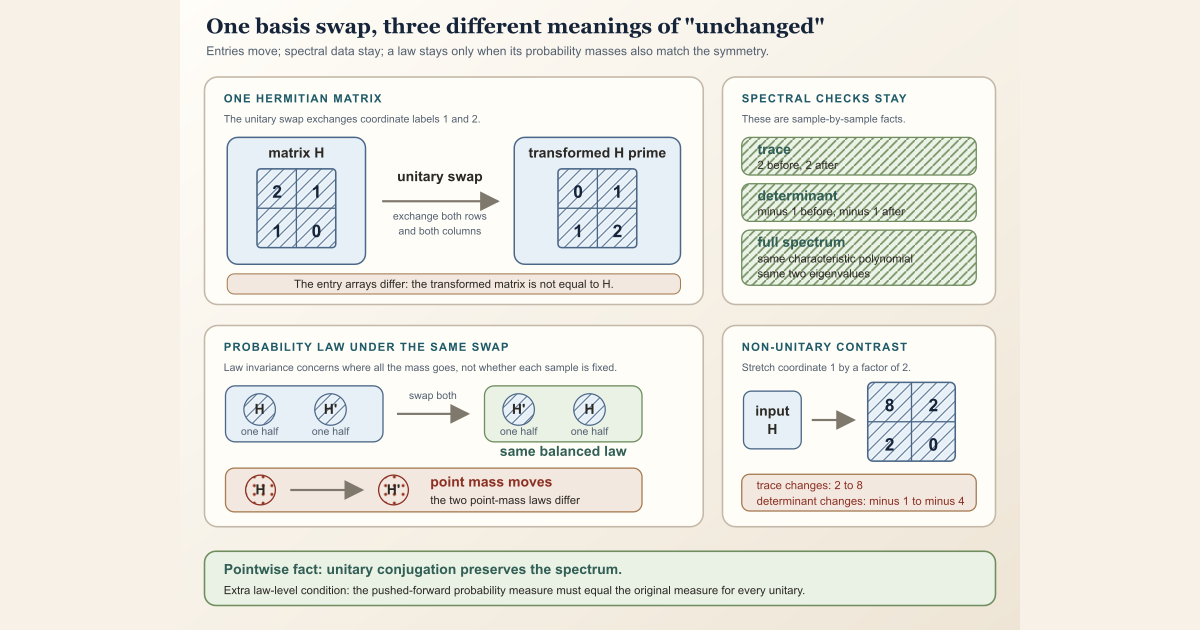
A unitary change of basis can alter every visible matrix entry while leaving the underlying Hermitian operator’s eigenvalues unchanged. Unitary invariance of a law asks for more: after making that change of basis, the entire probability distribution on matrices must be the same as before.
The distinction is easiest to see in one exact two-by-two calculation.
Start with one matrix and swap the basis vectors
Consider the real symmetric, hence complex Hermitian , matrix
\[ H= \begin{bmatrix} 2 & 1 \\ 1 & 0 \end{bmatrix} \]and the coordinate-swap matrix
\[ S= \begin{bmatrix} 0 & 1 \\ 1 & 0 \end{bmatrix}. \]The conjugate transpose \(S^*\) equals \(S\), and
\[ SS^*=S^2=I. \]Thus \(S\) is unitary. Multiplying in two visible steps gives
\[ \begin{aligned} SHS^* &= \begin{bmatrix} 0 & 1 \\ 1 & 0 \end{bmatrix} \begin{bmatrix} 2 & 1 \\ 1 & 0 \end{bmatrix} \begin{bmatrix} 0 & 1 \\ 1 & 0 \end{bmatrix} \\ &= \begin{bmatrix} 1 & 0 \\ 2 & 1 \end{bmatrix} \begin{bmatrix} 0 & 1 \\ 1 & 0 \end{bmatrix} &= \begin{bmatrix} 0 & 1 \\ 1 & 2 \end{bmatrix} =:H'. \end{aligned} \]The matrix changed: \(H'\ne H\). Nevertheless,
\[ \operatorname{tr}(H)=2=\operatorname{tr}(H'), \qquad \det(H)=-1=\det(H'). \]For a two-by-two matrix, the characteristic polynomial is determined by trace and determinant:
\[ \chi_H(\lambda) =\lambda^2-\operatorname{tr}(H)\lambda+\det(H) =\lambda^2-2\lambda-1 =\chi_{H'}(\lambda). \]Both matrices therefore have the same two eigenvalues,
\[ 1+\sqrt 2 \qquad\text{and}\qquad 1-\sqrt 2. \]This is deterministic spectral invariance: for this fixed matrix \(H\) and fixed unitary \(S\), conjugation changes coordinates but not the spectrum. It does not say that the matrix itself is fixed.
The same action can preserve a law without fixing samples
Let \(C_S\) denote the deterministic map
\[ C_S(M)=SMS^*. \]Because \(S^2=I\), the action exchanges the two matrices:
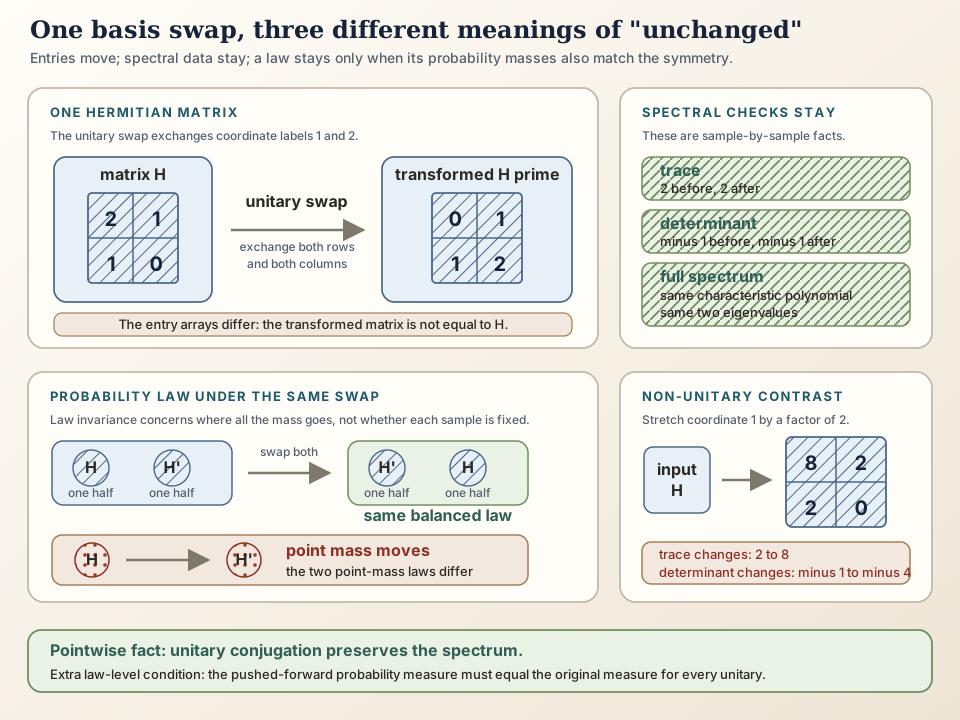
\[ C_S(H)=H', \qquad C_S(H')=H. \]Now put equal probability on them:
\[ \nu=\frac12\delta_H+\frac12\delta_{H'}. \]Here \(\delta_H\) is the point-mass probability measure concentrated at \(H\). Pushing \(\nu\) through \(C_S\) merely swaps the two equal masses:
\[ \begin{aligned} (C_S)_*\nu &=\frac12\delta_{C_S(H)}+\frac12\delta_{C_S(H')} \\ &=\frac12\delta_{H'}+\frac12\delta_H =\nu. \end{aligned} \]So this law is invariant under conjugation by \(S\), even though neither sample matrix is fixed by that conjugation.
The nearby false claim is
\[ C_S(H)=H. \]It is false. Equality in distribution does not become pointwise equality. Indeed, the one-point law is not invariant under this swap:
\[ (C_S)_*\delta_H=\delta_{H'}\ne\delta_H. \]The displayed equality is the invariance equation for the swap \(S\). It does not establish full unitary invariance, which quantifies over every unitary matrix rather than only \(S\) or the two-element subgroup it generates.
Why unitarity matters for the spectrum
The project defines congruence \(M\mapsto AMA^*\) for every square matrix \(A\), not only unitary ones. Such congruence preserves Hermiticity, but an arbitrary \(A\) need not preserve eigenvalues.
For example, stretch the first coordinate by a factor of two:
\[ A= \begin{bmatrix} 2 & 0 \\ 0 & 1 \end{bmatrix}. \]This matrix is not unitary because \(AA^*\ne I\). Direct multiplication gives
\[ AHA^* = \begin{bmatrix} 8 & 2 \\ 2 & 0 \end{bmatrix}. \]The result is still Hermitian, but
\[ \operatorname{tr}(AHA^*)=8\ne2, \qquad \det(AHA^*)=-4\ne-1. \]Thus “congruence preserves Hermiticity” is true for arbitrary \(A\), while “congruence preserves the spectrum” needs the unitary hypothesis.
From one symmetry to full unitary invariance
Let \(\nu\) be a measure on the space of \(n\times n\) complex matrices. For each fixed unitary \(U\), define
\[ C_U(H)=UHU^*. \]The measure \(\nu\) is unitarily invariant when
\[ (C_U)_*\nu=\nu \qquad \text{for every deterministic unitary }U. \]The symbol \((C_U)_*\nu\) is the pushforward measure . It records how probability mass moves when every sampled matrix is transformed by \(C_U\). Equivalently, for every measurable set \(B\) of matrices,
\[ \nu(B)=\nu\bigl(C_U^{-1}(B)\bigr). \]The word deterministic matters. A unitary \(U\) is chosen and held fixed, then the definition compares the law before and after applying that same change of basis to every sample. A statement involving one randomly sampled unitary is not a replacement for the quantifier over every fixed \(U\).
If a random Hermitian matrix \(X\) has probability distribution, or law \(\nu\), the same condition is written
\[ UXU^*\mathrel{\overset{d}{=}}X \qquad \text{for every deterministic unitary }U. \]The symbol \(\mathrel{\overset{d}{=}}\) means equality in distribution. It does not assert \(UX(\omega)U^*=X(\omega)\) for each outcome \(\omega\).
Keep the three levels separate
| Level | Exact statement | What it does not say |
|---|---|---|
| Deterministic action | \(H\mapsto UHU^*\) | The entries or matrix must stay fixed |
| Pointwise spectral invariance | \(\lambda^\downarrow(UHU^*)=\lambda^\downarrow(H)\) | The input law is invariant |
| Invariance in distribution | \((C_U)_*\nu=\nu\) for every unitary \(U\) | Each transformed sample equals the original sample |
Here \(\lambda^\downarrow(H)\) is the list of real eigenvalues of a Hermitian matrix in decreasing order, with multiplicities. Pointwise spectral invariance holds for every Hermitian \(H\) and unitary \(U\). Law invariance is an additional property of how probability mass is distributed across matrices.
Two fully invariant laws
For any real scalar \(c\), the point mass at \(cI\) is fully unitarily invariant:
\[ U(cI)U^*=cUU^*=cI \]for every unitary \(U\). This exact example is degenerate but useful. It shows that Gaussianity is not part of the definition.
The finite-dimensional
Gaussian unitary ensemble (GUE) gives a nondegenerate example. Under the
project’s Wigner scaling, its law is constructed from independent Gaussian
coordinates, identified with a scaled intrinsic Gaussian on Hermitian
Frobenius space, and then proved invariant under every deterministic unitary
conjugation. The checked endpoint is
GUE.matrixLaw_isUnitaryConjugationInvariant.
This proof uses equality of the whole joint law. Matching individual coordinate marginals would not be enough.
Spectral observables cannot test the whole law
Every unitary conjugation preserves the ordered eigenvalues and therefore preserves conjugation-invariant scalar quantities such as
\[ \operatorname{tr}(H^k) \]for positive integers \(k\). The project calls these trace-power observables .
But preserved spectral observables do not prove law invariance. The point mass \(\delta_H\) from the opening example moves to the different point mass \(\delta_{H'}\), even though \(H\) and \(H'\) have identical eigenvalues and identical trace powers of every order.
This is a useful diagnostic boundary:
- spectrum preservation is a sample-by-sample algebraic fact;
- unitary invariance is equality of complete measures; and
- checking selected scalar observables can miss a preferred eigenbasis.
In Lean: the law-level definition
RandomMatrix.IsUnitaryConjugationInvariant ννis aMeasure (Matrix ι ι ℂ), so the predicate concerns a complete measure on matrix space.Matrix.unitaryGroup ι ℂbundles a matrix together with its unitary equations.∀ Uquantifies over every fixed bundled unitary, not over one random conjugator.RandomMatrix.congruence (U : Matrix ι ι ℂ)is the function \(H\mapsto UHU^*\). The parenthesized expression coerces the bundled unitary back to its underlying matrix.Measure.mapis Lean’s pushforward operation. Its first argument is the measurable transformation and its second is the original measure.- The final
= νis equality of measures, not equality of individual matrices.
The exact checked project definition, with its namespace context, is:
namespace NonlinearDynamics.Random
namespace RandomMatrix

def IsUnitaryConjugationInvariant
    [Fintype ι] [DecidableEq ι]
    (ν : Measure (Matrix ι ι ℂ)) : Prop :=
  ∀ U : Matrix.unitaryGroup ι ℂ,
    Measure.map
      (congruence (U : Matrix ι ι ℂ)) ν = ν

end RandomMatrix
end NonlinearDynamics.Random
The finite index type ι names rows and columns.
Fintype ι says there are finitely many of them, while
DecidableEq ι lets Lean decide when two indices agree.
In Lean: the pointwise spectral theorem is different
RandomMatrix.orderedHermitianEigenvalues (RandomMatrix.hermitianCongruence U H) = RandomMatrix.orderedHermitianEigenvalues HH : RandomMatrix.HermitianEuclidean nis one intrinsic Hermitian matrix, not a random variable or measure.U : Matrix.unitaryGroup (Fin n) ℂis one fixed unitary matrix.hermitianCongruence U Hconstructs the transformed Hermitian matrix.orderedHermitianEigenvaluesreturns a functionFin n → ℝ, the decreasing eigenvalue vector with multiplicity.- Equality here is pointwise equality of two finite eigenvalue vectors. No probability law appears.
The theorem proving this proposition is
RandomMatrix.orderedHermitianEigenvalues_hermitianCongruence.
The separate GUE theorem proves the law-level predicate. Their different types
make it hard to accidentally treat one as the other.
Try the arithmetic locally with Lean and Std
The following tiny worksheet encodes only the opening integer calculation. It
uses a four-field record instead of Mathlib’s matrix library, so it imports
only Std and stays small enough for an ordinary Mac or Linux
machine.
Save it as UnitarySwapTutorial.lean outside the project’s
formalization/ directory:
import Std

structure Mat2 where
  a11 : Int
  a12 : Int
  a21 : Int
  a22 : Int
  deriving DecidableEq, Repr

def swapCongruence (M : Mat2) : Mat2 :=
  { a11 := M.a22
    a12 := M.a21
    a21 := M.a12
    a22 := M.a11 }

def stretchCongruence (M : Mat2) : Mat2 :=
  { a11 := 4 * M.a11
    a12 := 2 * M.a12
    a21 := 2 * M.a21
    a22 := M.a22 }

def matTrace (M : Mat2) : Int :=
  M.a11 + M.a22

def matDet (M : Mat2) : Int :=
  M.a11 * M.a22 - M.a12 * M.a21

def H : Mat2 :=
  { a11 := 2, a12 := 1, a21 := 1, a22 := 0 }

def Hswap : Mat2 :=
  { a11 := 0, a12 := 1, a21 := 1, a22 := 2 }

#eval swapCongruence H
#eval (matTrace H, matTrace Hswap, matDet H, matDet Hswap)

example : swapCongruence H = Hswap := by decide
example : H ≠ Hswap := by decide
example : matTrace (swapCongruence H) = matTrace H := by decide
example : matDet (swapCongruence H) = matDet H := by decide
example : matTrace (stretchCongruence H) = 8 := by decide
example : matDet (stretchCongruence H) = -4 := by decide
Run it with the repository’s pinned compiler:
elan run leanprover/lean4:v4.32.0 lean UnitarySwapTutorial.lean
The two #eval commands print the transformed record and the tuple
(2, 2, -1, -1). Each example asks Lean’s decidable
arithmetic kernel to verify one finite claim. This tutorial does not define
complex matrices, prove that \(S\) is unitary, construct a measure, or establish
the general spectral theorem. Those are Mathlib-backed project obligations.
Try the exact project interfaces
The project-backed worksheet below imports the full Hermitian-spectrum module, which transitively includes the law and finite-GUE invariance modules. It is a list of exact declaration checks, not a replacement proof:
import NonlinearDynamics.Random.RandomMatrices.HermitianSpectrum

open NonlinearDynamics.Random

#check RandomMatrix.congruence
#check RandomMatrix.measurable_congruence
#check RandomMatrix.IsUnitaryConjugationInvariant
#check HermitianRandomMatrix.law_conjugateBy
#check HermitianRandomMatrix.hasUnitaryConjugationInvariantLaw_iff
#check RandomMatrix.orderedHermitianEigenvalues_hermitianCongruence
#check GUE.matrixLaw_isUnitaryConjugationInvariant
The first three names expose the deterministic action, its measurability, and the measure-level predicate. The next two connect a bundled random Hermitian matrix to equality of its laws after conjugation. The ordered-eigenvalue theorem is pointwise. The final theorem is the checked nondegenerate finite-GUE law invariant under every deterministic unitary.
cd formalization
lake env lean -DwarningAsError=true NonlinearDynamics/Random/RandomMatrices/HermitianSpectrum.lean
Resource note: this exact file uses the repository's
pinned Lean and Mathlib dependencies. Initial project setup can require
substantial disk space and build time. For a lightweight first step on
macOS or Linux, use the page's standalone Lean-core or Std
tutorial.
Boundaries that prevent common mistakes
| Tempting claim | Correct statement |
|---|---|
| “Unitary conjugation leaves a matrix unchanged.” | It generally changes entries and eigenvectors; it preserves the spectrum. |
| “Same spectrum means same matrix law.” | Distinct point masses can sit on conjugate matrices with the same spectrum. |
| “Hermitian support implies unitary invariance.” | A law may live entirely on Hermitian matrices while preferring one basis. |
| “Invariance under one swap is full unitary invariance.” | Full invariance requires every unitary \(U\). |
| “A random unitary test proves the definition.” | The definition quantifies over each fixed deterministic unitary. |
| “Congruence by any matrix preserves eigenvalues.” | Arbitrary congruence preserves Hermiticity, but spectral preservation uses unitarity. |
| “A density depending on \(\operatorname{tr}(H^2)\) settles everything.” | A density proof must also show that the reference measure is preserved by the action. |
Where to continue
Review Hermitian matrix for the structural constraint preserved by every congruence, and pushforward measure for the law-level transport operation. The chapter From Normalized Hermitian Coordinates to Gaussian Unitary Ensemble Invariance builds the checked whole-law argument. The chapter Finite Hermitian Spectra and Empirical Measures develops ordered eigenvalues and their samplewise invariance. For the broader path from an outcome to a matrix law and then a spectrum, continue to Random Matrices: From Outcomes to Spectra.
References
Freeman J. Dyson. Statistical Theory of the Energy Levels of Complex Systems. I, Journal of Mathematical Physics 3, 140-156, 1962. This original paper introduces the orthogonal, unitary, and symplectic symmetry classes in their physical and group-theoretic setting.
Greg W. Anderson, Alice Guionnet, and Ofer Zeitouni. An Introduction to Random Matrices, Cambridge University Press, 2010. This monograph treats invariant matrix laws and Gaussian ensembles systematically.
Mathlib contributors.
The matrix unitary group,
Mathlib 4 documentation. This is the official source for
Matrix.unitaryGroup.
Mathlib contributors.
Pushforward of a measure,
Mathlib 4 documentation. This is the official source for
Measure.map.
Project source. Laws.lean defines matrix congruence and unitary invariance of a measure. GaussianUnitaryEnsembleInvariance.lean proves invariance of the finite GUE law, and HermitianSpectrum.lean proves ordered-spectrum invariance.