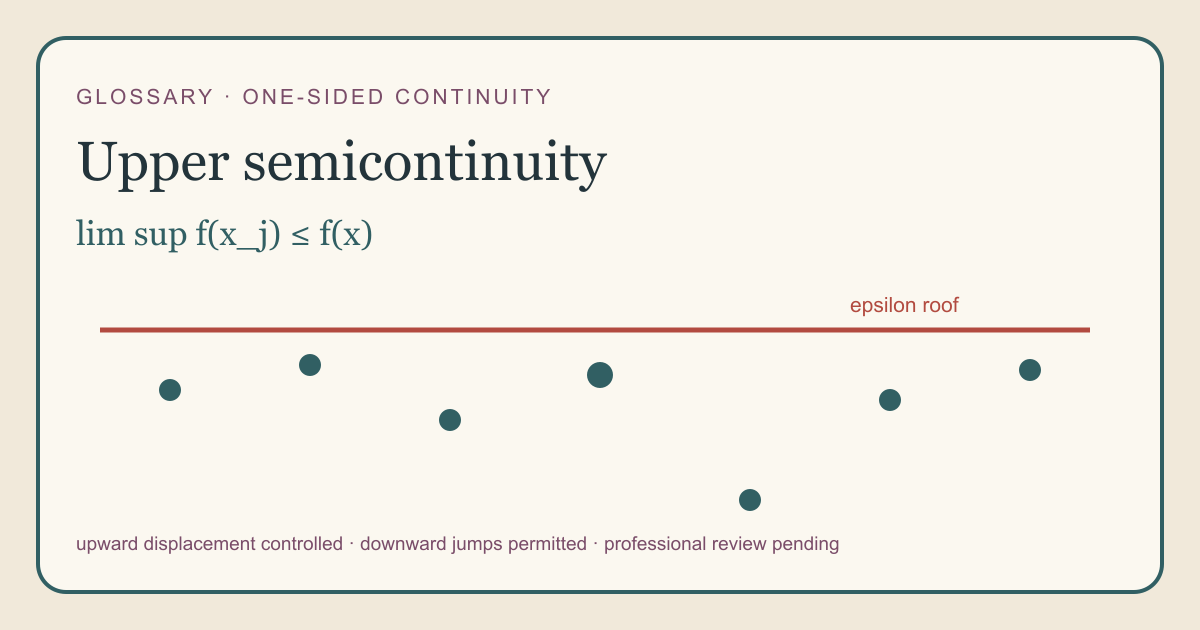
Consider
\[ f(x)= \begin{cases} 1,&x=0,\\ 0,&x\ne0. \end{cases} \]If \(x_j\to0\), then \(f(x_j)\le1=f(0)\), so
\[ \limsup_{j\to\infty}f(x_j)\le f(0). \]The function is upper semicontinuous at zero even though it is not continuous there. Its values may jump downward away from zero. Reversing the two values would create an upward jump at zero and would fail upper semicontinuity.
Definition
A real-valued function \(f:X\to\mathbb R\) is sequentially upper semicontinuous at \(x\) when every sequence \(x_j\to x\) satisfies
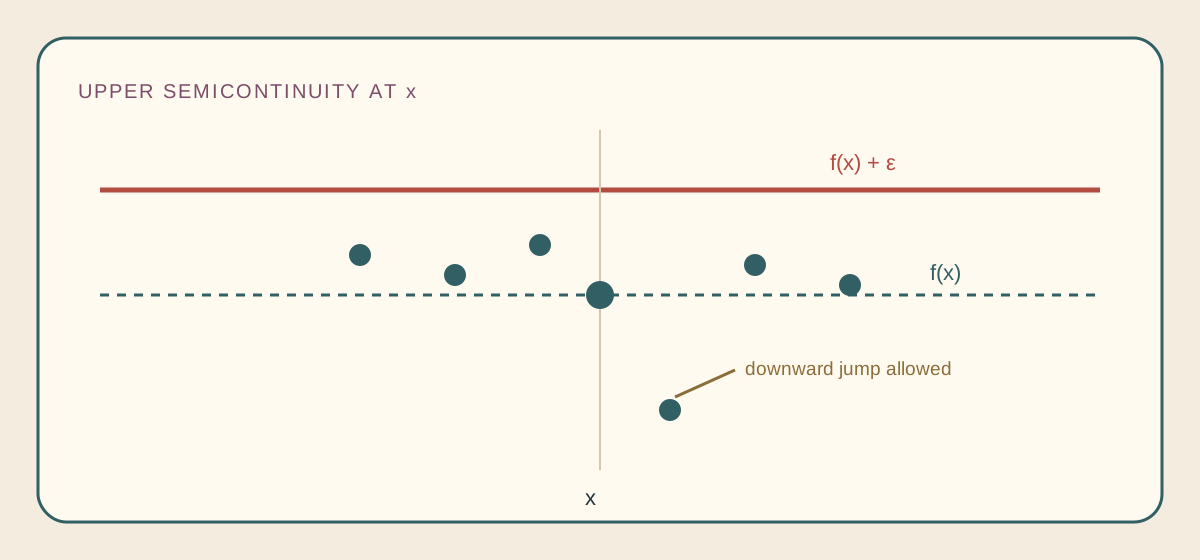
\[ \limsup_{j\to\infty}f(x_j)\le f(x). \]An equivalent epsilon formulation is:
\[ \forall\varepsilon\gt0,\quad f(x_j)\le f(x)+\varepsilon \quad\text{for all sufficiently large }j. \]In general topological spaces, the neighborhood or filter definition is the primary one. The sequential definition completely detects the topology in metric and first-countable settings, but not in every topological space.
In RMT-36
The input is a measurable finite-dimensional matrix generator over one fixed probability-preserving base. The output is its signed integrated real-log growth rate \(\lambda(G)\). RMT-36 proves the sequential statement
\[ G_j\longrightarrow G_0\ \text{uniformly} \quad\Longrightarrow\quad \forall\varepsilon\gt0,\quad \lambda(G_j)\le\lambda(G_0)+\varepsilon \ \text{eventually}, \]within a class having shared forward and inverse norm bounds and pointwise invertibility.
eventually_integratedRealLogGrowthRate_le_add\n hT hG hεhT fixes the probability-preserving base. hG is uniform convergence of
the generators. hε : 0 < ε records that the tolerance is positive.
eventually is expressed in the theorem by the filter notation
∀ᶠ n in atTop.cd formalization
lake env lean -DwarningAsError=true NonlinearDynamics/Random/RandomCocycles/GrowthRateStability.leanResource note: this exact file uses the repository's
pinned Lean and Mathlib dependencies. Initial project setup can require
substantial disk space and build time. For a lightweight first step on
macOS or Linux, use the page's standalone Lean-core or Std
tutorial.
Why infima often produce upper semicontinuity
Suppose
\[ f(x)=\inf_{k\ge1}q_k(x) \]and each fixed \(q_k\) is continuous. If \(y\gt f(x)\), one index \(k\) has \(q_k(x)\lt y\). Continuity preserves that strict inequality near \(x\), and \(f\le q_k\) transfers it to \(f\). This selects one upper witness.
RMT-36 follows exactly this pattern. The functions \(q_k\) are normalized finite-horizon signed log-norm integrals, and dominated convergence supplies their sequential continuity.
Boundaries
- Upper semicontinuity controls upward displacement, not downward displacement.
- It does not imply lower semicontinuity or continuity.
- A sequential theorem should not be silently promoted to a theorem for all nets in an arbitrary topology.
- RMT-36 varies the matrix generator only. It does not vary the base map or probability measure.
- The term stochastic stability may instead concern stationary measures or random attractors. Those are different outputs.
Related trail markers
- Limit superior
- Integrated real-log growth rate
- Upper Stability of Signed Integrated Cocycle Growth
- Upper Stability of Signed Cocycle Growth in Lean
References
- J. Bochi, “Genericity of zero Lyapunov exponents,” Ergodic Theory and Dynamical Systems 22(6), 1667–1696 (2002), doi:10.1017/S0143385702001165.
- L. Backes, A. Brown, and C. Butler, “Continuity of Lyapunov exponents for cocycles with invariant holonomies,” Journal of Modern Dynamics 12, 223–260 (2018), doi:10.3934/jmd.2018009.