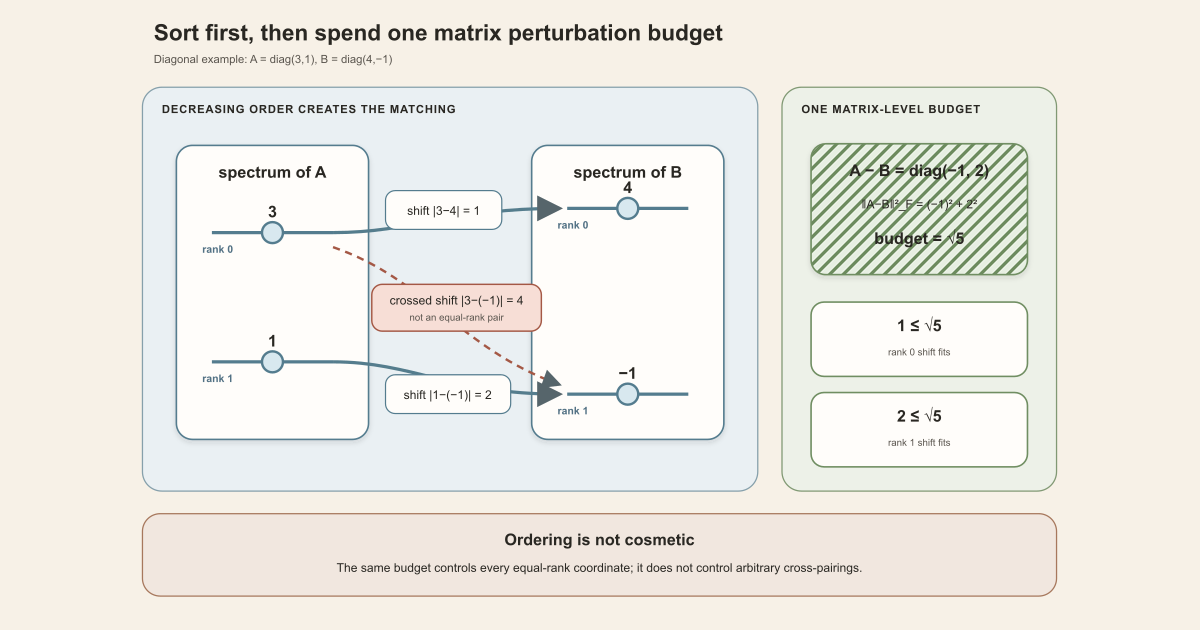
Start with two diagonal matrices
Take
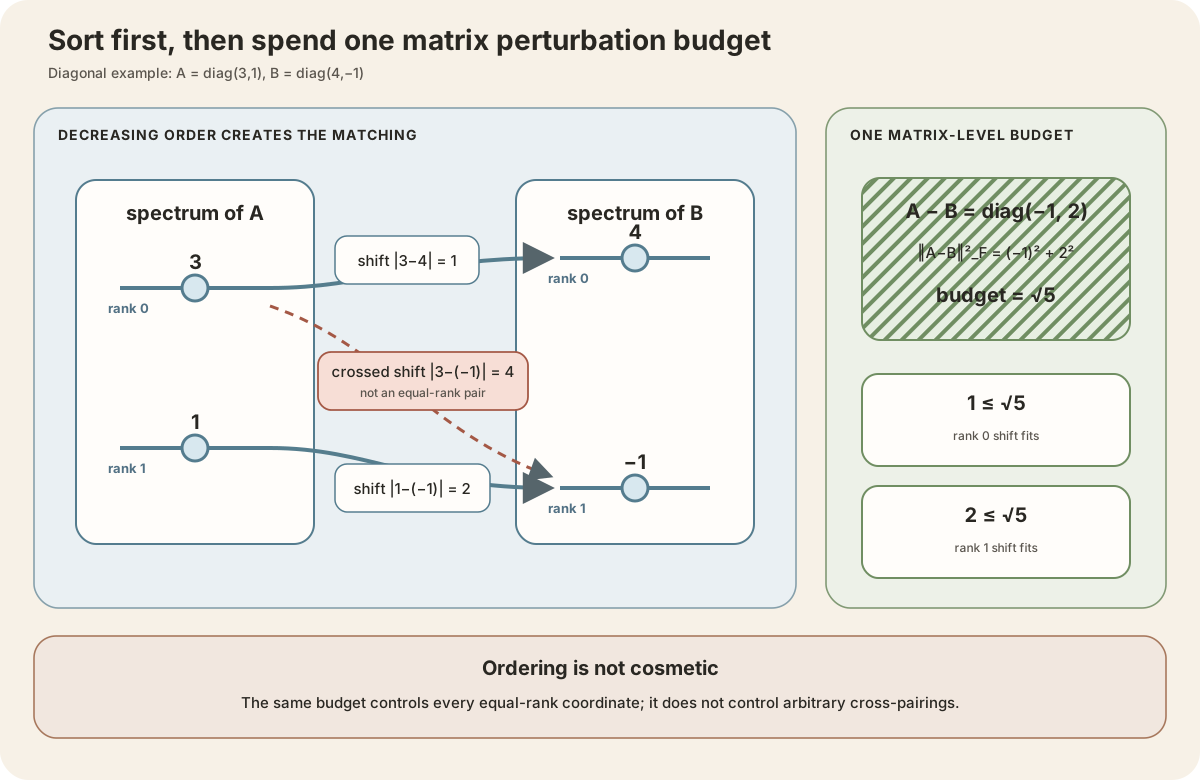
\[ A= \begin{pmatrix} 3&0\\ 0&1 \end{pmatrix}, \qquad B= \begin{pmatrix} 4&0\\ 0&-1 \end{pmatrix}. \]Their decreasingly ordered eigenvalues are
\[ \lambda(A)=(3,1), \qquad \lambda(B)=(4,-1). \]Match equal positions in those ordered lists. The two shifts are
\[ |3-4|=1, \qquad |1-(-1)|=2. \]Meanwhile,
\[ A-B= \begin{pmatrix} -1&0\\ 0&2 \end{pmatrix}, \qquad \lVert A-B\rVert_F =\sqrt{(-1)^2+2^2} =\sqrt5. \]Both \(1\le\sqrt5\) and \(2\le\sqrt5\), so the Frobenius Weyl bound holds at both indices. The sharper operator norm is \(2\), which also works.
Now make the tempting wrong comparison: pair the largest eigenvalue \(3\) of \(A\) with the smallest eigenvalue \(-1\) of \(B\). The apparent shift is \(4\), which exceeds \(\sqrt5\). This does not contradict Weyl’s theorem; it shows why the common ordering and equal-index pairing are part of the statement.
A Weyl eigenvalue bound controls how far the ordered eigenvalues of a Hermitian matrix can move when the matrix is perturbed. Write the real eigenvalues of two \(n\)-by-\(n\) Hermitian matrices in decreasing order:
\[ \lambda_0(A)\ge\lambda_1(A)\ge\cdots\ge\lambda_{n-1}(A), \qquad \lambda_0(B)\ge\lambda_1(B)\ge\cdots\ge\lambda_{n-1}(B). \]The classical operator-norm form says
\[ \left|\lambda_i(A)-\lambda_i(B)\right| \le \lVert A-B\rVert_{\mathrm{op}} \]for every index \(i\). The checked project theorem proves the following Frobenius-norm version directly:
\[ \boxed{ \left|\lambda_i(A)-\lambda_i(B)\right| \le \lVert A-B\rVert_F . } \]Here \(\lVert M\rVert_F^2=\sum_{j,k}|M_{jk}|^2\). Since the operator norm is at most the Frobenius norm, the checked statement is compatible with the sharper classical form, but it does not formalize that operator-norm theorem.
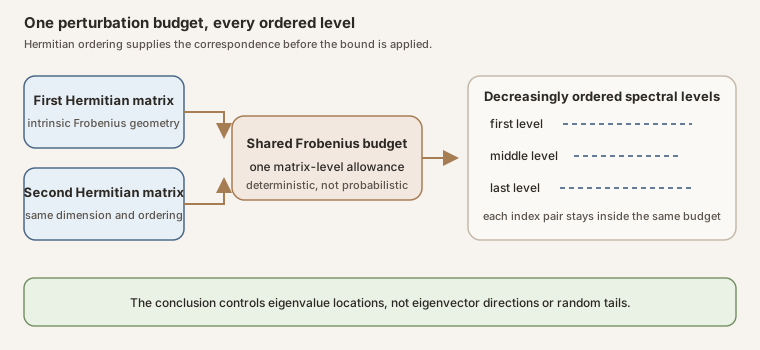
Why ordering is essential
An unordered spectrum is a multiset. A perturbation theorem then needs a matching rule before the phrase “the same eigenvalue” has meaning. Hermitian matrices provide a canonical rule: sort all eigenvalues decreasingly and compare equal indices.
This rule remains meaningful at repeated eigenvalues. If a double eigenvalue
splits under perturbation, the two new values occupy the corresponding
adjacent slots. No continuously chosen eigenvector is needed. The project uses
Mathlib’s antitone eigenvalues₀ enumeration, transported to
Fin n by an order-preserving equivalence
(Mathlib contributors).
The proof mechanism in one paragraph
Fix an index \(i\). The top spectral subspace of \(A\), spanned by eigenvectors with indices at most \(i\), has complex dimension \(i+1\). The bottom spectral subspace of \(B\), spanned by eigenvectors with indices at least \(i\), has dimension \(n-i\). Those dimensions add to \(n+1\), so the two subspaces cannot be disjoint inside an \(n\)-dimensional space. A nonzero vector \(x\) in their intersection satisfies
\[ \lambda_i(A)\lVert x\rVert^2 \le \operatorname{Re}\langle x,Ax\rangle, \qquad \operatorname{Re}\langle x,Bx\rangle \le \lambda_i(B)\lVert x\rVert^2. \]The matrix-vector estimate
\[ \lVert (A-B)x\rVert \le \lVert A-B\rVert_F\lVert x\rVert \]then bounds the difference of the two quadratic forms. Cancelling the positive quantity \(\lVert x\rVert^2\) gives the one-sided inequality
\[ \lambda_i(A)\le\lambda_i(B)+\lVert A-B\rVert_F. \]Swapping \(A\) and \(B\) supplies the other side and therefore the absolute value bound. This is a finite-dimensional min-max witness argument of the kind developed in standard matrix analysis (Bhatia).
A degeneracy example
Take
\[ A= \begin{bmatrix} 0&0\\ 0&0 \end{bmatrix}, \qquad B= \begin{bmatrix} \varepsilon&0\\ 0&-\varepsilon \end{bmatrix}. \]The ordered spectrum moves from \((0,0)\) to \((|\varepsilon|,-|\varepsilon|)\). Each coordinate moves by \(|\varepsilon|\), while
\[ \lVert A-B\rVert_F=\sqrt2\,|\varepsilon|. \]The bound holds even though every direction is an eigenvector of \(A\), so there is no canonical way to choose an eigenbasis of \(A\) that varies with \(B\). Eigenvalue stability survives degeneracy; eigenvector stability is a different question.
From a bound to measurability
The coordinate estimate says that each function
\[ A\longmapsto\lambda_i(A) \]is 1-Lipschitz from the intrinsic Hermitian Frobenius space to
\(\mathbb R\). A Lipschitz map is continuous, and a continuous map between the
Borel spaces used here is measurable. Mathlib packages exactly this chain in
LipschitzWith, Continuous, and
Measurable
(Mathlib contributors).
The project also packages the whole decreasing spectrum as 1-Lipschitz into the finite function space with its sup-style metric. This means every coordinate is controlled simultaneously by the same Frobenius budget. It is not an \(\ell^2\) estimate on the vector of eigenvalue differences.
Once coordinatewise measurability is available, the earlier conditional Giry-measurability results become unconditional. In particular, the spectral counting measure, the empirical spectral measure , its positive-dimensional probability wrapper, and the ambient Hermitian-or-zero observable are measurable maps into their respective target spaces.
Nearby theorems that this term does not name
| Nearby result | What it controls | Why it is different here |
|---|---|---|
| Hoffman-Wielandt | An \(\ell^2\) matching cost for the full spectra of normal matrices, bounded by Frobenius distance | The checked whole-vector theorem uses the finite sup metric, not the Euclidean eigenvalue norm (Hoffman and Wielandt) |
| Davis-Kahan | Rotation of an invariant subspace or eigenspace under a perturbation, with a spectral-gap denominator | RMT-10B proves no eigenvector or spectral-projector bound (Davis and Kahan) |
| Differentiable perturbation theory | Derivatives or analytic branches of eigenvalues and eigenvectors under stronger hypotheses | Lipschitz continuity alone supplies no derivative or smooth eigenbasis |
| Random-matrix concentration | Tail probabilities for spectral deviations under a probability law | The Weyl bound is deterministic and contains no probabilistic estimate |
The theorem also says nothing about a spectral density, a semicircle law, universality, eigenvalue rigidity, local spacing, or a large-dimension limit.
Lean interface
abs_orderedHermitianEigenvalues_sub_le_frobenius A B iabs_…sub_le…spells the inequality shape into the theorem name: absolute value of a subtraction is less than or equal to a bound.orderedHermitianEigenvaluesis the project’s decreasing eigenvalue enumeration, so the matching rule is already built into the function being compared.A B : HermitianEuclidean nare intrinsically Hermitian matrices equipped with the Frobenius geometry.i : Fin nis one valid ordered position. It cannot name an index outside the matrix dimension.- The norm notation in the theorem conclusion is the norm on
HermitianEuclidean n, proved by the project to agree with the Frobenius entry norm. - Applying the theorem returns a proof of the inequality; it does not numerically diagonalize either matrix.
The central checked declarations are:
theorem abs_orderedHermitianEigenvalues_sub_le_frobenius
    (A B : HermitianEuclidean n) (i : Fin n) :
    |orderedHermitianEigenvalues A i -
      orderedHermitianEigenvalues B i| ≤ ‖A - B‖

theorem lipschitzWith_orderedHermitianEigenvalues_apply (i : Fin n) :
    LipschitzWith 1 (fun H : HermitianEuclidean n =>
      orderedHermitianEigenvalues H i)
The norm on HermitianEuclidean n is the intrinsic Frobenius norm.
The numeral 1 records a valid Lipschitz constant; the theorem does
not assert that no smaller constant could work on a restricted domain.
Type the squared budget check locally
Square roots are unnecessary for the concrete comparison because all
quantities are nonnegative. Save this Std-only worksheet as
WeylBudget2.lean:
import Std

def orderedA : List Int := [3, 1]
def orderedB : List Int := [4, -1]

def square (z : Int) : Int := z * z

def frobeniusBudgetSquared : Int :=
  square (-1) + square 2

#eval frobeniusBudgetSquared
#eval square (3 - 4)
#eval square (1 - (-1))
#eval square (3 - (-1))

example : square (3 - 4) ≤ frobeniusBudgetSquared := by decide
example : square (1 - (-1)) ≤ frobeniusBudgetSquared := by decide
example : ¬ square (3 - (-1)) ≤ frobeniusBudgetSquared := by decide
Run it with the installed pinned toolchain:
elan run leanprover/lean4:v4.32.0 lean WeylBudget2.lean
This exact worksheet was executed successfully with Lean 4.32.0 and printed:
5
1
4
16
The first two theorems certify the correct ordered pairings after squaring. The third certifies that the crossed pairing fails this budget. This finite worksheet checks integer arithmetic. The general spectral statement is the checked project theorem below.
The authoritative source is
formalization/NonlinearDynamics/Random/RandomMatrices/HermitianSpectrumContinuity.lean.
In a clone with the repository’s pinned Lean and Mathlib dependencies
installed, a human can type:
import NonlinearDynamics.Random.RandomMatrices.HermitianSpectrumContinuity

#check NonlinearDynamics.Random.abs_orderedHermitianEigenvalues_sub_le_frobenius
#check NonlinearDynamics.Random.lipschitzWith_orderedHermitianEigenvalues_apply
#check NonlinearDynamics.Random.continuous_orderedHermitianEigenvalues_apply
#check NonlinearDynamics.Random.measurable_orderedHermitianEigenvalues_apply
These checks expose the perturbation, Lipschitz, continuity, and measurability layers in order. The full-project command below checks the complete pinned module and its Mathlib dependencies with the repository’s pinned dependencies installed.
cd formalization
lake env lean -DwarningAsError=true NonlinearDynamics/Random/RandomMatrices/HermitianSpectrumContinuity.lean
Resource note: this exact file uses the repository's
pinned Lean and Mathlib dependencies. Initial project setup can require
substantial disk space and build time. For a lightweight first step on
macOS or Linux, use the page's standalone Lean-core or Std
tutorial.
Where to continue
Hermitian Spectral Perturbation, Continuity, and Measurability develops the complete matrix-vector, eigenbasis, subspace-intersection, quadratic-form, Lipschitz, Giry, and Gaussian unitary ensemble (GUE) law bridge. Finite Hermitian Spectra and Empirical Measures constructs the ordered vector and measure-valued observables whose conditional measurability hypotheses this result discharges. The Hermitian Frobenius geometry entry explains the source norm.
References
Rajendra Bhatia. Matrix Analysis, Graduate Texts in Mathematics 169, Springer, 1997. The chapters on variational principles and spectral variation provide the standard finite-dimensional matrix-analysis context for ordered Hermitian eigenvalue perturbation. The project proves its Frobenius statement directly rather than importing a book theorem.
Alan J. Hoffman and Helmut W. Wielandt. The variation of the spectrum of a normal matrix, Duke Mathematical Journal 20 (1953), 37-39. This primary source establishes the full-spectrum Euclidean matching result cited only to distinguish it from the project’s sup-metric whole-vector theorem.
Chandler Davis and W. M. Kahan. The Rotation of Eigenvectors by a Perturbation. III, SIAM Journal on Numerical Analysis 7 (1970), 1-46. This primary source studies perturbation of invariant subspaces and gap-dependent rotation bounds. RMT-10B does not formalize those conclusions.
Mathlib contributors. Spectral theory of Hermitian matrices, Mathlib 4 documentation. This official page defines the ordered real Hermitian eigenvalues and eigenvector basis used in the proof.
Mathlib contributors.
Lipschitz continuous functions,
Mathlib 4 documentation. This official page defines
LipschitzWith and supplies the continuity consequences used by
the project.
The exact upstream Lean source audited for this entry is Mathlib commit
81a5d257,
the revision pinned by formalization/lake-manifest.json.